

Are HMO property investments really worth it? Problems or profit
Whether an HMO is worth it comes down to the net return, not the gross yield. Letting by the room can bring in more rent than letting to one household, but the costs are higher too, and HMOs need more hands-on management.
If you're considering HMO investments as part of your property investment strategy, you may have seen advertised gross-yield examples of 12-15%. Those headline figures are not a verified return for a particular property, but it's easy to be drawn in by them.
Article updated: August 2026
I felt exactly the same when I started with my first HMO, in Warrington. What I wish someone had told me is that an HMO changes your whole property business and your workload, not just your rental income.

What is a HMO rental property?
A HMO stands for a House in Multiple Occupation. This is a property rented out to at least three tenants who aren't from the same household but share facilities like bathrooms and kitchens. This definition covers a wide range of properties, from traditional house shares to purpose-built student accommodations. The most common property type is often converted Victorian and Edwardian terrace houses. Large houses that were once 3-4 bedrooms that have since been converted or extended to make 5,6 and sometimes even 7 bedroom houses of multiple occupation.
Houses of multiple occupation can work for many tenant profiles from social housing, students and professional tenants.
Why is the HMO Business Model so Popular?
HMOs have become increasingly popular in the UK for several reasons:
- Affordability for Tenants: In many city and towns, especially those with high housing costs, HMOs offer a more affordable option for individuals who can't afford to rent an entire property on their own.
- Gross Rental Income: Letting individual rooms can produce more gross rent than letting the same property to one household, but conversion, licensing, utilities, management, maintenance and finance costs also differ and must be included in the comparison.
- Increasing Demand: The growing number of students, young professionals, and single-person households has led to increased demand for flexible, affordable housing options.
- Housing Shortages: In many UK cities, there's a shortage of affordable housing. HMOs help address this issue by making more efficient use of existing housing stock without the need to build on green belt land outside of areas where housing demand is critically needed.
- Changing Lifestyle Preferences: Many young people prefer the social aspects and flexibility of shared living arrangements, particularly in the early stages of their careers.
The HMO market has evolved significantly in recent years. While traditionally associated with student housing or lower-quality accommodation, there's now a growing trend towards high-end, professionally managed HMOs catering to young professionals and key workers.
Do HMOs Offer The Best Returns and Profits?
HMOs typically bring in more gross rent than a standard buy-to-let, but whether that makes them the 'best' depends on what each landlord wants. Some look for the simplest option with the least time involved, others for capital growth, and many simply for cashflow and regular monthly profits. Buy-to-let and HMOs are the two main strategies, and there are outlier strategies too, like buying below market value houses or more digital approaches like tokenised real estate.
HMOs vs Traditional Buy-to-Let
An HMO asks for more management, more money up front and more regulation than a traditional buy-to-let. Either can produce a profit or a loss, and they differ in five key ways:
- Rental Income: HMOs typically generate higher gross rental income. For example, a 3-bedroom house rented to a family might bring in £1,500 per month. Converted to an HMO with 5 individual tenants, the same property might bring in £2,500 per month. That is a big rise in rental income from the same property.
- Occupancy Risk: HMOs can offer some protection against void periods. If one tenant moves out, you still have rental income from the others, unlike a traditional let where a vacant property means no income at all.
- Management Intensity: HMOs generally require more hands-on management. With more tenants, there's a higher likelihood of maintenance issues, conflicts between tenants and even neighbours, and more frequent tenant turnover.
- Initial Investment: Converting a property to an HMO often requires a significant initial investment for modifications like additional bathrooms, fire safety measures, and furnishings.
- Regulatory Requirements: HMOs are subject to more regulations, including licensing requirements and specific safety standards.
Potential Returns and Yields
HMO gross yields can be higher than those of traditional buy-to-lets because rent is collected by room. Published or advertised gross-yield ranges do not show the net return: compare them with current local rents and include conversion, licensing, utilities, management, maintenance, finance, tax and void costs.
Take a £250,000 property, let either to one household or by the room. The two gross yields compare like this:
- Traditional Buy-to-Let: A £250,000 property rented for £1,500 per month would yield 7.2% gross (£18,000 annual rent / £250,000 property value).
- House of Multiple Occupation: The same £250,000 property converted to a 5-bed HMO, with each room rented for £500 per month, would yield 12% gross (£30,000 annual rent / £250,000 property value).
However, it's crucial to remember that gross yield doesn't tell the whole story and HMOs have higher running costs than a traditional buy-to-let.
Here is a free HMO profit calculator to help you work out your true return on investment and HMO yields.
If you wish to compare to a buy-to-let rental yield, you can use our BTL calculator here.
HMOs' higher running costs can narrow the difference between their gross yield and the net yield of a traditional buy-to-let, so the comparison needs property-level income and costs.

How to Buy a HMO
Sourcing a HMO investment to buy can be done in a couple of ways depending on how much time and money you wish to invest. There are a range of opportunities including:
Some buyers start with a standard investment property to convert, while others compare ready-made buy-to-let properties that are already configured as HMOs.
Buy a Conversion Project
This involves purchasing a standard residential property and converting it into an HMO. This approach can offer good returns but requires careful planning and often significant upfront investment.
Converting has three advantages:
- Potential to add significant value to the property
- Ability to design the HMO to your specifications
- Can be cheaper than buying a ready-made HMO
It also has three drawbacks:
- Time-consuming and potentially stressful
- Risk of unexpected costs during conversion
- May require planning permission which can get denied or licensing requirements which can be costly to develop the property to those standards
Buy a Ready-made Deal
Buying an existing HMO can be a quicker way to start generating income, but it's crucial to perform thorough due diligence.
Three advantages come with buying an existing HMO:
- Immediate income generation
- Less initial work required
- Existing licensing and compliance in place
Its three drawbacks mirror the advantages of converting:
- Often more expensive to purchase
- May inherit problems or outdated designs
- Less opportunity to add value
Source a Purpose-built HMO
Investing in newly constructed, purpose-built HMO accommodation is becoming increasingly popular, especially in university towns.
Purpose-built HMOs are sold on three points:
- Modern, efficient designs
- Some schemes advertise time-limited rental or yield guarantees; compare the counterparty, guarantee period, conditions, purchase-price premium and position after the guarantee ends
- Typically fully managed, reducing landlord involvement
Against those points, there are three drawbacks:
- Usually require larger initial investment
- Less control over property management
- Potential for oversupply in some areas
When choosing your approach, consider your budget, time availability, DIY skills and local market conditions. In England, a relevant Article 4 direction can withdraw specified permitted development rights in a defined area. That means a conversion which would otherwise be permitted development needs a planning application; it does not ban the development or guarantee that an existing HMO is the only viable option. Check the exact direction, planning history and local policy with the council.
Adding Value with a HMO Renovation
Extensions
The first way to increase your chances of HMO property success is to look at extending into the garden or yard at the back of the property. This, of course, can either be a one or two-story extension.
This type of development can be a very cost-effective way to add additional rooms (bedrooms, en-suite bathrooms and living rooms) to your property, and is especially worthwhile in high-value areas. Many single-storey rear extensions can be built without planning permission under permitted development rights. That only applies if the property still has those rights and the extension meets all the permitted development conditions, including the size, height and boundary limits. The cost of the extension can also add significant value to the price of the property, making the HMO worth more than neighbouring properties.
Garage conversion
If the property has a connected garage and off-road parking, this can be a great use of space. If the garage is already a decent size, it can be turned into a large communal area. The garage often shares a wall with the kitchen, so knocking through to extend the communal space can be a great win.
This can be the most cost-effective type of conversion for adding additional floor space to your property, and you can easily check any local planning requirements with the government planning portal and local council.
Interior Design
Interior design is simple to do and can be very cost-effective. A property that stands out from local competition can earn higher monthly rents and improve occupancy, with tenants staying longer.
Something that you will find - when you start, researching HMOs in a given area - is that the rooms on offer tend to be very standard and really quite boring. Some HMOs on the market may look quite tired and run down or at best the bedrooms might look a little basic.
Don't be afraid to stand out and remember your staging photographs (those used in promotions) are very important to attract the highest quality tenants. If you spend a little bit of time and resources early on with a professional interior designer, this can provide a significant return on investment.

Financial Aspects of HMO Investments
House of Multiple Occupation Rental Yields
HMOs typically offer higher gross yields than standard buy-to-lets, often ranging from 10% to 15% or more. However, it's crucial to factor in higher running costs and management expenses when calculating net yields.
For example a very rough guide:
Gross Yield Calculation:
The gross yield divides the yearly rent by the property value:
- Property Value: £250,000
- Annual Rental Income (5 rooms at £500 per month): £30,000
- Gross Yield: (£30,000 / £250,000) x 100 = 12%
Net Yield Calculation:
The net yield takes the yearly expenses off the rent first:
- Annual Rental Income: £30,000
- Annual Expenses (maintenance, management, insurance, etc.): £12,100
- Net Income: £17,900
- Net Yield: (£17,900 / £250,000) x 100 = 7.2%
While the net yield is lower than the gross yield, it's still likely to be higher than a comparable traditional buy-to-let property.
Note this calculation is a guide, without any finance costs like a mortgage included. Below we look a bit deeper, to see the potential the return on investment.
HMO Running Costs
An HMO's costs fall into two groups: setup costs before the first tenant moves in, and running costs once it is let. There are five typical setup costs:
- Property purchase (including stamp duty, home survey and legal fees)
- Renovation and conversion costs (if applicable)
- Furniture and appliances
- HMO licence fee
- Safety certificates (gas, electrical, fire)
Once it is let, there are nine typical running costs:
- Mortgage payments
- Insurance (building, contents, and specialist HMO insurance)
- Utility bills (often these are included by landlords)
- Council tax
- Regular maintenance and repairs
- Cleaning of communal areas
- Management fees (make sure to use a specialist HMO management company)
- Advertising for new tenants
- Accountancy and tax return costs
It's important to budget for these costs when calculating potential returns. Many novice HMO investors underestimate ongoing costs, leading to cash flow issues.
Return On Investment (ROI) Calculation Example
Let's consider a more detailed example of a 5-bedroom HMO in an English university town:
The house costs £250,000 to buy:
- Property Purchase: £250,000
Half is paid in cash and half by mortgage:
- Cash deposit (50%): £125,000
- Mortgage 50% loan to value: £125,000
Initial Investment
- Cash deposit (50%): £125,000
- Stamp Duty: £10,000
- Legal Fees: £2,000
- Renovation and Conversion: £30,000
- Furniture and Appliances: £15,000
- Initial Certificates and Licensing: £3,000
Total Cash Invested: £185,000
---
All the income comes from the five rooms:
- Rental Income (5 rooms at £500 per month): £30,000
There are six annual expenses:
- Mortgage Interest (50% LTV at 5%): £6,250
- Insurance: £1,000
- Utilities: £3,000
- Council Tax: £1,500
- Maintenance and Repairs: £3,000
- Management Fees (12% of rental income): £3,600
Total Annual Expenses: £18,350
---
Net Annual Income: £30,000 - £18,350 = £11,650
ROI Calculation: (£11,650 / £185,000) x 100 = 6.29%
That return leaves out any rise or fall in what the property is worth. Mortgage balances, rents, costs and occupancy can all change over time, so the calculation should be rerun with current figures rather than assuming the return will increase.
Calculations
To help with your calculations, our loan-to-value calculator shows how much deposit you will need. Our HMO calculator works out the numbers for your specific property. If you are considering a different rental strategy, there is also our buy to let calculator.
A Quick House of Multiple Occupation Comparison Calculation
The "5 Month Rule"
A useful rule of thumb in HMO investing is the "5-Month Rule". This suggests that the income from approximately 5 months of the year will cover your annual running costs for an HMO.
Here's how it works:
If your HMO generates £2,500 per month in rent:
- Annual rental income: £2,500 x 12 = £30,000
- Estimated annual costs: £2,500 x 5 = £12,500
This leaves 7 months of rental income as potential profit (before tax and mortgage principal payments).
While this rule isn't exact and can vary depending on your specific circumstances, it provides a quick way to estimate expenses when evaluating potential HMO investments on a quick like for like basis.
Optimise Your HMO Layout
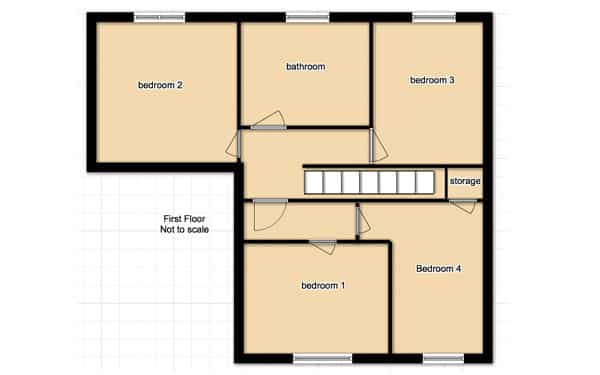
Bedroom Size Requirements
In England, mandatory licence conditions for licensed HMOs set these minimum sleeping-room sizes:
- One person aged 10 or over: At least 6.51 square metres (source: the Commons Library briefing)
- Two people aged 10 or over: At least 10.22 square metres
- One child under 10: At least 4.64 square metres
When measuring a sleeping room, exclude any floor area where the ceiling height is below 1.5 metres.
However, these are absolute minimums, and many local authorities have higher standards. For example, North Northamptonshire's guideline is 8 square metres for a single bedroom without cooking facilities, in a house without an adequate shared lounge or dining space.
For professional HMOs it is very unusual to have children staying in the property. In England, a room below 4.64 square metres must not be used as sleeping accommodation in an HMO that is required to be licensed. This is a statutory minimum. Planning for rooms around 8 square metres can be a practical design target, but check the applicable local standard.
When planning room sizes, consider that larger rooms can command higher rents and may be more attractive to potential tenants. A common strategy is to create a mix of room sizes for different budgets and preferences. Some tenants will choose the smaller room in the house for a slightly lower rent. Others want more space and are willing to pay a premium for it.
Communal Spaces
Well-designed shared areas are crucial for tenant satisfaction and can help reduce turnover. Consider the following when planning communal spaces:
- Living Areas: Provide comfortable seating and entertainment options. A good rule of thumb is to ensure seating for at least two thirds the number of tenants at any one time.
- Kitchens: Ensure adequate food preparation areas, storage, and appliances. For larger HMOs, consider multiple kitchens or kitchenettes to reduce congestion at peak times.
- Dining Spaces: Provide a dining table and chairs. This could be in the kitchen or a separate dining room, depending on the layout. Expecting tenants to eat in their bedrooms alone or on their lap at the sofa in a communal lounge is not a winning formula for attracting the best tenants.
- Outdoor Spaces: If possible, offer outdoor areas like gardens or patios. These can be a significant selling point, especially in city areas where space is limited. They are also a great communal space and help bring all the tenants together.
- Study Areas: For student HMOs, consider providing quiet study spaces if the property is large enough. This will help you stand out from the competition who often maximise the number of bedrooms but not communal space.
Remember, the quality of communal areas can significantly impact tenant satisfaction and, consequently, occupancy rates and rental income
Kitchen and Bathroom Guidelines
The guidelines cover what shared kitchens and bathrooms need. There are four kitchen points:
- Provide one set of cooking facilities per 5 tenants
- Ensure sufficient food storage space, including at least one cupboard per tenant
- Provide adequate refrigerator and freezer space
- Install appropriate ventilation (usually an extractor fan) as relying on tenants to open windows may not be enough
There are four bathroom points:
- Aim for one bathroom for every 3 tenants
- For HMOs with 5 or more occupants, consider providing a separate toilet in addition to the bathroom(s)
- Ensure all bathrooms have a washbasin, toilet, and bath or shower
- Provide adequate fan extractor ventilation in all bathrooms
En-suite bathrooms can be a premium feature, allowing you to charge higher rents for these rooms. However, they also increase initial conversion costs and can complicate plumbing maintenance.
When planning kitchens and bathrooms, consider future maintenance. For example, using easy-to-clean surfaces and durable fixtures can save time and money in the long run. This preparation can save you thousands of pounds in maintenance costs, throughout your years of ownership of the property.
Legal and Regulatory Considerations
Licensing Requirements
HMO licensing depends on the number of occupiers, their household relationships, the UK nation and any local council scheme. Our HMO licence requirements guide explains the thresholds, costs and application process. In England, mandatory licensing applies to qualifying large HMOs. Councils may also require additional licensing for smaller HMOs, while selective licensing is a separate scheme for privately rented homes.
Some local authorities have additional licensing schemes that may require licences for smaller HMOs. Always check with your local council for specific requirements in your area.
To obtain a licence, you typically need to:
- Ensure the property meets the required standards
- Submit a detailed application form
- Pay a fee (which can vary significantly between councils)
- Pass a 'fit and proper person' test
Licences usually last for 5 years, after which you'll need to renew.
Operating an HMO without a required licence is a criminal offence and can result in hefty fines or even imprisonment.
Health and Safety Regulations
HMO landlords must meet strict health and safety standards. The main points fall into five groups.
For fire safety, there are four main points:
- Install interlinked smoke alarms on every floor and in every key room
- Ensure clear escape routes
- Install fire doors on key rooms ensuring a safe escape route and protected rooms
- Thumbturn locks on doors for safe and easy exit
For gas safety, there are two requirements:
- Annual gas safety checks by a Gas Safe registered engineer
- Provide tenants with a copy of the gas safety certificate
For electrical safety, there are two checks:
- Electrical Installation Condition Report (EICR) every 5 years
- Regular PAT testing of portable appliances
General safety covers three areas:
- Adequate heating and ventilation
- Safe and secure windows and doors
- Prevention of trip hazards
On overcrowding, there are two requirements:
- Adhere to minimum room size requirements
- Ensure the property isn't overcrowded based on its facilities
Regular inspections are crucial to ensure ongoing compliance with these regulations.
Planning Permission and Article 4 Directions
In some areas, you may need planning permission to convert a property into an HMO, especially for larger HMOs (7 or more tenants).
Additionally, some local authorities have implemented Article 4 directions (resource: what is article 4 hmos) which withdraw the specified permitted development right within a defined area. Where the direction covers a change from a dwellinghouse (C3) to a small HMO (C4), a planning application is required for that change; the direction does not itself prohibit the proposal.
Article 4 directions are often implemented in areas with high concentrations of HMOs, typically near universities. They're designed to give local authorities more control over the spread of HMOs and maintain a balance in the local housing market.
There are three planning points to check before buying a property for an HMO:
- Whether the property already has HMO use class (C4 or sui generis)
- If there are any Article 4 directions in place
- Local planning policies regarding HMOs
Failing to obtain necessary planning permission can result in enforcement action, including having to return the property to its original use.
Managing A House Of Multiple Occupation
Self-Management vs Professional Management
Self-managing an HMO costs your own time, while professional management typically costs 10-15% of rental income.
Self-Management:
Doing it yourself keeps costs down and keeps you close to the tenants:
- Lower costs, potentially increasing your net yield
- Direct control over property and tenants
- Ability to build relationships with tenants
- Potentially faster response to issues
The catch is the time, knowledge and stress it takes, especially from a distance:
- Time-consuming, especially with higher tenant turnover
- Requires extensive knowledge of regulations
- Can be stressful, particularly when dealing with conflicts
- May be challenging if you don't live near the property
Professional Management:
An agent takes the day-to-day work off your hands:
- Saves time and reduces stress
- Expertise in regulations and best practices
- Efficient handling of maintenance and tenant issues
- Potentially better tenant screening and retention
- Useful if you're not local to the property
You pay for that in fees and in control, and service quality varies:
- Higher costs (typically 10-15% of rental income)
- Less direct control over day-to-day operations
- Quality of service can vary between agencies
The comparison depends on your experience and capacity for managing the day-to-day of the property, your tenants' requirements, the agency's service standard and its fee. Professional management transfers specified tasks to the agent, while the owner retains legal responsibility and pays 10-15% of rental income in this example.
HMO Landlord Tips
Reducing Utility Costs
Controlling utility costs is crucial for maintaining profitability in HMOs. The cost of electric and gas is growing each year and managing these costs is a necessity. Consider these approaches:
- Energy Efficiency: Install energy-efficient appliances, LED lighting, and proper insulation to reduce energy consumption.
- Smart Thermostats: Use programmable or smart thermostats to control heating and cooling efficiently.
- Water-Saving Fixtures: Install low-flow showerheads and dual-flush toilets to reduce water usage.
- Utility Caps: Consider implementing a 'fair usage' policy with caps on included utilities.
- Educate Tenants: Provide guidance on energy-saving practices and the environmental benefits of conservation.
- Regular Monitoring: Keep a close eye on utility bills to quickly identify and address any unusual spikes in usage.
Keeping A Happy House Among Tenants
Maintaining a peaceful living environment is key to keeping tenants happy and staying for long periods of time. This isn't just good for the household but also for your stress levels. Some tips include
- Careful Tenant Selection: Screen potential tenants not just for financial stability, but also for compatibility with existing tenants. Ask your current tenants what makes a perfect housemate.
- Clear Communication: Establish clear channels for tenants to communicate with each other and with you or the property manager.
- Conflict Resolution: Have a defined process for addressing and resolving conflicts between tenants don't leave it to chance.
- Regular Check-ins: Conduct periodic check-ins with tenants to address any brewing issues before they escalate.
- Community Building: Organise occasional social events or activities to help tenants build positive relationships.
- Swift Action on Complaints: Address serious complaints quickly and fairly.
Case study - Guide On How NOT To Do It
My first HMO taught me three lessons the hard way. Four bedrooms was too few, and a 45-minute drive was too far to self-manage. Including the bills in the rent cost me the most.
It was only a four-bedroom property. For my first HMO, I wanted to start small and I felt like 4 was a good number of tenants to have.
This was my first mistake...
Since then I've learned that it is hard to make a decent profit from a 4 bed HMO.
This is because the rental income that you make is often not enough to cover the extra work and maintenance costs that are required.
Sometimes you find that 4 bedrooms HMOs even need MORE management than a 5 or 6b bed, NOT LESS.
This is because with a 4-bed property every penny counts. You need to keep voids and utility bills extremely low to keep up your margins.
However, the location was great. It was right in the centre of town. It has always rented well... which is why I went for it in the first place.
But, this wasn't the problem.
In my experience, HMO tenants have moved on more often than tenants in a straightforward buy-to-let.
My second mistake...
The property was located about 45 minutes drive away from where I lived at the time.
Now, with a traditional let, this wouldn't cause a problem.
But, when you are self-managing an HMO, distances like that can be a real pain. The drive to the property to do regular viewings soon added up and proved to be a real drain on my time.
However, this wasn't the most costly mistake I made. This came with how I was managing the costs of the property.
One thing I have always done with my HMOs and shared property is I have included utility bills in the rent.
There are arguments for and against doing this.
But, what I have found is that doing this helps to get rooms in my properties rented faster.
Tenants want things simple after all. They don't want to split utility bills every month with other tenants whom they might not otherwise speak to.
The downside to doing this is that your tenants might not take ownership of the situation. That's to say that when they are paying for utilities, as a set amount, in their rent, they might not be paying attention to their energy usage.
There are thankfully now smarter solutions for keeping utility costs low.
For instance, smart thermostats are getting quite sophisticated these days. Google's Nest is one, Inspire is another.
Are HMOs Still Worth It?
It comes down to what is left from the rent once you pay the higher utility bills, regular maintenance, licensing and compliance costs, and allow for empty rooms. That net figure, not the headline rent, is what to compare with a standard buy-to-let.
Demand Has to Be Tested Locally
Local room demand, achievable rent and competing supply vary by neighbourhood and tenant group. The location guides for a London borough such as Bexley and cities such as Birmingham and Bradford illustrate how their wider price and rental markets differ; those area-level figures do not establish room demand for a specific HMO.
UK private rents increased by 7.0% to £1,339 in the 12 months to May 2025, according to ONS private rent figures. That national figure does not establish how many tenants moved into shared accommodation or what demand an individual HMO will receive.
The Reality Check: Costs Are Higher Too
Here's where it gets more complicated. While rents are rising, so is everything else.
Domestic energy prices have changed substantially in recent years, as the Commons Library energy briefing shows. Where an HMO's rent includes utilities, the landlord bears changes in usage and tariffs until the rent or contract changes, so the appraisal needs current bills and a higher-cost sensitivity case rather than a fixed national estimate.
Conversion costs vary with the layout, fire-safety work, bathrooms, kitchens, specification and local labour. Current itemised quotes are more reliable than applying one supplier or national percentage to every HMO project.
Purpose-built student accommodation and build-to-rent schemes can add competing units to a local market. The local planning pipeline, current occupancy and asking rents show whether that competition is material for a specific HMO.
Operating Requirements
HMOs carry a real management load, including where a managing agent is in place, so they operate differently from passive investments.
Bedroom count alone does not predict whether an HMO is viable. Gross income and net return depend on property-specific room demand, achievable rents, layout, licensing and conversion work, operating costs, competing supply, management time and available capital.
Eventually, if your circumstances change or you need to exit the investment, understanding how to sell an hmo becomes crucial. The process differs significantly from selling standard buy-to-let properties and requires targeting specialist investors who understand HMO yields and management requirements.
What the Current Model Requires
HMOs aren't the easy money they might have seemed a few years ago.
HMOs operate as active businesses rather than passive investments. The operating work includes understanding the local market, maintaining tenant relationships and keeping the property compliant and competitive.
Compared with standard buy-to-let, the model requires more operating experience, more capital for compliance and maintenance, and more management time. The return comparison should therefore use net income after those additional costs rather than headline rent.
Local demand, property configuration, licensing conditions, financing and management capacity are the main variables that determine whether an individual HMO remains viable.
Ready to buy property?
Browse investment properties with prices and gross yields shown for each opportunity.
See the latest deals