
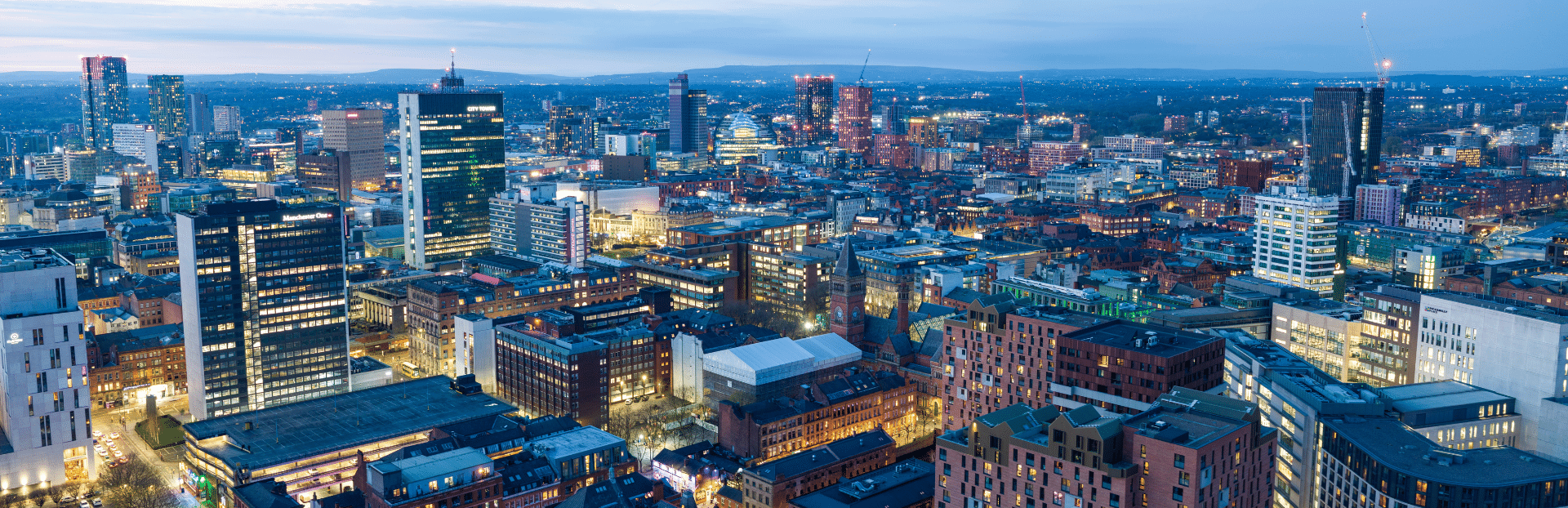
Manchester is a city in the North West of England. Average sold prices in Manchester sit at £248,071 on the HM Land Registry House Price Index, 15.6% above the North West regional average of £214,678 yet 14.4% below England's £289,946. That makes Manchester the premium market of the North West, priced above its surrounding boroughs but still below the national average. The city's population grew 9.7% between the 2011 and 2021 censuses, from 503,127 to 551,938 residents, comfortably ahead of the England and Wales average of 6.3%.
Manchester's prices are not propped up by high local wages. The median gross weekly salary is £698.00, below the North West's £720.10 and Great Britain's £752.40, so prices have pulled away from what local earners can afford. For investors that gap is the opportunity, because it leaves a large tenant base that needs to rent rather than buy. The spread between M11 at £208,132 and M21 at £417,169 creates a two-tier market within a single city, and the stronger yields have historically sat with the cheaper terraced postcodes of the east and north rather than the premium southern suburbs or the city-centre flats.
This guide covers the Manchester local authority area (ONS code E08000003) across 22 postcodes, from the city centre and inner suburbs out to the southern residential belt and Manchester Airport. It does not cover the wider Greater Manchester boroughs, which have their own guides for Salford, Bolton, and Stockport. Manchester sits at the centre of the North West city region.
Article updated: July 2026
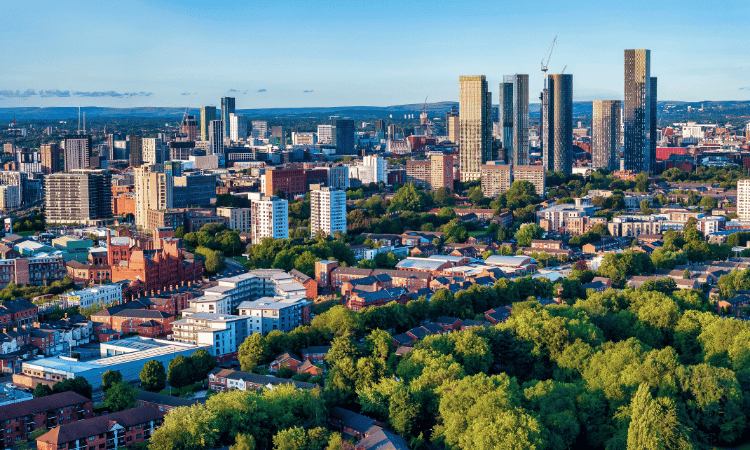
Why Invest in Manchester?
Manchester's population grew 9.7% between the 2011 and 2021 censuses, from 503,127 to 551,938 residents. That is well ahead of the England and Wales average of 6.3%, and it puts Manchester among the handful of English cities outside London that consistently pull in internal migration from the rest of the UK. Around 100,000 students study across the city's universities, and graduate retention here is among the highest in the country. Young professionals stay, employers follow, more young professionals arrive.
The local employment rate of 73.6% sits below both the North West average of 74.2% and Great Britain's 75.6%, and the unemployment rate of 6.6% is above the regional 4.1% and GB's 4.3%. Those readings reflect a big-city profile that concentrates both opportunity and deprivation in the same place. Over the past decade Manchester's economy has broadened well beyond its old reliance on financial services and the public sector, into technology, creative and digital industries, life sciences, and a large higher-education base.
Median gross annual earnings in Manchester are £36,280, which is 3.1% below the North West regional median of £37,445 and 7.3% below the Great Britain median of £39,125. Lower local pay reads two ways for an investor. It is part of why Manchester house prices have stayed below the England average, because prices are anchored to what local earners can afford. It also leaves a large pool of households who rent rather than buy, particularly in the city centre and the inner suburbs where prices have pulled away from local wages.
Manchester Economic Summary
- Population: 551,938 (2021 Census). Growth of 9.7% from 2011.
- Median annual salary: £36,280 (local), £37,445 (North West), £39,125 (Great Britain)
- Employment rate: 73.6% (local), 74.2% (North West), 75.6% (Great Britain)
- Unemployment rate: 6.6% (local), 4.1% (North West), 4.3% (Great Britain)
- Key employment sectors: Financial and professional services, technology, creative and digital, higher education, healthcare, public sector
Source: ONS Census 2021, Nomis Labour Market Profile (ASHE 2025, Employment Oct 2024-Sep 2025)
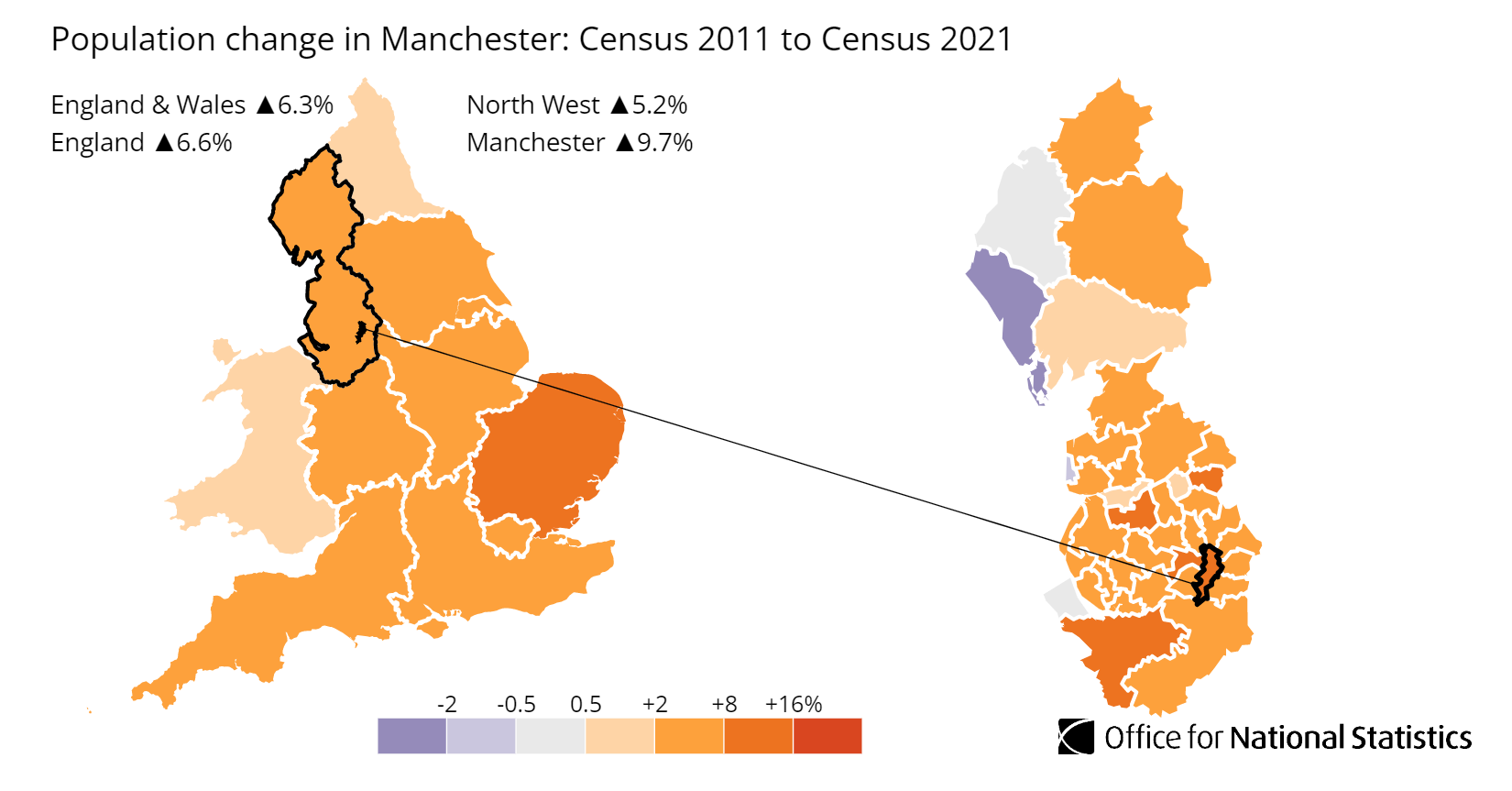
Source: Office for National Statistics - Population for Manchester
Regeneration and Investment in Manchester
Manchester carries over £15 billion of confirmed regeneration and infrastructure investment either under construction or with secured funding, the largest pipeline of any UK city outside London. For an investor the question is not whether Manchester is regenerating but which postcodes sit in the path of which scheme. The three below are the heaviest hitters by money committed and by the breadth of postcodes they touch.
- Victoria North (under construction, £4 billion): The UK's largest residential regeneration programme, delivering up to 15,000 new homes across seven neighbourhoods between Victoria Station and Queen's Park. It shifts the gravity of Manchester's rental market northward over the next decade, building a new residential market in the M40, M9, and M4 postcodes that barely existed before, with Phase 1 at Collyhurst due in 2026 and a new Metrolink stop at Sandhills funded. Updates at Manchester City Council.
- Old Trafford Regeneration (Mayoral Development Corporation launched January 2026, £7.3bn annual economic contribution): A 400-acre masterplan around a 100,000-seat new stadium, covering up to 48,000 jobs and 15,000 homes, chaired by Lord Sebastian Coe. It is the single largest regeneration catalyst in the city's history, and the M16 and M17 waterfront corridors opposite MediaCityUK are the postcodes in its direct path. Updates at GMCA.
- Northern Powerhouse Rail (funding confirmed January 2026, £45 billion programme): A new rail line from Liverpool to Manchester via Warrington and Manchester Airport, with a new underground station at Piccadilly and a new station at the airport, replacing the cancelled HS2 northern leg. The growth zones around each station are designed to unlock homes and jobs at scale, and for Manchester the Piccadilly and airport stations put the southern corridor of M22 and M23 in the frame. Updates at GOV.UK.
Manchester Property Market Analysis
Average property prices in Manchester have risen 633.8% since January 1995, from £33,806 to £248,071. The sections below break down that journey cycle by cycle, then drill into current postcode-level data for sold prices, price per square foot, asking prices, growth trends, and monthly transaction volumes.
When Was the Last House Price Crash in Manchester?
Manchester is recorded by HM Land Registry at local authority level, so every sold-price figure here covers the Manchester local authority area. The Land Registry House Price Index tracks average prices from January 1995 to March 2026, covering 31 years of market cycles.
The 1995 to 2007 boom: Manchester started at £33,806 in January 1995 and nearly quadrupled by the peak, reaching £134,540 in August 2007. The transformation from a post-industrial city into a major services and knowledge economy drove sustained demand, and the 2002 Commonwealth Games accelerated regeneration across East Manchester and the city centre.
2008 to 2009, the financial crisis: Prices fell from the August 2007 peak of £134,540 to a trough of £106,994 in March 2009, a decline of 20.5%. The worst year-on-year reading was -18.1% in February 2009. Manchester fell harder than both England (-18.2%) and the North West region (-18.3%), and the correction landed across all property types fairly evenly, with terraced houses hit hardest at -18.5% and detached least affected at -17.4%.
The 2010 to 2013 drift: Prices bounced off the trough but then moved sideways, holding between £110,621 in December 2011 and £119,793 in November 2013 with no sustained recovery. The wider North West bottomed out even later, not reaching its own trough until January 2013. Manchester's economy was rebuilding, but buyer confidence stayed fragile.
Recovery, 2014 to 2016: Growth returned, with prices climbing from around £120,000 to £148,000 as the city's economic diversification began to pay off. The BBC's move to MediaCityUK, the expansion of Manchester Airport, and a growing technology base created new demand. Prices passed the pre-crash peak of £134,540 in August 2015, eight years after it was set.
The 2017 to 2019 pre-pandemic growth: Prices rose from £153,000 to £171,000 as Manchester established itself as one of the UK's leading buy-to-let cities. Institutional money flowed into build-to-rent and purpose-built student accommodation, and the Northern Powerhouse narrative pulled in both domestic and overseas capital.
2020 to 2022, the pandemic surge: Prices climbed from £174,000 in early 2020 to a high of £234,545 in June 2022. Manchester's affordability relative to London and the South East made it a magnet for yield-seeking investors, and the stamp duty holiday amplified demand.
The 2023 rate shock: Higher mortgage rates paused the market, and prices slipped to £222,199 by May 2023 before steadying. The correction was modest compared to 2008, measured in months rather than years.
The 2024 high and gentle easing: The recovery carried prices to an all-time high of £255,632 in July 2024, then eased back to £248,071 by March 2026, a year-on-year change of 1.4% and around 3% below the peak. The city held onto the bulk of its pandemic-era gains, leaving the current price 84.4% above the pre-crash peak of £134,540.
Long-term growth summary:
- 5 years (March 2021 to March 2026): 18.2% growth (£209,849 to £248,071)
- 10 years (March 2016 to March 2026): 75.3% growth (£141,537 to £248,071)
- 15 years (March 2011 to March 2026): 122.6% growth (£111,448 to £248,071)
- 20 years (March 2006 to March 2026): 122.1% growth (£111,677 to £248,071)
- 30 years (January 1995 to March 2026): 633.8% growth (£33,806 to £248,071)
Manchester's 20.5% crash was deeper than both the regional and national averages, and recovery took eight years against England's six years and eight months, though the North West as a whole took longer still at nine years and five months, so Manchester led the regional recovery. An investor who bought at the exact peak in August 2007 would now be up 84.4% on the Land Registry average. The 30-year return of 633.8% reflects how far the city has come from its 1995 base, the highest starting discount of any major North West market. Source: HM Land Registry House Price Index for Manchester.
- All property types
- Detached
- Semi-detached
- Terraced
- Flats
- All property types
- Detached
- Semi-detached
- Terraced
- Flats
Sold House Prices in Manchester
Manchester's average sold price across all property types is £248,071, which is 14.4% below the England average of £289,946 as of March 2026. That headline discount is misleading, because every house type in Manchester actually sells at or above the England average. The all-property figure comes out below England only because Manchester's housing mix is weighted towards cheaper flats and terraces, not because a like-for-like home is cheaper here.
| Property Type | Manchester Average | England Average | Difference |
|---|---|---|---|
| Detached houses | £472,408 | £470,492 | +0.4% |
| Semi-detached houses | £324,158 | £288,185 | +12.5% |
| Terraced houses | £250,696 | £243,788 | +2.8% |
| Flats and maisonettes | £192,202 | £214,563 | -10.4% |
| All property types | £248,071 | £289,946 | -14.4% |
Detached houses at £472,408 sit 0.4% above England's £470,492. Manchester's detached stock is concentrated in the southern suburbs of Didsbury and Chorlton and the leafier pockets of Wythenshawe, where the buyer pool is professional families competing for a thin supply of larger homes. There is little of it across the city, which is why the type that matches England barely registers in the all-property average.
Semi-detached houses at £324,158 carry the largest premium at 12.5% above England's £288,185. This is the family-home workhorse of the inner and southern suburbs, and the premium reflects how tightly held that stock is in postcodes like M20, M21, and M19 where owner-occupiers and landlords compete for the same houses.
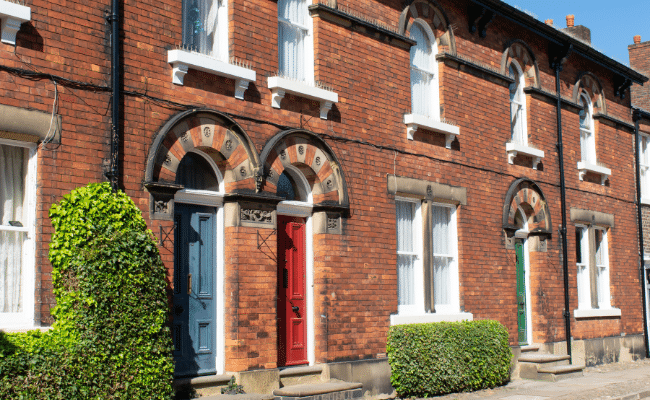
Terraced houses at £250,696 sit 2.8% above England's £243,788. The terraced stock is the backbone of Manchester's buy-to-let market, spread across the eastern and northern postcodes from Gorton and Openshaw up to Moston and Blackley. These are the houses that carry the strongest yields in the rental tables below, and the slight premium shows steady owner-occupier demand sitting underneath the investor interest.
Flats and maisonettes at £192,202 are the only type below the England average, at 10.4% under the national flat figure of £214,563. Manchester has built a large volume of city-centre apartments over the past fifteen years, and that supply has held flat prices down even as house prices rose. The flat market is concentrated in M1, M3, M4, and M15, the same postcodes that show the weakest recent capital growth.
Price Per Square Foot in Manchester
Sold prices per square foot range from £209 in M18 (Gorton, Abbey Hey) to £421 in M21 (Chorlton), a spread of £212 per square foot. Stripping out property size this way is the cleanest way to compare locations, and it shows the same split as everything else in Manchester: you pay roughly twice as much per square foot in Chorlton as in the eastern terraced postcodes.
| Rank | Area | Price Per Sq Ft |
|---|---|---|
| 1 | M18 (Gorton, Abbey Hey) | £209 |
| 2 | M9 (Blackley, Harpurhey) | £217 |
| 3 | M11 (Openshaw, Clayton) | £221 |
| 4 | M8 (Crumpsall, Cheetham Hill) | £225 |
| 5 | M40 (Moston, Collyhurst) | £233 |
| 6 | M12 (Ardwick, Openshaw) | £243 |
| 7 | M6 (Irlams o' th' Height, Pendleton) | £248 |
| 8 | M13 (Longsight, Ardwick) | £256 |
| 9 | M5 (Salford, Ordsall) | £268 |
| 10 | M14 (Fallowfield, Rusholme) | £276 |
| 11 | M22 (Wythenshawe, Northenden) | £285 |
| 12 | M19 (Levenshulme, Burnage) | £301 |
| 13 | M23 (Wythenshawe) | £309 |
| 14 | M16 (Old Trafford, Stretford) | £311 |
| 15 | M50 (Salford Quays) | £313 |
| 16 | M15 (Hulme, Castlefield) | £327 |
| 17 | M4 (Ancoats, Northern Quarter) | £341 |
| 18 | M1 (City Centre) | £354 |
| 19 | M20 (Didsbury) | £392 |
| 20 | M3 (Deansgate, Blackfriars) | £393 |
| 21 | M21 (Chorlton) | £421 |
| 22 | M2 (Deansgate, St Ann's Square) | Not enough data |
M18 (Gorton, Abbey Hey) at £209 per square foot is the cheapest bricks-and-mortar value in the city. This is the eastern terraced belt, where smaller two and three-bed houses change hands at prices that anchor the bottom of every table in this guide. The neighbouring eastern and northern postcodes of M9, M11, M8, and M40 all sit within £25 a square foot of it.
M21 (Chorlton) at £421 per square foot tops the table, just over double M18's rate. When a buyer pays that much per square foot they are paying for location rather than size, and in Manchester that means the established southern suburbs of Chorlton and Didsbury (M20 at £392) and the prime city-centre addresses around Deansgate (M3 at £393, M2 too thin to read). The same split runs through the whole city: roughly twice the price per square foot in the southern suburbs as in the eastern terraces.
For Sale Asking Prices in Manchester
The mean asking price across 22 postcodes is £268,032, with a £209,036 gap between the cheapest postcode (M11 (Openshaw, Clayton) at £208,132) and the most expensive (M21 (Chorlton) at £417,169). The £209,000 gap between them is the point: Manchester gives you a sub-£210,000 entry in the east and a £400,000-plus postcode in the south, so the postcode you pick matters as much as the city.
| Rank | Area | Asking Price |
|---|---|---|
| 1 | M11 (Openshaw, Clayton) | £208,132 |
| 2 | M18 (Gorton, Abbey Hey) | £212,763 |
| 3 | M50 (Salford Quays) | £219,713 |
| 4 | M9 (Blackley, Harpurhey) | £228,185 |
| 5 | M5 (Salford, Ordsall) | £232,009 |
| 6 | M6 (Irlams o' th' Height, Pendleton) | £232,633 |
| 7 | M40 (Moston, Collyhurst) | £238,127 |
| 8 | M4 (Ancoats, Northern Quarter) | £239,625 |
| 9 | M3 (Deansgate, Blackfriars) | £244,722 |
| 10 | M12 (Ardwick, Openshaw) | £245,623 |
| 11 | M13 (Longsight, Ardwick) | £248,096 |
| 12 | M14 (Fallowfield, Rusholme) | £261,804 |
| 13 | M8 (Crumpsall, Cheetham Hill) | £265,724 |
| 14 | M1 (City Centre) | £267,489 |
| 15 | M16 (Old Trafford, Stretford) | £267,896 |
| 16 | M22 (Wythenshawe, Northenden) | £272,544 |
| 17 | M15 (Hulme, Castlefield) | £273,212 |
| 18 | M23 (Wythenshawe) | £279,650 |
| 19 | M19 (Levenshulme, Burnage) | £323,158 |
| 20 | M2 (Deansgate, St Ann's Square) | £340,480 |
| 21 | M20 (Didsbury) | £377,952 |
| 22 | M21 (Chorlton) | £417,169 |
M11 (Openshaw, Clayton) at £208,132 is the lowest asking price in the city and the cheapest entry point in Manchester. The eastern terraced postcodes cluster at the bottom of the table, with M18, M9, and M40 all under £240,000, and that is where a fixed budget buys the most property and the highest yields.
M21 (Chorlton) at £417,169 is the most expensive, double M11 and the only postcode over £400,000. Chorlton and the neighbouring M20 (Didsbury, £377,952) are owner-occupier suburbs where the price reflects schools, transport, and a settled residential feel rather than rental return, which is why they sit at the bottom of the yield table later in this guide. The £209,036 gap between M11 and M21 is the whole story of Manchester in one number: the postcode you pick decides the investment as much as the city does.
House Price Growth in Manchester
M9 (Blackley, Harpurhey) has the strongest five-year growth at 52.3%, while M15 (Hulme) has the weakest at -25.4%. The cheaper, regenerating postcodes in the north and east have outgrown the city-centre flat market, where a long run of new-build apartment supply has held values flat or pushed them down.
| Area | 1 Year | 3 Years | 5 Years |
|---|---|---|---|
| M9 (Blackley, Harpurhey) | 12.4% | 20.2% | 52.3% |
| M18 (Gorton, Abbey Hey) | 5.8% | 2.8% | 40.8% |
| M16 (Old Trafford, Stretford) | 6.0% | 35.2% | 37.4% |
| M23 (Wythenshawe) | -3.6% | 9.7% | 35.7% |
| M40 (Moston, Collyhurst) | 8.2% | 12.1% | 35.6% |
| M12 (Ardwick, Openshaw) | -2.4% | 15.6% | 35.4% |
| M14 (Fallowfield, Rusholme) | 1.2% | 10.8% | 34.9% |
| M22 (Wythenshawe, Northenden) | 2.2% | 10.2% | 31.9% |
| M19 (Levenshulme, Burnage) | 0.6% | 9.0% | 29.3% |
| M21 (Chorlton) | 8.3% | 11.8% | 27.5% |
| M6 (Irlams o' th' Height, Pendleton) | 32.8% | -3.1% | 26.5% |
| M8 (Crumpsall, Cheetham Hill) | -2.4% | 7.2% | 19.2% |
| M20 (Didsbury) | 5.5% | 9.1% | 15.3% |
| M11 (Openshaw, Clayton) | 0.6% | 8.1% | 13.7% |
| M13 (Longsight, Ardwick) | 2.4% | -11.9% | 7.0% |
| M3 (Deansgate, Blackfriars) | -9.1% | 2.0% | -2.2% |
| M4 (Ancoats, Northern Quarter) | -14.5% | -13.3% | -4.0% |
| M1 (City Centre) | -29.0% | -12.3% | -5.4% |
| M5 (Salford, Ordsall) | -14.5% | -5.4% | -13.5% |
| M50 (Salford Quays) | -18.7% | -14.0% | -17.2% |
| M15 (Hulme, Castlefield) | -16.8% | -19.3% | -25.4% |
| M2 (Deansgate, St Ann's Square) | Not enough data | Not enough data | Not enough data |
M9 (Blackley, Harpurhey) at 52.3% over five years has the strongest growth in the city, and it sits alongside the other cheaper northern and eastern postcodes at the top of the table: M18 at 40.8%, M16 at 37.4%, M23 at 35.7%, and M40 at 35.6%. These are the regenerating terraced areas in the path of schemes like Victoria North, and they have outgrown the rest of the city from a low base.
The bottom of the table is the city-centre flat market. M15 (Hulme, Castlefield) is down 25.4% over five years, with M50 (Salford Quays), M5, M1, M4, and M3 all in negative territory. A long run of new-build apartment supply has held those values flat or pushed them backwards, the same postcodes that show the deepest flat discount in the sold-price table above. The eight-postcode swing between M9 and M15 over the same five years is the clearest sign that Manchester is two markets, not one.
Monthly Property Sales in Manchester
M20 (Didsbury) handles 58 property sales per month, while M12 (Ardwick, Openshaw) records 6. Turnover is the share of homes that change hands each year, and the gap between M20 and M12 matters: a busier market usually means more to choose from when buying and a clearer route out when you come to sell.
| Area | Sales Per Month | Turnover | Asking Price |
|---|---|---|---|
| M20 (Didsbury) | 58 | 24% | £377,952 |
| M4 (Ancoats, Northern Quarter) | 27 | 6% | £239,625 |
| M14 (Fallowfield, Rusholme) | 26 | 25% | £261,804 |
| M21 (Chorlton) | 26 | 24% | £417,169 |
| M22 (Wythenshawe, Northenden) | 26 | 20% | £272,544 |
| M16 (Old Trafford, Stretford) | 25 | 8% | £267,896 |
| M40 (Moston, Collyhurst) | 25 | 16% | £238,127 |
| M19 (Levenshulme, Burnage) | 24 | 23% | £323,158 |
| M6 (Irlams o' th' Height, Pendleton) | 23 | 13% | £232,633 |
| M9 (Blackley, Harpurhey) | 23 | 20% | £228,185 |
| M15 (Hulme, Castlefield) | 21 | 4% | £273,212 |
| M23 (Wythenshawe) | 19 | 19% | £279,650 |
| M3 (Deansgate, Blackfriars) | 19 | 3% | £244,722 |
| M11 (Openshaw, Clayton) | 18 | 32% | £208,132 |
| M18 (Gorton, Abbey Hey) | 18 | 43% | £212,763 |
| M5 (Salford, Ordsall) | 15 | 3% | £232,009 |
| M1 (City Centre) | 14 | 3% | £267,489 |
| M8 (Crumpsall, Cheetham Hill) | 12 | 20% | £265,724 |
| M50 (Salford Quays) | 7 | 5% | £219,713 |
| M12 (Ardwick, Openshaw) | 6 | 20% | £245,623 |
| M13 (Longsight, Ardwick) | 6 | 15% | £248,096 |
| M2 (Deansgate, St Ann's Square) | Not enough data | % | £340,480 |
M20 (Didsbury) records the most transactions at 58 a month on a 24% turnover, the busiest market in the city. The pricier southern suburbs of M20 and M21 combine deep stock with active demand, so there is usually plenty to choose from when buying and a clear route out when selling.
Turnover tells a different story from raw volume. The eastern terraced postcodes have the highest churn, with M18 at 43% and M11 at 32% of homes changing hands a year, while the city-centre flat postcodes of M1, M3, and M5 sit at just 3%. A high turnover signals an easier exit, and it is the eastern terraces, not the city centre, where homes move on quickly.
How Long Properties Take to Sell in Manchester
M18 (Gorton, Abbey Hey) sells fastest, with a typical listing finding a buyer in 65 days against 2.1 months of unsold stock, while M1 (City Centre) sits at the other end with 50 months of stock on the market. Days on market measures how long a typical home is listed before it sells; months of unsold stock is how long it would take to clear the current listings at the present sales rate. The lower both numbers are, the easier it is to sell when you want to.
| Area | Avg Days to Sell | Months of Unsold Stock | Market |
|---|---|---|---|
| M18 (Gorton, Abbey Hey) | 65 | 2.1 | Seller's market |
| M11 (Openshaw, Clayton) | 98 | 3.2 | Seller's market |
| M19 (Levenshulme, Burnage) | 132 | 4.3 | Seller's market |
| M21 (Chorlton) | 132 | 4.3 | Seller's market |
| M14 (Fallowfield, Rusholme) | 138 | 4.5 | Seller's market |
| M20 (Didsbury) | 138 | 4.5 | Seller's market |
| M22 (Wythenshawe, Northenden) | 152 | 5.0 | Seller's market |
| M23 (Wythenshawe) | 152 | 5.0 | Seller's market |
| M12 (Ardwick, Openshaw) | 160 | 5.3 | Seller's market |
| M13 (Longsight, Ardwick) | 179 | 5.9 | Seller's market |
| M16 (Old Trafford, Stretford) | 338 | 11.1 | Balanced market |
| M4 (Ancoats, Northern Quarter) | 608 | 20.0 | Buyer's market |
| M15 (Hulme, Castlefield) | 761 | 25.0 | Buyer's market |
| M3 (Deansgate, Blackfriars) | 1014 | 33.3 | Buyer's market |
| M1 (City Centre) | 1521 | 50.0 | Buyer's market |
| M2 (Deansgate, St Ann's Square) | Not enough data | Not enough data | Not enough data |
| M40 (Moston, Collyhurst) | Not enough data | Not enough data | Not enough data |
| M5 (Salford, Ordsall) | Not enough data | Not enough data | Not enough data |
| M50 (Salford Quays) | Not enough data | Not enough data | Not enough data |
| M6 (Irlams o' th' Height, Pendleton) | Not enough data | Not enough data | Not enough data |
| M8 (Crumpsall, Cheetham Hill) | Not enough data | Not enough data | Not enough data |
| M9 (Blackley, Harpurhey) | Not enough data | Not enough data | Not enough data |
The two-market split flips on exit speed, and that is the figure investors skip. The cheaper terraced postcodes in the east and north, M18, M11 and M19, are seller's markets where homes move in two to six months. The city-centre flat postcodes are the mirror image: M1, M3 and M15 carry twenty to fifty months of unsold stock. A high headline yield on a city-centre flat is worth less than it looks if it takes years to sell when you need your money back, so exit liquidity belongs in the sums alongside the rent.
What Type of Property Can You Buy in Manchester?
M19 (Levenshulme, Burnage) has the highest detached-house share at 14.2%, while M2 (Deansgate, St Ann's Square) has the highest flat share. The mix of housing stock shapes which strategies fit each postcode. A flat-heavy postcode suits a very different buy-to-let plan from a terraced or semi-detached suburb, so the mix is worth reading next to the yields. The figures come from the 2021 Census.
| Area | Detached | Semi-detached | Terraced | Flats |
|---|---|---|---|---|
| M1 (City Centre) | 0.2% | 0.7% | 1.5% | 97.5% |
| M11 (Openshaw, Clayton) | 6.9% | 33.2% | 41.2% | 18.6% |
| M12 (Ardwick, Openshaw) | 7.4% | 34.2% | 34.7% | 23.7% |
| M13 (Longsight, Ardwick) | 4.1% | 25.6% | 33.6% | 36.5% |
| M14 (Fallowfield, Rusholme) | 4.9% | 30.2% | 31.9% | 32.8% |
| M15 (Hulme, Castlefield) | 2.1% | 9.4% | 19.5% | 68.9% |
| M16 (Old Trafford, Stretford) | 4.7% | 32.9% | 19.7% | 42.7% |
| M18 (Gorton, Abbey Hey) | 5.8% | 37.3% | 38.4% | 18.4% |
| M19 (Levenshulme, Burnage) | 14.2% | 48.5% | 21.7% | 15.6% |
| M2 (Deansgate, St Ann's Square) | 0.2% | 0.4% | 0.0% | 99.4% |
| M20 (Didsbury) | 8.6% | 40.5% | 13.4% | 37.5% |
| M21 (Chorlton) | 5.5% | 49.8% | 20.2% | 24.5% |
| M22 (Wythenshawe, Northenden) | 10.2% | 41.2% | 29.9% | 18.8% |
| M23 (Wythenshawe) | 11.4% | 41.9% | 24.4% | 22.2% |
| M3 (Deansgate, Blackfriars) | 0.4% | 6.1% | 5.7% | 87.7% |
| M4 (Ancoats, Northern Quarter) | 1.4% | 5.9% | 9.4% | 83.1% |
| M40 (Moston, Collyhurst) | Not enough data | Not enough data | Not enough data | Not enough data |
| M5 (Salford, Ordsall) | Not enough data | Not enough data | Not enough data | Not enough data |
| M50 (Salford Quays) | Not enough data | Not enough data | Not enough data | Not enough data |
| M6 (Irlams o' th' Height, Pendleton) | Not enough data | Not enough data | Not enough data | Not enough data |
| M8 (Crumpsall, Cheetham Hill) | Not enough data | Not enough data | Not enough data | Not enough data |
| M9 (Blackley, Harpurhey) | Not enough data | Not enough data | Not enough data | Not enough data |
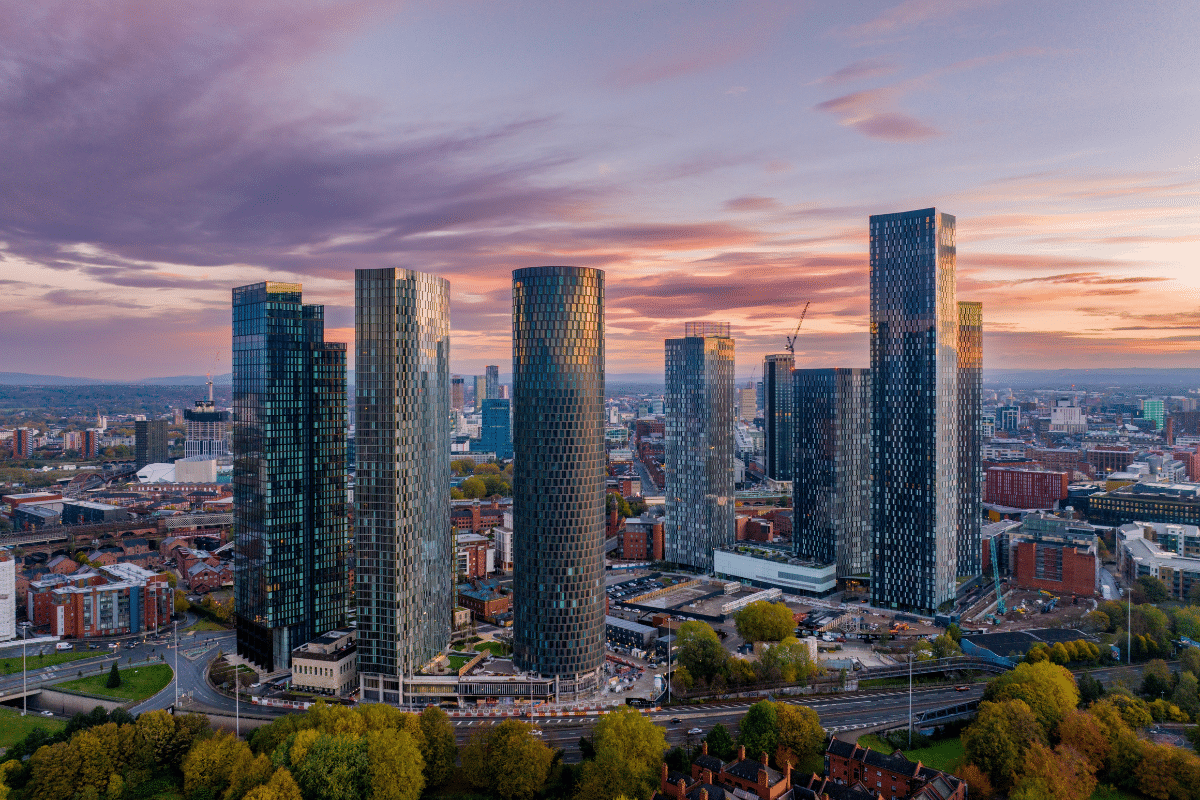
The city-centre postcodes are almost entirely flats: M2 at 99.4%, M1 at 97.5%, M3 at 87.7%, and M4 at 83.1%. That is the apartment stock that drives the city's headline rental demand, and it suits single lets and professional sharers, but it is also the stock showing the weakest recent price growth and the longest selling times. A flat-heavy postcode is a pure income play with a slower resale attached.
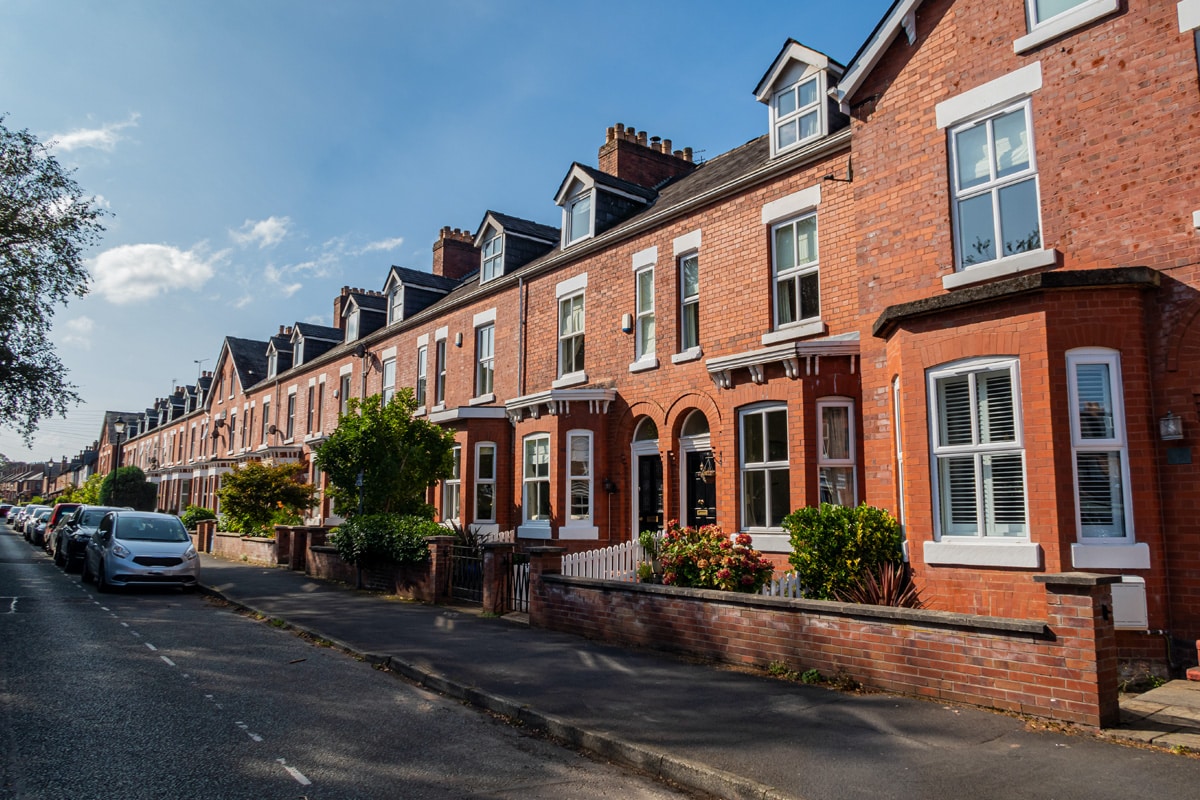
The eastern and southern suburbs are house markets. Terraced houses are the largest single category in M11 (41.2%) and M18 (38.4%), and semi-detached and detached homes dominate the southern belt, with M19 carrying the highest detached share at 14.2% and M21 the highest semi-detached at 49.8%. This is the stock most often run for family lets or as an HMO, and it lines up with the eastern terraces carrying the highest yields in the city.
Flats combine purpose-built, converted and commercial-building flats. A small share of mobile and temporary dwellings is not shown, so rows may not total 100%.
Manchester Rental Market Analysis
Monthly rents in Manchester range from £1,108 in M16 (Old Trafford, Stretford) to £1,759 in M14 (Fallowfield, Rusholme), with gross rental yields from 3.8% to 8.1%. For investors asking is buy to let worth it in Manchester, the figures below break rents, yields and tenant affordability down postcode by postcode. If you are looking at how to build a property portfolio uk across Greater Manchester, you can see the current buy-to-let property for sale alongside the data below.
Average Rent & Gross Rental Yields in Manchester
Gross rental yields in Manchester range from 3.8% in M21 (Chorlton) to 8.1% in M14 (Fallowfield, Rusholme), with a mean monthly rent across the 22 data-bearing postcodes of £1,312. The pattern holds right across the city: the strongest yields sit in the cheaper terraced postcodes of the east and north, not the headline city-centre flats.
| Area | Average Monthly Rent | Asking Price | Gross Yield |
|---|---|---|---|
| M14 (Fallowfield, Rusholme) | £1,759 | £261,804 | 8.1% |
| M15 (Hulme, Castlefield) | £1,672 | £273,212 | 7.3% |
| M13 (Longsight, Ardwick) | £1,433 | £248,096 | 6.9% |
| M4 (Ancoats, Northern Quarter) | £1,360 | £239,625 | 6.8% |
| M3 (Deansgate, Blackfriars) | £1,355 | £244,722 | 6.6% |
| M6 (Irlams o' th' Height, Pendleton) | £1,272 | £232,633 | 6.6% |
| M1 (City Centre) | £1,450 | £267,489 | 6.5% |
| M11 (Openshaw, Clayton) | £1,133 | £208,132 | 6.5% |
| M12 (Ardwick, Openshaw) | £1,302 | £245,623 | 6.4% |
| M18 (Gorton, Abbey Hey) | £1,141 | £212,763 | 6.4% |
| M5 (Salford, Ordsall) | £1,244 | £232,009 | 6.4% |
| M50 (Salford Quays) | £1,176 | £219,713 | 6.4% |
| M9 (Blackley, Harpurhey) | £1,149 | £228,185 | 6.0% |
| M40 (Moston, Collyhurst) | £1,169 | £238,127 | 5.9% |
| M19 (Levenshulme, Burnage) | £1,414 | £323,158 | 5.3% |
| M22 (Wythenshawe, Northenden) | £1,193 | £272,544 | 5.3% |
| M23 (Wythenshawe) | £1,206 | £279,650 | 5.2% |
| M20 (Didsbury) | £1,600 | £377,952 | 5.1% |
| M8 (Crumpsall, Cheetham Hill) | £1,131 | £265,724 | 5.1% |
| M16 (Old Trafford, Stretford) | £1,108 | £267,896 | 5.0% |
| M2 (Deansgate, St Ann's Square) | £1,255 | £340,480 | 4.4% |
| M21 (Chorlton) | £1,336 | £417,169 | 3.8% |
M14 (Fallowfield, Rusholme) at 8.1% is the top yield in the city, pairing a £261,804 asking price with £1,759 a month in rent. Fallowfield is Manchester's student heartland, so the high rent reflects rooms let individually in shared houses rather than a single family tenancy, and the yield comes with the management load that student lets carry. The neighbouring M15 (Hulme) at 7.3% and M13 (Longsight) at 6.9% sit on the same student-and-young-professional demand.
The middle of the table is a deep band of eastern and northern terraced postcodes, with M11, M18, M5, M50, and M12 all clustered between 6.4% and 6.5% on asking prices under £246,000. Fourteen of the 22 postcodes clear 5.5%, so income that beats the citywide average is available across a wide spread of the city rather than concentrated in one corner.
M21 (Chorlton) at 3.8% sits at the bottom. The £1,336 monthly rent is respectable, but against a £417,169 asking price the return is compressed, and the neighbouring M20 (Didsbury) at 5.1% tells the same story. These are owner-occupier suburbs where the price does more for capital value than for rental return.
Gross Rental Yield by Postcode
Is Manchester Rent High?
Monthly rents in Manchester range from 36.6% to 58.2% of the local median gross monthly income, with the area average sitting at 43.4%. The median gross weekly salary in Manchester is £698, which equates to £3,023 per month or £36,278 per year, below both the North West and Great Britain medians. That gap is part of why rents claim a larger share of income in the pricier postcodes than the citywide average suggests. Data from the Nomis Labour Market Profile (ASHE 2025).
| Rank | Area | Rent as % of Income |
|---|---|---|
| 1 | M14 (Fallowfield, Rusholme) | 58.2% |
| 2 | M15 (Hulme, Castlefield) | 55.3% |
| 3 | M20 (Didsbury) | 52.9% |
| 4 | M1 (City Centre) | 47.9% |
| 5 | M13 (Longsight, Ardwick) | 47.4% |
| 6 | M19 (Levenshulme, Burnage) | 46.8% |
| 7 | M4 (Ancoats, Northern Quarter) | 45.0% |
| 8 | M3 (Deansgate, Blackfriars) | 44.8% |
| 9 | M21 (Chorlton) | 44.2% |
| 10 | M12 (Ardwick, Openshaw) | 43.1% |
| 11 | M6 (Irlams o' th' Height, Pendleton) | 42.1% |
| 12 | M2 (Deansgate, St Ann's Square) | 41.5% |
| 13 | M5 (Salford, Ordsall) | 41.2% |
| 14 | M23 (Wythenshawe) | 39.9% |
| 15 | M22 (Wythenshawe, Northenden) | 39.4% |
| 16 | M50 (Salford Quays) | 38.9% |
| 17 | M40 (Moston, Collyhurst) | 38.7% |
| 18 | M9 (Blackley, Harpurhey) | 38.0% |
| 19 | M18 (Gorton, Abbey Hey) | 37.8% |
| 20 | M11 (Openshaw, Clayton) | 37.5% |
| 21 | M8 (Crumpsall, Cheetham Hill) | 37.4% |
| 22 | M16 (Old Trafford, Stretford) | 36.6% |
M16 (Old Trafford, Stretford) at 36.6% is the most affordable against local median pay, and the lower the rent-to-income reading the more headroom a tenant has, which tends to mean longer tenancies and fewer arrears. Every Manchester postcode sits above the widely cited 30% affordability mark, which reflects how far city rents have pulled away from a median wage that trails both the region and Great Britain.
M14 (Fallowfield, Rusholme) at 58.2% is the highest, but context matters. Fallowfield's rent figure is a whole-house student rent set against a single median salary, so it reads high precisely because the houses are let by the room rather than to one earner. The calculation uses gross rent against local median gross pay throughout, so it is a comparison benchmark rather than a household-budget forecast.
How Big Is Manchester's Private Rented Sector?
The private rented sector is deepest in M1 (City Centre) at 67.8% of households and shallowest in M23 (Wythenshawe) at 13.7%. The share of homes already rented privately is a guide to the size of the established tenant pool and the local lettings market.
| Area | Owned Outright | Owned with Mortgage | Private Rented | Social Rented |
|---|---|---|---|---|
| M1 (City Centre) | 9.9% | 14.2% | 67.8% | 7.1% |
| M2 (Deansgate, St Ann's Square) | 10.0% | 15.1% | 66.8% | 6.2% |
| M3 (Deansgate, Blackfriars) | 8.2% | 15.1% | 62.1% | 14.0% |
| M4 (Ancoats, Northern Quarter) | 6.2% | 16.1% | 61.6% | 15.6% |
| M14 (Fallowfield, Rusholme) | 12.7% | 13.3% | 48.8% | 24.2% |
| M13 (Longsight, Ardwick) | 11.2% | 14.2% | 41.6% | 32.4% |
| M15 (Hulme, Castlefield) | 7.2% | 9.2% | 39.4% | 43.4% |
| M20 (Didsbury) | 24.8% | 29.4% | 32.3% | 12.7% |
| M16 (Old Trafford, Stretford) | 20.5% | 20.6% | 31.8% | 26.3% |
| M18 (Gorton, Abbey Hey) | 15.1% | 20.6% | 29.8% | 32.2% |
| M12 (Ardwick, Openshaw) | 11.6% | 17.3% | 25.0% | 45.3% |
| M11 (Openshaw, Clayton) | 13.4% | 15.6% | 24.0% | 45.0% |
| M21 (Chorlton) | 26.1% | 32.0% | 22.4% | 19.0% |
| M19 (Levenshulme, Burnage) | 27.1% | 32.7% | 20.4% | 17.8% |
| M22 (Wythenshawe, Northenden) | 20.2% | 24.5% | 16.7% | 37.3% |
| M23 (Wythenshawe) | 22.1% | 25.6% | 13.7% | 37.5% |
| M40 (Moston, Collyhurst) | Not enough data | Not enough data | Not enough data | Not enough data |
| M5 (Salford, Ordsall) | Not enough data | Not enough data | Not enough data | Not enough data |
| M50 (Salford Quays) | Not enough data | Not enough data | Not enough data | Not enough data |
| M6 (Irlams o' th' Height, Pendleton) | Not enough data | Not enough data | Not enough data | Not enough data |
| M8 (Crumpsall, Cheetham Hill) | Not enough data | Not enough data | Not enough data | Not enough data |
| M9 (Blackley, Harpurhey) | Not enough data | Not enough data | Not enough data | Not enough data |
The city-centre postcodes have the deepest private rented sectors in Manchester, led by M1 at 67.8% and M2 at 66.8%, with M3 and M4 both above 60%. More than three in five homes in these postcodes are already let privately, which points to a large established tenant pool and an active lettings market, the flip side of the flat-heavy stock mix and the weaker capital growth that come with it.
The suburbs sit at the other end. M23 (Wythenshawe) at 13.7%, M22 at 16.7%, and M19 at 20.4% are owner-occupier areas where a larger share of homes is held outright or on a mortgage and fewer come to the rental market. A shallow rented sector is not a weakness for a landlord, it simply points to a market driven by families buying rather than renting, with M19 and M21 showing the highest combined ownership in the city.
Local Housing Allowance Rates in Manchester
Manchester spans 2 Broad Rental Market Areas, so Local Housing Allowance varies by postcode. Local Housing Allowance sets the maximum housing support a tenant on benefits can receive, so it acts as a rent floor for landlords letting to that part of the market. To check the current rate for a specific address, use the government's official Local Housing Allowance calculator.
| BRMA | Postcodes | Shared | 1 bed | 2 bed | 3 bed | 4 bed |
|---|---|---|---|---|---|---|
| Central Greater Manchester BRMA | M1, M11, M12, M13, M14, M15, M16, M18, M19, M2, M20, M21, M3 | £94.72/wk (£410/mo) | £178.36/wk (£773/mo) | £201.37/wk (£873/mo) | £218.63/wk (£947/mo) | £310.68/wk (£1,346/mo) |
| Southern Greater Manchester BRMA | M22, M23 | £94.72/wk (£410/mo) | £143.84/wk (£623/mo) | £172.60/wk (£748/mo) | £207.12/wk (£898/mo) | £322.19/wk (£1,396/mo) |
The two-bedroom rate runs at £201.37 a week (about £873 a month) across most of Manchester and £172.60 a week (about £748 a month) in the Wythenshawe postcodes of M22 and M23. Both sit below the £1,108 to £1,759 open-market rents recorded across the city, so a benefit-backed tenancy at the LHA rate sits under Manchester's open-market rents, and the stock that fits within these rates is concentrated in the cheaper eastern and northern postcodes where asking prices and rents are lowest.
Buy-to-Let Considerations
Are House Prices High in Manchester? Price-to-Earnings Ratios
Purchasing a property in Manchester requires between 5.7 and 11.5 times the median annual salary. This is based on the Nomis Labour Market Profile for Manchester showing the median gross annual income for local residents is £36,278.
The national benchmark for price-to-earnings is 7.4x (England's average sold price of £289,946 divided by the Great Britain median annual salary of £39,125). Fifteen of Manchester's 22 postcodes sit below that benchmark, meaning they are more affordable relative to local incomes than the England average is relative to national incomes.
| Rank | Area | Price-to-Earnings Ratio |
|---|---|---|
| 1 | M11 (Openshaw, Clayton) | 5.7x |
| 2 | M18 (Gorton, Abbey Hey) | 5.9x |
| 3 | M50 (Salford Quays) | 6.1x |
| 4 | M9 (Blackley, Harpurhey) | 6.3x |
| 5 | M5 (Salford, Ordsall) | 6.4x |
| 6 | M6 (Irlams o' th' Height, Pendleton) | 6.4x |
| 7 | M40 (Moston, Collyhurst) | 6.6x |
| 8 | M4 (Ancoats, Northern Quarter) | 6.6x |
| 9 | M3 (Deansgate, Blackfriars) | 6.7x |
| 10 | M12 (Ardwick, Openshaw) | 6.8x |
| 11 | M13 (Longsight, Ardwick) | 6.8x |
| 12 | M14 (Fallowfield, Rusholme) | 7.2x |
| 13 | M8 (Crumpsall, Cheetham Hill) | 7.3x |
| 14 | M1 (City Centre) | 7.4x |
| 15 | M16 (Old Trafford, Stretford) | 7.4x |
| 16 | M22 (Wythenshawe, Northenden) | 7.5x |
| 17 | M15 (Hulme, Castlefield) | 7.5x |
| 18 | M23 (Wythenshawe) | 7.7x |
| 19 | M19 (Levenshulme, Burnage) | 8.9x |
| 20 | M2 (Deansgate, St Ann's Square) | 9.4x |
| 21 | M20 (Didsbury) | 10.4x |
| 22 | M21 (Chorlton) | 11.5x |
M11 (Openshaw, Clayton) at 5.7x is the most affordable entry against local earnings, well below the 7.4x national benchmark, and the eastern and northern terraced postcodes of M18, M50, M9, and M5 all sit between 5.9x and 6.4x. A home at under six times local pay in a major city with this much tenant demand is competitive with the cheapest corners of the North West.
M21 (Chorlton) at 11.5x sits well above the benchmark, with the neighbouring M20 (Didsbury) at 10.4x close behind. At more than ten times the local median salary, these are the premium owner-occupier suburbs where buyers are typically dual-income households, and the elevated ratio is what compresses the yields in those postcodes.
Deposit Requirements in Manchester
A 30% deposit on property in Manchester ranges from £62,440 in M11 (Openshaw, Clayton) to £125,151 in M21 (Chorlton). The deposit alone for a Chorlton property is roughly double what gets an investor into the eastern postcodes, which shows how far the capital needed stretches across the city. Beyond the deposit, the buy to let stamp duty calculator and other buy to let costs add to the total capital required.
| Rank | Area | 30% Deposit Required |
|---|---|---|
| 1 | M11 (Openshaw, Clayton) | £62,440 |
| 2 | M18 (Gorton, Abbey Hey) | £63,829 |
| 3 | M50 (Salford Quays) | £65,914 |
| 4 | M9 (Blackley, Harpurhey) | £68,455 |
| 5 | M5 (Salford, Ordsall) | £69,603 |
| 6 | M6 (Irlams o' th' Height, Pendleton) | £69,790 |
| 7 | M40 (Moston, Collyhurst) | £71,438 |
| 8 | M4 (Ancoats, Northern Quarter) | £71,888 |
| 9 | M3 (Deansgate, Blackfriars) | £73,417 |
| 10 | M12 (Ardwick, Openshaw) | £73,687 |
| 11 | M13 (Longsight, Ardwick) | £74,429 |
| 12 | M14 (Fallowfield, Rusholme) | £78,541 |
| 13 | M8 (Crumpsall, Cheetham Hill) | £79,717 |
| 14 | M1 (City Centre) | £80,247 |
| 15 | M16 (Old Trafford, Stretford) | £80,369 |
| 16 | M22 (Wythenshawe, Northenden) | £81,763 |
| 17 | M15 (Hulme, Castlefield) | £81,964 |
| 18 | M23 (Wythenshawe) | £83,895 |
| 19 | M19 (Levenshulme, Burnage) | £96,947 |
| 20 | M2 (Deansgate, St Ann's Square) | £102,144 |
| 21 | M20 (Didsbury) | £113,385 |
| 22 | M21 (Chorlton) | £125,151 |
M11 (Openshaw, Clayton) is the cheapest way into Manchester at a £62,440 deposit, for a home renting at £1,133 a month on a 6.5% yield. The next three postcodes, M18, M50, and M9, all come in within £6,000 of that, so there is a cluster of sub-£70,000 entry points across the eastern and northern terraces.
The close deposits are not the same investment. M18 (Gorton, Abbey Hey) at £63,829 and M50 (Salford Quays) at £65,914 are roughly £2,000 apart, but M18 is a terraced postcode that grew 40.8% over five years on a 6.4% yield, while M50 is a Salford Quays flat market that fell 17.2% over the same period. Near-identical deposit, opposite five-year records. Buyers chasing a lower entry than the asking price often look through below market value channels rather than the open market.
What the Manchester Data Tells Buy-to-Let Investors
Manchester runs as two markets, and the cheaper one carries both the income and the growth. The eastern and northern terraced postcodes lead on yield, headed by M14 (Fallowfield) at 8.1% on a £261,804 entry, and they also lead on five-year capital growth, with M9 (Blackley, Harpurhey) up 52.3%. It is not often that yield and growth point at the same postcodes, but in Manchester they do, and they point north and east.
The city-centre flat market is the mirror image. M15 (Hulme) is down 25.4% over five years and M1, M3, M4, and M50 are all in negative territory, held back by a long run of new-build apartment supply. Those same postcodes carry the longest selling times in the city, with M1 sitting on 50 months of unsold stock, so a high headline yield on a city-centre flat is worth less than it looks if it takes years to sell when the money is needed back.
Liquidity broadly follows price. M20 (Didsbury) trades 58 sales a month against 6 in M12 (Ardwick, Openshaw), so the pricier southern suburbs are the easiest to move in and out of. A 30% deposit for buying an investment property across the city runs from £62,440 to £125,151 depending on the postcode, and fifteen of the 22 postcodes sit below the national price-to-earnings benchmark, so the city is affordable both in absolute terms and against local pay.
Manchester operates a city-wide Article 4 Direction requiring planning permission to convert a home to a small HMO, and a selective licensing scheme covering parts of Cheetham, Crumpsall, Harpurhey, Longsight, Miles Platting, Newton Heath, and Moss Side through to 2030. Together, these measures can affect an HMO purchase's feasibility, timetable and compliance costs. Before proceeding, check the property's existing planning use, whether it falls within a licensing designation and the standards that apply. Our guide to HMO licensing and current council fees explains the national thresholds and why Article 4 planning is a separate test.
How Manchester Compares
Manchester's mean asking price is £268,032, with a mean monthly rent of £1,312 and a top gross yield of 8.1%. The table sets Manchester against four nearby Greater Manchester markets on the three numbers that decide a buy-to-let: what you pay, what it rents for, and the yield that falls out.
| Location | Mean Asking Price | Mean Monthly Rent | Mean Gross Yield | Top Yield (postcode) |
|---|---|---|---|---|
| Manchester | £268,032 | £1,312 | 5.9% | 8.1% (M14) |
| Salford | £248,444 | £1,188 | 5.7% | 6.6% (M3, M6) |
| Bolton | £255,835 | £981 | 4.6% | 6.1% (M38) |
| Stockport | £374,681 | £1,326 | 4.2% | 6.0% (SK1) |
| Bury | £281,678 | £1,022 | 4.4% | 5.0% (M24) |
Manchester's mean asking price of £268,032 sits in the middle of this group, £19,588 above Salford and £106,649 below Stockport, the dearest location in the table. What sets Manchester apart is the yield: its top gross yield of 8.1% is well clear of the others, none of which passes 6.6%, because Manchester has a depth of high-yielding terraced postcodes that the surrounding boroughs do not.
For investors prioritising income, Manchester leads on top yield at 8.1%, while Stockport carries the highest mean rent at £1,326 a month on the heaviest asking price. Bolton at £255,835 offers the lowest mean rent for the lowest sustained entry, and Bury sits between them. For a data-driven comparison across all UK locations, see our best buy-to-let areas guide. Manchester anchors the northern end of our UK property investment coverage.
Frequently Asked Questions
Is Manchester a good place to invest in property?
Manchester has the fundamentals investors look for. The population grew 9.7% between the 2011 and 2021 censuses, average sold prices sit 14.4% below the England figure, and gross yields reach 8.1% in the strongest postcodes. Two major universities, a deep professional-services jobs base, and a large regeneration pipeline keep tenant demand high. Whether it suits a specific investor comes down to budget, target return, and risk appetite, which the postcode data here is built to inform.
What are the best areas for buy-to-let in Manchester?
It depends what you are optimising for. For yield, the cheaper terraced postcodes lead: M14 (Fallowfield) at 8.1%, with M13, M11 and M18 between 6.4% and 6.9%, all on asking prices under £262,000. For five-year capital growth, M9 (52.3%), M16 (37.4%) and M23 (35.7%) are strongest. The city-centre flat postcodes (M1, M3, M4, M15) carry decent yields but are working through a price correction in the new-build apartment market.
What is a good rental yield in Manchester?
The citywide average gross yield sits around 6%, so anything above that is doing well for the city. The top is 8.1% in M14 (Fallowfield), and 14 of the 22 postcodes clear 5.5%. A gross yield above 6% in a major city with this much tenant demand is competitive, but gross yield ignores mortgage costs, management, maintenance and voids, so the net figure after costs will be lower.
What type of property should I buy in Manchester?
Two types dominate, and they pull in different directions. Most of the higher-yielding stock is terraced housing in the east and north, in postcodes like M40, M18 and M9, which is also what most often gets run as an HMO for students and young professionals. The city centre is mostly flats, and M1 and M15 have the deepest tenant demand anywhere in Manchester. The trade-off shows up on resale: those flats have seen the weakest recent price growth and the longest selling times, so steady income tends to come with a slower exit.
How do I buy a buy-to-let property in Manchester?
Start with the number that fits your goal. For income, the higher yields sit in the cheaper terraced postcodes (M14, M13 and M11 at 6.5% to 8.1%), where a 30% deposit runs from about £62,000. For growth, the southern suburbs of M20 and M21 cost more but have a longer track record. A 30% deposit is the realistic figure for a buy-to-let mortgage, so on Manchester's £268,032 mean asking price that is roughly £80,000. Many of the best deals never reach the open market: BMV property and direct introductions to investment properties are how a lot of Manchester stock changes hands.
What are the up-and-coming areas in Manchester?
The regeneration money points north and east. Victoria North (a £4 billion scheme of up to 15,000 homes) is reshaping M40, M9 and M4; the Old Trafford masterplan and the MediaCityUK expansion lift M16 and M50; and Wythenshawe's town-centre scheme sits behind M22 and M23. Those are also where five-year growth has been strongest, with M9 at 52.3%, M40 at 35.6% and M23 at 35.7%, so the data and the regeneration pipeline point at the same postcodes.
Are Manchester house prices high compared to the national average?
No. The average sold price of £248,071 is 14.4% below the England figure of £289,946. Fifteen of the 22 postcodes have a price-to-income ratio under the national benchmark of 7.4 times local earnings, so the city is affordable in absolute terms and relative to local pay. The premium postcodes of M20 (Didsbury) and M21 (Chorlton) are the exceptions, with price-to-income ratios above 10 times, and M21 is home to Manchester's most expensive street.
Is Manchester buy-to-let still profitable in 2026?
Profitability depends on purchase price, mortgage terms and running costs. A property bought around average asking price in M14 at an 8.1% gross yield on a 65% LTV mortgage would generate positive cash flow before management fees; the same maths in M21 at a 3.8% yield would be marginal. Higher interest rates since 2022 have compressed margins across the UK buy-to-let market, so running the numbers on a specific property with current rates is essential before committing.
Ready to buy property?
Access off-market investment properties with an average 8%+ annual gross yield (beating the UK's typical 3-5%).
Get property alerts