
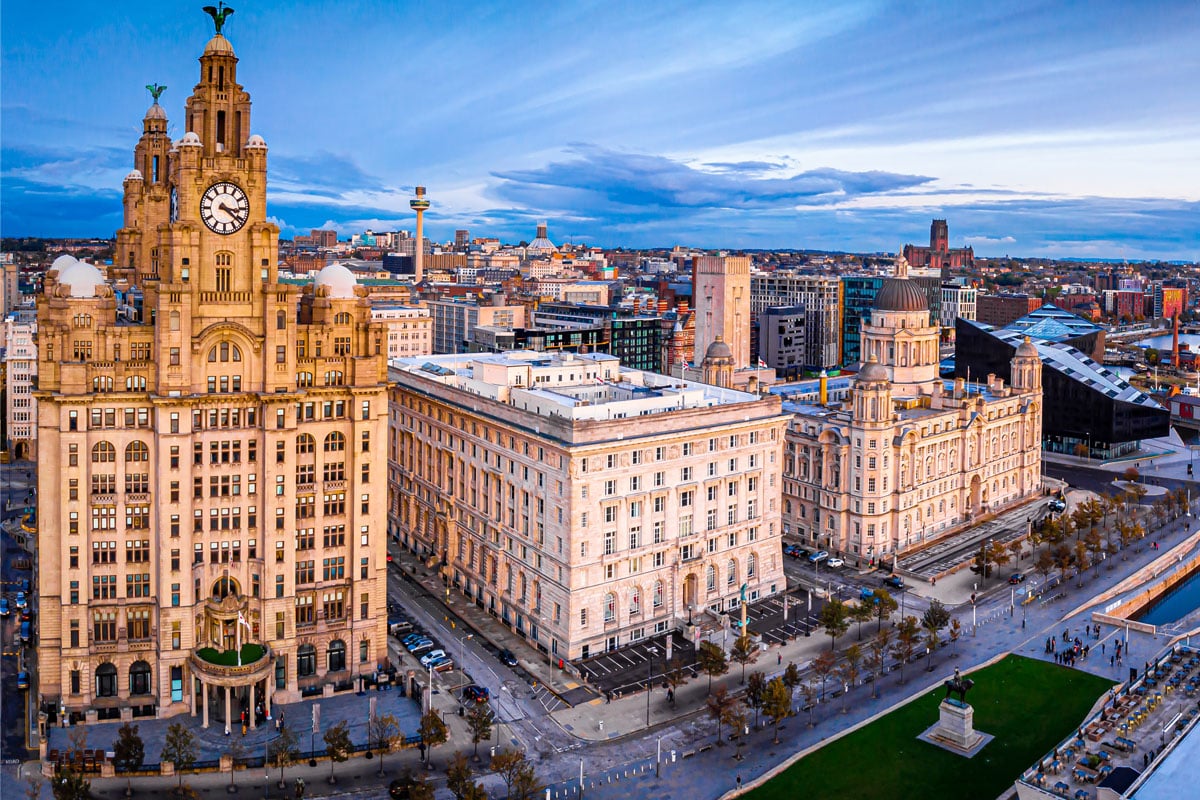
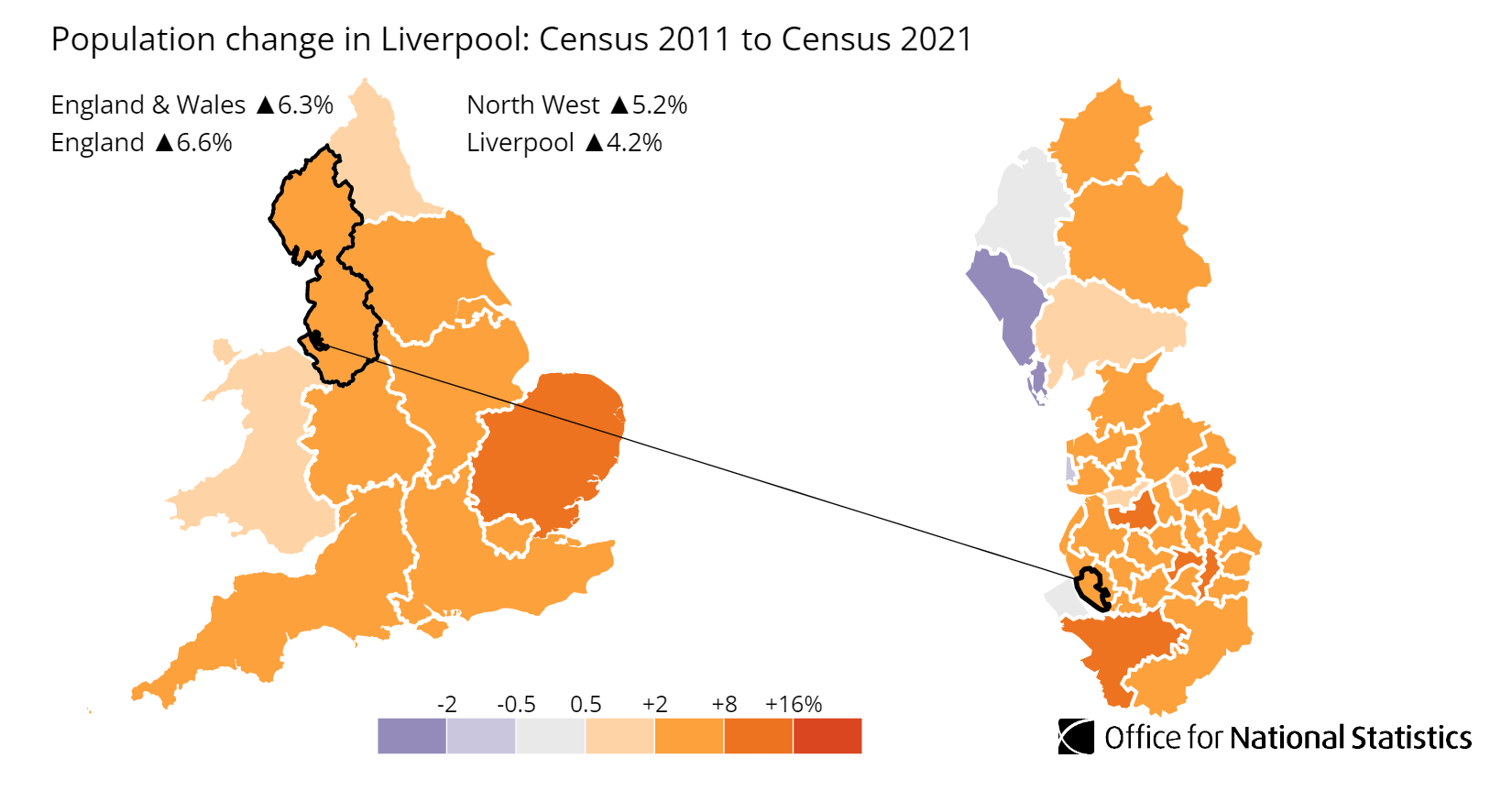
Liverpool is a city in Merseyside, in north-west England. The average sold price across Liverpool is £181,505 on the HM Land Registry House Price Index, 37.4% below the England average of £289,946 and 15.5% below the North West regional average of £214,678. Very few large English cities sit below their own region on price, and that is what makes Liverpool unusual. A city of nearly half a million people prices its housing below the towns around it, which is why the headline yields here run higher than almost anywhere else covered in these guides. The population grew 4.2% between the 2011 and 2021 censuses, from 466,415 to 486,088, reversing a long stretch of decline.
That affordability sits alongside wages that are slightly below the regional norm. The median gross weekly salary in Liverpool is £726.80, against £734.80 across the North West and £766.60 for Great Britain. Low prices on modest wages is the combination that produces high gross yields, and across the 25 postcodes here the spread runs wide: inner postcodes like L2, L4 and L20 carry asking prices under £140,000 and yields above 7%, while the southern suburbs of L18 and L16 push past £350,000. That is two very different markets inside one city boundary.
This guide covers the city of Liverpool (ONS code E08000012) across 25 postcode districts from L1 to L36. Liverpool sits in the North West region on the Mersey estuary, 35 miles west of Manchester. The wider region also includes Birkenhead across the river in Wirral and the surrounding Merseyside towns.
Article updated: July 2026
Why Invest in Liverpool?
Liverpool's population grew 4.2% between the 2011 and 2021 censuses, from 466,415 to 486,088 residents, reversing decades of decline. For most of the twentieth century the city was losing people. The turn back to growth, concentrated in the city centre and waterfront where new apartment stock has been added, is the single clearest signal that the long post-industrial story has changed direction. A growing population is a growing tenant base.
The student market is one of the deepest in the country. The University of Liverpool, Liverpool John Moores University and Liverpool Hope University together draw tens of thousands of students into the city, and that demand concentrates in the inner postcodes around the universities and hospitals. Healthcare is the other anchor: the Royal Liverpool University Hospital, Alder Hey Children's Hospital and the wider NHS trusts employ thousands of staff who rent close to where they work. The Port of Liverpool and the logistics around it add a third strand of employment that does not move easily.
Median gross annual earnings in Liverpool are £37,788, which is 1.1% below the North West regional median of £38,210 and 5.2% below the Great Britain median of £39,863. Lower local wages are part of why prices sit where they do, and the gap between modest wages and very low prices is exactly what lifts gross yields. It also means tenant demand at the more affordable end leans on students, key workers and benefit-supported renters rather than high earners, which shapes where the strongest rental markets sit.
Liverpool Economic Summary
- Population: 486,088 (2021 Census). Growth of 4.2% from 2011.
- Median annual salary: £37,788 (Liverpool), £38,210 (North West), £39,863 (Great Britain)
- Employment rate: 70.9% (Liverpool), 74.2% (North West), 75.6% (Great Britain)
- Unemployment rate: 4.6% (Liverpool)
- Key employment sectors: Health and social work, higher education, port and logistics, accommodation and food, professional and technical services
Source: ONS Census 2021, Nomis Labour Market Profile (ASHE 2025, Employment Oct 2024-Sep 2025)
Regeneration and Investment in Liverpool
Liverpool's waterfront is the focus of the £5.5 billion Liverpool Waters masterplan, the largest single regeneration scheme in the city. The investment is concentrated along the north docks, where decades of dereliction are being rebuilt into residential districts, and the new Everton stadium has already changed the skyline at Bramley-Moore Dock.
- Liverpool Waters (Under construction, £5.5 billion masterplan): Peel Waters' 148-acre dockland regeneration spans 2.3km of waterfront across five districts. The Central Docks phase covers 26 acres and is set to deliver more than 2,000 homes alongside a five-acre Central Park, with infrastructure works started in late 2025. This adds a large new residential quarter on the northern waterfront, where city-centre housing supply has long been constrained. Updates at Liverpool Waters.
- Everton Stadium at Bramley-Moore Dock (Completing, £500 million): The 52,888-capacity stadium opened ahead of the 2025-26 season at Bramley-Moore Dock, within the Liverpool Waters footprint. Projected to generate a £1.3 billion boost to the local economy and attract around 1.4 million visitors a year, the stadium acts as the catalyst that draws wider commercial and residential development into the north docks. Updates at Brabners.
- Knowledge Quarter and Paddington Village (Under construction, £1 billion): A 30-acre innovation district focused on life sciences, health, education and technology, running from Lime Street towards the Royal Liverpool Hospital. It delivers 1.8 million square feet of science, tech and health space, with around 300 affordable homes earmarked at Paddington, and is projected to create more than 10,000 skilled jobs. That builds a new tenant pool of research workers and medical professionals in the inner postcodes. Updates at Liverpool Knowledge Quarter.
Source: Office for National Statistics - Population for Liverpool
Liverpool Property Market Analysis
Average property prices in Liverpool have risen 441.5% since January 1995, from £33,517 to £181,505. The sections below break down that journey cycle by cycle, then drill into current postcode-level data for sold prices, price per square foot, asking prices, growth trends, and monthly transaction volumes.
When was the last house price crash in Liverpool?
All sold property prices for Liverpool are recorded by HM Land Registry at city level under the local authority code E08000012. The Land Registry House Price Index tracks average prices from January 1995 to March 2026, covering 31 years of market cycles.
The 1995 to 2007 boom: Liverpool started at £33,517 in January 1995. By December 2000 the average had reached £43,317, and growth then accelerated sharply through the early 2000s, passing £105,343 by December 2005. The market kept climbing to a pre-crash peak of £119,306 in September 2007, more than tripling in a little over twelve years.
2008 to 2013, a long, deep correction: Liverpool's downturn was harder and lasted far longer than the national one. From the September 2007 peak of £119,306, prices kept falling for more than five years, bottoming at £94,993 in March 2013. That is a decline of 20.4%, with the worst year-on-year reading at -13.8% in May 2009. Unlike many southern markets that turned within two years, Liverpool's lower-priced, more credit-sensitive stock stayed under water through the early-2010s austerity years.
Recovery, 2013 to 2018: Prices climbed slowly off the March 2013 trough. By December 2015 the average had only reached £107,868, still well short of the old peak. It was not until July 2018, at £121,907, that Liverpool finally passed its September 2007 high. The recovery took almost eleven years, one of the longest in any city covered here, and reflects how deep the correction ran.
2018 to 2020, steady single-digit growth: Prices moved up steadily without drama, reaching £118,898 by December 2019. Annual growth through this stretch sat in low single digits as the market normalised after the long recovery.
2020 to 2022, the pandemic surge: The stamp duty holiday and a shift towards more space turbocharged a low-priced market. Prices jumped from £118,898 in December 2019 to £136,437 by December 2020, then £147,401 by December 2021 and £164,488 by December 2022. That is a 38.3% rise over three years, the strongest run in Liverpool's record.
The 2023 rate shock: Higher mortgage rates cooled the market. Prices eased to £160,204 by December 2023, a modest pull-back of around 2.6% on the year. Liverpool's correction was shallow, helped by low sold prices that left less room to fall.
2024 to present: Growth resumed, with the average reaching £168,755 by December 2024 and a fresh all-time high of £183,450 in December 2025. The latest reading has eased gently to £181,505 in March 2026, leaving the current price 52.1% above the September 2007 pre-crash peak.
Long-term growth summary:
- 5 years (March 2021 to March 2026): 24.7% growth (£145,563 to £181,505)
- 10 years (March 2016 to March 2026): 73.5% growth (£104,597 to £181,505)
- 15 years (March 2011 to March 2026): 83.1% growth (£99,126 to £181,505)
- 20 years (March 2006 to March 2026): 71.5% growth (£105,838 to £181,505)
- 30 years (January 1995 to March 2026): 441.5% growth (£33,517 to £181,505)
Liverpool's 20.4% crash was deeper than England's national fall, and the near-eleven-year recovery was one of the longest in the country, a direct consequence of how far prices dropped. Set against that, the 30-year return of 441.5% is among the strongest of any city in these guides, and an investor who bought at the exact September 2007 peak would now be 52.1% ahead on the Land Registry average. The pattern is a low base, a long memory of the last crash, and a market where the income return has done more of the work than headline capital growth.
- All property types
- Detached
- Semi-detached
- Terraced
- Flats
- All property types
- Detached
- Semi-detached
- Terraced
- Flats
Sold House Prices in Liverpool
The average sold price across all property types in Liverpool is £181,505, which is 37.4% below the England average of £289,946 as of March 2026. That discount holds across every property type, but it is deepest at the affordable end. Flats sell 41.6% below England and terraces 29.4% below, while detached houses are 18.7% below. Those are the same terraced and flat homes, concentrated in the inner postcodes, that carry the city's 7% to 8% gross yields.
| Property Type | Liverpool Average | England Average | Difference |
|---|---|---|---|
| Detached houses | £382,334 | £470,492 | -18.7% |
| Semi-detached houses | £229,931 | £288,185 | -20.2% |
| Terraced houses | £172,063 | £243,788 | -29.4% |
| Flats and maisonettes | £125,262 | £214,563 | -41.6% |
| All property types | £181,505 | £289,946 | -37.4% |
Detached houses at £382,334 carry the smallest discount at 18.7% below England's £470,492. Liverpool's detached stock concentrates in the southern suburbs of L18, L25 and L19 and the outer districts towards L12 and L26, where larger family homes draw owner-occupiers rather than landlords. Annual growth of 3.9% points to steady demand rather than speculation.
Semi-detached houses at £229,931 sit 20.2% below England's £288,185. This is the broad middle of the Liverpool market, spread across the L13, L14 and L9 belt and the outer districts, with 4.5% annual growth, the strongest of any type. Semi-detached homes carry enough rent to work for income investors while staying well below the national average price.
Terraced houses at £172,063 offer a 29.4% discount to England's £243,788. The terraced stock is concentrated in the inner postcodes of L4, L6, L7 and L8, the streets that have always supplied Liverpool's rental market, and annual growth of 4.3% is close to the top of the table. These are the homes behind much of the city's high-yield activity.
Flats and maisonettes at £125,262 show the deepest discount at 41.6% below England's £214,563. The flat market is heaviest in the L1, L2 and L3 city-centre core, where waterfront and converted apartment stock dominates. Annual change of -1.4% is the only negative reading among the types, reflecting a city-centre apartment market that has absorbed a lot of new supply and is no longer rising.
Price Per Square Foot in Liverpool
£177 per square foot separates Liverpool's cheapest postcode from its dearest, with L4 at £126 and L16 at £303. Measuring by the square foot controls for how big the homes are, so it compares one location against another rather than a small flat against a large house. The cheapest space sits in the northern terraced belt, the dearest in the southern suburbs.
| Rank | Area | Price Per Sq Ft |
|---|---|---|
| 1 | L4 (Walton, Kirkdale) | £126 |
| 2 | L20 (Bootle, Orrell) | £130 |
| 3 | L5 (Everton, Vauxhall) | £136 |
| 4 | L6 (Anfield, Fairfield) | £136 |
| 5 | L2 (City Centre) | £145 |
| 6 | L13 (Old Swan, Tuebrook) | £156 |
| 7 | L9 (Aintree, Walton) | £158 |
| 8 | L11 (Norris Green, Croxteth) | £168 |
| 9 | L27 (Netherley) | £170 |
| 10 | L7 (Edge Hill, Kensington) | £173 |
| 11 | L8 (Toxteth, Dingle) | £175 |
| 12 | L24 (Speke) | £193 |
| 13 | L15 (Wavertree) | £196 |
| 14 | L10 (Fazakerley) | £199 |
| 15 | L36 (Huyton, Roby) | £201 |
| 16 | L14 (Knotty Ash, Dovecot) | £204 |
| 17 | L12 (West Derby) | £237 |
| 18 | L3 (City Centre, Vauxhall) | £241 |
| 19 | L19 (Garston, Aigburth) | £249 |
| 20 | L1 (City Centre, Ropewalks) | £267 |
| 21 | L26 (Halewood) | £267 |
| 22 | L17 (Aigburth, Sefton Park) | £276 |
| 23 | L25 (Woolton, Gateacre) | £283 |
| 24 | L18 (Mossley Hill, Allerton) | £298 |
| 25 | L16 (Childwall) | £303 |
L4 at £126 per square foot is the cheapest bricks-and-mortar value in the city. Walton and Kirkdale are dense terraced districts north of the centre with a long letting history, and that low cost of space is part of why L4 also carries one of the highest yields. Based on 668 transactions analysed, L4's rate sits well below the city's southern suburbs.
L16 at £303 per square foot tops the table. Childwall is an established residential suburb in south Liverpool, and the premium reflects larger family homes and steady owner-occupier demand. When buyers pay more per square foot, they are paying for location rather than additional space, and L16's rate is more than double L4's.
For Sale Asking Prices in Liverpool
L20 at £130,969 and L18 at £380,872 sit 190.8% apart, the widest asking-price gap in the city. That spread is wider than almost any city covered here and reflects two very different Liverpools: an affordable northern and inner belt, and a premium southern suburban arc. The mean asking price across all 24 priced postcodes is £210,314.
| Rank | Area | Asking Price |
|---|---|---|
| 1 | L20 (Bootle, Orrell) | £130,969 |
| 2 | L4 (Walton, Kirkdale) | £132,515 |
| 3 | L5 (Everton, Vauxhall) | £136,158 |
| 4 | L2 (City Centre) | £139,069 |
| 5 | L6 (Anfield, Fairfield) | £139,109 |
| 6 | L7 (Edge Hill, Kensington) | £149,287 |
| 7 | L13 (Old Swan, Tuebrook) | £157,598 |
| 8 | L11 (Norris Green, Croxteth) | £159,061 |
| 9 | L9 (Aintree, Walton) | £167,473 |
| 10 | L1 (City Centre, Ropewalks) | £173,933 |
| 11 | L8 (Toxteth, Dingle) | £176,043 |
| 12 | L3 (City Centre, Vauxhall) | £185,830 |
| 13 | L14 (Knotty Ash, Dovecot) | £199,499 |
| 14 | L10 (Fazakerley) | £199,563 |
| 15 | L36 (Huyton, Roby) | £206,335 |
| 16 | L15 (Wavertree) | £220,291 |
| 17 | L24 (Speke) | £246,625 |
| 18 | L12 (West Derby) | £253,741 |
| 19 | L17 (Aigburth, Sefton Park) | £272,004 |
| 20 | L19 (Garston, Aigburth) | £286,694 |
| 21 | L25 (Woolton, Gateacre) | £289,322 |
| 22 | L26 (Halewood) | £292,924 |
| 23 | L16 (Childwall) | £352,630 |
| 24 | L18 (Mossley Hill, Allerton) | £380,872 |
L20 at £130,969 is the lowest asking price in Liverpool. Bootle and Orrell sit just north of the city in the terraced belt, where small houses change hands cheaply and the rental market is well established. For an investor with a fixed budget, this end of the city offers the most property for the money and the lowest barrier to entry of any large city in these guides.
L18's £380,872 asking price is the city's premium. Mossley Hill and Allerton in the south hold Liverpool's larger period and family homes, drawing owner-occupiers rather than landlords. The gap between L18 and L20 is almost £250,000, which is why the same city can show 8% yields in one postcode and barely 4% in another. The rental yield data in the sections below confirms how that price hierarchy plays out for income. Our Land Registry ranking of Liverpool's most expensive streets extends that view across the wider postal town, including Formby.
House Price Growth in Liverpool
Nearly every Liverpool postcode posted strong five-year growth, led by L11 at 41.3%, with only the city-centre flat market in L1 negative at -11.1%. The five-year figures reflect the post-pandemic surge across the affordable house stock, while the one and three-year readings show which postcodes are still moving and which have cooled. The table below ranks the postcodes by five-year growth.
| Area | 1 Year | 3 Years | 5 Years |
|---|---|---|---|
| L11 (Norris Green, Croxteth) | 4.3% | 15.5% | 41.3% |
| L26 (Halewood) | -12.3% | 1.5% | 39.8% |
| L9 (Aintree, Walton) | 10.0% | 16.1% | 38.1% |
| L4 (Walton, Kirkdale) | 5.1% | 16.6% | 37.3% |
| L20 (Bootle, Orrell) | 12.1% | 12.7% | 35.0% |
| L13 (Old Swan, Tuebrook) | 7.5% | 8.9% | 33.2% |
| L15 (Wavertree) | 9.1% | 21.8% | 30.7% |
| L6 (Anfield, Fairfield) | -0.8% | 2.3% | 30.0% |
| L10 (Fazakerley) | 0.8% | 17.8% | 28.4% |
| L19 (Garston, Aigburth) | 5.3% | 16.6% | 26.8% |
| L17 (Aigburth, Sefton Park) | 6.2% | 8.2% | 25.7% |
| L24 (Speke) | 15.9% | 12.4% | 25.4% |
| L25 (Woolton, Gateacre) | 7.5% | 7.4% | 24.6% |
| L5 (Everton, Vauxhall) | 1.6% | -4.3% | 22.3% |
| L8 (Toxteth, Dingle) | -2.2% | -8.0% | 22.3% |
| L12 (West Derby) | -1.3% | 10.8% | 21.2% |
| L16 (Childwall) | 9.1% | 4.0% | 20.9% |
| L14 (Knotty Ash, Dovecot) | 0.1% | 4.9% | 20.5% |
| L36 (Huyton, Roby) | -0.7% | 3.9% | 11.0% |
| L7 (Edge Hill, Kensington) | 1.0% | 4.6% | 8.6% |
| L18 (Mossley Hill, Allerton) | -4.7% | 0.8% | 7.4% |
| L3 (City Centre, Vauxhall) | -7.8% | -7.3% | 7.4% |
| L2 (City Centre) | -18.8% | -38.4% | 4.3% |
| L1 (City Centre, Ropewalks) | -15.5% | -15.4% | -11.1% |
L11 at 41.3% has the strongest five-year growth in the city. Norris Green and Croxteth combine very low asking prices with steady demand, and the post-pandemic surge lifted that affordable stock hard. Across the inner and northern postcodes, five-year returns above 30% are common, which is the same low-base effect that produced the city's high yields.
The city-centre flat postcodes tell the opposite story. L1 and L2 are negative across one and three years, with L2 down 38.4% over three. These are the apartment-heavy core, where a wave of new-build and converted stock has weighed on values, so the headline city growth has come from houses in the inner and outer districts rather than from the waterfront flats.
Monthly Property Sales in Liverpool
Transaction volumes vary sharply across Liverpool, from 4 sales a month in the quietest city-centre postcodes to 40 in L4, with turnover running from 2% to 47%. The houses-dominated inner and outer districts trade actively, while the flat-heavy city centre sits much slower. The table below ranks the postcodes by monthly sales.
| Area | Sales Per Month | Turnover | Asking Price |
|---|---|---|---|
| L4 (Walton, Kirkdale) | 40 | 35% | £132,515 |
| L25 (Woolton, Gateacre) | 31 | 21% | £289,322 |
| L9 (Aintree, Walton) | 30 | 47% | £167,473 |
| L17 (Aigburth, Sefton Park) | 30 | 28% | £272,004 |
| L13 (Old Swan, Tuebrook) | 27 | 35% | £157,598 |
| L15 (Wavertree) | 27 | 23% | £220,291 |
| L36 (Huyton, Roby) | 26 | 19% | £206,335 |
| L18 (Mossley Hill, Allerton) | 23 | 25% | £380,872 |
| L20 (Bootle, Orrell) | 22 | 29% | £130,969 |
| L6 (Anfield, Fairfield) | 22 | 15% | £139,109 |
| L12 (West Derby) | 20 | 16% | £253,741 |
| L19 (Garston, Aigburth) | 17 | 20% | £286,694 |
| L3 (City Centre, Vauxhall) | 17 | 3% | £185,830 |
| L8 (Toxteth, Dingle) | 16 | 6% | £176,043 |
| L11 (Norris Green, Croxteth) | 14 | 36% | £159,061 |
| L14 (Knotty Ash, Dovecot) | 14 | 20% | £199,499 |
| L7 (Edge Hill, Kensington) | 12 | 24% | £149,287 |
| L10 (Fazakerley) | 11 | 37% | £199,563 |
| L24 (Speke) | 11 | 19% | £246,625 |
| L26 (Halewood) | 11 | 10% | £292,924 |
| L1 (City Centre, Ropewalks) | 11 | 2% | £173,933 |
| L5 (Everton, Vauxhall) | 9 | 8% | £136,158 |
| L16 (Childwall) | 8 | 18% | £352,630 |
| L2 (City Centre) | 4 | 2% | £139,069 |
L9's 47% turnover is the highest in Liverpool. Aintree and Walton combine affordable houses with strong demand, so a large share of the stock changes hands each year. For a buy-to-let investor, high turnover signals an easier exit when the time comes to sell, and the northern and inner house postcodes (L4, L11, L10, L13) all show turnover at 35% or more.
The city-centre flat postcodes sit at the other end. L1 and L2 turn over just 2% of their stock a year, with L2 seeing only 4 sales a month. That thin trade is a function of an apartment market with a lot of standing supply and slow absorption, and it is the practical reason the waterfront flats are harder to move than the terraced houses inland.
How Long Properties Take to Sell in Liverpool
Most of Liverpool's house postcodes clear quickly, with L9 finding a buyer in about 65 days, while the flat-heavy city centre sits for far longer. How long a sale takes is a real holding cost that a yield figure never shows, and in Liverpool it tracks the same split as everything else: houses sell, city-centre flats wait. The table below shows the postcodes with reliable selling-time data.
| Area | Avg Days to Sell | Months of Unsold Stock | Market |
|---|---|---|---|
| L9 (Aintree, Walton) | 65 | 2.1 | Seller's market |
| L11 (Norris Green, Croxteth) | 82 | 2.7 | Seller's market |
| L4 (Walton, Kirkdale) | 87 | 2.9 | Seller's market |
| L10 (Fazakerley) | 89 | 2.9 | Seller's market |
| L13 (Old Swan, Tuebrook) | 98 | 3.2 | Seller's market |
| L20 (Bootle, Orrell) | 105 | 3.4 | Seller's market |
| L15 (Wavertree) | 113 | 3.7 | Seller's market |
| L18 (Mossley Hill, Allerton) | 127 | 4.2 | Seller's market |
| L36 (Huyton, Roby) | 138 | 4.5 | Seller's market |
| L17 (Aigburth, Sefton Park) | 152 | 5.0 | Seller's market |
| L25 (Woolton, Gateacre) | 152 | 5.0 | Seller's market |
| L12 (West Derby) | 169 | 5.6 | Seller's market |
| L6 (Anfield, Fairfield) | 203 | 6.7 | Balanced market |
| L7 (Edge Hill, Kensington) | 217 | 7.1 | Balanced market |
| L8 (Toxteth, Dingle) | 435 | 14.3 | Buyer's market |
| L3 (City Centre, Vauxhall) | 1014 | 33.3 | Buyer's market |
| L1 (City Centre, Ropewalks) | 1521 | 50.0 | Buyer's market |
| L2 (City Centre) | 1521 | 50.0 | Buyer's market |
The contrast here is the headline. A house in L9 takes a little over two months to sell, while a city-centre flat in L1 or L2 can sit for years at the current rate of sale, with months of unsold stock running into the dozens. Those city-centre figures reflect an apartment market that is heavily oversupplied and trades rarely, so the long days-to-sell readings are about a thin, slow flat market rather than a problem with the wider city. For an income investor, the practical read is simple: the high-yielding terraced and semi-detached house postcodes are also the ones that sell, so the exit is far easier than the city-centre headline suggests.
What Type of Property Can You Buy in Liverpool?
The housing mix flips completely across the city: flats make up more than 80% of stock in the L2 city centre, while semi-detached and terraced houses dominate the inner and outer districts. The mix shapes which strategies fit where, and the figures below are drawn from 2021 Census records for each postcode.
| Area | Detached | Semi-detached | Terraced | Flats |
|---|---|---|---|---|
| L1 (City Centre, Ropewalks) | 2.0% | 14.6% | 10.9% | 72.2% |
| L2 (City Centre) | 1.1% | 9.1% | 7.7% | 81.6% |
| L3 (City Centre, Vauxhall) | 8.2% | 21.0% | 19.3% | 51.4% |
| L4 (Walton, Kirkdale) | 4.1% | 27.7% | 53.7% | 14.4% |
| L5 (Everton, Vauxhall) | 4.6% | 39.4% | 27.4% | 28.7% |
| L6 (Anfield, Fairfield) | 6.9% | 28.3% | 37.8% | 27.0% |
| L7 (Edge Hill, Kensington) | 5.0% | 21.5% | 30.2% | 43.3% |
| L8 (Toxteth, Dingle) | 4.0% | 20.4% | 29.8% | 45.7% |
| L9 (Aintree, Walton) | 14.4% | 40.0% | 28.1% | 17.5% |
| L10 (Fazakerley) | 16.4% | 58.0% | 17.7% | 7.8% |
| L11 (Norris Green, Croxteth) | 11.8% | 40.7% | 36.8% | 10.6% |
| L12 (West Derby) | 38.2% | 38.0% | 15.1% | 8.8% |
| L13 (Old Swan, Tuebrook) | 6.0% | 32.8% | 42.2% | 18.9% |
| L14 (Knotty Ash, Dovecot) | 15.6% | 46.2% | 28.3% | 10.0% |
| L15 (Wavertree) | 7.6% | 34.0% | 40.2% | 18.2% |
| L16 (Childwall) | 16.0% | 64.7% | 10.7% | 8.5% |
| L17 (Aigburth, Sefton Park) | 22.8% | 13.7% | 15.9% | 47.5% |
| L18 (Mossley Hill, Allerton) | 19.5% | 43.0% | 18.5% | 19.0% |
| L19 (Garston, Aigburth) | 18.8% | 32.4% | 29.5% | 19.3% |
| L20 (Bootle, Orrell) | 6.2% | 38.7% | 37.8% | 17.3% |
| L24 (Speke) | 21.6% | 53.2% | 22.3% | 2.9% |
| L25 (Woolton, Gateacre) | 19.4% | 46.6% | 19.8% | 14.2% |
| L26 (Halewood) | 30.2% | 40.0% | 13.2% | 5.6% |
| L36 (Huyton, Roby) | 20.4% | 47.1% | 23.8% | 8.6% |
L2 and L1 are overwhelmingly flats, at 81.6% and 72.2%. This is the city-centre apartment core, the stock that suits single lets and short-term tenancies but trades slowly and has shown the weakest price growth. The smaller-unit market here is large, but it competes against a steady supply of new build.
L4 is the most terraced postcode at 53.7%, with the inner belt of L6, L8 and L13 also heavy on terraced and flat stock. That is the smaller, lower-cost housing that typically drives buy-to-let, and it lines up with these postcodes carrying the lowest asking prices and the highest yields. Out towards L26, L36 and L25, semi-detached and detached houses take over, matching the higher prices and lower yields of the suburbs.
The flats figure covers both purpose-built blocks and conversions, and a small share of non-standard dwellings is excluded, so rows may not total 100%.
Liverpool Rental Market Analysis
Monthly rents in Liverpool run from £637 in L7 to £1,311 in L18, with gross rental yields reaching 8.0% in the affordable inner postcodes. For investors asking is buy to let worth it in Liverpool, the sections below break down rents, yields and tenant affordability postcode by postcode. If you are working out how to build a property portfolio in the North West, Liverpool's mix of very low asking prices and deep student and key-worker demand is what makes it one of the highest-yielding large cities in the country. Browse current buy-to-let properties for sale across the region.
Average Rent & Gross Rental Yields in Liverpool
Gross rental yields in Liverpool range from 3.6% in L15 to 8.0% in L2, with the cheapest inner postcodes delivering the strongest returns. The pattern is consistent: the lowest asking prices carry the highest yields, while the premium southern suburbs sit at the bottom. The table below ranks the 18 postcodes with both rent and price data by gross yield, with a further six postcodes listed by asking price where rental data is too thin to read a reliable yield.
| Area | Average Monthly Rent | Asking Price | Gross Yield |
|---|---|---|---|
| L2 (City Centre) | £924 | £139,069 | 8.0% |
| L4 (Walton, Kirkdale) | £835 | £132,515 | 7.6% |
| L20 (Bootle, Orrell) | £800 | £130,969 | 7.3% |
| L5 (Everton, Vauxhall) | £816 | £136,158 | 7.2% |
| L13 (Old Swan, Tuebrook) | £883 | £157,598 | 6.7% |
| L1 (City Centre, Ropewalks) | £934 | £173,933 | 6.4% |
| L3 (City Centre, Vauxhall) | £984 | £185,830 | 6.4% |
| L36 (Huyton, Roby) | £1,085 | £206,335 | 6.3% |
| L9 (Aintree, Walton) | £829 | £167,473 | 5.9% |
| L8 (Toxteth, Dingle) | £847 | £176,043 | 5.8% |
| L6 (Anfield, Fairfield) | £662 | £139,109 | 5.7% |
| L14 (Knotty Ash, Dovecot) | £939 | £199,499 | 5.6% |
| L7 (Edge Hill, Kensington) | £637 | £149,287 | 5.1% |
| L12 (West Derby) | £1,046 | £253,741 | 4.9% |
| L25 (Woolton, Gateacre) | £1,162 | £289,322 | 4.8% |
| L17 (Aigburth, Sefton Park) | £918 | £272,004 | 4.1% |
| L18 (Mossley Hill, Allerton) | £1,311 | £380,872 | 4.1% |
| L15 (Wavertree) | £661 | £220,291 | 3.6% |
| L10 (Fazakerley) | Not enough data | £199,563 | Not enough data |
| L11 (Norris Green, Croxteth) | Not enough data | £159,061 | Not enough data |
| L16 (Childwall) | Not enough data | £352,630 | Not enough data |
| L19 (Garston, Aigburth) | Not enough data | £286,694 | Not enough data |
| L24 (Speke) | Not enough data | £246,625 | Not enough data |
| L26 (Halewood) | Not enough data | £292,924 | Not enough data |
L2 at 8.0% is the highest yield in the city, pairing a £924 monthly rent with a £139,069 asking price. A 30% deposit of £41,721 buys into the top-yielding postcode, though the trade-off is real: L2 is a city-centre flat market with a -38.4% three-year price record and very slow sales, so the income return comes with weak capital growth and a hard exit.
L4 at 7.6%, L20 at 7.3% and L5 at 7.2% pair yields above 7% with houses that trade actively, the affordable terraced and inner districts where L4 alone sees 40 sales a month. The city-centre flats reach a higher 8.0% in L2, but with selling times running into years rather than the weeks-to-months these house postcodes see.
L15 at 3.6% sits at the bottom of the table. Wavertree's £661 average rent against a £220,291 asking price compresses the return, and the southern suburbs of L17 and L18 sit alongside it at 4.1%, where premium prices do more for capital values than for income.
Gross Rental Yield by Postcode
Is Liverpool Rent High?
Monthly rents in Liverpool consume between 20.2% and 41.6% of the local median gross monthly salary. The widely cited threshold for rent affordability is 30% of gross income, and most Liverpool postcodes sit comfortably below it. That headroom is one of the reasons the rental market is so deep: tenants here are not stretched to the limit, which tends to mean steadier tenancies and fewer arrears.
The median gross weekly salary in Liverpool is £726.80, which equates to £3,149 per month or £37,788 per year. This is below the North West regional median of £734.80 per week and the Great Britain median of £766.60 per week. Data from the Nomis Labour Market Profile (ASHE 2025).
| Rank | Area | Rent as % of Income |
|---|---|---|
| 1 | L18 (Mossley Hill, Allerton) | 41.6% |
| 2 | L25 (Woolton, Gateacre) | 36.9% |
| 3 | L36 (Huyton, Roby) | 34.5% |
| 4 | L12 (West Derby) | 33.2% |
| 5 | L3 (City Centre, Vauxhall) | 31.3% |
| 6 | L14 (Knotty Ash, Dovecot) | 29.8% |
| 7 | L1 (City Centre, Ropewalks) | 29.7% |
| 8 | L2 (City Centre) | 29.3% |
| 9 | L17 (Aigburth, Sefton Park) | 29.2% |
| 10 | L13 (Old Swan, Tuebrook) | 28.0% |
| 11 | L8 (Toxteth, Dingle) | 26.9% |
| 12 | L4 (Walton, Kirkdale) | 26.5% |
| 13 | L9 (Aintree, Walton) | 26.3% |
| 14 | L5 (Everton, Vauxhall) | 25.9% |
| 15 | L20 (Bootle, Orrell) | 25.4% |
| 16 | L6 (Anfield, Fairfield) | 21.0% |
| 17 | L15 (Wavertree) | 21.0% |
| 18 | L7 (Edge Hill, Kensington) | 20.2% |
| — | L10 (Fazakerley) | Not enough data |
| — | L11 (Norris Green, Croxteth) | Not enough data |
| — | L16 (Childwall) | Not enough data |
| — | L19 (Garston, Aigburth) | Not enough data |
| — | L24 (Speke) | Not enough data |
| — | L26 (Halewood) | Not enough data |
L7 at 20.2% is the most affordable for tenants. Edge Hill and Kensington carry a £637 average rent against a £3,149 monthly salary, leaving plenty of headroom, which matters to a landlord because affordable rents correlate with lower voids and fewer arrears. Much of the inner belt, L6 and L15 included, sits near or below 21%, helped by lower rents and a tenant base topped up by students.
L18 at 41.6% is the least affordable, but context matters. Mossley Hill and Allerton command the city's highest rent at £1,311, and tenants at that level are typically professional or dual-income households rather than single earners on the median salary.
How Big Is Liverpool's Private Rented Sector?
The private rented sector is deepest in the city centre, where it reaches 65.0% of households in L2 and 56.7% in L1, and thinnest in the southern suburbs at around 10% to 13%. With two-thirds of the city-centre core already rented privately, Liverpool has one of the most established inner-city lettings markets in the country, while the outer suburbs remain owner-occupier territory. The table below shows household tenure for a representative spread of postcodes.
| Area | Owned Outright | Owned with Mortgage | Private Rented | Social Rented |
|---|---|---|---|---|
| L2 (City Centre) | 12.8% | 12.6% | 65.0% | 8.8% |
| L1 (City Centre, Ropewalks) | 8.9% | 9.4% | 56.7% | 23.6% |
| L7 (Edge Hill, Kensington) | 11.7% | 12.0% | 39.8% | 35.5% |
| L3 (City Centre, Vauxhall) | 10.4% | 10.6% | 38.1% | 40.2% |
| L6 (Anfield, Fairfield) | 17.5% | 14.8% | 32.6% | 34.1% |
| L8 (Toxteth, Dingle) | 10.0% | 9.7% | 30.0% | 48.9% |
| L15 (Wavertree) | 28.4% | 27.3% | 28.5% | 15.1% |
| L13 (Old Swan, Tuebrook) | 26.2% | 24.6% | 27.1% | 21.3% |
| L17 (Aigburth, Sefton Park) | 27.6% | 24.9% | 26.7% | 20.2% |
| L4 (Walton, Kirkdale) | 23.5% | 19.0% | 23.9% | 33.0% |
| L5 (Everton, Vauxhall) | 7.3% | 7.6% | 22.6% | 62.1% |
| L9 (Aintree, Walton) | 31.2% | 29.0% | 20.5% | 18.5% |
| L20 (Bootle, Orrell) | 19.1% | 17.2% | 17.9% | 44.6% |
| L19 (Garston, Aigburth) | 31.6% | 32.5% | 15.0% | 20.5% |
| L14 (Knotty Ash, Dovecot) | 29.5% | 33.7% | 14.7% | 21.4% |
| L12 (West Derby) | 40.6% | 36.1% | 14.2% | 8.8% |
| L10 (Fazakerley) | 38.8% | 37.3% | 14.0% | 9.4% |
| L18 (Mossley Hill, Allerton) | 41.1% | 36.5% | 12.9% | 9.1% |
| L11 (Norris Green, Croxteth) | 24.1% | 22.3% | 12.6% | 40.6% |
| L36 (Huyton, Roby) | 33.1% | 34.2% | 12.2% | 19.4% |
| L16 (Childwall) | 44.6% | 38.3% | 11.2% | 5.3% |
| L25 (Woolton, Gateacre) | 38.7% | 31.6% | 11.1% | 17.2% |
| L26 (Halewood) | 44.5% | 33.1% | 9.8% | 11.5% |
| L24 (Speke) | 15.7% | 66.2% | 8.9% | 9.1% |
L2 and L1 have the deepest private rented sectors in Liverpool, at 65.0% and 56.7%. A rented share that high points to a large, proven tenant pool and a city-centre lettings market that runs on a constant churn of students and young professionals. The inner belt of L7, L8 and L15 also rents heavily, often alongside significant social housing, so the established tenant demand here is broad.
The southern suburbs are the mirror image. L18 and L25 are owner-occupier strongholds, with private renting around 11% to 13% and outright ownership above 38%. That is a different signal from yield: the deep rented sectors sit in the high-yield inner postcodes, while the low-yield suburbs are where people buy to live rather than to let.
Among the postcodes with enough rental listings to read with confidence, the balance varies. L17, L20 and L4 currently sit as landlord's markets where homes let quickly, while L6, L7 and L15 read as tenant's markets with more rental supply standing at any one time.
Local Housing Allowance Rates in Liverpool
Every Liverpool postcode falls within the Greater Liverpool Broad Rental Market Area, where Local Housing Allowance runs from £79.25 a week for a shared room to £201.37 a week for a four-bedroom home. The LHA rate is the ceiling on benefit-funded rent and, for a landlord letting to that part of the market, it reads as a reliable rent floor. The rates below apply across the whole city. To check the current rate for a specific address, you can use the government's official Local Housing Allowance calculator.
| Property Size | Weekly LHA Rate | Monthly Equivalent |
|---|---|---|
| Shared accommodation | £79.25 | £343 |
| 1 bedroom | £115.07 | £499 |
| 2 bedrooms | £136.93 | £593 |
| 3 bedrooms | £149.59 | £648 |
| 4 bedrooms | £201.37 | £872 |
The two-bedroom LHA rate of £136.93 a week works out at about £593 a month, below most of Liverpool's open-market rents but close to the cheapest inner postcodes where rents sit in the £637 to £835 band. A benefit-backed tenancy at the LHA rate therefore lines up well with the affordable terraced stock in L4, L5, L6 and L20, where the gap between the LHA rate and the market rent is smallest. The rates are identical in every Liverpool postcode because they are set across the single Greater Liverpool market area.
Buy-to-Let Considerations
Are House Prices High in Liverpool? Price-to-Earnings Ratios
Buying a property in Liverpool requires between 3.5 and 10.1 times the median annual salary, with most inner postcodes sitting well below the national benchmark. This is based on the Nomis Labour Market Profile for Liverpool showing the median gross annual income for Liverpool residents is £37,788.
The national benchmark for price-to-earnings is 7.4x (England's average sold price of £289,946 divided by the Great Britain median annual salary of £39,863). The great majority of Liverpool's postcodes sit below that benchmark, meaning they are more affordable relative to local incomes than the England average is relative to national incomes. The table below ranks a representative spread of postcodes.
| Rank | Area | Price-to-Earnings Ratio |
|---|---|---|
| 1 | L4 (Walton, Kirkdale) | 3.5x |
| 2 | L20 (Bootle, Orrell) | 3.5x |
| 3 | L5 (Everton, Vauxhall) | 3.6x |
| 4 | L2 (City Centre) | 3.7x |
| 5 | L6 (Anfield, Fairfield) | 3.7x |
| 6 | L7 (Edge Hill, Kensington) | 4.0x |
| 7 | L11 (Norris Green, Croxteth) | 4.2x |
| 8 | L13 (Old Swan, Tuebrook) | 4.2x |
| 9 | L9 (Aintree, Walton) | 4.4x |
| 10 | L1 (City Centre, Ropewalks) | 4.6x |
| 11 | L8 (Toxteth, Dingle) | 4.7x |
| 12 | L3 (City Centre, Vauxhall) | 4.9x |
| 13 | L10 (Fazakerley) | 5.3x |
| 14 | L14 (Knotty Ash, Dovecot) | 5.3x |
| 15 | L36 (Huyton, Roby) | 5.5x |
| 16 | L15 (Wavertree) | 5.8x |
| 17 | L24 (Speke) | 6.5x |
| 18 | L12 (West Derby) | 6.7x |
| 19 | L17 (Aigburth, Sefton Park) | 7.2x |
| 20 | L19 (Garston, Aigburth) | 7.6x |
| 21 | L25 (Woolton, Gateacre) | 7.7x |
| 22 | L26 (Halewood) | 7.8x |
| 23 | L16 (Childwall) | 9.3x |
| 24 | L18 (Mossley Hill, Allerton) | 10.1x |
L20 and L4 at 3.5x are the most affordable entry points in Liverpool, less than half the national benchmark of 7.4x. A property at three and a half times local earnings is exceptional value against almost any English city, and it is the foundation under Liverpool's high yields. The whole inner belt sits below 5x, which is rare for a city of this size.
L18 at 10.1x sits well above the national benchmark. At more than ten times the local median salary, Mossley Hill and Allerton are firmly premium suburban territory, where buyers are typically dual-income households. For investors, the elevated ratio compresses yields and extends the payback period, which is why the southern suburbs anchor the bottom of the yield table.
Deposit Requirements in Liverpool
A 30% deposit on a buy-to-let property in Liverpool ranges from £39,291 in L20 to £114,262 in L18. The gap between the cheapest and most expensive deposit is almost £75,000, enough to fund nearly two full deposits at the affordable end. For investors comparing Liverpool with other North West locations, the deposits here are among the lowest of any large city, sitting well below Manchester and the Cheshire belt.
Beyond the deposit, the stamp duty calculation and other buy to let running costs affect the total capital required.
| Rank | Area | 30% Deposit Required |
|---|---|---|
| 1 | L20 (Bootle, Orrell) | £39,291 |
| 2 | L4 (Walton, Kirkdale) | £39,754 |
| 3 | L5 (Everton, Vauxhall) | £40,847 |
| 4 | L2 (City Centre) | £41,721 |
| 5 | L6 (Anfield, Fairfield) | £41,733 |
| 6 | L7 (Edge Hill, Kensington) | £44,786 |
| 7 | L13 (Old Swan, Tuebrook) | £47,279 |
| 8 | L11 (Norris Green, Croxteth) | £47,718 |
| 9 | L9 (Aintree, Walton) | £50,242 |
| 10 | L1 (City Centre, Ropewalks) | £52,180 |
| 11 | L8 (Toxteth, Dingle) | £52,813 |
| 12 | L3 (City Centre, Vauxhall) | £55,749 |
| 13 | L14 (Knotty Ash, Dovecot) | £59,850 |
| 14 | L10 (Fazakerley) | £59,869 |
| 15 | L36 (Huyton, Roby) | £61,900 |
| 16 | L15 (Wavertree) | £66,087 |
| 17 | L24 (Speke) | £73,987 |
| 18 | L12 (West Derby) | £76,122 |
| 19 | L17 (Aigburth, Sefton Park) | £81,601 |
| 20 | L19 (Garston, Aigburth) | £86,008 |
| 21 | L25 (Woolton, Gateacre) | £86,796 |
| 22 | L26 (Halewood) | £87,877 |
| 23 | L16 (Childwall) | £105,789 |
| 24 | L18 (Mossley Hill, Allerton) | £114,262 |
L20 is the cheapest way into Liverpool at a £39,291 deposit, and the affordable inner cluster of L4, L5, L2 and L6 all sit within a few thousand pounds of it. At this level an investor can hold more than one property for the capital that a single suburban home would tie up, which is part of why Liverpool suits portfolio building rather than single trophy purchases.
Stepping up to L18 at £114,262 nearly triples the deposit, and that money buys a different kind of postcode rather than a better return. Mossley Hill is premium owner-occupier territory with a 4.1% yield, so the larger outlay is paying for capital values and a settled suburban setting, not for income. The cheaper inner postcodes keep the entry cost down and the yield up; the suburbs trade that for prestige and stability.

What the Liverpool Data Tells Buy-to-Let Investors
In Liverpool the cheapest postcodes are also the highest-yielding, and there are a lot of them. The affordable inner belt of L4, L20, L5 and L6 pairs asking prices under £140,000 with yields between 5.7% and 7.6%, the lowest deposits in the city at under £42,000, and price-to-earnings ratios below 4x. For an investor buying an investment property in Liverpool for income, this is where the numbers work hardest, and the houses here trade actively rather than sitting on the market.
The single highest yield, L2 at 8.0%, comes with a warning attached. It is a city-centre flat market with a -38.4% three-year price record and selling times measured in years, so the income is real but the capital growth and the exit are both weak. The same applies to L1 and L3: strong rents, deep rented sectors, but oversupplied apartment stock that has not grown in value. The city-centre flats earn their yield and not much else.
At the other end, the southern suburbs of L18, L17 and L25 carry the city's premium prices and the lowest yields, around 4%, with growth that has been gentler than the inner postcodes. They suit a different investor, one who wants a settled owner-occupier area and capital stability over headline income. Buyers chasing the lowest asking prices often look through off-market property in Liverpool channels, where the cheaper stock tends to move before it reaches the portals.
Liverpool runs a selective licensing scheme covering designated wards across the city, so checking the licensing position for a specific property with Liverpool City Council's property licensing checker is part of the homework here. Our HMO licence guide includes current Liverpool fees and explains how HMO licensing differs from selective licensing. Population growth, three universities, NHS demand and waterfront regeneration sit alongside a market where the lower-priced inner postcodes show higher yields, while the premium southern suburbs show lower yields and gentler recent growth.
How Liverpool Compares
Liverpool's mean asking price of £210,314 is the lowest of five North West locations compared here, while its top yield of 8.0% is the highest. The comparison below places Liverpool alongside four nearby locations, each with a different investor profile. The mean asking price and mean monthly rent are simple averages across all postcodes with data, and top gross yield is the single highest postcode yield in each location.
| Location | Mean Asking Price | Mean Monthly Rent | Mean Gross Yield | Top Yield (postcode) |
|---|---|---|---|---|
| Liverpool | £210,314 | £904 | 5.2% | 8.0% (L2) |
| Birkenhead | £214,598 | £802 | 4.5% | 7.9% (CH41) |
| Manchester | £268,032 | £1,312 | 5.9% | 8.1% (M14) |
| Warrington | £307,783 | £1,001 | 3.9% | 4.8% (WA1, WA5) |
| Chester | £339,728 | £1,204 | 4.3% | 4.7% (CH1) |
Liverpool is the most affordable location in this comparison at £210,314 mean asking price, and its 8.0% top yield leads the table. Its closest match on both counts is Birkenhead directly across the Mersey, where £214,598 prices and a 7.9% top yield make for an almost identical entry-level, high-yield proposition. Manchester reaches a slightly higher 8.1% top yield but on prices around 27% above Liverpool's, and a much higher mean rent of £1,312 that reflects a costlier, larger market.
At the other end, Warrington at 4.8% and Chester at 4.7% represent the Cheshire premium: higher prices, lower yields, and a more affluent tenant base. For investors prioritising income and a low entry cost, Liverpool and Birkenhead sit at the value end of the North West; for those wanting a wealthier tenant demographic, the Cheshire pair compete for different capital. For a data-driven comparison across the country, see our guide to the highest-yielding areas for buy-to-let. Liverpool's figures sit within our UK property investment coverage of 160-plus areas, all on the same sold-price basis.
Frequently Asked Questions
Is Liverpool a good place to invest in property?
For income, it is one of the strongest large cities in the country, and the reason is the gap between prices and rents. The average sold price is £181,505, about 37% below the England average and 15% below the wider North West, while rents hold up well enough to push top gross yields to 8.0%. A city of nearly half a million people that prices its housing below its own region is unusual, and that is what drives the returns.
It comes with the city's own character: a deep student and key-worker tenant base, a population growing again after decades of decline, and billions committed to waterfront regeneration. The trade-off is that the very highest yields sit in city-centre flats with weak capital growth, so the best all-round value is in the affordable house postcodes rather than the apartment market.
What are the best areas in Liverpool for property investment?
It depends whether you are after income or capital growth. For yield, the affordable inner and northern belt leads: L4 (Walton, Kirkdale) returns 7.6% on a £132,515 asking price, with L20 (Bootle) at 7.3% and L5 (Everton) at 7.2%, all on deposits under £42,000 and all in active sales markets. These are the terraced and inner districts that have always supplied Liverpool's rental market.
For capital growth and a settled tenant base, the southern suburbs of L18 (Mossley Hill), L25 (Woolton) and L17 (Aigburth) carry the premium prices and the lowest yields, around 4%. So if income matters most, the inner belt leads on yield and entry cost; if you want a stable owner-occupier area, the south is where to look.
How does Liverpool compare to Manchester for buy-to-let?
They are close on yield but far apart on price. Manchester reaches a slightly higher 8.1% top yield against Liverpool's 8.0%, but it does so on a mean asking price of £268,032, around 27% above Liverpool's £210,314, with a much higher mean rent of £1,312. Liverpool is the cheaper way into a high-yield North West market, and its deposits run lower across the board.
Manchester offers a larger, faster-growing economy and a deeper city-centre rental market, while Liverpool offers a lower entry cost and yields that are just as strong at the top end. For an investor weighing capital outlay against return, Liverpool does more with less money in.
Is there demand for student accommodation in Liverpool?
Yes, and it is one of the deepest student markets covered in these guides. The University of Liverpool, Liverpool John Moores University and Liverpool Hope University draw tens of thousands of students, and that demand concentrates in the inner postcodes around the campuses and hospitals, L6, L7, L8 and L15. Those areas combine low asking prices with reliable term-time demand, though student lets bring summer voids and more hands-on management than a standard tenancy.
On the shared-house side, current room adverts put a double with a shared bathroom at around £116 a week in L7 and £119 in L8, with most between roughly £90 and £160. For how the numbers work on a shared house, see our guide to HMO property, and for the purpose-built end of the market, our guide to student property investment.
Can I find buy-to-let property under £150,000 in Liverpool?
Yes, more easily than almost any large city. Five postcodes have an average asking price below £140,000, led by L20 (Bootle) at £130,969, L4 (Walton) at £132,515 and L5 (Everton) at £136,158. These are the affordable terraced and inner districts, and they also carry the highest yields, so the cheapest stock is also the best-performing on income. By property type, terraced houses across Liverpool average £172,063 and flats £125,262 on the Land Registry index, so a sub-£150,000 purchase is realistic on a house, not just a flat. If that price point is the target, explore below market value properties as well as the open market.
What are average house prices in Liverpool?
The average sold price across Liverpool is £181,505 on the Land Registry index, about 37.4% below the England average of £289,946 as of March 2026. Asking prices by postcode run from £130,969 in L20 (Bootle, Orrell) up to £380,872 in L18 (Mossley Hill, Allerton), with a city-wide mean of £210,314. By type, detached homes average £382,334, semi-detached £229,931, terraced £172,063 and flats £125,262.
Through a buy-to-let lens, the affordable inner postcodes are the cheapest entry and the highest-yielding, with L2 topping the yield table at 8.0%, while the southern suburbs are the dearest and lowest-yielding at around 4%.
What are the Local Housing Allowance rates in Liverpool?
Every Liverpool postcode sits in the Greater Liverpool Broad Rental Market Area, so they share one set of rates. As of June 2026, Local Housing Allowance runs at £79.25 a week for a shared room, £115.07 for a one-bed, £136.93 for two beds, £149.59 for three and £201.37 for four. That figure is the most a tenant on housing support can claim towards rent, so for that part of the market it effectively sets a floor, and it lines up closely with the cheapest inner-postcode rents.
What type of property is most common in Liverpool?
It depends entirely on where you look, because the mix flips across the city. The city centre is overwhelmingly flats, at 81.6% of stock in L2 and 72.2% in L1. Move inland to the terraced belt and houses take over: L4 (Walton) is 53.7% terraced, and the inner districts of L6, L8 and L13 are heavy on terraced and flat stock. Out in the suburbs of L25, L26 and L36, semi-detached and detached houses dominate. The smaller homes that usually suit buy-to-let, terraces and city-centre flats, concentrate in the inner postcodes.
How do I buy an investment property in Liverpool?
Decide first whether you are buying for income or for growth, because that points you at a different part of the city. The affordable inner belt (L4, L20, L5, L6) is the cheapest entry, from around a £39,000 deposit, and the highest-yielding at 5.7% to 7.6%. The southern suburbs (L18, L25, L17) cost two to three times as much to buy into and return roughly 4% on yield, but offer a settled owner-occupier area. Budget for a 30% deposit, which runs from about £39,000 in L20 to £114,000 in L18 depending on the postcode.
Beyond what is listed openly, many experienced investors buy below asking through off market property in Liverpool and BMV property. To see what is available now, browse investment properties in Liverpool or buy-to-let opportunities.
Ready to buy property?
Access off-market investment properties with an average 8%+ annual gross yield (beating the UK's typical 3-5%).
Get property alerts