
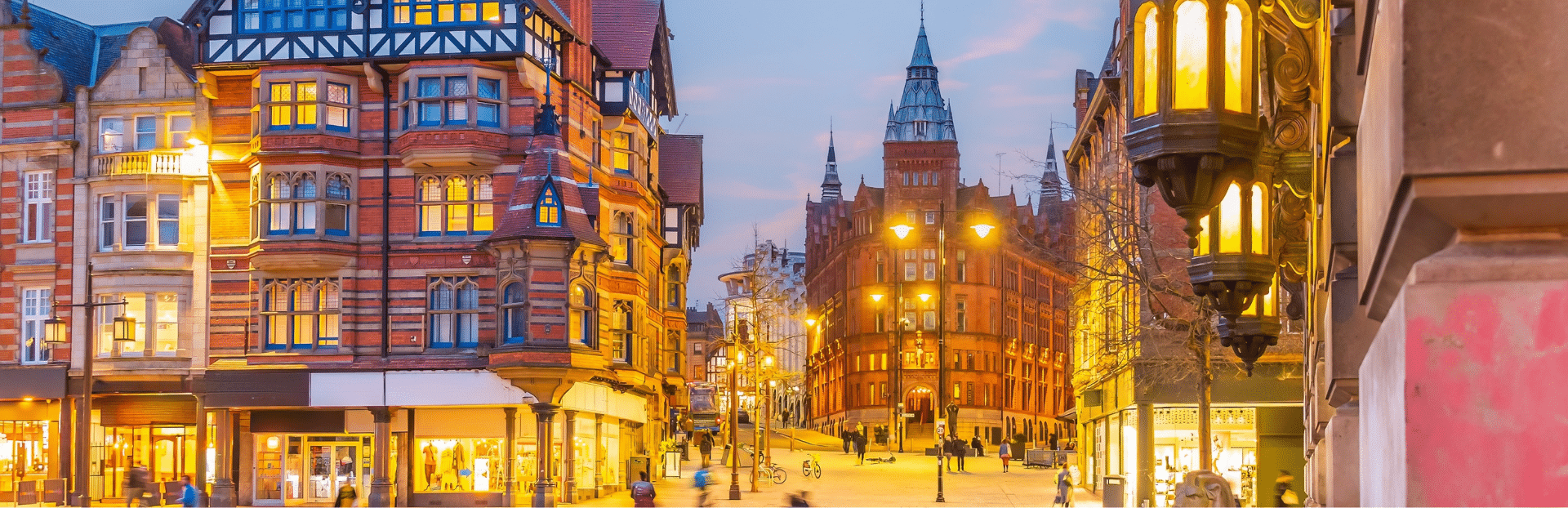
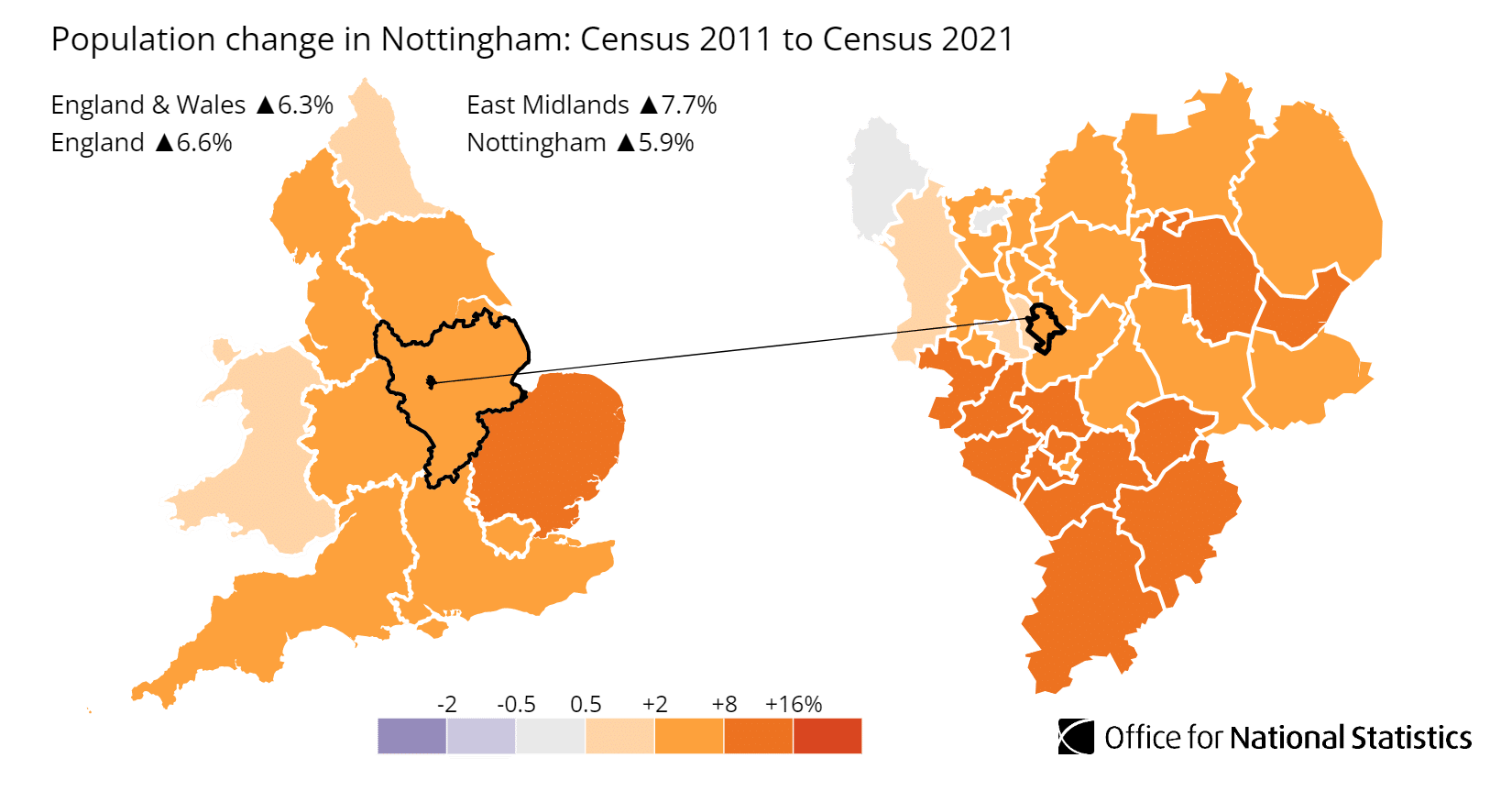
Nottingham is a city in the East Midlands, on the River Trent. Average sold prices in Nottingham sit at £192,397 on the HM Land Registry House Price Index, 33.6% below the England average of £289,946 and 20.4% below the East Midlands average of £241,747. That makes Nottingham one of the most affordable major cities in the East Midlands to buy into, cheaper on the Land Registry index than Derby, Leicester or Birmingham. The city's population grew 5.9% between the 2011 and 2021 censuses, from 305,680 to 323,632 residents.
What sets Nottingham apart from cheaper Midlands markets is what sits on top of that low entry cost: two universities bringing tens of thousands of students into a handful of postcodes, and a city-centre development programme worth £4 billion. The student economy is what pushes NG7 (Lenton, Radford) to an 8.2% gross yield, the highest in the city, while NG1 (City Centre, Lace Market) reaches 8.1% on the lowest asking price of all, £144,462. Across the ten postcodes, asking prices run from that £144,462 up to £305,362 in NG2, and rental data is available for every one.
This guide covers the unitary authority of the City of Nottingham (ONS code E06000018) across ten postcodes: NG1, NG2, NG3, NG5, NG6, NG7, NG8, NG11, NG15 and NG16. Nottingham sits at the centre of the East Midlands, with the M1 to the west and direct trains to London St Pancras in under two hours. Investors weighing the wider region often compare it with Derby and Leicester. Browse our best buy-to-let areas guide or return to the Property Investments UK homepage for the full range of resources.
Article updated: July 2026

Why Invest in Nottingham?
The City of Nottingham grew its population 5.9% between the 2011 and 2021 censuses, from 305,680 to 323,632 residents. A good chunk of that growth is students and young professionals, which is the demographic that fills rental homes rather than buys them. Two large universities sit inside the city boundary: the University of Nottingham, with its main campus and Jubilee Campus in NG7, and Nottingham Trent University in the city centre. Between them they bring tens of thousands of renters into a compact set of postcodes every academic year.
Earnings tell a different story from somewhere like Chester or the southern commuter towns. The median gross annual salary in Nottingham is £32,963, which is below both the East Midlands median of £37,492 and the Great Britain median of £39,863. The local employment rate of 67.0% also sits below the Great Britain figure of 75.6%. A large student population pulls both of those headline numbers down without telling you much about the working tenant base, so they read worse than the rental market actually behaves. The point for an investor is that low local wages and low purchase prices move together: yields hold up because the asset is cheap, not because rents are high.
The second economic anchor is health and bioscience. The Queen's Medical Centre is one of the largest teaching hospitals in the country, sitting alongside the University of Nottingham, and the BioCity incubator near the station has run since 2003. Add the Boots heritage on the southern edge of the city and you have a steady stream of professional and graduate employment that supports tenant demand outside the purely student postcodes. The Nottingham Express Transit tram network ties the universities, the hospital and the residential suburbs into the city centre, which spreads rental demand across more postcodes than the bus map alone would suggest.
Nottingham Economic Summary
- Population: 323,632 (2021 Census). Growth of 5.9% from 2011.
- Median annual salary: £32,963 (Nottingham), £37,492 (East Midlands), £39,863 (Great Britain)
- Employment rate: 67.0% (Nottingham), 75.6% (Great Britain)
- Unemployment rate: 7.6% (Nottingham)
- Key employment sectors: Higher education, health and social work, bioscience and pharmaceuticals, retail and distribution, public administration
Source: ONS Census 2021, Nomis Labour Market Profile (ASHE 2025, Employment Oct 2024-Sep 2025)
Regeneration and Investment in Nottingham
Nottingham is part-way through a city-centre development programme it values at £4 billion, with two of the largest sites, Broad Marsh and the Island Quarter, now under public ownership or active construction. The schemes that matter for the rental market are the ones adding homes and student beds in NG1 and NG2.
- Broad Marsh Regeneration (site acquired by Homes England, March 2025): A 20-acre redevelopment of the former Broadmarsh shopping centre at the southern gateway to the city centre, with a masterplan led by Heatherwick Studio targeting around 1,000 new homes alongside retail, leisure and green space. Homes England taking ownership of the site removes much of the delivery risk that stalled the scheme for years, and the location sits squarely inside NG1. Updates at GOV.UK Homes England.
- The Island Quarter (under construction, 36 acres): Conygar's mixed-use development on the eastern edge of the city centre, delivering close to 1,000 homes, a large purpose-built student block that is already operating, a bioscience building and around 11 acres of public green space. Phased over roughly a decade, it reshapes the land between the station and NG2. Updates at The Island Quarter.
- Nottingham £4 Billion Development Programme (multiple phases): The wider city-wide programme bundles Broad Marsh, the Island Quarter, Waterside, Unity Square and the Castle Meadow campus into a single pipeline targeting thousands of new homes and jobs across the next decade, coordinated with the East Midlands Combined County Authority. Updates at My Nottingham News.
Source: Office for National Statistics - Population for Nottingham
Nottingham Property Market Analysis
Average property prices in the City of Nottingham have risen 403.0% since January 1995, from £38,250 to £192,397. The sections below walk through that history cycle by cycle, then drop into current postcode-level data for sold prices, price per square foot, asking prices, growth, and transaction volumes.
When was the last house price crash in Nottingham?
All sold prices for Nottingham are recorded by HM Land Registry at City of Nottingham unitary authority level. The House Price Index runs from January 1995 to March 2026, covering 31 years and the full sweep of the 2008 crash, the recovery, and the post-pandemic climb.
The 1995 to 2007 boom: Nottingham started at £38,250 in January 1995. Prices roughly doubled to £75,800 by the end of 2002, then kept climbing through the buy-to-let-fuelled mid-2000s, reaching a pre-crash peak of £114,751 in February 2007. That is a tripling of the average price across twelve years.
2007 to 2009, the financial crisis: From the February 2007 peak of £114,751, prices fell to a trough of £90,779 by May 2009, a decline of 20.9% over 27 months. Flats took the hardest hit, in line with the national pattern where smaller city-centre units fell furthest. Nottingham's drop was a touch deeper than the England fall of around 18% over the same window, reflecting how much of the city's stock is lower-priced terraced and flatted housing that moves more sharply with credit conditions.
The 2010 to 2014 stagnation: Prices bounced off the May 2009 trough but then went sideways for years. The average drifted in the £95,000 to £100,000 band through 2010, 2011 and 2012, and was still only £100,100 by December 2013. Nottingham spent the early part of the decade unable to push back towards its old peak, a longer flat patch than the southern markets endured.
Recovery, 2015: Prices finally cleared the February 2007 peak in September 2015 at £115,029. That recovery took eight and a half years, slower than London and the South East, where prices had passed pre-crash levels a year or two earlier. By December 2015 the average reached £115,919.
The 2016 to 2019 pre-pandemic growth: Steady mid-single-digit growth returned. Prices climbed from £115,919 at the end of 2015 to roughly £150,000 by late 2019, a stretch where affordability and improving transport links kept demand ticking over without the froth seen further south.
2020 to 2022, the pandemic surge: The stamp duty holiday and the shift to remote working pushed Nottingham up sharply. From around £150,000 in early 2020 the average ran to roughly £190,000 by the end of 2022, the fastest stretch of growth since the mid-2000s.
The 2023 to 2024 rate shock: Higher mortgage rates cooled the market, but Nottingham's affordability cushioned the blow. Rather than a sharp fall, prices flattened and then ground higher, with the city's low price base making it less exposed to the rate squeeze than higher-value markets.
2025 to present: The average reached an all-time high of £194,868 in October 2025, then eased gently to £192,397 by the latest reading in March 2026. The current price is 67.7% above the February 2007 pre-crash peak. An investor who bought at the exact top in 2007 would be sitting on a gain of more than two-thirds on the Land Registry average, even after the recent easing.
Long-term growth summary:
- 5 years (March 2021 to March 2026): 18.5% growth (£162,379 to £192,397)
- 10 years (March 2016 to March 2026): 66.0% growth (£115,919 to £192,397)
- 15 years (March 2011 to March 2026): 102.1% growth (£95,214 to £192,397)
- 20 years (March 2006 to March 2026): 82.4% growth (£105,507 to £192,397)
- 30 years (January 1995 to March 2026): 403.0% growth (£38,250 to £192,397)
Nottingham's 20.9% crash was slightly deeper than the national average, and the eight-and-a-half-year recovery was on the slow side, both consequences of a housing stock weighted towards the cheaper, more credit-sensitive end. The flip side is the 30-year return of 403.0% and a price that now sits two-thirds above the old peak, which shows how much ground a low-base market can make up once the cycle turns.
- All property types
- Detached
- Semi-detached
- Terraced
- Flats
- All property types
- Detached
- Semi-detached
- Terraced
- Flats
Sold House Prices in Nottingham
The average sold price across all property types in the City of Nottingham is £192,397, which is 33.6% below the England average of £289,946 as of March 2026. That discount runs across every property type but it is not even. Detached houses are 31.8% cheaper than England, while flats are 41.4% cheaper. The pattern reflects a city built on terraced and semi-detached stock, with detached family homes scarcer and the flat market concentrated in the student and city-centre postcodes.
| Property Type | Nottingham Average | England Average | Difference |
|---|---|---|---|
| Detached houses | £321,040 | £470,492 | -31.8% |
| Semi-detached houses | £214,899 | £288,185 | -25.4% |
| Terraced houses | £171,028 | £243,788 | -29.8% |
| Flats and maisonettes | £125,727 | £214,563 | -41.4% |
| All property types | £192,397 | £289,946 | -33.6% |
Detached houses average £321,040, which is 31.8% below England's £470,492. Detached stock is thin on the ground in Nottingham, concentrated in the outer postcodes like NG16 (Eastwood, Kimberley) and NG5 (Arnold, Sherwood) rather than the inner city. Annual change of -0.4% points to a flat detached market over the past year.
Semi-detached houses average £214,899, a 25.4% discount to England's £288,185 and the smallest gap of any type here. This is the backbone of Nottingham's owner-occupier and family-let market, spread across the suburban postcodes from NG5 and NG8 (Wollaton, Aspley) out to NG11 (Clifton, Ruddington). Annual growth of 0.4% makes it the only property type to edge up over the year.
Terraced houses average £171,028, 29.8% below England's £243,788. The terraced stock is the workhorse of Nottingham buy-to-let, concentrated in inner-city postcodes like NG7 and NG6 (Bulwell, Bestwood) where it underpins both student and family lettings. Annual change of -0.1% leaves terraced prices essentially flat over the year.
Flats and maisonettes average £125,727, the deepest discount at 41.4% below England's £214,563. Nottingham's flat market sits mostly in NG1 and NG7, built around city-centre living and student demand rather than the institutional investor blocks that inflate flat prices in Manchester or Birmingham. Annual change of -5.5% confirms a soft flat market, the weakest reading of any type.
Price Per Square Foot in Nottingham
Price per square foot in Nottingham runs from £209 in NG7 to £318 in NG2, a £109 spread across the ten postcodes. Measuring by the square foot takes property size out of the comparison, so it shows what a location costs rather than what a bigger or smaller house costs. NG2 (West Bridgford, The Meadows) commands the top rate, reflecting West Bridgford's status as the city's most sought-after residential suburb.
| Rank | Area | Price Per Sq Ft |
|---|---|---|
| 1 | NG7 (Lenton, Radford, The Park) | £209 |
| 2 | NG1 (City Centre, Lace Market) | £212 |
| 3 | NG6 (Bulwell, Bestwood) | £212 |
| 4 | NG16 (Eastwood, Kimberley) | £239 |
| 5 | NG5 (Arnold, Sherwood) | £246 |
| 6 | NG3 (Mapperley, St Ann's) | £247 |
| 7 | NG15 (Hucknall) | £249 |
| 8 | NG8 (Wollaton, Aspley) | £262 |
| 9 | NG11 (Clifton, Ruddington) | £269 |
| 10 | NG2 (West Bridgford, The Meadows) | £318 |
NG7 at £209 per square foot is the cheapest space in the city, just below NG1 and NG6 at £212. That low per-foot cost in Lenton and Radford is the student market at work: a lot of older terraced housing carved into multiple-occupancy lets, where the per-square-foot price stays down even as the rental income per property runs high. Based on 641 transactions analysed, NG7 sits 34% below NG2.
NG2 at £318 per square foot tops the table by a clear margin, £49 ahead of the next postcode. When buyers pay that much per foot in West Bridgford and The Meadows, they are paying for the address, the schools and the riverside setting rather than for floor space. The 1,018 transactions analysed show a consistent premium that the rest of the city does not approach.
For Sale Asking Prices in Nottingham
NG1 at £144,462 and NG2 at £305,362 sit 111% apart, the widest asking-price gap of any two postcodes in the city. That hierarchy follows the sold-price pattern but stretches it further, because NG1's flat-heavy city-centre stock pulls its average right down. The mean asking price across all ten Nottingham postcodes is £242,515.
| Rank | Area | Asking Price |
|---|---|---|
| 1 | NG1 (City Centre, Lace Market) | £144,462 |
| 2 | NG6 (Bulwell, Bestwood) | £195,654 |
| 3 | NG7 (Lenton, Radford, The Park) | £204,758 |
| 4 | NG5 (Arnold, Sherwood) | £229,767 |
| 5 | NG16 (Eastwood, Kimberley) | £245,342 |
| 6 | NG3 (Mapperley, St Ann's) | £246,507 |
| 7 | NG8 (Wollaton, Aspley) | £277,521 |
| 8 | NG15 (Hucknall) | £279,874 |
| 9 | NG11 (Clifton, Ruddington) | £295,906 |
| 10 | NG2 (West Bridgford, The Meadows) | £305,362 |
NG1 at £144,462 is the cheapest way into Nottingham by a wide margin, more than £50,000 below the next postcode. That figure is held down by the area's stock, which is 83% flats, so the average reflects city-centre apartments rather than houses. For an investor with a fixed budget chasing yield, NG1 is where the entry cost is lowest, and the asking price below £145,000 explains why it carries one of the two highest yields in the city.
NG2's £305,362 asking price is the most expensive in Nottingham, more than twice NG1's. West Bridgford and The Meadows are owner-occupier territory, with good schools, a riverside setting and a short hop into the city centre keeping demand from family buyers high. The rental yield data further down confirms what that premium does to the income return.

House Price Growth in Nottingham
NG6 (Bulwell, Bestwood) leads Nottingham's five-year growth at 27.3%, while NG1 (City Centre, Lace Market) has fallen 24.2% over the same window. The spread between the two is the widest of any city in the region, and it tracks the split between the suburban house market and the city-centre flat market. Most of the outer postcodes posted solid five-year gains; NG1, NG7 and NG11 sit at the other end.
| Area | 1 Year | 3 Years | 5 Years |
|---|---|---|---|
| NG6 (Bulwell, Bestwood) | 2.5% | 4.7% | 27.3% |
| NG16 (Eastwood, Kimberley) | 1.3% | 2.3% | 22.6% |
| NG5 (Arnold, Sherwood) | -0.3% | 7.7% | 22.0% |
| NG11 (Clifton, Ruddington) | -12.5% | -13.0% | 12.7% |
| NG8 (Wollaton, Aspley) | 1.2% | 6.7% | 12.2% |
| NG15 (Hucknall) | -2.3% | -6.3% | 9.6% |
| NG7 (Lenton, Radford, The Park) | -10.2% | -7.0% | 9.5% |
| NG3 (Mapperley, St Ann's) | -2.8% | -2.7% | 8.1% |
| NG2 (West Bridgford, The Meadows) | -8.1% | 2.8% | 4.5% |
| NG1 (City Centre, Lace Market) | -15.1% | -14.9% | -24.2% |
NG6 at 27.3% over five years has the strongest growth in Nottingham, and it is positive across all three timeframes. Bulwell and Bestwood are lower-cost suburban postcodes north of the city, the kind of affordable house stock that posted the biggest gains through the pandemic price run. NG16 and NG5 follow close behind, all three pointing to the same story: the cheaper suburban house markets outgrew the city centre.
NG1's -24.2% over five years is the only negative five-year reading in the city, and it is negative across every timeframe. The city-centre flat market, which dominates NG1, has been the weakest part of Nottingham since the pandemic, with -15.1% over the past year alone. NG7 and NG11 also show recent falls, with NG7's student-heavy flat stock down 10.2% over the year despite a positive five-year figure.
Monthly Property Sales in Nottingham
Monthly sales run from 8 transactions in NG1 to 75 in NG5, with turnover rates from 3% in NG1 to 19% in NG6. Sales volume and turnover together show how readily a postcode trades, which matters when the time comes to sell. NG1 is the clear outlier, a thin city-centre flat market where very little changes hands relative to the stock that exists.
| Area | Sales Per Month | Turnover | Asking Price |
|---|---|---|---|
| NG5 (Arnold, Sherwood) | 75 | 16% | £229,767 |
| NG16 (Eastwood, Kimberley) | 59 | 12% | £245,342 |
| NG2 (West Bridgford, The Meadows) | 54 | 14% | £305,362 |
| NG3 (Mapperley, St Ann's) | 42 | 12% | £246,507 |
| NG15 (Hucknall) | 42 | 11% | £279,874 |
| NG8 (Wollaton, Aspley) | 41 | 14% | £277,521 |
| NG7 (Lenton, Radford, The Park) | 36 | 10% | £204,758 |
| NG6 (Bulwell, Bestwood) | 34 | 19% | £195,654 |
| NG11 (Clifton, Ruddington) | 28 | 10% | £295,906 |
| NG1 (City Centre, Lace Market) | 8 | 3% | £144,462 |
NG6 records the highest turnover at 19%, well clear of the rest, with Bulwell and Bestwood's affordable house stock changing hands often. For a buy-to-let investor, a high turnover rate means a deeper pool of comparable sales and an easier exit when the time comes to sell. NG5 sees the most transactions outright at 75 a month, the busiest postcode in the city by volume.
NG1 sits at the bottom on both measures, with just 8 sales a month and a 3% turnover rate. City-centre flats trade slowly, and a buyer in NG1 should expect a longer wait to sell than anywhere else in Nottingham. That thin liquidity is the trade-off for the city's lowest asking price and highest yield, and it is the single most important number to weigh against NG1's headline returns.
How Long Properties Take to Sell in Nottingham
How long a sale takes splits Nottingham sharply: NG6 (Bulwell, Bestwood) clears fastest at about 160 days, while NG1 (City Centre, Lace Market) sits for roughly 1,014 days. Days on market is the typical time a home is listed before it sells, and months of unsold stock shows how much for-sale supply is queued at the current rate of sales. NG1's figure is an extreme: a thin, slow-moving flat market where listings linger far longer than the city norm.
| Area | Avg Days to Sell | Months of Unsold Stock | Market |
|---|---|---|---|
| NG6 (Bulwell, Bestwood) | 160 | 5.3 | Seller's market |
| NG5 (Arnold, Sherwood) | 190 | 6.3 | Balanced market |
| NG2 (West Bridgford, The Meadows) | 217 | 7.1 | Balanced market |
| NG8 (Wollaton, Aspley) | 217 | 7.1 | Balanced market |
| NG3 (Mapperley, St Ann's) | 254 | 8.3 | Balanced market |
| NG16 (Eastwood, Kimberley) | 254 | 8.3 | Balanced market |
| NG15 (Hucknall) | 277 | 9.1 | Balanced market |
| NG7 (Lenton, Radford, The Park) | 304 | 10.0 | Balanced market |
| NG11 (Clifton, Ruddington) | 304 | 10.0 | Balanced market |
| NG1 (City Centre, Lace Market) | 1014 | 33.3 | Buyer's market |
The gap between NG6 at roughly 160 days and NG1 at over 1,000 is a holding cost, not a footnote. A property you cannot sell quickly is money tied up, and NG1's 33.3 months of unsold stock is the longest in the city by a distance. NG7, the other high-yield postcode, also sits towards the slow end at around 304 days, so both of Nottingham's top-yielding areas come with slower exits than the suburban house markets.
What Type of Property Can You Buy in Nottingham?
Detached and semi-detached houses dominate the suburban postcodes, while NG1 is 83% flats, the most extreme stock split of any postcode in the city. The mix of housing stock shapes which strategy fits where. The figures below come from 2021 Census records for each postcode.
| Area | Detached | Semi-detached | Terraced | Flats |
|---|---|---|---|---|
| NG1 (City Centre, Lace Market) | 1.9% | 5.2% | 9.8% | 83.0% |
| NG2 (West Bridgford, The Meadows) | 23.6% | 24.8% | 21.7% | 29.0% |
| NG3 (Mapperley, St Ann's) | 34.6% | 30.3% | 15.7% | 19.3% |
| NG5 (Arnold, Sherwood) | 41.4% | 30.2% | 13.8% | 10.9% |
| NG6 (Bulwell, Bestwood) | 27.1% | 36.0% | 27.1% | 9.3% |
| NG7 (Lenton, Radford, The Park) | 25.5% | 26.9% | 22.3% | 24.7% |
| NG8 (Wollaton, Aspley) | 40.9% | 38.1% | 14.8% | 6.2% |
| NG11 (Clifton, Ruddington) | 45.7% | 35.3% | 12.6% | 4.9% |
| NG15 (Hucknall) | 45.7% | 35.8% | 14.6% | 3.8% |
| NG16 (Eastwood, Kimberley) | 50.1% | 30.1% | 15.6% | 3.5% |
NG1 is the city's flat market in a single number: 83.0% of its stock is flats, with houses of any kind a small minority. That lines up with NG1 carrying the lowest asking price, the highest yield band, and the slowest sales in Nottingham, all of which trace back to a market made of city-centre apartments. NG7 is the next most flat-heavy at 24.7%, with terraced housing making up another 22.3%, the stock that feeds its student lettings.
At the other end, NG16 is the most house-dominated postcode at 50.1% detached and just 3.5% flats. The outer suburban postcodes, NG11, NG15 and NG16, all show detached shares above 45% and flat shares below 5%, which matches their family-buyer profile and their stronger five-year growth. These are owner-occupier areas where the smaller rental units that drive yield are scarce.
Flats combine purpose-built blocks and converted units, and a small share of mobile or temporary dwellings is left out, so the rows may not add up to 100%.
Nottingham Rental Market Analysis
Monthly rents in Nottingham run from £896 in NG16 to £1,403 in NG7, with gross rental yields from 3.9% to 8.2% across the ten postcodes. For investors asking is buy to let worth it in Nottingham, the sections below break the rents, yields and tenant affordability down postcode by postcode. If you are weighing how to build a property portfolio in the Midlands, Nottingham pairs a low entry cost with a student-driven demand base that few cities can match. Browse current buy-to-let homes for sale across the region.
Average Rent & Gross Rental Yields in Nottingham
Gross rental yields in Nottingham range from 3.9% in NG15 to 8.2% in NG7. The two highest yields belong to the two cheapest postcodes for their rent, NG7 at 8.2% and NG1 at 8.1%, both driven by the student and city-centre rental markets. The lowest yields sit with the priciest suburban postcodes, where high asking prices compress the income return.
| Area | Average Monthly Rent | Asking Price | Gross Yield |
|---|---|---|---|
| NG7 (Lenton, Radford, The Park) | £1,403 | £204,758 | 8.2% |
| NG1 (City Centre, Lace Market) | £977 | £144,462 | 8.1% |
| NG6 (Bulwell, Bestwood) | £930 | £195,654 | 5.7% |
| NG8 (Wollaton, Aspley) | £1,186 | £277,521 | 5.1% |
| NG5 (Arnold, Sherwood) | £954 | £229,767 | 5.0% |
| NG3 (Mapperley, St Ann's) | £969 | £246,507 | 4.7% |
| NG2 (West Bridgford, The Meadows) | £1,181 | £305,362 | 4.6% |
| NG11 (Clifton, Ruddington) | £1,119 | £295,906 | 4.5% |
| NG16 (Eastwood, Kimberley) | £896 | £245,342 | 4.4% |
| NG15 (Hucknall) | £916 | £279,874 | 3.9% |
NG7 at 8.2% pairs the highest rent in the city, £1,403 a month, with a mid-table asking price of £204,758. That combination is the student market: houses in multiple occupation in Lenton and Radford pull in rent per property well above a standard family let, which lifts the yield even though the purchase price is not the lowest in the city. A 30% deposit of £61,427 gets an investor into the top-yielding postcode.
NG1 at 8.1% gets there a different way, with the city's lowest rent of £977 sitting on its lowest asking price of £144,462. City-centre flats let to young professionals and students, and the low entry cost does the work the rent cannot. NG15 sits at the bottom at 3.9%, where a £279,874 asking price in Hucknall meets a modest £916 rent, the weakest income return in Nottingham.
Gross Rental Yield by Postcode
Is Nottingham Rent High?
Monthly rents in Nottingham take between 32.6% and 51.1% of the local median gross monthly salary. The widely cited affordability threshold is 30% of gross income, and every Nottingham postcode sits above it. That is a function of low local wages as much as high rents, since the city's median salary is below both the regional and national figures.
The median gross weekly salary in Nottingham is £633.90, which works out at £2,747 per month or £32,963 per year. That sits below the East Midlands median of £720.80 a week and the Great Britain median of £766.60 a week. Data from the Nomis Labour Market Profile (ASHE 2025).
| Rank | Area | Rent as % of Income |
|---|---|---|
| 1 | NG7 (Lenton, Radford, The Park) | 51.1% |
| 2 | NG8 (Wollaton, Aspley) | 43.2% |
| 3 | NG2 (West Bridgford, The Meadows) | 43.0% |
| 4 | NG11 (Clifton, Ruddington) | 40.7% |
| 5 | NG1 (City Centre, Lace Market) | 35.6% |
| 6 | NG3 (Mapperley, St Ann's) | 35.3% |
| 7 | NG5 (Arnold, Sherwood) | 34.7% |
| 8 | NG6 (Bulwell, Bestwood) | 33.8% |
| 9 | NG15 (Hucknall) | 33.3% |
| 10 | NG16 (Eastwood, Kimberley) | 32.6% |
NG16 at 32.6% is the closest any Nottingham postcode comes to the 30% affordability mark, with Eastwood and Kimberley's modest rents against the local median. For a landlord, rents that sit nearer affordable levels tend to come with fewer arrears and longer tenancies, since tenants are not stretched to the limit each month.
NG7 at 51.1% looks alarming on the single-earner median, but the context matters: this is the student postcode, where rents are usually split across a house of sharers rather than paid by one person on the median salary. A £1,403 rent shared three or four ways looks very different against student-household incomes than against one local wage.
How Big Is Nottingham's Private Rented Sector?
NG1 leads the city with 63.6% of households privately rented, far ahead of NG7 at 42.7%, while the outer postcodes sit nearer 12-13%. The share of homes already let privately is a read on how deep and established the local tenant pool is. The table below shows household tenure by postcode.
| Area | Owned Outright | Owned with Mortgage | Private Rented | Social Rented |
|---|---|---|---|---|
| NG1 (City Centre, Lace Market) | 8.3% | 7.2% | 63.6% | 20.1% |
| NG7 (Lenton, Radford, The Park) | 22.0% | 18.3% | 42.7% | 16.4% |
| NG2 (West Bridgford, The Meadows) | 24.5% | 24.5% | 35.2% | 14.7% |
| NG3 (Mapperley, St Ann's) | 34.0% | 30.8% | 19.4% | 15.1% |
| NG6 (Bulwell, Bestwood) | 28.2% | 30.7% | 16.9% | 23.0% |
| NG8 (Wollaton, Aspley) | 32.2% | 31.1% | 15.0% | 21.0% |
| NG5 (Arnold, Sherwood) | 44.4% | 28.9% | 14.4% | 11.6% |
| NG16 (Eastwood, Kimberley) | 46.2% | 32.2% | 12.8% | 8.4% |
| NG15 (Hucknall) | 41.9% | 37.3% | 12.7% | 7.6% |
| NG11 (Clifton, Ruddington) | 45.6% | 33.4% | 12.3% | 8.2% |
NG1 and NG7 have the deepest private rented sectors in the city by a long way, at 63.6% and 42.7% of households. A rented share that high tells you the lettings market is already established and active rather than something you would be building from scratch, which fits NG1's city-centre flats and NG7's student houses. Both pair that depth with the city's highest yields, so in these two postcodes a deep tenant pool and a strong income return point the same way.
NG1 is also the one postcode with enough homes advertised to read the rental market with any confidence. Around 953 homes were on the rental market there, taking roughly 181 days to let on average, which points to plentiful supply rather than a shortage and currently leaves the balance with tenants rather than landlords. The suburban postcodes carry far smaller rented sectors, nearer 12-13%, where owner-occupation dominates and the rental market is shallower.
Local Housing Allowance Rates in Nottingham
All ten Nottingham postcodes fall within the Nottingham Broad Rental Market Area, where Local Housing Allowance runs from £87.45 a week for a shared room to £223.23 a week for a four-bedroom home. Local Housing Allowance is the most a tenant on housing benefit can claim towards rent, so for that part of the market it sets an effective floor on what a let can earn. The rates below apply across the whole city. To check the current rate for a specific address, use the government's official Local Housing Allowance calculator.
| Property Size | Weekly LHA Rate | Monthly Equivalent |
|---|---|---|
| Shared accommodation | £87.45 | £379 |
| 1 bedroom | £126.58 | £549 |
| 2 bedrooms | £149.59 | £648 |
| 3 bedrooms | £172.60 | £748 |
| 4 bedrooms | £223.23 | £967 |
The two-bedroom LHA rate of £149.59 a week works out at about £648 a month, below the £896 to £1,403 market rents recorded across Nottingham's postcodes. A benefit-backed tenancy therefore lets at less than the open market, and the stock that fits within these rates clusters in the cheaper postcodes like NG6 and NG16 rather than the student or premium areas. The shared-accommodation rate of £87.45 a week is the one that matters most for the room-by-room HMO market in NG7. Because the whole city sits in one rental market area, these rates are identical in every Nottingham postcode.
Buy-to-Let Considerations
Are House Prices High in Nottingham? Price-to-Earnings Ratios
Buying in Nottingham takes between 4.4 and 9.3 times the local median annual salary. This uses the Nomis Labour Market Profile for Nottingham, which puts the median gross annual income for Nottingham residents at £32,963.
The national benchmark for price-to-earnings is 7.3x (England's average sold price of £289,946 divided by the Great Britain median annual salary of £39,863). Four of Nottingham's ten postcodes sit below that benchmark, meaning they are more affordable against local incomes than England is against national ones.
| Rank | Area | Price-to-Earnings Ratio |
|---|---|---|
| 1 | NG1 (City Centre, Lace Market) | 4.4x |
| 2 | NG6 (Bulwell, Bestwood) | 5.9x |
| 3 | NG7 (Lenton, Radford, The Park) | 6.2x |
| 4 | NG5 (Arnold, Sherwood) | 7.0x |
| 5 | NG16 (Eastwood, Kimberley) | 7.4x |
| 6 | NG3 (Mapperley, St Ann's) | 7.5x |
| 7 | NG8 (Wollaton, Aspley) | 8.4x |
| 8 | NG15 (Hucknall) | 8.5x |
| 9 | NG11 (Clifton, Ruddington) | 9.0x |
| 10 | NG2 (West Bridgford, The Meadows) | 9.3x |
NG1 at 4.4x is the most affordable postcode against local earnings, well below the national 7.3x benchmark. At under four and a half times the local median salary, the city-centre flat stock is cheap relative to wages, which is the other side of its high yield. NG6 and NG7 follow at 5.9x and 6.2x, the two other postcodes where prices stay low against income.
NG2 at 9.3x sits at the top, more than nine times the local median salary. West Bridgford's premium pricing puts it out of reach of a single median earner, and buyers there are typically dual-income households or families trading in from elsewhere. The high ratio is what drags NG2's gross yield down to 4.6% despite its strong rents.
Deposit Requirements in Nottingham
A 30% deposit on a Nottingham buy-to-let runs from £43,339 in NG1 to £91,609 in NG2. The £48,270 gap between the cheapest and dearest deposit is wide enough to fund the whole of an NG1 deposit again. For investors comparing Nottingham with the rest of the Midlands, the cheapest deposit here undercuts Derby and Leicester while still buying into a two-university city.
Beyond the deposit, the stamp duty calculation and other buy-to-let running costs add to the capital you need up front.
| Rank | Area | 30% Deposit Required |
|---|---|---|
| 1 | NG1 (City Centre, Lace Market) | £43,339 |
| 2 | NG6 (Bulwell, Bestwood) | £58,696 |
| 3 | NG7 (Lenton, Radford, The Park) | £61,427 |
| 4 | NG5 (Arnold, Sherwood) | £68,930 |
| 5 | NG16 (Eastwood, Kimberley) | £73,603 |
| 6 | NG3 (Mapperley, St Ann's) | £73,952 |
| 7 | NG8 (Wollaton, Aspley) | £83,256 |
| 8 | NG15 (Hucknall) | £83,962 |
| 9 | NG11 (Clifton, Ruddington) | £88,772 |
| 10 | NG2 (West Bridgford, The Meadows) | £91,609 |
NG1 is the cheapest way into Nottingham at a £43,339 deposit, and it buys the 8.1% yield with it. The catch sits in the liquidity data: NG1 trades slowly, at 8 sales a month and over 1,000 days on the market, so the low deposit comes with the hardest exit in the city. Stepping up to NG6 costs roughly £15,000 more and buys a faster-moving suburban house market with the strongest five-year growth at 27.3%.
At the top, NG7 and NG5 are within £7,500 of each other on the deposit but earn their keep very differently. NG7 brings in the city's highest rent at £1,403 a month for an 8.2% yield off its student houses, while NG5 returns a steadier 5.0% on a deeper suburban market in Arnold and Sherwood. Similar deposits, two different income profiles.

What the Nottingham Data Tells Buy-to-Let Investors
In Nottingham the two highest yields belong to the two postcodes built on tenant demand rather than owner-occupiers. NG7 leads on yield at 8.2%, off the city's highest rent of £1,403 a month from its student houses in Lenton and Radford. NG1 follows at 8.1%, reaching it through the lowest asking price in the city, £144,462, and the lowest deposit at £43,339 for buying an investment property in Nottingham. Both run on the deepest private rented sectors in the city, 63.6% in NG1 and 42.7% in NG7.
The trade-off in those two postcodes is liquidity. NG1 trades at just 8 sales a month and sits on the market for over 1,000 days, the slowest exit in Nottingham by a distance, and NG7 is on the slow side too at around 304 days. The high yield is real, but so is the time your money stays tied up when you come to sell.
For capital growth, the picture flips to the suburbs. NG6 (Bulwell, Bestwood) posted the strongest five-year growth at 27.3% and the fastest sales in the city, with NG16 and NG5 close behind, all three lower-cost house markets that ran hardest through the pandemic. At the premium end, NG2 (West Bridgford) carries strong rents but a 4.6% yield and a 9.3 times price-to-earnings ratio, so its appeal is the address and the schools rather than the income return. Buyers chasing an asking price below the open market often work the off-market property in Nottingham route.
Nottingham operates selective licensing in designated areas alongside a citywide additional HMO scheme. Mandatory HMO licensing also applies citywide to qualifying properties, so landlords should check the address against the city council's property licensing pages before buying. Our guide to HMO licensing rules and costs includes Nottingham's current fee benchmark and the national mandatory threshold. With two universities, a major teaching hospital and a £4 billion regeneration pipeline behind it, Nottingham reads as a high-yield, low-entry market where the income comes with slower exits and the growth has sat in the suburbs.
How Nottingham Compares
Nottingham's mean asking price of £242,515 is the second-lowest of five East Midlands and neighbouring cities compared here, and its top yield of 8.2% sits just behind Sheffield's 8.5% at the front of the table. The comparison places Nottingham alongside four nearby cities, each with a different investor profile. Mean asking price and mean monthly rent are simple averages across all postcodes with data; top gross yield is the single highest postcode yield in each city.
| Location | Mean Asking Price | Mean Monthly Rent | Mean Gross Yield | Top Yield (postcode) |
|---|---|---|---|---|
| Sheffield | £240,169 | £935 | 4.7% | 8.5% (S3) |
| Nottingham | £242,515 | £1,053 | 5.2% | 8.2% (NG1, NG7) |
| Birmingham | £274,029 | £1,111 | 4.9% | 7.2% (B18) |
| Derby | £282,243 | £984 | 4.2% | 5.8% (DE1) |
| Leicester | £300,970 | £1,058 | 4.2% | 7.3% (LE1) |
Nottingham is the second-cheapest city to buy into here at £242,515 mean asking price, narrowly above Sheffield at £240,169, while carrying a higher mean rent of £1,053 against Sheffield's £935. The two sit close together at the high-yield, low-cost end of the table, with Nottingham's 8.2% top yield just shy of Sheffield's 8.5%.
At the other end, Leicester is the most expensive at £300,970 and Derby the lowest-yielding at 5.8%, so neighbouring Derby costs more than Nottingham yet returns less on yield. Birmingham sits in the middle on price with a 7.2% top yield and the deepest market of the five. For a data-driven comparison across every UK location, see our highest-yielding areas guide.
Frequently Asked Questions
Is Nottingham a good place to live for buy-to-let tenants?
For renters, yes, and that is much of the investment case. Two universities and a major teaching hospital keep a steady flow of students, graduates and healthcare staff looking for homes, and the tram network makes it easy to live a few postcodes out and still get into the centre quickly. That is the kind of tenant demand that does not dry up.
The wage picture is more mixed. The local median salary of £32,963 sits below the regional and national averages, partly because the student population drags the headline down. For a landlord, the practical read is that rents take a high share of a single local wage, so the steadier tenancies tend to be the shared student houses and the dual-income family lets rather than a single earner on the median.
What are the best areas in Nottingham for property investment?
Depends what you are buying for, and the city splits cleanly. If income is the goal, NG7 (Lenton, Radford) leads on yield at 8.2% off the student market, and NG1 (City Centre, Lace Market) is close behind at 8.1% on the cheapest asking price in the city. Both run on deep rental markets but trade slowly when you come to sell.
If you are after capital growth, the suburbs have done the work: NG6 (Bulwell, Bestwood) grew 27.3% over five years, with NG16 and NG5 not far behind. The premium spot is NG2 (West Bridgford) at £305,362, but its 4.6% yield shows the price is doing more for the address than the income return.
Is there demand for student accommodation in Nottingham?
Heavily, and it is concentrated in NG7. The University of Nottingham's main campus and Jubilee Campus both sit in NG7, and the area is essentially a student economy: 42.7% of households there are privately rented, and the £1,403 average rent that drives the city's top yield comes from houses let room by room rather than single family tenancies. Nottingham Trent's city-centre campus also feeds demand into NG1.
On the HMO side, a sample of current NG7 room adverts puts a double with a shared bathroom at around £119 a week, with most between £98 and £144 across 160 adverts, and an ensuite double nearer £145. Student lets come with summer voids and more hands-on management than a standard tenancy, so they need factoring in. For the purpose-built end of the market, see our guide to student property investment, and for how the numbers work on a shared house, our HMO investment guide.
Can I find buy-to-let property under £150,000 in Nottingham?
Yes, mainly in NG1 (City Centre, Lace Market), where the average asking price is £144,462. That figure is so low because the stock there is 83% flats, so it is city-centre apartments rather than houses that fall under £150,000. Across the rest of the city, flats average £125,727 on the Land Registry index, so the way under £150,000 is by property type as much as by postcode. If a low asking price is the priority, NG1 flats are the obvious place to look, or explore below market value properties.
How does Nottingham compare to Derby for buy-to-let?
Nottingham comes out ahead on both cost and yield, which is unusual for two neighbouring cities. Its mean asking price of £242,515 is roughly £40,000 below Derby's £282,243, and its top yield of 8.2% is well clear of Derby's 5.8%. So you pay less in Nottingham and the headline income return is higher.
Derby's pull is its own employment base, anchored by Rolls-Royce and Toyota, which gives it a different, more industrial tenant profile. Nottingham leans on students, healthcare and a bigger city-centre regeneration story. For an income-focused buyer comparing the two, the Nottingham numbers are the stronger ones on paper.
When will the Broad Marsh regeneration affect Nottingham property prices?
Not for several years yet. Homes England only took ownership of the site in March 2025, and a 20-acre, 1,000-home scheme on that scale runs across the back half of the decade once masterplanning, demolition and phased construction are factored in. Any real effect on NG1 prices is a 2030-and-beyond story.
What the Homes England purchase does change now is credibility. The site had stalled for years, and public ownership removes much of the delivery risk that hung over it. The Island Quarter nearby is already further along, with its student block operating, so the wider city-centre pipeline is visibly moving rather than just on paper.
What are average house prices in Nottingham?
The average sold price across the City of Nottingham is £192,397 on the Land Registry index, about 33.6% below the England average of £289,946 as of March 2026. Asking prices by postcode run from £144,462 in NG1 (City Centre, Lace Market) up to £305,362 in NG2 (West Bridgford), with a city-wide mean of £242,515. By type, detached homes average £321,040, semi-detached £214,899, terraced £171,028 and flats £125,727.
Through a buy-to-let lens, NG1 and NG7 are the cheapest entry routes to the highest yields, at 8.1% and 8.2%, while NG2 is the dearest and among the lowest-yielding at 4.6%.
What are the Local Housing Allowance rates in Nottingham?
All ten Nottingham postcodes fall in the Nottingham Broad Rental Market Area, so they share one set of rates. As of June 2026, Local Housing Allowance runs at £87.45 a week for a shared room, £126.58 for a one-bed, £149.59 for two beds, £172.60 for three and £223.23 for four. That figure is the most a tenant on housing support can claim towards rent, so for that part of the market it acts as a floor on what a let can earn.
What type of property is most common in Nottingham?
It depends entirely on the postcode, and that is the unusual thing about Nottingham. NG1 (City Centre) is 83% flats, the most extreme split in the city, while the outer suburbs are the opposite: NG16 is 50.1% detached and just 3.5% flats. Across the suburban postcodes, detached and semi-detached houses dominate, and terraced housing, the classic buy-to-let stock, is most concentrated in NG6 and NG7 at around 22-27%.
How do I buy an investment property in Nottingham?
Decide first whether you are buying for income or for growth, because in Nottingham that points you at opposite ends of the city. NG7 (Lenton, Radford) and NG1 (City Centre) lead on yield at 8.2% and 8.1% off their rental markets, while NG6 and NG5 in the suburbs have done the running on five-year growth. Budget for a 30% deposit, which runs from £43,339 in NG1 to £91,609 in NG2.
Beyond what is openly listed, experienced investors often come in below asking through off-market property and below market value properties. To see what is available now, browse investment properties or buy-to-let homes for sale.
Ready to buy property?
Access off-market investment properties with an average 8%+ annual gross yield (beating the UK's typical 3-5%).
Get property alerts