
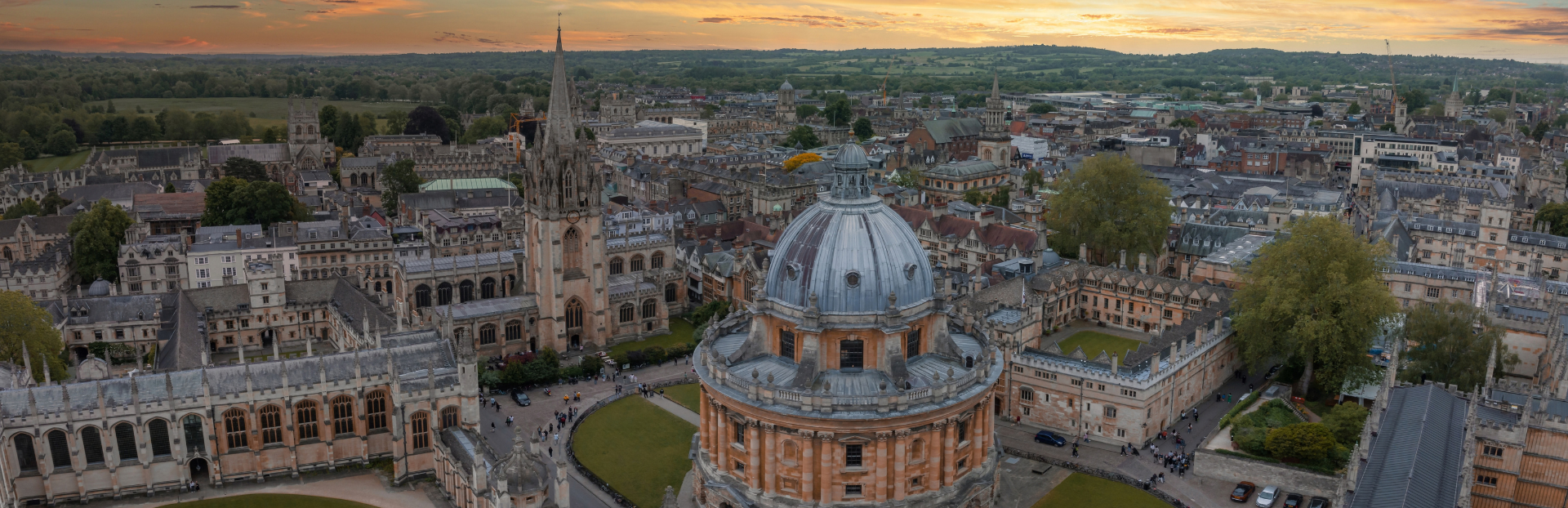
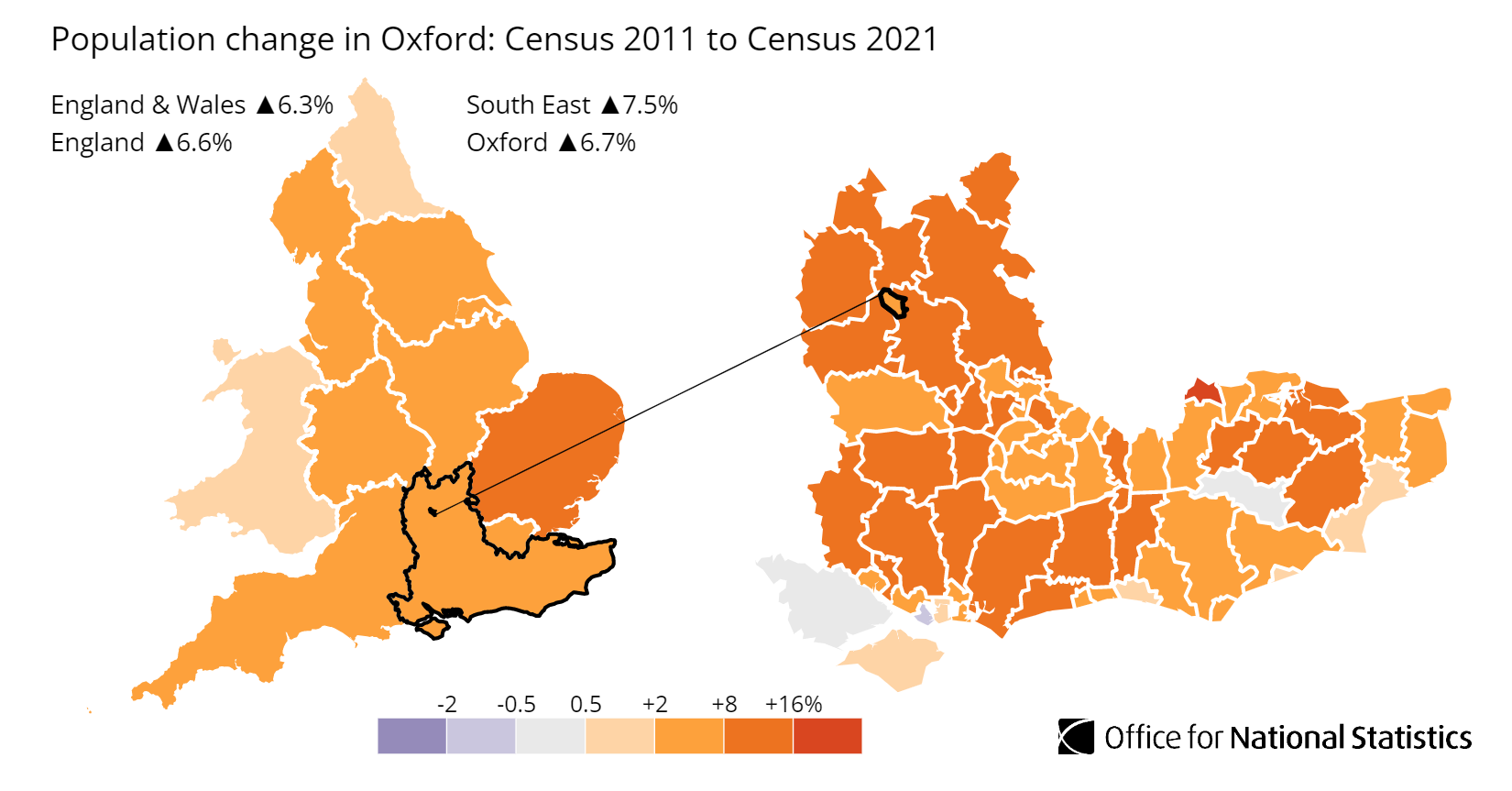
Oxford is a city in Oxfordshire, in the South East of England. Average sold prices in Oxford sit at £473,994 on the HM Land Registry House Price Index, 63.5% above the England average of £289,946 and 25.2% above the South East regional average of £378,515. Oxford is one of the most expensive cities in England to buy in, and the reason is supply more than wages. Two universities and dozens of colleges hold a large share of the central land, and a tight green belt rings the built-up area, so very little new housing reaches the market in a city that keeps drawing people in. The population grew 6.67% between the 2011 and 2021 censuses, from 151,906 to 162,040 residents.
That scarcity pushes prices well past what local earnings would suggest on their own. Median gross annual earnings in Oxford are £43,289, which is 10.6% above the Great Britain median of £39,125 but only 4.0% above the South East. Prices, by contrast, run more than 60% above England. The gap is filled by London-overspill buyers, the colleges and the science and medical employers, all competing for a housing stock that cannot easily grow. For an investor, that produces a market where the cheaper postcodes do the rental work: OX4 (Cowley, Iffley) yields 4.8% on a £423,886 asking price, while OX2 (Summertown, North Oxford) at £655,292 returns 3.8%.
This guide covers the local authority of Oxford (ONS code E07000178) across postcodes OX1, OX2, OX3, OX4, OX5, OX33 and OX44. Oxford sits in the South East region, 57 miles north-west of London and 27 miles north of Reading. The wider county takes in Bicester, Banbury and Witney, and Oxford anchors the high-value commuter corridor that runs down towards Reading and the Thames Valley.
Article updated: July 2026
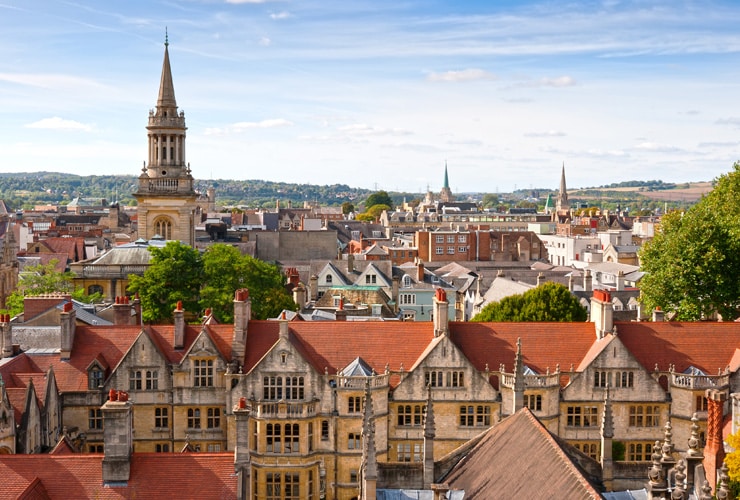
Why Invest in Oxford?
Oxford grew its population 6.67% between the 2011 and 2021 censuses, from 151,906 to 162,040 residents, broadly in line with the England and Wales average of 6.3%. What sets the city apart is not the rate of growth but the demand pressure behind it. Two universities, a major teaching-hospital network and a cluster of science and technology employers keep pulling in workers, students and researchers, while the supply of homes barely moves. That mismatch is the single most important fact for anyone weighing up Oxford.
The local employment rate is 77.4%, above the Great Britain average of 75.6%. Oxford's economy leans heavily on education, health, and the life-sciences and tech sector that has built up around the university. The University of Oxford and Oxford Brookes University together house tens of thousands of students, a renting population that turns over every year and underpins demand in the cheaper postcodes. The BMW Mini plant in Cowley remains one of the largest single employers in the city, anchoring the OX4 jobs market.
Median gross annual earnings in Oxford are £43,289, which is 10.6% above the Great Britain median of £39,125 and 4.0% above the South East median of £41,616. Those are good wages, but they do not explain a market priced 63.5% above England. The rest comes from London commuters and the colleges competing for a fixed pool of housing, which is why even Oxford's better-paid tenants tend to rent for years rather than buy. That keeps the rental market deep.
Oxford Economic Summary
- Population (Oxford): 162,040 (2021 Census). Growth of 6.67% from 2011.
- Median annual salary: £43,289 (local), £41,616 (South East), £39,125 (Great Britain)
- Employment rate: 77.4% (local), 75.6% (Great Britain)
- Key employment sectors: Education, human health and social work, professional and scientific services, manufacturing, accommodation and food
Source: ONS Census 2021, Nomis Labour Market Profile (ASHE 2025)
Regeneration and Investment in Oxford
Oxford's biggest schemes cluster in the west end and at the edges of the green belt, where the city is trying to add homes and lab space without spilling into protected countryside. The three projects below have funding secured or planning approved.
- Oxpens, Oxford West End (Approved January 2025, 234 homes): OXWED, a joint venture between Nuffield College and Oxford City Council, won approval to redevelop the 15-acre derelict Oxpens site with 234 apartments alongside student accommodation, a hotel, offices and laboratories, with construction expected to start in 2026. It adds residential supply to a city-centre site that has sat unused for years, in a market where new homes are scarce. Updates at OXWED.
- Oxford station redevelopment (£161 million, funding confirmed): Network Rail is rebuilding Oxford station with a new western entrance near Botley Road, a new island platform and a replaced Botley Road bridge, backed by £161 million of government and local funding. Faster, more frequent services to London and the planned East West Rail link strengthen Oxford's commuter pull, which feeds the rental demand the city's investors rely on. Updates at GOV.UK.
- Begbroke Innovation District (Outline approved, around 1,800 homes): A joint venture between the University of Oxford and Legal & General has outline planning permission for around 1,800 homes, up to half of them affordable, plus research and workspace on land north of the city near Begbroke. It is one of the largest residential additions planned for the Oxford area and is now in detailed design. Updates at Oxford University Development.
Source: Office for National Statistics - Population for Oxford
Oxford Property Market Analysis
Average property prices in Oxford have risen 477.2% since January 1995, from £82,121 to £473,994. The sections below trace that path cycle by cycle, then drill into current postcode-level data for sold prices, price per square foot, asking prices, growth trends and monthly transaction volumes.
When was the last house price crash in Oxford?
All sold prices for Oxford come from the HM Land Registry House Price Index at local-authority level. The index runs from January 1995 to the latest reading, covering 31 years of market cycles.
The 1995 to 2007 climb: Oxford started at £82,121 in January 1995. By December 2000 the average had reached £156,114, almost doubling in six years as low rates and easier mortgage lending fed a fast-rising market. Prices kept climbing through the 2000s and reached their pre-crash high of £305,073 in October 2007.
2008 to 2009, the financial crisis: Prices fell from the October 2007 peak of £305,073 to a trough of £235,043 in February 2009, a decline of 23.0% over 16 months. The worst year-on-year reading was -22.4% in February 2009. Oxford's fall was steeper than England's national decline, which is what tends to happen in a high-value market: the average is dragged down sharply when transactions thin out and the more expensive sales stop.
Recovery, 2009 to 2010: The bounce was fast. Prices climbed off the February 2009 trough and first passed the October 2007 peak by September 2010, when the average reached £307,486. That recovery took around three and a half years, far quicker than many markets managed, because Oxford's supply shortage and the steady demand behind it left little room for prices to stay low.
2011 to 2016, the long climb: Growth ran hard through this period. The average moved from £287,309 in March 2011 to £408,136 by December 2015 and £427,759 by March 2016. Oxford added more than £120,000 to its average price in five years, one of the strongest runs of any city outside London.
2017 to 2019, the plateau: Growth flattened. After the rapid mid-decade gains, prices drifted in a narrow band as affordability caught up with the market and the 2016 stamp duty changes cooled the top end.
2020 to 2022, the pandemic surge: The stamp duty holiday and the move towards more space lifted the market again. Prices rose to £460,586 by December 2020 (4.0% annual growth) and reached £474,555 by December 2022 (7.4% annual).
2023 onwards, the rate shock and easing: Higher mortgage rates slowed Oxford. Prices eased to £469,421 by December 2023, recording -1.1% annual growth, then ground back up to an all-time high of £517,061 in September 2024. Since that peak the average has softened to £473,994 by the latest reading in March 2026, leaving prices 55.4% above the October 2007 pre-crash high.
Long-term growth summary:
- 5 years (March 2021 to March 2026): 6.6% growth (£444,614 to £473,994)
- 10 years (March 2016 to March 2026): 10.8% growth (£427,759 to £473,994)
- 15 years (March 2011 to March 2026): 65.0% growth (£287,309 to £473,994)
- 20 years (December 2005 to March 2026): 92.4% growth (£246,401 to £473,994)
- 30 years (January 1995 to March 2026): 477.2% growth (£82,121 to £473,994)
Oxford's 23.0% crash was deeper than the national fall, but the recovery was quick and the 30-year return of 477.2% is among the strongest of any English city. The recent path is calmer: prices reached a high of £517,061 in September 2024 and have eased back since, so a buyer at that September 2024 peak would be holding a small paper loss on the Land Registry average today. Someone who bought at the October 2007 pre-crash high would be up 55.4%.
- All property types
- Detached
- Semi-detached
- Terraced
- Flats
- All property types
- Detached
- Semi-detached
- Terraced
- Flats
Source: HM Land Registry House Price Index for Oxford, January 1995 to March 2026.
Sold House Prices in Oxford
The average sold price across all property types in Oxford is £473,994, which is 63.5% above the England average of £289,946 as of March 2026. Oxford carries a premium across every property type, but the size of that premium varies sharply by type. Detached and semi-detached houses sell for more than double the England figure, while flats are only a third higher. The pattern says a lot about where the money goes: the family houses near good schools and the colleges are what people compete hardest for, and that is where Oxford's scarcity bites most.
| Property Type | Oxford Average | England Average | Difference |
|---|---|---|---|
| Detached houses | £966,151 | £470,492 | +105.3% |
| Semi-detached houses | £585,841 | £288,185 | +103.3% |
| Terraced houses | £465,340 | £243,788 | +90.9% |
| Flats and maisonettes | £287,426 | £214,563 | +34.0% |
| All property types | £473,994 | £289,946 | +63.5% |
Detached houses average £966,151, which is 105.3% above England's £470,492. These are the period houses of North Oxford and the larger family homes in OX2 and the OX33 and OX44 villages, the stock the colleges, consultants and senior academics compete for. A near-£1 million average puts most detached houses out of buy-to-let reach and into owner-occupier territory. Detached prices grew 1.2% over the past year.
Semi-detached houses average £585,841, sitting 103.3% above England's £288,185, almost the same premium as detached. This is the bulk of Oxford's family-letting stock, concentrated in OX3 (Headington, Marston) and the OX4 and OX5 suburbs. Semis grew 1.0% over the past year, in line with the wider market.
Terraced houses average £465,340, a 90.9% premium over England's £243,788. The Victorian terraces of Jericho, Cowley Road and East Oxford fall in this band, and they are the workhorse of the small-landlord and student-share market because they divide naturally into rooms. Terraced growth of 0.2% over the past year was the flattest of the house types.
Flats and maisonettes average £287,426, a 34.0% premium over England's £214,563 and the smallest gap of any type. The flat market is the entry point for most Oxford investors, with stock in central OX1, the Cowley and Iffley corridor of OX4, and the newer canal-side and station developments. Flats were down 5.1% over the past year, the only property type to fall, which has narrowed the gap between flat and house prices.
Price Per Square Foot in Oxford
Just £141 per square foot separates Oxford's cheapest postcode from its dearest, with OX44 at £427 and OX2 at £568. Measuring by the square foot takes property size out of the comparison, so it reads location value rather than how big the homes happen to be. OX2 (Summertown, North Oxford) commands the highest rate, which fits its position as the most sought-after residential quarter of the city.
| Rank | Area | Price Per Sq Ft |
|---|---|---|
| 1 | OX44 (Garsington, Stadhampton) | £427 |
| 2 | OX5 (Kidlington) | £430 |
| 3 | OX33 (Wheatley) | £457 |
| 4 | OX4 (Cowley, Iffley) | £481 |
| 5 | OX3 (Headington, Marston) | £500 |
| 6 | OX1 (City Centre, Jericho) | £525 |
| 7 | OX2 (Summertown, North Oxford) | £568 |
OX44 at £427 per square foot is the lowest in the table. This is the rural southern fringe around Garsington and Stadhampton, where larger plots and village houses bring the per-foot figure down even though the headline asking price is high. The cheaper per-foot rate reflects land on the city's edge rather than the central postcodes.
OX2 at £568 per square foot tops the table, 33% above OX44. North Oxford and Summertown are where Oxford's per-foot value concentrates: tree-lined Victorian streets, the catchment for sought-after schools, and walking distance to the centre and the station. Paying the highest per-foot rate here buys location more than space.
For Sale Asking Prices in Oxford
OX4 at £423,886 and OX2 at £655,292 sit 54.6% apart, the widest asking-price gap across Oxford's seven postcodes. That order broadly tracks sold prices, but the spread is wide for a single city. The mean asking price across all seven Oxford postcodes is £535,752.
| Rank | Area | Asking Price |
|---|---|---|
| 1 | OX4 (Cowley, Iffley) | £423,886 |
| 2 | OX3 (Headington, Marston) | £473,173 |
| 3 | OX5 (Kidlington) | £488,399 |
| 4 | OX1 (City Centre, Jericho) | £535,952 |
| 5 | OX33 (Wheatley) | £562,020 |
| 6 | OX44 (Garsington, Stadhampton) | £611,540 |
| 7 | OX2 (Summertown, North Oxford) | £655,292 |
OX4 at £423,886 is the lowest asking price in Oxford and the only postcode below the £473,994 city-wide Land Registry average. Cowley and Iffley hold most of the city's terraced and flat stock, the BMW Mini plant on their doorstep and a steady student presence from Oxford Brookes, which is why OX4 is both the cheapest way in and the highest-yielding postcode in the city.
OX2 at £655,292 is the most expensive. Summertown and North Oxford are the premium residential postcode, with the largest period houses, the strongest school catchments and the highest per-foot rates. The gap between OX2 and OX4 is £231,406, a wide spread for a city this compact, and it is the difference between owner-occupier territory at the top and the working rental market at the bottom.
House Price Growth in Oxford
OX4 was the only Oxford postcode to post positive growth across all three timeframes: 4.1% over one year, 6.5% over three years and 11.7% over five. Every postcode delivered different results, and the spread reveals where recent demand has held up. OX4 (Cowley, Iffley) leads on every horizon, while OX2 (Summertown, North Oxford) and OX44 (Garsington, Stadhampton) gave back ground over five years.
| Area | 1 Year | 3 Years | 5 Years |
|---|---|---|---|
| OX4 (Cowley, Iffley) | 4.1% | 6.5% | 11.7% |
| OX1 (City Centre, Jericho) | -2.9% | -5.7% | 9.4% |
| OX3 (Headington, Marston) | -0.8% | -3.7% | 7.9% |
| OX33 (Wheatley) | -0.3% | -7.8% | 5.5% |
| OX5 (Kidlington) | -1.8% | -6.5% | 2.3% |
| OX2 (Summertown, North Oxford) | 0.1% | 1.7% | -0.4% |
| OX44 (Garsington, Stadhampton) | -2.2% | -13.8% | -0.9% |
OX4 at 11.7% has the highest five-year growth in Oxford and is the only postcode positive on all three measures. Cowley and Iffley have firmed up as the affordable, well-let end of the city has drawn more buyers, and the Mini plant and Brookes demand have kept the area busy through a flat market elsewhere.
OX2 sits at the opposite end with -0.4% over five years despite holding up best over the past year at 0.1%. The most expensive postcode has gone sideways: prices that were already very high had less room to climb, and the premium North Oxford stock is most exposed to the top-end slowdown that followed the rate rises.
OX44 recorded the steepest three-year fall at -13.8%. The rural southern villages trade thinly, so a small number of high-value sales swings the average more than it would in a busier postcode, and the five-year figure of -0.9% reflects how lightly the area transacts.
Monthly Property Sales in Oxford
Transaction volumes split Oxford in two, with the city postcodes running 26 to 35 sales a month while the outlying villages of OX33 and OX44 manage just 5 each. The busy central and suburban postcodes give a far deeper pool of comparable sales than the rural fringe. Turnover sits at 9% to 10% across the city postcodes and drops to 6% in OX33.
| Area | Sales Per Month | Turnover | Asking Price |
|---|---|---|---|
| OX2 (Summertown, North Oxford) | 35 | 9% | £655,292 |
| OX4 (Cowley, Iffley) | 34 | 10% | £423,886 |
| OX3 (Headington, Marston) | 26 | 9% | £473,173 |
| OX5 (Kidlington) | 16 | 9% | £488,399 |
| OX1 (City Centre, Jericho) | 12 | 9% | £535,952 |
| OX33 (Wheatley) | 5 | 6% | £562,020 |
| OX44 (Garsington, Stadhampton) | 5 | 8% | £611,540 |
OX4 records 34 sales a month at the highest turnover in the city, 10%. Cowley and Iffley combine the deepest pool of mid-priced and smaller stock with steady demand, so homes change hands more often than anywhere else in Oxford. For a landlord, frequent transactions mean an easier exit and more recent comparables when it comes time to value or sell.
OX1 sees just 12 sales a month despite covering the city centre, because so much of the central land is college and university owned and the residential stock is thin. OX33 and OX44 sit lowest at 5 a month each, the rural villages where homes are held for years and the market is quiet.
How Long Properties Take to Sell in Oxford
Selling speed runs from about 304 days in OX1 and OX4 to roughly 507 days in OX33, so even the quicker Oxford postcodes take the best part of a year to find a buyer. Days on market measures how long a home is listed before it sells; the months of unsold stock figure shows how much for-sale supply is sitting there at the current rate of sales. Oxford's high prices mean longer sale times than cheaper markets, and that is a real cost when you come to exit.
| Area | Avg Days to Sell | Months of Unsold Stock | Market |
|---|---|---|---|
| OX1 (City Centre, Jericho) | 304 | 10.0 | Balanced market |
| OX4 (Cowley, Iffley) | 304 | 10.0 | Balanced market |
| OX3 (Headington, Marston) | 338 | 11.1 | Balanced market |
| OX5 (Kidlington) | 338 | 11.1 | Balanced market |
| OX2 (Summertown, North Oxford) | 380 | 12.5 | Buyer's market |
| OX44 (Garsington, Stadhampton) | 380 | 12.5 | Buyer's market |
| OX33 (Wheatley) | 507 | 16.7 | Buyer's market |
How long your money stays tied up at the end is the figure that rarely makes it into a yield table, and in Oxford it matters more than most places. OX4 clears in about 304 days against OX33's 507, and the 10 months of unsold stock in OX4 against 16.7 in OX33 is the difference between a slow sale and a very slow one. A faster-moving postcode is less time carrying a property you are trying to move on, which is part of why the busier, cheaper end of the city is easier to run as a let.
What Type of Property Can You Buy in Oxford?
The housing mix splits Oxford clearly: OX4 (Cowley, Iffley) is the flat-and-terrace postcode, with 29.1% flats and 25.9% terraces, while the village postcodes are dominated by detached houses, up to 56.5% in OX33. The mix shapes which strategy fits where. The figures below come from 2021 Census records for each postcode.
| Area | Detached | Semi-detached | Terraced | Flats |
|---|---|---|---|---|
| OX1 (City Centre, Jericho) | 47.2% | 21.6% | 12.0% | 17.2% |
| OX2 (Summertown, North Oxford) | 37.8% | 23.5% | 15.2% | 19.0% |
| OX3 (Headington, Marston) | 45.3% | 26.5% | 11.0% | 12.0% |
| OX4 (Cowley, Iffley) | 9.7% | 27.0% | 25.9% | 29.1% |
| OX5 (Kidlington) | 41.8% | 34.9% | 13.7% | 7.9% |
| OX33 (Wheatley) | 56.5% | 28.7% | 6.7% | 5.1% |
| OX44 (Garsington, Stadhampton) | 44.7% | 34.7% | 12.1% | 4.1% |
OX4 is the outlier and the most relevant postcode for buy-to-let. Just 9.7% of its stock is detached, while flats make up 29.1% and terraces 25.9%, the highest shares of both in the city. That smaller-unit stock is what suits single lets, student shares and the room-by-room market, and it lines up with OX4 carrying the lowest asking price and the highest yield in Oxford.
OX33 sits at the other end, 56.5% detached and only 5.1% flats, with OX44 close behind. The village postcodes are family-house territory, which matches their high asking prices and thin rental markets. OX1 and OX2 carry the next-largest flat shares at 17.2% and 19.0%, much of it central and period conversions.
Flats combine purpose-built blocks and converted units, and a small share of non-standard dwellings is left out, so the rows may not add up to exactly 100%.
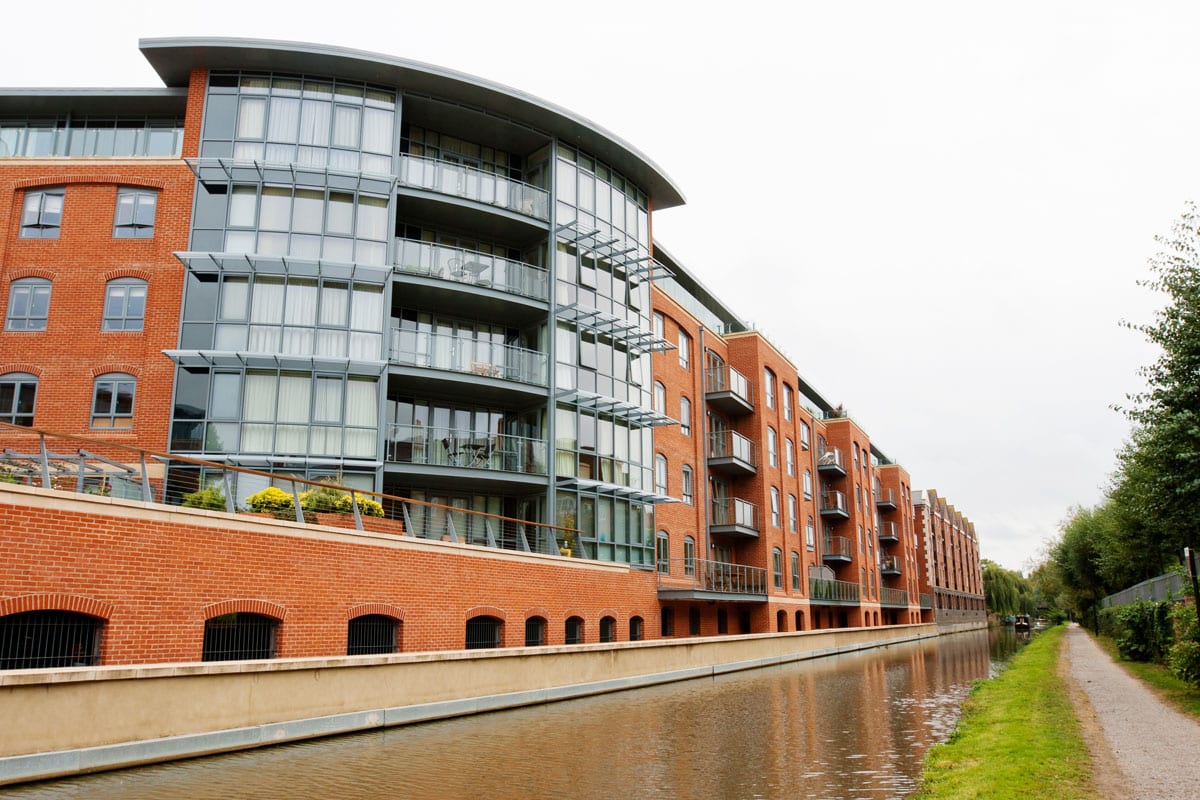
Oxford Rental Market Analysis
Monthly rents in Oxford run from £1,661 in OX5 to £2,066 in OX2, with gross rental yields from 3.8% to 4.8% across the five postcodes that carry rent data. For investors asking whether buy to let is worth it in Oxford, the sections below break down rents, yields and tenant affordability postcode by postcode. The pull here is a deep, year-round tenant base from two universities, the hospitals and the science economy, paired with some of the highest house prices in the country, which is why income returns are modest and the rental work concentrates in the cheaper postcodes. Browse buy-to-let investments for sale across the region.
Average Rent & Gross Rental Yields in Oxford
Gross rental yields in Oxford range from 3.8% in OX2 to 4.8% in OX4. The cheapest postcode delivers the highest yield and the most expensive delivers the lowest, the usual Oxford pattern. OX2 charges the highest rent at £2,066 a month but ranks last for yield at 3.8%, because its £655,292 asking price is 54.6% higher than OX4's.
| Area | Average Monthly Rent | Asking Price | Gross Yield |
|---|---|---|---|
| OX4 (Cowley, Iffley) | £1,693 | £423,886 | 4.8% |
| OX1 (City Centre, Jericho) | £1,996 | £535,952 | 4.5% |
| OX3 (Headington, Marston) | £1,722 | £473,173 | 4.4% |
| OX5 (Kidlington) | £1,661 | £488,399 | 4.1% |
| OX2 (Summertown, North Oxford) | £2,066 | £655,292 | 3.8% |
| OX33 (Wheatley) | Not enough data | £562,020 | Not enough data |
| OX44 (Garsington, Stadhampton) | Not enough data | £611,540 | Not enough data |
OX4 at 4.8% pairs the lowest asking price with a solid £1,693 monthly rent to give the best yield in the city. A 30% deposit of £127,166 gets an investor into Oxford's highest-yielding postcode. The tenant base in Cowley and Iffley is mixed: Mini-plant workers, young professionals priced out of the centre, and Oxford Brookes students, which spreads void risk across more than one segment.
OX2 at 3.8% sits at the bottom of the yield table. The £2,066 monthly rent is the highest in Oxford, but the £655,292 asking price means the income return is still the lowest. In Summertown the premium price does far more for capital value than for rental return, which is why it reads as an owner-occupier postcode that happens to let.
OX33 (Wheatley) and OX44 (Garsington, Stadhampton) carry no reliable rent figure, so their yield reads as not enough data. Both are high-priced village postcodes where lettings are scarce, and with so few homes advertised to rent at any one time a yield figure would not be dependable.
Gross Rental Yield by Postcode
Is Oxford Rent High?
Monthly rents in Oxford take between 46.0% and 57.3% of the local median gross monthly salary, well above the level seen in most cities. The widely cited affordability threshold is 30% of gross income, and every Oxford postcode sits comfortably above it. That gap is the clearest sign of how far prices and rents have outrun local wages, and it is why so many Oxford tenants share a house or rent room by room rather than take a whole property.
The median gross weekly salary in Oxford is £832.50, which works out at £3,607 per month or £43,289 per year. That is above the Great Britain median of £752.40 a week and a little above the South East median of £800.30. Data from the Nomis Labour Market Profile (ASHE 2025).
| Rank | Area | Rent as % of Income |
|---|---|---|
| 1 | OX2 (Summertown, North Oxford) | 57.3% |
| 2 | OX1 (City Centre, Jericho) | 55.3% |
| 3 | OX3 (Headington, Marston) | 47.7% |
| 4 | OX4 (Cowley, Iffley) | 46.9% |
| 5 | OX5 (Kidlington) | 46.0% |
| — | OX33 (Wheatley) | Not enough data |
| — | OX44 (Garsington, Stadhampton) | Not enough data |
OX5 at 46.0% is the most affordable for a single tenant on the local median wage, though it is still half as much again as the 30% benchmark. Kidlington sits north of the city, so it draws renters who want a lower rent and are willing to commute in, which tends to mean longer, steadier tenancies.
OX2 at 57.3% is the least affordable, with a £2,066 monthly rent against a £3,607 monthly salary. Few single earners on the median wage rent in Summertown; the typical tenants are dual-income professional households or families, and a large share of the demand at this end comes from people whose incomes sit well above the city median.
How Big Is Oxford's Private Rented Sector?
The private rented sector is deepest in OX2 and OX4, where it accounts for 25.3% and 24.1% of households, and shallowest in the village postcodes of OX33 and OX44 at around 18%. The share of homes already let privately is a guide to how established the local tenant pool is, and across Oxford it is high, a city where renting is the norm for a large part of the working population. The table below shows household tenure by postcode.
| Area | Owned Outright | Owned with Mortgage | Private Rented | Social Rented |
|---|---|---|---|---|
| OX2 (Summertown, North Oxford) | 39.4% | 22.2% | 25.3% | 12.4% |
| OX4 (Cowley, Iffley) | 29.9% | 19.4% | 24.1% | 24.8% |
| OX1 (City Centre, Jericho) | 41.6% | 26.9% | 22.4% | 8.5% |
| OX3 (Headington, Marston) | 43.4% | 25.4% | 21.8% | 8.9% |
| OX44 (Garsington, Stadhampton) | 40.2% | 31.5% | 19.7% | 7.7% |
| OX5 (Kidlington) | 40.0% | 31.1% | 18.2% | 8.2% |
| OX33 (Wheatley) | 46.7% | 29.7% | 18.1% | 5.3% |
OX2 and OX4 have the largest private rented sectors in Oxford, both close to a quarter of all households. A deeper rented sector points to an active lettings market and a wider pool of existing tenants. The two postcodes get there differently: OX2 pairs its rented share with the city's lowest yield at 3.8% and a high-income tenant base, while OX4 pairs a similar share with the highest yield at 4.8% and a far larger social-rented sector at 24.8%, the working end of the Oxford market.
On the rental-demand side, three of the four city postcodes with enough listings to read currently sit as landlord's markets. OX3 (Headington, Marston) is the tightest, with around 100 homes advertised to rent and an average of roughly 39 days to let, while OX4 and OX2 also let faster than they sell. OX1 is more balanced, with about 86 homes on the rental market taking around 97 days to let, reflecting the higher rents and smaller central stock.
Local Housing Allowance Rates in Oxford
All seven Oxford postcodes fall within the Oxford Broad Rental Market Area, where Local Housing Allowance runs from £126.58 a week for a shared room to £402.74 a week for a four-bedroom home. Local Housing Allowance is the most a tenant on housing support can claim towards rent, so for that part of the market it works as an effective rent floor. The rates below apply right across Oxford. To check the current figure for a specific address, you can use the government's official Local Housing Allowance calculator.
| Property Size | Weekly LHA Rate | Monthly Equivalent |
|---|---|---|
| Shared accommodation | £126.58 | £549 |
| 1 bedroom | £207.12 | £898 |
| 2 bedrooms | £258.90 | £1,122 |
| 3 bedrooms | £304.93 | £1,321 |
| 4 bedrooms | £402.74 | £1,745 |
The two-bedroom LHA rate of £258.90 a week works out at about £1,122 a month, which sits below Oxford's £1,661 to £2,066 open-market rents. A benefit-backed two-bed tenancy at the LHA rate therefore comes in under the open market, and the stock that fits within these rates is concentrated in OX4, where asking prices and rents are lowest. The shared-accommodation rate of £126.58 a week is the more relevant figure in a city this expensive, because room-by-room letting is how a large share of the lower-cost market actually works.
Buy-to-Let Considerations
Are House Prices High in Oxford? Price-to-Earnings Ratios
Buying in Oxford takes between 9.8 and 15.1 times the median annual salary, and every postcode sits well above the national benchmark. This is based on the Nomis Labour Market Profile for Oxford, which puts the median gross annual income for Oxford residents at £43,289.
The national benchmark for price-to-earnings is 7.4x (England's average sold price of £289,946 divided by the Great Britain median annual salary of £39,125). None of Oxford's seven postcodes comes close to that figure. The lowest, OX4 at 9.8x, is still a third higher than the England-to-national ratio, which is a plain measure of how stretched Oxford is against local wages.
| Rank | Area | Price-to-Earnings Ratio |
|---|---|---|
| 1 | OX4 (Cowley, Iffley) | 9.8x |
| 2 | OX3 (Headington, Marston) | 10.9x |
| 3 | OX5 (Kidlington) | 11.3x |
| 4 | OX1 (City Centre, Jericho) | 12.4x |
| 5 | OX33 (Wheatley) | 13.0x |
| 6 | OX44 (Garsington, Stadhampton) | 14.1x |
| 7 | OX2 (Summertown, North Oxford) | 15.1x |
OX4 at 9.8x is the most affordable entry in Oxford relative to local earnings, which is why it carries the highest yield and the most active rental market. Even so, at nearly ten times the median salary it is far from cheap; it is simply the least expensive corner of a costly city.
OX2 at 15.1x is the most stretched in Oxford. At more than fifteen times the local median salary, Summertown and North Oxford depend on dual-income households, wealth from outside the city and London-overspill money. For an investor, the high ratio is what compresses the yield to 3.8% and pushes the payback period out.
Deposit Requirements in Oxford
A 30% deposit on a buy-to-let property in Oxford ranges from £127,166 in OX4 to £196,588 in OX2. The gap between the cheapest and most expensive deposit is £69,422, money that would be a full deposit in many cheaper UK cities. These are large numbers by national standards, and they are the main barrier to entry in Oxford: the deposit, not the mortgage, is what keeps most investors out of the higher postcodes.
Beyond the deposit, the stamp duty calculation and the other running costs of buy-to-let add to the capital you need up front.
| Rank | Area | 30% Deposit Required |
|---|---|---|
| 1 | OX4 (Cowley, Iffley) | £127,166 |
| 2 | OX3 (Headington, Marston) | £141,952 |
| 3 | OX5 (Kidlington) | £146,520 |
| 4 | OX1 (City Centre, Jericho) | £160,786 |
| 5 | OX33 (Wheatley) | £168,606 |
| 6 | OX44 (Garsington, Stadhampton) | £183,462 |
| 7 | OX2 (Summertown, North Oxford) | £196,588 |
OX4 is the cheapest way into Oxford at a £127,166 deposit, and it also happens to be the postcode that does the most rental work, with the highest yield, the busiest market and the deepest pool of smaller lettable stock. Stepping up to OX3 (Headington, Marston) costs roughly £15,000 more in deposit and brings a slightly larger, more suburban housing stock with a similar yield.
At the top of the table, OX2 needs a £196,588 deposit, £69,422 more than OX4. That extra outlay buys Summertown and North Oxford, the city's strongest capital-value postcode, but on a 3.8% yield. OX4 keeps the entry cost down and earns more income; OX2 trades both away for the prime North Oxford address and the long-run value that has historically sat with it.
What the Oxford Data Tells Buy-to-Let Investors
In Oxford the cheapest way in is also the highest-yielding and the fastest-growing postcode. OX4 (Cowley, Iffley) tops the city on yield at 4.8% while carrying the lowest asking price for an investment property in Oxford at £423,886. It also grew fastest, up 11.7% over five years and positive on every shorter horizon too. A 30% deposit there is £127,166, the lowest in Oxford, for a home renting at £1,693 a month.
The reason OX4 carries that combination is its housing stock. It holds the city's highest share of flats at 29.1% and terraces at 25.9%, the smaller units that let well, alongside the BMW Mini plant and a steady stream of Oxford Brookes tenants. It is also the busiest sales market in Oxford at 34 transactions a month and 10% turnover, which makes for an easier exit than anywhere else in the city.
At the other end, OX2 (Summertown, North Oxford) charges the highest rent at £2,066 a month, but on a £655,292 asking price that is a 3.8% yield and a 15.1 times price-to-earnings ratio. Across the whole city, the wall in front of most investors is the deposit: even the cheapest postcode needs £127,166 down, and the top needs nearly £200,000. Buyers who want to come in below those asking prices often look through below market value and off-market channels, where the value tends to sit in a market this tightly supplied.
Oxford operates city-wide selective licensing for private landlords alongside one of the country's larger additional HMO licensing regimes, so most lettings in the city need a licence. Check Oxford City Council's property licensing pages before letting. With two universities, a major hospital network and a science economy behind it, Oxford reads as a low-yield, high-demand market: the income returns are modest by national standards, but the tenant base is as deep and durable as any city outside London.
How Oxford Compares
Oxford's mean asking price of £535,752 is the highest of four nearby markets compared here, and its top yield of 4.8% sits at the lower end alongside Cambridge. The comparison below places Oxford next to three nearby Thames Valley and university markets, each with a different investor profile. The mean asking price and mean monthly rent are simple averages across all postcodes with data; the top gross yield is the single highest postcode yield in each location.
| Location | Mean Asking Price | Mean Monthly Rent | Mean Gross Yield | Top Yield (postcode) |
|---|---|---|---|---|
| Milton Keynes | £392,949 | £1,393 | 4.3% | 7.0% (MK9) |
| Reading | £419,047 | £1,536 | 4.4% | 6.2% (RG1) |
| Cambridge | £501,183 | £1,690 | 4.0% | 4.7% (CB2) |
| Oxford | £535,752 | £1,828 | 4.1% | 4.8% (OX4) |
Oxford is the most expensive market in this comparison at £535,752 mean asking price, and it commands the highest mean rent at £1,828. Its 4.8% top yield is fractionally ahead of Cambridge at 4.7%, the other ancient university city, which trades on the same low-yield, high-demand basis. The two sit close on every measure: high prices, modest yields, and a tenant base anchored by universities and a science economy.
For investors weighting income over capital value, Milton Keynes at 7.0% and Reading at 6.2% deliver materially higher top yields on lower asking prices. Reading shares Oxford's Thames Valley commuter pull and its Elizabeth Line and rail links, but at a lower price point. Oxford and Cambridge are the prestige end of this group, where the case has historically rested on tenant depth and long-run value rather than headline yield. For a data-led comparison across every UK location, see our guide to the best buy-to-let areas.
Frequently Asked Questions
Is Oxford a good place to live for buy-to-let tenants?
It is one of the most rentable cities in the country, and that comes down to demand outstripping supply. Two universities, the John Radcliffe and Churchill hospitals and a growing science and tech cluster keep pulling people in, while the green belt and the colleges keep a lid on new housing. The result is a deep, year-round tenant base across students, NHS staff, researchers and Mini-plant workers.
The trade-off is cost. Rents take 46% to 57% of the local median wage depending on the postcode, so plenty of tenants share a house or rent a single room rather than take a whole property. For a landlord that means strong demand, but a market where room-by-room and shared lets do a lot of the work.
What are the best areas in Oxford for property investment?
The postcodes split fairly cleanly. OX4 (Cowley, Iffley) is the cheapest way in at £423,886 and carries the highest yield at 4.8%, along with the strongest growth and the busiest market, so it leans towards income and activity. OX1 (City Centre, Jericho) is the central postcode at £535,952 with a 4.5% yield, where flats and period terraces suit professional and student lets.
OX2 (Summertown, North Oxford) is the premium end at £655,292 and the lowest yield at 3.8%, the prime residential address that has historically held its value. OX3 (Headington, Marston) sits in the middle at £473,173 and 4.4%, close to the hospitals and Oxford Brookes. So if income is what matters, OX4 leads on yield, price and growth; if you are buying for a prestige North Oxford address, OX2 is the one, on a lower return.
How does Oxford compare to Cambridge for buy-to-let?
They are close to mirror images. Both are ancient university cities with deep tenant demand, high prices and modest yields. Oxford's mean asking price is £535,752 against Cambridge's £501,183, and the top yields are almost identical at 4.8% and 4.7%. Mean rents are similar too, £1,828 in Oxford and £1,690 in Cambridge.
The choice between them rarely comes down to the numbers, because they sit so close. Both rest on the same case: a renting population anchored by universities, hospitals and a science economy, in a city where supply cannot easily grow. Whichever you pick, you are buying tenant depth and long-run value rather than headline cash flow.
Is there demand for student accommodation in Oxford?
Yes, and it is one of the strongest drivers of the rental market. The University of Oxford and Oxford Brookes together house tens of thousands of students, and much of the off-campus demand lands in OX4 (Cowley, Iffley) and around OX3 (Headington), where Oxford Brookes has its main campuses. Cowley Road and East Oxford terraces have long been the heart of the student-share market. Student lets bring summer voids and more hands-on management than a standard tenancy, so factor that in. For the purpose-built end of the market, see our guide to student property investment.
On the HMO side, a sample of current Oxford room adverts puts a double room with a shared bathroom at around £174 a week in OX4, with most between £148 and £208, rising to about £196 a week in OX2. Oxford operates an additional HMO licensing scheme across the city, so anyone letting room by room needs to budget for licensing and the higher management it brings. For how the numbers work on a shared house, see our guide to HMO property.
Can I find buy-to-let property under £450,000 in Oxford?
Only in the cheaper postcodes, and mostly by property type rather than by area. The lowest postcode average is OX4 (Cowley, Iffley) at £423,886, so the city as a whole sits above £450,000 on average. OX3 (Headington, Marston) is next at £473,173. Below those averages, the way in is flats, which average £287,426 across Oxford on the Land Registry index, and the smaller terraces in OX4 and East Oxford.
If a sub-£450,000 budget is the target, OX4 flats and terraces are where to look first, or look for stock priced under open-market asking through the below-market-value route.
When will the Oxpens and station developments affect Oxford property prices?
Not for several years. The Oxpens scheme won planning approval in January 2025 and is expected to start construction in 2026, delivering 234 homes plus student rooms, a hotel and lab space, so its impact on the wider market is a late-2020s story. The £161 million station redevelopment is further along, with the new western entrance and Botley Road works due to improve commuter links over the next couple of years.
The bigger residential addition is the Begbroke Innovation District north of the city, with outline permission for around 1,800 homes, but that too is years from completion. None of these will change Oxford's underlying supply shortage quickly; they chip away at it rather than solve it.
What are average house prices in Oxford?
The average sold price across Oxford is £473,994 on the Land Registry index, about 63.5% above the England average of £289,946 and 25.2% above the South East average of £378,515, as of March 2026. Asking prices by postcode run from £423,886 in OX4 (Cowley, Iffley) up to £655,292 in OX2 (Summertown, North Oxford), with a city-wide mean of £535,752. By type, detached homes average £966,151, semi-detached £585,841, terraced £465,340 and flats £287,426.
Through a buy-to-let lens, OX4 is the cheapest entry and the highest-yielding at 4.8%, while OX2 is the dearest and lowest-yielding at 3.8%.
What are the Local Housing Allowance rates in Oxford?
All Oxford postcodes fall in the Oxford Broad Rental Market Area, so they share one set of rates. As of June 2026, Local Housing Allowance runs at £126.58 a week for a shared room, £207.12 for a one-bed, £258.90 for two beds, £304.93 for three and £402.74 for four. That figure is the most a tenant on housing support can claim towards rent, so for that part of the market it sets an effective floor. In a city as expensive as Oxford, the shared-accommodation rate is often the more relevant one, because room-by-room letting is how much of the lower-cost market works.
What type of property is most common in Oxford?
It varies sharply by postcode, which is unusual. Detached houses dominate the village postcodes, up to 56.5% of stock in OX33 (Wheatley). But OX4 (Cowley, Iffley) is the opposite: just 9.7% detached, with flats at 29.1% and terraces at 25.9%, the highest shares of both in the city. Those smaller units are what usually suit buy-to-let, and they concentrate in OX4 and the central OX1 and OX2 postcodes, where period houses have been divided into flats.
How do I buy an investment property in Oxford?
Start by being clear on what you want the money to do, because in Oxford that points you at a very different postcode. For income, OX4 (Cowley, Iffley) is the cheapest entry at £423,886 and the highest-yielding at 4.8%, with the busiest market and the strongest recent growth. For a prime North Oxford address held mainly for long-run value, OX2 (Summertown) is the postcode, on a lower 3.8% yield. Either way, budget for a 30% deposit, which runs from £127,166 in OX4 to £196,588 in OX2, the real barrier to entry in this city.
Beyond what is listed openly, experienced investors often buy below asking through off-market property and BMV property, which can matter more in a tightly supplied market like Oxford. To see what is available now, browse investment properties or buy-to-let homes for sale.
Ready to buy property?
Access off-market investment properties with an average 8%+ annual gross yield (beating the UK's typical 3-5%).
Get property alerts