
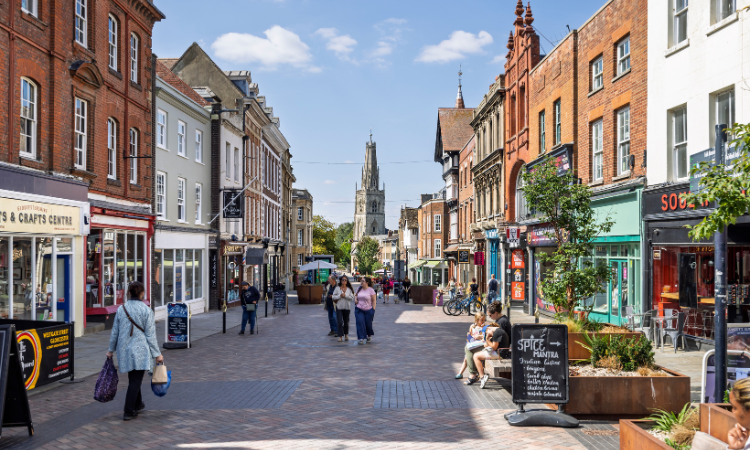
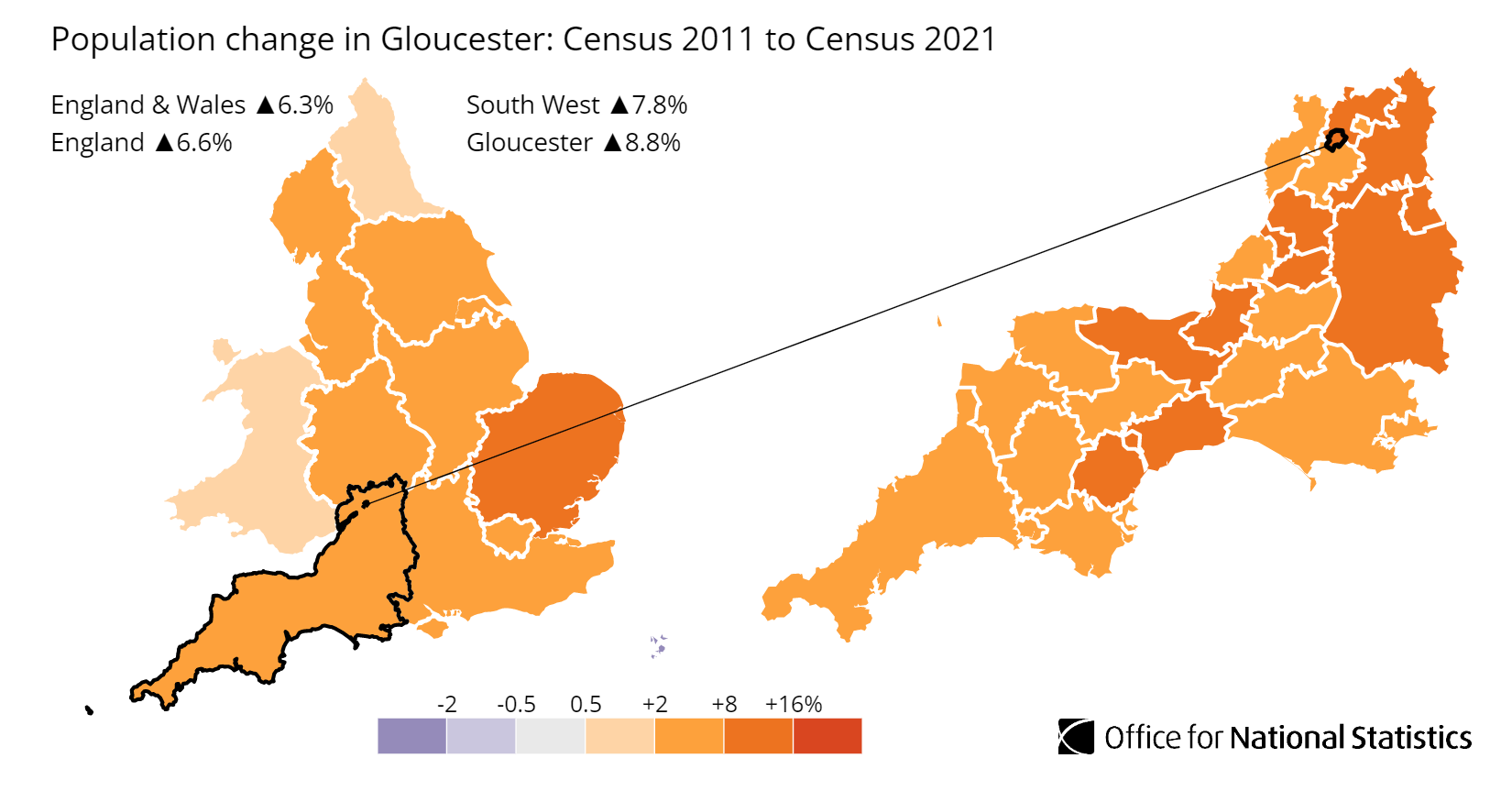
Gloucester is a cathedral city in Gloucestershire, in south-west England. Average sold prices in Gloucester sit at £237,968 on the HM Land Registry House Price Index, 17.9% below the England average of £289,946 and 20.9% under the South West regional average of £300,849. That puts Gloucester among the more affordable cathedral cities in the South West, a county town priced well below the Cotswold villages and stone-built Cheltenham five miles up the road. The local authority added 8.82% to its population between the 2011 and 2021 censuses, from 121,688 to 132,416 residents.
Gloucester's affordability is the headline for an income investor. Median earnings here run below the regional and national average, so the city does not carry Cheltenham's wage premium, but the asking prices are lower to match and the gross yields hold up. The spread between GL1 at £207,595 and GL3 at £340,392 is wide for a four-postcode city, and the cheaper postcode is where the rental return concentrates. GL1 alone delivers a 6.1% gross yield, the highest in the city and well clear of the rest.
This guide covers the city of Gloucester (ONS code E07000081) across postcodes GL1, GL2, GL3, and GL4. Gloucester sits on the River Severn in the South West, 5 miles west of Cheltenham and 35 miles north-east of Bristol. The wider county also takes in the Cotswolds to the east and the Forest of Dean to the west.
Article updated: July 2026
Why Invest in Gloucester?
Gloucester grew its population 8.82% between the 2011 and 2021 censuses, from 121,688 to 132,416 residents. That is faster than the England and Wales average of 6.3%, and it has happened in a compact, walkable city with a Norman cathedral, a regenerated waterfront, and a railway position that puts Bristol, Cheltenham, and the wider South West within easy reach. The city has drawn new residents on the strength of jobs and affordability rather than postcard appeal, which is a steadier kind of demand than a tourism-led market.
The local employment rate of 84.2% is well above both the South West average and Great Britain's 75.6%. Gloucester's economy leans on health and social work, which accounts for 21.7% of employee jobs, followed by wholesale and retail (14.5%), administrative and support services (8.7%), and roughly equal shares in accommodation and food and in education (7.2% each). The University of Gloucestershire holds two campuses in the city, including a new City Campus in the centre, and that student population feeds the rental market in GL1.
Median gross annual earnings in Gloucester are £34,617, which is below the South West and below the Great Britain median of £39,125. Lower local wages mean tenants here have less headroom than Cheltenham renters, so rent affordability matters more in the numbers. The trade-off is that asking prices are lower to match, which is what keeps Gloucester's gross yields ahead of its wealthier neighbour. A high employment rate on modest wages points to a working tenant base in steady jobs rather than one stretched on benefits.
Gloucester Economic Summary
- Population (Gloucester): 132,416 (2021 Census). Growth of 8.82% from 2011.
- Median annual salary: £34,617 (local), £39,125 (Great Britain)
- Employment rate: 84.2% (local), 75.6% (Great Britain)
- Key employment sectors: Health and social work, wholesale and retail, administrative and support services, accommodation and food, education
Source: ONS Census 2021, Nomis Labour Market Profile (ASHE 2025, Employment Jan-Dec 2025)
Regeneration and Investment in Gloucester
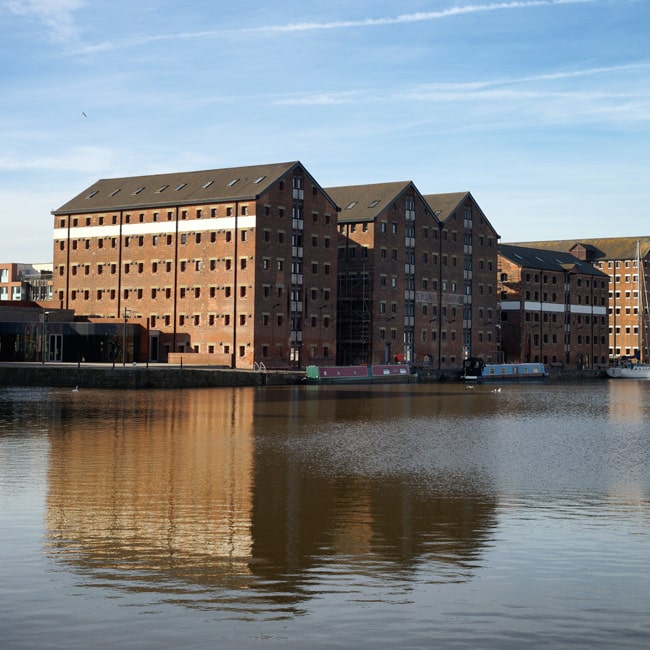
Gloucester's regeneration runs from the Quays on the old docks to the £107 million Kings Quarter scheme in the city centre, which was named the UK's best long-term regeneration initiative of 2025. Two decades of brownfield investment have reshaped a city that once turned its back on its waterfront, and the most recent phase has put a university campus and new offices into the heart of GL1.
- Kings Quarter and The Forum (Largely complete, £107 million-plus): Anchored by The Forum, a digital and office campus with more than 125,000 square feet of workspace, a 131-bedroom four-star hotel, apartments, and retail, delivered by Reef Group with Gloucester City Council. Kings Quarter was named the best long-term regeneration initiative in the UK for 2025 by the retail and leisure property body Revo, judged ahead of major schemes including London's Wembley Park. Updates at Invest in Gloucester.
- University of Gloucestershire City Campus (Open): The former Debenhams department store in the city centre, bought by the university in 2021, reopened as a teaching campus to students in August 2025. The new campus brings a permanent student and staff population into GL1, alongside a public library and an arts and health centre. It sits a short walk from the Kings Quarter scheme above.
- Gloucester Quays and the Docks (Mature, £300 million-plus): Peel L&P has invested more than £300 million in the regeneration of Gloucester's historic docks, turning a redundant Victorian port into a designer outlet, homes, and waterside leisure, and supporting close to 3,500 jobs. The waterfront sits within GL1 and GL2 and has been the catalyst for the wider city regeneration. Updates at Invest in Gloucester.
Source: Office for National Statistics - Gloucester
Gloucester Property Market Analysis
Average property prices in Gloucester have risen 488.6% since January 1995, from £40,431 to £237,968. The sections below break down that journey cycle by cycle, then drill into current postcode-level data for sold prices, price per square foot, asking prices, growth trends, and monthly transaction volumes.
When was the last house price crash in Gloucester?
Gloucester is its own local authority, so all sold property prices from HM Land Registry are recorded at city level. The Land Registry House Price Index tracks average prices from January 1995 to March 2026, covering 31 years of market cycles.
The 1995 to 2007 boom: Gloucester started at £40,431 in January 1995. By December 2000, prices had reached £65,593, a 62.2% increase in six years as low interest rates and easier mortgage lending fed through. Growth ran hard through the early 2000s, and the market peaked at £152,746 in August 2007, almost four times the 1995 figure.
2008 to 2009, the financial crisis: Prices fell from the August 2007 peak of £152,746 to a trough of £116,771 in May 2009, a decline of 23.6% over 21 months. The worst year-on-year reading was -19.9% in February 2009. Gloucester's fall was deeper than the typical England correction of around 18%, which is the other side of an affordable market: lower-priced cities tend to overshoot harder on the way down when credit tightens, because more of the buyer base is borrowing close to its limit.
The 2010 to 2013 plateau: Prices bounced off the May 2009 trough, reaching £135,125 by December 2010, then drifted sideways. By December 2013 the average stood at £133,136, still below the 2010 level. Gloucester spent four years stuck in a narrow band, unable to push back towards the pre-crash peak.
Recovery, 2014 to 2015: Growth returned, with prices rising from £145,844 in December 2014 to £154,068 by December 2015. That December 2015 reading was the first month to clear the August 2007 pre-crash peak of £152,746. It took just over eight years to recover the lost ground.
The 2016 to 2019 pre-pandemic growth: Steady gains continued. Prices moved from £167,489 in December 2016 to £178,257 in December 2017, £183,932 in December 2018, and £187,960 in December 2019. Annual growth eased from the high single digits down towards 2% by the end of the decade.
2020 to 2022, the pandemic surge: The stamp duty holiday and a rush for space lifted Gloucester along with the rest of the country. Prices climbed from £186,720 in June 2020 to £193,919 by December 2020, then £211,060 by December 2021 (8.8% annual growth), reaching £234,554 by December 2022 (11.1% annual growth).
The 2023 to 2024 rate shock: Higher mortgage rates cooled the market. Prices slipped to £230,953 by June 2023 and £233,308 by December 2023, with annual growth turning slightly negative. The dip carried into mid-2024, with June 2024 at £225,206, down 2.5% on the year.
2025 to present: The market steadied and edged up again, reaching £236,618 by December 2024 and a record £238,306 in February 2026, before easing back to £237,968 in the latest March 2026 reading. The current price is 55.8% above the pre-crash peak of £152,746.
Long-term growth summary:
- 5 years (March 2021 to March 2026): 19.2% growth (£199,573 to £237,968)
- 10 years (March 2016 to March 2026): 50.7% growth (£157,896 to £237,968)
- 15 years (March 2011 to March 2026): 89.0% growth (£125,895 to £237,968)
- 20 years (March 2006 to March 2026): 79.7% growth (£132,392 to £237,968)
- 30 years (March 1996 to March 2026): 490.1% growth (£40,328 to £237,968)
Gloucester's 23.6% crash was steeper than the national average, but the recovery was no slower than England's, and the 30-year return of 488.6% sits among the stronger long-run records for a city of its price. The deeper fall is the affordable market's pattern: it drops harder in a downturn, then it has further to climb when demand returns. Someone who bought at the very top in August 2007 would now be 55.8% ahead on the Land Registry average.
- All property types
- Detached
- Semi-detached
- Terraced
- Flats
- All property types
- Detached
- Semi-detached
- Terraced
- Flats
Sold House Prices in Gloucester
The average sold price across all property types in Gloucester is £237,968, which is 17.9% below the England average of £289,946 as of March 2026. That discount runs through every property type, but it is widest at the bottom of the market. Flats sell 38.8% below the England average, while semi-detached houses are only 3.8% below. The gap is a read on Gloucester's housing mix: the family stock holds its value against the national market, while the flat market reflects a smaller, value-led city without the institutional apartment building seen in Bristol.
| Property Type | Gloucester Average | England Average | Difference |
|---|---|---|---|
| Detached houses | £413,360 | £470,492 | -12.1% |
| Semi-detached houses | £277,105 | £288,185 | -3.8% |
| Terraced houses | £208,766 | £243,788 | -14.4% |
| Flats and maisonettes | £131,320 | £214,563 | -38.8% |
| All property types | £237,968 | £289,946 | -17.9% |
Detached houses at £413,360 carry a 12.1% discount to England's £470,492. Gloucester's detached stock sits in the GL2 and GL4 suburbs to the north and south of the city, where larger family homes compete with the cheaper edge of the Cotswold and Cheltenham markets nearby. Annual growth of 3.2% points to steady, unspectacular demand.
Semi-detached houses at £277,105 sit just 3.8% below England's £288,185, the smallest discount of any type. This is the heart of Gloucester's family market and the workhorse of its buy-to-let stock, spread across all four postcodes. Annual growth of 4.3% is the strongest of any property type in the city, which fits a market where mid-priced family homes are in steady demand from both owner-occupiers and landlords.
Terraced houses at £208,766 offer a 14.4% discount to England's £243,788. The terraced stock concentrates in GL1, where Victorian and Edwardian streets close to the city centre and the docks make up much of the lower-cost rental market. Annual growth of 3.7% keeps terraces ahead of detached houses on price movement.
Flats and maisonettes at £131,320 show the deepest discount at 38.8% below England's £214,563. Gloucester is not a flat-heavy city outside the docks. The waterfront conversions and a handful of city-centre blocks make up most of the apartment stock, so flat prices track local demand alone, without the new-build apartment premium that lifts flat values in larger regional cities. Annual change of -1.5% confirms a soft market at this end.
Price Per Square Foot in Gloucester
Just over £100 per square foot separates Gloucester's cheapest postcode from its dearest, with GL1 at £230 and GL3 at £332. Measuring by the square foot takes property size out of the comparison and shows what each postcode's location commands on its own. GL3, covering the eastern suburbs of Hucclecote and Brockworth, holds the top rate, while GL1 in the centre is the cheapest space in the city.
| Rank | Area | Price Per Sq Ft |
|---|---|---|
| 1 | GL1 (City Centre, Docks) | £230 |
| 2 | GL4 (Abbeymead, Tuffley) | £312 |
| 3 | GL2 (Quedgeley, Hempsted) | £322 |
| 4 | GL3 (Hucclecote, Brockworth) | £332 |
GL1 at £230 per square foot is the cheapest postcode for bricks-and-mortar value, around 31% below GL3. This is the city centre and the docks, where the housing splits between Victorian terraces and converted or purpose-built flats. Based on 720 transactions analysed, GL1 carries both the lowest price per square foot and the lowest asking price in Gloucester.
GL3 at £332 per square foot tops the table, ahead of GL2 and GL4. The postcode runs east through Hucclecote and out towards Brockworth at the foot of the Cotswold escarpment, where larger detached and semi-detached homes set the tone. All 803 transactions analysed show a consistent premium over the rest of the city.
For Sale Asking Prices in Gloucester
GL1 at £207,595 and GL3 at £340,392 sit 64.0% apart, the full spread of a four-postcode city built around one affordable centre and three pricier suburbs. The hierarchy tracks the price-per-square-foot table, and the mean asking price across all four Gloucester postcodes is £299,777.
| Rank | Area | Asking Price |
|---|---|---|
| 1 | GL1 (City Centre, Docks) | £207,595 |
| 2 | GL4 (Abbeymead, Tuffley) | £310,739 |
| 3 | GL2 (Quedgeley, Hempsted) | £340,381 |
| 4 | GL3 (Hucclecote, Brockworth) | £340,392 |
GL1 at £207,595 is the only postcode where a purchase falls below the city-wide Land Registry average of £237,968, and it sits more than £100,000 below the next postcode up. For an investor with a fixed budget, GL1 buys the most property for the money and the lowest barrier to entry in Gloucester, which is the postcode where the yield also peaks.
GL3 at £340,392 and GL2 at £340,381 are within a few hundred pounds of each other at the top of the table, the two suburban postcodes where detached family homes dominate. They cost roughly 64% more than GL1, and the rental yield figures below show why that premium does more for an owner-occupier than for a landlord.
House Price Growth in Gloucester
Every Gloucester postcode posted positive five-year growth, led by GL4 at 19.5%, but the one-year and three-year figures are mostly negative across the city. The five-year window captures the pandemic surge, while the shorter windows show the rate-shock cooling that followed. GL4 (Abbeymead, Tuffley) leads the long view, while GL1 (City Centre, Docks) holds the only positive one-year reading of any postcode.
| Area | 1 Year | 3 Years | 5 Years |
|---|---|---|---|
| GL4 (Abbeymead, Tuffley) | -0.2% | 0.4% | 19.5% |
| GL3 (Hucclecote, Brockworth) | -6.0% | -4.1% | 12.4% |
| GL2 (Quedgeley, Hempsted) | -5.3% | -7.1% | 9.1% |
| GL1 (City Centre, Docks) | 1.3% | -1.0% | 8.2% |
GL4 at 19.5% has the highest five-year return in Gloucester, and it is also the only postcode with positive three-year growth at 0.4%. Abbeymead and Tuffley are settled residential suburbs south-east of the centre, and that steadiness shows up as the most consistent figures of the four. Over five years the area has comfortably outgrown the rest of the city.
GL1 carries the only positive one-year reading at 1.3%, against falls in the three suburban postcodes. The city-centre and docks stock has held up better than the suburbs over the past year, though its five-year return of 8.2% is the lowest of the four, reflecting the softer flat market that sits within the postcode.
GL2 and GL3 both show negative one-year and three-year figures, down 5.3% and 6.0% over the year, after stronger five-year gains of 9.1% and 12.4%. The suburban detached market took the brunt of the rate-shock cooling, which is the pattern across much of the country where the priciest stock moved first.
Monthly Property Sales in Gloucester
Monthly sales range from 39 to 52 transactions per postcode across Gloucester, with the busiest market in GL2 and the highest turnover in GL4. Even the quietest of the four postcodes sees a steady flow of completions. Turnover rates, the share of homes changing hands each year, run from 13% in GL1 up to 18% in GL4.
| Area | Sales Per Month | Turnover | Asking Price |
|---|---|---|---|
| GL2 (Quedgeley, Hempsted) | 52 | 14% | £340,381 |
| GL1 (City Centre, Docks) | 40 | 13% | £207,595 |
| GL4 (Abbeymead, Tuffley) | 40 | 18% | £310,739 |
| GL3 (Hucclecote, Brockworth) | 39 | 17% | £340,392 |
GL4's 18% turnover is the highest in Gloucester, just ahead of GL3 at 17%. Abbeymead and Tuffley combine steady family demand with a deep pool of mid-priced stock, so homes change hands more often than in the city centre. A higher turnover gives a landlord an easier exit when the time comes to sell, because there are more comparable sales moving through the market.
GL2 records the most transactions at 52 a month, against a 14% turnover rate. The postcode covers a large, growing area around Quedgeley and Hempsted with a bigger total housing stock, so a high number of monthly sales still represents a moderate share of the whole. GL1 sits at the lowest turnover at 13%, where the city-centre flats sit longer before selling than the suburban family homes.
How Long Properties Take to Sell in Gloucester
The eastern suburbs clear fastest: GL4 (Abbeymead, Tuffley) takes about 169 days to find a buyer, against roughly 234 days in GL1 (City Centre, Docks). That 65-day gap is real money in a landlord's exit. Days on market is the typical time a home is listed before it sells; the months of unsold stock shows how much for-sale supply is queued up at the current rate of sales.
| Area | Avg Days to Sell | Months of Unsold Stock | Market |
|---|---|---|---|
| GL4 (Abbeymead, Tuffley) | 169 | 5.6 | Seller's market |
| GL3 (Hucclecote, Brockworth) | 179 | 5.9 | Seller's market |
| GL2 (Quedgeley, Hempsted) | 217 | 7.1 | Balanced market |
| GL1 (City Centre, Docks) | 234 | 7.7 | Balanced market |
The eastern suburbs and the centre run on different clocks. GL4 and GL3 sit at under six months of unsold stock, the level where supply is tight enough to count as a seller's market, while GL1 carries 7.7 months and takes the longest to sell. The highest-yielding postcode is also the slowest to exit, so the income an investor earns in GL1 comes with a longer wait when it is time to sell up.
What Type of Property Can You Buy in Gloucester?
The city centre and the suburbs are almost mirror images: detached homes make up over half the stock in GL2 and GL4, while GL1 is dominated by terraces and flats. The mix of housing shapes which strategies fit each postcode, and the figures below come from 2021 Census records for each one.
| Area | Detached | Semi-detached | Terraced | Flats |
|---|---|---|---|---|
| GL1 (City Centre, Docks) | 9.7% | 28.7% | 24.5% | 35.5% |
| GL2 (Quedgeley, Hempsted) | 56.8% | 24.7% | 9.3% | 5.8% |
| GL3 (Hucclecote, Brockworth) | 47.0% | 33.2% | 12.1% | 5.3% |
| GL4 (Abbeymead, Tuffley) | 58.5% | 25.8% | 8.8% | 5.6% |
GL1 holds by far the largest share of flats at 35.5% and terraces at 24.5%, with detached houses making up under a tenth of its stock. That is the smaller-unit housing that typically forms a buy-to-let portfolio, and it lines up with GL1 carrying the lowest asking price and the highest gross yield in the city. The dock conversions and city-centre flats suit single lets and student sharers, while the terraced streets offer lower-cost family lets.
GL4 is the most detached-dominated postcode at 58.5%, with flats at just 5.6%. Detached and semi-detached houses together account for more than 84% of GL4's stock, which matches its higher asking prices and its place at the family end of the market. The housing here is weighted towards owner-occupier homes rather than the smaller units that drive rental income, even though the postcode also posted the strongest five-year growth.
The flats figure covers both purpose-built blocks and conversions. A small share of mobile and temporary dwellings is left out, so the rows may not add up to 100%.
Gloucester Rental Market Analysis
Monthly rents in Gloucester range from £1,048 in GL1 to £1,332 in GL2, with gross rental yields from 4.4% to 6.1% across the four postcodes. For investors asking is buy-to-let worth it in Gloucester, the sections below break down rents, yields, and tenant affordability postcode by postcode. If you are looking at starting a property business in the South West, Gloucester's mix of affordable asking prices and an 84.2% employment rate offers a higher-yielding way into the region than its wealthier neighbours. Browse current buy-to-let property for sale across the region.
Average Rent & Gross Rental Yields in Gloucester
Gross rental yields in Gloucester range from 4.4% in GL3 to 6.1% in GL1. The cheapest postcode delivers the highest yield by a clear margin, with GL1's 6.1% sitting more than a full point above the rest of the city. GL2 charges the highest monthly rent at £1,332 but yields 4.7%, because its £340,381 asking price is 64% above GL1's.
| Area | Average Monthly Rent | Asking Price | Gross Yield |
|---|---|---|---|
| GL1 (City Centre, Docks) | £1,048 | £207,595 | 6.1% |
| GL2 (Quedgeley, Hempsted) | £1,332 | £340,381 | 4.7% |
| GL4 (Abbeymead, Tuffley) | £1,156 | £310,739 | 4.5% |
| GL3 (Hucclecote, Brockworth) | £1,241 | £340,392 | 4.4% |
GL1 at 6.1% pairs the lowest asking price with the lowest rent at £1,048, yet still returns the strongest yield in Gloucester by some distance. A 30% deposit of £62,278 buys into the highest-yielding postcode in the city, which is also where the rentable terraced and flat stock concentrates.
The tenant base in GL1 is mixed. The dock and city-centre flats draw young professionals and University of Gloucestershire students, while the terraced streets house working families on more modest incomes. That spread of tenant types helps cushion void risk across different parts of the rental market.
GL3 at 4.4% sits at the bottom of Gloucester's yield table. The £1,241 monthly rent is healthy, but the £340,392 asking price means the income return is compressed. In the suburban postcodes the premium price does more for capital value and rent level than it does for yield.
Gross Rental Yield by Postcode
Is Gloucester Rent High?
Monthly rents in Gloucester take between 36.3% and 46.2% of the local median gross monthly salary. The widely cited threshold for rent affordability is 30% of gross income, and every Gloucester postcode sits above it. That is a tighter picture than many South West cities, and it comes down to a single number: local wages here are lower than the regional average, so even modest rents take a bigger bite.
The median gross weekly salary in Gloucester is £665.70, which works out at £2,885 per month or £34,617 per year. This is below the South West median of £722.00 per week and the Great Britain median of £752.40 per week. Data from the Nomis Labour Market Profile (ASHE 2025).
| Rank | Area | Rent as % of Income |
|---|---|---|
| 1 | GL2 (Quedgeley, Hempsted) | 46.2% |
| 2 | GL3 (Hucclecote, Brockworth) | 43.0% |
| 3 | GL4 (Abbeymead, Tuffley) | 40.1% |
| 4 | GL1 (City Centre, Docks) | 36.3% |
GL1 at 36.3% is the most affordable for tenants, which is no surprise given it carries the lowest rent at £1,048. For a landlord that affordability matters, because rents that sit closer to what tenants can comfortably pay tend to come with fewer arrears and longer tenancies. The headroom is tighter here than in a higher-wage city, but it is widest of Gloucester's four postcodes.
GL2 at 46.2% is the least affordable, with its £1,332 rent set against the median local salary. Tenants paying at that level in Quedgeley and the suburbs are typically dual-income households or families rather than single earners on the median wage, so the headline ratio overstates the strain on the households actually renting there.
How Big Is Gloucester's Private Rented Sector?
The private rented sector is deepest by far in GL1, at 32.7% of households, more than double the share in any of the three suburban postcodes. The proportion of homes already let privately is a guide to how established the local tenant pool is, and in Gloucester it is heavily concentrated in the centre. The table below shows household tenure by postcode.
| Area | Owned Outright | Owned with Mortgage | Private Rented | Social Rented |
|---|---|---|---|---|
| GL1 (City Centre, Docks) | 22.7% | 23.5% | 32.7% | 19.2% |
| GL2 (Quedgeley, Hempsted) | 45.9% | 31.4% | 15.6% | 5.8% |
| GL3 (Hucclecote, Brockworth) | 40.7% | 34.3% | 15.4% | 7.6% |
| GL4 (Abbeymead, Tuffley) | 45.1% | 33.9% | 13.5% | 6.9% |
GL1 has by far the largest private rented sector in Gloucester, almost a third of all households, alongside the city's highest share of social renting at 19.2% and its lowest owner-occupation. A deep rented sector points to an active local lettings market and a wide pool of existing tenants, which sits alongside GL1's position as the highest-yielding postcode. The three suburban postcodes are owner-occupier territory, with private renting between 13.5% and 15.6% and outright ownership above 40%.
The rental supply backs that up. GL1 and GL2 both read as landlord's markets, where rental homes let quickly and few sit empty. In GL1 around 68 homes were on the rental market at the time of measurement and took roughly 41 days to let, while GL2 had about 37 on the market letting in around 35 days. The eastern suburbs of GL3 and GL4 have too few rental listings at any one time to read reliably, which fits their thinner private rented sectors.
Local Housing Allowance Rates in Gloucester
All four Gloucester postcodes fall within the Gloucester Broad Rental Market Area, where Local Housing Allowance runs from £93.51 a week for a shared room to £276.16 a week for a four-bedroom home. Local Housing Allowance is the most a tenant on benefits can claim towards rent, so for that part of the market it sets an effective floor on what a landlord can charge. The rates below apply across the whole of Gloucester. To check the current rate for a specific address, you can use the government's official Local Housing Allowance calculator.
| Property Size | Weekly LHA Rate | Monthly Equivalent |
|---|---|---|
| Shared accommodation | £93.51 | £405 |
| 1 bedroom | £126.58 | £549 |
| 2 bedrooms | £166.85 | £723 |
| 3 bedrooms | £195.62 | £848 |
| 4 bedrooms | £276.16 | £1,197 |
The two-bedroom LHA rate of £166.85 a week works out at about £723 a month, below the £1,048 to £1,332 open-market rents recorded across Gloucester's postcodes. A benefit-backed tenancy at the LHA rate therefore sits under the city's market rents, and the stock that fits within these rates is concentrated in GL1, where both the asking prices and the open-market rents are lowest. The rates are the same in every Gloucester postcode because they are set across the whole Gloucester market area.
Buy-to-Let Considerations
Are House Prices High in Gloucester? Price-to-Earnings Ratios
Buying a property in Gloucester takes between 6.0 and 9.8 times the median annual salary. This is based on the Nomis Labour Market Profile for Gloucester showing the median gross annual income for Gloucester residents is £34,617.
The national benchmark for price-to-earnings is 7.4x (England's average sold price of £289,946 divided by the Great Britain median annual salary of £39,125). One of Gloucester's four postcodes (GL1) sits below that national benchmark, meaning it is more affordable relative to local incomes than the England average is relative to national incomes.
| Rank | Area | Price-to-Earnings Ratio |
|---|---|---|
| 1 | GL1 (City Centre, Docks) | 6.0x |
| 2 | GL4 (Abbeymead, Tuffley) | 9.0x |
| 3 | GL2 (Quedgeley, Hempsted) | 9.8x |
| 4 | GL3 (Hucclecote, Brockworth) | 9.8x |
GL1 at 6.0x is below the national benchmark of 7.4x and is the most affordable entry point in Gloucester. At six times local earnings, GL1 is competitive with many higher-yielding postcodes elsewhere in the country, and here it comes with the city's highest yield attached.
GL3 and GL2 at 9.8x sit well above the benchmark. At close to ten times the local median salary, the suburban postcodes are firmly in family owner-occupier territory, where buyers tend to be dual-income households. For an investor, the higher ratio is the same story the yields tell: more of the price is going into capital value than into income.
Deposit Requirements in Gloucester
A 30% deposit on a buy-to-let property in Gloucester ranges from £62,278 in GL1 to £102,118 in GL3. The gap between the cheapest and most expensive deposit is just under £40,000. GL1 is by some way the lowest barrier to entry in the city, and it is also where the rental yield peaks, so the smallest deposit buys into the strongest income return.
Beyond the deposit, the SDLT calculator and other buy to let expenses affect the total capital required.
| Rank | Area | 30% Deposit Required |
|---|---|---|
| 1 | GL1 (City Centre, Docks) | £62,278 |
| 2 | GL4 (Abbeymead, Tuffley) | £93,222 |
| 3 | GL2 (Quedgeley, Hempsted) | £102,114 |
| 4 | GL3 (Hucclecote, Brockworth) | £102,118 |
GL1 is the cheapest way into Gloucester at a £62,278 deposit, around £31,000 less than the next postcode up. That money buys the highest-yielding postcode, the deepest rental market, and the lowest price-to-earnings ratio in the city, all in one place. For an income-focused investor, GL1 lines up almost every metric in the same postcode.
At the other end, GL2 and GL3 sit within a few pounds of each other on the deposit at just over £102,000, but they are not quite the same investment. GL3 has grown more over five years at 12.4% against GL2's 9.1%, and it sells faster at 179 days against 217, while GL2 commands the higher rent at £1,332 a month. Near-identical deposit, slightly different profiles between two suburban postcodes.
What the Gloucester Data Tells Buy-to-Let Investors
In Gloucester the cheapest way in is also the highest-yielding postcode by a wide margin. GL1 has the top yield at 6.1%, the lowest asking price for buying an investment property at £207,595, and the most affordable prices against local earnings at 6.0 times income. A 30% deposit there is £62,278, the lowest in the city, for a home renting at £1,048 a month.
GL1's case rests on more than yield. It holds the city's deepest private rented sector at 32.7% of households, the highest share of the terraced and flat stock that suits letting, and a rental market that lets quickly. The trade-offs are real and worth naming: it carries the slowest sale time at 234 days, the lowest five-year capital growth at 8.2%, and a soft flat market within the postcode. The income concentrates here; the capital growth has been stronger elsewhere.
GL4 has grown most over five years at 19.5% and is the only postcode positive over three years, with the fastest sale time at 169 days, on a 4.5% yield and a £93,222 deposit. GL2 commands the highest rent at £1,332 a month and the most monthly sales, while GL3 sits at the bottom for yield at 4.4% but has held its five-year growth at 12.4%. The three suburban postcodes are where capital value and family demand sit; GL1 is where the income is. Buyers who want to come in below the asking prices here often work through off market properties channels.
Gloucester has no selective licensing for private landlords, though shared houses can still need a licence, so confirm the current position on Gloucester City Council's housing pages. With an 84.2% employment rate, a regenerated waterfront, and a growing university presence, but wages below the regional average, it combines lower asking prices with higher headline yields than its wealthier neighbours, with tenant affordability the number to keep an eye on.
How Gloucester Compares
Gloucester's mean asking price of £299,777 is among the lowest of the four comparison locations here, a touch above Worcester, while its top yield of 6.1% is the highest, a straight swap of price for income against neighbouring Cheltenham. The comparison below places Gloucester alongside three nearby locations, each with a different investor profile. The mean asking price and mean monthly rent are simple averages across all postcodes with data. Top gross yield is the single highest postcode yield in each location.
| Location | Mean Asking Price | Mean Monthly Rent | Mean Gross Yield | Top Yield (postcode) |
|---|---|---|---|---|
| Worcester | £295,727 | £953 | 3.9% | 5.0% (WR4) |
| Gloucester | £299,777 | £1,194 | 4.8% | 6.1% (GL1) |
| Swindon | £349,254 | £1,194 | 4.1% | 5.2% (SN2) |
| Cheltenham | £448,418 | £1,400 | 3.7% | 4.7% (GL50) |
Gloucester is the second-cheapest location in this comparison at £299,777 mean asking price, a touch above Worcester, and its top yield of 6.1% is the highest of the four. The contrast with Cheltenham five miles away is the sharpest. The spa town's mean asking price of £448,418 runs around 50% higher than Gloucester's, while its top yield drops to 4.7%. That is the affordable-city trade in one line, with Gloucester taking the income and Cheltenham the prestige and the capital values.
Beyond that contrast, Swindon is dearer than Gloucester at £349,254 and yields a touch less at 5.2%, on the back of strong rail links to London, while Worcester to the north is the cheapest of the four at £295,727 on a 5.0% top yield, a comparable cathedral-city market on the Severn. For an investor prioritising income across the western South West and Midlands fringe, Gloucester sits at the higher-yield, lower-cost end of this group. For a data-driven comparison across all UK locations, see our best buy-to-let areas guide.
Frequently Asked Questions
Is Gloucester a good place to live for buy-to-let tenants?
It works for tenants in steady jobs, and the employment picture is the strong point. Gloucester's employment rate is 84.2%, well above the Great Britain figure of 75.6%, and the economy leans on health and social work, retail, and education, which are sectors that keep people in work through ups and downs.
The catch is wages. The typical salary here is £34,617 a year, below the regional and national average, so tenants have less spare income than in a wealthier city. That makes affordable rent the thing to get right. It is also a compact, walkable city with fast trains to Bristol and Cheltenham, which suits renters who settle rather than move on each year.
What are the best areas in Gloucester for property investment?
The split is unusually clean. GL1 (City Centre and Docks) is the cheapest way in at £207,595 and carries by far the highest yield at 6.1%, plus the city's deepest rental market, so it leans heavily towards income. The trade-off is the slowest sale time and the lowest capital growth.
The three suburban postcodes lean the other way. GL4 (Abbeymead and Tuffley) has grown most over five years at 19.5% and sells fastest, while GL3 (Hucclecote and Brockworth) and GL2 (Quedgeley and Hempsted) sit close behind on growth with higher rents but lower yields around 4.4% to 4.7%. So if income matters most, GL1 leads on yield, price, and rental depth; if you want capital growth, the eastern suburbs have done more of it.
How does Gloucester compare to Cheltenham for buy-to-let?
They are two halves of the same five-mile stretch with opposite numbers. Gloucester is the affordable, higher-yield end: a top gross yield of 6.1% against Cheltenham's 4.7%, and a mean asking price of £299,777, roughly 29% cheaper than Cheltenham's £420,517. Gloucester also has the deeper working tenant base, while Cheltenham brings higher wages and a more premium market.
Cheltenham trades that yield for prestige, stronger local earnings, and the spa-town pull that supports its capital values. Historically the income has been better in Gloucester and the growth and price level higher in Cheltenham. Which matters more comes down to whether you are buying for monthly return or for the longer-term value of the asset.
Is there demand for student accommodation in Gloucester?
Yes, and it centres on GL1. The University of Gloucestershire runs two campuses in the city, including a new City Campus in the former Debenhams building that opened to students in August 2025, right in the centre. With the lowest rents in the city at £1,048 a month and the largest stock of flats and terraces, GL1 is the natural area for shared student lets. They come with summer voids and more hands-on management than a standard tenancy, so factor that in. For the purpose-built end of the market, see our guide to purpose built student accommodation.
On the HMO side, a sample of current GL1 room adverts puts a double room with a shared bathroom at around £141 a week, with most between £115 and £156 (the middle 80% of 35 adverts). That was the only room type with enough live listings for a reliable figure, so ensuite and single-room rents are harder to pin down. For how the numbers work on a shared house, see our complete guide to investing in HMOs.
Can I find buy-to-let property under £250,000 in Gloucester?
Yes, and more easily than in most cities. GL1 (City Centre and Docks) averages £207,595, comfortably under £250,000, and the city-wide sold average is £237,968. Beyond the centre, the way in below the suburban averages is by property type: terraced houses across Gloucester average £208,766 and flats average £131,320 on the Land Registry index. If a sub-£250,000 entry is the target, GL1 is the postcode to start in, or look at terraces and flats across the wider city, or explore BMV properties for sale.
What are average house prices in Gloucester?
The average sold price across Gloucester is £237,968 on the Land Registry index, about 17.9% below the England average of £289,946 as of March 2026. Asking prices by postcode run from £207,595 in GL1 (City Centre, Docks) up to £340,392 in GL3 (Hucclecote, Brockworth), with a city-wide mean of £299,777. By type, detached homes average £413,360, semi-detached £277,105, terraced £208,766, and flats £131,320.
Through a buy-to-let lens, GL1 is the cheapest entry and the highest-yielding at 6.1%, while the suburban postcodes are dearer and yield between 4.4% and 4.7%.
What are the Local Housing Allowance rates in Gloucester?
All four Gloucester postcodes fall in the Gloucester Broad Rental Market Area, so they share one set of rates. As of June 2026, Local Housing Allowance runs at £93.51 a week for a shared room, £126.58 for a one-bed, £166.85 for two beds, £195.62 for three, and £276.16 for four. That figure is the most a tenant on housing support can claim towards rent, so for that part of the market it effectively sets a floor on what a landlord can charge.
What type of property is most common in Gloucester?
It depends which part of the city. In the suburbs, detached houses dominate, running from 47.0% of the stock in GL3 up to 58.5% in GL4. The centre is the opposite: GL1 is mostly flats and terraces, at 35.5% and 24.5%, with detached homes making up under a tenth of its housing. That is why GL1 is the postcode where buy-to-let stock concentrates, while the suburbs are weighted towards family homes.
How do I buy an investment property in Gloucester?
Decide first whether you are buying for income or for capital growth, because in Gloucester the two point at different postcodes. GL1 (City Centre, Docks) is the cheapest entry at £207,595 and the highest-yielding at 6.1%, with the deepest rental market. GL4 (Abbeymead, Tuffley) has the strongest five-year growth at 19.5% and the fastest sales. Budget for a 30% deposit, which runs from £62,278 in GL1 to £102,118 in GL3.
Beyond what is listed openly, plenty of experienced investors buy below asking through off-market property sales and below market value property. To see what is available now, browse investment properties or buy-to-let homes for sale.
Ready to buy property?
Access off-market investment properties with an average 8%+ annual gross yield (beating the UK's typical 3-5%).
Get property alerts