
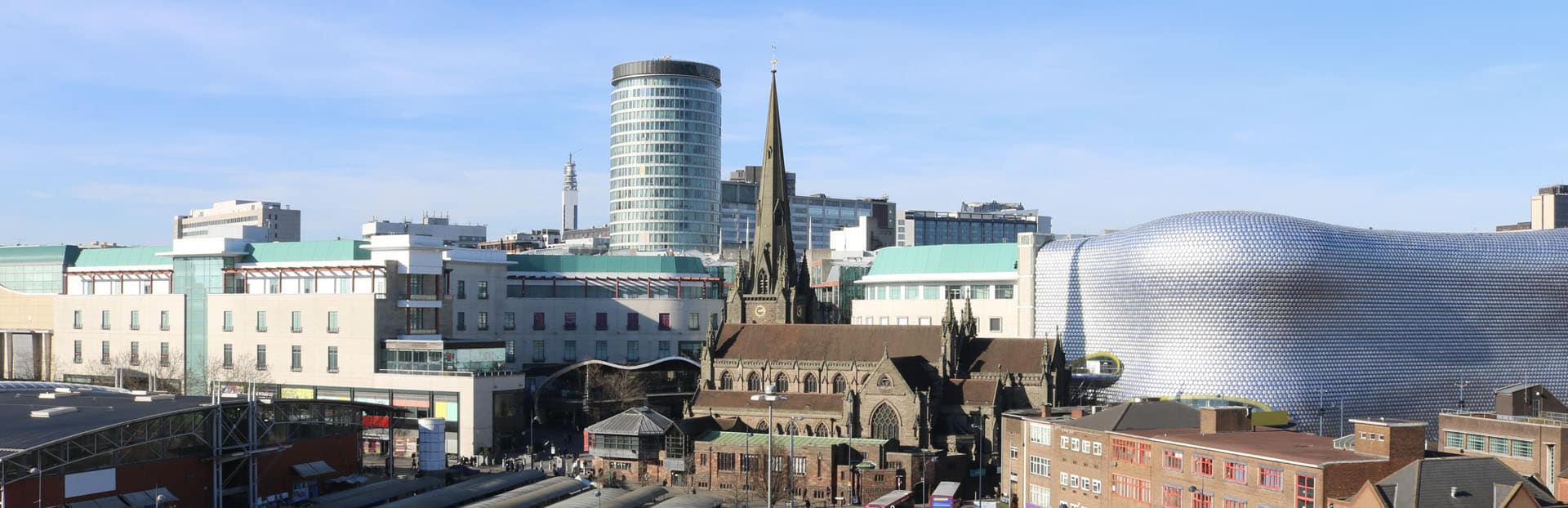
Birmingham is the largest city in the West Midlands, in central England. Average sold prices across Birmingham sit at £233,056 on the HM Land Registry House Price Index, 19.6% below England's £289,946 yet level with the wider West Midlands average of £232,897. Birmingham is the price-setter for its region rather than a discount to it, which is unusual for a major city: most carry a premium over the area around them. The local authority's population reached 1,144,919 at the 2021 Census, a 6.7% rise from 1,073,045 in 2011, making it the largest local authority in the country outside London.
What Birmingham gives a buy-to-let investor is range. The 44 postcodes with price data run from £184,439 in B18 (Hockley, Jewellery Quarter) to £516,097 in B74 (Four Oaks, Little Aston), a 2.8-fold spread inside one local authority. Historically the higher yields have sat with the cheaper inner postcodes and the lower yields with premium Sutton Coldfield, so the city covers the income end and the growth end of the market without an investor having to leave it.
This guide covers the Birmingham local authority (ONS code E08000025) across its B-prefixed postcodes, from the city centre and inner districts out to the Sutton Coldfield postcodes in the north. Birmingham sits at the centre of the West Midlands conurbation, with Solihull to the south-east, Walsall and Wolverhampton to the north-west, and Dudley to the west, each of which has its own separate guide. The wider best buy-to-let areas guide sets Birmingham against other UK cities.
Article updated: July 2026
Why Invest in Birmingham?
Birmingham added 71,874 residents between the 2011 and 2021 censuses, taking the population to 1,144,919, a 6.7% rise that outpaced the England and Wales average of 6.3%. A city growing faster than the national average needs more homes than it has, and the private rented sector takes up a large part of that gap. Birmingham's population is also young by national standards, with a median age below the England figure, and younger households rent more than they buy.
The economy is broad rather than dependent on one sector. Birmingham built its name on manufacturing, but professional services, financial services, healthcare and education now carry the larger share of employment. HSBC moved its UK retail bank headquarters to the city in 2018, the BBC is relocating to Digbeth, and firms including Goldman Sachs and PwC hold significant Birmingham offices. Five universities bring roughly 80,000 students into the city each year, which underpins demand for shared and single-let rental stock close to the campuses.
Median gross annual earnings in Birmingham are £35,989, which is 3.0% below the West Midlands median of £37,050 and 8.0% below the Great Britain median of £39,125. Lower local wages pull purchase prices down faster than they pull rents down, which is why the affordability ratios in the sections below favour the investor. Tenant demand holds up because the working population is large, even where average earnings sit below the national line.
The employment rate of 67.0% is below both the West Midlands and national figures, and unemployment of 7.8% runs above the national average. Those numbers reflect a city still working through an economic transition and a concentration of deprivation in some inner wards. In practice, rental demand has historically been firmest in the suburban postcodes with good transport into the employment centres rather than in the most deprived inner-city areas.
Birmingham Economic Summary
- Population: 1,144,919 (2021 Census). Growth of 6.7% from 2011.
- Median annual salary: £35,989 (local), £37,050 (West Midlands), £39,125 (Great Britain)
- Employment rate: 67.0% (local)
- Unemployment rate: 7.8% (local)
- Key employment sectors: Professional services, financial services, healthcare, education, advanced manufacturing, public administration
Source: ONS Census 2021, Nomis Labour Market Profile (ASHE 2025)
Regeneration and Investment in Birmingham
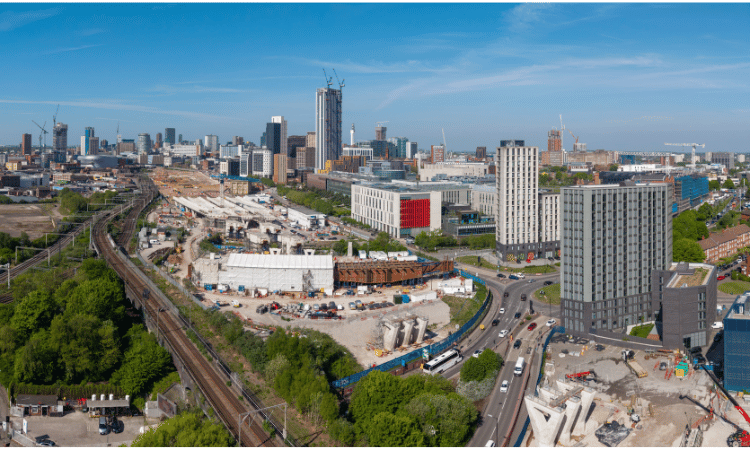
Two schemes alone, Ladywood at £2.5 billion and Smithfield at £1.9 billion, account for over 15,000 of the homes Birmingham is planning to build, and the bulk of that supply lands after 2028. The investment is concentrated in and around the city centre, where the wider development pipeline runs into the billions and the residential component is large enough to shift the supply picture in the postcodes near it.
- Ladywood Estate Regeneration (Masterplanning, £2.5 billion): Birmingham City Council and Berkeley St Joseph signed a development agreement in spring 2025 to deliver up to 12,000 new homes in Ladywood over a roughly 20-year horizon, at least 20% of them affordable, with existing council homes maintained, renewed or replaced. The council describes it as one of Europe's single biggest urban regeneration sites, capable of delivering around 10% of the city's housing need to 2044, and projects up to 41,000 jobs. A planning application is expected in 2026 with construction from 2028. Updates at Berkeley Group.
- Birmingham Smithfield (Under construction, £1.9 billion): A 17-hectare mixed-use scheme on the former wholesale markets site south of the Bullring, delivered by Lendlease with Birmingham City Council. The full scheme targets over 3,000 homes alongside retail, leisure and the relocated Bull Ring Markets, with the first residential phase of 408 build-to-rent homes. The council gave the scheme unanimous approval in June 2024, archaeology works are underway, and Phase 1 construction is starting in early 2026. Updates at Invest West Midlands.
- HS2 Curzon Street Station (Under construction): The first new intercity terminus built in Britain since the 19th century, sitting on the edge of the city centre in Eastside. Foundation works completed in 2025 with around 2,000 concrete columns installed, and the station is designed for a 49-minute journey to central London under a 70-metre arched roof, rated BREEAM Excellent. It connects on foot to Moor Street and the Midland Metro, with the project supporting more than 1,000 construction jobs. The opening timeline has moved back following the wider HS2 programme reset. Updates at HS2.
The Digbeth Creative Quarter sits alongside these, with around 6,000 homes in the pipeline across Digbeth and Eastside at a 55% affordable target, anchored by the BBC's move into the Typhoo Tea Factory and a creative cluster that has drawn MasterChef and Digbeth Loc. Studios. For an investor, the practical point is timing: most of this housing supply arrives from 2028 onward, so the schemes shape the medium-term story for the central postcodes rather than this year's rents.
Birmingham Property Market Analysis
Average property prices in Birmingham have risen 436.9% since January 1995, from £43,407 to £233,056. The sections below walk through that journey, the last crash and recovery, then drill into current postcode-level data for sold prices, price per square foot, asking prices, growth, transaction volumes and selling times.
When was the last house price crash in Birmingham?
All sold prices here come from the HM Land Registry House Price Index at Birmingham local authority level, which tracks the market month by month from January 1995 to the latest March 2026 reading. That is 31 years of cycles to read against.
The 1995 to 2007 climb: Birmingham started at £43,407 in January 1995. By December 2000 the average had reached £61,648, and the early 2000s boom then ran hard, lifting prices to £132,493 by December 2005. The market peaked at £144,135 in September 2007, more than three times the 1995 starting point.
2008 to 2009, the financial crisis: Prices fell from the September 2007 peak of £144,135 to a trough of £119,101 in June 2009, a decline of 17.4% over 21 months. The worst year-on-year reading was -14.9% in May 2009. Birmingham's fall was close to the England decline of 18.2% over the same crisis, without the buffer that higher-value markets carried.
2010 to 2013, the flat years: The recovery off the 2009 trough stalled. The average sat at £130,817 in December 2010, drifted to £128,157 by December 2012, and only edged back to £133,510 by December 2013. Birmingham spent roughly four years moving sideways, well short of the pre-crash peak.
Recovery, 2014 to 2016: Growth returned. Prices rose from £141,027 in December 2014 to £144,376 by July 2015, the month the average first passed the September 2007 peak of £144,135. The recovery took just under eight years. By December 2016 the average had reached £161,029, with 8.2% annual growth.
2017 to 2019, steady growth then a pause: Prices climbed from £172,917 in December 2017 to £183,247 by December 2018, then slipped slightly to £182,379 by December 2019 as the market cooled ahead of the pandemic. Annual growth ran between 6% and 7% before that pause.
2020 to 2022, the pandemic surge: The stamp duty holiday and a rush for space lifted Birmingham sharply. The average moved from £184,007 in June 2020 to £192,065 by December 2020, then £207,532 by December 2021 (8.1% annual), and on to £233,948 by December 2022, a 12.7% annual jump.
2023 to present: Higher mortgage rates cooled the market. Prices eased to £222,515 by June 2023 and recorded -3.9% annual growth by December 2023. The average then recovered to an all-time high of £234,500 in November 2024 before settling back to £233,056 by the latest reading in March 2026. The current price is 61.7% above the September 2007 pre-crash peak.
Long-term growth summary:
- 5 years (March 2021 to March 2026): 14.9% growth (£202,880 to £233,056)
- 10 years (March 2016 to March 2026): 53.4% growth (£151,945 to £233,056)
- 15 years (March 2011 to March 2026): 85.3% growth (£125,782 to £233,056)
- 20 years (March 2006 to March 2026): 76.5% growth (£132,040 to £233,056)
- 30 years (January 1995 to March 2026): 436.9% growth (£43,407 to £233,056)
Birmingham's 17.4% crash was close to the national fall, and the eight-year wait to recover the peak reflects the long flat stretch between 2010 and 2013 that held back much of the Midlands. The 30-year return of 436.9% sits above England's, helped by the lower 1995 base. The market also peaked in November 2024 and has eased back a little since, so the most recent year has been flat rather than rising, with the latest annual reading at 0.0%.
- All property types
- Detached
- Semi-detached
- Terraced
- Flats
- All property types
- Detached
- Semi-detached
- Terraced
- Flats
Sold House Prices in Birmingham by Property Type
Every property type in Birmingham sells below the England average, but the discount widens sharply from houses to flats: detached homes are 6.3% under the national figure, flats 32.5% under it. The table below sets Birmingham's sold prices by type against England, drawn from the Land Registry index for March 2026.
| Property Type | Birmingham Average | England Average | Difference |
|---|---|---|---|
| Detached | £441,016 | £470,492 | -6.3% |
| Semi-detached | £273,098 | £288,185 | -5.2% |
| Terraced | £220,450 | £243,788 | -9.6% |
| Flat | £144,874 | £214,563 | -32.5% |
Detached houses at £441,016 carry the narrowest discount at 6.3% below England's £470,492. Birmingham's detached stock concentrates in the Sutton Coldfield postcodes in the north, B74 (Four Oaks, Little Aston) and B75 (Mere Green, Roughley), where detached homes make up roughly half of all property. Annual growth of 0.5% points to a steady rather than fast-moving top end.
Semi-detached houses at £273,098 sit 5.2% below England's £288,185, the smallest gap after detached. This is the backbone of Birmingham's letting stock, found across the mid-suburban postcodes such as B26 (Sheldon, Yardley) at 61.5% semi-detached and B28 (Hall Green) at 60.6%. Annual growth of 1.3% is the strongest of the four types.
Terraced houses at £220,450 come in 9.6% below England's £243,788. Terraced stock is concentrated in the inner postcodes, B11 (Sparkhill, Tyseley) at 48.0% terraced, B18 (Hockley, Jewellery Quarter) at 42.4% and B12 (Balsall Heath, Highgate) at 43.2%, which is exactly where the higher gross yields sit. Annual growth was 0.6%.
Flats and maisonettes at £144,874 show by far the deepest discount at 32.5% below England's £214,563. Birmingham's flat stock skews to the city-centre and Edgbaston postcodes, B15 (Edgbaston) at 58.5% flats and B16 (Ladywood) at 51.9%, much of it leasehold apartment blocks rather than the converted period stock seen in southern cities. Annual change of -3.7% confirms a market that has softened while houses held flat.
Price Per Square Foot in Birmingham
Across Birmingham's postcodes, price per square foot runs from £178 in B6 (Aston) to £394 in B12 (Balsall Heath, Highgate). Measuring by the square foot controls for how big the homes are, so it compares the location rather than the house type. The inner terraced postcodes sit at the bottom, while the apartment-heavy central districts and the premium Sutton Coldfield postcodes sit at the top.
| Rank | Area | Price Per Sq Ft |
|---|---|---|
| 1 | B6 (Aston) | £178 |
| 2 | B19 (Lozells, Newtown) | £178 |
| 3 | B21 (Handsworth) | £186 |
| 4 | B8 (Alum Rock, Ward End) | £201 |
| 5 | B10 (Small Heath) | £205 |
| 6 | B9 (Bordesley Green) | £209 |
| 7 | B18 (Hockley, Jewellery Quarter) | £209 |
| 8 | B11 (Sparkhill, Tyseley) | £214 |
| 9 | B20 (Handsworth Wood) | £216 |
| 10 | B23 (Erdington, Short Heath) | £222 |
| 11 | B35 (Castle Vale) | £223 |
| 12 | B16 (Ladywood) | £235 |
| 13 | B25 (Yardley) | £242 |
| 14 | B33 (Stechford, Kitts Green) | £246 |
| 15 | B44 (Kingstanding) | £246 |
| 16 | B24 (Erdington, Tyburn) | £251 |
| 17 | B34 (Shard End) | £252 |
| 18 | B27 (Acocks Green) | £255 |
| 19 | B32 (Woodgate, Bartley Green) | £258 |
| 20 | B1 (City Centre) | £259 |
| 21 | B38 (Kings Norton) | £261 |
| 22 | B42 (Perry Barr) | £269 |
| 23 | B31 (Northfield) | £272 |
| 24 | B43 (Great Barr, Hamstead) | £273 |
| 25 | B14 (Kings Heath) | £280 |
| 26 | B5 (City Centre, Digbeth) | £282 |
| 27 | B26 (Sheldon, Yardley) | £283 |
| 28 | B45 (Rednal, Rubery) | £284 |
| 29 | B29 (Selly Oak) | £286 |
| 30 | B13 (Moseley) | £287 |
| 31 | B30 (Bournville, Stirchley) | £297 |
| 32 | B28 (Hall Green) | £304 |
| 33 | B15 (Edgbaston) | £305 |
| 34 | B17 (Harborne) | £328 |
| 35 | B73 (Boldmere, Wylde Green) | £328 |
| 36 | B72 (Sutton Coldfield Town Centre) | £332 |
| 37 | B76 (Walmley, Minworth) | £348 |
| 38 | B74 (Four Oaks, Little Aston) | £351 |
| 39 | B75 (Mere Green, Roughley) | £354 |
| 40 | B47 (Hollywood, Wythall) | £366 |
| 41 | B3 (City Centre, Snow Hill) | £372 |
| 42 | B12 (Balsall Heath, Highgate) | £394 |
| 43 | B2 (City Centre, New Street) | Not enough data |
| 44 | B4 (City Centre, Corporation St) | Not enough data |
B6 (Aston) at £178 per square foot is the cheapest space in the city, with B18 (Hockley, Jewellery Quarter) and B9 (Bordesley Green) just above at £209. These are the inner terraced and converted postcodes north and east of the centre, where the floor area is cheap but the stock is older. The low per-foot figure is the other side of the high gross yield those postcodes carry.
B12 tops the table at £394 per square foot, ahead of the Sutton Coldfield postcodes despite its lower asking price. That gap reflects the apartment stock in Balsall Heath and Highgate close to the centre, where buyers pay for compact new-build floor space rather than larger suburban homes. B75 (Mere Green, Roughley) at £354 and B74 (Four Oaks, Little Aston) at £351 lead the suburban end, where the per-foot rate buys established detached housing rather than central convenience.
For Sale Asking Prices in Birmingham
Asking prices across Birmingham's 44 postcodes with data run from £184,439 in B18 (Hockley, Jewellery Quarter) to £516,097 in B74 (Four Oaks, Little Aston), a 2.8-fold spread, with a city-wide mean of £274,029. That hierarchy tracks the geography: cheapest in the inner terraced postcodes, dearest in the Sutton Coldfield north.
| Rank | Area | Asking Price |
|---|---|---|
| 1 | B18 (Hockley, Jewellery Quarter) | £184,439 |
| 2 | B19 (Lozells, Newtown) | £186,395 |
| 3 | B2 (City Centre, New Street) | £191,624 |
| 4 | B3 (City Centre, Snow Hill) | £202,048 |
| 5 | B1 (City Centre) | £207,241 |
| 6 | B16 (Ladywood) | £210,119 |
| 7 | B6 (Aston) | £211,868 |
| 8 | B12 (Balsall Heath, Highgate) | £213,111 |
| 9 | B35 (Castle Vale) | £213,421 |
| 10 | B23 (Erdington, Short Heath) | £215,052 |
| 11 | B21 (Handsworth) | £219,145 |
| 12 | B5 (City Centre, Digbeth) | £222,511 |
| 13 | B44 (Kingstanding) | £226,617 |
| 14 | B33 (Stechford, Kitts Green) | £227,125 |
| 15 | B34 (Shard End) | £227,699 |
| 16 | B9 (Bordesley Green) | £230,286 |
| 17 | B11 (Sparkhill, Tyseley) | £230,572 |
| 18 | B8 (Alum Rock, Ward End) | £235,726 |
| 19 | B10 (Small Heath) | £235,863 |
| 20 | B25 (Yardley) | £236,217 |
| 21 | B27 (Acocks Green) | £239,725 |
| 22 | B42 (Perry Barr) | £242,433 |
| 23 | B15 (Edgbaston) | £248,418 |
| 24 | B26 (Sheldon, Yardley) | £256,565 |
| 25 | B24 (Erdington, Tyburn) | £259,170 |
| 26 | B32 (Woodgate, Bartley Green) | £261,403 |
| 27 | B4 (City Centre, Corporation St) | £263,778 |
| 28 | B31 (Northfield) | £268,882 |
| 29 | B38 (Kings Norton) | £274,172 |
| 30 | B43 (Great Barr, Hamstead) | £278,669 |
| 31 | B14 (Kings Heath) | £280,181 |
| 32 | B30 (Bournville, Stirchley) | £284,881 |
| 33 | B29 (Selly Oak) | £295,984 |
| 34 | B20 (Handsworth Wood) | £316,545 |
| 35 | B13 (Moseley) | £316,950 |
| 36 | B45 (Rednal, Rubery) | £326,251 |
| 37 | B28 (Hall Green) | £334,971 |
| 38 | B76 (Walmley, Minworth) | £373,390 |
| 39 | B17 (Harborne) | £382,611 |
| 40 | B73 (Boldmere, Wylde Green) | £402,330 |
| 41 | B72 (Sutton Coldfield Town Centre) | £422,386 |
| 42 | B47 (Hollywood, Wythall) | £440,298 |
| 43 | B75 (Mere Green, Roughley) | £444,093 |
| 44 | B74 (Four Oaks, Little Aston) | £516,097 |
B18 at £184,439 is the cheapest way into Birmingham and the only postcode here under £185,000. Hockley and the Jewellery Quarter mix older terraces with newer apartment conversions, and the low asking price is what lifts B18 to the top of the yield table. The next step up, B16 (Ladywood) at £210,119, is £25,680 more, which is the largest gap between any two adjacent postcodes at the bottom of this table.
B74 at £516,097 is the most expensive postcode by a clear margin, £71,000 above B75 (Mere Green, Roughley). Four Oaks and Little Aston are detached-house territory on the northern edge of the city, closer in character to the Staffordshire commuter belt than to inner Birmingham. The rental yield data below confirms what that price implies: the premium postcodes earn their return through capital value, not income.
House Price Growth in Birmingham
B9 (Bordesley Green) leads five-year growth at 37.7%, while the volatile city-centre postcodes sit at the bottom, B3 (City Centre, Snow Hill) down 31.0% over five years. The strongest five-year returns sit with the cheaper inner and outer-suburban postcodes; the weakest cluster in the thin city-centre flat markets, where small transaction samples swing the index.
| Area | 1 Year | 3 Years | 5 Years |
|---|---|---|---|
| B9 (Bordesley Green) | 1.8% | 10.9% | 37.7% |
| B26 (Sheldon, Yardley) | 4.3% | 8.9% | 31.8% |
| B44 (Kingstanding) | 4.6% | 7.8% | 31.1% |
| B33 (Stechford, Kitts Green) | 5.9% | 8.2% | 30.4% |
| B10 (Small Heath) | 2.3% | 11.0% | 29.8% |
| B21 (Handsworth) | 1.2% | 5.3% | 28.1% |
| B8 (Alum Rock, Ward End) | 2.9% | 5.4% | 27.9% |
| B35 (Castle Vale) | 0.8% | -1.4% | 27.5% |
| B32 (Woodgate, Bartley Green) | 6.1% | 9.7% | 25.7% |
| B6 (Aston) | -8.2% | 5.0% | 24.5% |
| B43 (Great Barr, Hamstead) | 1.1% | 1.5% | 23.3% |
| B15 (Edgbaston) | 19.0% | 8.8% | 22.6% |
| B31 (Northfield) | -2.4% | 5.3% | 22.4% |
| B34 (Shard End) | -1.1% | 1.1% | 22.2% |
| B24 (Erdington, Tyburn) | 0.0% | 8.3% | 21.0% |
| B23 (Erdington, Short Heath) | 2.4% | 2.1% | 20.8% |
| B11 (Sparkhill, Tyseley) | 4.8% | 6.6% | 20.6% |
| B27 (Acocks Green) | 1.9% | 2.4% | 19.1% |
| B29 (Selly Oak) | 0.3% | 3.2% | 18.5% |
| B38 (Kings Norton) | 5.1% | 15.2% | 18.5% |
| B42 (Perry Barr) | -3.1% | 3.8% | 18.5% |
| B28 (Hall Green) | -1.6% | 0.7% | 17.7% |
| B12 (Balsall Heath, Highgate) | 17.0% | 18.9% | 17.4% |
| B25 (Yardley) | -4.8% | 1.8% | 16.2% |
| B76 (Walmley, Minworth) | 5.9% | 5.5% | 16.0% |
| B14 (Kings Heath) | -1.4% | 0.1% | 15.6% |
| B30 (Bournville, Stirchley) | -1.7% | 2.2% | 13.4% |
| B47 (Hollywood, Wythall) | -2.5% | -2.8% | 13.2% |
| B13 (Moseley) | -3.2% | 4.5% | 11.2% |
| B18 (Hockley, Jewellery Quarter) | -8.0% | -1.8% | 9.6% |
| B75 (Mere Green, Roughley) | 2.8% | 4.5% | 9.3% |
| B45 (Rednal, Rubery) | -4.7% | -0.2% | 8.8% |
| B17 (Harborne) | 11.5% | -1.8% | 7.8% |
| B20 (Handsworth Wood) | 5.2% | -1.1% | 6.9% |
| B74 (Four Oaks, Little Aston) | 6.6% | 4.0% | 5.4% |
| B72 (Sutton Coldfield Town Centre) | 3.4% | 11.5% | 5.2% |
| B16 (Ladywood) | 3.4% | 8.9% | -1.0% |
| B73 (Boldmere, Wylde Green) | -5.4% | -5.8% | -2.6% |
| B19 (Lozells, Newtown) | -8.8% | -2.4% | -5.3% |
| B1 (City Centre) | -22.6% | -23.9% | -18.6% |
| B5 (City Centre, Digbeth) | -31.4% | -36.3% | -22.5% |
| B3 (City Centre, Snow Hill) | -44.3% | -33.0% | -31.0% |
| B2 (City Centre, New Street) | Not enough data | Not enough data | Not enough data |
| B4 (City Centre, Corporation St) | -100.0% | -100.0% | Not enough data |
B9 at 37.7% over five years tops the table, with B26 (Sheldon, Yardley) at 31.8% and B44 (Kingstanding) at 31.1% close behind. These are mid-priced suburban and inner-east postcodes where the recovery from the lower 2021 base has been strongest. B9 paired that five-year run with a more modest 1.8% over the past year, so the bulk of its growth came earlier in the cycle.
At the other end, the city-centre postcodes show the steepest falls: B3 (City Centre, Snow Hill) is down 31.0% over five years, B5 (City Centre, Digbeth) 22.5% and B1 (City Centre) 18.6%. These rest on small numbers of mostly-flat transactions where one quarter's sales can move the average sharply, so they read as data noise more than a market trend. Among the suburban postcodes, B73 (Boldmere, Wylde Green) is the weakest at -2.6% over five years and B16 (Ladywood) -1.0%, held back by the central flat market that the sold-price section showed falling 3.7% nationally. A couple of postcodes show large recent one-year jumps, B15 (Edgbaston) up 19.0% and B12 (Balsall Heath, Highgate) up 17.0%, again on small samples where new-build apartment completions can swing the figure.
Monthly Property Sales in Birmingham
Turnover across Birmingham ranges from 2% of stock changing hands a year in B1 (City Centre) to 33% in B34 (Shard End). Monthly sales volumes and turnover rates show how easily a postcode trades, which matters when the time comes to sell.
| Area | Sales Per Month | Turnover | Asking Price |
|---|---|---|---|
| B31 (Northfield) | 49 | 25% | £268,882 |
| B14 (Kings Heath) | 34 | 21% | £280,181 |
| B23 (Erdington, Short Heath) | 33 | 14% | £215,052 |
| B26 (Sheldon, Yardley) | 32 | 18% | £256,565 |
| B74 (Four Oaks, Little Aston) | 29 | 8% | £516,097 |
| B75 (Mere Green, Roughley) | 29 | 14% | £444,093 |
| B30 (Bournville, Stirchley) | 28 | 26% | £284,881 |
| B44 (Kingstanding) | 28 | 23% | £226,617 |
| B13 (Moseley) | 25 | 13% | £316,950 |
| B12 (Balsall Heath, Highgate) | 23 | 17% | £213,111 |
| B28 (Hall Green) | 23 | 16% | £334,971 |
| B73 (Boldmere, Wylde Green) | 23 | 10% | £402,330 |
| B45 (Rednal, Rubery) | 22 | 29% | £326,251 |
| B27 (Acocks Green) | 21 | 24% | £239,725 |
| B32 (Woodgate, Bartley Green) | 21 | 14% | £261,403 |
| B43 (Great Barr, Hamstead) | 21 | 14% | £278,669 |
| B76 (Walmley, Minworth) | 20 | 11% | £373,390 |
| B17 (Harborne) | 19 | 7% | £382,611 |
| B29 (Selly Oak) | 19 | 14% | £295,984 |
| B38 (Kings Norton) | 19 | 31% | £274,172 |
| B42 (Perry Barr) | 19 | 20% | £242,433 |
| B24 (Erdington, Tyburn) | 18 | 10% | £259,170 |
| B33 (Stechford, Kitts Green) | 18 | 32% | £227,125 |
| B11 (Sparkhill, Tyseley) | 15 | 23% | £230,572 |
| B34 (Shard End) | 15 | 33% | £227,699 |
| B20 (Handsworth Wood) | 14 | 17% | £316,545 |
| B16 (Ladywood) | 11 | 4% | £210,119 |
| B25 (Yardley) | 10 | 30% | £236,217 |
| B8 (Alum Rock, Ward End) | 9 | 20% | £235,726 |
| B21 (Handsworth) | 9 | 14% | £219,145 |
| B47 (Hollywood, Wythall) | 9 | 20% | £440,298 |
| B72 (Sutton Coldfield Town Centre) | 9 | 7% | £422,386 |
| B1 (City Centre) | 8 | 2% | £207,241 |
| B15 (Edgbaston) | 7 | 3% | £248,418 |
| B18 (Hockley, Jewellery Quarter) | 7 | 9% | £184,439 |
| B5 (City Centre, Digbeth) | 6 | 3% | £222,511 |
| B9 (Bordesley Green) | 6 | 15% | £230,286 |
| B19 (Lozells, Newtown) | 4 | 13% | £186,395 |
| B35 (Castle Vale) | 4 | 22% | £213,421 |
| B3 (City Centre, Snow Hill) | 3 | 2% | £202,048 |
| B6 (Aston) | 3 | 20% | £211,868 |
| B10 (Small Heath) | 2 | 8% | £235,863 |
| B2 (City Centre, New Street) | Not enough data | Not enough data | £191,624 |
| B4 (City Centre, Corporation St) | Not enough data | Not enough data | £263,778 |
B34 (Shard End) has the highest turnover at 33%, with B33 (Stechford, Kitts Green) at 32% on 18 sales a month against a £227,125 asking price. These are mid-priced suburban postcodes with a deep pool of semi-detached and terraced family stock, so homes change hands often. For a landlord, high turnover signals an easier exit when the time comes to sell. B31 (Northfield) at 25% runs the highest monthly volume in the table at 49 sales.
B1 (City Centre) records the lowest turnover at 2%, with B15 (Edgbaston) and B3 (City Centre, Snow Hill) close behind, because the central apartment stock sits far longer before selling. B16 (Ladywood) at 4% is the other low-turnover postcode, where the flat market moves slowly. The days-to-sell section below shows what that means in calendar terms.
How Long Properties Take to Sell in Birmingham
Selling speed splits Birmingham widely: B34 (Shard End) clears fastest at about 85 days, while the central flat markets of B1 (City Centre), B3 (City Centre, Snow Hill) and B15 (Edgbaston) sit for over four years on the current rate of sale. Days on market is the typical time a home is listed before it sells, and the months of unsold stock shows how much for-sale supply is sitting there at the current sales rate.
| Area | Avg Days to Sell | Months of Unsold Stock | Market |
|---|---|---|---|
| B34 (Shard End) | 85 | 2.8 | Seller's market |
| B38 (Kings Norton) | 95 | 3.1 | Seller's market |
| B25 (Yardley) | 105 | 3.4 | Seller's market |
| B33 (Stechford, Kitts Green) | 109 | 3.6 | Seller's market |
| B45 (Rednal, Rubery) | 117 | 3.8 | Seller's market |
| B8 (Alum Rock, Ward End) | 122 | 4.0 | Seller's market |
| B35 (Castle Vale) | 122 | 4.0 | Seller's market |
| B11 (Sparkhill, Tyseley) | 127 | 4.2 | Seller's market |
| B30 (Bournville, Stirchley) | 127 | 4.2 | Seller's market |
| B31 (Northfield) | 127 | 4.2 | Seller's market |
| B44 (Kingstanding) | 127 | 4.2 | Seller's market |
| B27 (Acocks Green) | 132 | 4.3 | Seller's market |
| B42 (Perry Barr) | 152 | 5.0 | Seller's market |
| B14 (Kings Heath) | 160 | 5.3 | Seller's market |
| B47 (Hollywood, Wythall) | 160 | 5.3 | Seller's market |
| B6 (Aston) | 169 | 5.6 | Seller's market |
| B9 (Bordesley Green) | 169 | 5.6 | Seller's market |
| B12 (Balsall Heath, Highgate) | 169 | 5.6 | Seller's market |
| B26 (Sheldon, Yardley) | 169 | 5.6 | Seller's market |
| B21 (Handsworth) | 179 | 5.9 | Seller's market |
| B20 (Handsworth Wood) | 190 | 6.3 | Balanced market |
| B19 (Lozells, Newtown) | 203 | 6.7 | Balanced market |
| B28 (Hall Green) | 203 | 6.7 | Balanced market |
| B43 (Great Barr, Hamstead) | 203 | 6.7 | Balanced market |
| B13 (Moseley) | 234 | 7.7 | Balanced market |
| B23 (Erdington, Short Heath) | 234 | 7.7 | Balanced market |
| B32 (Woodgate, Bartley Green) | 234 | 7.7 | Balanced market |
| B75 (Mere Green, Roughley) | 234 | 7.7 | Balanced market |
| B29 (Selly Oak) | 254 | 8.3 | Balanced market |
| B24 (Erdington, Tyburn) | 277 | 9.1 | Balanced market |
| B76 (Walmley, Minworth) | 304 | 10.0 | Balanced market |
| B10 (Small Heath) | 338 | 11.1 | Balanced market |
| B18 (Hockley, Jewellery Quarter) | 338 | 11.1 | Balanced market |
| B73 (Boldmere, Wylde Green) | 338 | 11.1 | Balanced market |
| B74 (Four Oaks, Little Aston) | 380 | 12.5 | Buyer's market |
| B17 (Harborne) | 435 | 14.3 | Buyer's market |
| B72 (Sutton Coldfield Town Centre) | 435 | 14.3 | Buyer's market |
| B16 (Ladywood) | 761 | 25.0 | Buyer's market |
| B5 (City Centre, Digbeth) | 1014 | 33.3 | Buyer's market |
| B1 (City Centre) | 1521 | 50.0 | Buyer's market |
| B3 (City Centre, Snow Hill) | 1521 | 50.0 | Buyer's market |
| B15 (Edgbaston) | 1521 | 50.0 | Buyer's market |
| B2 (City Centre, New Street) | Not enough data | Not enough data | Not enough data |
| B4 (City Centre, Corporation St) | Not enough data | Not enough data | Not enough data |
The suburban family postcodes clear quickest. B34 at 85 days, B25 (Yardley) at 105 and B33 (Stechford, Kitts Green) at 109 each carry under 3.6 months of unsold stock, which the PropertyData reading classes as a seller's market. A faster-moving postcode is less time carrying a property you are trying to move on.
The central apartment postcodes are the opposite. B1, B3 and B15 all show the reading's ceiling of around 1,521 days and 50 months of stock, and B16 (Ladywood) around 761 days and 25 months, reading as buyer's markets where the listed flat supply far outweighs the rate of sale. Those figures rest on thin transaction samples and a glut of new-build apartment listings, so they overstate how long a well-priced individual home would actually take, but the direction is clear: exit liquidity in central Birmingham flats is materially slower than in the suburban house markets.
What Type of Property Can You Buy in Birmingham?
The housing mix swings hard across the city: terraced houses make up 48.0% of stock in B11 (Sparkhill, Tyseley), while detached homes reach 50.6% in B75 (Mere Green, Roughley) and flats reach 58.5% in B15 (Edgbaston). That mix shapes which strategy fits each postcode. The figures below come from 2021 Census records for each postcode.
| Area | Detached | Semi-detached | Terraced | Flats |
|---|---|---|---|---|
| B1 (City Centre) | 0.8% | 2.5% | 3.1% | 93.4% |
| B2 (City Centre, New Street) | 0.7% | 0.4% | 1.0% | 97.8% |
| B3 (City Centre, Snow Hill) | 1.0% | 1.7% | 1.6% | 95.3% |
| B4 (City Centre, Corporation St) | 6.8% | 24.3% | 22.9% | 46.0% |
| B5 (City Centre, Digbeth) | 18.1% | 8.0% | 6.9% | 66.9% |
| B6 (Aston) | 6.9% | 18.3% | 46.1% | 28.5% |
| B8 (Alum Rock, Ward End) | 8.8% | 38.8% | 39.0% | 13.4% |
| B9 (Bordesley Green) | 8.0% | 25.9% | 32.8% | 33.3% |
| B10 (Small Heath) | 8.0% | 23.2% | 51.5% | 17.1% |
| B11 (Sparkhill, Tyseley) | 7.8% | 24.3% | 48.0% | 19.9% |
| B12 (Balsall Heath, Highgate) | 6.3% | 18.6% | 43.2% | 31.8% |
| B13 (Moseley) | 21.0% | 27.6% | 23.8% | 27.6% |
| B14 (Kings Heath) | 10.3% | 40.2% | 29.6% | 19.8% |
| B15 (Edgbaston) | 23.0% | 8.5% | 9.7% | 58.5% |
| B16 (Ladywood) | 11.5% | 19.1% | 17.5% | 51.9% |
| B17 (Harborne) | 23.8% | 31.5% | 21.5% | 23.1% |
| B18 (Hockley, Jewellery Quarter) | 6.5% | 18.5% | 42.4% | 32.0% |
| B19 (Lozells, Newtown) | 5.7% | 15.2% | 29.4% | 49.5% |
| B20 (Handsworth Wood) | 17.1% | 39.9% | 21.9% | 21.0% |
| B21 (Handsworth) | 8.7% | 33.7% | 43.9% | 13.7% |
| B23 (Erdington, Short Heath) | 8.7% | 37.4% | 25.1% | 28.6% |
| B24 (Erdington, Tyburn) | 11.3% | 51.3% | 20.6% | 16.8% |
| B25 (Yardley) | 7.0% | 34.9% | 39.9% | 18.1% |
| B26 (Sheldon, Yardley) | 6.7% | 61.5% | 16.2% | 15.6% |
| B27 (Acocks Green) | 6.5% | 38.8% | 29.3% | 25.3% |
| B28 (Hall Green) | 14.4% | 60.6% | 14.7% | 10.4% |
| B29 (Selly Oak) | 11.4% | 42.5% | 29.1% | 17.0% |
| B30 (Bournville, Stirchley) | 9.4% | 39.0% | 29.6% | 22.0% |
| B31 (Northfield) | 10.8% | 45.9% | 24.7% | 18.6% |
| B32 (Woodgate, Bartley Green) | 16.5% | 41.9% | 25.7% | 16.0% |
| B33 (Stechford, Kitts Green) | 5.5% | 45.7% | 29.9% | 19.0% |
| B34 (Shard End) | 8.3% | 42.7% | 33.0% | 16.0% |
| B35 (Castle Vale) | 5.2% | 37.2% | 36.3% | 21.2% |
| B38 (Kings Norton) | 36.7% | 29.5% | 17.7% | 16.0% |
| B42 (Perry Barr) | 11.0% | 55.2% | 19.5% | 14.4% |
| B43 (Great Barr, Hamstead) | 21.2% | 57.2% | 11.2% | 10.3% |
| B44 (Kingstanding) | 3.4% | 54.2% | 29.9% | 12.5% |
| B45 (Rednal, Rubery) | 48.0% | 31.9% | 12.0% | 8.0% |
| B47 (Hollywood, Wythall) | 46.8% | 35.6% | 10.9% | 6.3% |
| B72 (Sutton Coldfield Town Centre) | 47.0% | 20.0% | 9.3% | 23.7% |
| B73 (Boldmere, Wylde Green) | 27.7% | 26.9% | 7.3% | 38.0% |
| B74 (Four Oaks, Little Aston) | 47.0% | 22.2% | 3.5% | 27.3% |
| B75 (Mere Green, Roughley) | 50.6% | 27.3% | 8.8% | 13.0% |
| B76 (Walmley, Minworth) | 45.0% | 34.0% | 9.2% | 11.9% |
The inner postcodes hold the terraced and flat stock that usually drives buy-to-let. B11 is 48.0% terraced, B12 (Balsall Heath, Highgate) 43.2% terraced and 31.8% flats, and B18 (Hockley, Jewellery Quarter) 42.4% terraced. This is the smaller-unit, lower-priced stock, and it lines up with the inner postcodes carrying the highest gross yields in the city. The central B15 and B16 (Ladywood) are the flat-heavy outliers at 58.5% and 51.9%, suited to single lets rather than family tenancies.
The Sutton Coldfield and outer postcodes sit at the other end. B75 is 50.6% detached, B45 (Rednal, Rubery) 48.0% and B74 (Four Oaks, Little Aston) 47.0%. Detached and semi-detached houses together make up more than three-quarters of the stock in those postcodes, which matches their premium prices and the lowest yields in the city. The housing there is weighted to owner-occupier family homes rather than the smaller units that drive rental income.
Flats include both purpose-built blocks and converted units, and a small share of mobile and temporary dwellings is left out, so the rows may not add to 100%.
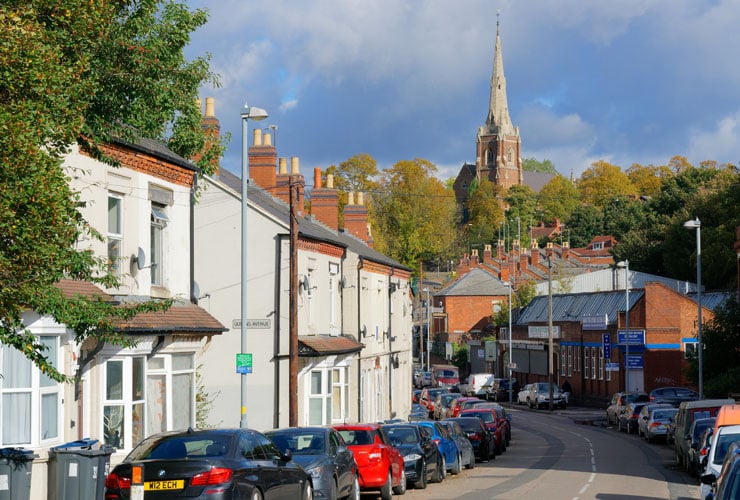
Birmingham Rental Market Analysis
Monthly rents across Birmingham run from £886 in B8 (Alum Rock, Ward End) to £1,338 in B17 (Harborne), with gross yields from 3.0% to 7.2%. For investors weighing whether buy to let is worth it in Birmingham, the sections below break down rents, yields and tenant affordability postcode by postcode. If you are working out how to build a property portfolio in the Midlands, Birmingham's spread lets you target income or growth inside one city. You can also browse buy-to-let homes for sale across the UK.
Average Rent & Gross Rental Yields in Birmingham
Gross rental yields in Birmingham range from 3.0% in B74 (Four Oaks, Little Aston) to 7.2% in B18 (Hockley, Jewellery Quarter). The cheapest postcode delivers the highest yield and the most expensive delivers the lowest, the standard pattern in a city this wide. B18 reaches 7.2% on a £1,114 rent against its £184,439 asking price, while B74 charges more rent at £1,286 yet yields just 3.0% on a £516,097 asking price.
| Area | Average Monthly Rent | Asking Price | Gross Yield |
|---|---|---|---|
| B18 (Hockley, Jewellery Quarter) | £1,114 | £184,439 | 7.2% |
| B3 (City Centre, Snow Hill) | £1,153 | £202,048 | 6.8% |
| B2 (City Centre, New Street) | £1,045 | £191,624 | 6.5% |
| B19 (Lozells, Newtown) | £992 | £186,395 | 6.4% |
| B1 (City Centre) | £1,091 | £207,241 | 6.3% |
| B11 (Sparkhill, Tyseley) | £1,200 | £230,572 | 6.2% |
| B44 (Kingstanding) | £1,170 | £226,617 | 6.2% |
| B5 (City Centre, Digbeth) | £1,092 | £222,511 | 5.9% |
| B33 (Stechford, Kitts Green) | £1,123 | £227,125 | 5.9% |
| B9 (Bordesley Green) | £1,114 | £230,286 | 5.8% |
| B12 (Balsall Heath, Highgate) | £1,028 | £213,111 | 5.8% |
| B16 (Ladywood) | £1,020 | £210,119 | 5.8% |
| B23 (Erdington, Short Heath) | £1,042 | £215,052 | 5.8% |
| B42 (Perry Barr) | £1,160 | £242,433 | 5.7% |
| B4 (City Centre, Corporation St) | £1,218 | £263,778 | 5.5% |
| B43 (Great Barr, Hamstead) | £1,266 | £278,669 | 5.5% |
| B15 (Edgbaston) | £1,127 | £248,418 | 5.4% |
| B32 (Woodgate, Bartley Green) | £1,171 | £261,403 | 5.4% |
| B26 (Sheldon, Yardley) | £1,134 | £256,565 | 5.3% |
| B27 (Acocks Green) | £1,041 | £239,725 | 5.2% |
| B25 (Yardley) | £950 | £236,217 | 4.8% |
| B29 (Selly Oak) | £1,183 | £295,984 | 4.8% |
| B31 (Northfield) | £1,076 | £268,882 | 4.8% |
| B14 (Kings Heath) | £1,095 | £280,181 | 4.7% |
| B28 (Hall Green) | £1,274 | £334,971 | 4.6% |
| B8 (Alum Rock, Ward End) | £886 | £235,726 | 4.5% |
| B24 (Erdington, Tyburn) | £974 | £259,170 | 4.5% |
| B17 (Harborne) | £1,338 | £382,611 | 4.2% |
| B30 (Bournville, Stirchley) | £964 | £284,881 | 4.1% |
| B45 (Rednal, Rubery) | £1,073 | £326,251 | 3.9% |
| B13 (Moseley) | £969 | £316,950 | 3.7% |
| B76 (Walmley, Minworth) | £1,148 | £373,390 | 3.7% |
| B20 (Handsworth Wood) | £918 | £316,545 | 3.5% |
| B73 (Boldmere, Wylde Green) | £1,163 | £402,330 | 3.5% |
| B72 (Sutton Coldfield Town Centre) | £1,157 | £422,386 | 3.3% |
| B75 (Mere Green, Roughley) | £1,232 | £444,093 | 3.3% |
| B74 (Four Oaks, Little Aston) | £1,286 | £516,097 | 3.0% |
| B6 (Aston) | Not enough data | £211,868 | Not enough data |
| B10 (Small Heath) | Not enough data | £235,863 | Not enough data |
| B21 (Handsworth) | Not enough data | £219,145 | Not enough data |
| B34 (Shard End) | Not enough data | £227,699 | Not enough data |
| B35 (Castle Vale) | Not enough data | £213,421 | Not enough data |
| B38 (Kings Norton) | Not enough data | £274,172 | Not enough data |
| B47 (Hollywood, Wythall) | Not enough data | £440,298 | Not enough data |
B18 at 7.2% combines the lowest asking price in the city with a solid £1,114 rent to top the yield table. A 30% deposit of £55,332 buys into the highest-yielding postcode in Birmingham, though the trade-off shows up elsewhere: B18 is slow to sell at around 338 days and rests on a thin transaction sample.
B11 (Sparkhill, Tyseley) and B44 (Kingstanding) follow at 6.2%, both inner-suburban postcodes with terraced and semi-detached stock under £231,000 and strong five-year growth behind them. These are the postcodes where income and a faster sale meet, with B11 clearing in about 127 days.
At the bottom, B74, B75 (Mere Green, Roughley) and B72 (Sutton Coldfield Town Centre) all sit at 3.3% or below. The premium northern postcodes charge the city's higher rents but on asking prices above £420,000, so the income return stays compressed. In Sutton Coldfield the price does more for the capital position than for the yield.
Gross Rental Yield by Postcode (top 10)
Is Birmingham Rent High?
Monthly rents in Birmingham take between 29.5% and 44.6% of the local median gross monthly salary, with all but the cheapest postcode above the 30% affordability mark. The widely cited threshold for rent affordability is 30% of gross income. Only B8 (Alum Rock, Ward End) sits below it, which reflects local earnings running below the national line rather than rents running especially high.
The median gross weekly salary in Birmingham is £692.10, which equates to £2,999 per month or £35,989 per year. This is below the West Midlands regional median of £712.50 per week and the Great Britain median of £752.40 per week. Data from the Nomis Labour Market Profile (ASHE 2025).
| Rank | Area | Rent as % of Income |
|---|---|---|
| 1 | B17 (Harborne) | 44.6% |
| 2 | B74 (Four Oaks, Little Aston) | 42.9% |
| 3 | B28 (Hall Green) | 42.5% |
| 4 | B43 (Great Barr, Hamstead) | 42.2% |
| 5 | B75 (Mere Green, Roughley) | 41.1% |
| 6 | B4 (City Centre, Corporation St) | 40.6% |
| 7 | B11 (Sparkhill, Tyseley) | 40.0% |
| 8 | B29 (Selly Oak) | 39.4% |
| 9 | B32 (Woodgate, Bartley Green) | 39.0% |
| 10 | B44 (Kingstanding) | 39.0% |
| 11 | B73 (Boldmere, Wylde Green) | 38.8% |
| 12 | B42 (Perry Barr) | 38.7% |
| 13 | B72 (Sutton Coldfield Town Centre) | 38.6% |
| 14 | B3 (City Centre, Snow Hill) | 38.4% |
| 15 | B76 (Walmley, Minworth) | 38.3% |
| 16 | B26 (Sheldon, Yardley) | 37.8% |
| 17 | B15 (Edgbaston) | 37.6% |
| 18 | B33 (Stechford, Kitts Green) | 37.4% |
| 19 | B9 (Bordesley Green) | 37.1% |
| 20 | B18 (Hockley, Jewellery Quarter) | 37.1% |
| 21 | B14 (Kings Heath) | 36.5% |
| 22 | B5 (City Centre, Digbeth) | 36.4% |
| 23 | B1 (City Centre) | 36.4% |
| 24 | B31 (Northfield) | 35.9% |
| 25 | B45 (Rednal, Rubery) | 35.8% |
| 26 | B2 (City Centre, New Street) | 34.8% |
| 27 | B23 (Erdington, Short Heath) | 34.7% |
| 28 | B27 (Acocks Green) | 34.7% |
| 29 | B12 (Balsall Heath, Highgate) | 34.3% |
| 30 | B16 (Ladywood) | 34.0% |
| 31 | B19 (Lozells, Newtown) | 33.1% |
| 32 | B24 (Erdington, Tyburn) | 32.5% |
| 33 | B13 (Moseley) | 32.3% |
| 34 | B30 (Bournville, Stirchley) | 32.1% |
| 35 | B25 (Yardley) | 31.7% |
| 36 | B20 (Handsworth Wood) | 30.6% |
| 37 | B8 (Alum Rock, Ward End) | 29.5% |
| 38 | B6 (Aston) | Not enough data |
| 39 | B10 (Small Heath) | Not enough data |
| 40 | B21 (Handsworth) | Not enough data |
| 41 | B34 (Shard End) | Not enough data |
| 42 | B35 (Castle Vale) | Not enough data |
| 43 | B38 (Kings Norton) | Not enough data |
| 44 | B47 (Hollywood, Wythall) | Not enough data |
B8 (Alum Rock, Ward End) at 29.5% is the most affordable for tenants and the only postcode below the 30% line, with B30 (Bournville, Stirchley) at 32.1% and B13 (Moseley) at 32.3% just above it on rents under £970. Affordable rents matter to a landlord because tenants who are not stretched tend to stay longer and fall into arrears less often.
B17 (Harborne) at 44.6% is the least affordable, on the city's highest rent of £1,338. Tenants paying that level in Harborne are typically professional or dual-income households rather than single earners on the median salary, so the headline ratio against one median wage overstates the squeeze on the people actually renting there.
How Big Is Birmingham's Private Rented Sector?
The private rented sector is deepest in the city-centre postcodes, where it reaches 64.8% of households in B2 (City Centre, New Street) and 55.7% in B1 (City Centre), and shallowest on the rural fringe, where B47 (Hollywood, Wythall) sits at 7.7%. The share of homes already rented privately shows how established the tenant pool is in each postcode. The table below shows household tenure across Birmingham.
| Area | Owned Outright | Owned with Mortgage | Private Rented | Social Rented |
|---|---|---|---|---|
| B2 (City Centre, New Street) | 3.8% | 4.7% | 64.8% | 26.1% |
| B3 (City Centre, Snow Hill) | 5.6% | 11.4% | 60.6% | 21.5% |
| B1 (City Centre) | 6.4% | 12.1% | 55.7% | 24.8% |
| B5 (City Centre, Digbeth) | 16.5% | 15.5% | 46.4% | 20.9% |
| B16 (Ladywood) | 17.2% | 17.9% | 40.5% | 23.3% |
| B15 (Edgbaston) | 24.8% | 20.5% | 36.6% | 17.4% |
| B18 (Hockley, Jewellery Quarter) | 15.6% | 14.8% | 31.1% | 37.8% |
| B9 (Bordesley Green) | 21.6% | 19.6% | 28.8% | 28.8% |
| B11 (Sparkhill, Tyseley) | 26.2% | 21.5% | 28.5% | 22.8% |
| B4 (City Centre, Corporation St) | 17.8% | 17.1% | 27.7% | 36.4% |
| B25 (Yardley) | 22.0% | 26.4% | 27.6% | 23.3% |
| B27 (Acocks Green) | 24.9% | 27.3% | 27.2% | 19.6% |
| B10 (Small Heath) | 27.0% | 19.3% | 27.1% | 26.1% |
| B73 (Boldmere, Wylde Green) | 32.2% | 31.3% | 26.8% | 9.3% |
| B21 (Handsworth) | 24.6% | 18.1% | 26.4% | 29.2% |
| B12 (Balsall Heath, Highgate) | 23.4% | 16.1% | 25.9% | 33.5% |
| B23 (Erdington, Short Heath) | 23.2% | 25.5% | 25.9% | 23.5% |
| B6 (Aston) | 18.6% | 16.8% | 25.7% | 37.9% |
| B29 (Selly Oak) | 27.1% | 22.9% | 25.4% | 23.2% |
| B17 (Harborne) | 32.1% | 29.0% | 23.7% | 14.2% |
| B42 (Perry Barr) | 31.6% | 34.7% | 23.4% | 9.6% |
| B8 (Alum Rock, Ward End) | 27.2% | 24.3% | 22.6% | 25.2% |
| B20 (Handsworth Wood) | 31.2% | 24.2% | 22.4% | 21.5% |
| B24 (Erdington, Tyburn) | 26.3% | 29.0% | 22.2% | 20.1% |
| B13 (Moseley) | 33.0% | 28.8% | 21.4% | 16.3% |
| B44 (Kingstanding) | 29.8% | 30.6% | 19.2% | 19.5% |
| B26 (Sheldon, Yardley) | 33.7% | 32.7% | 19.0% | 13.7% |
| B30 (Bournville, Stirchley) | 29.5% | 27.6% | 18.4% | 23.2% |
| B72 (Sutton Coldfield Town Centre) | 45.3% | 34.5% | 17.6% | 2.5% |
| B74 (Four Oaks, Little Aston) | 41.9% | 34.2% | 17.6% | 6.1% |
| B28 (Hall Green) | 38.5% | 36.3% | 16.9% | 7.5% |
| B19 (Lozells, Newtown) | 12.1% | 12.0% | 16.8% | 57.1% |
| B33 (Stechford, Kitts Green) | 24.7% | 25.7% | 16.8% | 31.4% |
| B76 (Walmley, Minworth) | 41.2% | 37.6% | 16.1% | 4.4% |
| B14 (Kings Heath) | 30.8% | 30.4% | 15.5% | 20.8% |
| B32 (Woodgate, Bartley Green) | 32.2% | 26.2% | 15.4% | 24.9% |
| B38 (Kings Norton) | 37.4% | 26.8% | 15.3% | 19.3% |
| B31 (Northfield) | 27.6% | 28.0% | 13.7% | 27.5% |
| B34 (Shard End) | 26.4% | 28.1% | 13.5% | 29.4% |
| B43 (Great Barr, Hamstead) | 42.6% | 37.5% | 13.5% | 5.9% |
| B75 (Mere Green, Roughley) | 44.9% | 38.5% | 11.7% | 4.4% |
| B35 (Castle Vale) | 22.3% | 20.8% | 9.7% | 46.6% |
| B45 (Rednal, Rubery) | 38.1% | 41.3% | 7.9% | 9.9% |
| B47 (Hollywood, Wythall) | 48.6% | 34.8% | 7.7% | 6.8% |
The city-centre postcodes carry the largest private rented sectors, from 64.8% in B2 down through 60.6% in B3 (City Centre, Snow Hill) and 55.7% in B1, the high-density apartment districts where renting is already the dominant tenure. Among the more conventional buy-to-let postcodes, B16 (Ladywood) at 40.5%, B18 (Hockley, Jewellery Quarter) at 31.1% and B9 (Bordesley Green) at 28.8% lead, the inner postcodes that also carry the highest yields, so the deep tenant base and the income return line up. The Sutton Coldfield and rural-fringe postcodes sit at the other end, with private renting at 7.7% in B47 (Hollywood, Wythall) and 11.7% in B75 (Mere Green, Roughley), where outright and mortgaged ownership dominate.
Rental liquidity varies as much as the tenure share. Among the postcodes with enough listings to read, B12 (Balsall Heath, Highgate) lets fastest at around 10 days and reads as a landlord's market, with B18 close behind at 33 days. At the other extreme, B29 (Selly Oak) carries 738 homes on the rental market taking around 262 days to let, which reads as a tenant's market: that is the student belt around the University of Birmingham, where supply is heavy and turnover is seasonal rather than scarce.
Local Housing Allowance Rates in Birmingham
The whole of Birmingham falls within the Birmingham Broad Rental Market Area, where Local Housing Allowance runs from £78.61 a week for a shared room to £253.15 a week for a four-bedroom home. Local Housing Allowance is the most a tenant on housing support can claim toward rent, so for that part of the market it effectively sets a floor. The rates below apply across every Birmingham postcode. To check the current rate for a specific address, you can use the government's official Local Housing Allowance calculator.
| Property Size | Weekly LHA Rate | Monthly Equivalent |
|---|---|---|
| Shared accommodation | £78.61 | £341 |
| 1 bedroom | £159.95 | £693 |
| 2 bedrooms | £172.60 | £748 |
| 3 bedrooms | £189.86 | £823 |
| 4 bedrooms | £253.15 | £1,097 |
The two-bedroom rate of £172.60 a week works out at about £748 a month, below the £886 to £1,338 open-market rents recorded across Birmingham's postcodes. A benefit-backed tenancy at the LHA rate therefore sits under Birmingham's open-market rents, and the stock that fits within it concentrates in the cheaper inner postcodes such as B18, B9 and B44 (Kingstanding) where both asking prices and rents are lowest. Because Birmingham is a single rental market area, these rates are identical in every postcode.
Buy-to-Let Considerations
Are House Prices High in Birmingham? Price-to-Earnings Ratios
Buying across these Birmingham postcodes takes between 5.1 and 14.3 times the local median annual salary. This uses the Nomis Labour Market Profile for Birmingham, which puts the median gross annual income for Birmingham residents at £35,989.
The national benchmark for price-to-earnings is 7.4x (England's average sold price of £289,946 divided by the Great Britain median annual salary of £39,125). Twenty-seven of Birmingham's 44 postcodes sit below that benchmark, meaning they are more affordable against local incomes than the England average is against national incomes.
| Rank | Area | Price-to-Earnings Ratio |
|---|---|---|
| 1 | B18 (Hockley, Jewellery Quarter) | 5.1x |
| 2 | B19 (Lozells, Newtown) | 5.2x |
| 3 | B2 (City Centre, New Street) | 5.3x |
| 4 | B3 (City Centre, Snow Hill) | 5.6x |
| 5 | B1 (City Centre) | 5.8x |
| 6 | B16 (Ladywood) | 5.8x |
| 7 | B6 (Aston) | 5.9x |
| 8 | B12 (Balsall Heath, Highgate) | 5.9x |
| 9 | B35 (Castle Vale) | 5.9x |
| 10 | B23 (Erdington, Short Heath) | 6.0x |
| 11 | B21 (Handsworth) | 6.1x |
| 12 | B5 (City Centre, Digbeth) | 6.2x |
| 13 | B44 (Kingstanding) | 6.3x |
| 14 | B33 (Stechford, Kitts Green) | 6.3x |
| 15 | B34 (Shard End) | 6.3x |
| 16 | B9 (Bordesley Green) | 6.4x |
| 17 | B11 (Sparkhill, Tyseley) | 6.4x |
| 18 | B8 (Alum Rock, Ward End) | 6.5x |
| 19 | B10 (Small Heath) | 6.6x |
| 20 | B25 (Yardley) | 6.6x |
| 21 | B27 (Acocks Green) | 6.7x |
| 22 | B42 (Perry Barr) | 6.7x |
| 23 | B15 (Edgbaston) | 6.9x |
| 24 | B26 (Sheldon, Yardley) | 7.1x |
| 25 | B24 (Erdington, Tyburn) | 7.2x |
| 26 | B32 (Woodgate, Bartley Green) | 7.3x |
| 27 | B4 (City Centre, Corporation St) | 7.3x |
| 28 | B31 (Northfield) | 7.5x |
| 29 | B38 (Kings Norton) | 7.6x |
| 30 | B43 (Great Barr, Hamstead) | 7.7x |
| 31 | B14 (Kings Heath) | 7.8x |
| 32 | B30 (Bournville, Stirchley) | 7.9x |
| 33 | B29 (Selly Oak) | 8.2x |
| 34 | B20 (Handsworth Wood) | 8.8x |
| 35 | B13 (Moseley) | 8.8x |
| 36 | B45 (Rednal, Rubery) | 9.1x |
| 37 | B28 (Hall Green) | 9.3x |
| 38 | B76 (Walmley, Minworth) | 10.4x |
| 39 | B17 (Harborne) | 10.6x |
| 40 | B73 (Boldmere, Wylde Green) | 11.2x |
| 41 | B72 (Sutton Coldfield Town Centre) | 11.7x |
| 42 | B47 (Hollywood, Wythall) | 12.2x |
| 43 | B75 (Mere Green, Roughley) | 12.3x |
| 44 | B74 (Four Oaks, Little Aston) | 14.3x |
B18 (Hockley, Jewellery Quarter) at 5.1x is the most affordable postcode against local earnings, well under the national 7.4x. That ratio is competitive with many of the Midlands' highest-yielding postcodes, and it is the arithmetic behind B18's 7.2% yield. Most of the table, from B18 up to B4 (City Centre, Corporation St) at 7.3x, sits below the national benchmark; only the premium suburban postcodes climb above it.
B74 (Four Oaks, Little Aston) at 14.3x sits furthest above the benchmark. At more than fourteen times the local median salary, B74 is firmly in premium owner-occupier territory, where buyers are typically dual-income households or those moving in from further south. For an investor, that ratio compresses the yield and lengthens the payback, which is why the premium postcodes sit at the bottom of the yield table.
Deposit Requirements in Birmingham
A 30% deposit on a buy-to-let property in Birmingham ranges from £55,332 in B18 (Hockley, Jewellery Quarter) to £154,829 in B74 (Four Oaks, Little Aston). The gap between the cheapest and dearest deposit is £99,497, almost enough to fund a second deposit in B18. For investors comparing Birmingham with the surrounding West Midlands, these deposits sit above Wolverhampton but well below Solihull.
Beyond the deposit, the stamp duty calculation and the other buy-to-let costs shape the total capital you need.
| Rank | Area | 30% Deposit Required |
|---|---|---|
| 1 | B18 (Hockley, Jewellery Quarter) | £55,332 |
| 2 | B19 (Lozells, Newtown) | £55,918 |
| 3 | B2 (City Centre, New Street) | £57,487 |
| 4 | B3 (City Centre, Snow Hill) | £60,614 |
| 5 | B1 (City Centre) | £62,172 |
| 6 | B16 (Ladywood) | £63,036 |
| 7 | B6 (Aston) | £63,560 |
| 8 | B12 (Balsall Heath, Highgate) | £63,933 |
| 9 | B35 (Castle Vale) | £64,026 |
| 10 | B23 (Erdington, Short Heath) | £64,516 |
| 11 | B21 (Handsworth) | £65,744 |
| 12 | B5 (City Centre, Digbeth) | £66,753 |
| 13 | B44 (Kingstanding) | £67,985 |
| 14 | B33 (Stechford, Kitts Green) | £68,138 |
| 15 | B34 (Shard End) | £68,310 |
| 16 | B9 (Bordesley Green) | £69,086 |
| 17 | B11 (Sparkhill, Tyseley) | £69,172 |
| 18 | B8 (Alum Rock, Ward End) | £70,718 |
| 19 | B10 (Small Heath) | £70,759 |
| 20 | B25 (Yardley) | £70,865 |
| 21 | B27 (Acocks Green) | £71,918 |
| 22 | B42 (Perry Barr) | £72,730 |
| 23 | B15 (Edgbaston) | £74,525 |
| 24 | B26 (Sheldon, Yardley) | £76,970 |
| 25 | B24 (Erdington, Tyburn) | £77,751 |
| 26 | B32 (Woodgate, Bartley Green) | £78,421 |
| 27 | B4 (City Centre, Corporation St) | £79,133 |
| 28 | B31 (Northfield) | £80,665 |
| 29 | B38 (Kings Norton) | £82,252 |
| 30 | B43 (Great Barr, Hamstead) | £83,601 |
| 31 | B14 (Kings Heath) | £84,054 |
| 32 | B30 (Bournville, Stirchley) | £85,464 |
| 33 | B29 (Selly Oak) | £88,795 |
| 34 | B20 (Handsworth Wood) | £94,964 |
| 35 | B13 (Moseley) | £95,085 |
| 36 | B45 (Rednal, Rubery) | £97,875 |
| 37 | B28 (Hall Green) | £100,491 |
| 38 | B76 (Walmley, Minworth) | £112,017 |
| 39 | B17 (Harborne) | £114,783 |
| 40 | B73 (Boldmere, Wylde Green) | £120,699 |
| 41 | B72 (Sutton Coldfield Town Centre) | £126,716 |
| 42 | B47 (Hollywood, Wythall) | £132,089 |
| 43 | B75 (Mere Green, Roughley) | £133,228 |
| 44 | B74 (Four Oaks, Little Aston) | £154,829 |
B18 is the cheapest entry into the city at a £55,332 deposit, and it is also the highest-yielding postcode, the unusual case where the lowest entry cost and the best income return sit together. The next rungs up, B16 (Ladywood) at £63,036 and B12 (Balsall Heath, Highgate) at £63,933, stay under £64,000.
At the top, B74's £154,829 deposit is nearly three times B18's. That extra capital buys detached family homes in Four Oaks on a 3.0% yield, where the return comes from the capital value rather than the monthly rent. The deposit table mirrors the price hierarchy, so the choice of postcode sets both the capital outlay and the income-versus-growth balance in one decision.
What the Birmingham Data Tells Buy-to-Let Investors
In Birmingham the cheapest entry is also the highest-yielding postcode. B18 (Hockley, Jewellery Quarter) carries the top yield at 7.2%, the lowest asking price for an investment property in Birmingham at £184,439, and the most affordable prices against local earnings at 5.1 times income. A 30% deposit there is £55,332, the lowest in the city, on a home renting at £1,114 a month. The trade-off is liquidity: B18 takes around 338 days to sell and rests on a thin transaction sample.
The inner-suburban postcodes are where income and a faster exit meet. B11 (Sparkhill, Tyseley) and B44 (Kingstanding) both yield 6.2% on asking prices under £231,000, with strong five-year growth (20.6% and 31.1%) behind them, and B11 clears in about 127 days against B18's 338. B9 (Bordesley Green) led the city on five-year growth at 37.7%. These mid-priced postcodes carry the deep terraced and semi-detached stock that has historically driven Birmingham's rental market.
The premium Sutton Coldfield postcodes work the other way. B74 (Four Oaks, Little Aston) charges the city's higher rents at £1,286 a month, but a £516,097 asking price and a 14.3 times price-to-earnings ratio pull the yield to 3.0%, the lowest here. In those northern postcodes the price does more for the capital position than for the income. Buyers who want to come in below asking often work the off-market property in Birmingham route, before stock reaches the portals.
Birmingham reads as a wide market rather than a single bet: a 19.6% discount to England on average sold prices, a population over 1.1 million, and billions of regeneration weighted toward the city centre from 2028 onward. The yield band sits with the cheaper inner postcodes and the growth-and-prestige band with Sutton Coldfield, so the city covers both ends without an investor leaving its boundary.
How Birmingham Compares
Birmingham's mean asking price of £274,029 is the second lowest of six West Midlands locations compared here, yet its top yield of 7.2% is the highest in the group. The comparison below sets Birmingham against five neighbours in the conurbation. The mean asking price and mean monthly rent are simple averages across all postcodes with data, and the top gross yield is the single highest postcode yield in each location.
| Location | Mean Asking Price | Mean Monthly Rent | Mean Gross Yield | Top Yield (postcode) |
|---|---|---|---|---|
| Wolverhampton | £255,437 | £986 | 4.6% | 5.5% (WV1) |
| Birmingham | £274,029 | £1,111 | 4.9% | 7.2% (B18) |
| Dudley | £274,570 | £947 | 4.1% | 5.0% (DY4, WV14) |
| Walsall | £284,303 | £1,017 | 4.3% | 6.2% (WS2) |
| Coventry | £293,448 | £1,085 | 4.4% | 6.9% (CV1) |
| Solihull | £503,452 | £1,285 | 3.1% | 5.6% (B37) |
Birmingham combines the second-lowest mean asking price in the table with the highest top yield and the joint-highest mean rent at £1,111. Only Wolverhampton is cheaper to enter, at £255,437, but its top yield of 5.5% trails Birmingham's 7.2%. Dudley sits at almost the same mean asking price as Birmingham but its rents are lower and its top yield is the weakest in the group at 5.0%.
Coventry is the nearest match on the income side, with a 6.9% top yield against Birmingham's 7.2%, though on a higher mean asking price of £293,448. Walsall sits in the middle at a 6.2% top yield. Solihull is the premium outlier at £503,452, nearly double Birmingham's mean asking price, with a 5.6% top yield that reflects its more affluent, owner-occupier base. For a data-driven comparison across all UK locations, see our guide to the best buy-to-let areas.
Frequently Asked Questions
Is Birmingham a good place to live for buy-to-let tenants?
It comes down to jobs and scale. Birmingham is the largest city outside London, with a population over 1.1 million and five universities bringing around 80,000 students a year, so the pool of working and studying renters is deep. Employment runs at 67.0% and unemployment at 7.8%, both worse than the national average, which is why rental demand has historically been firmest in the suburban postcodes with good transport into the centre rather than in the most deprived inner wards.
For a tenant it is an easy place to rent in, with fast trains, a large jobs market and rents that, while above 30% of the local median wage everywhere, still sit below what the same money buys in London or the South East.
What are the best areas in Birmingham for property investment?
Birmingham is wide enough to split cleanly between income and growth. For income, the inner postcodes lead: B18 (Hockley, Jewellery Quarter) tops the yield table at 7.2% on the city's lowest asking price of £184,439, with B11 (Sparkhill, Tyseley) and B44 (Kingstanding) at 6.2% just behind. For growth, B9 (Bordesley Green) led on five-year capital growth at 37.7%, with B26 (Sheldon, Yardley) at 31.8%.
At the other end, the Sutton Coldfield postcodes, B74 (Four Oaks, Little Aston) and B75 (Mere Green, Roughley), are premium owner-occupier territory at over £440,000 with yields around 3%. So if income is the priority, B18 leads on yield and price; if it is capital growth, B9 and the inner-east postcodes have done the work. For the wider picture on where people choose to live, see our guide to the best places to live in Birmingham.
How does Birmingham compare to the rest of the West Midlands for buy-to-let?
Birmingham holds the highest top yield in the conurbation at 7.2%, on the second-lowest mean asking price of £274,029. Wolverhampton has the cheaper mean asking price at £255,437 but its top yield stops at 5.5%. Coventry is the closest match on income at 6.9%, though its homes cost more on average. Solihull is the premium outlier at over £500,000 mean asking, with a 5.6% top yield.
Historically Birmingham has offered the broadest range of the West Midlands markets, from sub-£185,000 inner terraces to Sutton Coldfield homes over half a million, inside one local authority. That breadth, rather than any single headline number, is what sets it apart from its neighbours.
Is there demand for student accommodation in Birmingham?
Yes, and it concentrates around the universities rather than spreading evenly. B29 (Selly Oak) is the clearest example: it carried around 738 homes on the rental market at the latest reading, the deepest rental supply of any postcode here, which reflects the student belt around the University of Birmingham. That depth comes with seasonal voids and more hands-on management than a standard tenancy, which is the shape of the shared-let market around a campus rather than a quiet single let.
On the HMO side, a sample of B29 room adverts puts a double en-suite at around £152 a week, while B18 doubles with a shared bathroom run nearer £119. For the purpose-built end of the market, see our guide to student property investment, and for how the numbers work on a shared house, our guide to investing in HMOs.
Can I find buy-to-let property under £200,000 in Birmingham?
Yes, in the inner postcodes. B18 (Hockley, Jewellery Quarter) averages £184,439, the only postcode in this set under £185,000, and B16 (Ladywood) at £210,119 and B12 (Balsall Heath, Highgate) at £213,111 sit just above. By property type the entry point is lower still: Birmingham flats average £144,874 on the Land Registry index and terraced houses £220,450, so a flat or smaller terrace in the inner postcodes is the way under £200,000.
To beat the asking prices, the cheaper stock often moves through below market value channels before it reaches the portals.
When will HS2 and the city centre regeneration affect Birmingham property prices?
Mostly toward the end of the decade rather than now. The two largest housing schemes, Ladywood (£2.5 billion, up to 12,000 homes) and Smithfield (£1.9 billion, over 3,000 homes), are still at masterplanning or early-construction stage, with Ladywood's planning application due in 2026 and construction from 2028, and Smithfield's first phase starting in early 2026. HS2 Curzon Street is under construction but its opening has moved back following the wider HS2 reset.
So the regeneration shapes the medium-term story for the central postcodes rather than this year's rents. The credibility is in the scale and the signed agreements, but anyone pricing it into a purchase today is looking at a multi-year wait before it shows up in values.
What are average house prices in Birmingham?
On the Land Registry index, the average sold price across Birmingham is £233,056, about 19.6% below the England average of £289,946 as of March 2026, and almost exactly level with the West Midlands regional average. Asking prices by postcode run from £184,439 in B18 (Hockley, Jewellery Quarter) to £516,097 in B74 (Four Oaks, Little Aston), with a city-wide mean of £274,029. By type, detached homes average £441,016, semi-detached £273,098, terraced £220,450 and flats £144,874.
Through a buy-to-let lens, B18 is the cheapest entry and the highest-yielding at 7.2%, while the Sutton Coldfield postcodes are the dearest and lowest-yielding.
What are the Local Housing Allowance rates in Birmingham?
The whole city sits in the Birmingham Broad Rental Market Area, so it shares one set of rates. As of June 2026, Local Housing Allowance runs at £78.61 a week for a shared room, £159.95 for a one-bed, £172.60 for two beds, £189.86 for three and £253.15 for four. That figure is the most a tenant on housing support can claim toward rent, so for that part of the market it sets a floor, and the stock that fits within it concentrates in the cheaper inner postcodes.
What type of property is most common in Birmingham?
It varies sharply by postcode. Semi-detached houses dominate the mid-suburban ring, reaching 61.5% of stock in B26 (Sheldon, Yardley) and 60.6% in B28 (Hall Green). Terraced houses lead the inner postcodes, at 48.0% in B11 (Sparkhill, Tyseley). Detached homes take over in the Sutton Coldfield north, at 50.6% in B75 (Mere Green, Roughley), and flats concentrate in the centre, at 58.5% in B15 (Edgbaston). The smaller terraces and flats that usually suit buy-to-let are clustered in the inner postcodes, which is where the higher yields sit.
How do I buy an investment property in Birmingham?
Decide first whether you are buying for income or for growth, because that points you at a different part of the city. B18 (Hockley, Jewellery Quarter) is the cheapest entry at £184,439 and the highest-yielding at 7.2%, while B9 (Bordesley Green) and the inner-east postcodes have delivered the strongest five-year growth. Budget for a 30% deposit, which runs from £55,332 in B18 to £154,829 in B74 (Four Oaks, Little Aston).
Beyond what is listed openly, many experienced investors buy below asking through off market properties. To see what is available now across the UK, browse available buy-to-let property or start with the wider Property Investments UK resources.
Ready to buy property?
Access off-market investment properties with an average 8%+ annual gross yield (beating the UK's typical 3-5%).
Get property alerts