
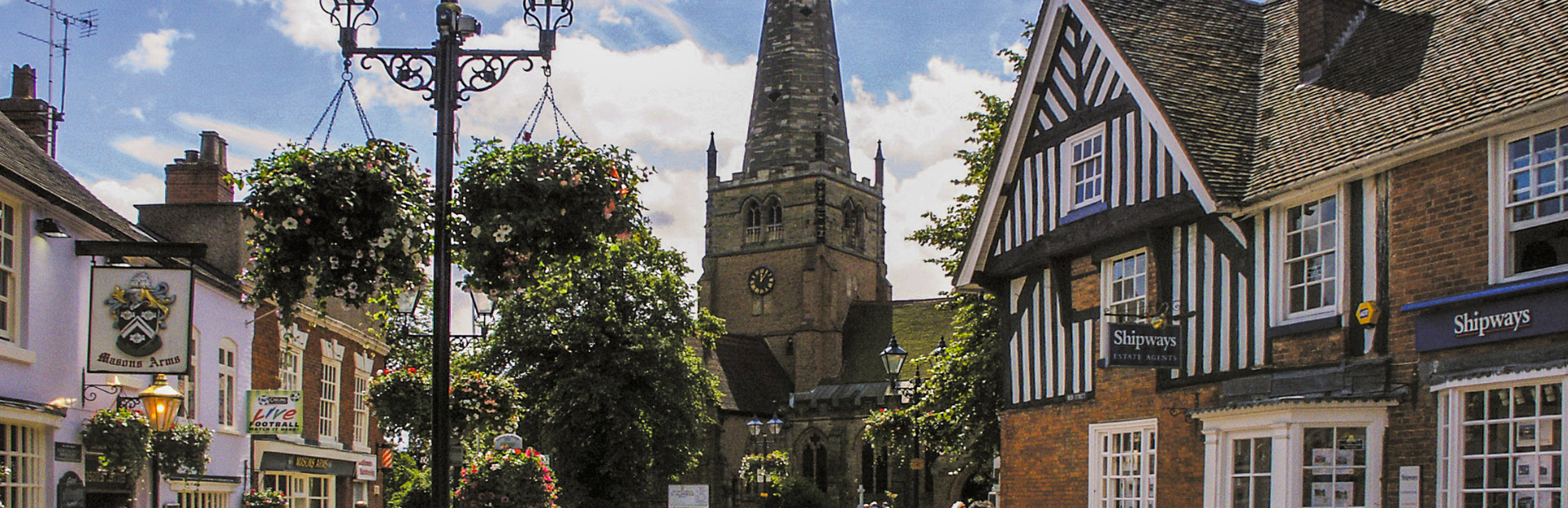
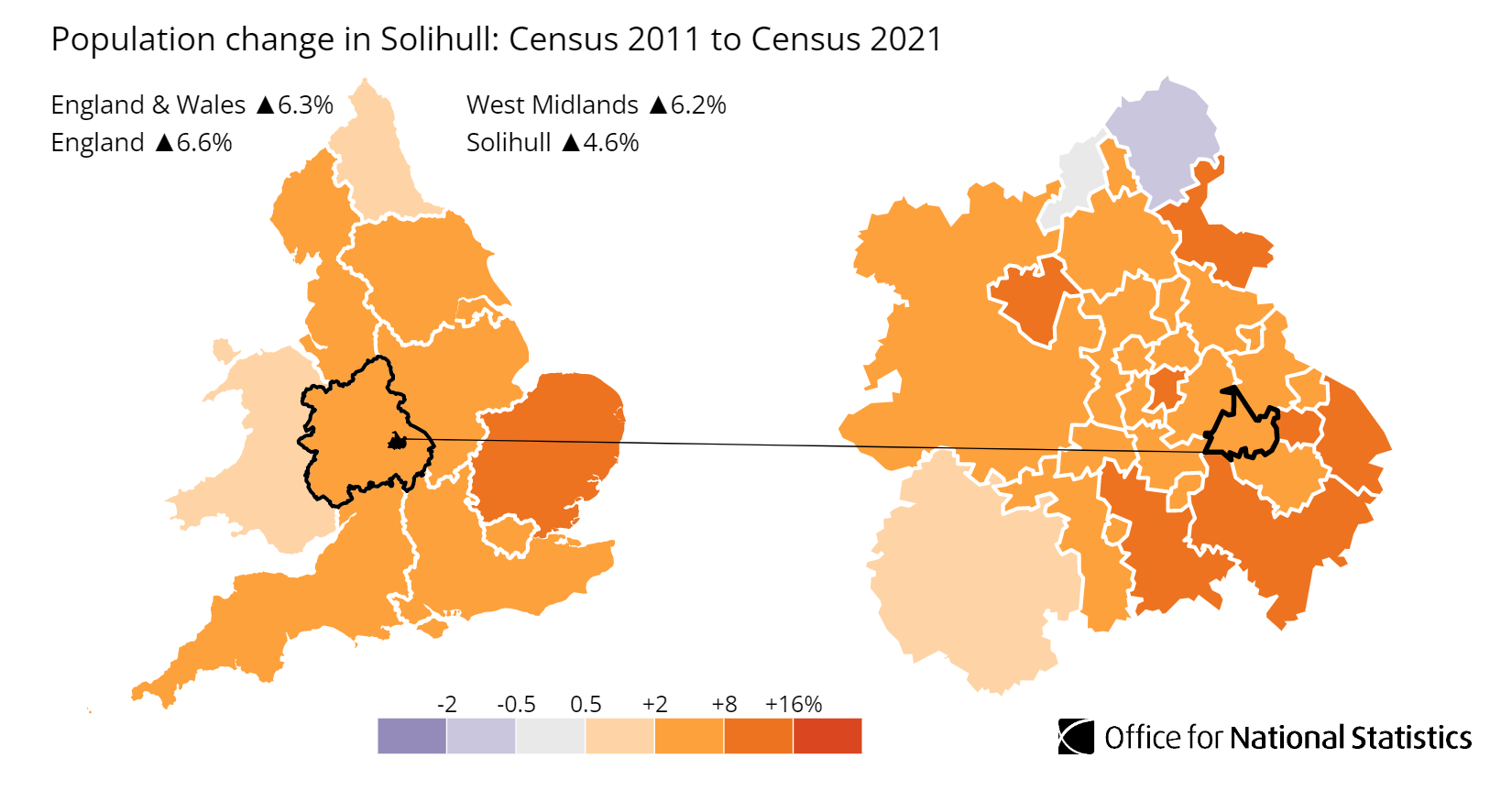
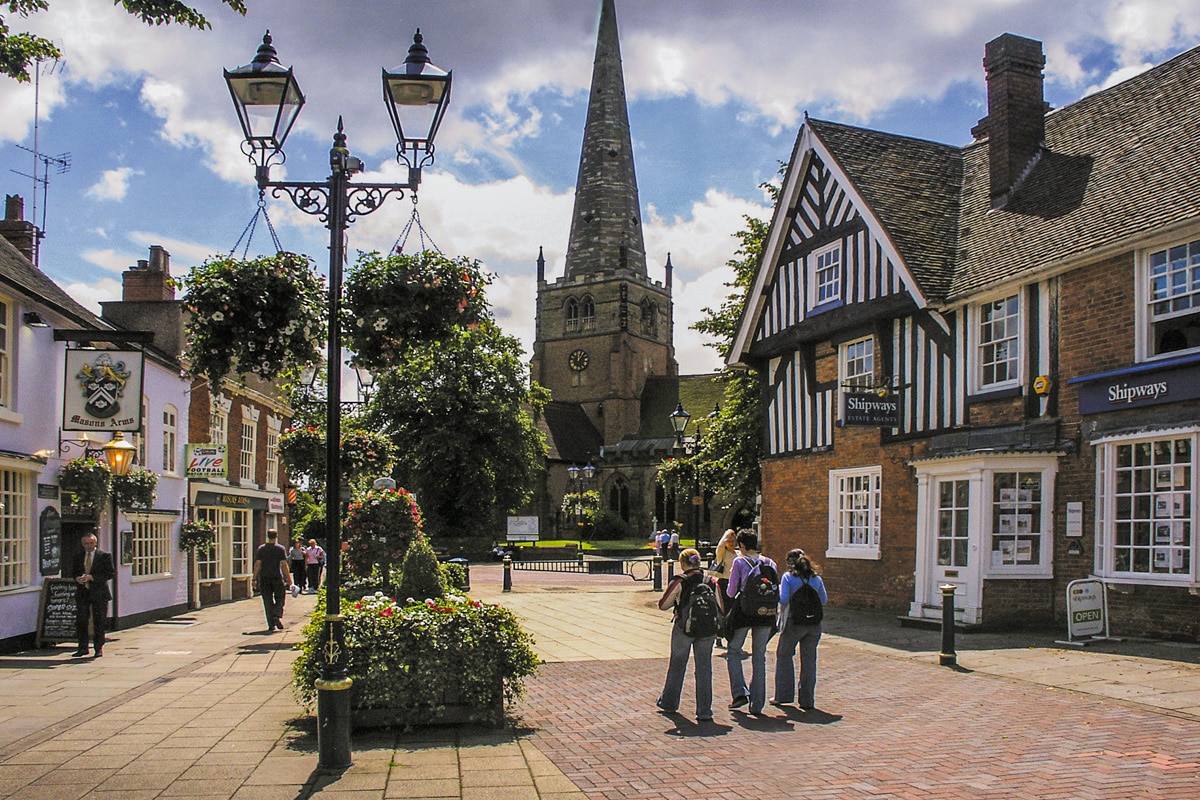
Solihull is a town in the West Midlands, just south-east of Birmingham. The average sold price across Solihull is £330,181 on the HM Land Registry House Price Index, 41.8% above the West Midlands regional average of £232,897 and 13.9% above England's £289,946. That puts Solihull near the top of the regional table. It is the most expensive part of greater Birmingham, and the data behind it reads as a capital-value market first and an income market second. The borough's population grew 4.63% between the 2011 and 2021 censuses, from 206,674 to 216,240 residents.
Solihull's premium is built on its detached stock and its location. Detached homes average £587,998, fully 25.0% above the England average for that type, and the borough sits next to the NEC, Birmingham Airport and the Jaguar Land Rover plant on Lode Lane, with the HS2 Interchange station now under construction at Arden Cross. That employment base supports genuine tenant demand, but it also pushes asking prices up: across the eight postcodes they run from £243,460 in B37 to £841,545 in B94, the widest spread of any location we cover in the West Midlands. The income is concentrated at the northern end. B37, on the Birmingham fringe, is the one postcode that returns a Birmingham-style yield at 5.6%.
This guide covers the metropolitan borough of Solihull (ONS code E08000029) across postcodes B37, B90, B91, B92, B93, B94, B95 and CV7. Solihull sits in the West Midlands, immediately south-east of Birmingham, with the rural Warwickshire fringe to its south. Investors weighing the wider conurbation may also look at buy to let in Birmingham next door.
Article updated: June 2026
Why Invest in Solihull?
Solihull's median gross weekly salary is £901.80, which is 26.6% above the West Midlands figure of £712.50 and 19.9% above the Great Britain median of £752.40. Higher local wages are the foundation of the whole market: they let tenants absorb higher rents, and they explain why prices sit so far above the rest of the region. The borough grew its population 4.63% between the 2011 and 2021 censuses, from 206,674 to 216,240, a slower rate than the England and Wales average of 6.3%, which fits an established, settled area rather than a fast-expanding one.
The local employment rate is 77.2%, above Great Britain's 75.6% and the wider West Midlands. Solihull's economy leans on the NEC and the M42 corridor, with Birmingham Airport, Birmingham Business Park and the Jaguar Land Rover plant at Lode Lane all inside or on the edge of the borough. Median gross annual earnings of £46,896 sit well above the regional pay base, and that mix of high-skilled employment and short commutes into central Birmingham keeps demand for rented homes steady across the northern postcodes.
The wage base matters more here than in most West Midlands locations, because Solihull's prices only make sense against its incomes. A borough where the typical worker earns close to £47,000 a year can support a tenant paying £1,350 a month, and that is the engine behind the yields in B91 and B92 even at asking prices well above £350,000.
Solihull Economic Summary
- Population (Solihull): 216,240 (2021 Census). Growth of 4.63% from 2011.
- Median annual salary: £46,896 (local), £39,125 (Great Britain)
- Median weekly salary: £901.80 (local), £712.50 (West Midlands), £752.40 (Great Britain)
- Employment rate: 77.2% (local), 75.6% (Great Britain)
- Unemployment rate: 5.1% (local)
- Key employment sectors: Automotive manufacturing, aviation and logistics, exhibitions and events, professional services, retail
Source: ONS Census 2021, Nomis Labour Market Profile (ASHE 2025, Employment Oct 2024-Sep 2025)
Regeneration and Investment in Solihull
Solihull is home to one of the UK's largest regeneration projects: the £370 million HS2 Interchange station at Arden Cross, with 3,000 new homes planned around it. The investment is concentrated in the north of the borough, near the NEC and Birmingham Airport, where a new transport node and a major employment campus are being built alongside the exhibition centre.
- Arden Cross / HS2 Interchange (Enabling works commenced, £370 million station; £3.2 billion Health Technology Campus): A new HS2 Interchange station anchors the Arden Cross masterplan, with the £370 million station contract awarded to Laing O'Rourke. Muse Places submitted planning for 1,600 homes in March 2025 as the first phase of a new neighbourhood of around 3,000 homes, and the University of Warwick and Arden Cross Limited are progressing a £3.2 billion Health Technology Campus. An automated people mover will connect the site to the NEC, Birmingham International Station and Birmingham Airport. A station of this scale typically draws new high-skilled jobs into the B92 and B37 postcodes nearby. Updates at Construction Wave.
- East Birmingham to Solihull Metro Extension (Planning and design phase, part of the £1.3 billion West Midlands Metro expansion): A proposed Metro extension would connect East Birmingham through to Solihull and the HS2 Interchange area, linking the existing tram network to the new station. Tram connectivity tends to lift commuter accessibility for the suburbs it reaches, which over time supports rental and capital demand along the route. Updates at Solihull Council.
Source: Office for National Statistics - Population for Solihull
Solihull Property Market Analysis
Average property prices in Solihull have risen 402.0% since January 1995, from £65,777 to £330,181. The sections below break that journey down cycle by cycle, then drill into current postcode-level data for sold prices, price per square foot, asking prices, growth trends, and monthly transaction volumes.
When was the last house price crash in Solihull?
Solihull's sold prices from HM Land Registry are recorded at metropolitan borough level. The Land Registry House Price Index tracks the average from January 1995 to March 2026, covering 31 years of market cycles.
The 1995 to 2007 boom: Solihull started at £65,777 in January 1995. By December 2000 the average had reached £104,756, a 59.3% rise over six years as low interest rates and rising mortgage availability fed demand. Growth carried on through the early 2000s, reaching £188,170 by December 2005, before the market peaked at £207,128 in October 2007.
2008 to 2009, the financial crisis: Prices fell from the October 2007 peak of £207,128 to a trough of £170,714 in May 2009, a decline of 17.6% over 19 months. The worst year-on-year reading came in May 2009 at -12.3%. Solihull's higher-value, owner-occupier-heavy stock did not escape the downturn, but the borough's deep equity base meant fewer forced sales than the lower-priced markets nearby.
The 2010 to 2013 stagnation: Prices bounced off the May 2009 trough but then drifted. By December 2010 the average stood at £184,170, and it was still only £196,186 by December 2013. Solihull spent close to four years moving sideways, unable to push back through its pre-crash peak.
Recovery, 2014: Prices first surpassed the October 2007 peak of £207,128 in August 2014, when the average reached £210,495. The recovery took just under seven years, broadly in line with the wider market.
2015 to 2019, steady pre-pandemic growth: Growth settled into a steadier rhythm. The average climbed from £228,170 in March 2016 to £243,654 by December 2016, then on to £262,824 by December 2019. Annual growth through this stretch ran in the low-to-mid single digits.
2020 to 2022, the pandemic surge: The stamp duty holiday and a rush for space pushed Solihull hard. The average jumped from £262,824 at the end of 2019 to £281,325 by December 2020, then £303,861 by December 2021 and £333,949 by December 2022. The all-time high came in October 2022 at £335,813.
The 2023 rate shock: Higher mortgage rates cooled the market. Prices eased to £324,210 by December 2023, a -2.9% annual reading and the first sustained pullback since the crisis. Solihull's correction was modest, helped by the low-debt, equity-rich profile of much of its housing stock.
2024 to present: Prices recovered to £331,516 by December 2024 (2.3% annual growth) before easing slightly to £330,181 by the latest reading in March 2026. The current average sits just below the October 2022 high, and 59.4% above the pre-crash peak of £207,128.
Long-term growth summary:
- 5 years (March 2021 to March 2026): 10.5% growth (£298,672 to £330,181)
- 10 years (March 2016 to March 2026): 44.7% growth (£228,170 to £330,181)
- 15 years (March 2011 to March 2026): 79.3% growth (£184,170 to £330,181)
- 20 years (March 2006 to March 2026): 77.1% growth (£186,476 to £330,181)
- 30 years (January 1995 to March 2026): 402.0% growth (£65,777 to £330,181)
Solihull's 17.6% crash was in line with the regional and national falls, and the 30-year return of 402.0% reflects strong long-term capital growth on a high-value base. The five-year figure of 10.5% is the softest in the table, which tells you the heat of 2020 to 2022 has come out of the market: a buyer who paid the October 2022 high would be marginally underwater on the index today, while one who bought before the pandemic is comfortably ahead.
- All property types
- Detached
- Semi-detached
- Terraced
- Flats
- All property types
- Detached
- Semi-detached
- Terraced
- Flats
Sold House Prices in Solihull
The average sold price across all property types in Solihull is £330,181, which is 13.9% above the England average of £289,946 as of March 2026. Solihull is one of the few West Midlands markets that trades at a premium to England rather than a discount, and the premium is not spread evenly. Detached houses sit 25.0% above the England figure for their type, while flats are the one category that trades below it. That tells you what kind of place this is: a borough of large family houses rather than a city of apartments.
| Property Type | Solihull Average | England Average | Difference |
|---|---|---|---|
| Detached houses | £587,998 | £470,492 | +25.0% |
| Semi-detached houses | £344,689 | £288,185 | +19.6% |
| Terraced houses | £263,810 | £243,788 | +8.2% |
| Flats and maisonettes | £180,607 | £214,563 | -15.8% |
| All property types | £330,181 | £289,946 | +13.9% |
Detached houses at £587,998 carry the largest premium, 25.0% above England's £470,492. This is the heart of the Solihull market. The detached stock is concentrated in B93 (Knowle, Dorridge), B94 (Hockley Heath) and B95 (Henley-in-Arden), the village belt on the Warwickshire fringe, where buyers pay for space, schools and a semi-rural setting within commuting distance of Birmingham. Annual growth of 1.0% points to a stable, equity-rich market rather than a fast-moving one.
Semi-detached houses at £344,689 sit 19.6% above England's £288,185 and are the workhorse of the borough's lettings market. The semi-detached stock spreads across B90 (Shirley), B91 (Town Centre) and B92 (Olton, Elmdon), the suburban middle of Solihull where most rented family homes are found. Annual growth of 1.8% was the strongest of any property type over the past year.
Terraced houses at £263,810 carry the smallest premium, 8.2% above England's £243,788, and are the most affordable house type in the borough. Terraced stock is most common in the northern postcodes, B37 (Chelmsley Wood, Marston Green) and CV7 (Balsall Common, Meriden) towards the Coventry edge, where prices come closest to the wider regional level. Annual growth of 1.3% keeps terraces broadly in step with the market.
Flats and maisonettes at £180,607 are the only property type to trade below the England average, 15.8% under England's £214,563, and they were the only category to fall over the past year at -3.5%. Solihull has little of the city-centre apartment stock that inflates flat values in central Birmingham or Manchester, so flat prices here reflect local demand alone, mostly a smaller pool of purpose-built blocks in B91 around the town centre.
Price Per Square Foot in Solihull
£229 per square foot separates Solihull's cheapest postcode from its most expensive, with B37 at £235 and B93 at £464. Measuring by the square foot controls for how big the homes are, so it compares the value of one location against another rather than one house type against another. B93 (Knowle, Dorridge) commands the highest rate, which fits its position as the premium village postcode in the borough.
| Rank | Area | Price Per Sq Ft |
|---|---|---|
| 1 | B37 (Chelmsley Wood, Marston Green) | £235 |
| 2 | CV7 (Balsall Common, Meriden) | £302 |
| 3 | B92 (Olton, Elmdon) | £333 |
| 4 | B90 (Shirley, Cheswick Green) | £359 |
| 5 | B91 (Solihull Town Centre) | £375 |
| 6 | B95 (Henley-in-Arden) | £407 |
| 7 | B94 (Hockley Heath) | £430 |
| 8 | B93 (Knowle, Dorridge) | £464 |
B37 at £235 per square foot is the cheapest bricks-and-mortar value in Solihull. This is the Chelmsley Wood and Marston Green end, on the Birmingham boundary, where the housing stock is more affordable and the postcode prices closest to the wider region. Based on 453 transactions analysed, B37's rate sits 49% below B93's.
B93 at £464 per square foot tops the table. When buyers pay this much per square foot they are paying for location, and in B93 that means Knowle's conservation-area centre and the larger detached homes of Dorridge. All 362 transactions analysed show a consistent premium over the rest of the borough.
For Sale Asking Prices in Solihull
B37 at £243,460 and B94 at £841,545 sit 245.7% apart, by far the widest asking-price gap of any location we cover in the West Midlands. That spread mirrors the sold-price hierarchy, but it is more extreme: Solihull is really two markets, a Birmingham-fringe north and a Warwickshire-village south. The mean asking price across all eight postcodes is £503,452.
| Rank | Area | Asking Price |
|---|---|---|
| 1 | B37 (Chelmsley Wood, Marston Green) | £243,460 |
| 2 | B92 (Olton, Elmdon) | £354,162 |
| 3 | B90 (Shirley, Cheswick Green) | £369,855 |
| 4 | CV7 (Balsall Common, Meriden) | £406,232 |
| 5 | B91 (Solihull Town Centre) | £485,476 |
| 6 | B93 (Knowle, Dorridge) | £641,326 |
| 7 | B95 (Henley-in-Arden) | £685,557 |
| 8 | B94 (Hockley Heath) | £841,545 |
B37 at £243,460 is the only postcode where a buy-to-let purchase falls below the borough's Land Registry average of £330,181, and the gap to the next postcode, B92 at £354,162, is £110,702. For an investor on a fixed budget, B37 offers the most property for the money and the lowest barrier into the borough. It is also the postcode that behaves most like neighbouring Birmingham, which is where its yield comes from.
At the other end, B94's £841,545 asking price is owner-occupier territory through and through. Hockley Heath and the surrounding hamlets sit on the rural Warwickshire fringe, where the stock is large detached houses on big plots. The rental data below confirms what the price implies: the income return at this end of the borough does not stack up against the capital outlay.
House Price Growth in Solihull
Three of Solihull's eight postcodes posted positive growth across all three timeframes, with B91 (Town Centre) the strongest at 5.6% one-year, 11.1% three-year and 9.0% five-year. The picture splits sharply by area: the suburban core held up, while the priciest village postcodes have given back ground over one and three years.
| Area | 1 Year | 3 Years | 5 Years |
|---|---|---|---|
| B37 (Chelmsley Wood, Marston Green) | -1.7% | 2.0% | 16.5% |
| B92 (Olton, Elmdon) | 3.2% | 4.8% | 14.2% |
| B91 (Solihull Town Centre) | 5.6% | 11.1% | 9.0% |
| B90 (Shirley, Cheswick Green) | -0.3% | 2.8% | 8.1% |
| B93 (Knowle, Dorridge) | -3.0% | -3.0% | 6.7% |
| B95 (Henley-in-Arden) | -9.8% | -15.2% | 4.1% |
| CV7 (Balsall Common, Meriden) | -2.2% | -0.5% | -6.2% |
| B94 (Hockley Heath) | -9.7% | -20.1% | -9.9% |
B37 at 16.5% five-year growth and B92 at 14.2% lead the table over the longer window, and both come from the more affordable, more liquid end of the borough. B91 is the one postcode positive across all three timeframes, with the town centre's suburban family stock proving the most resilient through the recent rate cycle.
The premium village postcodes tell the opposite story over the shorter windows. B94 (Hockley Heath) is down 20.1% over three years and B95 (Henley-in-Arden) down 15.2%, as the very top of the market, the £700,000-plus detached homes that surged through 2021 and 2022, has cooled hardest. Transaction volumes there are thin, so a handful of high-value sales moves these figures sharply; the longer-run picture is steadier than the one-year readings suggest.
Monthly Property Sales in Solihull
Monthly transaction volumes range from 4 sales in B95 to 45 in B90, with turnover rates from 5% to 17% across the borough. The busiest postcodes are the suburban middle, where mid-priced family homes change hands regularly; the quietest are the village postcodes, where high prices and a small pool of stock mean far fewer sales.
| Area | Sales Per Month | Turnover | Asking Price |
|---|---|---|---|
| B90 (Shirley, Cheswick Green) | 45 | 13% | £369,855 |
| B91 (Solihull Town Centre) | 34 | 12% | £485,476 |
| B92 (Olton, Elmdon) | 34 | 14% | £354,162 |
| CV7 (Balsall Common, Meriden) | 30 | 10% | £406,232 |
| B37 (Chelmsley Wood, Marston Green) | 20 | 17% | £243,460 |
| B93 (Knowle, Dorridge) | 19 | 12% | £641,326 |
| B94 (Hockley Heath) | 7 | 7% | £841,545 |
| B95 (Henley-in-Arden) | 4 | 5% | £685,557 |
B37's 17% turnover is the highest in the borough, even though it records only 20 sales a month. Its smaller, cheaper stock changes hands more often as a share of the total, which matters for a landlord because higher turnover means an easier exit when the time comes to sell. B90 records the most sales overall at 45 a month, reflecting the depth of Shirley's mid-priced family market.
At the village end, B95 and B94 turn over just 5% and 7% of stock a year. A high-value home on the Warwickshire fringe can sit for a long time, and that thin liquidity is a real consideration: it shapes both how long your capital is committed and how the next section's selling times read.
How Long Properties Take to Sell in Solihull
Selling speed splits Solihull cleanly by price: B37 (Chelmsley Wood, Marston Green) clears fastest at about 179 days, while B95 (Henley-in-Arden) takes roughly 608 days. A yield figure tells you nothing about how long your money is tied up when you come to sell, and in Solihull that exit time runs from under six months at the cheap end to close to two years at the top. Days on market is the typical time a home is listed before it sells; months of unsold stock shows how much for-sale supply is sitting there at the current rate of sales.
| Area | Avg Days to Sell | Months of Unsold Stock | Market |
|---|---|---|---|
| B37 (Chelmsley Wood, Marston Green) | 179 | 5.9 | Seller's market |
| B92 (Olton, Elmdon) | 234 | 7.7 | Balanced market |
| B93 (Knowle, Dorridge) | 234 | 7.7 | Balanced market |
| B90 (Shirley, Cheswick Green) | 254 | 8.3 | Balanced market |
| B91 (Solihull Town Centre) | 277 | 9.1 | Balanced market |
| CV7 (Balsall Common, Meriden) | 304 | 10.0 | Balanced market |
| B94 (Hockley Heath) | 435 | 14.3 | Buyer's market |
| B95 (Henley-in-Arden) | 608 | 20.0 | Buyer's market |
B37 is the only postcode reading as a seller's market, with 5.9 months of unsold stock against B95's 20.0. That gap is a holding cost most yield comparisons leave out: a B95 home is a far slower thing to sell than a B37 one, and slower exits in the premium postcodes are part of what offsets their capital-growth appeal. For an income-led investor, the fast-moving, cheaper end of the borough is also the more liquid one.
What Type of Property Can You Buy in Solihull?
Detached homes are the largest single category in every Solihull postcode, from 39.8% of stock in B37 to 64.5% in B94, while terraced houses and flats are concentrated in the northern postcodes. The mix of housing stock shapes which strategy fits each area. The figures below are drawn from 2021 Census records for each postcode.
| Area | Detached | Semi-detached | Terraced | Flats |
|---|---|---|---|---|
| B37 (Chelmsley Wood, Marston Green) | 39.8% | 34.2% | 13.6% | 11.2% |
| B90 (Shirley, Cheswick Green) | 45.2% | 34.1% | 9.7% | 10.0% |
| B91 (Solihull Town Centre) | 54.1% | 22.5% | 4.9% | 18.2% |
| B92 (Olton, Elmdon) | 46.7% | 33.0% | 7.9% | 12.2% |
| B93 (Knowle, Dorridge) | 54.5% | 22.8% | 12.3% | 10.3% |
| B94 (Hockley Heath) | 64.5% | 20.4% | 5.6% | 5.8% |
| B95 (Henley-in-Arden) | 53.0% | 26.4% | 8.3% | 5.4% |
| CV7 (Balsall Common, Meriden) | 43.9% | 30.3% | 15.8% | 7.3% |
B37 holds the most balanced mix in the borough, with detached homes at 39.8% sitting alongside the highest terraced share at 13.6% and a flats share of 11.2%. That smaller-unit stock is what typically forms the buy-to-let market, and it lines up with B37 carrying the lowest asking price and the highest gross yield. B91 holds the largest flats share at 18.2%, the purpose-built blocks around the town centre that suit single lets and professional couples.
B94 is the most detached-dominated postcode at 64.5%, with detached and semi-detached houses together making up more than 84% of its stock and the smallest combined terraced-and-flat share. That matches its position as the most expensive postcode and confirms what kind of place it is: large family homes for owner-occupiers, not the smaller units that drive rental income.
The flats figure covers both purpose-built blocks and conversions. A small share of non-standard dwellings is not shown, so rows may not total 100%.
Solihull Rental Market Analysis
Monthly rents in Solihull run from £1,136 in B37 to £1,418 in B93, with gross rental yields from 2.7% to 5.6% across the six postcodes that carry rental data. For investors asking is buy to let worth it in Solihull, the sections below break down rents, yields and tenant affordability postcode by postcode. If you are weighing how to build a property portfolio in the West Midlands, Solihull's combination of high wages and steady employment offers a more resilient tenant base than most of the region, though the headline yields sit below it. Browse the available buy-to-let property across the area.
Average Rent & Gross Rental Yields in Solihull
Gross rental yields in Solihull range from 2.7% in B93 to 5.6% in B37. The cheapest postcode delivers the highest yield and the most expensive, B93, delivers the lowest. B93 charges the highest monthly rent at £1,418 but yields just 2.7% because its £641,326 asking price is more than two and a half times B37's. This is the clearest reading of why Solihull is a capital-value market: rents barely move across the borough while prices climb steeply, so the yield falls as you go up the price ladder.
| Area | Average Monthly Rent | Asking Price | Gross Yield |
|---|---|---|---|
| B37 (Chelmsley Wood, Marston Green) | £1,136 | £243,460 | 5.6% |
| B92 (Olton, Elmdon) | £1,350 | £354,162 | 4.6% |
| B90 (Shirley, Cheswick Green) | £1,238 | £369,855 | 4.0% |
| CV7 (Balsall Common, Meriden) | £1,214 | £406,232 | 3.6% |
| B91 (Solihull Town Centre) | £1,356 | £485,476 | 3.4% |
| B93 (Knowle, Dorridge) | £1,418 | £641,326 | 2.7% |
| B95 (Henley-in-Arden) | Not enough data | £685,557 | Not enough data |
| B94 (Hockley Heath) | Not enough data | £841,545 | Not enough data |
B37 at 5.6% combines the lowest asking price with a competitive rent of £1,136 to deliver the only Birmingham-style yield in the borough. A 30% deposit of £73,038 buys into the highest-yielding postcode in Solihull, on the Birmingham fringe, where the tenant base draws on the wider conurbation's commuters and the workforce around the airport and the NEC.
B93 at 2.7% sits at the bottom of the yield table. The £1,418 rent is the highest in the borough, but against a £641,326 asking price the income return is heavily compressed. Knowle and Dorridge are bought for the homes and the schools, not the yield, and the rental figure here works better as a sense-check on affordability than as an investment case.
Gross Rental Yield by Postcode
Is Solihull Rent High?
Monthly rents in Solihull take between 29.1% and 36.3% of the local median gross monthly salary. The widely cited affordability threshold is 30% of gross income. Only B37 falls below that line; the other five postcodes with rental data sit above it, which reflects rents that are high in absolute terms even though local wages are well above the regional norm.
The median gross weekly salary in Solihull is £901.80, which works out at £3,908 per month or £46,896 per year. That is above both the West Midlands median of £712.50 a week and the Great Britain median of £752.40. Data from the Nomis Labour Market Profile (ASHE 2025).
| Rank | Area | Rent as % of Income |
|---|---|---|
| 1 | B93 (Knowle, Dorridge) | 36.3% |
| 2 | B91 (Solihull Town Centre) | 34.7% |
| 3 | B92 (Olton, Elmdon) | 34.6% |
| 4 | B90 (Shirley, Cheswick Green) | 31.7% |
| 5 | CV7 (Balsall Common, Meriden) | 31.1% |
| 6 | B37 (Chelmsley Wood, Marston Green) | 29.1% |
| - | B95 (Henley-in-Arden) | Not enough data |
| - | B94 (Hockley Heath) | Not enough data |
B37 at 29.1% is the most affordable for tenants, the only postcode where the typical rent of £1,136 leaves headroom against the median Solihull wage. Affordable rents tend to mean fewer arrears and longer tenancies, because a tenant who is not stretched stays put, and that void-and-arrears resilience is part of what underpins B37's income case.
B93 at 36.3% is the least affordable on the median wage, but the context matters. The tenants who can afford £1,418 a month in Knowle and Dorridge are typically dual-income professional households rather than single earners on the borough median, so the headline ratio overstates the real strain on that segment.
How Big Is Solihull's Private Rented Sector?
The private rented sector is deepest in B37 and CV7, at 19.3% and 17.3% of households, and shallowest in B90 at 10.5%. How much of the local stock is already rented privately is a guide to how established and how tested the local lettings market is. The table below shows household tenure by postcode.
| Area | Owned Outright | Owned with Mortgage | Private Rented | Social Rented |
|---|---|---|---|---|
| B37 (Chelmsley Wood, Marston Green) | 39.6% | 28.0% | 19.3% | 12.2% |
| CV7 (Balsall Common, Meriden) | 44.0% | 30.5% | 17.3% | 7.4% |
| B91 (Solihull Town Centre) | 49.8% | 33.3% | 13.5% | 2.8% |
| B92 (Olton, Elmdon) | 43.9% | 37.6% | 13.4% | 4.7% |
| B95 (Henley-in-Arden) | 50.6% | 31.4% | 12.3% | 4.6% |
| B94 (Hockley Heath) | 46.7% | 36.0% | 11.9% | 4.6% |
| B93 (Knowle, Dorridge) | 46.8% | 35.5% | 10.9% | 6.0% |
| B90 (Shirley, Cheswick Green) | 39.4% | 41.7% | 10.5% | 6.6% |
B37 has the largest private rented sector in the borough at 19.3%, the deepest existing tenant pool of any Solihull postcode and a useful signal alongside its top yield. It also carries the highest social-rented share at 12.2%, which fits its mixed housing stock and its position on the Birmingham edge. CV7 follows at 17.3%, its rented sector spread across the commuter villages of Balsall Common and Meriden.
At the other end, B90, B93 and B94 have the smallest rented sectors, around a tenth of households, with much higher owner-occupation. B90 shows the highest share owned with a mortgage at 41.7%, the mark of an established family-buyer postcode rather than a landlord one. A thinner rented sector does not rule out letting, but it does mean a smaller pool of proven local tenant demand.
Of the borough's postcodes, B90, B91 and CV7 carry enough live rental listings to read the lettings market with any confidence, and across all three the balance currently sits with landlords rather than tenants, with homes letting in roughly 32 to 43 days. The remaining postcodes have too few rental listings at any one time to read reliably.
Local Housing Allowance Rates in Solihull
Solihull's postcodes span three Broad Rental Market Areas, so Local Housing Allowance is not uniform across the borough: the Solihull BRMA covers six postcodes, while B37 falls in the Birmingham BRMA and CV7 in the Coventry BRMA. Local Housing Allowance sets the maximum housing support a tenant on benefits can claim, so for that part of the market it acts as a rent floor. Because Solihull straddles three market areas, which BRMA a property sits in changes the figure. To check the current rate for a specific address, you can use the government's official Local Housing Allowance calculator.
| Property Size | Solihull BRMA (weekly) | Birmingham BRMA (B37) | Coventry BRMA (CV7) |
|---|---|---|---|
| Shared accommodation | £94.93 | £78.61 | £99.50 |
| 1 bedroom | £161.10 | £159.95 | £132.33 |
| 2 bedrooms | £189.86 | £172.60 | £155.34 |
| 3 bedrooms | £230.14 | £189.86 | £178.36 |
| 4 bedrooms | £316.44 | £253.15 | £230.14 |
The two-bedroom rate runs from £155.34 a week in the Coventry BRMA up to £189.86 in the Solihull BRMA, which works out at roughly £673 to £823 a month. All three sit well below the £1,136 to £1,418 open-market rents recorded across the borough, so a benefit-backed tenancy underpins the lower end of the market rather than competing for the typical Solihull let. The stock that fits within these rates is concentrated in B37, where both prices and rents are lowest, and the B37 figure follows the Birmingham BRMA because that is the market area it borders. As of June 2026, the rates apply borough-wide within each market area.
Buy-to-Let Considerations
Are House Prices High in Solihull? Price-to-Earnings Ratios
Buying in Solihull takes between 5.2 and 17.9 times the median annual salary, depending on the postcode. This is based on the Nomis Labour Market Profile for Solihull, which puts the median gross annual income for Solihull residents at £46,896.
The national benchmark for price-to-earnings is 7.4x (England's average sold price of £289,946 divided by the Great Britain median annual salary of £39,125). One of Solihull's eight postcodes, B37, sits below that benchmark, meaning it is more affordable relative to local incomes than the England average is relative to national incomes.
| Rank | Area | Price-to-Earnings Ratio |
|---|---|---|
| 1 | B37 (Chelmsley Wood, Marston Green) | 5.2x |
| 2 | B92 (Olton, Elmdon) | 7.6x |
| 3 | B90 (Shirley, Cheswick Green) | 7.9x |
| 4 | CV7 (Balsall Common, Meriden) | 8.7x |
| 5 | B91 (Solihull Town Centre) | 10.4x |
| 6 | B93 (Knowle, Dorridge) | 13.7x |
| 7 | B95 (Henley-in-Arden) | 14.6x |
| 8 | B94 (Hockley Heath) | 17.9x |
B37 at 5.2x is the only Solihull postcode below the national benchmark of 7.4x, and the most affordable entry into the borough relative to local earnings. At a little over five times the local median wage, it is competitive with many of the West Midlands' higher-yielding postcodes, but it sits in a borough with materially higher wages and a deeper employment base.
B94 at 17.9x is the least affordable in the borough by a wide margin. At nearly eighteen times the local median salary, Hockley Heath is firmly in premium owner-occupier territory, bought by dual-income or downsizing households rather than financed against a single local wage. For an investor, a ratio this high compresses the yield and stretches the payback period well beyond what the income can justify.
Deposit Requirements in Solihull
A 30% deposit on a buy-to-let property in Solihull ranges from £73,038 in B37 to £252,464 in B94. The gap between the cheapest and most expensive deposit is £179,426, enough to fund more than two further deposits in B37. For investors comparing Solihull with other West Midlands locations, these deposit requirements sit above Birmingham and Coventry, reflecting the borough's premium pricing.
Beyond the deposit, the stamp duty calculation and other running costs of buy-to-let affect the total capital required.
| Rank | Area | 30% Deposit Required |
|---|---|---|
| 1 | B37 (Chelmsley Wood, Marston Green) | £73,038 |
| 2 | B92 (Olton, Elmdon) | £106,249 |
| 3 | B90 (Shirley, Cheswick Green) | £110,956 |
| 4 | CV7 (Balsall Common, Meriden) | £121,870 |
| 5 | B91 (Solihull Town Centre) | £145,643 |
| 6 | B93 (Knowle, Dorridge) | £192,398 |
| 7 | B95 (Henley-in-Arden) | £205,667 |
| 8 | B94 (Hockley Heath) | £252,464 |
B37 is the cheapest way into Solihull at a £73,038 deposit, and it is also the postcode whose numbers work hardest, pairing the lowest entry with the top 5.6% yield and the fastest sale. Stepping up to B92 costs roughly £33,000 more, and that buys a different proposition: Olton and Elmdon sit deeper in the suburban core, with a 4.6% yield, the second-strongest, on a £1,350 rent and 14.2% five-year growth.
At the top of the table, B93 and B91 require deposits of £192,398 and £145,643, and the extra capital does very little for the income. B91 yields 3.4% and B93 just 2.7%, so the deposit difference between them and B37 is not buying a better return; it is buying capital exposure to the premium village and town-centre stock, a different investment goal entirely.
What the Solihull Data Tells Buy-to-Let Investors
In Solihull, the income lives at the northern edge, not in the affluent core. B37 (Chelmsley Wood, Marston Green) has the top yield at 5.6%, the lowest asking price for an investment property in Solihull at £243,460, the lowest price-to-earnings ratio at 5.2x, and the fastest sale in the borough. A 30% deposit there is £73,038, the lowest by far, for a home renting at £1,136 a month. It is the one postcode that behaves like neighbouring Birmingham, and the data points the same way every time.
B92 (Olton, Elmdon) is the middle ground: a 4.6% yield on a £1,350 rent, 14.2% growth over five years, and a price-to-earnings ratio of 7.6x. It sits deeper in the suburban core than B37, with a deeper owner-occupier base, so it trades a little yield for a more settled residential feel. B91 (Town Centre) is the one postcode positive across one, three and five years, but at a 3.4% yield it leans towards capital stability over income.
The village belt, B93, B94 and B95, is a different investment entirely. Yields run from 2.7% down to where the rental data thins out, deposits climb past £250,000, and selling times stretch towards two years. These postcodes are bought for capital and lifestyle, not cash flow, and an income-led investor will find the maths does not stack up against the northern end. Buyers who want to come in below the asking prices here usually work the off-market property routes, where premium stock often moves before it is openly listed.
Solihull has no selective licensing scheme for private landlords, so mandatory HMO licensing is the main requirement, covered on Solihull Metropolitan Borough Council's property licensing pages. With wages a quarter above the regional norm, an HS2 station rising at Arden Cross and a broad employment base around the airport and the NEC, the borough reads as a capital-value market with one genuine income pocket: lower headline yields than the rest of the West Midlands, on far stronger fundamentals underneath.
How Solihull Compares
Solihull's mean asking price of £503,452 is the highest of five West Midlands locations compared here by a wide margin, yet its top yield of 5.6% sits below all four of its neighbours. The comparison below places Solihull alongside four nearby locations, each with a different investor profile. The mean asking price and mean monthly rent are simple averages across all postcodes with data. Top gross yield is the single highest postcode yield in each location.
| Location | Mean Asking Price | Mean Monthly Rent | Mean Gross Yield | Top Yield (postcode) |
|---|---|---|---|---|
| Wolverhampton | £255,437 | £986 | 4.6% | 5.5% (WV1) |
| Birmingham | £274,029 | £1,111 | 4.9% | 7.2% (B18) |
| Walsall | £284,303 | £1,017 | 4.3% | 6.2% (WS2) |
| Coventry | £293,448 | £1,085 | 4.4% | 6.9% (CV1) |
| Solihull | £503,452 | £1,285 | 3.1% | 5.6% (B37) |
Solihull is the most expensive location in this group at £503,452 mean asking price, around 72% above the next dearest, and the only one where the headline yield does not beat the others: its top of 5.6% sits below Birmingham at 7.2%, Coventry at 6.9% and Walsall at 6.2%. That is the Solihull trade in one line: you pay a clear premium for the borough's wages, schools and setting, and you accept a lower income return for it.
For investors prioritising yield, Birmingham next door and Coventry, the other HS2 borough, deliver materially higher top-line returns at roughly half the entry cost. Wolverhampton offers the lowest asking price in the table. Solihull earns its place for a different investor: one buying into a more affluent, lower-volatility tenant base, with the B37 pocket the single spot where the borough's premium and a competitive yield overlap. For a data-driven comparison across the whole country, see our guide to the highest-yielding buy-to-let areas.
Frequently Asked Questions
Is Solihull a posh, expensive area, and is it a good place to invest?
Solihull is one of the most affluent and expensive boroughs in the West Midlands, and the data backs that up: the typical wage is £901.80 a week, a quarter above the regional figure, and the average sold price of £330,181 sits 13.9% above the England average when most of the region trades below it. The village postcodes, Knowle, Dorridge and Hockley Heath, are firmly upmarket, with detached homes averaging close to £600,000.
For a landlord, that affluence cuts both ways. It supports a stable, higher-earning tenant base and low arrears, but it also pushes prices up faster than rents, which is why yields here are lower than in cheaper parts of the conurbation. The affluence is a capital-value and tenant-quality signal, not a yield one.
What are the best areas in Solihull for property investment?
Solihull splits cleanly by area. For income, B37 (Chelmsley Wood, Marston Green) is the clear pick: the cheapest entry at £243,460, the top yield at 5.6%, the fastest sale, and the only postcode below the national affordability benchmark. B92 (Olton, Elmdon) is the next step, with a 4.6% yield and the borough's strongest medium-term growth.
For capital exposure rather than cash flow, B91 (Town Centre) has been the most resilient, positive across one, three and five years, while the village postcodes B93, B94 and B95 carry the highest prices and the lowest yields. If income matters most, the northern edge near Birmingham leads; if you are buying for the long-term value of premium stock, the south of the borough is where it sits.
What yields can you get on a buy-to-let in Solihull?
Gross yields run from 5.6% in B37 down to 2.7% in B93, across the six postcodes with rental data. B37 on the Birmingham fringe is the only one returning a yield comparable to the wider conurbation; the rest sit between 3% and 4.6%, because rents are fairly even across the borough while prices climb steeply. Rents themselves range from £1,136 a month in B37 to £1,418 in B93.
The pattern is the headline of the whole market: the cheaper the postcode, the higher the yield, because the income does not scale with the price. An investor chasing yield should look hardest at B37 and B92; one buying for capital growth will accept the lower returns further south.
How does Solihull compare to Birmingham for buy-to-let?
They are close neighbours but opposite propositions. Birmingham is the higher-yield, lower-cost end, with a mean asking price of £274,029 and a top yield of 7.2%, against Solihull's £503,452 and 5.6%. Birmingham also gives you far more stock and a deeper student and city-centre rental market to choose from.
Solihull trades that yield for a wealthier, lower-volatility tenant base, higher local wages and a semi-rural setting in its southern postcodes. The exception is B37, which physically borders Birmingham and behaves like it, with a 5.6% yield that closes much of the gap. For most of the borough, though, you are paying a Solihull premium for tenant quality and capital stability, not for income.
Will the HS2 Interchange at Arden Cross lift Solihull property prices?
Not in the short term, but it is the most significant thing happening in the borough. The £370 million Interchange station is under construction, with planning submitted in March 2025 for the first 1,600 of around 3,000 new homes at Arden Cross, plus a £3.2 billion Health Technology Campus with the University of Warwick. The nearest postcodes, B92 and B37, are the ones most likely to feel the effect through new jobs and improved connectivity.
The realistic time horizon is years, not months. Major station projects tend to influence prices once the line opens and the surrounding employment lands, so anyone pricing it in today is taking a long-term view. The 3,000 homes also add fresh supply, which is worth weighing alongside any uplift.
What type of property is most common in Solihull?
Detached houses, by a clear margin, and in every postcode. They run from 39.8% of the stock in B37 up to 64.5% in B94 (Hockley Heath). That detached weighting is the defining feature of the borough and the reason prices sit so far above the region. The smaller homes that usually suit buy-to-let, terraces and flats, are most concentrated in the northern postcodes, with B91 holding the largest flats share at 18.2% around the town centre and B37 the most balanced overall mix.
What are the Local Housing Allowance rates in Solihull?
Solihull is unusual in spanning three Broad Rental Market Areas, so the rates are not uniform. Six postcodes fall in the Solihull BRMA, where as of June 2026 the weekly rate runs from £94.93 for a shared room to £316.44 for a four-bed. B37 follows the Birmingham BRMA (£78.61 to £253.15) and CV7 the Coventry BRMA (£99.50 to £230.14). The figure is the most a tenant on housing support can claim towards rent, so for that part of the market it effectively sets a floor, and which BRMA a property sits in changes that floor.
How do I buy an investment property in Solihull?
Start by deciding whether you are buying for income or for capital, because in Solihull the two point to opposite ends of the borough. For income, B37 (Chelmsley Wood, Marston Green) is the cheapest entry at £243,460 and the highest-yielding at 5.6%. For capital exposure, the town-centre and village postcodes hold premium stock at far lower yields. Budget for a 30% deposit, which runs from £73,038 in B37 to £252,464 in B94.
Beyond what is openly listed, experienced investors often buy below asking through off-market property and below market value property channels, which matters more in a premium market like Solihull where the best-value stock rarely reaches the portals. To see what is available now, browse investment property or current buy-to-let opportunities.
Ready to buy property?
Access off-market investment properties with an average 8%+ annual gross yield (beating the UK's typical 3-5%).
Get property alerts