

Newcastle upon Tyne is a city in Tyne and Wear, in north-east England. Average sold prices across Newcastle upon Tyne sit at £203,273 on the HM Land Registry House Price Index, 25.8% above the North East regional average of £161,629 yet 29.9% below England's £289,946. That places Newcastle in a useful spot for a buy-to-let investor: a major regional capital where the income comes off a low price base. The local authority's population grew 7.1% between the 2011 and 2021 censuses, from 280,177 to 300,125 residents.
Newcastle is where the North East's affordability meets genuine city-scale demand. Two universities put more than 50,000 students into the rental market, the Royal Victoria Infirmary and Freeman Hospital anchor one of the NHS's largest teaching complexes, and the Newcastle Helix science district keeps a life-sciences workforce in the city centre. For investors, the headline is the gross yield: NE1 (City Centre) and NE6 (Byker, Walker) return 9.3% and 9.0%, off asking prices of £141,787 and £172,028. Those are figures the higher-priced South cannot reach.
This guide uses two geographic layers. The population, earnings and Land Registry House Price Index figures refer to Newcastle upon Tyne local authority (ONS code E08000021). The postcode tables compare the wider Newcastle postal market wherever data is available, including NE18 and NE20 in Northumberland. Figures for those postcodes are postal-market comparisons, not Newcastle City Council area statistics.
Data snapshot: The House Price Index figures on this page use the March 2026 release; postcode datasets retain the vintages stated in their sections.
Article updated: July 2026

Why Invest in Newcastle?
Newcastle upon Tyne, the local authority the city sits within, grew its population 7.1% between the 2011 and 2021 censuses, from 280,177 to 300,125 residents. That growth rate is above the England and Wales average of 6.3%, reflecting a city adding residents rather than losing them. Newcastle's pull is its scale: the largest economy in the North East, two universities, and a teaching-hospital cluster that together keep tenant demand running across a wide spread of postcodes.
The local employment rate of 70.0% sits below both the North East average of 71.0% and Great Britain's 75.6%, a figure that understates the city because more than 50,000 students are counted as economically inactive while being very active renters. Newcastle's economy leans on higher education, healthcare and life sciences around Newcastle Helix, digital technology, and a retail and hospitality base anchored by Eldon Square. The two universities, Newcastle and Northumbria, put a structural floor under demand in NE1, NE2 (Jesmond) and NE7 (Heaton).
Median gross annual earnings across Newcastle upon Tyne are £35,446, which is 1.8% above the North East regional median of £34,835 but 9.4% below the Great Britain median of £39,125. Local wages are modest, but so are house prices, and that is the combination that keeps yields high. A tenant base earning regional-level wages can comfortably cover rents that still produce strong returns against Newcastle's low asking prices.
Newcastle Economic Summary
- Population (Newcastle upon Tyne): 300,125 (2021 Census). Growth of 7.1% from 2011.
- Median annual salary: £35,446 (local), £34,835 (North East), £39,125 (Great Britain)
- Employment rate: 70.0% (local), 71.0% (North East), 75.6% (Great Britain)
- Unemployment rate: Not published (ONS sample-size suppression)
- Key employment sectors: Higher education, healthcare and life sciences, digital technology, professional services, retail and hospitality
Source: ONS Census 2021, Nomis Labour Market Profile (ASHE 2025, Employment Oct 2024-Sep 2025)
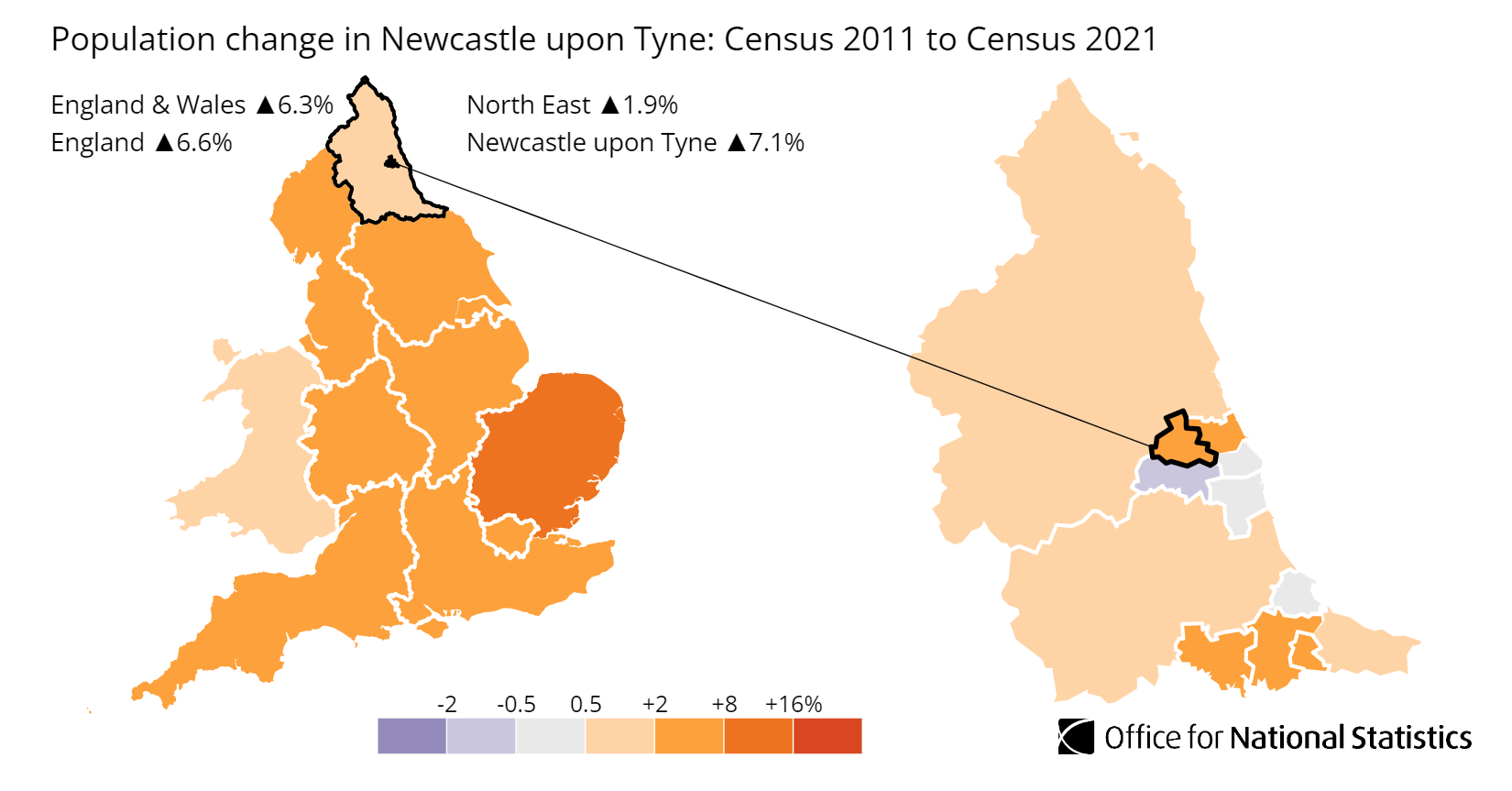
Source: Office for National Statistics - Population for Newcastle upon Tyne
Regeneration and Investment in Newcastle
Newcastle's largest housing pipeline now has government money behind it: £121.8 million of funding to bring forward up to 2,500 homes on the Forth Yards brownfield site by the Tyne. The regeneration here is past the planning-on-paper stage. Money is committed, the Helix science district is open, and the city's last major brownfield site has its remediation funding secured.
- Forth Yards and Quayside West (underway, £121.8m government funding): The transformation of a long-derelict brownfield site on the Tyne into a new mixed-use neighbourhood of up to 2,500 homes, with Homes England leading the Quayside West parcel of around 1,100 homes next to Newcastle Central Station. This is the single largest residential pipeline in the city centre, and the government funding to remediate the land removes the cost that had stalled it for two decades. Updates at GOV.UK.
- Newcastle Helix (operational, life-sciences district): A science and innovation district in central Newcastle now home to The Biosphere, the National Innovation Centre for Data and the National Innovation Centre for Ageing. The wider regional life-sciences ecosystem the council values at around £1.7 billion supports close to 130 organisations and more than 4,000 jobs, with demand for lab and office space prompting the council to seek a private partner to expand. Helix is the working proof that large-scale regeneration delivers in Newcastle. Updates at Newcastle City Council.
- North East AI Growth Zone (committed, £30bn+ regional investment): A data-centre and AI investment programme anchored at Blyth and Cobalt Park near Newcastle, backed by Blackstone and tied to the Stargate UK deployment alongside OpenAI and NVIDIA, with around 5,000 high-skilled roles forecast. The site sits outside the city proper, but the workforce draws on Newcastle's universities and adds to housing demand across Tyneside. Updates at The Catalyst Newcastle.
Newcastle Property Market Analysis
Average property prices in Newcastle upon Tyne have risen 354.4% since January 1995, from £44,733 to £203,273. The sections below break down that journey cycle by cycle, then drill into current postcode-level data for sold prices, price per square foot, asking prices, growth trends, and monthly transaction volumes.
When was the last house price crash in Newcastle?
Newcastle's sold prices are recorded by HM Land Registry at local-authority level for Newcastle upon Tyne. The Land Registry House Price Index tracks average prices from January 1995 to the latest reading, covering more than 30 years of market cycles. Newcastle's crash was middling in depth but unusually long in its recovery, and that is the part worth understanding before you buy.
The 1995 to 2007 build-up: Newcastle started at £44,733 in January 1995. Growth was slow through the late 1990s, reaching £59,807 by December 2000. Then the early-2000s buy-to-let boom took hold and prices nearly tripled in seven years, climbing to £140,974 by December 2005 and peaking at £163,104 in July 2007. Cheap credit and rapid mortgage availability carried prices well past what local wages alone could support.
2008 to 2009, the financial crisis: Prices fell from the July 2007 peak of £163,104 to £132,854 by May 2009, the first leg of a decline that ran deeper than the national average. The worst year-on-year reading was -16.3% in February 2009. Newcastle's fall tracked the North East region more closely than England, where higher-value markets held up better through the early stages of the downturn.
The 2009 to 2013 double dip: This is where Newcastle parted ways with London and the South East. Prices bounced off the 2009 low to £142,213 by December 2010, then slid again. By December 2012 the average had fallen to £131,608, below the 2009 trough. Newcastle spent four years drifting sideways and down while southern markets had already turned the corner.
Recovery, 2014 to 2019: Growth returned slowly. By December 2015 the average reached £151,684, still well short of the pre-crash peak. It was not until September 2019, at £166,661, that prices finally passed the July 2007 high of £163,104. That recovery took just over twelve years, against roughly eight and a half for England. The long climb back is Newcastle's defining recent feature.
2020 to 2022, the pandemic surge: The stamp duty holiday and a shift towards more affordable cities accelerated Newcastle. Prices rose from £164,661 in December 2020 to £174,057 by December 2021 and £185,015 by December 2022. The relative affordability that had held the market back now worked in its favour, as buyers priced out elsewhere looked north.
2023 to present: Higher mortgage rates cooled the market only briefly. Prices reached £188,879 by December 2023 and £196,034 by December 2024, then hit an all-time high of £208,204 in January 2026 before easing to £203,273 by the latest March 2026 reading. The current price is 24.6% above the pre-crash peak of £163,104.
Long-term growth summary:
- 5 years (March 2021 to March 2026): 20.3% growth (£168,922 to £203,273)
- 10 years (March 2016 to March 2026): 35.8% growth (£149,651 to £203,273)
- 15 years (March 2011 to March 2026): 51.9% growth (£133,794 to £203,273)
- 20 years (March 2006 to March 2026): 41.6% growth (£143,548 to £203,273)
- 30 years (January 1995 to March 2026): 354.4% growth (£44,733 to £203,273)
Newcastle's 19.3% peak-to-trough fall, from £163,104 in July 2007 to £131,608 in December 2012, was deeper than Chester's and slower to mend. An investor who bought at the exact July 2007 peak waited until September 2019 to break even on the Land Registry average, then saw a further 24.6% gain by March 2026. The 30-year return of 354.4% is strong, but the twelve-year recovery is the reminder that a regional market like Newcastle can take its time turning a downturn around.
- All property types
- Detached
- Semi-detached
- Terraced
- Flats
- All property types
- Detached
- Semi-detached
- Terraced
- Flats
Sold House Prices in Newcastle
The average sold price across all property types in Newcastle upon Tyne is £203,273, which is 29.9% below the England average of £289,946 as of March 2026. That discount is the heart of Newcastle's yield story, and it widens as you move down the property ladder. Flats sit 41.6% below the England figure, while detached houses are only 16.6% below. The spread reflects a city where the affordable terraced and flat stock that drives rental income is priced a long way under the national benchmark.
| Property Type | Newcastle upon Tyne Average | England Average | Difference |
|---|---|---|---|
| Detached houses | £392,413 | £470,492 | -16.6% |
| Semi-detached houses | £233,335 | £288,185 | -19.0% |
| Terraced houses | £203,246 | £243,788 | -16.6% |
| Flats and maisonettes | £125,342 | £214,563 | -41.6% |
| All property types | £203,273 | £289,946 | -29.9% |
Detached houses at £392,413 carry the smallest discount at 16.6% below England's £470,492. Annual growth of 1.9% points to steady change in the Newcastle upon Tyne local-authority index. The wider postcode comparison below also includes NE18 and NE20 in Northumberland, but those districts are not part of this local-authority average.
Semi-detached houses at £233,335 sit 19.0% below England's £288,185. This is the suburban workhorse of Newcastle's market, with the largest semi-detached shares in NE7 (Heaton, High Heaton) and NE13. Annual growth of 2.3% is the strongest of any property type in the city, reflecting consistent owner-occupier and family-let demand for three-bedroom homes.
Terraced houses at £203,246 offer a 16.6% discount to England's £243,788. The terraced stock spreads across NE6 (Byker, Walker), NE4 (Fenham, Arthur's Hill) and NE5 (Westerhope, Blakelaw), the streets that supply much of Newcastle's lower-cost rental market. Annual growth of 1.5% keeps terraces among the steadier performers.
Flats and maisonettes at £125,342 show the deepest discount at 41.6% below England's £214,563. Flats dominate NE1, where 94.3% of the housing stock is apartments, and make up a large share of NE2 and NE6. The low flat prices are what produce Newcastle's top yields, but annual change of -3.4% confirms a softer market for apartments specifically, a point worth weighing against the headline returns.
Price Per Square Foot in Newcastle
£170 per square foot separates the wider Newcastle postal market's cheapest measured postcode from its most expensive, with NE4 at £159 and NE20 at £329. Measuring by the square foot controls for how big the homes are, so it compares the value of one location against another rather than one house type against another. NE20 covers Ponteland and Darras Hall in Northumberland, outside Newcastle upon Tyne local authority, and tops this broader postcode comparison. Our Land Registry ranking of Newcastle's most expensive streets uses the same wider postal-town scope.
| Rank | Area | Price Per Sq Ft |
|---|---|---|
| 1 | NE4 (Fenham, Arthur's Hill) | £159 |
| 2 | NE15 (Lemington, Newburn) | £181 |
| 3 | NE5 (Westerhope, Blakelaw) | £199 |
| 4 | NE6 (Byker, Walker) | £205 |
| 5 | NE1 (City Centre) | £209 |
| 6 | NE7 (Heaton, High Heaton) | £247 |
| 7 | NE13 (Wideopen, Dinnington) | £253 |
| 8 | NE3 (Gosforth) | £256 |
| 9 | NE2 (Jesmond) | £285 |
| 10 | NE20 (Ponteland, Darras Hall) | £329 |
| - | NE18 (Stamfordham) | Not enough data |
NE4 at £159 per square foot is the cheapest space in Newcastle. Fenham and Arthur's Hill carry a deep stock of terraced and flatted housing close to the universities and the West Road, which keeps the per-foot cost down even as rental demand stays strong. Based on 299 transactions analysed, NE4's rate sits 52% below NE20's.
NE20 at £329 per square foot tops the table. Ponteland and Darras Hall are established commuter villages north-west of the city with a high share of detached stock, and the figure is based on 256 transactions analysed.
For Sale Asking Prices in Newcastle
NE1 at £141,787 and NE20 at £658,436 sit a long way apart, the widest asking-price gap of any North East city in this guide. That hierarchy follows the housing stock: city-centre flats at the bottom, commuter-village detached homes at the top. The mean asking price across the ten Newcastle postcodes with data is £262,699.
| Rank | Area | Asking Price |
|---|---|---|
| 1 | NE1 (City Centre) | £141,787 |
| 2 | NE6 (Byker, Walker) | £172,028 |
| 3 | NE4 (Fenham, Arthur's Hill) | £186,103 |
| 4 | NE5 (Westerhope, Blakelaw) | £197,285 |
| 5 | NE7 (Heaton, High Heaton) | £217,727 |
| 6 | NE15 (Lemington, Newburn) | £225,862 |
| 7 | NE3 (Gosforth) | £247,937 |
| 8 | NE2 (Jesmond) | £281,990 |
| 9 | NE13 (Wideopen, Dinnington) | £297,838 |
| 10 | NE20 (Ponteland, Darras Hall) | £658,436 |
| - | NE18 (Stamfordham) | Not enough data |
NE1 at £141,787 is the cheapest way into Newcastle and the only postcode in the asking-price table below £150,000. The step from NE1 to NE6 is £30,241, and from there the table climbs gently through the inner-city and suburban postcodes. For an investor working to a fixed budget, NE1 and NE6 offer the most income per pound committed, with the trade-offs covered in the yield and selling-time sections below.
NE20's £658,436 asking price is an outlier in a North East context. Ponteland and Darras Hall sit in premium owner-occupier territory, where detached family homes draw buyers from the wider region and from professionals working in the city. At more than four and a half times NE1's asking price, NE20 represents a different price tier from the inner-city postcodes; the rental dataset does not contain enough NE20 evidence to calculate a yield.
House Price Growth in Newcastle
Two Newcastle postcodes posted positive growth across all three timeframes: NE6 at 1.6% (one-year), 14.9% (three-year) and 26.5% (five-year), and NE7 at 10.1%, 12.6% and 14.2%. Every Newcastle postcode with data delivered a positive five-year return, but the recent picture is more mixed, with several inner-city postcodes negative over one year. NE6 (Byker, Walker) leads the five-year table at 26.5%.
| Area | 1 Year | 3 Years | 5 Years |
|---|---|---|---|
| NE6 (Byker, Walker) | 1.6% | 14.9% | 26.5% |
| NE20 (Ponteland, Darras Hall) | -0.9% | -1.0% | 16.2% |
| NE7 (Heaton, High Heaton) | 10.1% | 12.6% | 14.2% |
| NE2 (Jesmond) | 10.0% | -2.5% | 13.3% |
| NE5 (Westerhope, Blakelaw) | -4.9% | -0.4% | 12.8% |
| NE3 (Gosforth) | -1.6% | 14.7% | 12.3% |
| NE15 (Lemington, Newburn) | -6.9% | -8.2% | 5.2% |
| NE1 (City Centre) | -3.6% | -4.9% | 2.0% |
| NE4 (Fenham, Arthur's Hill) | -10.6% | 5.8% | 1.5% |
| NE13 (Wideopen, Dinnington) | 2.7% | -1.0% | 0.6% |
| NE18 (Stamfordham) | Not enough data | Not enough data | Not enough data |
NE6 at 26.5% has the highest five-year return in Newcastle and the rare distinction of being positive across all three timeframes. Byker and Walker, the riverside terraced belt east of the centre, have seen demand build steadily as buyers track the lower asking prices and the area's proximity to the Quayside. NE6 pairs that growth record with the city's second-highest yield, a combination that is unusual in the same postcode.
NE7 (Heaton, High Heaton) is the other postcode positive in every period, at 10.1% over one year, 12.6% over three and 14.2% over five. Heaton's mix of terraced and semi-detached family stock close to the city and the universities supports consistent demand. At the other end, NE15 (Lemington, Newburn) and NE4 carry negative one-year and three-year readings while still holding small positive five-year returns, a reminder that recent direction and longer-term growth can pull in different ways within the same city.
Monthly Property Sales in Newcastle
Transaction volumes vary widely across Newcastle, from 7 sales a month in NE1 to 43 in NE3. The suburban postcodes change hands most often, while the city-centre flat market in NE1 is far quieter. Turnover, the share of stock that sells in a year, ranges from 4% in NE1 to 40% in NE7.
| Area | Sales Per Month | Turnover | Asking Price |
|---|---|---|---|
| NE3 (Gosforth) | 43 | 22% | £247,937 |
| NE5 (Westerhope, Blakelaw) | 42 | 31% | £197,285 |
| NE6 (Byker, Walker) | 35 | 38% | £172,028 |
| NE13 (Wideopen, Dinnington) | 29 | 13% | £297,838 |
| NE15 (Lemington, Newburn) | 27 | 15% | £225,862 |
| NE2 (Jesmond) | 14 | 11% | £281,990 |
| NE4 (Fenham, Arthur's Hill) | 14 | 19% | £186,103 |
| NE7 (Heaton, High Heaton) | 14 | 40% | £217,727 |
| NE20 (Ponteland, Darras Hall) | 11 | 11% | £658,436 |
| NE1 (City Centre) | 7 | 4% | £141,787 |
| NE18 (Stamfordham) | Not enough data | Not enough data | Not enough data |
NE7's 40% turnover rate is the highest in Newcastle, with Heaton's family stock changing hands at almost twice the city's average pace. NE6 is close behind at 38%. For a buy-to-let investor, a high turnover rate signals an easier exit when the time comes to sell, because there is a deep and active pool of buyers for that kind of property.
NE1 records the fewest transactions at 7 per month and the lowest turnover at 4%. The city-centre flat market is thin and slow-moving: a smaller buyer pool, a lot of similar stock, and apartments that sit longer before selling. That quietness is the counterweight to NE1's top yield, and it runs through into the selling-time data below.
How Long Properties Take to Sell in Newcastle
Selling speed splits Newcastle sharply: NE7 (Heaton) clears fastest at about 53 days, while NE1 (City Centre) is slowest at roughly 608 days. Days on market is the typical number of days a home is listed before it sells; the months of unsold stock shows how much for-sale supply is sitting there at the current rate of sales. The gap between the two ends of this table is the widest in any city in this guide, and it matters because a yield figure says nothing about how long your money is tied up at the exit.
| Area | Avg Days to Sell | Months of Unsold Stock | Market |
|---|---|---|---|
| NE7 (Heaton, High Heaton) | 53 | 1.8 | Seller's market |
| NE5 (Westerhope, Blakelaw) | 85 | 2.8 | Seller's market |
| NE6 (Byker, Walker) | 101 | 3.3 | Seller's market |
| NE3 (Gosforth) | 138 | 4.5 | Seller's market |
| NE4 (Fenham, Arthur's Hill) | 169 | 5.6 | Seller's market |
| NE15 (Lemington, Newburn) | 203 | 6.7 | Balanced market |
| NE13 (Wideopen, Dinnington) | 234 | 7.7 | Balanced market |
| NE2 (Jesmond) | 277 | 9.1 | Balanced market |
| NE20 (Ponteland, Darras Hall) | 277 | 9.1 | Balanced market |
| NE1 (City Centre) | 608 | 20.0 | Buyer's market |
NE7 at 1.8 months of unsold stock is the tightest market in the city, and NE6 at 3.3 months is not far behind, so the two postcodes that score well on growth also offer a quick exit. NE1 is the warning at the other end: 20 months of unsold flats and the only buyer's market in Newcastle. A 9.3% yield in NE1 comes with the slowest exit of any postcode here, so the income looks strong on day one but the capital can be hard to release when you want it back.
What Type of Property Can You Buy in Newcastle?
The housing mix swings hard by postcode, from NE1 where 94.3% of stock is flats to NE18 (Stamfordham) where 58.7% is detached. The mix shapes which strategy fits each area. The figures below are drawn from 2021 Census records for each postcode.
| Area | Detached | Semi-detached | Terraced | Flats |
|---|---|---|---|---|
| NE1 (City Centre) | 0.9% | 1.2% | 3.5% | 94.3% |
| NE2 (Jesmond) | 4.8% | 16.1% | 20.2% | 59.0% |
| NE3 (Gosforth) | 21.1% | 38.0% | 20.8% | 20.1% |
| NE4 (Fenham, Arthur's Hill) | 7.3% | 26.9% | 25.5% | 40.2% |
| NE5 (Westerhope, Blakelaw) | 30.0% | 33.2% | 28.9% | 7.8% |
| NE6 (Byker, Walker) | 4.8% | 27.0% | 29.3% | 38.8% |
| NE7 (Heaton, High Heaton) | 27.4% | 44.4% | 13.6% | 14.7% |
| NE13 (Wideopen, Dinnington) | 36.3% | 40.9% | 15.7% | 7.0% |
| NE15 (Lemington, Newburn) | 32.4% | 36.9% | 24.0% | 6.6% |
| NE18 (Stamfordham) | 58.7% | 27.3% | 12.8% | 1.1% |
| NE20 (Ponteland, Darras Hall) | 54.7% | 25.2% | 17.4% | 2.3% |
NE1 is overwhelmingly a flat market at 94.3%, with almost no houses at all. That is the smaller-unit stock that drives the city-centre buy-to-let trade, and it lines up with NE1 carrying the lowest asking price and the joint-highest yield, though it also explains the slow exit. NE2 and NE6 are the other flat-heavy postcodes at 59.0% and 38.8%, supporting single lets and student sharers near Jesmond and the river.
NE18 and NE20 sit at the opposite end, with detached houses at 58.7% and 54.7% and almost no flats. Stamfordham and Ponteland are rural and commuter-village postcodes weighted towards owner-occupier family homes rather than the smaller units that drive rental income, which matches their premium prices. The rental dataset does not contain enough evidence to calculate a yield for either postcode.
Flats combine purpose-built and converted units. A small share of mobile and temporary dwellings is not shown, so rows may not total 100%.

Newcastle Rental Market Analysis
Monthly rents in Newcastle range from £875 in NE5 to £1,565 in NE2, with gross rental yields running from 4.6% to 9.3% across the postcodes with data. For investors asking is buy to let worth it in Newcastle, the sections below break down rents, yields, and tenant affordability postcode by postcode. If you are weighing where to invest for yield in the North East, Newcastle's low asking prices and deep student demand put its top yields among the strongest in the region. Browse current buy-to-let property for sale across the area.
Average Rent & Gross Rental Yields in Newcastle
Gross rental yields in Newcastle run from 4.6% in NE13 to 9.3% in NE1. The cheapest postcodes deliver the highest yields, and the city-centre flat market in NE1 tops the table on the strength of its £141,787 asking price rather than its rent. NE6 (Byker, Walker) is close behind at 9.0%, pairing a strong yield with the best five-year growth in the city.
| Area | Average Monthly Rent | Asking Price | Gross Yield |
|---|---|---|---|
| NE1 (City Centre) | £1,093 | £141,787 | 9.3% |
| NE6 (Byker, Walker) | £1,296 | £172,028 | 9.0% |
| NE2 (Jesmond) | £1,565 | £281,990 | 6.7% |
| NE4 (Fenham, Arthur's Hill) | £1,036 | £186,103 | 6.7% |
| NE7 (Heaton, High Heaton) | £1,061 | £217,727 | 5.8% |
| NE5 (Westerhope, Blakelaw) | £875 | £197,285 | 5.3% |
| NE15 (Lemington, Newburn) | £982 | £225,862 | 5.2% |
| NE3 (Gosforth) | £1,063 | £247,937 | 5.1% |
| NE13 (Wideopen, Dinnington) | £1,130 | £297,838 | 4.6% |
| NE20 (Ponteland, Darras Hall) | Not enough data | £658,436 | Not enough data |
| NE18 (Stamfordham) | Not enough data | Not enough data | Not enough data |
NE1 at 9.3% combines the lowest asking price with a mid-range rent of £1,093 to deliver the top yield. A 30% deposit of £42,536 gets an investor into the highest-yielding postcode in the city, the lowest entry cost in this guide. The income is real, but the earlier selling-time data is the caveat: NE1 flats are slow to sell, so this is a hold-for-income postcode rather than a quick-turnaround one.
NE6 at 9.0% is the more rounded high-yield option. Byker and Walker pair a £1,296 rent against a £172,028 asking price, and unlike NE1 the postcode also delivered the city's best five-year growth and a quick 101-day exit. NE2 (Jesmond) charges the highest rent in Newcastle at £1,565, driven by its student and young-professional market, but its £281,990 asking price pulls the yield down to 6.7%.
Gross Rental Yield by Postcode
Is Newcastle Rent High?
Monthly rents in Newcastle consume between 29.6% and 53.0% of the local median gross monthly salary. The widely cited threshold for rent affordability is 30% of gross income. Only NE5 falls below that line on the median wage, with the rest of the city above it, reflecting Newcastle's modest local earnings against rents pushed up by student and professional demand.
The median gross weekly salary in Newcastle is £681.70, which equates to £2,954 per month or £35,446 per year. This is just above the North East regional median of £669.90 per week but below the Great Britain median of £752.40 per week. Data from the Nomis Labour Market Profile (ASHE 2025).
| Rank | Area | Rent as % of Income |
|---|---|---|
| 1 | NE2 (Jesmond) | 53.0% |
| 2 | NE6 (Byker, Walker) | 43.9% |
| 3 | NE13 (Wideopen, Dinnington) | 38.2% |
| 4 | NE1 (City Centre) | 37.0% |
| 5 | NE3 (Gosforth) | 36.0% |
| 6 | NE7 (Heaton, High Heaton) | 35.9% |
| 7 | NE4 (Fenham, Arthur's Hill) | 35.1% |
| 8 | NE15 (Lemington, Newburn) | 33.2% |
| 9 | NE5 (Westerhope, Blakelaw) | 29.6% |
| - | NE20 (Ponteland, Darras Hall) | Not enough data |
NE5 at 29.6% is the only postcode where the median rent sits inside the 30% affordability mark. A monthly rent of £875 against a monthly salary of £2,954 leaves headroom, which tends to correlate with lower void periods and fewer arrears, because tenants who are not financially stretched stay longer.
NE2 at 53.0% is the least affordable on the median wage, but the figure needs context. Jesmond's £1,565 rent reflects a market built on students sharing the cost and young professionals on above-median incomes, not single earners on the city's median salary. Reading NE2 against the median understates how the rents are actually paid.
How Big Is Newcastle's Private Rented Sector?
The private rented sector is deepest in NE1 and NE2, where it accounts for 61.0% and 46.5% of households, and shallowest in NE13 and NE7 at 10.1% and 14.1%. The share of homes already let privately is a guide to the size of the established tenant pool and the depth of the local lettings market. The table below shows household tenure by postcode.
| Area | Owned Outright | Owned with Mortgage | Private Rented | Social Rented |
|---|---|---|---|---|
| NE1 (City Centre) | 8.5% | 8.1% | 61.0% | 22.0% |
| NE2 (Jesmond) | 16.8% | 12.2% | 46.5% | 23.9% |
| NE18 (Stamfordham) | 40.2% | 23.2% | 34.7% | 1.8% |
| NE20 (Ponteland, Darras Hall) | 41.7% | 27.5% | 27.0% | 3.6% |
| NE4 (Fenham, Arthur's Hill) | 14.9% | 15.7% | 25.9% | 42.8% |
| NE6 (Byker, Walker) | 19.9% | 20.0% | 21.9% | 37.3% |
| NE3 (Gosforth) | 33.8% | 34.9% | 19.5% | 11.3% |
| NE15 (Lemington, Newburn) | 37.4% | 33.6% | 17.6% | 11.0% |
| NE5 (Westerhope, Blakelaw) | 32.2% | 37.8% | 14.8% | 13.8% |
| NE7 (Heaton, High Heaton) | 40.1% | 36.9% | 14.1% | 8.5% |
| NE13 (Wideopen, Dinnington) | 30.8% | 46.6% | 10.1% | 12.2% |
NE1 and NE2 have the largest private rented sectors in Newcastle, at 61.0% and 46.5% of households, which is exactly where the city-centre and Jesmond student and professional markets concentrate. A private rented share that high points to a deep, tested lettings market with a constant flow of tenants, though it also means more landlord competition for those tenants. NE4 and NE6 pair mid-sized rented sectors with large social-rented shares of 42.8% and 37.3%, the inner-west and east terraced belt.
Rental listing volume is healthy enough in several postcodes to read the rental market with confidence. NE3 (Gosforth) currently sits as a landlord's market, with around 75 homes advertised to rent taking about 39 days to let, while NE2, NE4 and NE6 read as tenant's markets where supply is more plentiful and homes take longer to let. NE1 sits balanced, with close to 397 homes advertised, the deepest rental supply in the city.
Local Housing Allowance Rates in Newcastle
All eleven Newcastle postcodes fall within the Tyneside Broad Rental Market Area, where Local Housing Allowance runs from £87.76 a week for a shared room to £212.88 a week for a four-bedroom home. Local Housing Allowance is the maximum housing support a tenant on benefits can claim, so for a landlord letting to that part of the market it acts as a reliable rent floor. The rates below apply across the whole of Newcastle. To check the current rate for a specific address, you can use the government's official Local Housing Allowance calculator.
| Property Size | Weekly LHA Rate | Monthly Equivalent |
|---|---|---|
| Shared accommodation | £87.76 | £380 |
| 1 bedroom | £112.77 | £489 |
| 2 bedrooms | £126.58 | £549 |
| 3 bedrooms | £149.59 | £648 |
| 4 bedrooms | £212.88 | £922 |
The two-bedroom LHA rate of £126.58 a week works out at about £549 a month, well below the £875 to £1,565 open-market rents recorded across Newcastle's postcodes. A benefit-backed tenancy at the LHA rate therefore sits under the city's open-market rents, and the stock that fits within these rates is found mainly in NE5, NE15 and the cheaper terraced parts of NE6, where rents are lowest. The rates are identical in every Newcastle postcode because they are set across the whole Tyneside market area.
Buy-to-Let Considerations
Are House Prices High in Newcastle? Price-to-Earnings Ratios
Using Newcastle upon Tyne's median annual salary as a common benchmark, asking prices in the wider postcode table range from 4.0 to 18.6 times earnings. The Nomis Labour Market Profile for Newcastle upon Tyne reports median gross annual income of £35,446. NE18 and NE20 sit outside the local authority, so their figures are comparisons with the city salary benchmark rather than local affordability ratios for those Northumberland districts.
These ratios use one Newcastle upon Tyne salary measure as a common benchmark for the postcode asking-price table. They show the spread between postcodes, rather than a like-for-like national affordability ranking.
| Rank | Area | Price-to-Earnings Ratio |
|---|---|---|
| 1 | NE1 (City Centre) | 4.0x |
| 2 | NE6 (Byker, Walker) | 4.9x |
| 3 | NE4 (Fenham, Arthur's Hill) | 5.3x |
| 4 | NE5 (Westerhope, Blakelaw) | 5.6x |
| 5 | NE7 (Heaton, High Heaton) | 6.1x |
| 6 | NE15 (Lemington, Newburn) | 6.4x |
| 7 | NE3 (Gosforth) | 7.0x |
| 8 | NE2 (Jesmond) | 8.0x |
| 9 | NE13 (Wideopen, Dinnington) | 8.4x |
| 10 | NE20 (Ponteland, Darras Hall) | 18.6x |
| - | NE18 (Stamfordham) | Not enough data |
NE1 at 4.0x is the lowest ratio in this postcode comparison. It also sits alongside the top measured yield, which is what makes the city-centre flat market work for income-focused investors despite its slow exit.
NE20 sits at 18.6 times the Newcastle upon Tyne salary benchmark, far above the other postcodes in this comparison. Because Ponteland and Darras Hall are in Northumberland, this is not a local NE20 price-to-earnings ratio. It is a common-benchmark comparison that helps show the scale of the postcode's asking-price premium.
Deposit Requirements in Newcastle
A 30% deposit on a buy-to-let property in Newcastle ranges from £42,536 in NE1 to £197,531 in NE20. The gap between the cheapest and most expensive deposit is £154,995, enough to fund more than three further deposits in NE1. For investors comparing Newcastle with other North East locations, the cheapest deposits here sit below Durham and broadly in line with the lower end of Sunderland.
Beyond the deposit, the stamp duty calculation and other buy-to-let running costs affect the total capital required.
| Rank | Area | 30% Deposit Required |
|---|---|---|
| 1 | NE1 (City Centre) | £42,536 |
| 2 | NE6 (Byker, Walker) | £51,608 |
| 3 | NE4 (Fenham, Arthur's Hill) | £55,831 |
| 4 | NE5 (Westerhope, Blakelaw) | £59,186 |
| 5 | NE7 (Heaton, High Heaton) | £65,318 |
| 6 | NE15 (Lemington, Newburn) | £67,759 |
| 7 | NE3 (Gosforth) | £74,381 |
| 8 | NE2 (Jesmond) | £84,597 |
| 9 | NE13 (Wideopen, Dinnington) | £89,351 |
| 10 | NE20 (Ponteland, Darras Hall) | £197,531 |
| - | NE18 (Stamfordham) | Not enough data |
NE1 is the cheapest way into Newcastle at a £42,536 deposit, and it buys the top yield in the city. Stepping up to NE6 costs roughly £9,000 more, and that money buys a 9.0% yield alongside the city's best five-year growth at 26.5% and a far quicker exit than NE1's city-centre flats. For an income investor weighing the two, NE6 trades a fraction of a percent on yield for a much easier road out.
At the suburban end, NE3 (Gosforth) and NE2 (Jesmond) are within about £10,000 of each other on the deposit but earn their keep differently. NE3 brings a higher transaction volume and a steadier family-let market, while NE2 commands the city's highest rent on the back of its student and professional demand. Similar deposit, two distinct rental profiles.

What the Newcastle Data Tells Buy-to-Let Investors
In Newcastle the cheapest way in is also the highest-yielding postcode. NE1 has the top yield at 9.3%, the lowest asking price for buying an investment property at £141,787, and the most affordable prices against local earnings at 4.0 times income. A 30% deposit there is £42,536, the lowest in the city, for a home renting at £1,093 a month. The catch is the exit: NE1 flats take around 608 days to sell, the slowest in Newcastle, so the postcode rewards income over a quick turnaround.
NE6 (Byker, Walker) is the more balanced high-yield option, at 9.0% on a £172,028 asking price. Unlike NE1 it also posted the city's best five-year growth at 26.5%, was positive across one, three and five years, and clears in about 101 days. For an investor who wants strong income without NE1's liquidity risk, NE6 is the postcode that pairs them.
NE7 (Heaton) is the growth-and-speed pick, positive across every timeframe and the fastest-selling postcode in the city at 53 days, though its 5.8% yield sits below the city-centre pair. At the top end, NE20 (Ponteland) carries the highest asking price and an 18.6 times ratio against the Newcastle upon Tyne salary benchmark, but its rent and yield data is unavailable. NE13 has the lowest measured yield at 4.6%. Buyers who want to come in below asking on any of these tend to work the below market value and off-market property in Newcastle routes.
Newcastle has no citywide selective licensing scheme covering all private landlords, though parts of the city operate selective licensing and a citywide additional HMO scheme applies, so check the specific street against the council's property licensing pages before you buy. With two universities, a large teaching-hospital workforce and a regeneration pipeline now backed by committed funding, Newcastle reads as a high-yield regional capital where the income is real but the slower postcodes need patience on the way out.
How Newcastle Compares
Newcastle's mean asking price of £262,699 is the highest of four North East locations compared here, yet its top yield of 9.3% is the strongest broad-market reading in the group, with only Sunderland's thin SR1 market higher at 12.0%. The comparison below places Newcastle alongside three nearby North East locations, each with a different investor profile. The mean asking price and mean monthly rent are simple averages across all postcodes with data. Top gross yield is the single highest postcode yield in each location.
| Location | Mean Asking Price | Mean Monthly Rent | Mean Gross Yield | Top Yield (postcode) |
|---|---|---|---|---|
| Sunderland | £163,026 | £698 | 5.1% | 12.0% (SR1) |
| Middlesbrough | £187,754 | £743 | 4.7% | 8.2% (TS1, TS3) |
| Durham | £190,986 | £793 | 5.0% | 5.5% (DH7, DH9) |
| Newcastle | £262,699 | £1,122 | 5.1% | 9.3% (NE1) |
The wider Newcastle postal-market comparison is the most expensive here at £262,699 mean asking price, but it also commands the highest mean rent at £1,122 and a 9.3% top yield that only Sunderland's thin city-centre 12.0% exceeds. The mean asking price is pulled up by premium Northumberland postcodes such as NE20, while the top yield comes from the affordable city-centre and Byker stock, so the postal market spans a wider price-and-return range than its smaller neighbours.
For investors prioritising the lowest entry cost, Sunderland at £163,026 is the cheapest in the group, with a 12.0% top yield of its own from the thin SR1 city-centre market. Middlesbrough at £187,754 posts a strong 8.2% top yield, while Durham at £190,986 trades yield for a more stable, university-anchored tenant base at 5.5%. Newcastle sits at the top of the group on both price and rent, offering the deepest market and the strongest broad-based yields for investors comfortable with a larger entry cost. For a data-driven comparison across all UK locations, see our best buy-to-let areas guide.
Frequently Asked Questions
Is Newcastle a good place to live for buy-to-let tenants?
For a lot of renters, yes, and it comes down to scale and price. Newcastle is the largest economy in the North East, with two universities, a major teaching-hospital cluster and a growing life-sciences sector around Helix, so there is a broad spread of tenants rather than reliance on one employer. Local wages are modest at around £682 a week, below the national £752, but rents are affordable enough that demand stays steady.
It is also an easy city to rent in. The Tyne and Wear Metro links the suburbs to the centre, East Coast Main Line trains reach London in under three hours, and a compact, walkable core suits both students and professionals. That mix keeps tenant demand running across a wide range of postcodes.
What are the best areas in Newcastle for property investment?
It depends whether you are after income or a balance of income and growth. For pure yield, NE1 (City Centre) leads at 9.3% on the lowest asking price in the city, £141,787, though its flats are slow to sell. NE6 (Byker, Walker) is close behind at 9.0% and arguably the more rounded choice, because it also posted the city's best five-year growth at 26.5% and sells far quicker than NE1.
For steadier capital growth, NE7 (Heaton) was positive across one, three and five years and is the fastest-selling postcode at 53 days, while NE3 (Gosforth) offers a deep, active family-let market. NE2 (Jesmond) is the place for student and young-professional lets, with the highest rent in the city at £1,565, though its higher prices keep the yield at 6.7%.
How does Newcastle compare to Sunderland for buy-to-let?
They sit at different ends of the price scale. Sunderland is the cheaper entry, with a mean asking price of £163,026 against Newcastle's £262,699, and a top yield of 7.7%. Newcastle costs more on average but reaches a higher top yield of 9.3% through its affordable city-centre and Byker stock, and it commands a higher mean rent at £1,122 against Sunderland's £698.
The bigger difference is depth. Newcastle's two universities, larger employment base and broader spread of postcodes give it a deeper, more varied rental market, while Sunderland offers a lower-cost route in. The split is between the lowest asking price in Sunderland and the deepest tenant demand in Newcastle.
Is there demand for student accommodation in Newcastle?
Yes, and it is one of the city's strongest rental drivers. Newcastle and Northumbria universities between them attract more than 50,000 students, concentrated around NE1 (City Centre), NE2 (Jesmond) and NE7 (Heaton). Jesmond is the traditional student heartland, which is part of why NE2 carries the highest rent in the city at £1,565. Student lets come with summer voids and more hands-on management than a standard tenancy, so factor that in. For the purpose-built end of the market, see our guide to student property investment.
Can I find buy-to-let property in Newcastle under £150,000?
Yes, NE1 (City Centre) averages £141,787 on the asking-price data, the only postcode below £150,000, and it happens to carry the top yield at 9.3%. NE6 (Byker, Walker) is next at £172,028. Below those averages, the way in is by property type: flats across Newcastle upon Tyne average £125,342 on the Land Registry sold-price index, and terraced houses in NE4, NE5 and the cheaper parts of NE6 sit under their postcode averages. If sub-£150,000 is the target, NE1 flats and the lower-cost terraced stock are where to look, or explore below market value options.
When will the Forth Yards and AI Growth Zone developments affect Newcastle property prices?
Not in the short term. Forth Yards secured its £121.8 million remediation funding in 2026, with a private delivery partner still to be appointed, so the up-to-2,500 homes are a build-out over the coming years rather than an immediate price mover. The North East AI Growth Zone is a regional programme anchored near Newcastle, and its effect on housing would come through workforce demand over time, not a sudden shift.
What both schemes do is signal sustained investment into the wider area. Newcastle Helix is the proof that this kind of regeneration delivers in the city, but anyone pricing in Forth Yards or the AI Growth Zone today is looking at a multi-year horizon, not a quick uplift.
What are average house prices in Newcastle?
The average sold price across Newcastle upon Tyne local authority is £203,273 on the Land Registry index, about 29.9% below the England average of £289,946 as of March 2026. In the wider postal-market comparison, asking prices run from £141,787 in NE1 (City Centre) up to £658,436 in NE20 (Ponteland, Darras Hall), with a mean of £262,699 across the postcodes with data. NE20 is in Northumberland and is not included in the local-authority sold-price average. By type, detached homes average £392,413, semi-detached £233,335, terraced £203,246 and flats £125,342 within the Newcastle upon Tyne local-authority index.
Within the wider postcode comparison, NE1 is the cheapest entry and the highest-yielding at 9.3%. NE20 is the dearest, but its rent and yield data is unavailable; NE13 has the lowest measured yield at 4.6%.
What are the Local Housing Allowance rates in Newcastle?
All eleven Newcastle postcodes fall in the Tyneside Broad Rental Market Area, so they share one set of rates. As of June 2026, Local Housing Allowance runs at £87.76 a week for a shared room, £112.77 for a one-bed, £126.58 for two beds, £149.59 for three and £212.88 for four. That figure is the most a tenant on housing support can claim towards rent, so for that part of the market it effectively sets a floor.
What type of property is most common in Newcastle?
It varies more by postcode than in most cities. NE1 (City Centre) is almost entirely flats at 94.3%, and NE2 (Jesmond) and NE6 (Byker, Walker) are flat-heavy too. The suburban and commuter postcodes flip the other way: NE18 (Stamfordham) and NE20 (Ponteland) are dominated by detached houses at 58.7% and 54.7%, while NE7 (Heaton) and NE13 (Wideopen) lean towards semi-detached family homes. The terraced and flatted stock that usually suits buy-to-let concentrates in the inner-city postcodes.
How do I buy an investment property in Newcastle?
Decide first whether you are buying for income or for a balance of income and growth, because that points you at a different postcode. NE1 (City Centre) is the cheapest entry at £141,787 and the highest-yielding at 9.3%, best held for income given its slow exit. NE6 (Byker, Walker) pairs a 9.0% yield with the city's strongest five-year growth and a quicker sale. Budget for a 30% deposit, which runs from £42,536 in NE1 to £197,531 in NE20.
Beyond what is listed openly, plenty of experienced investors buy below asking through off market properties and buy-to-let homes for sale. To see what is available now, browse investment properties in Newcastle.
Ready to buy property?
Access off-market investment properties with an average 8%+ annual gross yield (beating the UK's typical 3-5%).
Get property alerts