

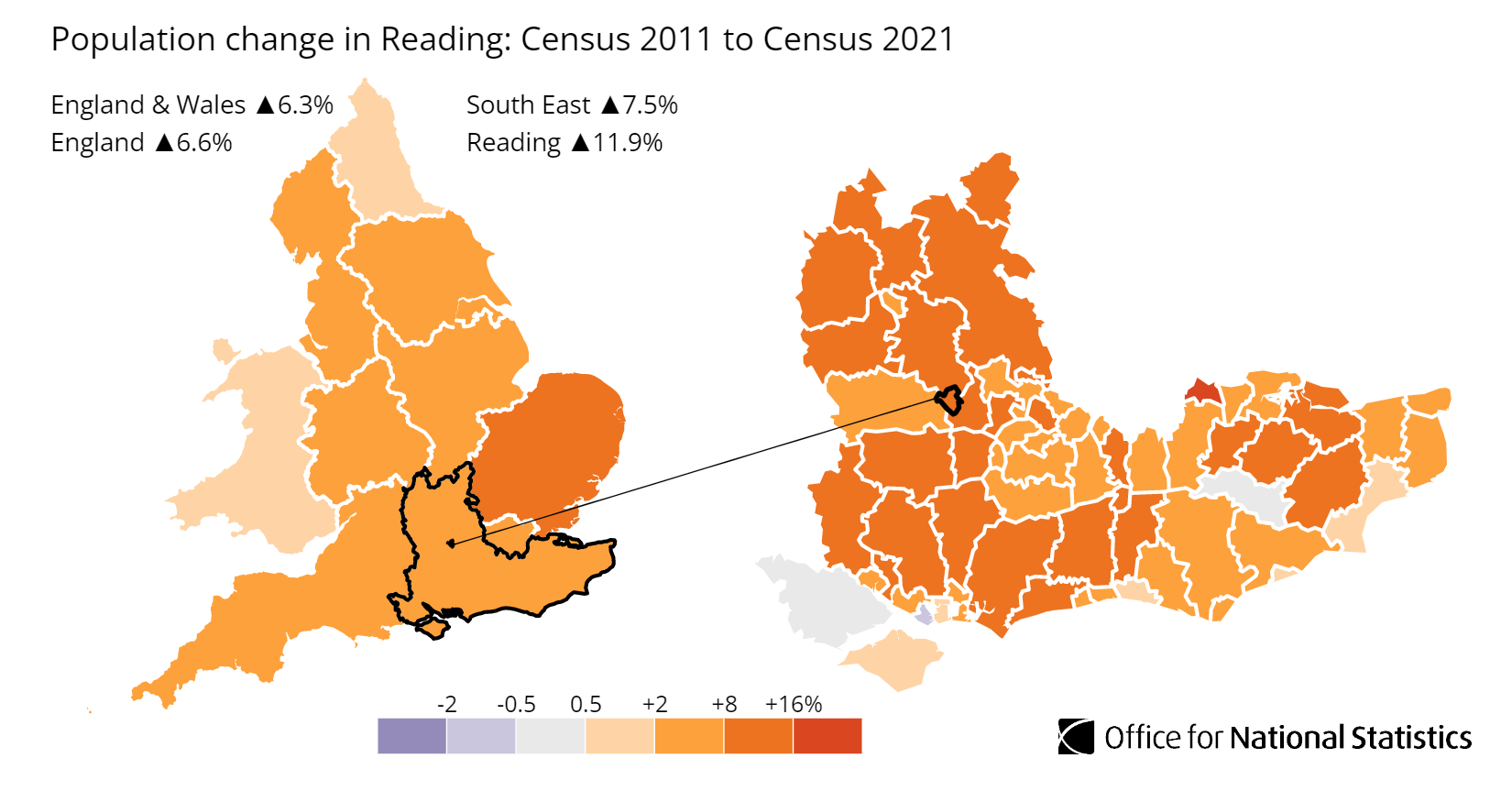
Reading is a large town in Berkshire, in the South East of England. Average sold prices in Reading sit at £349,144 on the HM Land Registry House Price Index, 20.4% above the England average of £289,946 yet 7.8% below the wider South East regional average of £378,515. That places Reading as a mid-priced point inside an expensive region, a Thames Valley commuter town carrying a clear premium over the national figure without reaching the cost of the Berkshire and Surrey belt around it. The town's population grew 11.9% between the 2011 and 2021 censuses, from 155,698 to 174,224 residents, nearly double the England and Wales average of 6.3%.
What separates Reading from the rest of the Thames Valley is the yield ceiling. The town tops out at a 6.2% gross yield in RG1, higher than Slough, Oxford or Bracknell can reach despite all three sitting at higher average prices. Reading's pull is a fast 30-minute Elizabeth line and main-line run into central London paired with a genuine local employment base, with the Thames Valley technology corridor and the office towers around the station drawing the white-collar tenants who fill the town-centre flats. For investors, the spread between RG1 at £277,394 and RG4 at £575,733 creates a two-tier market in one town, where the higher yields sit with the cheaper, smaller-unit postcodes rather than the family suburbs.
This guide covers the unitary authority of Reading (ONS code E06000038) across postcodes RG1, RG2, RG4, RG6, RG30 and RG31. Reading sits in the South East, 40 miles west of central London on the M4 and the Great Western main line. The wider highest-yielding areas shortlist covers how Reading ranks against the rest of the country.
Article updated: July 2026
Why Invest in Reading?
Reading grew its population 11.9% between the 2011 and 2021 censuses, from 155,698 to 174,224 residents, nearly twice the England and Wales average of 6.3%. That puts it among the faster-growing towns in the South East, adding residents on the back of jobs rather than just spillover from London. Reading's appeal rests on its position at the head of the Thames Valley, a half-hour commute from the capital, with an economy that stands on its own rather than serving purely as a dormitory town.
The local employment rate of 82.4% is well above Great Britain's 75.6%. Reading anchors the Thames Valley technology corridor, with major technology, insurance and professional services employers clustered around the town and the M4. That employment base, more than the commute, is what keeps the rental market deep across all six postcodes, and it skews the tenant pool towards higher earners who can absorb the town's rents.
Median gross annual earnings for Reading residents are £40,700, above the Great Britain median of £39,125 but slightly under the South East regional figure. Reading is the unusual case where a strong local economy still sits just below its own region on pay, because the surrounding Berkshire and Surrey commuter belt pulls the regional median up. Many of Reading's renters are London commuters earning above the local median, which is part of why the town's rents run higher than its resident pay alone would suggest.
Reading Economic Summary
- Population (Reading): 174,224 (2021 Census). Growth of 11.9% from 2011.
- Median annual salary: £40,700 (local), £39,125 (Great Britain)
- Median weekly pay: £782.70 (local), £800.30 (South East), £752.40 (Great Britain)
- Employment rate: 82.4% (local), 75.6% (Great Britain)
- Key economic sectors: Information and communication technology, insurance and financial services, professional and scientific services, wholesale and retail, accommodation and food
Source: ONS Census 2021, Nomis Labour Market Profile (ASHE 2025)
Regeneration and Investment in Reading
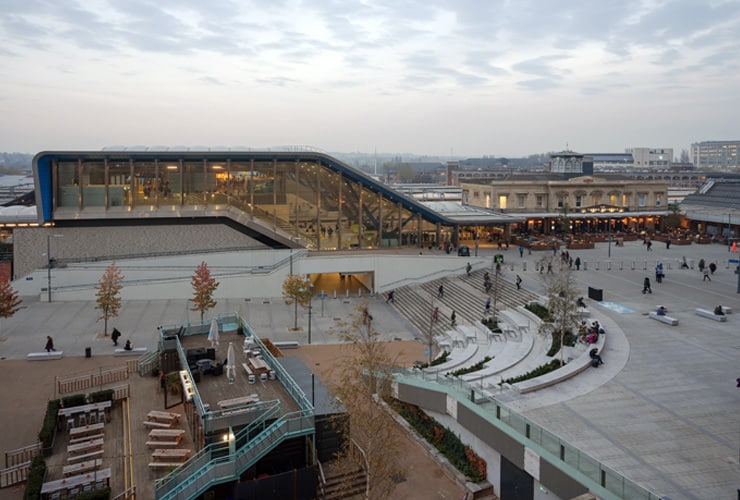
Reading's town-centre regeneration is concentrated around the station, where the Station Hill scheme has already delivered 598 build-to-rent apartments alongside a 275,000 sq ft office tower. The investment is reshaping the RG1 core, and two further large build-to-rent schemes have approval nearby that together add more than 1,200 rental homes to the town centre over the coming years.
- Station Hill (Phase 1 and 2 complete): A 598-apartment build-to-rent development (Ebb & Flow) sits alongside One Station Hill, a 17-storey, 275,000 sq ft Grade A office tower directly outside Reading station, with two acres of public realm, restaurants and food halls. The Grade A office space draws the white-collar employers that drive rental demand in RG1, and the build-to-rent units are already lettable. Updates at Station Hill Reading.
- Minster Quarter, Broad Street Mall (Planning approved May 2025): McLaren Living and AEW have approval for 643 build-to-rent homes across four buildings on a 4.6-acre site south of Broad Street Mall, with 19,000 sq ft of commercial space and an NHS Walk-In Centre extension, targeting BREEAM Excellent. A scheme of this scale signals institutional confidence in Reading's rental market and adds significant town-centre supply. Updates at McLaren Property.
- Royal Elm Park (Design code approved October 2025): A mixed-use scheme beside the Select Car Leasing Stadium in south Reading adds 618 apartments, a 246-bedroom hotel, 102 serviced apartments, a convention centre and over 18,000 sq m of public open space to the RG2 area. The convention centre and hotel create local employment, and design code approval after a nine-year planning process points to delivery momentum. Updates at Reading Today.
Source: Office for National Statistics - Population for Reading
Reading Property Market Analysis
Average property prices in Reading have risen 498.8% since January 1995, from £58,306 to £349,144. The sections below break down that journey cycle by cycle, then drill into current postcode-level data for sold prices, price per square foot, asking prices, growth trends, and monthly transaction volumes.
When was the last house price crash in Reading?
Reading's sold prices come from HM Land Registry at unitary authority level, covering the whole town. The Land Registry House Price Index tracks average prices from January 1995 to March 2026, spanning 31 years of market cycles.
The 1995 to 2007 boom: Reading started at £58,306 in January 1995. By December 2000 prices had reached £122,266, more than doubling in six years as the Thames Valley technology boom and easy mortgage credit pushed the market up. Growth continued through the early 2000s, reaching £185,014 by December 2005, and the market peaked at £223,512 in December 2007.
2008 to 2009, the financial crisis: Prices fell from the December 2007 peak of £223,512 to a trough of £181,603 in January 2009, a decline of 18.7% in just over a year. The worst year-on-year reading was -18.5% in January 2009. Reading's fall was close to the England decline of around 18% over the same period, with the town's exposure to financial-sector employment offering little buffer when that sector contracted.
The 2009 to 2013 recovery and plateau: Prices bounced off the January 2009 trough faster than much of the country, reaching £201,005 by December 2010 as London money pushed back out along the M4. The market then steadied, drifting around the £200,000 to £219,000 band and reaching £218,881 by December 2013, still short of the pre-crash peak six years on.
Recovery and surge, 2014 to 2017: Prices passed the December 2007 peak of £223,512 in February 2014, a recovery that took just over six years. Growth then accelerated sharply, with the average rising from £253,958 in December 2014 to £303,366 by March 2016 and £319,957 by December 2017. The Thames Valley was one of the fastest-rising markets in the country through this stretch.
2018 to 2020, the pre-pandemic dip: Reading is unusual in that it softened before the pandemic. Prices eased from £319,957 in December 2017 to £310,108 by December 2018 and £299,963 by December 2019, then bottomed at £292,509 in June 2020. Stretched affordability and the post-2016 cooling of the pricier South East markets caught up with the town while much of the country was still flat or rising.
2020 to 2022, the pandemic surge: The stamp duty holiday and the shift towards more space turned the market around. Prices climbed from the June 2020 reading of £292,509 to £305,900 by December 2020, £325,406 by December 2021 and £358,325 by December 2022, a recovery of more than 22% from the mid-2020 floor in two and a half years.
2023 to present: Higher mortgage rates cooled the market. Prices eased to £340,891 by June 2023 and £340,447 by December 2023, then climbed again to an all-time high of £360,385 in September 2024 before settling back. The latest reading is £349,144 in March 2026, 56.2% above the pre-crash peak of £223,512 and a gentle 3.1% off the September 2024 high.
Long-term growth summary:
- 5 years (March 2021 to March 2026): 11.8% growth (£312,309 to £349,144)
- 10 years (March 2016 to March 2026): 15.1% growth (£303,366 to £349,144)
- 15 years (December 2010 to March 2026): 73.7% growth (£201,005 to £349,144)
- 20 years (December 2005 to March 2026): 88.7% growth (£185,014 to £349,144)
- 30 years (January 1995 to March 2026): 498.8% growth (£58,306 to £349,144)
Reading's 18.7% crash was slightly deeper than the England average, reflecting how closely the town tracked the financial sector through 2008. The 30-year return of 498.8% is one of the stronger long-run records in the dataset, helped by the early-2000s technology boom. The standout feature, though, is the 2018 to 2020 softening: where most of the country was flat before the pandemic, Reading actually fell, a sign of how far affordability had stretched. An investor who bought at the exact December 2007 peak would now be sitting on a 56.2% gain on the Land Registry average.
- All property types
- Detached
- Semi-detached
- Terraced
- Flats
- All property types
- Detached
- Semi-detached
- Terraced
- Flats
Sold House Prices in Reading by Property Type
Reading's sold prices carry a clear premium over England across every property type except flats, where the gap narrows to almost nothing. The figures below are HM Land Registry sold prices for the town as a whole, set against the England average, and they show where Reading's premium is concentrated.
| Property Type | Reading Average | England Average | Difference |
|---|---|---|---|
| Detached | £711,854 | £470,492 | +51.3% |
| Semi-detached | £440,662 | £288,185 | +52.9% |
| Terraced | £352,157 | £243,788 | +44.5% |
| Flats | £223,496 | £214,563 | +4.2% |
Detached homes in Reading average £711,854, which is 51.3% above the England detached average. This is the most expensive end of the local market, concentrated in the Caversham (RG4) and Lower Earley (RG6) suburbs where larger family houses dominate. Detached prices eased 0.6% over the past year, the gentle cooling that has run across the higher-priced end of the South East.
Semi-detached houses average £440,662, a 52.9% premium over England and the widest of any type. These are the suburban family homes of Tilehurst, Caversham and Earley, the backbone of the owner-occupier market. Semi-detached values held up over the year with a 0.2% gain, the only type in Reading to record positive annual growth.
Terraced houses average £352,157, 44.5% above the England terraced figure. Terraces concentrate in the town-centre fringe and the older Victorian streets of RG1 and RG30, and they form a chunk of the lower-cost lettings stock. Terraced prices slipped 0.6% over the year.
Flats average £223,496, just 4.2% above England and the one type where Reading does not carry a meaningful premium. Flats are concentrated in RG1, the town centre, where the build-to-rent and converted stock sits. They are also the only type to fall meaningfully over the year, down 5.3%, which has reopened a route into the town below £250,000 for buyers focused on the smaller-unit, higher-yielding end.
Average Asking Prices in Reading by Postcode
Asking prices in Reading run from £277,394 in RG1 to £575,733 in RG4, a spread of nearly £300,000 across the six postcodes. Asking prices are what homes are currently listed at, drawn from live for-sale listings, and they set the entry cost before any negotiation. RG1, the town centre, is the cheapest way in and also the highest-yielding postcode.
| Rank | Area | Asking Price |
|---|---|---|
| 1 | RG1 (Town Centre) | £277,394 |
| 2 | RG30 (Tilehurst, Southcote) | £331,717 |
| 3 | RG2 (Whitley, Shinfield) | £397,094 |
| 4 | RG31 (Tilehurst, Calcot) | £445,000 |
| 5 | RG6 (Earley, Lower Earley) | £487,342 |
| 6 | RG4 (Caversham) | £575,733 |
RG1 at £277,394 is the only Reading postcode where the average asking price sits below £300,000, and it carries the highest yield at 6.2%. The town centre is dominated by flats and terraced stock, which is the smaller-unit housing that anchors the rental market. At the other end, RG4 (Caversham) at £575,733 is the family-suburb premium, more than double RG1 on price but yielding less than half.
Price Per Square Foot in Reading by Postcode
Price per square foot in Reading runs from £383 in RG30 to £474 in RG6. Measuring by the square foot takes house size out of the comparison, so it reads location value rather than how big the homes happen to be. On that basis the suburban postcodes of Caversham and Earley command the most per square foot, not the town centre.
| Rank | Area | Price Per Sq Ft |
|---|---|---|
| 1 | RG6 (Earley, Lower Earley) | £474 |
| 2 | RG4 (Caversham) | £471 |
| 3 | RG31 (Tilehurst, Calcot) | £437 |
| 4 | RG2 (Whitley, Shinfield) | £422 |
| 5 | RG1 (Town Centre) | £387 |
| 6 | RG30 (Tilehurst, Southcote) | £383 |
RG6 (Earley) tops the table at £474 per square foot, with RG4 (Caversham) close behind at £471. These are the established family suburbs where buyers pay up for the address rather than the floor area. RG1 at £387 sits near the bottom on a per-square-foot basis even though it is the cheapest postcode outright, which tells you the town centre is priced low on space as well as on headline price, the combination that produces its leading yield.
Property Price Growth Trends in Reading by Postcode
Five-year growth in Reading runs from 6.0% in RG2 to 14.9% in RG31, but the three-year picture is negative in five of the six postcodes. The growth figures below track each postcode's price movement over one, three and five years. They show a town where the recent record is mixed: solid five-year gains in the suburbs, but a softer medium-term reading that reflects the post-2022 cooling.
| Area | 1 Year | 3 Years | 5 Years |
|---|---|---|---|
| RG31 (Tilehurst, Calcot) | +2.1% | -0.5% | +14.9% |
| RG30 (Tilehurst, Southcote) | -3.0% | +0.7% | +10.7% |
| RG1 (Town Centre) | +0.6% | -0.6% | +9.3% |
| RG6 (Earley, Lower Earley) | -1.5% | -4.5% | +7.4% |
| RG4 (Caversham) | +0.8% | -3.8% | +7.1% |
| RG2 (Whitley, Shinfield) | -6.5% | -4.1% | +6.0% |
RG31 (Tilehurst, Calcot) leads on five-year growth at 14.9% and is one of only two postcodes positive over the past year, at 2.1%. RG30, the neighbouring Tilehurst postcode, is the only one positive over three years at 0.7%, with 10.7% over five. At the other end, RG2 (Whitley, Shinfield) is the weakest on every timeframe, down 6.5% over the year and up just 6.0% over five, the south Reading postcode where the new Royal Elm Park supply sits. The pattern across the town is a five-year record that is comfortably positive everywhere paired with a softer recent year, the South East cooling working through the local market.
Monthly Sales Volumes in Reading by Postcode
RG1 is the busiest market in Reading, with 41 sales a month, while RG31 turns over the fastest at 18% of its stock a year. Sales volumes show how liquid each postcode is, both the raw number of monthly transactions and the turnover rate, which is the share of the housing stock that changes hands in a year. A higher turnover means an easier market to buy into and to sell out of.
| Area | Sales Per Month | Turnover | Asking Price |
|---|---|---|---|
| RG1 (Town Centre) | 41 | 9% | £277,394 |
| RG4 (Caversham) | 35 | 12% | £575,733 |
| RG2 (Whitley, Shinfield) | 33 | 12% | £397,094 |
| RG30 (Tilehurst, Southcote) | 32 | 12% | £331,717 |
| RG6 (Earley, Lower Earley) | 25 | 15% | £487,342 |
| RG31 (Tilehurst, Calcot) | 24 | 18% | £445,000 |
RG1 records the most sales at 41 a month, which fits a town centre packed with flats and smaller units that change hands often. But its 9% annual turnover is the lowest of the six, because the stock of homes there is large. RG31 sits at the other end: fewer monthly sales at 24, but the highest turnover at 18%, a smaller, faster-moving suburban market. For a landlord, RG31's turnover points to an easier exit, while RG1's volume points to a steady supply of stock to buy.
How Long Does It Take to Sell in Reading?
RG31 clears fastest, with homes finding a buyer in about 169 days and the lowest stock overhang, while RG1 sits for around 380 days with 12.5 months of unsold supply on the market. A yield figure tells you nothing about how long your money is tied up at the end. Days on market is the typical time a home is listed before it sells; months of supply is how much for-sale stock is queued at the current sales rate. The gap between RG31 and RG1 is a real holding cost that the rent column never shows.
| Area | Days on Market | Months of Supply | Market |
|---|---|---|---|
| RG31 (Tilehurst, Calcot) | 169 | 5.6 | Seller's market |
| RG6 (Earley, Lower Earley) | 190 | 6.3 | Balanced market |
| RG2 (Whitley, Shinfield) | 234 | 7.7 | Balanced market |
| RG30 (Tilehurst, Southcote) | 234 | 7.7 | Balanced market |
| RG4 (Caversham) | 277 | 9.1 | Balanced market |
| RG1 (Town Centre) | 380 | 12.5 | Buyer's market |
RG31 is the one seller's market in Reading, clearing in around 169 days on 5.6 months of supply, which makes for the quickest exit. RG1 is the opposite: the same town-centre flat stock that produces the top yield also takes the longest to sell, about 380 days with 12.5 months of supply sitting on the market. That is the trade-off the headline 6.2% yield hides. RG1 earns the most while you hold it but is the slowest to get back out of, so it suits a longer hold rather than a quick flip.
What Type of Property Can You Buy in Reading?
RG1 is overwhelmingly flats at 51.2% of its stock, while the five suburban postcodes are dominated by detached and semi-detached houses. The mix of housing stock shapes which strategy fits each postcode. The figures below are drawn from 2021 Census records for each postcode.
| Area | Detached | Semi-detached | Terraced | Flats |
|---|---|---|---|---|
| RG1 (Town Centre) | 6.4% | 17.2% | 25.2% | 51.2% |
| RG2 (Whitley, Shinfield) | 35.6% | 33.9% | 15.7% | 13.7% |
| RG4 (Caversham) | 41.7% | 30.7% | 12.6% | 13.5% |
| RG6 (Earley, Lower Earley) | 34.6% | 35.8% | 18.1% | 11.4% |
| RG30 (Tilehurst, Southcote) | 31.4% | 33.7% | 17.5% | 16.1% |
| RG31 (Tilehurst, Calcot) | 34.3% | 33.0% | 17.4% | 14.4% |
RG1 is the clear outlier, with flats making up 51.2% of the stock and just 6.4% detached. That town-centre concentration of flats and terraces (terraces add another 25.2%) is exactly the smaller-unit housing that drives buy-to-let, and it lines up with RG1 carrying the lowest asking price and the highest yield in Reading. City-centre flats suit single lets and sharers, while the build-to-rent supply around the station sets the going rate.
RG4 (Caversham) is the most detached-weighted postcode at 41.7%, with detached and semi-detached together above 72%. That matches its premium asking prices and its lowest yield, family-suburb housing for owner-occupiers rather than the smaller units that drive rental income. The Tilehurst and Earley postcodes sit in between, a balanced mix of detached and semi-detached family homes with a modest flat share.
Flats combine purpose-built and converted units, and a small share of mobile and temporary dwellings is excluded, so rows may not total 100%.
Reading Rental Market Analysis
Monthly rents in Reading range from £1,235 in RG31 to £2,022 in RG6, with gross rental yields from 3.1% to 6.2% across the six postcodes. For investors asking is buy to let worth it in Reading, the sections below break down rents, yields and tenant affordability postcode by postcode. If you are weighing up how to build a property portfolio in the Thames Valley, Reading's mix of high wages, an 82.4% employment rate and a deep commuter rental base offers a steadier tenant pool than higher-yielding markets further north. Browse current buy-to-let investments for sale across the region.
Average Rent & Gross Rental Yields in Reading
Gross rental yields in Reading range from 3.1% in RG4 to 6.2% in RG1. The cheapest postcode delivers the highest yield and the most expensive delivers the lowest, the same pattern as the asking-price table. RG6 (Earley) charges the highest rent at £2,022 a month but yields 5.0%, because its £487,342 asking price is 76% above RG1's.
| Area | Average Monthly Rent | Asking Price | Gross Yield |
|---|---|---|---|
| RG1 (Town Centre) | £1,436 | £277,394 | 6.2% |
| RG2 (Whitley, Shinfield) | £1,677 | £397,094 | 5.1% |
| RG6 (Earley, Lower Earley) | £2,022 | £487,342 | 5.0% |
| RG30 (Tilehurst, Southcote) | £1,347 | £331,717 | 4.9% |
| RG31 (Tilehurst, Calcot) | £1,235 | £445,000 | 3.3% |
| RG4 (Caversham) | £1,502 | £575,733 | 3.1% |
RG1 delivers the best return in the town at 6.2%, the highest of any Thames Valley commuter town. It does that by pairing the lowest asking price, £277,394, with a solid £1,436 monthly rent, so a 30% deposit of £83,218 buys into the highest-yielding postcode. The town-centre flats here let to the young professionals and commuters that the station-side offices and the Elizabeth line bring in.
RG4 (Caversham) at 3.1% sits at the bottom of Reading's yield table. The £1,502 monthly rent is respectable, but the £575,733 asking price means the income return is compressed. In Caversham the premium price does far more for capital value than for yield.
Gross Rental Yield by Postcode
Is Reading Rent High?
Monthly rents in Reading consume between 36.4% and 59.6% of the local median gross monthly salary, with every postcode above the 30% affordability line. The widely cited threshold for rent affordability is 30% of gross income, and no Reading postcode sits below it on local pay. That reflects two things: high rents across the Thames Valley, and a tenant base that often earns above the local median because so many are London commuters rather than residents on Reading wages.
The median gross weekly salary in Reading is £782.70, which equates to £3,392 per month or £40,700 per year. This sits just below the South East regional median of £800.30 a week but above the Great Britain median of £752.40. Data from the Nomis Labour Market Profile (ASHE 2025).
| Rank | Area | Rent as % of Income |
|---|---|---|
| 1 | RG6 (Earley, Lower Earley) | 59.6% |
| 2 | RG2 (Whitley, Shinfield) | 49.4% |
| 3 | RG4 (Caversham) | 44.3% |
| 4 | RG1 (Town Centre) | 42.3% |
| 5 | RG30 (Tilehurst, Southcote) | 39.7% |
| 6 | RG31 (Tilehurst, Calcot) | 36.4% |
RG31 at 36.4% is the most affordable for tenants on local pay, and RG1 sits at 42.3%. The figures look high against the 30% benchmark, but they understate affordability for much of Reading's tenant base, because a large share of renters commute into London and earn well above the local median. RG6 (Earley) at 59.6% is the least affordable on paper: a £2,022 rent against a £3,392 local monthly salary, but the larger family homes there typically house dual-income households rather than single median earners.
How Big Is Reading's Private Rented Sector?
The private rented sector is deepest by far in RG1, where it accounts for 47.1% of households, against 14.4% to 24.4% across the suburban postcodes. The share of homes already rented privately is a guide to the size of the established tenant pool. The table below shows household tenure by postcode.
| Area | Owned Outright | Owned with Mortgage | Private Rented | Social Rented |
|---|---|---|---|---|
| RG1 (Town Centre) | 17.1% | 20.3% | 47.1% | 14.1% |
| RG4 (Caversham) | 34.1% | 31.3% | 24.4% | 9.3% |
| RG2 (Whitley, Shinfield) | 27.2% | 40.8% | 20.4% | 9.8% |
| RG30 (Tilehurst, Southcote) | 36.0% | 33.4% | 20.2% | 9.3% |
| RG6 (Earley, Lower Earley) | 36.8% | 37.0% | 19.0% | 6.3% |
| RG31 (Tilehurst, Calcot) | 39.1% | 36.2% | 14.4% | 9.3% |
RG1 has the largest private rented sector in Reading by a wide margin, with nearly half of all households renting privately, the deepest established tenant pool in the town. That concentration is the engine behind its top yield: a town centre built around lettings, with the lowest owner-occupation at 37.4% combined and the highest renter share. RG4 (Caversham) follows at 24.4%, still a solid rented market in a family suburb, while RG31 (Tilehurst, Calcot) is the most owner-occupied at 14.4% private rented. Across the rental listings, RG1 reads as a landlord's market on current supply, with homes letting in around 52 days, the deep, proven demand you would expect where almost half the stock is already rented.
Local Housing Allowance Rates in Reading
All six Reading postcodes fall within the Reading Broad Rental Market Area, where Local Housing Allowance runs from £90.10 a week for a shared room to £380.65 a week for a four-bedroom home. Local Housing Allowance caps the housing benefit a tenant can receive, which sets an effective rent floor for landlords letting to that part of the market. The rates below apply across the whole of Reading. To check the current rate for a specific address, you can use the government's official Local Housing Allowance calculator.
| Property Size | Weekly LHA Rate | Monthly Equivalent |
|---|---|---|
| Shared accommodation | £90.10 | £390 |
| 1 bedroom | £195.62 | £848 |
| 2 bedrooms | £252.00 | £1,092 |
| 3 bedrooms | £299.18 | £1,297 |
| 4 bedrooms | £380.65 | £1,650 |
The two-bedroom LHA rate of £252.00 a week works out at about £1,092 a month, which sits below Reading's open-market rents of £1,235 to £2,022. A benefit-backed tenancy at the LHA rate therefore lands under the town's market rents, and the stock that fits within these rates is concentrated in RG1 and the Tilehurst postcodes, where asking prices and rents are lowest. The rates are identical across every Reading postcode because they are set for the whole Reading market area.
Buy-to-Let Considerations
Are House Prices High in Reading? Price-to-Earnings Ratios
Purchasing a property in Reading requires between 6.8 and 14.1 times the median annual salary. This is based on the Nomis Labour Market Profile for Reading showing the median gross annual income for Reading residents is £40,700.
The national benchmark for price-to-earnings is 7.4x (England's average sold price of £289,946 divided by the Great Britain median annual salary of £39,125). One of Reading's six postcodes (RG1) sits below that national benchmark, meaning it is more affordable relative to local incomes than the England average is relative to national incomes.
| Rank | Area | Price-to-Earnings Ratio |
|---|---|---|
| 1 | RG1 (Town Centre) | 6.8x |
| 2 | RG30 (Tilehurst, Southcote) | 8.2x |
| 3 | RG2 (Whitley, Shinfield) | 9.8x |
| 4 | RG31 (Tilehurst, Calcot) | 10.9x |
| 5 | RG6 (Earley, Lower Earley) | 12.0x |
| 6 | RG4 (Caversham) | 14.1x |
RG1 at 6.8x is the only Reading postcode below the national benchmark of 7.4x, the most affordable entry point in the town relative to local pay. A property at under seven times local earnings, in a town with an 82.4% employment rate, is a rare combination in the South East. RG4 (Caversham) at 14.1x sits at the top: more than fourteen times local median earnings, firmly premium territory where buyers are typically dual-income households or those moving out from London. For investors, that elevated ratio is what compresses Caversham's yield to 3.1%.
Deposit Requirements in Reading
A 30% deposit on a buy-to-let property in Reading ranges from £83,218 in RG1 to £172,720 in RG4. The gap between the cheapest and most expensive deposit is £89,502, more than a whole second deposit in RG1. For investors comparing Reading with other Thames Valley locations, these deposits sit below Bracknell and Oxford but above Swindon at the cheaper end of the corridor.
Beyond the deposit, the stamp duty calculation and other buy-to-let running costs affect the total capital required.
| Rank | Area | 30% Deposit Required |
|---|---|---|
| 1 | RG1 (Town Centre) | £83,218 |
| 2 | RG30 (Tilehurst, Southcote) | £99,515 |
| 3 | RG2 (Whitley, Shinfield) | £119,128 |
| 4 | RG31 (Tilehurst, Calcot) | £133,500 |
| 5 | RG6 (Earley, Lower Earley) | £146,203 |
| 6 | RG4 (Caversham) | £172,720 |
RG1 is the cheapest way into Reading at a £83,218 deposit, and it buys the highest yield in the town at the same time, an unusual pairing. Stepping up to RG30 (Tilehurst, Southcote) costs about £16,000 more and moves you from town-centre flats to a suburban mix of family houses on a still-healthy 4.9% yield. At the top, RG4 (Caversham) needs a £172,720 deposit, more than double RG1, for a family suburb that earns its return through capital value rather than rent. The deposit gap across Reading is wide enough that the same capital buys very different propositions.
What the Reading Data Tells Buy-to-Let Investors
In Reading the cheapest way in is also the highest-yielding postcode, and it tops every Thames Valley commuter town for yield. RG1 has the top yield at 6.2%, the lowest asking price for buying an investment property in Reading at £277,394, and the most affordable prices against local earnings at 6.8 times income. A 30% deposit there is £83,218, the lowest in the town, for a flat-heavy town centre renting at £1,436 a month with nearly half the stock already let privately.
The catch with RG1 is exit speed. The same town-centre flat market that produces the top yield is the slowest to sell out of, around 380 days on 12.5 months of supply, so it reads as a longer-term income hold rather than a quick trade. RG31 (Tilehurst, Calcot) is the opposite end of that trade-off: a lower 3.3% yield but the fastest exit in the town at 169 days, and the strongest five-year growth at 14.9%.
The suburban postcodes earn their keep differently. RG6 (Earley) charges the highest rent at £2,022 a month but yields 5.0% on a £487,342 price, while RG4 (Caversham) is the premium family suburb at £575,733 and the lowest yield at 3.1%, where the price does more for capital value than income. Buyers who want to come in below asking often look through off-market property in Reading channels, where the value tends to sit before a home is openly listed.
Reading has no selective licensing scheme covering standard private lets, though the council runs mandatory and additional licensing for houses in multiple occupation, so check the current position on Reading Borough Council's property licensing pages. With high local wages, an 82.4% employment rate, a deep commuter rental base and over 1,800 build-to-rent homes delivered or approved around the town centre, it reads as a steadier Thames Valley market than its headline prices suggest: a real yield ceiling in RG1 sitting on top of strong London-facing tenant demand.
How Reading Compares
Reading's mean asking price of £419,047 sits in the middle of five Thames Valley locations compared here, yet its top yield of 6.2% is the highest of the group by more than a point. The comparison below places Reading alongside four nearby commuter towns, each with a different investor profile. The mean asking price and mean monthly rent are simple averages across all postcodes with data. Top gross yield is the single highest postcode yield in each location.
| Location | Mean Asking Price | Mean Monthly Rent | Mean Gross Yield | Top Yield (postcode) |
|---|---|---|---|---|
| Swindon | £349,254 | £1,194 | 4.1% | 5.2% (SN2) |
| Reading | £419,047 | £1,536 | 4.4% | 6.2% (RG1) |
| Slough | £444,990 | £1,504 | 4.1% | 4.8% (SL1) |
| Oxford | £535,752 | £1,828 | 4.1% | 4.8% (OX4) |
| Bracknell | £560,934 | £1,931 | 4.1% | 4.8% (RG12) |
Reading is the standout for yield in this group. Its 6.2% top yield is more than a point clear of every other Thames Valley town here, including the more expensive Slough, Oxford and Bracknell, which all top out at 4.8% on higher mean prices. That gap comes from RG1: a genuinely cheap, rental-dominated town centre inside an otherwise premium town.
For investors weighing income against entry cost, Swindon is the cheapest in the table at £349,254 and reaches 5.2%, the lower-priced western end of the corridor. Slough, Oxford and Bracknell sit above Reading on price but below it on yield, the higher-cost Berkshire and Oxfordshire end where capital values lead and income returns compress. Reading lands in the middle on price while leading on yield, which is the combination that sets it apart in the Thames Valley. For a data-driven comparison across all UK locations, see our best places to invest in buy-to-let guide.
Frequently Asked Questions
Is Reading a good place to live for buy-to-let tenants?
It is one of the stronger Thames Valley options, and it comes down to jobs and the commute. Reading's employment rate is 82.4%, well above the national 75.6%, and it anchors the Thames Valley technology corridor with major employers around the town and the M4. Add a fast Elizabeth line and main-line run into central London, and you get a tenant base of professionals and commuters who tend to be in steady, well-paid work.
That mix is also why the rental market is deep. Nearly half of all households in the town centre (RG1) already rent privately, so demand is established rather than untested.
What are the best areas in Reading for property investment?
The postcodes split fairly cleanly. RG1 (Town Centre) is the cheapest way in at £277,394 and carries the highest yield at 6.2%, a flat-heavy town centre where almost half the homes are already rented, so it leans towards income. RG31 (Tilehurst, Calcot) has the strongest five-year growth at 14.9% and the fastest exit in the town, so it leans towards growth and liquidity.
At the top end, RG4 (Caversham) is the premium family suburb at £575,733 and the lowest yield at 3.1%, while RG6 (Earley) charges the highest rent at £2,022 a month on a 5.0% yield. So if income matters most, RG1 leads on yield and price; if you want capital growth and a quicker sale, the Tilehurst postcodes are where to look.
How does Reading compare to Slough for buy-to-let?
They are both Berkshire commuter towns on the Elizabeth line, but Reading currently has the edge on yield. Reading's top postcode reaches 6.2% against Slough's 4.8%, and Reading's mean asking price of £419,047 is actually a little below Slough's £444,990. So Reading offers both a higher yield ceiling and a slightly lower average entry, which is an unusual pairing.
Slough sits closer to London and has its own large employment base around the trading estate, so tenant demand there is strong too. But on the numbers, Reading's RG1 town centre gives a buy-to-let investor a higher return for less outlay. You can compare the detail in our Slough buy-to-let guide.
Is there demand for student accommodation in Reading?
Yes, centred on the University of Reading, whose main Whiteknights campus sits in the RG6 area south-east of the town centre. Student demand supports shared houses and flats in RG6 and the neighbouring RG2, though purpose-built schemes around the campus take a chunk of the first-year market. Student lets come with summer voids and more hands-on management than a standard tenancy, so factor that in.
On the HMO side, a sample of current RG1 room adverts puts a double with a shared bathroom at around £154 a week and an ensuite double at around £189, with the bulk of shared-bath rooms between £127 and £185. For how the numbers work on a shared house, see our HMO investment guide, or for the purpose-built end, our guide to student property investment.
Can I find buy-to-let property under £250,000 in Reading?
Not on average by postcode now, since the cheapest is RG1 (Town Centre) at £277,394. The way in below £250,000 is by property type rather than postcode: flats across Reading average £223,496 on the Land Registry index, and they are the only type that fell over the past year, down 5.3%. Those flats concentrate in RG1, exactly where the highest yield is. If sub-£250,000 is the target, RG1 flats are the route, or explore below market value properties.
When will the Station Hill and Minster Quarter developments affect Reading property prices?
Station Hill is already having an effect: its first build-to-rent phase and the 275,000 sq ft office tower are complete, which lifts both rental supply and the white-collar employment that drives town-centre demand. The Minster Quarter scheme (643 build-to-rent homes) was approved in May 2025 and Royal Elm Park (618 homes) in October 2025, so those add to supply over the next several years rather than immediately.
For investors, the near-term read is more rental competition in RG1 and RG2 as build-to-rent units come on stream, balanced against the employment and footfall the offices and convention centre bring. The bigger price effects are a multi-year story as the schemes complete.
What are average house prices in Reading?
The average sold price in Reading is £349,144 on the Land Registry index, about 20.4% above the England average of £289,946 as of March 2026, but 7.8% below the wider South East region. Asking prices by postcode run from £277,394 in RG1 (Town Centre) up to £575,733 in RG4 (Caversham), with a town-wide mean of £419,047. By type, detached homes average £711,854, semi-detached £440,662, terraced £352,157 and flats £223,496.
Through a buy-to-let lens, RG1 is the cheapest entry and the highest-yielding at 6.2%, while RG4 is the dearest and lowest-yielding.
What are the Local Housing Allowance rates in Reading?
All six Reading postcodes fall in the Reading Broad Rental Market Area, so they share one set of rates. As of June 2026, Local Housing Allowance runs at £90.10 a week for a shared room, £195.62 for a one-bed, £252.00 for two beds, £299.18 for three and £380.65 for four. That figure is the most a tenant on housing support can claim towards rent, so for that part of the market it effectively sets a floor.
What type of property is most common in Reading?
It splits sharply between the town centre and the suburbs. In RG1 (Town Centre), flats dominate at 51.2% of the stock, with terraces a further 25.2%, the smaller-unit housing that suits buy-to-let. The five suburban postcodes flip that: detached and semi-detached houses are the bulk of the stock, peaking in RG4 (Caversham) at 41.7% detached. So the rental-friendly flats are concentrated in RG1, while the family houses sit out in Caversham, Earley and Tilehurst.
How do I buy an investment property in Reading?
Decide first whether you are buying for income or for growth, because that points you at a different postcode. RG1 (Town Centre) is the cheapest entry at £277,394 and the highest-yielding at 6.2%, the income play. RG31 (Tilehurst, Calcot) pairs a lower yield with the strongest five-year growth at 14.9% and the fastest exit. Budget for a 30% deposit, which runs from £83,218 in RG1 to £172,720 in RG4.
Beyond what is listed openly, plenty of experienced investors buy below asking through off-market property in Reading and BMV property. To see what is available now, browse investment property in Reading or buy-to-let homes for sale.
Ready to buy property?
Access off-market investment properties with an average 8%+ annual gross yield (beating the UK's typical 3-5%).
Get property alerts