
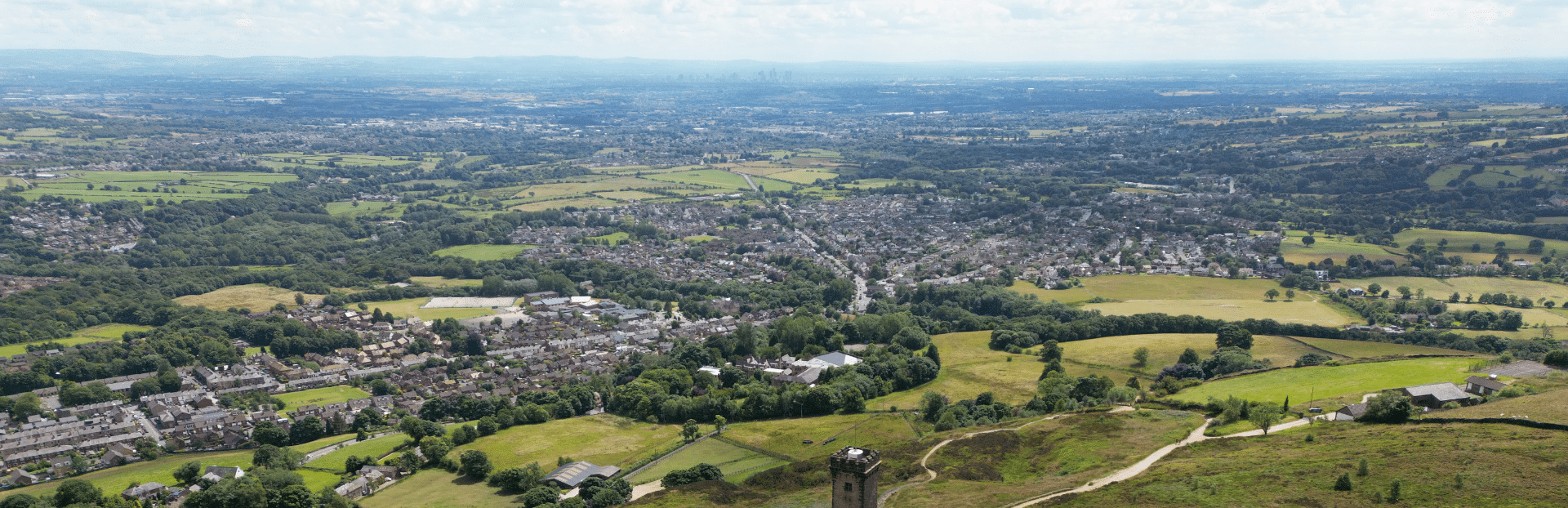
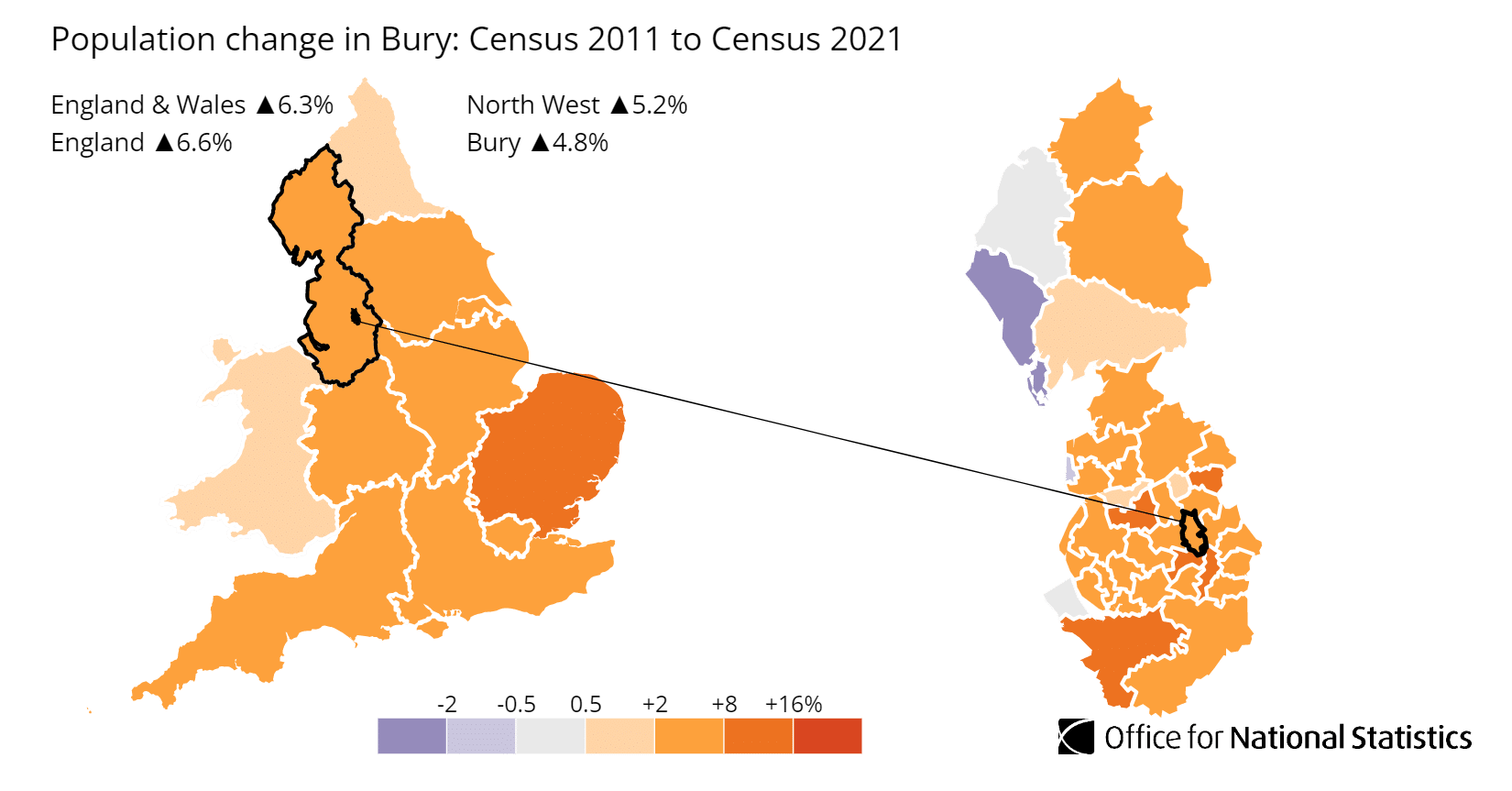
Bury is a town in Greater Manchester, in the north-west of England, giving its name to the wider metropolitan borough. Average sold prices in Bury sit at £236,357 on the HM Land Registry House Price Index, 18.5% below the England average of £289,946 as of March 2026. That discount is the headline for an investor: Bury is one of the more affordable boroughs on Manchester's northern commuter belt, priced below the city itself while sharing its tram network and labour market. The borough's population grew 4.75% between the 2011 and 2021 censuses, from 185,060 to 193,851 residents.
What makes Bury unusual is how little separates its postcodes on value per square foot. Just £84 stands between the cheapest space (M26, Radcliffe, at £221 per square foot) and the dearest (M25, Prestwich, at £305), so the choice between postcodes is less about price and more about which corner of the borough fits the strategy. The highest yield sits with one of the cheaper entry points: M24 (Middleton) tops the table at 5.0% on a £269,730 asking price, while M26 is the lowest way in at £233,709.
This guide covers the metropolitan borough of Bury (ONS code E08000002) across nine postcodes: BL0, BL2, BL8, BL9, M24, M25, M26, M44, and M45. Bury sits in Greater Manchester, around eight miles north of Manchester city centre, linked by the Metrolink tram and the M66. The wider Greater Manchester market also takes in Bolton to the west and Rochdale to the east.
Article updated: July 2026
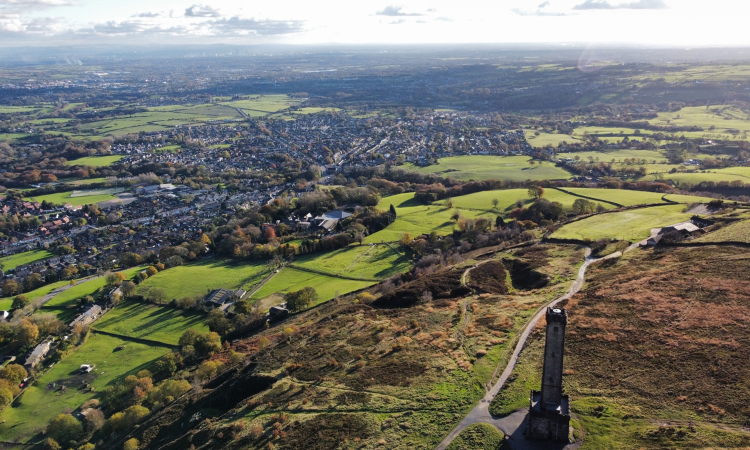
Why Invest in Bury?
Bury's population grew 4.75% between the 2011 and 2021 censuses, from 185,060 to 193,851 residents. That is below the England and Wales average of 6.3%, the steady growth of an established commuter borough rather than a fast-expanding city. Bury's pull is its position eight miles north of Manchester with a direct tram line into the centre, paired with housing that costs noticeably less than the city's inner suburbs.
The local employment rate is 69.2%, below the North West average of 74.2% and Great Britain's 75.6%, with unemployment at 6.8%. The borough's economy leans on health and social care, retail, manufacturing, and public administration, and a sizeable share of working residents commute out to jobs in central Manchester and Salford. That commuter income, more than purely local wages, is what underpins much of the rental demand across the M-prefixed postcodes closest to the city.
Median gross annual earnings for Bury residents are £35,767, which is below both the North West median of £37,445 and the Great Britain median of £39,125. Lower local wages mean affordability matters more here than in higher-earning parts of the North West, and it is one reason the borough's house prices have stayed well under the England average. For a landlord, the trade-off is a tenant base that is more price-sensitive but also large and stable.
Bury Economic Summary
- Population (Bury): 193,851 (2021 Census). Growth of 4.75% from 2011.
- Median annual salary: £35,767 (local), £37,445 (North West), £39,125 (Great Britain)
- Employment rate: 69.2% (local), 74.2% (North West), 75.6% (Great Britain)
- Unemployment rate: 6.8% (local)
- Key employment sectors: Health and social care, retail, manufacturing, public administration, education
Source: ONS Census 2021, Nomis Labour Market Profile (ASHE 2025)
Regeneration and Investment in Bury
Bury sits inside a regeneration pipeline worth well over £160 million in committed public funding, led by the Atom Valley programme spanning the borough's northern edge. The investment is concentrated on employment land, town-centre renewal, and the Prestwich village scheme on the Manchester-facing side of the borough.
- Atom Valley Northern Gateway (Under construction, part of a £400 million Greater Manchester programme): A major employment and housing zone spanning Bury and Rochdale, planned to deliver around 21,000 jobs, 13 million square feet of employment space, and 3,000 homes. Balfour Beatty has been appointed main contractor for the Western Access infrastructure works, which confirms delivery is moving from plan to ground. Updates at Atom Valley.
- Bury Market and Town Centre Regeneration (Under construction, £20 million Levelling Up Fund plus a wider pipeline): A £20 million government grant is funding a new flexi-hall and market improvements, with the oversailing canopy reaching full structural completion, alongside a broader programme of town-centre living and transport upgrades. A busier, refreshed market town centre supports footfall and the case for town-centre rental stock in BL9. Updates at Bury Council.
- Prestwich Village Centre Redevelopment (Under construction, £6.8 million plus private investment): A revitalisation of Prestwich village centre including a 275-space travel hub due to complete in 2026, with plans for up to 200 homes across three blocks. Prestwich (M25) is one of the most sought-after Manchester-commuter suburbs in the borough, so new homes and transport here land in its highest-priced postcode. Updates at Bury Council.
Bury Property Market Analysis
Average property prices in Bury have risen 490.7% since January 1995, from £40,013 to £236,357. The sections below trace that journey cycle by cycle, then drill into current postcode-level data for sold prices, price per square foot, asking prices, growth, transaction volumes, and selling times.
When was the last house price crash in Bury?
Bury is a metropolitan borough within Greater Manchester, so all sold property prices from HM Land Registry are recorded at this borough level. The Land Registry House Price Index tracks Bury's average from January 1995 to March 2026, covering 31 years of market cycles.
The 1995 to 2007 boom: Bury started at £40,013 in January 1995. Prices reached £51,048 by December 2000 and accelerated through the early 2000s, passing £125,219 by December 2005. The market peaked at £141,530 in December 2007, driven by cheap credit, growing Manchester commuter demand, and the Metrolink connection.
2008 to 2009, the financial crisis: Prices turned down sharply after the credit crunch, with the worst year-on-year reading hitting -13.0% in July 2009. Bury's early correction was broadly in line with the national fall, though the more damaging part of its downturn came later than England's.
2010 to 2012, the double-dip: Unlike England, which bottomed out in 2009 and started recovering, Bury slipped a second time. Prices partly rebounded to £128,149 by June 2010, then drifted lower again, reaching the borough's actual trough of £113,638 in February 2012. That is a 19.7% decline from the December 2007 peak, and the delayed bottom is typical of northern towns where recovery momentum took longer to build.
Recovery, 2013 to 2016: Prices climbed slowly off the trough, from £121,404 in December 2013 to £134,470 by December 2015. They first regained the pre-crash peak in October 2016 at £142,139. That recovery took nearly nine years, a good deal longer than England's, which had passed its own pre-crash peak by 2014.
The 2017 to 2019 pre-pandemic growth: Steady gains followed, with the average moving from £154,306 in December 2017 to £163,250 in December 2018 and £168,541 in December 2019. Annual growth held between 3% and 9% as Manchester's expanding economy pulled buyers towards Bury's cheaper stock.
2020 to 2022, the pandemic surge: The stamp duty holiday and a shift towards larger suburban homes turbocharged the market. Prices jumped from £169,134 in June 2020 to £183,552 by December 2020 (8.9% annual growth), then £201,810 by December 2021, and £226,493 by December 2022 (12.2% annual).
The 2023 rate shock: Higher mortgage rates cooled the run. The average eased to £222,248 by December 2023, recording -1.9% annual growth, a modest correction rather than a slump.
2024 to present: Prices recovered to £232,098 by December 2024 and reached a fresh all-time high of £240,467 in January 2026 before easing back to £236,357 by March 2026. The current price is 67.0% above the December 2007 pre-crash peak.
Long-term growth summary:
- 5 years (March 2021 to March 2026): 23.3% growth (£191,649 to £236,357)
- 10 years (March 2016 to March 2026): 74.5% growth (£135,447 to £236,357)
- 15 years (March 2011 to March 2026): 98.8% growth (£118,891 to £236,357)
- 20 years (March 2006 to March 2026): 89.8% growth (£124,514 to £236,357)
- 30 years (January 1995 to March 2026): 490.7% growth (£40,013 to £236,357)
Bury's 19.7% peak-to-trough fall was deeper than England's, and its nine-year recovery was slower, both signs of a northern market that took the long way back from 2008. The 490.7% return over three decades still shows solid long-term capital growth, and the recent peak in January 2026 confirms the borough has more than reset its pre-crash ceiling. An investor who bought at the December 2007 peak would be sitting on a 67.0% gain on the Land Registry average today.
- All property types
- Detached
- Semi-detached
- Terraced
- Flats
- All property types
- Detached
- Semi-detached
- Terraced
- Flats
Sold House Prices in Bury
The average sold price across all property types in Bury is £236,357, which is 18.5% below the England average of £289,946 as of March 2026. Every property type sits below its England equivalent, but the discount widens sharply towards the cheaper end of the market. Detached houses are 14.1% below England, while flats are 39.3% below. That pattern says a lot about Bury: this is a borough of houses, where the affordable family stock is the core of the market and flats are a thin, lower-value slice.
| Property Type | Bury Average | England Average | Difference |
|---|---|---|---|
| Detached houses | £403,981 | £470,492 | -14.1% |
| Semi-detached houses | £263,747 | £288,185 | -8.5% |
| Terraced houses | £196,948 | £243,788 | -19.2% |
| Flats and maisonettes | £130,347 | £214,563 | -39.3% |
| All property types | £236,357 | £289,946 | -18.5% |
Detached houses at £403,981 carry the second-smallest discount at 14.1% below England's £470,492. These cluster in the borough's greener fringes, the Tottington and Harwood stock in BL8, Ramsbottom in BL0, and the larger Prestwich and Whitefield homes. Annual growth of 1.8% points to steady, owner-occupier demand rather than investor-led heat.
Semi-detached houses at £263,747 are the closest to their England benchmark, just 8.5% below £288,185. This is the workhorse of the Bury market and the dominant stock in several postcodes, accounting for more than 60% of homes in M25 (Prestwich). Annual growth of 2.5% is the strongest of any type, which fits a borough where mid-priced family houses do most of the letting.
Terraced houses at £196,948 sit 19.2% below England's £243,788. Terraces are concentrated in the older BL postcodes and in Radcliffe (M26), where rows of two and three-bed houses make up the bulk of the lower-cost rental stock. Annual growth of 1.9% keeps pace with the wider market.
Flats and maisonettes at £130,347 show the deepest discount at 39.3% below England's £214,563. Bury has very little purpose-built apartment stock and nothing like the city-centre tower market of central Manchester, so flat values reflect local demand alone. Annual change of -3.3% confirms a soft, thinly traded corner of the market.
Price Per Square Foot in Bury
Just £84 per square foot separates Bury's cheapest postcode from its dearest, with M26 (Radcliffe) at £221 and M25 (Prestwich) at £305. Measuring by the square foot takes property size out of the comparison and shows what a location itself commands. In Bury that range is tight for a nine-postcode borough, a sign that the underlying value gap between neighbourhoods is narrower here than the headline asking prices suggest.
| Rank | Area | Price Per Sq Ft |
|---|---|---|
| 1 | M26 (Radcliffe) | £221 |
| 2 | BL9 (Bury Town Centre, Heap Bridge) | £229 |
| 3 | BL2 (Tonge Moor, Breightmet) | £231 |
| 4 | M24 (Middleton) | £246 |
| 5 | M44 (Irlam) | £258 |
| 6 | BL8 (Tottington, Harwood) | £265 |
| 7 | BL0 (Ramsbottom) | £274 |
| 8 | M45 (Whitefield) | £288 |
| 9 | M25 (Prestwich) | £305 |
M26 at £221 per square foot is the cheapest bricks-and-mortar value in the borough, covering Radcliffe's terraced and semi-detached stock between Bury and Manchester. With 678 transactions analysed, the figure is well evidenced rather than a small-sample quirk.
M25 at £305 tops the table, around 38% above M26. Prestwich is the most established Manchester-commuter suburb in the borough, and the premium per square foot reflects buyers paying for that proximity and the village setting rather than for extra floor area. All 476 transactions analysed point to a consistent premium over the rest of Bury.
For Sale Asking Prices in Bury
M26 (Radcliffe) at £233,709 and M25 (Prestwich) at £330,143 sit 41.3% apart, the full span of asking prices across Bury's nine postcodes. That hierarchy broadly tracks the per-square-foot order, but the spread is wider because the dearest postcodes also hold the larger homes. The mean asking price across all nine postcodes is £281,678.
| Rank | Area | Asking Price |
|---|---|---|
| 1 | M26 (Radcliffe) | £233,709 |
| 2 | BL2 (Tonge Moor, Breightmet) | £238,829 |
| 3 | M44 (Irlam) | £253,712 |
| 4 | BL9 (Bury Town Centre, Heap Bridge) | £256,265 |
| 5 | M24 (Middleton) | £269,730 |
| 6 | M45 (Whitefield) | £313,581 |
| 7 | BL0 (Ramsbottom) | £319,485 |
| 8 | BL8 (Tottington, Harwood) | £319,645 |
| 9 | M25 (Prestwich) | £330,143 |
M26 at £233,709 is the lowest entry point in the borough and the only postcode below £235,000. Radcliffe sits on the tram line between Bury and Manchester, which gives a cheaper postcode genuine commuter pull. For an investor working to a budget, this is the most property for the money in Bury, and the gap to the next-cheapest postcode is only around £5,000. Investors hunting a discount on these figures often look through BMV properties for sale rather than the open portals.
M25 at £330,143 is the borough's ceiling, around £96,000 above M26. Prestwich is premium owner-occupier territory, helped by its village centre and the fastest commute into Manchester. The rental yield data below confirms that the higher price does more for the rent than for the return.
House Price Growth in Bury
M44 (Irlam) leads Bury on five-year growth at 40.8%, with BL2 (Tonge Moor, Breightmet) close behind at 38.5%. All nine postcodes delivered positive five-year returns, but the one-year and three-year readings are far more mixed, with two postcodes slipping over the past year. The spread between the strongest and weakest five-year figures, 40.8% against 9.8%, is the widest gap in any Bury table.
| Area | 1 Year | 3 Years | 5 Years |
|---|---|---|---|
| M44 (Irlam) | 7.1% | 11.1% | 40.8% |
| BL2 (Tonge Moor, Breightmet) | 2.4% | 9.9% | 38.5% |
| BL9 (Bury Town Centre, Heap Bridge) | 0.2% | 12.6% | 31.1% |
| M45 (Whitefield) | 0.5% | 11.6% | 23.9% |
| M24 (Middleton) | -1.0% | 6.9% | 23.3% |
| M25 (Prestwich) | 0.3% | 3.1% | 19.2% |
| BL8 (Tottington, Harwood) | -0.7% | 2.2% | 18.1% |
| M26 (Radcliffe) | 3.2% | 12.3% | 16.2% |
| BL0 (Ramsbottom) | -0.1% | 6.3% | 9.8% |
M44 at 40.8% five-year growth is the borough's strongest performer and is still rising, with a 7.1% one-year reading. Irlam sits on the southern edge of the borough near the M60 and the Manchester Ship Canal, and from lower starting prices it has recorded the borough's strongest five-year growth at 40.8%.
BL2 at 38.5% over five years pairs strong growth with the fastest selling times in the borough, a combination Tonge Moor and Breightmet have built on cheaper terraced stock close to Bolton. At the other end, BL0 (Ramsbottom) has the softest five-year figure at 9.8% and edged down 0.1% over the past year, one of three postcodes to slip slightly over the last twelve months, a reminder that Ramsbottom's premium, slow-moving stock trades capital growth for its sought-after village setting north of Bury.
Monthly Property Sales in Bury
Sales volumes range from 16 a month in M45 (Whitefield) to 45 in M24 (Middleton), with turnover rates between 10% and 30%. Even the quietest postcodes see consistent transactions, and the busier ones change hands often enough to give an investor a reliable exit. Turnover, the share of stock that sells each year, varies more than raw volume.
| Area | Sales Per Month | Turnover | Asking Price |
|---|---|---|---|
| M24 (Middleton) | 45 | 19% | £269,730 |
| BL2 (Tonge Moor, Breightmet) | 41 | 30% | £238,829 |
| BL9 (Bury Town Centre, Heap Bridge) | 39 | 15% | £256,265 |
| BL8 (Tottington, Harwood) | 33 | 15% | £319,645 |
| M26 (Radcliffe) | 32 | 19% | £233,709 |
| M25 (Prestwich) | 21 | 14% | £330,143 |
| M44 (Irlam) | 18 | 20% | £253,712 |
| BL0 (Ramsbottom) | 17 | 10% | £319,485 |
| M45 (Whitefield) | 16 | 14% | £313,581 |
BL2's 30% turnover rate is the highest in Bury, well clear of the rest. Tonge Moor and Breightmet combine cheaper stock with steady demand, so a larger share of homes changes hands each year. For a landlord, a high-turnover postcode usually means an easier sale when the time comes to move on.
M24 records the most transactions at 45 a month, the busiest market in the borough by raw volume, on a moderate 19% turnover. At the other end, BL0 has both the lowest volume at 17 a month and the lowest turnover at 10%, with Ramsbottom's larger, pricier homes sitting longer before they sell.
How Long Properties Take to Sell in Bury
BL2 (Tonge Moor, Breightmet) clears fastest at about 109 days, while BL0 (Ramsbottom) is the slowest at roughly 304 days, nearly three times as long. The days-on-market figure is how long a typical home is listed before it sells, and the months-of-unsold-stock figure shows how much for-sale supply is queued at the current rate of sales. Together they show how quickly capital can be released at the exit.
| Area | Avg Days to Sell | Months of Unsold Stock | Market |
|---|---|---|---|
| BL2 (Tonge Moor, Breightmet) | 109 | 3.6 | Seller's market |
| M44 (Irlam) | 152 | 5.0 | Seller's market |
| M26 (Radcliffe) | 160 | 5.3 | Seller's market |
| M24 (Middleton) | 169 | 5.6 | Seller's market |
| M45 (Whitefield) | 190 | 6.3 | Balanced market |
| BL9 (Bury Town Centre, Heap Bridge) | 203 | 6.7 | Balanced market |
| BL8 (Tottington, Harwood) | 217 | 7.1 | Balanced market |
| M25 (Prestwich) | 217 | 7.1 | Balanced market |
| BL0 (Ramsbottom) | 304 | 10.0 | Balanced market |
How long your money stays tied up at the exit rarely shows up in a yield figure, yet BL2's 3.6 months of unsold stock and BL0's 10.0 describe two very different holds on the same balance sheet. The four fastest-selling postcodes all read as seller's markets, where lower prices and steady commuter demand keep stock moving. The pricier suburbs of Prestwich, Tottington and Ramsbottom sit longer, so a higher headline value there comes with a slower release of capital when you sell.
What Type of Property Can You Buy in Bury?
Semi-detached houses are the largest stock category in six of Bury's nine postcodes, peaking at 63.0% in M25 (Prestwich), while terraced homes dominate the older BL0 (Ramsbottom) at 44.6%. The housing mix shapes which strategy fits where, and the figures below come from 2021 Census records for each postcode.
| Area | Detached | Semi-detached | Terraced | Flats |
|---|---|---|---|---|
| BL0 (Ramsbottom) | 30.0% | 17.9% | 44.6% | 7.5% |
| BL2 (Tonge Moor, Breightmet) | 26.8% | 35.6% | 29.9% | 6.8% |
| BL8 (Tottington, Harwood) | 39.4% | 27.6% | 26.1% | 6.9% |
| BL9 (Bury Town Centre, Heap Bridge) | 29.2% | 31.7% | 26.9% | 12.0% |
| M24 (Middleton) | 25.5% | 40.8% | 25.9% | 7.7% |
| M25 (Prestwich) | 12.4% | 63.0% | 11.4% | 13.1% |
| M26 (Radcliffe) | 20.3% | 43.1% | 25.9% | 10.6% |
| M44 (Irlam) | 15.3% | 54.8% | 17.1% | 12.8% |
| M45 (Whitefield) | 27.0% | 45.0% | 15.1% | 12.9% |
BL0 (Ramsbottom) holds the largest share of terraced houses at 44.6%, the only postcode where terraces outnumber semis. That older stock is part of why Ramsbottom's price per square foot reads higher than its terraced mix alone would suggest, as the area pairs character housing with a sought-after village setting north of Bury.
M25 (Prestwich) is the most semi-dominated postcode at 63.0%, with the smallest detached share at 12.4%. Semis and flats together make up more than three-quarters of its stock, which suits the professional commuter lettings that drive demand here, and lines up with Prestwich carrying the borough's highest asking price and lowest yield. Across the M-prefixed postcodes nearer Manchester, the flat share is consistently higher than in the BL postcodes, reflecting the more urban edge of the borough.
Flats cover both purpose-built blocks and converted units, and a small share of mobile and temporary dwellings is left out, so rows may not total 100%.
Bury Rental Market Analysis
Monthly rents in Bury run from £926 in BL2 and BL9 to £1,153 in M45, with gross rental yields between 3.6% and 5.0% across the eight postcodes with rental data. For investors asking is buy to let a good investment in Bury, the sections below break down rents, yields, and tenant affordability postcode by postcode. If you are looking at how to build property portfolio uk on Manchester's commuter belt, Bury's mix of low asking prices and tram-linked demand gives a different balance from the higher-yielding inner-city postcodes. Browse current buy-to-let property for sale across the region.
Average Rent & Gross Rental Yields in Bury
Gross rental yields in Bury range from 3.6% in BL0 to 5.0% in M24. The borough's best yield sits with one of the cheaper postcodes rather than the dearest, and the most expensive postcode, M25, lands near the bottom of the table. M44 (Irlam) is shown without yield because it currently has too few rental listings to produce a reliable figure.
| Area | Average Monthly Rent | Asking Price | Gross Yield |
|---|---|---|---|
| M24 (Middleton) | £1,114 | £269,730 | 5.0% |
| M26 (Radcliffe) | £933 | £233,709 | 4.8% |
| BL2 (Tonge Moor, Breightmet) | £926 | £238,829 | 4.7% |
| M45 (Whitefield) | £1,153 | £313,581 | 4.4% |
| BL9 (Bury Town Centre, Heap Bridge) | £926 | £256,265 | 4.3% |
| M25 (Prestwich) | £1,144 | £330,143 | 4.2% |
| BL8 (Tottington, Harwood) | £1,008 | £319,645 | 3.8% |
| BL0 (Ramsbottom) | £972 | £319,485 | 3.6% |
| M44 (Irlam) | Not enough data | £253,712 | Not enough data |
M24 at 5.0% combines a mid-range £269,730 asking price with the borough's joint-highest rent at £1,114 to deliver the top yield. A 30% deposit of £80,919 buys into Middleton, which sits on the M-prefixed, Manchester-facing side of the borough where tenant demand is deepest.
M26 at 4.8% is the closest challenger and does it on the cheapest stock in Bury, a £233,709 asking price against £933 in rent. Radcliffe pairs the lowest entry cost with the second-highest yield, the sort of combination that keeps cash-flow-led investors interested.
BL0 at 3.6% sits at the bottom of the table. Ramsbottom commands a respectable £972 in rent, but a £319,485 asking price means the income return is compressed. Here, as in Prestwich, the premium price does more for capital value than for yield.
Gross Rental Yield by Postcode
Is Bury Rent High?
Monthly rents in Bury take between 31.1% and 38.7% of the local median gross monthly salary. The widely used threshold for rent affordability is 30% of gross income, and every Bury postcode with rental data sits just above that line. The spread is fairly narrow, which reflects a borough where rents track local wages reasonably closely rather than running away from them.
The median gross weekly salary in Bury is £687.80, which equates to £2,980 per month or £35,767 per year. This is below the North West regional median of £720.10 per week and the Great Britain median of £752.40 per week. Data from the Nomis Labour Market Profile (ASHE 2025).
| Rank | Area | Rent as % of Income |
|---|---|---|
| 1 | M45 (Whitefield) | 38.7% |
| 2 | M25 (Prestwich) | 38.4% |
| 3 | M24 (Middleton) | 37.4% |
| 4 | BL8 (Tottington, Harwood) | 33.8% |
| 5 | BL0 (Ramsbottom) | 32.6% |
| 6 | M26 (Radcliffe) | 31.3% |
| 7 | BL2 (Tonge Moor, Breightmet) | 31.1% |
| 8 | BL9 (Bury Town Centre, Heap Bridge) | 31.1% |
| 9 | M44 (Irlam) | Not enough data |
BL2 and BL9 are the most affordable for tenants at 31.1%, where a £926 rent against a £2,980 monthly salary leaves the most headroom. Affordable rents tend to mean fewer voids and fewer arrears, because tenants who are not financially stretched stay put for longer.
M45 (Whitefield) at 38.7% is the least affordable on the median salary, though context matters. The higher rents in Whitefield, Prestwich and Middleton are aimed largely at Manchester commuters whose household income often runs above the borough median, so the headline ratio overstates the stretch for that tenant group.
How Big Is Bury's Private Rented Sector?
The private rented sector is deepest in M26 (Radcliffe) at 17.4% of households and shallowest in BL0 (Ramsbottom) at 12.3%, a tighter band than many Greater Manchester boroughs. The share of homes already let privately is a guide to the size of the established tenant pool, and the table below shows household tenure by postcode.
| Area | Owned Outright | Owned with Mortgage | Private Rented | Social Rented |
|---|---|---|---|---|
| M26 (Radcliffe) | 36.7% | 34.7% | 17.4% | 10.7% |
| M25 (Prestwich) | 38.3% | 38.0% | 16.5% | 6.9% |
| BL9 (Bury Town Centre, Heap Bridge) | 38.4% | 31.7% | 14.6% | 14.8% |
| M45 (Whitefield) | 39.0% | 35.3% | 14.2% | 11.0% |
| BL2 (Tonge Moor, Breightmet) | 42.4% | 31.3% | 13.4% | 12.4% |
| M24 (Middleton) | 36.7% | 39.0% | 12.8% | 10.6% |
| M44 (Irlam) | 39.7% | 31.5% | 12.6% | 15.7% |
| BL8 (Tottington, Harwood) | 46.9% | 36.3% | 12.4% | 4.2% |
| BL0 (Ramsbottom) | 43.5% | 40.6% | 12.3% | 3.3% |
M26 (Radcliffe) has the largest private rented sector at 17.4%, ahead of Prestwich at 16.5%. A deeper rented share points to an active lettings market with a wider pool of sitting tenants, and in Radcliffe's case it pairs that depth with the borough's second-highest yield at 4.8%. The two most rural postcodes, Tottington and Harwood (BL8) and Ramsbottom (BL0), have the smallest rented sectors and the highest outright ownership, BL8 leading at 46.9%, which fits their owner-occupier, family-home character.
Just two postcodes, M24 and BL9, currently carry enough homes advertised to let to read the rental market with confidence, and in both the balance sits with landlords. Around 36 homes were on the rental market in M24, letting in roughly 32 days on average, with BL9 close behind, both pointing to brisk tenant demand rather than oversupply. The remaining postcodes have too few live rental listings to read reliably.
Local Housing Allowance Rates in Bury
Bury straddles two Broad Rental Market Areas, so the Local Housing Allowance a benefit-funded tenant can claim depends on the postcode: a two-bedroom home runs at £132.33 a week across the Bolton and Bury area but £201.37 in the Central Greater Manchester area. Local Housing Allowance sets the maximum housing support a tenant on benefits can receive, which acts as a rent floor for landlords letting to that part of the market. The split below is unusual for a single borough and worth checking against any individual property. To confirm the current rate for a specific address, use the government's official Local Housing Allowance calculator.
| Property Size | Bolton and Bury (Weekly) | Central Greater Manchester (Weekly) |
|---|---|---|
| Shared accommodation | £78.59 | £94.72 |
| 1 bedroom | £109.32 | £178.36 |
| 2 bedrooms | £132.33 | £201.37 |
| 3 bedrooms | £161.10 | £218.63 |
| 4 bedrooms | £218.63 | £310.68 |
The Central Greater Manchester rates, which apply to M24 (Middleton), M25 (Prestwich) and M44 (Irlam), run well above the Bolton and Bury rates that cover the BL postcodes plus M26 (Radcliffe) and M45 (Whitefield). A two-bed at £201.37 a week in the Central area works out at around £873 a month, close to open-market rents in those postcodes, while the £132.33 Bolton and Bury rate of about £573 a month sits further below the local market. For a landlord weighing a benefit-backed let, the postcode decides how much of the open-market rent the allowance will cover.
Buy-to-Let Considerations
Are House Prices High in Bury? Price-to-Earnings Ratios
Buying in Bury takes between 6.5 and 9.2 times the median annual salary. This is based on the Nomis Labour Market Profile for Bury showing the median gross annual income for Bury residents is £35,767.
The national benchmark for price-to-earnings is 7.4x (England's average sold price of £289,946 divided by the Great Britain median annual salary of £39,125). Four of Bury's nine postcodes sit below that national benchmark, meaning they are more affordable against local incomes than the England average is against national incomes.
| Rank | Area | Price-to-Earnings Ratio |
|---|---|---|
| 1 | M26 (Radcliffe) | 6.5x |
| 2 | BL2 (Tonge Moor, Breightmet) | 6.7x |
| 3 | M44 (Irlam) | 7.1x |
| 4 | BL9 (Bury Town Centre, Heap Bridge) | 7.2x |
| 5 | M24 (Middleton) | 7.5x |
| 6 | M45 (Whitefield) | 8.8x |
| 7 | BL8 (Tottington, Harwood) | 8.9x |
| 8 | BL0 (Ramsbottom) | 8.9x |
| 9 | M25 (Prestwich) | 9.2x |
M26 at 6.5x is the most affordable entry in Bury and comfortably below the 7.4x national benchmark. At six and a half times local earnings, Radcliffe is competitive with many of the North West's higher-yielding postcodes while sitting on the Manchester tram line.
M25 at 9.2x is the least affordable, well above the national benchmark. At more than nine times the local median salary, Prestwich is firmly in commuter-premium territory, and the elevated ratio is the flip side of the postcode also carrying the borough's highest asking price and lowest yield.
Deposit Requirements in Bury
A 30% deposit on a buy-to-let property in Bury ranges from £70,113 in M26 to £99,043 in M25. The gap between the cheapest and most expensive deposit is £28,930, narrower than in most multi-postcode boroughs, which reflects how tightly Bury's prices sit together. For investors comparing Bury with the rest of Greater Manchester, these deposits sit above the cheapest Bolton and Rochdale postcodes but below the premium end of the city.
Beyond the deposit, the additional stamp duty calculator and other buy to let expenses add to the total capital required.
| Rank | Area | 30% Deposit Required |
|---|---|---|
| 1 | M26 (Radcliffe) | £70,113 |
| 2 | BL2 (Tonge Moor, Breightmet) | £71,649 |
| 3 | M44 (Irlam) | £76,114 |
| 4 | BL9 (Bury Town Centre, Heap Bridge) | £76,880 |
| 5 | M24 (Middleton) | £80,919 |
| 6 | M45 (Whitefield) | £94,074 |
| 7 | BL0 (Ramsbottom) | £95,846 |
| 8 | BL8 (Tottington, Harwood) | £95,894 |
| 9 | M25 (Prestwich) | £99,043 |
M26 is the cheapest way into Bury at a £70,113 deposit, and stepping up to BL2 costs barely £1,500 more for a similar terraced-and-semi market on the Bolton side. The first real jump in deposit comes at M24, where another £4,000 or so over BL9 buys into the borough's top-yielding postcode rather than just a higher price.
At the top, BL0, BL8 and M25 cluster within around £3,200 of each other on deposit but offer very different propositions. M25 (Prestwich) brings the fastest commute and deepest rental demand on the lowest yield, while BL0 (Ramsbottom) and BL8 (Tottington, Harwood) are owner-occupier suburbs with the slowest sales in the borough. Similar deposit, different jobs for the money.

What the Bury Data Tells Buy-to-Let Investors
In Bury the highest yield does not come with the highest price. M24 (Middleton) tops the yield table at 5.0% on a £269,730 asking price for investment properties UK, with a 30% deposit of £80,919 against a £1,114 monthly rent. M26 (Radcliffe) is the cheapest way in at £233,709 and runs a close 4.8% yield, so the borough's best income returns sit with its more affordable, Manchester-facing postcodes rather than its premium suburbs.
Every postcode grew over five years, but the recent picture is mixed. M44 (Irlam) leads at 40.8% over five years and is still climbing at 7.1% over the past year, while M24 and BL8 slipped slightly over the last twelve months even though both hold positive five-year returns. Where growth and yield come closest to meeting is M26, which pairs a 4.8% yield with 16.2% five-year growth and the lowest asking price in the borough.
At the other end, M25 (Prestwich) carries the highest asking price at £330,143 and the highest rent among the family suburbs at £1,144, but with a 4.2% yield and a 9.2x price-to-earnings ratio the premium does more for capital value than for income. BL0 (Ramsbottom) and BL8 round out the lower-yield, owner-occupier end, where slower sales mean a longer wait at the exit. Buyers chasing a discount on these figures often work the off market properties route before stock reaches the portals.
Bury has no borough-wide selective licensing for private landlords, though HMOs still need a licence and the current position is set out on Bury Council's property licensing pages. With prices 18.5% below the England average, a direct tram line into Manchester, and a regeneration pipeline led by Atom Valley, the borough reads as an affordability-and-commuter play: modest headline yields, low entry costs, and demand tied to the city next door.
How Bury Compares
Bury's mean asking price of £281,678 is the highest of six Greater Manchester locations compared here, yet its top yield of 5.0% sits at the bottom of the group. The comparison below places Bury alongside five neighbouring locations, each with a different investor profile. The mean asking price and mean monthly rent are simple averages across all postcodes with data, and the top gross yield is the single highest postcode yield in each location.
| Location | Mean Asking Price | Mean Monthly Rent | Mean Gross Yield | Top Yield (postcode) |
|---|---|---|---|---|
| Salford | £248,444 | £1,188 | 5.7% | 6.6% (M3, M6) |
| Rochdale | £254,913 | £992 | 4.7% | 5.0% (M24, OL16) |
| Bolton | £255,835 | £981 | 4.6% | 6.1% (M38) |
| Oldham | £263,190 | £1,019 | 4.6% | 5.4% (OL7) |
| Manchester | £268,032 | £1,312 | 5.9% | 8.1% (M14) |
| Bury | £281,678 | £1,022 | 4.4% | 5.0% (M24) |
Bury is the most expensive location in this comparison at £281,678 mean asking price, and its top yield of 5.0% matches Rochdale at the lower end of the group. The higher mean reflects Bury's premium Prestwich, Whitefield and Ramsbottom postcodes pulling the average up, rather than a uniformly costly borough.
For investors prioritising income, Manchester at 8.1% and Salford at 6.6% deliver the higher top-line yields, both driven by city-centre and inner-suburb rental demand. Bolton at 6.1% offers a cheaper mean entry than Bury with a stronger top yield, while Oldham at 5.4% sits between the two. Bury's case is less about headline yield and more about a Manchester-commuter location with low price-to-earnings ratios and a deep house-based market. For a data-driven comparison across the region, see our best buy-to-let areas guide.
Frequently Asked Questions
Is Bury a good place to invest in buy-to-let?
Its case rests on affordability and the Manchester commute rather than on headline yield. Bury's average sold price is £236,357, around 18.5% below the England average, and a 30% deposit starts at £70,113 in M26 (Radcliffe). The tram into Manchester city centre and the Atom Valley regeneration pipeline underpin tenant demand, while gross yields of 3.6% to 5.0% are modest next to the inner city. The borough's profile is lower entry cost and commuter demand set against the higher yields available closer to Manchester.
What are the best areas in Bury for property investment?
It depends whether you are chasing income or growth. For yield, M24 (Middleton) leads at 5.0% and M26 (Radcliffe) follows at 4.8% on the cheapest asking price in the borough, both on the Manchester-facing side where rental demand is deepest. For growth, M44 (Irlam) has run hardest at 40.8% over five years and is still rising, while BL2 (Tonge Moor, Breightmet) pairs 38.5% five-year growth with the fastest selling times. The premium suburbs of Prestwich (M25) and Ramsbottom (BL0) carry the highest prices but the lowest yields, so they lean towards capital value over income.
What are average house prices in Bury?
The average sold price across Bury is £236,357 on the Land Registry index, about 18.5% below the England average of £289,946 as of March 2026. Asking prices by postcode run from £233,709 in M26 (Radcliffe) up to £330,143 in M25 (Prestwich), with a borough-wide mean of £281,678. By type, detached homes average £403,981, semi-detached £263,747, terraced £196,948 and flats £130,347.
How does Bury compare to Bolton for buy-to-let?
Bolton is the cheaper, higher-yielding of the two. Its mean asking price is £255,835 against Bury's £281,678, and its top yield reaches 6.1% compared with Bury's 5.0%. Bury trades that for a marginally shorter Manchester commute via the tram and a slightly more affluent commuter profile in its M-prefixed postcodes. Historically, Bolton has been the stronger cash-flow play and Bury the steadier commuter-belt hold, so which fits depends on whether income or location matters more to you.
What type of property is most common in Bury?
Semi-detached houses, in most of the borough. They are the largest category in six of the nine postcodes and peak at 63.0% of stock in M25 (Prestwich). Terraced houses lead only in BL0 (Ramsbottom) at 44.6%, while flats are a small slice everywhere, highest in the M-prefixed postcodes nearer Manchester at around 13%. Detached homes are most common in the greener BL8 (Tottington, Harwood) at 39.4%.
Can I find buy-to-let property under £235,000 in Bury?
Yes, in one postcode on average. M26 (Radcliffe) averages £233,709, which keeps it under that mark, with BL2 (Tonge Moor, Breightmet) the next-cheapest just over it at £238,829. Below those averages, the way in is by property type: terraced houses average £196,948 across the borough and flats £130,347 on the Land Registry index, so Radcliffe and the older BL terraces are where the cheaper stock concentrates. To go lower still, look at below market value property.
What are the Local Housing Allowance rates in Bury?
Bury is split across two Broad Rental Market Areas, so the rate depends on the postcode. The BL postcodes plus M26 (Radcliffe) and M45 (Whitefield) fall in the Bolton and Bury area, where as of June 2026 a two-bed runs at £132.33 a week. M24 (Middleton), M25 (Prestwich) and M44 (Irlam) fall in the Central Greater Manchester area, where the same two-bed is £201.37 a week. The allowance is the most a tenant on housing support can claim towards rent, so for that part of the market it sets a floor that varies sharply across the borough.
How do I buy an investment property in Bury?
Start by deciding whether income or growth comes first, because the two point at different postcodes. For income, M24 (Middleton) at 5.0% and M26 (Radcliffe) at 4.8% lead on yield and sit on the cheaper, Manchester-facing side of the borough. For growth, M44 (Irlam) and BL2 (Tonge Moor, Breightmet) have run hardest over five years. Budget for a 30% deposit, which runs from £70,113 in M26 to £99,043 in M25. Beyond the open portals, plenty of investors buy below asking through off-market property sales, or you can browse current buy-to-let property for sale across the region.
Ready to buy property?
Access off-market investment properties with an average 8%+ annual gross yield (beating the UK's typical 3-5%).
Get property alerts