
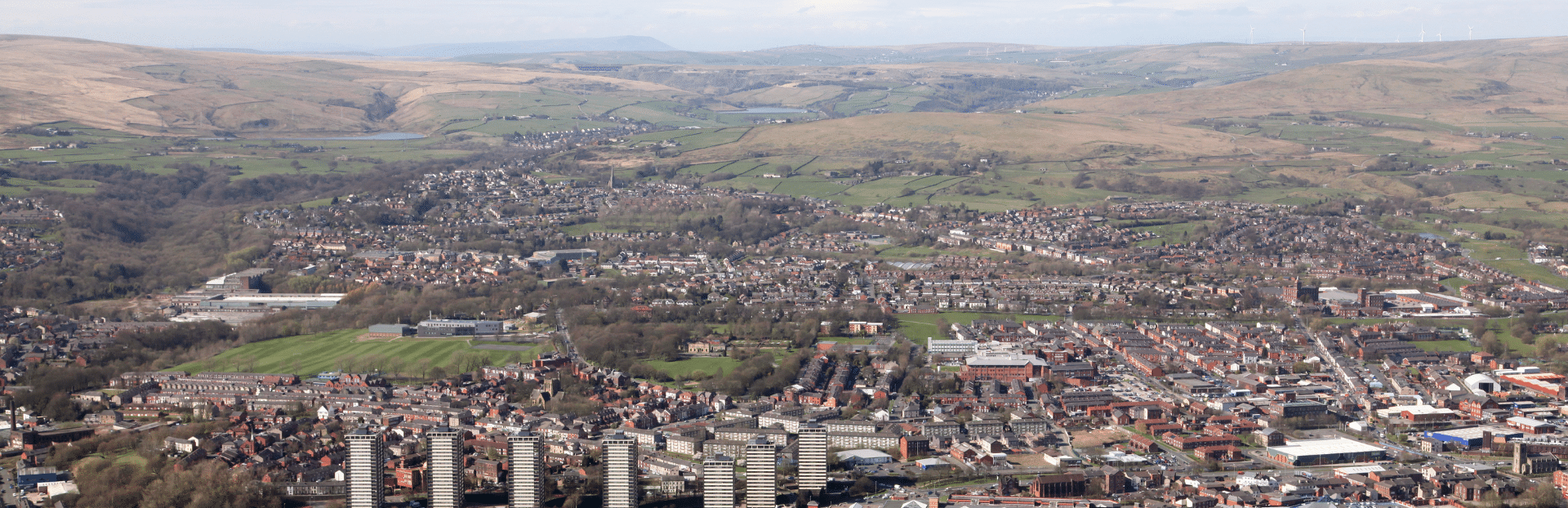
Rochdale is a metropolitan borough of Greater Manchester, in north-west England. Average sold prices in Rochdale sit at £206,368 on the HM Land Registry House Price Index, 3.9% below the North West regional average of £214,678 and 28.8% below England's £289,946. That makes Rochdale one of the more affordable boroughs in Greater Manchester, priced below the region as well as the nation, with the cheapest postcode entry asking under £240,000. The borough's population grew 5.7% between the 2011 and 2021 censuses, from 211,699 to 223,773 residents.
Rochdale's prices are anchored to local earnings rather than pulled up by them. The median gross weekly salary is £666.50, below the North West's £720.10 and Great Britain's £752.40, and house prices have stayed close to what local earners can afford rather than racing ahead of them. For an investor that combination, a low price base and a wage-constrained ownership market, leaves a sizeable tenant pool and a borough where a 30% deposit starts near £72,000. The spread between OL16 at £240,211 and M24 at £269,730 is narrow by big-city standards, so the choice between postcodes here is less about price tier and more about yield, growth track record, and how quickly each area sells.
This guide covers the Rochdale metropolitan borough (ONS code E08000005) across eight postcodes, from the town centre out through Heywood, Middleton, Littleborough, and the Oldham and Bury fringes that fall within Rochdale's catchment. Rochdale sits ten miles north-east of Manchester on the Pennine edge, linked to the city centre by the Metrolink tram. It is one of the ten boroughs of the North West city region, alongside neighbouring guides for Oldham, Bury, and Bolton.
Article updated: July 2026
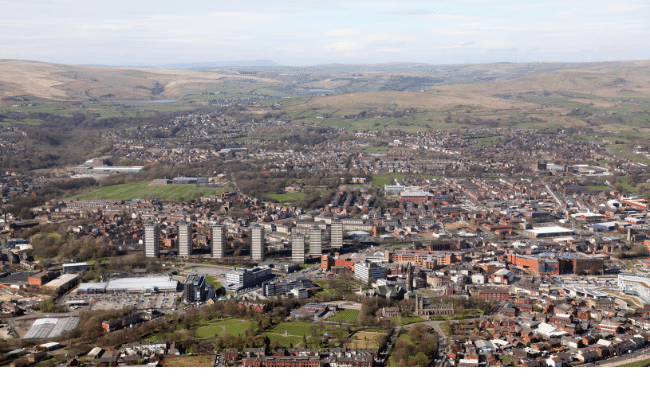
Why Invest in Rochdale?
Rochdale's population grew 5.7% between the 2011 and 2021 censuses, from 211,699 to 223,773 residents. That is a touch below the England and Wales average of 6.3%, but it represents steady growth in a borough that spent decades losing residents to the wider conurbation. The pull is straightforward: Rochdale offers Greater Manchester access at a fraction of central prices, with the Metrolink tram running into Manchester city centre from Rochdale town centre and the train into Manchester Victoria in under twenty minutes.
The local employment rate of 68.5% sits below both the North West average of 74.2% and Great Britain's 75.6%, and the unemployment rate of 7.0% runs above the regional 4.1% and GB's 4.3%. Those readings reflect a borough still rebuilding its economic base after the long decline of its cotton-mill industries, and they are part of why Rochdale prices have stayed below the regional average. The economy now leans on manufacturing, logistics, wholesale and retail, and health and social work, with the borough's position on the M62 corridor and the new advanced-manufacturing investment at Atom Valley reshaping the employment picture over the next decade.
Median gross annual earnings in Rochdale are £34,660, which is 7.4% below the North West regional median of £37,445 and 11.4% below the Great Britain median of £39,125. Lower local pay reads two ways for an investor. It is the main reason house prices here sit below the regional figure, because prices track what local earners can afford to buy. It also leaves a large pool of households that rent rather than buy, which is the demand a buy-to-let landlord is letting into.
Rochdale Economic Summary
- Population: 223,773 (2021 Census). Growth of 5.7% from 2011.
- Median annual salary: £34,660 (local), £37,445 (North West), £39,125 (Great Britain)
- Employment rate: 68.5% (local), 74.2% (North West), 75.6% (Great Britain)
- Unemployment rate: 7.0% (local), 4.1% (North West), 4.3% (Great Britain)
- Key employment sectors: Manufacturing, transport and logistics, wholesale and retail, health and social work, public sector
Source: ONS Census 2021, Nomis Labour Market Profile (ASHE 2025, Employment Oct 2024-Sep 2025)
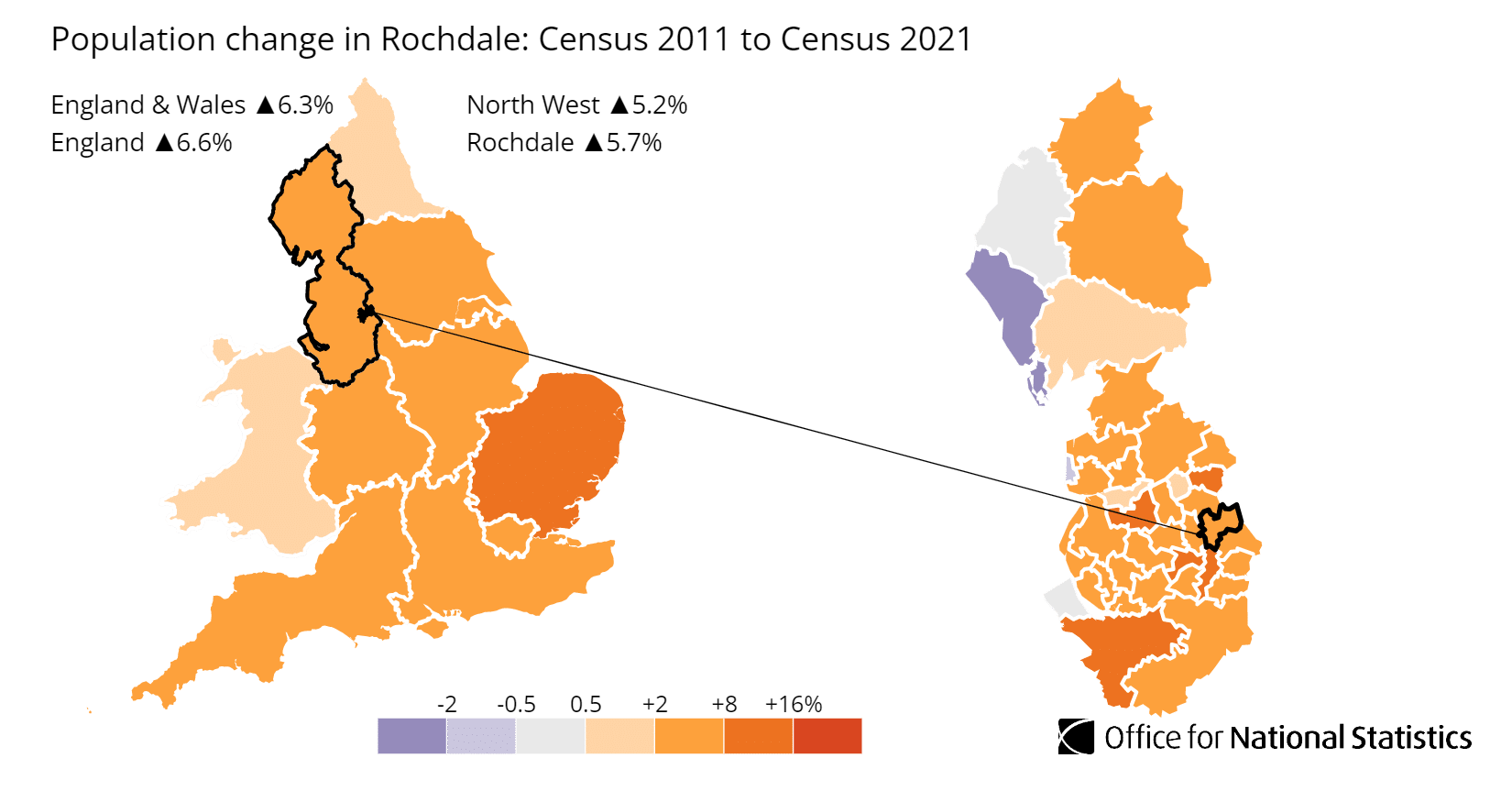
Source: Office for National Statistics - Population for Rochdale
Regeneration and Investment in Rochdale
Rochdale Borough Council has set out £197.6 million of capital investment across the borough for the year from April 2026, with around £120 million of it coming from external funding and grants. The money is concentrated on housing and on the corridor around the town's five railway stations, and it lands on top of the advanced-manufacturing investment going into Atom Valley on the borough's eastern edge. The three schemes below are the heaviest by money committed and by their reach across the postcodes investors actually buy in.
- Atom Valley (under construction): A joint advanced-manufacturing growth zone spanning Rochdale, Bury, and Oldham, set to deliver up to 20,000 jobs over the coming decade. The first building, the Sustainable Materials and Manufacturing Centre next to Kingsway Business Park in Rochdale, is a 30,000 sq ft facility delivered by the Greater Manchester Combined Authority, Rochdale Development Agency, and the University of Manchester, with completion expected in summer 2026. A jobs base of that scale sitting on the OL11 and OL16 side of the borough shifts the long-term tenant-demand picture for the east of Rochdale. Updates at Rochdale Development Agency.
- Station Gardens (under construction, £15 million): A scheme of 81 homes on a long-vacant brownfield site off Drake Street, a short walk from Rochdale railway station and the town centre, funded through a successful bid to the government's Community Regeneration Partnerships Fund and built by Willmott Dixon. The two-, three-, and four-bedroom homes are a mix of social and affordable tenures and are billed as the first net-zero homes delivered under a council-backed scheme in the borough, with completion expected in early 2028. Updates at Willmott Dixon.
- Five Stations regeneration (funded): More than £6 million is earmarked for physical regeneration around the borough's five railway stations, Rochdale, Littleborough, Smithy Bridge, Castleton, and Mills Hill, with new homes, commercial space, and public-realm work in the pipeline. The Rochdale element includes a new public square in front of the station and 33 apartments on a brownfield site at the corner of Maclure Road and Station Road, with construction set to begin in early 2026. The work concentrates new supply on the OL11, OL15, and OL16 commuter corridor that the Manchester train serves. Updates at Rochdale capital funding round-up.
Rochdale Property Market Analysis
Average property prices in Rochdale have risen 441.0% since January 1995, from £38,149 to £206,368. The sections below break down that journey cycle by cycle, then drill into current postcode-level data for sold prices, price per square foot, asking prices, growth trends, and monthly transaction volumes.
When Was the Last House Price Crash in Rochdale?
Rochdale sits within its own metropolitan borough, so all sold prices from HM Land Registry are recorded at borough level. The Land Registry House Price Index tracks average prices from January 1995 to March 2026, covering 31 years of market cycles, and Rochdale's stand out for the depth and length of its post-2008 fall.
The 1995 to 2007 boom: Rochdale started at £38,149 in January 1995. Growth was slow for the first half of the decade, reaching £46,405 by December 2000, then accelerated sharply through the early 2000s. Prices passed £75,666 by December 2003 and £108,603 by December 2005, before peaking at £128,118 in December 2007, a more than threefold rise over the boom.
2008 to 2009, the financial crisis: The fall was severe. Prices dropped from the December 2007 peak of £128,118 towards a low that took years to find, with the worst year-on-year reading of -16.2% recorded in April 2009 at £102,713. A lower-priced market with a smaller equity cushion took the downturn harder than the premium parts of Greater Manchester, and Rochdale's correction ran deeper than the regional and national falls.
The 2010 to 2013 stagnation: Where many markets bounced off the 2009 low, Rochdale ground lower for another four years. Prices slipped from £104,151 in December 2010 to £102,966 in December 2011, and on down to a trough of £97,807 in February 2013. From peak to trough that is a fall of 23.7%, and the borough spent the early 2010s as one of the slowest North West markets to turn.
Recovery, 2014 to 2018: Growth returned gradually. Prices rose from £106,904 in December 2014 to £114,579 by December 2016 and £123,195 by December 2017. The pre-crash peak of £128,118 was not regained until October 2018, when prices hit £128,980. It took almost eleven years to recover, one of the longest recovery periods in the region.
2019 to 2022, the pandemic surge: Once it turned, the market ran hard. Prices reached £137,565 by December 2019, then the stamp duty holiday and a flight to space and affordability lifted them to £145,421 by December 2020 and £161,251 by December 2021 (10.9% annual growth). The run peaked at £186,604 in November 2022, with December 2022 recording 15.5% annual growth as buyers priced out of dearer boroughs looked north.
The 2023 rate shock: Higher mortgage rates cooled the market. Prices eased to £182,937 by December 2023, a -1.8% annual reading. The pullback was modest, in keeping with a lower-priced market carrying less debt exposure than the conurbation's pricier corners.
2024 to present: Growth resumed, with prices reaching £196,682 by December 2024 (7.5% annual growth) and an all-time high of £208,888 in December 2025. The latest reading in March 2026 is £206,368, a gentle easing of 1.2% from the December high. The current price is 61.1% above the pre-crash peak of £128,118.
Long-term growth summary:
- 5 years (March 2021 to March 2026): 35.7% growth (£152,112 to £206,368)
- 10 years (March 2016 to March 2026): 84.3% growth (£112,004 to £206,368)
- 15 years (March 2011 to March 2026): 106.2% growth (£100,088 to £206,368)
- 20 years (March 2006 to March 2026): 92.3% growth (£107,307 to £206,368)
- 30 years (January 1995 to March 2026): 441.0% growth (£38,149 to £206,368)
Rochdale's 23.7% crash was deeper than both the regional and national averages, and the near-eleven-year recovery was among the longest in the North West, the legacy of a wage-constrained market that took time to rebuild momentum. But the 30-year return of 441.0% is strong, and the 106.2% gain over the past fifteen years shows the recovery, once it arrived, was substantial. An investor who bought at the exact December 2007 peak would now be sitting on a 61.1% gain on the Land Registry average.
- All property types
- Detached
- Semi-detached
- Terraced
- Flats
- All property types
- Detached
- Semi-detached
- Terraced
- Flats
Sold House Prices in Rochdale
Rochdale's average sold price across all property types is £206,368, which is 28.8% below the England average of £289,946 as of March 2026. Unlike many Greater Manchester boroughs where the headline discount is a quirk of housing mix, Rochdale sells below England on every single property type, which is the clearest read on how affordable the borough genuinely is.
| Property Type | Rochdale Average | England Average | Difference |
|---|---|---|---|
| Detached houses | £357,106 | £470,492 | -24.1% |
| Semi-detached houses | £222,347 | £288,185 | -22.8% |
| Terraced houses | £169,255 | £243,788 | -30.6% |
| Flats and maisonettes | £113,304 | £214,563 | -47.2% |
| All property types | £206,368 | £289,946 | -28.8% |
Detached houses at £357,106 sell 24.1% below England's £470,492, and they are the borough's higher end, concentrated in the greener fringes of Norden in OL12, Bamford in OL11, and the semi-rural edges of OL2 and OL15. Detached values grew 3.4% over the past year, the slower end of the borough's pace, in keeping with a smaller buyer pool competing for the larger homes.
Semi-detached houses at £222,347 sit 22.8% below England's £288,185 and are the family-home workhorse of the borough, spread across Middleton in M24, Royton and Shaw in OL2, and the inter-war suburbs ringing the town. This is the type with the steadiest demand from owner-occupiers and landlords alike, and at 4.4% annual growth it was the firmest of the four types over the past year.
Terraced houses at £169,255 are 30.6% below England's £243,788, and they are the backbone of Rochdale's buy-to-let market. The dense terraced streets of central Rochdale, Heywood in OL10, and Littleborough in OL15 are where the cheapest entry points and the strongest yields sit, and terraced values rose 3.6% over the year, tracking the broad market.
Flats and maisonettes at £113,304 carry the largest discount at 47.2% below the England flat figure of £214,563. Rochdale has little of the city-centre apartment stock that props up flat values in Manchester, so its flats are mostly older converted and low-rise units at the bottom of the price ladder. They were the only type to fall over the past year, down 1.9%, a thin and volatile segment that suits a different plan from the borough's terraced mainstay.
Price Per Square Foot in Rochdale
Sold prices per square foot range from £214 in OL16 (Rochdale, Milnrow) to £248 in OL2 (Royton, Shaw), a spread of just £34 per square foot. Measuring by the square foot strips out how big the homes are and compares the locations themselves, and in Rochdale it shows an unusually flat market: the dearest space costs only about 16% more than the cheapest, far tighter than the spreads seen in bigger Greater Manchester markets.
| Rank | Area | Price Per Sq Ft |
|---|---|---|
| 1 | OL16 (Rochdale, Milnrow) | £214 |
| 2 | OL12 (Rochdale, Norden) | £217 |
| 3 | OL10 (Heywood) | £219 |
| 4 | OL11 (Rochdale, Bamford) | £219 |
| 5 | BL9 (Bury) | £229 |
| 6 | OL15 (Littleborough) | £242 |
| 7 | M24 (Middleton) | £246 |
| 8 | OL2 (Royton, Shaw) | £248 |
The central and eastern Rochdale postcodes of OL16, OL12, and OL11 hold the cheapest space at £214 to £219 per square foot, the heart of the terraced market. The Oldham-fringe and Bury-fringe postcodes of OL2, M24, and BL9 carry a modest premium at £229 to £248, reflecting the larger semi-detached stock and the slightly better commuter pull of Middleton and Royton. The narrow spread tells the same story as the asking prices: Rochdale is a single, affordable market rather than a borough split into premium and budget halves.
For Sale Asking Prices in Rochdale
Current asking prices range from £239,906 in OL10 (Heywood) to £269,730 in M24 (Middleton), a spread of under £30,000 across the eight postcodes. Asking prices run ahead of the Land Registry sold figures because they reflect what is on the market now rather than what has completed, and the tight band confirms how little postcode-to-postcode variation there is for a buyer choosing across the borough.
| Rank | Area | Asking Price |
|---|---|---|
| 1 | OL10 (Heywood) | £239,906 |
| 2 | OL16 (Rochdale, Milnrow) | £240,211 |
| 3 | OL12 (Rochdale, Norden) | £242,674 |
| 4 | BL9 (Bury) | £256,265 |
| 5 | OL15 (Littleborough) | £260,040 |
| 6 | OL11 (Rochdale, Bamford) | £261,054 |
| 7 | OL2 (Royton, Shaw) | £269,426 |
| 8 | M24 (Middleton) | £269,730 |
Heywood in OL10 and central Rochdale in OL16 carry the lowest asking prices at £239,906 and £240,211, the cheapest way into the borough and the postcodes where the terraced yield stock concentrates. Middleton in M24 and Royton and Shaw in OL2 top the table near £269,700, where larger semi-detached homes and the Oldham-and-Manchester commuter pull lift values. A buyer wanting below the asking band here would look through off-market routes, where the keenest prices tend to move before a property is openly listed.
House Price Growth in Rochdale
Five-year capital growth ranges from 18.3% in OL15 (Littleborough) to 36.9% in OL10 (Heywood), a wide spread that shows how unevenly the recovery reached across the borough. The longer-run figures matter more than the one-year readings, several of which are negative as the market eases back from its late-2025 high.
| Area | 1 Year | 3 Years | 5 Years |
|---|---|---|---|
| OL10 (Heywood) | -1.6% | +9.6% | +36.9% |
| BL9 (Bury) | +0.2% | +12.6% | +31.1% |
| OL11 (Rochdale, Bamford) | -2.7% | +8.9% | +29.9% |
| OL2 (Royton, Shaw) | +0.7% | +14.6% | +29.4% |
| OL16 (Rochdale, Milnrow) | -2.4% | +8.0% | +26.4% |
| M24 (Middleton) | -1.0% | +6.9% | +23.3% |
| OL12 (Rochdale, Norden) | +1.1% | +13.3% | +23.3% |
| OL15 (Littleborough) | +0.2% | +4.1% | +18.3% |
Heywood in OL10 leads on five-year growth at 36.9%, with the Bury-fringe BL9 at 31.1% and Bamford in OL11 at 29.9% close behind, so the cheapest terraced corners of the borough have also been the fastest-growing. OL2 stands out on the three-year reading at 14.6%, the firmest recent momentum in the table. The negative one-year figures in OL11, OL16, and M24 are the market giving back a little of the late-2025 surge rather than a structural decline, since the three- and five-year numbers across the borough remain firmly positive.
Monthly Property Sales in Rochdale
M24 (Middleton) is the busiest market with around 45 sales a month, while OL15 (Littleborough) is the quietest at 15. Transaction volume is a read on how liquid each postcode is: the more sales completing each month, the easier it is to buy when you are looking and to sell when you need to exit.
| Area | Sales Per Month | Turnover | Asking Price |
|---|---|---|---|
| M24 (Middleton) | 45 | 19% | £269,730 |
| OL12 (Rochdale, Norden) | 41 | 21% | £242,674 |
| BL9 (Bury) | 39 | 15% | £256,265 |
| OL2 (Royton, Shaw) | 39 | 13% | £269,426 |
| OL11 (Rochdale, Bamford) | 35 | 17% | £261,054 |
| OL16 (Rochdale, Milnrow) | 28 | 18% | £240,211 |
| OL10 (Heywood) | 22 | 15% | £239,906 |
| OL15 (Littleborough) | 15 | 17% | £260,040 |
Middleton in M24 and Norden in OL12 turn over the most stock at around 41 to 45 sales a month, the most active markets to transact in. Heywood in OL10 and Littleborough in OL15 are the thinnest at 15 to 22 sales a month, so a buyer there may wait longer for the right property and a seller may take longer to find a buyer. Turnover, the share of the local stock that changes hands each year, runs highest in OL12 at 21%, pointing to a market where homes move on more frequently.
How Long Properties Take to Sell in Rochdale
OL12 (Rochdale, Norden) sells fastest, with a typical listing finding a buyer in about 145 days against 4.8 months of unsold stock, while OL2 (Royton, Shaw) is the slowest at 234 days and 7.7 months of stock. A headline yield says nothing about how long your money is tied up at the end, so exit speed belongs in the sums. Days on market is how long a typical home is listed before it sells; months of unsold stock is how long it would take to clear the current listings at the present sales rate.
| Area | Avg Days to Sell | Months of Unsold Stock | Market |
|---|---|---|---|
| OL12 (Rochdale, Norden) | 145 | 4.8 | Seller's market |
| OL16 (Rochdale, Milnrow) | 160 | 5.3 | Seller's market |
| M24 (Middleton) | 169 | 5.6 | Seller's market |
| OL11 (Rochdale, Bamford) | 179 | 5.9 | Seller's market |
| OL10 (Heywood) | 190 | 6.3 | Balanced market |
| OL15 (Littleborough) | 190 | 6.3 | Balanced market |
| BL9 (Bury) | 203 | 6.7 | Balanced market |
| OL2 (Royton, Shaw) | 234 | 7.7 | Balanced market |
The four central and eastern Rochdale postcodes, OL12, OL16, M24, and OL11, are seller's markets where homes move in roughly five to six months, the easiest places to exit when you need to. OL2 and BL9 sit at the other end, with stock taking seven to eight months to clear at the current pace. The gap between fastest and slowest is about three months, narrow enough that exit speed is a secondary consideration here rather than the dominant one it becomes in flat-heavy city-centre markets.
What Type of Property Can You Buy in Rochdale?
OL11 (Rochdale, Bamford) has the highest detached-house share at 30.6%, while OL16 (Rochdale, Milnrow) carries the highest flat share at 11.9%. The mix of housing stock shapes which strategies fit each postcode, so it is worth reading next to the yields. The figures come from the 2021 Census.
| Area | Detached | Semi-detached | Terraced | Flats |
|---|---|---|---|---|
| BL9 (Bury) | 29.2% | 31.7% | 26.9% | 12.0% |
| M24 (Middleton) | 25.5% | 40.8% | 25.9% | 7.7% |
| OL10 (Heywood) | 22.9% | 33.4% | 35.9% | 7.6% |
| OL11 (Rochdale, Bamford) | 30.6% | 36.4% | 22.4% | 10.3% |
| OL12 (Rochdale, Norden) | 29.1% | 32.7% | 30.6% | 7.4% |
| OL15 (Littleborough) | 28.4% | 27.7% | 30.9% | 6.9% |
| OL16 (Rochdale, Milnrow) | 22.3% | 37.9% | 27.8% | 11.9% |
| OL2 (Royton, Shaw) | 20.5% | 38.5% | 30.6% | 10.4% |
Rochdale is overwhelmingly a house market, with very little flat stock anywhere: even the flat-heaviest postcodes, BL9 and OL16, sit just above 11% flats, and the rest run below 11%. Semi-detached homes are the largest single category across most of the borough, peaking at 40.8% in M24 and 38.5% in OL2, the inter-war and post-war suburbs where families buy. Terraced housing is strongest in Heywood (OL10 at 35.9%), Littleborough (OL15 at 30.9%), and OL12, the dense streets that carry the borough's best yields and the stock most often run as a single let or a small HMO.
The flats figure covers both purpose-built blocks and converted units; a small share of mobile and temporary dwellings is not shown, so rows may not total 100%.
Rochdale Rental Market Analysis
Monthly rents in Rochdale range from £926 in BL9 (Bury) to £1,114 in M24 (Middleton), with gross rental yields from 4.3% to 5.0%. For investors asking is buy to let worth it in Rochdale, the figures below break rents, yields, and tenant affordability down postcode by postcode. If you are weighing the borough alongside its neighbours, you can see the current buy-to-let opportunities against the data here.
Average Rent & Gross Rental Yields in Rochdale
Gross rental yields in Rochdale range from 4.3% in BL9 (Bury) to 5.0% in M24 (Middleton) and OL16 (Rochdale, Milnrow), with a mean monthly rent across the seven data-bearing postcodes of £992. The yields sit in a narrow band, but the pattern is consistent: the strongest returns pair the cheapest terraced asking prices with steady tenant demand rather than chasing the highest rents.
| Area | Average Monthly Rent | Asking Price | Gross Yield |
|---|---|---|---|
| M24 (Middleton) | £1,114 | £269,730 | 5.0% |
| OL16 (Rochdale, Milnrow) | £992 | £240,211 | 5.0% |
| OL10 (Heywood) | £964 | £239,906 | 4.8% |
| OL12 (Rochdale, Norden) | £943 | £242,674 | 4.7% |
| OL11 (Rochdale, Bamford) | £1,007 | £261,054 | 4.6% |
| OL2 (Royton, Shaw) | £999 | £269,426 | 4.4% |
| BL9 (Bury) | £926 | £256,265 | 4.3% |
| OL15 (Littleborough) | Not enough data | £260,040 | Not enough data |
M24 (Middleton) tops the table at 5.0%, pairing the borough's highest rent of £1,114 a month with a £269,730 asking price, helped by Middleton's tram and motorway links into Manchester. OL16 (Rochdale, Milnrow) matches it at 5.0% from the other direction, on the borough's second-cheapest asking price of £240,211 and a £992 rent. Heywood (OL10) at 4.8% and Norden (OL12) at 4.7% complete the top group, all built on cheaper terraced stock. BL9 (Bury) sits at the bottom at 4.3%, where a higher asking price relative to its rent compresses the return. Rental listings are thin where PropertyData has the figures, but the demand signal is strong: BL9, M24, and OL16 each read as a landlord's market, with homes finding tenants in roughly four to eight weeks.
Gross Rental Yield by Postcode
Is Rochdale Rent High?
Monthly rents in Rochdale range from 32.0% to 38.6% of the local median gross monthly income, with the area average sitting at 34.4%. The median gross weekly salary in Rochdale is £666.50, which equates to £2,888 per month or £34,660 per year, below both the North West and Great Britain medians. Rents claiming around a third of local income leaves headroom for tenants, which is part of why arrears and voids tend to be lower in markets like this than in the stretched parts of the conurbation. Data from the Nomis Labour Market Profile (ASHE 2025).
| Rank | Area | Rent as % of Income |
|---|---|---|
| 1 | M24 (Middleton) | 38.6% |
| 2 | OL11 (Rochdale, Bamford) | 34.9% |
| 3 | OL2 (Royton, Shaw) | 34.6% |
| 4 | OL16 (Rochdale, Milnrow) | 34.4% |
| 5 | OL10 (Heywood) | 33.4% |
| 6 | OL12 (Rochdale, Norden) | 32.7% |
| 7 | BL9 (Bury) | 32.0% |
| 8 | OL15 (Littleborough) | Not enough data |
M24 (Middleton) is the least affordable to rent at 38.6% of local income, the flip side of carrying the borough's highest rent. The rest of the borough sits between 32% and 35%, a band where rent takes about a third of a median local wage. That affordability headroom is a quiet strength for a landlord: tenants who are not stretched are tenants who stay and pay.
How Big Is Rochdale's Private Rented Sector?
The private rented sector is deepest in OL15 (Littleborough) at 19.3% of households and shallowest in M24 (Middleton) at 12.8%. The share of homes already let privately is a guide to the size of the established tenant pool and how active the local lettings market is.
| Area | Owned Outright | Owned with Mortgage | Private Rented | Social Rented |
|---|---|---|---|---|
| OL15 (Littleborough) | 43.5% | 33.2% | 19.3% | 3.9% |
| OL16 (Rochdale, Milnrow) | 31.2% | 35.1% | 19.0% | 14.3% |
| OL10 (Heywood) | 35.9% | 29.3% | 18.1% | 15.6% |
| OL11 (Rochdale, Bamford) | 37.5% | 29.7% | 15.9% | 16.5% |
| OL2 (Royton, Shaw) | 36.9% | 32.7% | 15.0% | 15.0% |
| BL9 (Bury) | 38.4% | 31.7% | 14.6% | 14.8% |
| OL12 (Rochdale, Norden) | 39.9% | 37.3% | 14.2% | 8.3% |
| M24 (Middleton) | 36.7% | 39.0% | 12.8% | 10.6% |
Littleborough in OL15 and central Rochdale in OL16 have the deepest private rented sectors at 19.3% and 19.0%, with Heywood (OL10) close behind at 18.1%, so the established tenant pool is largest in the central and northern parts of the borough. Middleton in M24 and Norden in OL12 are the most owner-occupied, with private renting at 12.8% and 14.2%. A shallower rented sector is not a weakness for a landlord, it points to a market driven by families buying rather than renting, but the higher-share postcodes carry the proven lettings demand a first-time investor in the borough may prefer.
Local Housing Allowance Rates in Rochdale
Rochdale spans three Broad Rental Market Areas, so Local Housing Allowance varies by postcode. Local Housing Allowance is the maximum housing support a tenant on benefits can receive, so it acts as a rent floor for a landlord letting to that part of the market. To check the current rate for a specific address, use the government's official Local Housing Allowance calculator.
| BRMA | Postcodes | Shared | 1 bed | 2 bed | 3 bed | 4 bed |
|---|---|---|---|---|---|---|
| Oldham & Rochdale BRMA | OL11, OL12, OL15, OL16, OL2 | £79.36/wk (£344/mo) | £109.32/wk (£474/mo) | £132.91/wk (£576/mo) | £159.95/wk (£693/mo) | £218.63/wk (£948/mo) |
| Central Greater Manchester BRMA | M24 | £94.72/wk (£410/mo) | £178.36/wk (£773/mo) | £201.37/wk (£873/mo) | £218.63/wk (£948/mo) | £310.68/wk (£1,346/mo) |
| Bolton and Bury BRMA | BL9, OL10 | £78.59/wk (£341/mo) | £109.32/wk (£474/mo) | £132.33/wk (£574/mo) | £161.10/wk (£698/mo) | £218.63/wk (£948/mo) |
Most of Rochdale's postcodes fall in the Oldham & Rochdale BRMA, where the two-bedroom rate is £132.91 a week (about £576 a month). M24 (Middleton) sits in the higher Central Greater Manchester BRMA, where the two-bedroom rate jumps to £201.37 a week (about £873 a month), close to its £1,114 open-market rent. The Heywood and Bury postcodes of OL10 and BL9 fall in the Bolton and Bury BRMA at £132.33 a week (about £574 a month) for a two-bed. The benefit-backed rates sit below the £926 to £1,114 open-market rents recorded across the borough, but the gap is narrow in the cheaper Oldham & Rochdale postcodes, which is what makes the lower-priced terraced stock workable for a landlord letting to that tenant base.
Buy-to-Let Considerations
Are House Prices High in Rochdale? Price-to-Earnings Ratios
Purchasing a property in Rochdale requires between 6.9 and 7.8 times the median annual salary. This is based on the Nomis Labour Market Profile for Rochdale showing the median gross annual income for local residents is £34,660.
The national benchmark for price-to-earnings is 7.4x (England's average sold price of £289,946 divided by the Great Britain median annual salary of £39,125). Three of Rochdale's eight postcodes sit below that benchmark, meaning they are more affordable relative to local incomes than the England average is relative to national incomes, and the tight 6.9x to 7.8x band shows how evenly priced the borough is against local pay.
| Rank | Area | Price-to-Earnings Ratio |
|---|---|---|
| 1 | OL10 (Heywood) | 6.9x |
| 2 | OL16 (Rochdale, Milnrow) | 6.9x |
| 3 | OL12 (Rochdale, Norden) | 7.0x |
| 4 | BL9 (Bury) | 7.4x |
| 5 | OL15 (Littleborough) | 7.5x |
| 6 | OL11 (Rochdale, Bamford) | 7.5x |
| 7 | OL2 (Royton, Shaw) | 7.8x |
| 8 | M24 (Middleton) | 7.8x |
Heywood (OL10) and central Rochdale (OL16) are the most affordable entries against local earnings at 6.9x, with Norden (OL12) at 7.0x, all below the 7.4x national benchmark. Middleton (M24) and Royton and Shaw (OL2) top the table at 7.8x, where larger semi-detached stock and the better commuter pull lift prices relative to the borough wage. Even the dearest postcode here costs under eight times local pay, which keeps Rochdale among the more affordable corners of Greater Manchester whichever postcode you choose.
Deposit Requirements in Rochdale
A 30% deposit on property in Rochdale ranges from £71,972 in OL10 (Heywood) to £80,919 in M24 (Middleton). The spread of under £9,000 between the cheapest and dearest deposit is one of the tightest in Greater Manchester, so the capital needed to get in is much the same across the borough. Beyond the deposit, the buy to let stamp duty calculator and other buy-to-let running costs add to the total capital required.
| Rank | Area | 30% Deposit Required |
|---|---|---|
| 1 | OL10 (Heywood) | £71,972 |
| 2 | OL16 (Rochdale, Milnrow) | £72,063 |
| 3 | OL12 (Rochdale, Norden) | £72,802 |
| 4 | BL9 (Bury) | £76,880 |
| 5 | OL15 (Littleborough) | £78,012 |
| 6 | OL11 (Rochdale, Bamford) | £78,316 |
| 7 | OL2 (Royton, Shaw) | £80,828 |
| 8 | M24 (Middleton) | £80,919 |
Heywood (OL10), central Rochdale (OL16), and Norden (OL12) need the smallest deposits at around £72,000, the cheapest way to acquire stock in the borough and the same postcodes that carry the strongest yields. Middleton (M24) and Royton and Shaw (OL2) need close to £81,000 for their larger semi-detached homes. With so little separating the top and bottom of the deposit table, the choice of postcode in Rochdale turns far more on yield and growth track record than on how much cash gets you through the door.
What the Rochdale Data Tells Buy-to-Let Investors
Rochdale is an affordability play, and the income and the growth both sit in the cheaper terraced east. The two top-yielding postcodes pull from opposite ends: M24 (Middleton) at 5.0% on the borough's highest rent of £1,114, and OL16 (Rochdale, Milnrow) at 5.0% on its second-cheapest asking price of £240,211. Heywood (OL10) at 4.8% rounds out the income leaders, and it has also been the fastest grower over five years at 36.9%, so yield and capital growth point at the same cheaper terraced corners.
The borough's defining feature is how little separates its postcodes. Asking prices span just £30,000, deposits under £9,000, and price per square foot only £34, so this is one market rather than a premium-and-budget split. That makes the decision less about which tier to buy in and more about matching a postcode to a plan: the terraced streets of OL16, OL10, and OL12 for yield and the fastest exits, the semi-detached suburbs of M24 and OL2 for the steadiest owner-occupier demand and the busiest resale markets.
Liquidity is even across the borough, with most postcodes turning over 28 to 45 sales a month and selling in five to eight months. A 30% deposit for buying an investment property here runs from £71,972 to £80,919, and three of the eight postcodes sit below the national price-to-earnings benchmark, so the borough is affordable both in absolute terms and against local pay. The longer-term case rests on the £197.6 million regeneration pipeline and the Atom Valley jobs investment landing alongside one of Greater Manchester's lowest price bases.
How Rochdale Compares
Rochdale's mean asking price is £254,913, with a mean monthly rent of £992 and a top gross yield of 5.0%. The table sets Rochdale against four neighbouring Greater Manchester markets on the three numbers that decide a buy-to-let: what you pay, what it rents for, and the yield that falls out.
| Location | Mean Asking Price | Mean Monthly Rent | Mean Gross Yield | Top Yield (postcode) |
|---|---|---|---|---|
| Rochdale | £254,913 | £992 | 4.7% | 5.0% (M24, OL16) |
| Bolton | £255,835 | £981 | 4.6% | 6.1% (M38) |
| Oldham | £263,190 | £1,019 | 4.6% | 5.4% (OL7) |
| Manchester | £268,032 | £1,312 | 5.9% | 8.1% (M14) |
| Bury | £281,678 | £1,022 | 4.4% | 5.0% (M24) |
Rochdale's mean asking price of £254,913 is the lowest in this group, a touch under Bolton at £255,835 and £26,765 below Bury, the dearest in the table. The trade-off shows up in the yield: Rochdale's top gross yield of 5.0% is the softest of the five, matched only by Bury, while Manchester leads at 8.1% on the back of its deep pool of high-yielding terraced postcodes that the outer boroughs cannot match.
For investors prioritising the lowest entry, Rochdale leads the group on price, with Oldham and Bolton close behind. Manchester carries both the highest rent at £1,312 a month and the highest yield, while Bury sits at the top of the table on price for a yield no better than Rochdale's. For a data-driven comparison across all UK locations, see our highest-yielding areas guide. Every guide at Property Investments UK uses the same Land Registry basis as this one, so Rochdale compares cleanly with any area we cover.
Frequently Asked Questions
Is Rochdale a good place to invest in property?
Rochdale's appeal is affordability with Greater Manchester access. Average sold prices sit 28.8% below the England figure and 3.9% below the North West, the cheapest postcode asks under £240,000, and the Metrolink tram links the town centre to central Manchester. Gross yields reach 5.0% in M24 and OL16, the population grew 5.7% between the 2011 and 2021 censuses, and a £197.6 million regeneration pipeline is landing alongside the Atom Valley jobs investment. Whether it suits a specific investor comes down to budget, target return, and risk appetite, which the postcode data here is built to inform.
What are the best areas for buy-to-let in Rochdale?
It depends what you are optimising for. For yield, the cheaper terraced postcodes lead: M24 (Middleton) and OL16 (Milnrow) both at 5.0%, with OL10 (Heywood) at 4.8%, all on asking prices at or under £270,000. For five-year capital growth, OL10 (Heywood) is strongest at 36.9%, with BL9 at 31.1% and OL11 at 29.9%. The borough's postcodes are unusually close together on price, so the choice is more about matching an area to a plan than about price tier.
What is a good rental yield in Rochdale?
The borough average gross yield sits around 4.7%, so anything above that is doing well for Rochdale. The top is 5.0% in M24 and OL16, and most of the seven data-bearing postcodes clear 4.6%. A gross yield around 5% on an asking price under £250,000 is competitive for an affordable Greater Manchester borough, but gross yield ignores mortgage costs, management, maintenance, and voids, so the net figure after costs will be lower.
What type of property should I buy in Rochdale?
Rochdale is a house market, with very little flat stock anywhere. The higher-yielding stock is terraced housing in the central and northern postcodes like OL16, OL10, and OL12, which is also what most often gets run as a single let or a small HMO. The semi-detached suburbs of M24, OL2, and OL11 cost a little more and suit family lets with the steadiest owner-occupier demand underneath. The thin, low-priced flat segment was the only property type to fall in value over the past year, so it suits a very different plan from the borough's terraced mainstay.
How do I buy a buy-to-let property in Rochdale?
Start with the number that fits your goal. For income, the higher yields sit in the cheaper terraced postcodes, OL16, OL10, and M24 at 4.8% to 5.0%, where a 30% deposit runs from about £72,000. For growth, OL10 and the OL2 corridor have the firmer recent track record. A 30% deposit is the realistic figure for a buy-to-let mortgage, so on Rochdale's £254,913 mean asking price that is roughly £76,000. Many of the keenest deals never reach the open market: below market value properties and direct introductions to investment properties are how a lot of stock in the borough changes hands.
What are the up-and-coming areas in Rochdale?
The regeneration money concentrates on the town-centre and station corridor and the eastern manufacturing edge. The £15 million Station Gardens scheme is building 81 net-zero homes off Drake Street by the railway station, the Five Stations programme is reshaping the OL11, OL15, and OL16 commuter belt, and the Atom Valley advanced-manufacturing investment is bringing up to 20,000 jobs to the OL11 and OL16 side of the borough over the coming decade. Those eastern terraced postcodes are also where five-year growth and yields have been strongest, so the data and the regeneration pipeline broadly point at the same parts of the borough.
Are Rochdale house prices high compared to the national average?
No. The average sold price of £206,368 is 28.8% below the England figure of £289,946, and Rochdale sells below England on every property type, not just on the headline average. Three of the eight postcodes have a price-to-income ratio under the national benchmark of 7.4 times local earnings, and even the dearest, M24 and OL2 at 7.8x, sit only just above it. That makes Rochdale one of the more affordable boroughs in Greater Manchester both in absolute terms and against local pay.
Is Rochdale buy-to-let still profitable in 2026?
Profitability depends on purchase price, mortgage terms, and running costs. A property bought around average asking price in M24 or OL16 at a 5.0% gross yield on a 65% LTV mortgage would generate modest positive cash flow before management fees, helped by the low purchase price keeping the borrowing down; the same maths at a 4.3% yield in BL9 would be tighter. Higher interest rates since 2022 have compressed margins across the UK buy-to-let market, so running the numbers on a specific property with current rates is essential before committing.
Ready to buy property?
Access off-market investment properties with an average 8%+ annual gross yield (beating the UK's typical 3-5%).
Get property alerts