
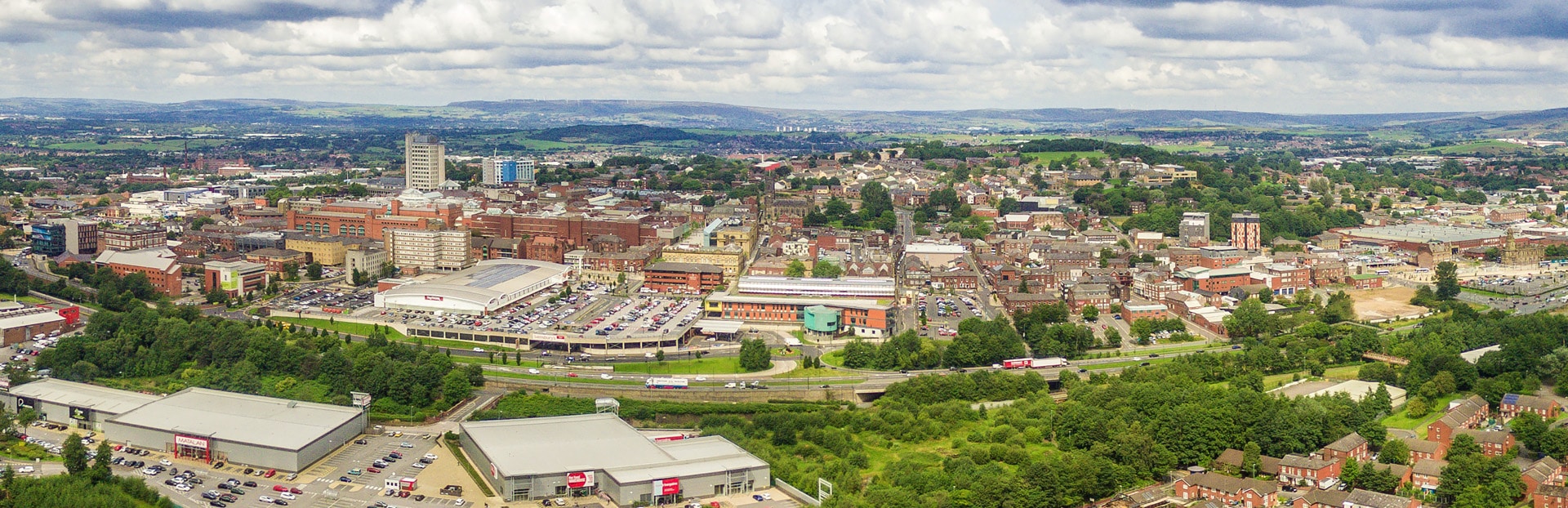
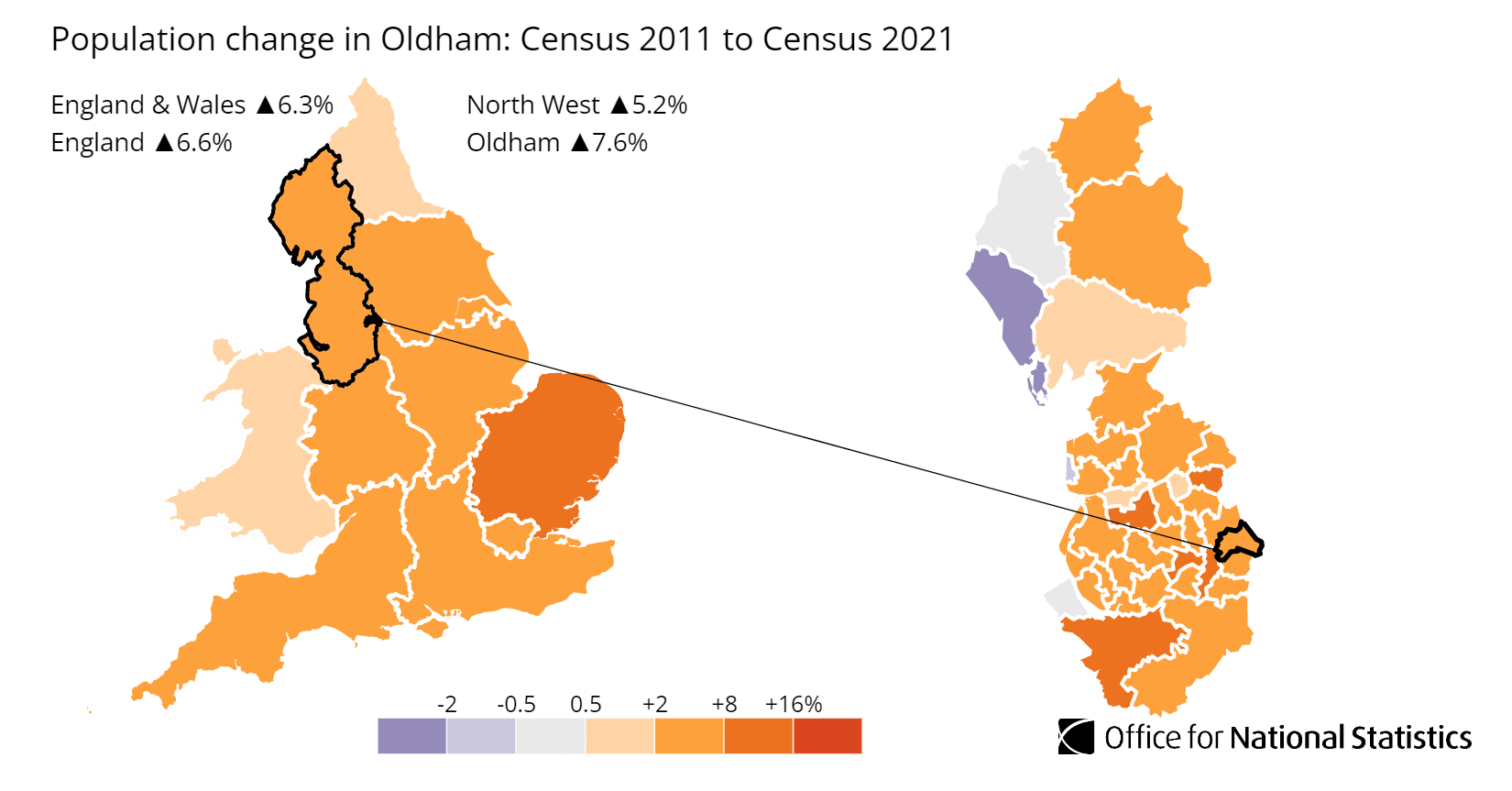
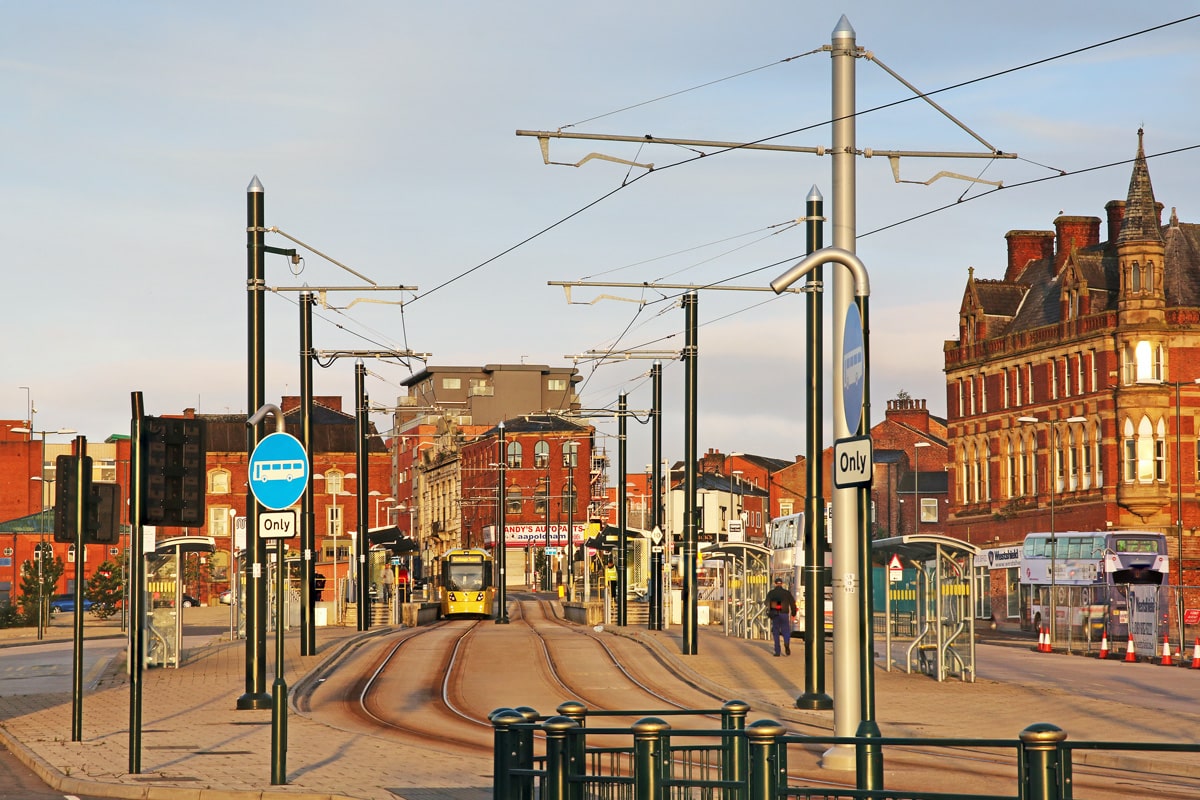
Oldham is a metropolitan borough of Greater Manchester, in North West England. Average sold prices in Oldham sit at £209,728 on the HM Land Registry House Price Index, just 2.3% below the North West regional average of £214,678 and 27.7% below England's £289,946. That places Oldham among the more affordable Greater Manchester boroughs, a Pennine-edge town where the average home costs roughly £80,000 less than the England figure while sitting on the Metrolink tram line into central Manchester. The borough's population grew 7.64% between the 2011 and 2021 censuses, from 224,897 to 242,088 residents.
Oldham's appeal to buy-to-let investors is the combination of a low price base and yields that the dearer parts of Greater Manchester cannot match. OL7 (Ashton-under-Lyne) tops the borough at a 5.4% gross yield, and OL8 (Werneth, Hollinwood) and M35 (Failsworth) both reach 5.2%, all on asking prices below £256,000. At the other end, OL3 (Saddleworth, Uppermill) is premium Pennine commuter territory at £394,493, where the yield drops to 3.5%. That spread gives a single borough two distinct investment cases.
This guide covers the metropolitan borough of Oldham (ONS code E08000004) and the surrounding postcodes that make up its property market: OL1, OL2, OL3, OL4, OL5, OL7, OL8, and OL9, alongside M24 (Middleton), M35 (Failsworth), and SK15 (Stalybridge). Oldham sits in the North West region, around seven miles north-east of Manchester city centre, with tram and rail links running into the regional core. The wider Manchester buy-to-let market and neighbouring boroughs such as Stockport share the same Greater Manchester tenant pool.
Article updated: July 2026
Why Invest in Oldham?
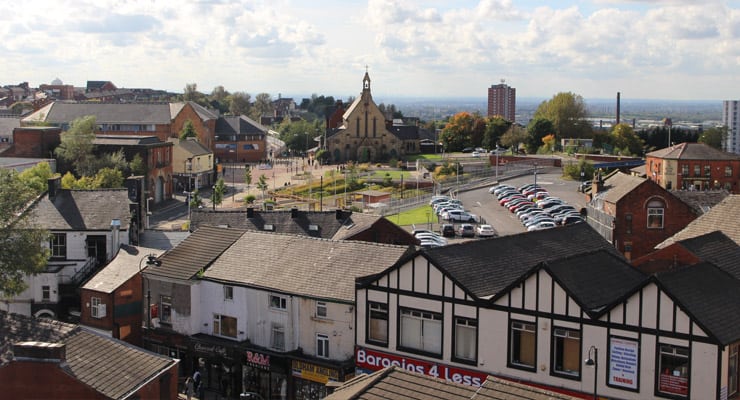
Oldham grew its population 7.64% between the 2011 and 2021 censuses, from 224,897 to 242,088 residents, slightly ahead of the England and Wales average of 6.3%. The borough is one of the ten that make up Greater Manchester, sitting on the moorland edge where the conurbation meets the Pennines. Its draw for a renter is the same as its draw for an investor: lower housing costs than central Manchester, with a tram ride into the city for work.
The local employment rate of 67.9% sits below both the North West average of 74.2% and Great Britain's 75.6%, and that is part of Oldham's profile. This is a working town with a lower wage base than the more affluent Greater Manchester boroughs, which keeps both prices and rents accessible. Oldham's economy leans on health and social work, wholesale and retail, manufacturing, and education, with the town centre and the trading estates around Hollinwood and Chadderton providing much of the local employment.
Median gross annual earnings in Oldham are £34,042, which is 9.1% below the North West regional median of £37,455 and 13.0% below the Great Britain median of £39,125. Lower local wages cap what tenants can pay, so Oldham works as a yield play rather than a high-rent one: the value sits in the gap between low asking prices and steady, if modest, rents. The Metrolink connection matters here, because it widens the tenant pool to commuters who work in Manchester but want a rent they can afford.
Oldham Economic Summary
- Population (Oldham): 242,088 (2021 Census). Growth of 7.64% from 2011.
- Median annual salary: £34,042 (local), £37,455 (North West), £39,125 (Great Britain)
- Employment rate: 67.9% (local), 74.2% (North West), 75.6% (Great Britain)
- Unemployment rate: 4.3% (local)
- Key employment sectors: Health and social work, wholesale and retail, manufacturing, education, administrative services
Source: ONS Census 2021, Nomis Labour Market Profile (ASHE 2025)
Regeneration and Investment in Oldham
Oldham's town centre is in the middle of a 15-year regeneration programme aiming to build thousands of new homes, anchored by the £31.5 million Princes Gate scheme. The investment is concentrated on the town centre itself, replacing dated retail and leisure stock with housing, a new market hall, and a restored theatre. For an investor, the relevant point is that the borough is putting residential supply back into the centre, on the doorstep of the tram network.
- Oldham Town Centre Living Regeneration (Under construction, 15-year programme): An ambitious programme to create thousands of new homes in the town centre. Princes Gate will deliver 331 homes with £31.5 million of Greater Manchester Combined Authority funding, with construction starting in 2026, alongside a separate 11-storey, 120-apartment building. The wider programme adds new housing on the doorstep of the Metrolink network. Updates at Oldham Council.
- SportsTown (Planning, £70 million): A major sports and community complex developed with Oldham Athletic and Oldham RLFC, creating a new sporting quarter at the eastern end of the town. It is intended to anchor regeneration in that part of Oldham and draw visitors from across Greater Manchester. Updates at The Oldham Times.
- Spindles Transformation and Coliseum Theatre (Under construction, completing 2026): The conversion of the Spindles shopping centre into a new indoor market hall and entertainment space, alongside the restoration of the historic Coliseum Theatre and a new town square. Both projects are due to complete in 2026, lifting footfall in the centre. Updates at The Oldham Times.
Source: Office for National Statistics - Population for Oldham
Oldham Property Market Analysis
Average property prices in Oldham have risen 471.4% since January 1995, from £36,706 to £209,728. The sections below trace that path through the market's cycles, then drill into current postcode-level data for sold prices, price per square foot, asking prices, growth trends, and monthly transaction volumes.
When was the last house price crash in Oldham?
Oldham is a metropolitan borough, so HM Land Registry records all of its sold prices at borough level. The House Price Index tracks the average from January 1995 to the latest March 2026 reading, covering 31 years of the market.
The 1995 to 2007 boom: Oldham started at £36,706 in January 1995, one of the lowest borough averages in Greater Manchester. Prices climbed slowly through the late 1990s, reaching £41,698 by December 2000, then accelerated sharply through the early-2000s credit boom to £101,306 by December 2005. The market peaked at £125,437 in December 2007, more than triple the 1995 base in twelve years.
2008 to 2009, the financial crisis: Prices fell from the December 2007 peak of £125,437 to £100,357 by March 2009, a drop of 20.0% in fifteen months. The worst year-on-year reading was -17.8% in March 2009. Oldham's correction was steeper than England's 18.2% fall, reflecting the borough's exposure to the lower-value, higher-loan-to-value lending that the credit crunch hit hardest.
The 2010 to 2013 stagnation: This is where Oldham's cycle parts company with the headline national story. Rather than a clean recovery, prices ground lower for years. The average stood at £108,381 in December 2010, drifted to £102,373 by December 2012, and bottomed at £97,961 in February 2013, below even the 2009 low. Oldham spent more than five years under its post-crash 2009 level before the market turned.
Recovery, 2014 to 2017: Growth returned slowly, with prices rising from £106,761 in December 2014 to £116,464 by December 2016. The average finally pushed back above the December 2007 peak of £125,437 in November 2017, reaching £126,560. The recovery took almost ten years, longer than England's, a measure of how deep the Pennine stagnation ran.
The 2018 to 2019 pre-pandemic growth: Steady mid-single-digit growth followed. Prices moved from £129,206 in December 2018 to £137,635 by December 2019, with annual growth running between 3.6% and 6.5%.
2020 to 2022, the pandemic surge: The stamp duty holiday and a wave of buyers priced out of central Manchester pushed Oldham hard. Prices jumped from £138,812 in June 2020 to £150,287 by December 2020 (9.2% annual growth), then ran on through 2021 to £166,209 by December 2021 (10.6% annual). By December 2022 the average reached £186,609, a 12.3% annual gain.
The 2023 rate shock: Higher mortgage rates cooled the market. Prices eased to £181,613 by June 2023 and £185,200 by December 2023, recording -0.8% annual growth. Oldham's affordability cushioned it, since lower absolute prices meant smaller monthly payment shocks than higher-value markets faced.
2024 to present: Growth resumed, with prices reaching £196,754 by December 2024 (6.2% annual) and an all-time high of £214,962 in October 2025. The average has since eased to £209,728 by the latest March 2026 reading. The current price is 67.2% above the pre-crash peak of £125,437.
Long-term growth summary:
- 5 years (March 2021 to March 2026): 33.1% growth (£157,604 to £209,728)
- 10 years (March 2016 to March 2026): 90.5% growth (£110,076 to £209,728)
- 15 years (March 2011 to March 2026): 102.9% growth (£103,371 to £209,728)
- 20 years (March 2006 to March 2026): 104.8% growth (£102,405 to £209,728)
- 30 years (January 1995 to March 2026): 471.4% growth (£36,706 to £209,728)
Oldham's 21.9% peak-to-trough fall was deeper than the national average, and its return to the old peak took nearly ten years. But the 30-year return of 471.4% is among the strongest in Greater Manchester, helped by the low starting base. A buyer who came in at the exact December 2007 peak would be sitting on a 67.2% gain on the Land Registry average today, even after a longer wait than buyers in more expensive markets had.
- All property types
- Detached
- Semi-detached
- Terraced
- Flats
- All property types
- Detached
- Semi-detached
- Terraced
- Flats
Sold House Prices in Oldham
The average sold price across all property types in Oldham is £209,728, which is 27.7% below the England average of £289,946 as of March 2026. That discount is wider than most Greater Manchester boroughs and it widens further as you move down the property ladder. Flats are 40.7% below the England figure, while detached houses are 21.4% below. The pattern tells you where Oldham's value sits: its terraced and flat stock, the natural buy-to-let end of the market, carries the deepest discount to the national average.
| Property Type | Oldham Average | England Average | Difference |
|---|---|---|---|
| Detached houses | £369,968 | £470,492 | -21.4% |
| Semi-detached houses | £238,913 | £288,185 | -17.1% |
| Terraced houses | £177,704 | £243,788 | -27.1% |
| Flats and maisonettes | £127,322 | £214,563 | -40.7% |
| All property types | £209,728 | £289,946 | -27.7% |
Detached houses at £369,968 carry the smallest discount at 21.4% below England's £470,492. Oldham's detached stock concentrates in the Saddleworth villages of OL3 and the greener edges of OL2, where Pennine-fringe homes draw commuters who want space and a tram link without paying central-Manchester prices. Annual growth of 1.0% points to a stable rather than a heated market.
Semi-detached houses at £238,913 sit 17.1% below England's £288,185, the smallest discount after detached homes. This is the backbone of Oldham's housing stock and its mainstream lettings market, spread right across the borough from Royton and Shaw in OL2 to Failsworth in M35. Annual growth of 1.5% is the strongest of any property type here.
Terraced houses at £177,704 offer a 27.1% discount to England's £243,788. The terraced stock is heaviest in the inner postcodes, OL8 (Werneth, Hollinwood) and OL1 (Town Centre, Chadderton), the classic mill-town terraces that make up much of the affordable buy-to-let market. Annual growth of 1.1% keeps pace with the borough average.
Flats and maisonettes at £127,322 show the deepest discount at 40.7% below England's £214,563. Oldham has little of the purpose-built apartment stock that inflates flat values in central Manchester, so its flat prices reflect local demand only. Annual change of -4.3% confirms a soft market for this type, and it is the one property category in the borough going backwards.
Price Per Square Foot in Oldham
£122 per square foot separates Oldham's cheapest space from its dearest, with OL8 at £204 and OL3 at £326. Measuring by the square foot controls for how big the homes are, so it compares the value of one postcode against another rather than one house type against another. OL3 (Saddleworth, Uppermill) commands the top rate, reflecting the premium stone-built village property of the Saddleworth moorland fringe.
| Rank | Area | Price Per Sq Ft |
|---|---|---|
| 1 | OL8 (Werneth, Hollinwood) | £204 |
| 2 | OL1 (Town Centre, Chadderton) | £206 |
| 3 | OL7 (Ashton-under-Lyne) | £220 |
| 4 | OL4 (Lees, Springhead) | £230 |
| 5 | OL9 (Chadderton, Westwood) | £235 |
| 6 | M24 (Middleton) | £246 |
| 7 | OL2 (Royton, Shaw) | £248 |
| 8 | SK15 (Stalybridge) | £251 |
| 9 | M35 (Failsworth) | £253 |
| 10 | OL5 (Mossley) | £255 |
| 11 | OL3 (Saddleworth, Uppermill) | £326 |
OL8 at £204 per square foot is the cheapest space in the borough, narrowly ahead of OL1 at £206. Both are inner-Oldham postcodes carrying the terraced and flat stock that suits buy-to-let, and both feed straight into the borough's highest yields. From 463 transactions analysed in OL8, the per-square-foot figure sits 37% below OL3's.
OL3 at £326 per square foot is the outlier, 60% dearer than OL8. When a buyer pays that much per square foot, they are paying for the location: the Saddleworth villages of Uppermill, Greenfield, and Diggle, where period stone homes on the moorland edge command a premium that the rest of the borough does not. The 297 transactions analysed there hold that gap consistently.
For Sale Asking Prices in Oldham
OL1 at £206,033 and OL3 at £394,493 sit 91.5% apart, the widest asking-price gap in the borough. That range mirrors the sold-price hierarchy but stretches it further. The mean asking price across all eleven Oldham postcodes is £263,190.
| Rank | Area | Asking Price |
|---|---|---|
| 1 | OL1 (Town Centre, Chadderton) | £206,033 |
| 2 | OL7 (Ashton-under-Lyne) | £219,760 |
| 3 | OL8 (Werneth, Hollinwood) | £239,864 |
| 4 | OL5 (Mossley) | £242,698 |
| 5 | OL9 (Chadderton, Westwood) | £249,089 |
| 6 | M35 (Failsworth) | £255,570 |
| 7 | OL4 (Lees, Springhead) | £256,006 |
| 8 | OL2 (Royton, Shaw) | £269,426 |
| 9 | M24 (Middleton) | £269,730 |
| 10 | SK15 (Stalybridge) | £292,424 |
| 11 | OL3 (Saddleworth, Uppermill) | £394,493 |
OL1 at £206,033 is the cheapest way into Oldham and the only postcode where the asking price falls below the borough's mean of £263,190. It covers the town centre and Chadderton, where terraced and flat stock keeps the entry cost down. For an investor on a fixed budget, OL1 buys the most property for the money and the lowest barrier to entry in the borough.
OL3's £394,493 asking price is the borough's anomaly. It is 91.5% above OL1 and sits closer to a Cheshire commuter-belt price than a Greater Manchester one, because Saddleworth's stone villages compete for a different buyer entirely. The yield data in the sections below confirms that OL3 is owner-occupier territory, not a buy-to-let postcode.
House Price Growth in Oldham
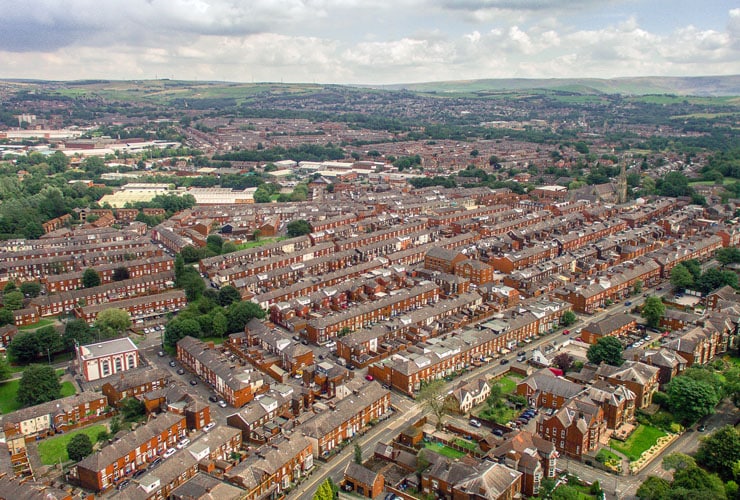
Every Oldham postcode posted positive five-year growth, led by OL8 at 54.4%, with seven of the ten rising across all three timeframes. The five-year column is uniformly strong because it captures the pandemic surge, while the one-year readings split between postcodes still rising and the four that have eased back from the 2025 high.
| Area | 1 Year | 3 Years | 5 Years |
|---|---|---|---|
| OL8 (Werneth, Hollinwood) | -2.4% | 21.0% | 54.4% |
| OL1 (Town Centre, Chadderton) | 3.6% | 15.6% | 34.4% |
| OL7 (Ashton-under-Lyne) | 3.9% | 12.3% | 30.3% |
| OL2 (Royton, Shaw) | 0.7% | 14.6% | 29.4% |
| M35 (Failsworth) | 7.1% | 17.0% | 27.5% |
| OL9 (Chadderton, Westwood) | 6.2% | 10.3% | 26.0% |
| OL4 (Lees, Springhead) | 6.9% | 20.4% | 25.3% |
| M24 (Middleton) | -1.0% | 6.9% | 23.3% |
| OL5 (Mossley) | 0.2% | 3.8% | 16.8% |
| OL3 (Saddleworth, Uppermill) | -2.7% | 7.5% | 16.1% |
| SK15 (Stalybridge) | -0.2% | 4.5% | 14.6% |
OL8 at 54.4% over five years posted the strongest growth in the borough, far ahead of the rest. Werneth and Hollinwood started from the lowest price base, so the pandemic rerating lifted them proportionally more. The -2.4% one-year reading shows that gain has paused recently, but the medium-term record is clear.
M35 (Failsworth) is the steadiest of the seven that rose across all three windows, posting the highest one-year reading at 7.1% alongside 17.0% (three-year) and 27.5% (five-year). Its position on the Manchester side of the borough, closest to the city and the M60, gives it the most consistent demand. OL1, OL4, and OL9 also grew across all three timeframes, while OL3 and SK15, the dearer postcodes, posted the weakest five-year returns.
The four postcodes with negative one-year readings, OL8, OL3, M24, and SK15, all still hold positive three- and five-year growth, so the recent softness reads as a pause after the 2025 high rather than a reversal.
Monthly Property Sales in Oldham
Monthly transactions run from 10 in OL5 to 45 in M24, with 263 sales a month across the borough. Even the quietest postcodes see steady turnover, and the busiest, M24 and OL2, reflect their larger housing stock. Turnover rates, the share of homes changing hands each year, vary from 11% in OL3 to 32% in OL7.
| Area | Sales Per Month | Turnover | Asking Price |
|---|---|---|---|
| M24 (Middleton) | 45 | 19% | £269,730 |
| OL2 (Royton, Shaw) | 39 | 13% | £269,426 |
| OL9 (Chadderton, Westwood) | 34 | 27% | £249,089 |
| OL4 (Lees, Springhead) | 29 | 16% | £256,006 |
| OL8 (Werneth, Hollinwood) | 25 | 29% | £239,864 |
| M35 (Failsworth) | 21 | 17% | £255,570 |
| SK15 (Stalybridge) | 18 | 14% | £292,424 |
| OL7 (Ashton-under-Lyne) | 17 | 32% | £219,760 |
| OL1 (Town Centre, Chadderton) | 13 | 18% | £206,033 |
| OL3 (Saddleworth, Uppermill) | 12 | 11% | £394,493 |
| OL5 (Mossley) | 10 | 16% | £242,698 |
OL7's 32% turnover is the highest in the borough, well ahead of the rest. Ashton-under-Lyne combines an affordable price base with a deep pool of terraced and flat stock, so a larger share of homes change hands each year. For a landlord, high turnover signals an easier exit when the time comes to sell. OL9 at 27% and OL8 at 29% follow the same pattern, all three sitting in the inner, lower-priced part of the borough.
OL3 records both the fewest sales and the lowest turnover at 11%, the mark of a premium postcode where larger, dearer family homes sit longer and trade hands less often. M24 leads on volume at 45 a month because Middleton has the borough's largest housing stock, but its 19% turnover is mid-range.
How Long Properties Take to Sell in Oldham
OL8 (Werneth, Hollinwood) clears fastest at about 89 days, while OL3 (Saddleworth, Uppermill) is slowest at roughly 277 days, a three-fold gap within one borough. Days on market measures how long a typical home is listed before it sells; months of unsold stock shows how much for-sale supply is queued at the current sales rate. The two together describe how quickly your money comes back out at the end.
| Area | Avg Days to Sell | Months of Unsold Stock | Market |
|---|---|---|---|
| OL8 (Werneth, Hollinwood) | 89 | 2.9 | Seller's market |
| OL9 (Chadderton, Westwood) | 117 | 3.8 | Seller's market |
| OL7 (Ashton-under-Lyne) | 122 | 4.0 | Seller's market |
| M24 (Middleton) | 169 | 5.6 | Seller's market |
| M35 (Failsworth) | 169 | 5.6 | Seller's market |
| OL5 (Mossley) | 169 | 5.6 | Seller's market |
| OL1 (Town Centre, Chadderton) | 179 | 5.9 | Seller's market |
| OL4 (Lees, Springhead) | 179 | 5.9 | Seller's market |
| SK15 (Stalybridge) | 190 | 6.3 | Balanced market |
| OL2 (Royton, Shaw) | 234 | 7.7 | Balanced market |
| OL3 (Saddleworth, Uppermill) | 277 | 9.1 | Balanced market |
The inner, lower-priced postcodes are where Oldham sells fastest. OL8 clears in under three months and OL9 and OL7 in around four, so the same postcodes that carry the highest yields also offer the quickest exit, an unusually clean pairing. At the top of the table, OL3's 9.1 months of unsold stock means a Saddleworth sale can sit for the best part of a year, a real holding cost set against its lower yield.
What Type of Property Can You Buy in Oldham?
Semi-detached and terraced houses dominate Oldham's stock, with terraces the largest single type in the inner postcodes and detached homes concentrated in OL3. The housing mix shapes which strategy fits each postcode. The figures below are drawn from 2021 Census records for each area.
| Area | Detached | Semi-detached | Terraced | Flats |
|---|---|---|---|---|
| OL1 (Town Centre, Chadderton) | 17.0% | 32.6% | 35.9% | 14.5% |
| OL2 (Royton, Shaw) | 20.5% | 38.5% | 30.6% | 10.4% |
| OL3 (Saddleworth, Uppermill) | 34.8% | 29.4% | 29.3% | 5.9% |
| OL4 (Lees, Springhead) | 25.0% | 33.3% | 34.2% | 7.5% |
| OL5 (Mossley) | 11.5% | 36.8% | 41.0% | 9.9% |
| OL7 (Ashton-under-Lyne) | 9.2% | 34.7% | 36.1% | 19.7% |
| OL8 (Werneth, Hollinwood) | 8.9% | 36.3% | 41.0% | 13.7% |
| OL9 (Chadderton, Westwood) | 13.7% | 37.1% | 33.0% | 16.0% |
| M24 (Middleton) | 25.5% | 40.8% | 25.9% | 7.7% |
| M35 (Failsworth) | 23.3% | 34.8% | 34.3% | 7.4% |
| SK15 (Stalybridge) | 22.8% | 50.3% | 20.8% | 6.0% |
OL7 and OL8 hold the largest terraced and flat shares in the borough: terraces make up 36.1% of OL7 and 41.0% of OL8, with flats adding 19.7% and 13.7%. That is the smaller-unit stock that typically forms the buy-to-let market, and it lines up with these two postcodes carrying the borough's highest yields. The mill-town terraces of Werneth and Ashton suit single lets and house-shares on modest rents.
OL3 is the most detached-weighted postcode at 34.8%, with the fewest flats at 5.9%. The Saddleworth villages are built around larger family homes rather than the smaller units that drive rental income, which matches OL3's premium prices and lowest yield. SK15 (Stalybridge) is the most semi-detached at 50.3%, a steady family-home market on the Tameside edge.
The flats figure covers both purpose-built blocks and conversions; a small share of non-standard dwellings is not shown, so rows may fall short of 100%.
Oldham Rental Market Analysis
Monthly rents in Oldham run from £853 in OL1 to £1,147 in OL3, with gross rental yields from 3.5% to 5.4% across the borough. For investors asking is buy to let worth it in Oldham, the sections below break down rents, yields, and tenant affordability postcode by postcode. If you are looking at how to build a property portfolio in Greater Manchester, Oldham's low asking prices and Metrolink links offer a higher-yielding alternative to the city centre. Browse current buy-to-let investments for sale across the region.
Average Rent & Gross Rental Yields in Oldham
Gross rental yields in Oldham range from 3.5% in OL3 to 5.4% in OL7. Unlike many cities, the cheapest postcode is not the highest-yielding one here. OL7 (Ashton-under-Lyne) tops the table at 5.4% on a £219,760 asking price, while OL1, the cheapest postcode at £206,033, sits a little lower at 5.0% because its rents are the most modest in the borough.
| Area | Average Monthly Rent | Asking Price | Gross Yield |
|---|---|---|---|
| OL7 (Ashton-under-Lyne) | £994 | £219,760 | 5.4% |
| OL8 (Werneth, Hollinwood) | £1,037 | £239,864 | 5.2% |
| M35 (Failsworth) | £1,115 | £255,570 | 5.2% |
| OL1 (Town Centre, Chadderton) | £853 | £206,033 | 5.0% |
| M24 (Middleton) | £1,114 | £269,730 | 5.0% |
| OL9 (Chadderton, Westwood) | £1,015 | £249,089 | 4.9% |
| OL2 (Royton, Shaw) | £999 | £269,426 | 4.4% |
| OL4 (Lees, Springhead) | £919 | £256,006 | 4.3% |
| SK15 (Stalybridge) | £995 | £292,424 | 4.1% |
| OL3 (Saddleworth, Uppermill) | £1,147 | £394,493 | 3.5% |
| OL5 (Mossley) | Not enough data | £242,698 | Not enough data |
OL7 at 5.4% pairs a low asking price of £219,760 with a £994 rent to deliver the borough's best yield. A 30% deposit of £65,928 buys into the highest-yielding postcode in Oldham. Ashton-under-Lyne's terraced and flat stock and its own Metrolink line make it a natural single-let and house-share market.
OL8 and M35 both reach 5.2%, but for different reasons: OL8 keeps its asking price low at £239,864, while M35's higher £1,115 rent offsets its dearer £255,570 price. OL3 at 3.5% sits at the bottom. The £1,147 rent is the highest in the borough, but the £394,493 asking price means the income return is the weakest of all eleven postcodes. In OL3 the premium price does far more for the rent than for the yield.
Gross Rental Yield by Postcode
Is Oldham Rent High?
Monthly rents in Oldham take between 30.1% and 40.4% of the local median gross salary. The widely cited threshold for rent affordability is 30% of gross income. Only OL1 sits at that line, with the rest of the borough above it, which reflects Oldham's lower wage base as much as its rents: when local earnings are modest, even moderate rents take a larger share.
The median gross weekly salary in Oldham is £654.70, which equates to £2,837 per month or £34,042 per year. This sits below the North West regional median of £720.10 per week and the Great Britain median of £752.40 per week. Data from the Nomis Labour Market Profile (ASHE 2025).
| Rank | Area | Rent as % of Income |
|---|---|---|
| 1 | OL3 (Saddleworth, Uppermill) | 40.4% |
| 2 | M35 (Failsworth) | 39.3% |
| 3 | M24 (Middleton) | 39.3% |
| 4 | OL8 (Werneth, Hollinwood) | 36.6% |
| 5 | OL9 (Chadderton, Westwood) | 35.8% |
| 6 | OL2 (Royton, Shaw) | 35.2% |
| 7 | SK15 (Stalybridge) | 35.1% |
| 8 | OL7 (Ashton-under-Lyne) | 35.0% |
| 9 | OL4 (Lees, Springhead) | 32.4% |
| 10 | OL1 (Town Centre, Chadderton) | 30.1% |
| — | OL5 (Mossley) | Not enough data |
OL1 at 30.1% is the most affordable for tenants. A £853 monthly rent against a £2,837 monthly salary lands right on the 30% mark. Affordable rents tend to mean lower void periods and fewer arrears, because tenants who are not stretched stay longer, which matters for a landlord far more than a slightly higher headline rent.
OL3 at 40.4% is the least affordable against the median salary, but the context is different there. OL3's £1,147 rents go to Saddleworth households that are typically professional or dual-income rather than single earners on the borough median, so the affordability ratio overstates the real squeeze on that postcode's tenants.
How Big Is Oldham's Private Rented Sector?
The private rented sector is deepest in OL7 at 23.6% of households and shallowest in M24 at 12.8%. How much of the local stock is already let privately shows how established the tenant demand is, and OL7's near-quarter share marks it as the borough's most proven lettings market. The table below shows household tenure by postcode.
| Area | Owned Outright | Owned with Mortgage | Private Rented | Social Rented |
|---|---|---|---|---|
| OL7 (Ashton-under-Lyne) | 27.2% | 24.4% | 23.6% | 24.4% |
| OL8 (Werneth, Hollinwood) | 24.1% | 23.8% | 19.8% | 31.6% |
| SK15 (Stalybridge) | 29.9% | 30.5% | 18.6% | 20.9% |
| OL1 (Town Centre, Chadderton) | 29.5% | 31.3% | 17.3% | 21.3% |
| OL3 (Saddleworth, Uppermill) | 41.1% | 34.5% | 16.0% | 8.1% |
| OL5 (Mossley) | 34.8% | 36.3% | 16.0% | 12.5% |
| OL9 (Chadderton, Westwood) | 31.0% | 30.5% | 15.9% | 21.8% |
| M35 (Failsworth) | 38.9% | 34.1% | 15.6% | 11.2% |
| OL4 (Lees, Springhead) | 37.0% | 34.6% | 15.4% | 12.3% |
| OL2 (Royton, Shaw) | 36.9% | 32.7% | 15.0% | 15.0% |
| M24 (Middleton) | 36.7% | 39.0% | 12.8% | 10.6% |
OL7 has the deepest private rented sector at 23.6%, paired with a high social-rented share of 24.4%, so Ashton-under-Lyne already houses a large rented population across both tenures. That depth matches its top yield and points to a tested, liquid lettings market rather than an untried one. OL8 follows at 19.8% private rented, again the borough's lower-priced, higher-yielding end.
OL3 and OL5, the dearer Saddleworth-side postcodes, have the highest outright ownership (41.1% and 34.8%) and the smallest social-rented shares, the profile of settled owner-occupier villages rather than a rental market. M24 has the shallowest private rented sector at 12.8%, weighted instead towards mortgaged ownership.
Only M24 (Middleton) has enough homes advertised to rent to read the rental market with any confidence, and there the balance currently favours landlords. Around 36 homes were on the rental market, letting in about 32 days on average, which points to brisk tenant demand. The other postcodes have too few rental listings at any one time to read reliably.
Local Housing Allowance Rates in Oldham
Oldham spans three Broad Rental Market Areas, so its Local Housing Allowance rates are not uniform across the borough: a two-bedroom rate runs from £132.91 a week in the core Oldham postcodes to £201.37 in the Failsworth and Middleton postcodes. Local Housing Allowance caps the housing benefit a tenant can receive, which sets an effective rent floor for landlords letting to that part of the market. Because Oldham's postcodes fall across three rental market areas, the rate a benefit-backed tenancy can support depends on where in the borough the property sits.
| Property Size | Oldham & Rochdale BRMA (OL1-OL9) | Central Greater Manchester BRMA (M24, M35) | Tameside & Glossop BRMA (OL5, OL7, SK15) |
|---|---|---|---|
| Shared accommodation | £79.36 | £94.72 | £73.89 |
| 1 bedroom | £109.32 | £178.36 | £120.82 |
| 2 bedrooms | £132.91 | £201.37 | £138.08 |
| 3 bedrooms | £159.95 | £218.63 | £172.60 |
| 4 bedrooms | £218.63 | £310.68 | £264.66 |
The split matters for any landlord letting to the benefits market. A two-bedroom home in Failsworth (M35) or Middleton (M24) can draw £201.37 a week of housing support, about £872 a month, while the same size home in the core Oldham postcodes draws £132.91, about £576 a month, a meaningful gap on the same borough's map. The core Oldham & Rochdale rates sit below the open-market rents recorded across the borough, so the benefit-backed end clusters in the lowest-priced postcodes, OL1 and OL8, where asking prices and rents are both at their lowest. Rates are reviewed each April. To check the current rate for a specific address, use the government's official Local Housing Allowance calculator.
Buy-to-Let Considerations
Are House Prices High in Oldham? Price-to-Earnings Ratios
Buying in Oldham takes between 6.1 and 11.6 times the local median salary. This is based on the Nomis Labour Market Profile for Oldham showing a median gross annual income of £34,042.
The national benchmark for price-to-earnings is 7.4x (England's average sold price of £289,946 divided by the Great Britain median annual salary of £39,125). Five of Oldham's eleven postcodes sit below that national benchmark, meaning they are more affordable against local incomes than the England average is against national incomes, even though Oldham's wages are lower than the national figure.
| Rank | Area | Price-to-Earnings Ratio |
|---|---|---|
| 1 | OL1 (Town Centre, Chadderton) | 6.1x |
| 2 | OL7 (Ashton-under-Lyne) | 6.5x |
| 3 | OL8 (Werneth, Hollinwood) | 7.0x |
| 4 | OL5 (Mossley) | 7.1x |
| 5 | OL9 (Chadderton, Westwood) | 7.3x |
| 6 | M35 (Failsworth) | 7.5x |
| 7 | OL4 (Lees, Springhead) | 7.5x |
| 8 | OL2 (Royton, Shaw) | 7.9x |
| 9 | M24 (Middleton) | 7.9x |
| 10 | SK15 (Stalybridge) | 8.6x |
| 11 | OL3 (Saddleworth, Uppermill) | 11.6x |
OL1 at 6.1x is the most affordable postcode against local earnings and sits well below the 7.4x national benchmark. OL7 at 6.5x is close behind, and these two cheapest, most affordable postcodes are also the highest-yielding, which is the heart of Oldham's buy-to-let case.
OL3 at 11.6x is firmly in premium territory, costing more than eleven times the local median salary. Saddleworth buyers are usually dual-income households or buyers trading in from dearer markets, not locals on the median wage. For an investor, that elevated ratio compresses the yield and stretches the payback period, which is why OL3 reads as an owner-occupier postcode rather than a rental one.
Deposit Requirements in Oldham
A 30% deposit on a buy-to-let in Oldham runs from £61,810 in OL1 to £118,348 in OL3. The gap between the cheapest and dearest deposit is £56,538, enough to fund most of a second deposit in OL1. These deposits sit among the lowest in Greater Manchester, below Stockport and the city centre, which is a large part of why Oldham works for an investor watching capital efficiency.
Beyond the deposit, the stamp duty calculation and other running costs of buy-to-let affect the total capital required.
| Rank | Area | 30% Deposit Required |
|---|---|---|
| 1 | OL1 (Town Centre, Chadderton) | £61,810 |
| 2 | OL7 (Ashton-under-Lyne) | £65,928 |
| 3 | OL8 (Werneth, Hollinwood) | £71,959 |
| 4 | OL5 (Mossley) | £72,809 |
| 5 | OL9 (Chadderton, Westwood) | £74,727 |
| 6 | M35 (Failsworth) | £76,671 |
| 7 | OL4 (Lees, Springhead) | £76,802 |
| 8 | OL2 (Royton, Shaw) | £80,828 |
| 9 | M24 (Middleton) | £80,919 |
| 10 | SK15 (Stalybridge) | £87,727 |
| 11 | OL3 (Saddleworth, Uppermill) | £118,348 |
OL1 is the cheapest way into Oldham at a £61,810 deposit, and OL7 is barely £4,000 more at £65,928, for the borough's top yield. The first three rungs of the table, OL1, OL7, and OL8, are the lowest-priced, highest-yielding, fastest-selling postcodes in the borough, which makes them the natural entry points for a yield-focused buyer.
OL7 and OL8 are within £6,000 of each other on the deposit, but they earn their keep slightly differently. OL7 has the higher yield at 5.4% and the deeper rented sector, while OL8 has the lowest price per square foot in the borough and the strongest five-year growth at 54.4%. Similar entry cost, a marginal tilt towards income in OL7 and towards past growth in OL8.
What the Oldham Data Tells Buy-to-Let Investors
Oldham's best buy-to-let value sits in its cheapest, inner postcodes, where the top yields, lowest deposits, and fastest sales line up. OL7 (Ashton-under-Lyne) carries the highest yield at 5.4% on a £219,760 asking price for an investment property. Its £65,928 deposit and the deepest private rented sector in the borough back that yield up. OL8 (Werneth, Hollinwood) reaches 5.2% with the lowest price per square foot, the strongest five-year growth at 54.4%, and the quickest sale at about 89 days.
OL1 (Town Centre, Chadderton) is the cheapest entry of all at £206,033, with the lowest deposit at £61,810 and the most affordable rents against local earnings at 6.1 times income. Its 5.0% yield is a notch below OL7's because OL1's rents are the most modest in the borough, but for a buyer prioritising the lowest possible entry cost, it is the way in.
At the other end, OL3 (Saddleworth, Uppermill) is the borough's premium postcode at £394,493 with a 3.5% yield, an 11.6 times price-to-earnings ratio, and sales that take the best part of a year. It is an owner-occupier market that happens to share a council with the rest of Oldham. Buyers who want to come in below asking often work the off-market property channels before homes reach the portals.
Oldham runs no borough-wide selective licensing scheme, though the council does designate specific areas where a licence is required, so check Oldham Council's property licensing pages for the postcode you are buying in. With a low price base, Metrolink links into central Manchester, and a 15-year town-centre regeneration programme underway, it reads as a yield-led play: lower rents and a softer wage base than central Manchester, but cheaper entry and stronger headline yields than the city core.
How Oldham Compares
Oldham's mean asking price of £263,190 sits in the middle of five Greater Manchester locations, and its top yield of 5.4% lands between the higher-yielding city core and the lower-yielding premium boroughs. The comparison below places Oldham alongside four nearby locations, each with a different investor profile. The mean asking price and mean monthly rent are simple averages across all postcodes with data. Top gross yield is the single highest postcode yield in each location.
| Location | Mean Asking Price | Mean Monthly Rent | Mean Gross Yield | Top Yield (postcode) |
|---|---|---|---|---|
| Wigan | £233,131 | £892 | 4.6% | 5.4% (M46) |
| Rochdale | £254,913 | £992 | 4.7% | 5.0% (M24, OL16) |
| Oldham | £263,190 | £1,019 | 4.6% | 5.4% (OL7) |
| Manchester | £268,032 | £1,312 | 5.9% | 8.1% (M14) |
| Stockport | £374,681 | £1,326 | 4.2% | 6.0% (SK1) |
Oldham's £263,190 mean asking price sits just below Manchester and well below Stockport, the premium end of the group at £374,681. On yield, Oldham's 5.4% top reading matches Wigan and beats Rochdale, though Manchester's city-centre apartment market reaches a higher 8.1% on a different kind of stock.
For investors chasing the highest headline yield, Manchester's 8.1% leads the group, but that figure comes from city-centre flats that behave very differently from Oldham's terraced and semi-detached stock. Wigan offers the lowest entry of the five at £233,131 and matches Oldham on top yield. Oldham's case is its balance: cheaper than Manchester and Stockport, higher-yielding than Rochdale, and on the tram line into the city. For a data-driven comparison across the country, see our highest-yielding areas guide.
Frequently Asked Questions
Is Oldham a good place to live for buy-to-let tenants?
It works for a particular tenant: someone who wants Greater Manchester access at a rent they can afford. Oldham's median wage is £654.70 a week, below the regional and national figures, and its employment rate of 67.9% is lower than the Greater Manchester average, so this is a value-end rental market rather than a high-rent one.
What it offers tenants is affordability and connectivity. The Metrolink tram runs from Oldham into central Manchester, so a renter can work in the city and pay an Oldham rent. That combination keeps demand steady at the lower-priced end, which is exactly where the borough's best yields sit.
What are the best areas in Oldham for property investment?
For yield, the inner postcodes lead. OL7 (Ashton-under-Lyne) tops the borough at 5.4% on a £219,760 asking price, with the deepest private rented sector and its own tram line. OL8 (Werneth, Hollinwood) reaches 5.2% with the lowest price per square foot and the fastest sales, around 89 days. OL1 (Town Centre, Chadderton) is the cheapest entry at £206,033 and a 5.0% yield.
If growth matters more than headline yield, M35 (Failsworth) is the steadiest, posting the borough's strongest one-year reading and rising across one, three, and five years, helped by sitting closest to Manchester. The premium OL3 (Saddleworth) postcode is the one to skip for buy-to-let: high prices, a 3.5% yield, and slow sales make it owner-occupier territory.
How does Oldham compare to Manchester for buy-to-let?
They suit different strategies. Manchester's top yield reaches 8.1%, against Oldham's 5.4%, but that headline comes from city-centre apartment stock that carries service charges, ground rents, and more competition. Oldham's yields come from terraced and semi-detached houses with fewer overheads and a lower mean asking price of £263,190 against Manchester's £268,032.
The bigger difference is the tenant base and the deposit. Oldham's £61,810 cheapest deposit is well below the city centre, and its tenants are commuters and local workers rather than the young-professional and student market that drives central Manchester. Oldham is the lower-cost, house-led play; Manchester is the higher-yield, apartment-led one.
Can I find buy-to-let property under £210,000 in Oldham?
Yes, more easily than in most of Greater Manchester. OL1 (Town Centre, Chadderton) has a mean asking price of £206,033, the only postcode below the borough average, and OL7 (Ashton-under-Lyne) is close behind at £219,760. Below the postcode averages, the terraced stock in OL8 and the flats across the borough, which average £127,322 on the Land Registry index, sit lower still.
If a sub-£210,000 purchase is the target, the inner postcodes, OL1, OL7, and OL8, are where to look, or explore below market value stock for an even lower entry.
When will the town centre regeneration affect Oldham property prices?
It is a long programme, so the effect is gradual rather than sudden. The town centre living scheme runs over fifteen years, with the £31.5 million Princes Gate development starting construction in 2026 and the Spindles market hall and Coliseum Theatre completing in 2026. Those near-term completions will lift town-centre footfall first.
The bigger residential impact, thousands of new homes near the tram network, plays out across the back half of the decade and beyond. Anyone pricing in the full programme today is looking several years ahead, though the early phases give the wider plan credibility.
What are average house prices in Oldham?
The average sold price in Oldham is £209,728 on the Land Registry index, about 27.7% below the England average of £289,946 as of March 2026. Asking prices by postcode run from £206,033 in OL1 (Town Centre, Chadderton) up to £394,493 in OL3 (Saddleworth, Uppermill), with a borough-wide mean of £263,190. By type, detached homes average £369,968, semi-detached £238,913, terraced £177,704, and flats £127,322.
Through a buy-to-let lens, OL7 is the highest-yielding postcode at 5.4% and OL1 the cheapest entry, while OL3 is the dearest and lowest-yielding.
What are the Local Housing Allowance rates in Oldham?
Oldham is unusual in spanning three Broad Rental Market Areas, so the rates depend on the postcode. The core Oldham postcodes (OL1, OL2, OL3, OL4, OL8, OL9) fall in the Oldham & Rochdale BRMA, where the two-bed rate is £132.91 a week as of June 2026. Middleton (M24) and Failsworth (M35) fall in the higher Central Greater Manchester BRMA at £201.37 for a two-bed, and Mossley, Ashton (OL5, OL7) and Stalybridge (SK15) sit in the Tameside & Glossop BRMA at £138.08. That figure is the most a tenant on housing support can claim towards rent.
What type of property is most common in Oldham?
Terraced and semi-detached houses, which together make up most of the borough's stock. Terraces are the single largest type in the inner postcodes, peaking at 41.0% in OL8 (Werneth, Hollinwood), the mill-town housing that suits buy-to-let. Detached homes are concentrated in OL3 (Saddleworth) at 34.8%, and SK15 (Stalybridge) is the most semi-detached at 50.3%. Flats are a small share everywhere, highest in OL7 at 19.7%.
How do I buy an investment property in Oldham?
Decide first whether you are buying for income or for growth, because it points you to different postcodes. For yield, OL7 (Ashton-under-Lyne) leads at 5.4% and OL1 (Town Centre, Chadderton) is the cheapest entry at £206,033. For steadier growth, M35 (Failsworth) has risen across every timeframe. Budget for a 30% deposit, which runs from £61,810 in OL1 to £118,348 in OL3.
Beyond what is listed openly, experienced investors often buy below asking through off market property and BMV property. To see what is available now, browse investment properties in Oldham or buy-to-let homes for sale.
Ready to buy property?
Access off-market investment properties with an average 8%+ annual gross yield (beating the UK's typical 3-5%).
Get property alerts