
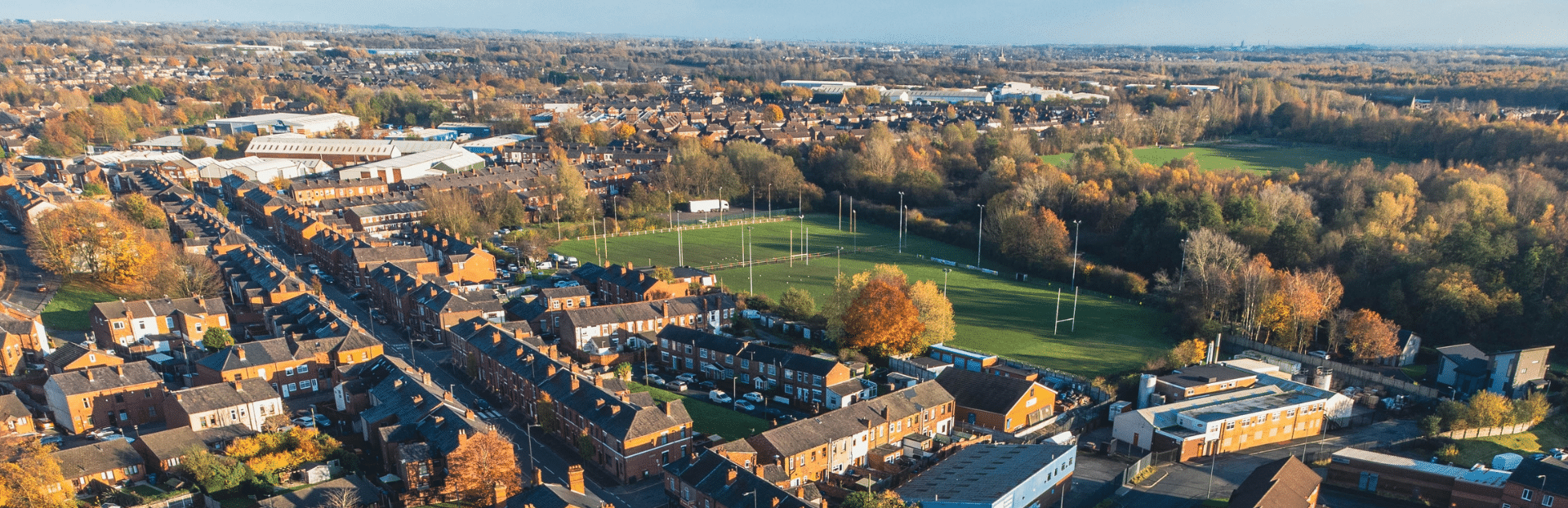
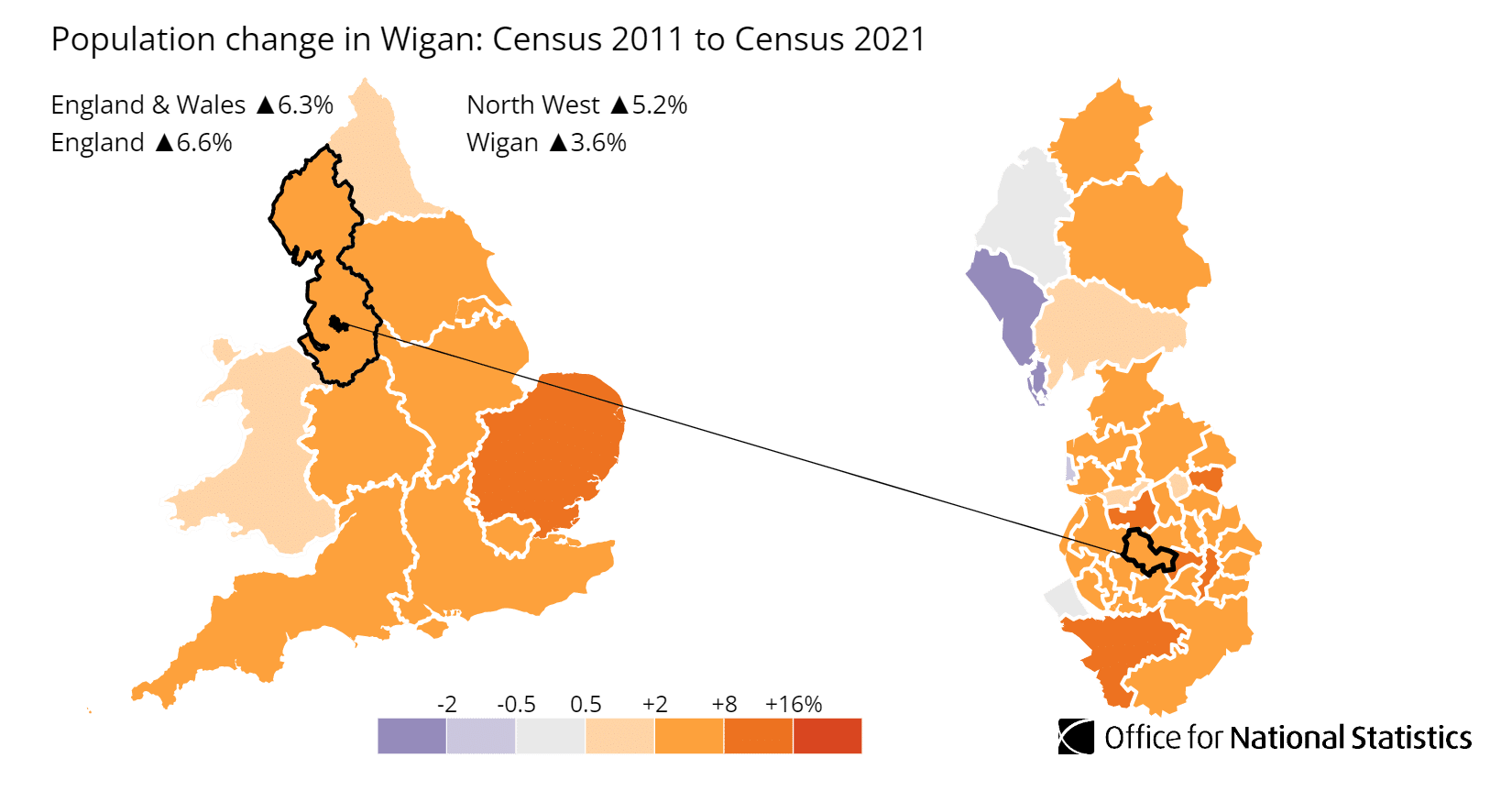
Wigan is a metropolitan borough of Greater Manchester. Average sold prices across the Metropolitan Borough of Wigan sit at £186,749 on the HM Land Registry House Price Index, 35.6% below England's £289,946 and 13.0% below the North West regional average of £214,678. That makes Wigan one of the cheapest boroughs in Greater Manchester, and the low asking price is what does the heavy lifting on yield here. The borough's population grew 3.61% between the 2011 and 2021 censuses, from 317,849 to 329,330 residents.
Wigan is a borough of two centres. The town of Wigan sits on the western side with WN1 and WN3 forming the urban core, while Leigh (WN7) works as a second centre six miles east with its own high street and its own rental market. That structure gives an investor two distinct tenant pools rather than one. Across the eleven postcodes, asking prices run from £187,976 in WN1 to £310,575 in M29 Tyldesley, and gross yields from 3.7% in WA3 to 5.4% in M46 Atherton, so the borough spans two very different buy-to-let cases within one local authority.
This guide covers all eleven postcodes in the Metropolitan Borough of Wigan (ONS code E08000010). Wigan sits in the North West, 20 minutes by rail from Manchester and 40 from Liverpool, with the M6, M61 and A580 crossing the borough. Investors comparing the wider area often also look at Bolton to the north-east and buy-to-let in Manchester to the east.
Article updated: July 2026
Why Invest in Wigan?
The Metropolitan Borough of Wigan grew its population 3.61% between the 2011 and 2021 censuses, from 317,849 to 329,330 residents. That is steady rather than fast, which is what you would expect from a borough without a university or a major corporate headquarters drawing people in. The growth is organic: households priced out of Salford and Trafford move west along the M61, and the borough's affordability keeps absorbing them.
Wigan's economy leans on logistics, distribution and the public sector. The M6, M61 and the A580 East Lancashire Road make the borough one of the best-connected in Greater Manchester for road freight, and large distribution operations sit in and around it. Those are shift-pattern jobs, and they generate consistent demand for the two and three-bedroom terraced houses that cluster near the industrial estates. That is the stock most landlords here are buying.
Median gross annual earnings in Wigan are £37,377, a little under both the North West median of £37,445 and the Great Britain median of £39,125. What makes that unusual is how small the gap is for a borough with prices this low. Local wages sit almost level with the region while sold prices run a third below England, so the price-to-earnings maths stays compressed and the affordability ratios stay favourable for buy-to-let entry.
Wigan Economic Summary
- Population: 329,330 (2021 Census). Growth of 3.61% from 2011.
- Median annual salary: £37,377 (Wigan), £37,445 (North West), £39,125 (Great Britain)
- Employment rate: 71.5% (Wigan)
- Unemployment rate: 3.4% (Wigan)
- Key employment sectors: Logistics and distribution, public sector, manufacturing, retail, construction
Source: ONS Census 2021, Nomis Labour Market Profile (ASHE 2025, Employment Oct 2024-Sep 2025)
Wigan's employment rate of 71.5% sits below the Great Britain figure of 75.6%, while unemployment at 3.4% is lower than the national average. The two readings together describe a borough with lower workforce participation but not higher joblessness: economically inactive residents, from carers to early retirees, account for the gap rather than people out of work. For a landlord, the low unemployment reading matters more, because it points to tenants who are in work and able to pay.
Regeneration and Investment in Wigan
Wigan's regeneration runs across two town centres at once, with more than £340m of active investment reshaping Wigan and Leigh in parallel. That dual programme is why the strongest price growth in the borough clusters in the WN postcodes closest to the town-centre sites rather than spreading evenly.
- Eckersley Mill / Cotton Works (under construction, £180m): A historic mill complex on the Leeds-Liverpool Canal being converted into more than 950 homes, offices, a food hall and a waterside quarter. The residential density alone will change the tenant pool in WN1 and WN3 as units come to market. Updates at Wigan Council.
- The Galleries redevelopment (under construction, £135m): The dated shopping centre is being replaced with around 500 homes, a Hampton by Hilton hotel, a market hall, cinema and leisure space, and the scheme is set to create around 660 jobs. The hotel and leisure mix points to a busier town-centre evening economy. Updates at Wigan Council.
- Leigh Town Centre regeneration (under construction, £32m): A civic hub anchored by tech tenant Agilisys, with public-realm work across Leigh's core. Smaller than the Wigan sites, but it gives Leigh an employment anchor of its own, separate from the town centre six miles west. Updates at Wigan Council.
Source: Office for National Statistics - Population for Wigan
Wigan Property Market Analysis
Average property prices across the Metropolitan Borough of Wigan have risen 391.3% since January 1995, from £38,010 to £186,749. The sections below walk through that history cycle by cycle, then drill into current postcode-level data for sold prices, price per square foot, asking prices, growth trends and monthly transaction volumes.
When was the last house price crash in Wigan?
All sold prices from HM Land Registry are recorded at borough level, so the figures here cover the whole Metropolitan Borough of Wigan. The Land Registry House Price Index tracks average prices from January 1995 to the latest reading in March 2026, covering 31 years of market cycles.
The 1995 to 2007 boom: Wigan opened 1995 at £38,010. Prices climbed steadily through the late 1990s and then accelerated from 2001, carried by cheap credit and a national housing boom. By December 2007 the average had reached £125,172, more than triple where it started twelve years earlier.
2008 to 2009, the financial crisis: From the December 2007 peak of £125,172, prices fell to a trough of £99,005 in March 2012, a decline of 20.9%. The worst year-on-year reading was -17.3% in April 2009. Wigan's fall was deeper than many northern boroughs because cheap terraced stock and heavy exposure to first-time-buyer mortgage products meant the credit squeeze hit hard.
The 2010 to 2013 stagnation: Prices barely moved. The December readings tell it plainly: £104,378 in 2010, £101,983 in 2011, £102,111 in 2012 and £105,079 in 2013, four years inside a £3,000 band. The trough of £99,005 came in March 2012, while markets in the South were already recovering.
Recovery, 2014 to 2017: Growth returned gradually, from £109,347 in December 2014 to £112,452 in 2015, £120,191 in 2016 and £124,185 in 2017. Help to Buy and improving employment pushed prices back towards the pre-crash peak, but they had not yet cleared it.
2018 to 2019, recovery complete: Prices finally passed the December 2007 peak in July 2018 at £125,506, a recovery that took ten and a half years. That was one of the slowest of any Greater Manchester borough. December 2019 closed at £130,335.
2020 to 2022, the pandemic surge: The stamp duty holiday and the shift to remote working lifted Wigan sharply, from £131,202 in March 2020 to £179,672 by December 2022, growth of 37.0% in under three years. The borough's affordability made it a natural beneficiary of the race for space as buyers moved out of central Manchester.
The 2023 rate shock: Higher mortgage rates cooled the market. December 2023 read £175,566, down 2.3% on the 2022 close. Brief and shallow next to 2008.
2024 to present: Prices stabilised and pushed to new highs, reaching £185,239 by December 2024 and an all-time high of £191,358 in December 2025 before easing to £186,749 by March 2026, when the annual change was -0.8%. Wigan now sits 49.2% above its pre-crash peak.
Long-term growth summary:
- 5 years (March 2021 to March 2026): 28.0% growth (£145,892 to £186,749)
- 10 years (March 2016 to March 2026): 67.2% growth (£111,690 to £186,749)
- 15 years (March 2011 to March 2026): 82.8% growth (£102,177 to £186,749)
- 20 years (March 2006 to March 2026): 70.1% growth (£109,778 to £186,749)
- 30 years (January 1995 to March 2026): 391.3% growth (£38,010 to £186,749)
The 2008 crash is the reference point for anyone weighing downside here. A 20.9% fall took ten and a half years to recover, one of the longest recovery periods in Greater Manchester. The context matters, though: the pre-crash peak was inflated by easy lending into cheap stock, lending standards are tighter now, the town-centre regeneration did not exist in 2007, and the price-to-earnings ratios across the borough are more compressed today than they were then.
Source: HM Land Registry House Price Index for Wigan
- All property types
- Detached
- Semi-detached
- Terraced
- Flats
- All property types
- Detached
- Semi-detached
- Terraced
- Flats
Sold House Prices in Wigan
Sold prices confirm Wigan's position as one of the cheapest boroughs in the North West. The headline average of £186,749 is 35.6% below England's £289,946. Every property type trades at a substantial discount, but the size of that gap varies by type.
| Property Type | Wigan Average | England Average | Difference |
|---|---|---|---|
| Detached houses | £305,430 | £470,492 | -35.1% |
| Semi-detached houses | £194,913 | £288,185 | -32.4% |
| Terraced houses | £151,334 | £243,788 | -37.9% |
| Flats and maisonettes | £101,241 | £214,563 | -52.8% |
| All property types | £186,749 | £289,946 | -35.6% |
Detached houses in Wigan average £305,430, a 35.1% discount to the England detached average of £470,492. Most of the detached stock sits in the borough's more expensive postcodes, WN6 Standish, M29 Tyldesley and WA3 Golborne, where owner-occupier demand is strongest and buy-to-let yields compress. The tenant pool at this price point is narrow, so detached homes here are bought more for family occupation than for letting.
Semi-detached houses at £194,913 sit 32.4% below the England figure. Semis are the most common single type across Wigan's suburban postcodes, from WN3 Winstanley to WN5 Orrell, and they carry the smallest discount to the national average of any type. Owner-occupier demand in those areas keeps semi prices closer to the national line than terraces or flats.
Terraced houses at £151,334 are 37.9% below England. Terraces are the backbone of Wigan's rental market: the two and three-bedroom Victorian and Edwardian stock in WN1, WN2 and WN7 is what most landlords here target. At this price point, even modest monthly rents translate into meaningful gross yields.
Flats and maisonettes at £101,241 carry the deepest discount, 52.8% below the England flat average of £214,563. That reflects how thin Wigan's flat market is. The borough is dominated by houses, flat stock concentrates in the town centre and a handful of purpose-built schemes, and limited owner-occupier demand keeps prices low. The 950-plus units at Eckersley Mill will add materially to that stock over the coming years.
Price Per Square Foot in Wigan
Average asking prices can flatter or penalise a postcode simply because of the size of homes it contains. Price per square foot strips out that size effect and shows what a buyer actually pays for space.
Wigan's price per square foot runs from £189 in WN8 to £276 in WA3, a spread of £87 across the eleven postcodes. That is a tighter band than many boroughs, and it reflects Wigan's relatively uniform stock of terraces and semis.
| Rank | Area | Price Per Sq Ft |
|---|---|---|
| 1 | WN8 (Skelmersdale, Upholland) | £189 |
| 2 | WN1 (Town Centre, Swinley) | £199 |
| 3 | WN7 (Leigh) | £200 |
| 4 | WN2 (Hindley, Aspull) | £203 |
| 5 | WN5 (Orrell, Billinge) | £207 |
| 6 | M46 (Atherton) | £214 |
| 7 | WN3 (Ince, Winstanley) | £216 |
| 8 | WN4 (Ashton-in-Makerfield) | £217 |
| 9 | WN6 (Standish, Shevington) | £226 |
| 10 | M29 (Tyldesley) | £271 |
| 11 | WA3 (Golborne, Lowton) | £276 |
WN8 at £189 per square foot is the cheapest space in the borough. Upholland sits on Wigan's western edge, bordering West Lancashire, and the lower per-foot cost tracks its ex-council stock and its distance from the main employment centres. WN1 Town Centre at £199 and WN7 Leigh at £200 follow close behind.
The middle band from WN2 to WN4 (£203 to £217) holds the core buy-to-let postcodes. WN3 at £216 is not the cheapest space, but it pairs a mid-range per-foot cost with one of the stronger yields and the second-strongest five-year growth in the borough. An investor there pays a small premium per foot and earns more back on each pound deployed. Read this alongside the yield data further down.
WA3 Golborne at £276 and M29 Tyldesley at £271 are the most expensive space in the borough. Both sit on the eastern and southern fringes where proximity to Warrington and Manchester lifts values, and WA3 posted the strongest one-year price change of any Wigan postcode at 6.2%.
Figures reflect averages across all property types and ages. Individual values depend on condition, location within the postcode, and building age.
For Sale Asking Prices in Wigan
Asking prices show what sellers and agents expect the market to pay. They run ahead of sold prices in a rising market and sit above actual transaction values when a market cools, so they read as a forward signal rather than a settled one.
Wigan's asking prices range from £187,976 in WN1 to £310,575 in M29, a spread of £122,599 across the eleven postcodes. Six postcodes sit below £220,000, which keeps most of the borough within reach for buy-to-let entry.
| Rank | Area | Asking Price |
|---|---|---|
| 1 | WN1 (Town Centre, Swinley) | £187,976 |
| 2 | WN7 (Leigh) | £198,767 |
| 3 | WN2 (Hindley, Aspull) | £198,873 |
| 4 | WN3 (Ince, Winstanley) | £213,039 |
| 5 | WN5 (Orrell, Billinge) | £218,637 |
| 6 | M46 (Atherton) | £228,461 |
| 7 | WN6 (Standish, Shevington) | £230,932 |
| 8 | WN4 (Ashton-in-Makerfield) | £232,589 |
| 9 | WN8 (Skelmersdale, Upholland) | £235,331 |
| 10 | WA3 (Golborne, Lowton) | £309,256 |
| 11 | M29 (Tyldesley) | £310,575 |
Three postcodes cluster within £11,000 of each other at the bottom of the table. WN1, WN7 and WN2 all sit under £199,000, so the entry cost between them is close to identical. The choice comes down to yield, growth and tenant profile rather than price. WN3 is next at £213,039 and stands out in that cheaper group: a modest price premium buys the second-strongest five-year growth in the borough at 30.8%.
WA3 Golborne at £309,256 and M29 Tyldesley at £310,575 sit in a bracket of their own. Both are on the borough's southern and eastern edges, closer to Warrington and Manchester, and both are more than £70,000 above the next postcode down. They are the areas where owner-occupier demand and commuter pull push prices well above the Wigan norm.
The mean asking price across all eleven Wigan postcodes is £233,131. That figure feeds the comparison section later, where Wigan is measured against Bolton, St Helens, Warrington and Salford.
House Price Growth in Wigan
Five-year growth captures a full market cycle and filters out the short-term noise that a single year can carry. One-year figures can swing on a handful of transactions, so the five-year column is the better read on whether an area is genuinely appreciating.
All eleven Wigan postcodes posted positive five-year growth, with WN2 Hindley leading at 31.2%. An investor who bought in WN2 five years ago has seen the strongest capital appreciation in the borough, from one of its most affordable postcodes.
| Area | 1 Year | 3 Years | 5 Years |
|---|---|---|---|
| WN2 (Hindley, Aspull) | -3.6% | 6.5% | 31.2% |
| WN3 (Ince, Winstanley) | 3.8% | 13.0% | 30.8% |
| WN4 (Ashton-in-Makerfield) | 4.0% | 12.5% | 28.1% |
| M46 (Atherton) | 0.9% | 7.9% | 27.2% |
| WN5 (Orrell, Billinge) | 0.6% | 14.0% | 25.2% |
| M29 (Tyldesley) | 5.6% | 3.6% | 22.0% |
| WN7 (Leigh) | 2.5% | 6.9% | 21.1% |
| WA3 (Golborne, Lowton) | 6.2% | 6.9% | 20.8% |
| WN1 (Town Centre, Swinley) | -13.4% | 5.7% | 14.1% |
| WN8 (Skelmersdale, Upholland) | -7.2% | 5.0% | 9.5% |
| WN6 (Standish, Shevington) | -1.0% | -1.7% | 5.6% |
WN2 and WN3 sit at the top of the growth table at 31.2% and 30.8% over five years. Both are among the cheapest four postcodes by asking price, and both sit close to Wigan town centre's regeneration zone, where the Eckersley Mill and Galleries investment is lifting the surrounding residential streets. Cheap entry paired with the borough's strongest five-year appreciation is the combination that has done most for total returns here.
WN6 Standish is the clear laggard at 5.6% over five years. Three-year growth of -1.7% and a one-year reading of -1.0% show a postcode that has flattened. Standish is already the borough's most established residential area, and its values may have reached what the local market will carry.
WN1 Town Centre and WN8 Skelmersdale posted the steepest one-year falls, at -13.4% and -7.2%. Both remain positive over five years, so the recent movement reads as a pullback from post-pandemic highs rather than a structural decline. In WN1's case, the town-centre construction disruption and the thin, volatile flat market amplify short-term swings.
Monthly Property Sales in Wigan
Transaction volumes and turnover rates show how liquid a market is. Volume points to the depth of the buyer pool, turnover to how quickly stock is absorbed relative to what is available, and both feed into how straightforward an exit will be.
Monthly sales range from 22 in WN4 to 48 in WN2, with 371 transactions a month across the eleven postcodes. WN1 Town Centre carries the highest turnover in the borough at 27%, meaning its stock is absorbed faster relative to what is listed than anywhere else in Wigan.
| Area | Sales Per Month | Turnover | Asking Price |
|---|---|---|---|
| WN2 (Hindley, Aspull) | 48 | 19% | £198,873 |
| WN7 (Leigh) | 46 | 15% | £198,767 |
| WN6 (Standish, Shevington) | 43 | 25% | £230,932 |
| WA3 (Golborne, Lowton) | 43 | 17% | £309,256 |
| WN8 (Skelmersdale, Upholland) | 33 | 16% | £235,331 |
| WN5 (Orrell, Billinge) | 32 | 20% | £218,637 |
| WN3 (Ince, Winstanley) | 29 | 23% | £213,039 |
| M46 (Atherton) | 26 | 24% | £228,461 |
| WN1 (Town Centre, Swinley) | 25 | 27% | £187,976 |
| M29 (Tyldesley) | 24 | 22% | £310,575 |
| WN4 (Ashton-in-Makerfield) | 22 | 19% | £232,589 |
WN2 Hindley and WN7 Leigh record the most transactions, at 48 and 46 a month. Both are among the cheapest postcodes in the borough, and the volume reflects a deep pool of affordable terraced and semi-detached stock changing hands. For an investor, plenty of comparable sales makes pricing an entry and an exit more straightforward.
WN1 Town Centre pairs the borough's highest turnover, 27%, with one of its lowest sales counts at 25 a month. A high turnover on modest volume points to a smaller pool of stock that moves quickly when it comes up. As the Eckersley Mill and Galleries units complete, WN1's volume profile is likely to shift.
M46 Atherton and WN3 Winstanley both sit near the top of the turnover table, at 24% and 23%, which lines up with them carrying two of the stronger yields in the borough. Where stock moves quickly and rents hold up, the exit tends to be easier.
How Long Properties Take to Sell in Wigan
Selling speed splits the borough in two: WN1 (Town Centre, Swinley) clears fastest at about 113 days, while WN7 (Leigh) is slowest at roughly 217 days. Days on market is the typical number of days a home is up for sale before it sells; the months of unsold stock shows how much for-sale supply is sitting there at the current rate of sales.
| Area | Avg Days to Sell | Months of Unsold Stock | Market |
|---|---|---|---|
| WN1 (Town Centre, Swinley) | 113 | 3.7 | Seller's market |
| WN3 (Ince, Winstanley) | 117 | 3.8 | Seller's market |
| M29 (Tyldesley) | 127 | 4.2 | Seller's market |
| WN6 (Standish, Shevington) | 132 | 4.3 | Seller's market |
| M46 (Atherton) | 132 | 4.3 | Seller's market |
| WN2 (Hindley, Aspull) | 145 | 4.8 | Seller's market |
| WN5 (Orrell, Billinge) | 152 | 5.0 | Seller's market |
| WA3 (Golborne, Lowton) | 179 | 5.9 | Seller's market |
| WN8 (Skelmersdale, Upholland) | 190 | 6.3 | Balanced market |
| WN4 (Ashton-in-Makerfield) | 203 | 6.7 | Balanced market |
| WN7 (Leigh) | 217 | 7.1 | Balanced market |
A yield figure says nothing about how quickly you can get back out. WN1 and WN3 both sit under four months of unsold stock, so a home there tends to find a buyer quickly. WN7 Leigh, at 7.1 months, is the slowest to clear despite being one of the cheapest and busiest postcodes by volume, which tells you Leigh carries a large pool of stock on the market at any one time. For an investor buying in Leigh, that leaves more room to negotiate on price.
What Type of Property Can You Buy in Wigan?
The housing mix swings sharply across the borough, from WA3 Golborne where detached and semi-detached homes make up 84% of stock, to WN7 Leigh where terraces and flats reach 44%. That mix shapes which strategies fit each postcode. The figures below are drawn from 2021 Census records for each postcode.
| Area | Detached | Semi-detached | Terraced | Flats |
|---|---|---|---|---|
| WN1 (Town Centre, Swinley) | 40.5% | 29.4% | 20.8% | 9.1% |
| WN2 (Hindley, Aspull) | 25.0% | 34.5% | 32.4% | 7.8% |
| WN3 (Ince, Winstanley) | 18.8% | 49.5% | 25.4% | 6.3% |
| WN4 (Ashton-in-Makerfield) | 26.2% | 40.1% | 28.1% | 5.4% |
| WN5 (Orrell, Billinge) | 25.6% | 49.3% | 19.2% | 5.8% |
| WN6 (Standish, Shevington) | 45.7% | 36.0% | 14.3% | 3.5% |
| WN7 (Leigh) | 20.4% | 35.9% | 31.1% | 12.5% |
| WN8 (Skelmersdale, Upholland) | 52.1% | 25.5% | 18.9% | 3.5% |
| M29 (Tyldesley) | 41.8% | 37.9% | 15.0% | 2.9% |
| M46 (Atherton) | 21.9% | 34.3% | 32.1% | 10.5% |
| WA3 (Golborne, Lowton) | 50.6% | 33.2% | 12.3% | 3.5% |
WN7 Leigh and M46 Atherton hold the largest shares of terraced houses and flats, at 43.6% and 42.6% of stock combined. That is the smaller-unit stock that usually forms the buy-to-let market, and it lines up with both postcodes carrying yields towards the top of the borough. Terraced housing suits family lets, while the flat share supports single and couple tenancies.
At the other end, WA3 Golborne and WN8 Skelmersdale are the most house-dominated postcodes, with detached and semi-detached homes making up 84% and 78% of stock and flats under 4%. That weighting towards owner-occupier family homes matches their higher asking prices and lower yields. The housing here is bought to live in more than to let.
Flats combine purpose-built and converted units. A small share of mobile and temporary dwellings is not shown, so rows may not total 100%.
Wigan Rental Market Analysis
Monthly rents in Wigan range from £784 in WN1 to £1,020 in M46, with gross rental yields from 3.7% to 5.4% across the eleven postcodes. For investors weighing up whether rental property is a worthwhile investment in Wigan, the sections below break down rents, yields and tenant affordability postcode by postcode. If you are working out how to build a property portfolio in the North West, Wigan's sub-£190,000 asking prices and yields above 5% put it among the more accessible boroughs in Greater Manchester. Browse current buy-to-let homes for sale across the region.
Average Rent & Gross Rental Yields in Wigan
Gross rental yield is calculated from the average asking price and average monthly rent for each postcode. It does not account for void periods, maintenance, management fees or mortgage costs, so it is a starting point for comparison rather than a profit forecast.
M46 Atherton delivers Wigan's highest gross yield at 5.4%, where monthly rents of £1,020 meet an asking price of £228,461. At the other end, WA3 Golborne sits at 3.7% and M29 Tyldesley at 3.9%, the two most expensive postcodes in the borough. The yield spread from top to bottom is 1.7 percentage points, which is the difference between a postcode that generates real cash flow and one that leans on capital appreciation.
| Area | Average Monthly Rent | Asking Price | Gross Yield |
|---|---|---|---|
| M46 (Atherton) | £1,020 | £228,461 | 5.4% |
| WN7 (Leigh) | £844 | £198,767 | 5.1% |
| WN1 (Town Centre, Swinley) | £784 | £187,976 | 5.0% |
| WN2 (Hindley, Aspull) | £832 | £198,873 | 5.0% |
| WN3 (Ince, Winstanley) | £883 | £213,039 | 5.0% |
| WN6 (Standish, Shevington) | £916 | £230,932 | 4.8% |
| WN4 (Ashton-in-Makerfield) | £894 | £232,589 | 4.6% |
| WN8 (Skelmersdale, Upholland) | £879 | £235,331 | 4.5% |
| WN5 (Orrell, Billinge) | £810 | £218,637 | 4.4% |
| M29 (Tyldesley) | £1,001 | £310,575 | 3.9% |
| WA3 (Golborne, Lowton) | £954 | £309,256 | 3.7% |
M46 at 5.4% reaches the top on the strength of rent as much as price. Its £1,020 monthly rent is the highest in the borough, and it lands on a mid-range asking price, so the maths works from both ends. Atherton draws tenants commuting to both Manchester and Bolton, which supports that rent.
WN7 Leigh at 5.1% and the WN1, WN2 and WN3 cluster at 5.0% carry the borough's other stronger yields, and they get there through low prices rather than high rents. WN1 has the cheapest asking price in the borough at £187,976. Even on the lowest rent in Wigan, £784 a month, it still returns 5.0%, which is the pattern across the affordable town-centre postcodes: modest rents, but prices low enough to make them work.
WA3 and M29 share the bottom of the table at 3.7% and 3.9%. Both are the most expensive postcodes in the borough, and although WA3 commands one of the higher rents at £954, its £309,256 asking price compresses the return. In these two postcodes the case rests on the local data showing high prices alongside modest rents, so the income return is thinner than in the cheaper WN postcodes.
Gross Rental Yield by Postcode
Is Wigan Rent High?
Across Wigan's postcodes, rent consumes between 25.2% and 32.8% of the local median gross monthly salary. The widely cited threshold for affordability is 30% of gross income, and only three of the eleven postcodes sit above it. That positions Wigan as one of the more affordable boroughs in Greater Manchester for tenants.
The median gross weekly salary in Wigan is £718.80, which equates to £3,115 per month or £37,377 per year. This is marginally below the North West regional median of £720.10 per week and below the Great Britain median of £752.40 per week. Data from the Nomis Labour Market Profile (ASHE 2025).
| Rank | Area | Rent as % of Income |
|---|---|---|
| 1 | M46 (Atherton) | 32.8% |
| 2 | M29 (Tyldesley) | 32.1% |
| 3 | WA3 (Golborne, Lowton) | 30.6% |
| 4 | WN6 (Standish, Shevington) | 29.4% |
| 5 | WN4 (Ashton-in-Makerfield) | 28.7% |
| 6 | WN3 (Ince, Winstanley) | 28.3% |
| 7 | WN8 (Skelmersdale, Upholland) | 28.2% |
| 8 | WN7 (Leigh) | 27.1% |
| 9 | WN2 (Hindley, Aspull) | 26.7% |
| 10 | WN5 (Orrell, Billinge) | 26.0% |
| 11 | WN1 (Town Centre, Swinley) | 25.2% |
M46 Atherton at 32.8% is the least affordable, which fits: it carries the highest rent and the highest yield in the borough. M29 at 32.1% and WA3 at 30.6% are the other two above the 30% line, and all three are the borough's higher-rent postcodes. Tenants there are paying more of their income towards rent, so a landlord's margin for arrears is thinner.
WN1 Town Centre at 25.2% is the most affordable, combining the cheapest asking price with the lowest rent. Eight of the eleven postcodes sit below the 30% line, which means most Wigan tenants have real headroom in their budgets. Arrears risk is lower when rent is a quarter of gross income rather than a third, and that headroom is one of the quieter advantages of a low-price borough.
How Big Is Wigan's Private Rented Sector?
The private rented sector is deepest in WN7 Leigh at 21.4% of households and WN2 Hindley at 17.2%, and shallowest in WN8 Skelmersdale at 9.5% and WA3 Golborne at 10.3%. The share of homes already rented privately is a guide to the size of the established tenant pool and the local lettings market, and it varies more sharply across Wigan than most single boroughs. Each postcode's tenure split is set out below.
| Area | Owned Outright | Owned with Mortgage | Private Rented | Social Rented |
|---|---|---|---|---|
| WN7 (Leigh) | 31.2% | 32.6% | 21.4% | 13.8% |
| M46 (Atherton) | 35.2% | 34.6% | 17.6% | 11.3% |
| WN2 (Hindley, Aspull) | 36.9% | 31.0% | 17.2% | 14.4% |
| WN4 (Ashton-in-Makerfield) | 38.9% | 37.5% | 16.0% | 7.3% |
| WN3 (Ince, Winstanley) | 35.1% | 37.6% | 15.9% | 11.2% |
| WN1 (Town Centre, Swinley) | 44.3% | 33.7% | 14.3% | 7.3% |
| M29 (Tyldesley) | 40.5% | 38.7% | 13.2% | 5.9% |
| WN5 (Orrell, Billinge) | 39.7% | 35.6% | 11.0% | 13.3% |
| WN6 (Standish, Shevington) | 48.7% | 34.1% | 10.5% | 5.9% |
| WA3 (Golborne, Lowton) | 45.3% | 37.7% | 10.3% | 6.3% |
| WN8 (Skelmersdale, Upholland) | 46.7% | 34.7% | 9.5% | 8.4% |
WN7 Leigh has the largest private rented sector in the borough, at more than a fifth of households, and M46 Atherton and WN2 Hindley follow close behind. A deeper rented sector points to an active local lettings market and a wider pool of existing tenants, which is a different signal from yield. The three postcodes with the largest rented sectors are also among the borough's stronger-yielding areas, so the tenant demand and the return line up in the same places.
WN6 Standish, WA3 Golborne and WN8 Skelmersdale sit at the other end, with owner-occupation above 80% once outright and mortgaged owners are combined, and private rented shares around a tenth. Those are the settled residential postcodes where the market is built around families buying to live rather than to let.
Rental listings run thin across most of the borough, and just three postcodes carry enough live adverts to read the current lettings balance with any confidence. In WN2, WN6 and WN7 the balance currently sits with landlords rather than tenants, with homes letting in around 39 to 48 days, which points to steady demand rather than a glut of empty stock.
Local Housing Allowance Rates in Wigan
All eleven Wigan postcodes fall within the Wigan Broad Rental Market Area, where Local Housing Allowance runs from £78.21 a week for a shared room to £178.36 a week for a four-bedroom home. Local Housing Allowance sets the maximum housing support a tenant on benefits can receive, so it acts as a rent floor for landlords letting to that part of the market. The rates below apply across the whole borough. To check the current rate for a specific address, you can use the government's official Local Housing Allowance calculator.
| Property Size | Weekly LHA Rate | Monthly Equivalent |
|---|---|---|
| Shared accommodation | £78.21 | £339 |
| 1 bedroom | £92.05 | £399 |
| 2 bedrooms | £115.07 | £499 |
| 3 bedrooms | £136.93 | £593 |
| 4 bedrooms | £178.36 | £773 |
The two-bedroom LHA rate of £115.07 a week works out at about £499 a month, well below the £784 to £1,020 monthly market rents recorded across Wigan's postcodes. A benefit-backed tenancy at the LHA rate therefore sits under Wigan's open-market rents, and the stock that fits within these rates is concentrated in the cheaper WN1, WN2 and WN7 terraces. The rates are the same in every Wigan postcode because they are set across the whole Wigan market area.
Buy-to-Let Considerations
Are House Prices High in Wigan? Price-to-Earnings Ratios
Purchasing a property in Wigan requires between 5.0 and 8.3 times the median annual salary. This is based on the Nomis Labour Market Profile for Wigan showing the median gross annual income for Wigan residents is £37,377.
For a reference point, England's average sold price of £289,946 against the Great Britain median annual salary of £39,125 works out at 7.4 times income. Nine of Wigan's eleven postcodes come in under that figure, so most of the borough is more affordable against local wages than England as a whole is against national wages, and that consistency across eleven postcodes is unusual.
| Rank | Area | Price-to-Earnings Ratio |
|---|---|---|
| 1 | WN1 (Town Centre, Swinley) | 5.0x |
| 2 | WN2 (Hindley, Aspull) | 5.3x |
| 3 | WN7 (Leigh) | 5.3x |
| 4 | WN3 (Ince, Winstanley) | 5.7x |
| 5 | WN5 (Orrell, Billinge) | 5.8x |
| 6 | M46 (Atherton) | 6.1x |
| 7 | WN4 (Ashton-in-Makerfield) | 6.2x |
| 8 | WN6 (Standish, Shevington) | 6.2x |
| 9 | WN8 (Skelmersdale, Upholland) | 6.3x |
| 10 | M29 (Tyldesley) | 8.3x |
| 11 | WA3 (Golborne, Lowton) | 8.3x |
The four cheapest postcodes by asking price also carry the lowest price-to-earnings ratios. WN1 at 5.0x, WN2 and WN7 at 5.3x, and WN3 at 5.7x all sit well under the national benchmark. A sub-6x ratio means a property costs around five to six years of local wages, which keeps first-time buyers in the market and puts a floor under prices that supports demand when the time comes to sell.
M29 Tyldesley and WA3 Golborne at 8.3x are the only postcodes above the national benchmark. Both are on the borough's edge, closer to Manchester and Warrington, and their prices run ahead of what Wigan's local wages would typically support. Buyers there are often commuters earning salaries elsewhere, so the borough-wide median understates what purchasers in those two postcodes actually earn.
Deposit Requirements in Wigan
A 30% deposit on a buy-to-let property in Wigan ranges from £56,393 in WN1 to £93,172 in M29. The table below uses a 30% deposit throughout, which is the conservative end of what buy-to-let lenders look for and tends to unlock better interest rates, and that matters for cash flow in a yield-driven market.
| Rank | Area | 30% Deposit Required |
|---|---|---|
| 1 | WN1 (Town Centre, Swinley) | £56,393 |
| 2 | WN7 (Leigh) | £59,630 |
| 3 | WN2 (Hindley, Aspull) | £59,662 |
| 4 | WN3 (Ince, Winstanley) | £63,912 |
| 5 | WN5 (Orrell, Billinge) | £65,591 |
| 6 | M46 (Atherton) | £68,538 |
| 7 | WN6 (Standish, Shevington) | £69,280 |
| 8 | WN4 (Ashton-in-Makerfield) | £69,777 |
| 9 | WN8 (Skelmersdale, Upholland) | £70,599 |
| 10 | WA3 (Golborne, Lowton) | £92,777 |
| 11 | M29 (Tyldesley) | £93,172 |
The three cheapest postcodes cluster within £3,300 of each other, from £56,393 to £59,662. WN1, WN7 and WN2 all require deposits under £60,000, so the entry cost between them is close to level. The gap between the cheapest deposit, WN1, and M46, the highest-yielding postcode, is around £12,000, which is a modest premium to reach the borough's top yield.
A clear step separates the sub-£71,000 group from the top two. WN3 through WN8 fill the £64,000 to £71,000 band, then WA3 and M29 jump to around £93,000, more than £22,000 above the next postcode down. For an investor working with around £60,000 of deposit capital, three postcodes are immediately in reach, all yielding 5.0% or better. Beyond the deposit, the stamp duty calculation and other buy to let running costs add to the total capital required.

What the Wigan Data Tells Buy-to-Let Investors
In Wigan the yield and the growth sit in the same cheap postcodes, which is not the usual pattern. M46 Atherton tops the yield table at 5.4%, and the WN1, WN2, WN3 and WN7 cluster all return 5.0% or more on asking prices under £214,000. For buying an investment property in Wigan, those are the postcodes where the entry cost is low enough to make the maths work.
WN2 Hindley and WN3 Winstanley lead the five-year growth table at 31.2% and 30.8%, and both sit in the cheaper half of the borough by asking price. WN3 also carries a 5.0% yield, so income and growth converge in the same postcode there, close to the town-centre regeneration zone. Across most boroughs those two things pull apart; in Wigan's WN core they line up.
At the other end, WA3 Golborne and M29 Tyldesley are the most expensive postcodes and the lowest-yielding at 3.7% and 3.9%. Both have grown over five years, and WA3 posted the strongest one-year change in the borough, but the high asking prices keep the income return thin. WN6 Standish is the flat spot: the borough's laggard on growth at 5.6% over five years, with a one-year reading of -1.0%, in an already-established residential market.
Wigan Council does not operate a selective licensing scheme anywhere in the borough, but shared houses that meet the definition of a House in Multiple Occupation need a mandatory HMO licence. The rules are set out on Wigan Council's landlord licensing pages. Check the current requirements before purchasing, as licensing conditions affect operating costs. Buyers who want to come in below asking often look through off-market property in Wigan channels.
How Wigan Compares
Wigan's mean asking price of £233,131 is the second-cheapest of five North West locations compared here, and its top yield of 5.4% sits mid-table. The comparison below places Wigan alongside four nearby boroughs, each with a different investor profile. The mean asking price and mean monthly rent are simple averages across all postcodes with data. Top gross yield is the single highest postcode yield in each location.
| Location | Mean Asking Price | Mean Monthly Rent | Mean Gross Yield | Top Yield (postcode) |
|---|---|---|---|---|
| St Helens | £230,577 | £917 | 4.8% | 5.3% (L35, WA9) |
| Wigan | £233,131 | £892 | 4.6% | 5.4% (M46) |
| Salford | £248,444 | £1,188 | 5.7% | 6.6% (M3, M6) |
| Bolton | £255,835 | £981 | 4.6% | 6.1% (M38) |
| Warrington | £307,783 | £1,001 | 3.9% | 4.8% (WA1, WA5) |
St Helens is the only location cheaper than Wigan in this group, by £2,554 on the mean asking price, and Wigan edges it on top yield, 5.4% to 5.3%. The two Merseyside-fringe boroughs are the low-cost end of this comparison, and they sit within touching distance of each other on both price and return.
Salford and Bolton both show higher top yields, at 6.6% and 6.1%, but both cost more to enter. Salford commands much the highest mean rent in the group at £1,188, reflecting its proximity to Manchester city centre and MediaCityUK, and its £248,444 mean asking price sits £15,000 above Wigan. Bolton pairs a higher yield with a similar terraced housing stock and logistics economy to Wigan, on a mean asking price around £22,000 higher.
Warrington is the outlier on price. Its mean asking price of £307,783 pushes it into a different bracket, and its top yield of 4.8%, the lowest in the table, reflects that premium pricing compressing returns. For an investor with limited capital who wants entry into the North West around the £230,000 mark, Wigan and St Helens are the two closest options here, and they sit above Warrington on yield while costing far less to buy into. For a data-driven view across all UK locations, see our best places to invest in buy-to-let guide.
Frequently Asked Questions
Is Wigan a good place to live for buy-to-let tenants?
It works well for tenants, and that starts with cost. Rent takes between 25.2% and 32.8% of the local median wage across the borough, and eight of the eleven postcodes sit below the 30% affordability line, so most Wigan tenants keep real headroom in their budgets. Unemployment is low at 3.4%, which points to a tenant base that is in work.
It is also a practical place to rent. The borough runs on shift-pattern logistics and distribution jobs, with fast road and rail links to Manchester and Liverpool, so tenants can reach work across a wide area without paying city-centre rents.
What are the best areas in Wigan for property investment?
The strongest numbers cluster in the cheaper WN postcodes rather than the pricier edges. M46 (Atherton) carries the highest yield at 5.4% on a £1,020 monthly rent, and the WN1, WN2, WN3 and WN7 group all return 5.0% or more on asking prices under £214,000. WN2 (Hindley) and WN3 (Winstanley) also lead the borough on five-year growth at 31.2% and 30.8%.
At the top end, WA3 (Golborne) and M29 (Tyldesley) are the most expensive postcodes and the lowest-yielding at 3.7% and 3.9%, while WN6 (Standish) has the weakest five-year growth at 5.6%. So if income is the priority, M46 leads on yield and the cheap WN cluster runs close behind; if growth matters most, WN2 and WN3 have appreciated fastest over five years.
How does Wigan compare to Bolton for buy-to-let?
They are close cousins. Both run on logistics employment and a stock of affordable terraces, but Bolton carries the higher top yield at 6.1% against Wigan's 5.4%, and the higher mean rent at £981 against £892. Wigan is the cheaper way in, with a mean asking price of £233,131 against Bolton's £255,835 and 30% deposits starting at £56,393.
Bolton has the larger town-centre economy and a university drawing student demand. Wigan's dual-centre structure, town plus Leigh, gives an investor two separate rental markets inside one borough. Which fits comes down to capital budget and whether the extra yield in Bolton outweighs the lower entry cost in Wigan.
Can I find buy-to-let property in Wigan under £150,000?
Yes, by property type rather than by postcode. The asking-price averages in this guide run from £187,976 in WN1 up to £310,575 in M29, but those are postcode averages across all property types. Wigan's terraced-house average on the Land Registry index is £151,334, and individual two-bedroom terraces in WN1, WN2 and WN7 regularly list below £150,000. Flats across the borough average £101,241.
At a £150,000 purchase, a 30% deposit is £45,000. The stock that fits under that line is the terraced housing that forms the core of Wigan's rental market, concentrated in the cheaper town-centre and Leigh postcodes. For coming in below asking, it is also worth looking at below market value properties.
What impact will the Wigan town centre regeneration have on property prices?
The effect is already visible in the data. The two postcodes closest to the regeneration zone, WN2 and WN3, have posted the borough's strongest five-year growth at 31.2% and 30.8%, ahead of the completion of either the Eckersley Mill or Galleries schemes. That growth pre-dates the new homes coming to market.
What happens next depends on supply. Eckersley Mill alone will add more than 950 residential units to the WN1 and WN3 area, with around 500 more at The Galleries. Whether that lifts or holds down existing rents comes down to whether the new stock pulls in a different tenant demographic or competes head-on with the terraced and flat stock landlords already let. It is a multi-year story rather than an immediate one.
What are average house prices in Wigan?
The average sold price across the Metropolitan Borough of Wigan is £186,749 on the Land Registry index, about 35.6% below the England average of £289,946 as of March 2026. Asking prices by postcode run from £187,976 in WN1 (Town Centre, Swinley) up to £310,575 in M29 (Tyldesley), with a borough-wide mean of £233,131. By type, detached homes average £305,430, semi-detached £194,913, terraced £151,334 and flats £101,241.
Through a buy-to-let lens, the cheaper WN cluster carries the stronger yields, with M46 (Atherton) top at 5.4%, while the pricier WA3 and M29 sit lowest at 3.7% and 3.9%.
What type of property is most common in Wigan?
It varies by postcode, which is unusual for a single borough. Semi-detached houses lead in the WN core, reaching 49.5% of stock in WN3 (Winstanley) and 49.3% in WN5 (Orrell), while detached homes dominate the edges, at 52.1% in WN8 (Skelmersdale) and 50.6% in WA3 (Golborne). The smaller stock that usually suits buy-to-let, terraces and flats, is most concentrated in WN7 (Leigh) and M46 (Atherton), where the two types together make up around 43% of homes.
How do I buy an investment property in Wigan?
Start by deciding whether you are buying for income or for growth, because in Wigan that points you at a slightly different postcode. M46 (Atherton) is the highest-yielding at 5.4%, while WN1 (Town Centre) is the cheapest entry at a £56,393 deposit and still returns 5.0%. WN2 and WN3 pair 5.0% yields with the strongest five-year growth in the borough. Budget for a 30% deposit, which runs from £56,393 in WN1 to £93,172 in M29.
Beyond what is listed openly, plenty of experienced investors buy below asking through off-market property in Wigan and below market value properties. To see what is available now, browse investment properties in Wigan or buy-to-let homes for sale.
Ready to buy property?
Access off-market investment properties with an average 8%+ annual gross yield (beating the UK's typical 3-5%).
Get property alerts