
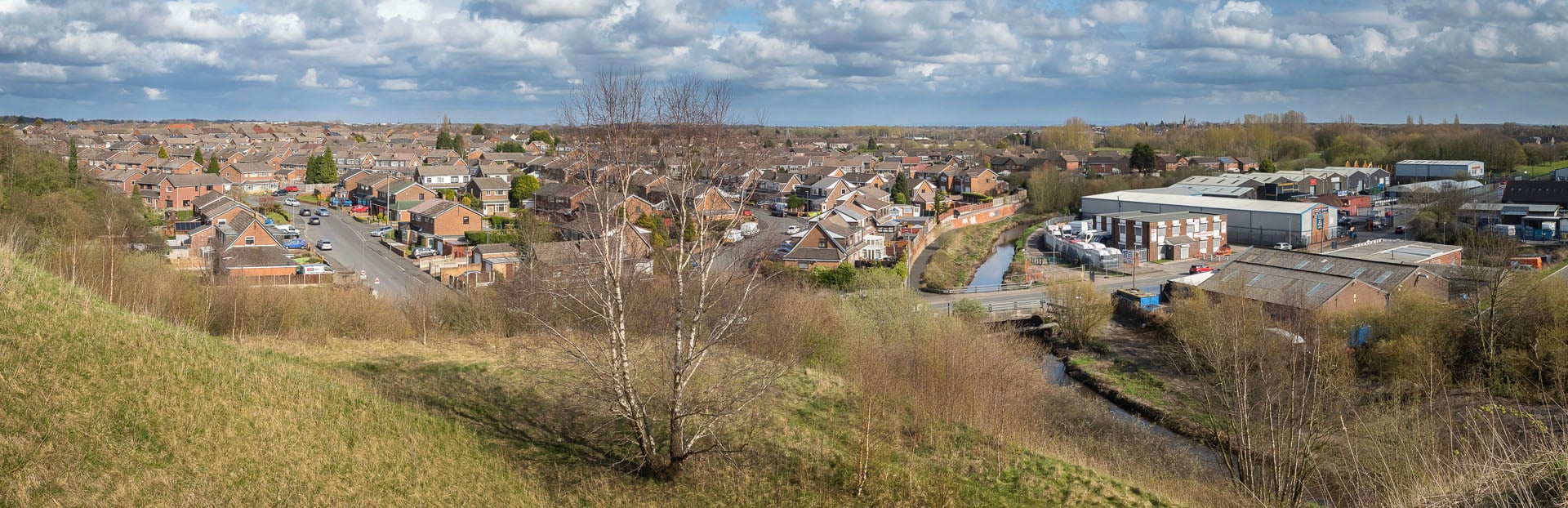
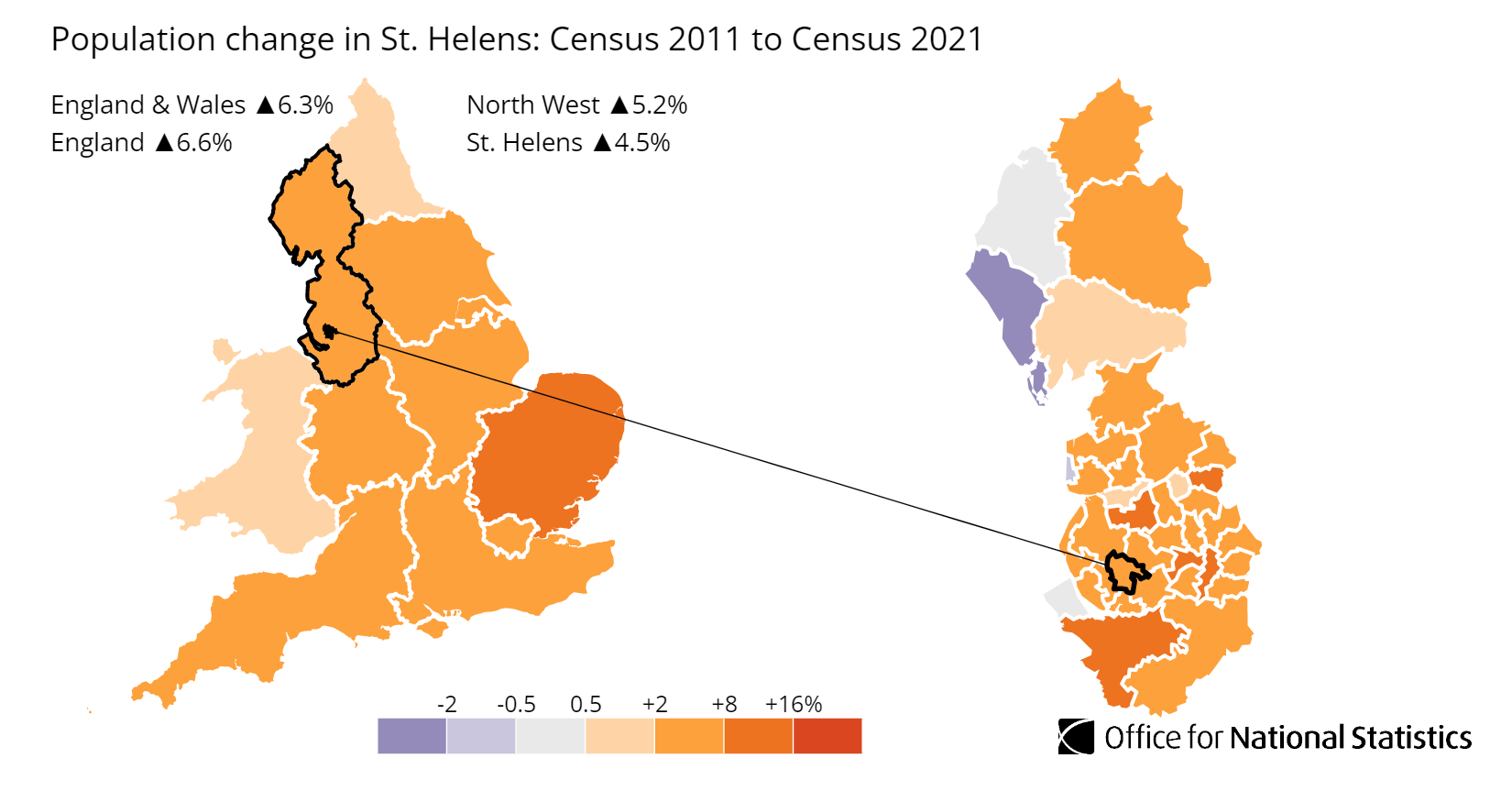
St Helens is a town in Merseyside, in north-west England. The average sold price across St Helens is £181,417 on the HM Land Registry House Price Index, 37.4% below England's £289,946 and 15.5% below the North West average of £214,678. That places St Helens among the cheapest metropolitan boroughs in the region, priced below Liverpool, Manchester and the wider Cheshire commuter belt. The borough's population grew 4.53% between the 2011 and 2021 censuses, from 175,308 to 183,248 residents.
St Helens sits on wages that track the region almost exactly. The median gross weekly salary in the borough is £717.40, against £720.10 across the North West and £752.40 for Great Britain. That near-average wage base paired with well-below-average house prices is what keeps gross yields sitting between 4.4% and 5.3% across all eight postcodes, with WA9 (St Helens South, Sutton) at the top. The spread between the cheapest asking price in WA9 at £192,977 and the dearest in L34 (Prescot) at £262,121 is narrow for a borough this size, so most of St Helens stays within reach of an investor priced out of nearby Liverpool or Warrington.
This guide covers the Metropolitan Borough of St Helens (ONS code E08000013) across postcodes L34, L35, WA9, WA10, WA11, WA12, WN4 and WN5. St Helens sits in Merseyside between Liverpool and Wigan, anchored by its glass-manufacturing heritage and a growing life-sciences economy. Investors comparing the region may also weigh up Liverpool, Warrington, Wigan and Birkenhead. Browse all our highest-yielding areas across the country.
Article updated: July 2026
Why Invest in St Helens?
St Helens' population grew 4.53% to 183,248 between the 2011 and 2021 censuses, and the borough's median annual salary of £37,306 sits within £139 of the North West figure. Steady population growth and near-regional wages give you a rental market where working tenants can afford to pay while house prices stay low enough to deliver a yield. No town in England has been shaped by one industry quite like St Helens. Pilkington founded its glass business here in 1826 and turned the borough into a global centre for flat glass, employing many thousands at its height. Glass manufacturing at Pilkington's Watson Street works finally ceased in early 2026 after nearly 200 years, and what has grown up to replace those jobs is the part that matters for a landlord.
The borough has leaned into logistics, distribution and advanced manufacturing. St Helens sits at the junction of the M6, M62 and the East Lancashire Road, which makes it one of the better-connected distribution points between the Liverpool and Manchester conurbations, and large warehousing operations serve both. Whiston Hospital, run by Mersey and West Lancashire Teaching Hospitals NHS Trust, is the borough's single largest employer and anchors healthcare work across the area. That mix of logistics jobs and a major hospital gives the rental market a broad tenant base rather than dependence on any one employer.
The 4.53% population rise between 2011 and 2021 sat below the England and Wales average of 6.3% for the same period, which reads as steady demand rather than rapid expansion. The housing stock is weighted towards terraced and semi-detached homes, which keeps prices affordable and gives buy-to-let investors natural entry points. Some of that stock is older terraced housing in WA9 and WA10 that can be bought below the borough average as renovation property.
Earnings here run close to the regional line. The median annual salary of £37,306 compares with £37,445 across the North West and £39,125 for Great Britain. That £139 gap between local and regional pay means St Helens workers earn broadly what the wider region earns, while housing costs stay well below regional cities like Manchester or Liverpool.
St Helens Economic Summary
- Population: 183,248 (2021 Census). Growth of 4.53% from 2011.
- Median annual salary: £37,306 (St Helens), £37,445 (North West), £39,125 (Great Britain)
- Employment rate: 75.3% (St Helens)
- Unemployment rate: Data suppressed (St Helens sample below the disclosure threshold)
- Key employment sectors: Glass and advanced manufacturing, logistics and distribution, healthcare, life sciences, public services
Source: ONS Census 2021, Nomis Labour Market Profile (ASHE 2025)
St Helens' employment rate of 75.3% is broadly in line with the Great Britain average of 75.6%. Nomis has suppressed the borough unemployment figure because the Annual Population Survey sample is too small to publish a reliable estimate, which is common for smaller metropolitan boroughs. For a landlord, the combination that matters is affordable housing, wages that track the region, and transport links that keep working households in the area. That is the profile of a market where rent is paid by people in steady jobs who are priced into renting rather than buying.
Regeneration and Investment in St Helens
Confirmed investment is turning St Helens from a glass-manufacturing town into an advanced-manufacturing and life-sciences base. The three projects below are committed capital rather than speculative plans.
- Glass Futures (completed, £54m): A global centre for glass research that opened in St Helens in 2023, home to the world's first openly accessible test and trial furnace for decarbonising glass production. It has drawn in industry and government-backed research partners. For a landlord, Glass Futures matters because it creates skilled work in a borough where traditional manufacturing employment has fallen away. Updates at Glass Futures.
- Project HALO (planning approved October 2025, construction from Spring 2026): A life-sciences and advanced-manufacturing scheme delivering 85,000 sq ft of workspace across four "Tech Box" units on a brownfield site next to Glass Futures. Planning permission was granted on 7 October 2025 and construction is expected to start in Spring 2026, adding lab and light-production space to the borough's growing science cluster. Updates at Construction Enquirer.
- St Helens town centre regeneration (under way): The town centre scheme, delivered with VINCI, adds a new Market Hall, a 120-bedroom Hampton by Hilton hotel, 56 apartments and eight townhouses. It reworks a large part of the centre into a mixed-use quarter, and the residential element lands directly in WA10 where asking prices and rents are lowest. Updates at St Helens Borough Council.
Source: Office for National Statistics - Population for St Helens
St Helens Property Market Analysis
St Helens has taken the average home from £38,701 in January 1995 to £181,417 by March 2026, a 368.8% climb across three decades. The sections below walk that journey cycle by cycle, then break out current postcode-level data for sold prices, price per square foot, asking prices, growth trends and monthly transaction volumes.
When was the last house price crash in St Helens?
The Metropolitan Borough of St Helens has its own entry in the HM Land Registry House Price Index, covering every recorded transaction from January 1995 to March 2026. The series shows one deep crash, an unusually long stagnation, and a strong pandemic-era recovery.
The 1995 to 2007 climb: St Helens began 1995 at £38,701 and moved slowly, reaching only £46,984 by December 2000. The pace then changed. Cheap credit and rising demand pushed prices to £80,378 by January 2004, and on to a peak of £120,943 in July 2007. In little over a decade the average had more than tripled, in a borough where the median wage was well under £30,000 at the time.
2007 to 2012, the financial crisis: From the July 2007 peak of £120,943, prices fell to a trough of £94,394 in February 2012, a decline of 22.0% over 55 months. The worst single reading was -17.0% in the year to July 2009. St Helens fell more steeply than both the North West (-18.3%) and England (-18.2%) because a higher-value southern market has more distance to give up in a downturn, and the borough's reliance on manufacturing meant local job losses bit harder than in more diversified economies.
2012 to 2016, the long flat spell: Where many English cities began recovering from 2013, St Helens stayed put. Prices moved in a narrow band around £95,000 to £102,000 for four years. By December 2015 the average was £101,925, still 15.7% below the pre-crash peak.
2017 to 2019, the slow recovery: Growth returned, but at a crawl. Prices climbed from £101,925 in December 2015 to £121,229 by December 2019, with annual gains mostly between 1% and 3%. The average first cleared the July 2007 peak in September 2019, at £122,088. Getting back to the pre-crash high took just over twelve years.
2020 to 2022, the pandemic surge: The stamp duty holiday and the shift to home working drove the strongest run since the early 2000s. Prices jumped from £119,913 in March 2020 to £168,204 by December 2022, a 40.3% rise in under three years, with annual growth hitting 15.6% in December 2022. St Helens' affordability made it a beneficiary as buyers moved out of pricier city centres.
2023, the rate shock: Higher mortgage rates cooled the market and prices eased from £168,204 in December 2022 to £164,071 by December 2023, a dip of 2.5%. Brief and shallow next to the 2007 to 2012 fall.
2024 to 2026: Prices resumed rising, reaching £170,369 by December 2024 and an all-time high of £183,789 in February 2026 before easing to £181,417 in March 2026, with annual growth of 3.9%. The current average sits 50.0% above the pre-crash peak of £120,943.
Long-term property value growth in St Helens
- 5 years (March 2021 to March 2026): +31.5% (£137,964 to £181,417)
- 10 years (March 2016 to March 2026): +78.4% (£101,672 to £181,417)
- 15 years (March 2011 to March 2026): +83.0% (£99,131 to £181,417)
- 20 years (March 2006 to March 2026): +68.7% (£107,541 to £181,417)
- 30 years (January 1995 to March 2026): +368.8% (£38,701 to £181,417)
The 20-year gain of 68.7% is smaller than the 15-year gain of 83.0% because March 2006 sat close to the top of the boom. An investor who bought at the wrong point in 2006 or 2007 waited more than twelve years just to break even on the Land Registry average. The 31.5% five-year figure shows the other side of the same coin: when the cycle turns in a low-priced borough, percentage gains come off a small base and stack up quickly.
- All property types
- Detached
- Semi-detached
- Terraced
- Flats
- All property types
- Detached
- Semi-detached
- Terraced
- Flats
Source: HM Land Registry House Price Index for St Helens, January 1995 to March 2026.
Sold House Prices in St Helens
The average sold price across all property types in St Helens is £181,417, which is 37.4% below the England average of £289,946 as of March 2026. That discount is not spread evenly across the market. Flats sit 55.3% below the England figure, while detached houses are 36.4% below. The gap tells you something about the housing mix: St Helens has little premium apartment stock, so its flat prices reflect ex-local-authority and older converted units rather than new city-centre developments.
| Property Type | St Helens Average | England Average | Difference |
|---|---|---|---|
| Detached houses | £299,085 | £470,492 | -36.4% |
| Semi-detached houses | £196,289 | £288,185 | -31.9% |
| Terraced houses | £150,956 | £243,788 | -38.1% |
| Flats and maisonettes | £95,816 | £214,563 | -55.3% |
| All property types | £181,417 | £289,946 | -37.4% |
Detached houses at £299,085 carry a 36.4% discount to England's £470,492. Detached stock is concentrated in the more suburban postcodes such as L34 (Prescot), L35 (Whiston, Rainhill) and WA11 (Haydock, Rainford), where larger family homes attract owner-occupiers rather than landlords. Annual growth of 3.7% points to stable demand at this end of the market.
Semi-detached houses at £196,289 sit 31.9% below England's £288,185, the smallest discount of any type here. Semis are the most common home across the borough and form the core of family rental stock in areas like WA11 and WA12 (Newton-le-Willows, Earlestown). Owner-occupier competition keeps this type priced a little closer to the national line than terraces, and annual growth of 4.5% is the strongest of the four types.
Terraced houses at £150,956 show a 38.1% discount to England's £243,788. Terraces are the backbone of St Helens' rental stock, particularly the rows of Victorian and inter-war housing in WA9 and WA10 (St Helens Centre, Eccleston). For a buy-to-let investor this is the workhorse: affordable terraced housing in a market where tenants earn close to the regional wage. Annual growth of 4.1% keeps terraces among the borough's better performers.
Flats and maisonettes at £95,816 offer the deepest discount at 55.3% below England's £214,563. A sub-£100,000 flat means a 30% deposit under £29,000, but the flat market here is thin and mostly older stock, without the student or young-professional demand that supports apartments in a city centre. Annual change of -1.9% is the one negative reading among the four types, which fits a small, quiet segment. The postcode-level data below shows where rental demand actually concentrates.
Price Per Square Foot in St Helens
Average asking prices can mislead, because a postcode can look dear simply because its homes are larger. Price per square foot strips that out. St Helens runs from £184 per square foot in WA10 to £241 in WA12, a spread of just £57 across eight postcodes. That is a tight range, and even the priciest space in the borough would rank as cheap in most southern English towns.
| Rank | Area | Price Per Sq Ft |
|---|---|---|
| 1 | WA10 (St Helens Centre, Eccleston) | £184 |
| 2 | WA9 (St Helens South, Sutton) | £189 |
| 3 | WN5 (Billinge, Orrell) | £207 |
| 4 | WA11 (Haydock, Rainford) | £208 |
| 5 | WN4 (Ashton-in-Makerfield) | £217 |
| 6 | L35 (Whiston, Rainhill) | £220 |
| 7 | L34 (Prescot) | £222 |
| 8 | WA12 (Newton-le-Willows, Earlestown) | £241 |
WA10 at £184 per square foot is the cheapest bricks-and-mortar value in St Helens. This is the town centre and Eccleston, where older terraced stock keeps the per-foot cost down. WA10 also carries the highest transaction volume in the borough at 46 sales a month and a 4.8% yield, so cheap space, deep demand and a workable return sit in the same postcode.
WA12 at £241 per square foot tops the table, though it is still affordable by national standards. Newton-le-Willows is a commuter town with its own station on the Liverpool to Manchester line, and that connectivity premium pushes its per-foot cost above the rest of the borough. Read alongside the growth data, WA12's five-year rise of 17.9% is the softest in the borough, so the higher per-foot price is not being matched by faster appreciation.
The mid-range cluster of WN5, WA11 and WN4 (£207 to £217) covers three of the borough's stronger five-year growth postcodes, each up more than 25%. Reasonable space costs and sustained growth in the same postcodes is a pairing worth noting when weighing where to buy.
For Sale Asking Prices in St Helens
WA9 at £192,977 and L34 at £262,121 sit £69,144 apart, the full width of St Helens' asking-price range. Asking prices are what sellers and agents believe the market will pay, not what buyers actually paid, so they run ahead of the £181,417 Land Registry sold-price average. Even so, that £69,144 spread is narrow for a borough with eight postcodes, which keeps most of St Helens open to an investor priced out of Liverpool or Warrington. The mean asking price across all eight postcodes is £230,577.
| Rank | Area | Asking Price |
|---|---|---|
| 1 | WA9 (St Helens South, Sutton) | £192,977 |
| 2 | WA10 (St Helens Centre, Eccleston) | £197,626 |
| 3 | WN5 (Billinge, Orrell) | £218,637 |
| 4 | WA12 (Newton-le-Willows, Earlestown) | £227,830 |
| 5 | WN4 (Ashton-in-Makerfield) | £232,589 |
| 6 | WA11 (Haydock, Rainford) | £255,632 |
| 7 | L35 (Whiston, Rainhill) | £257,202 |
| 8 | L34 (Prescot) | £262,121 |
WA9 and WA10 cluster below £198,000, and both come in below the borough's £230,577 mean asking price. These are the two core St Helens postcodes covering the town centre, Eccleston, Sutton and the southern suburbs. For an investor the entry cost is close to identical, so the choice comes down to yield and tenant profile: WA9 delivers the borough's highest yield at 5.3% against WA10's 4.8%, a gap worth reading alongside the rental data below.
L34 Prescot at £262,121 is the most expensive postcode, though only £4,919 above L35. Prescot is a distinct town with its own identity, and the Shakespeare North Playhouse, which opened in 2022, has brought cultural investment, while the M57 links residents into Liverpool. But the higher asking price compresses the yield to 4.4%, level with WN5 at the bottom of the borough table.
For investors looking for below market value properties, the WA9 and WA10 postcodes offer asking prices closest to the £181,417 Land Registry sold-price average, which is where the gap between listing and completion tends to be narrowest.

House Price Growth in St Helens
Seven of St Helens' eight postcodes delivered five-year growth above 17%, with WA11 Haydock and Rainford leading at 29.6%. For a buy-to-let investor the five-year figure carries the most weight. It captures a full cycle and filters out the noise a single year can throw up. One-year readings can swing on a handful of sales; five years shows whether an area is genuinely appreciating.
An investor who bought a £197,000 property in WA11 five years ago would be sitting on a home now asking around £255,632, roughly £58,000 of paper equity in an area that also delivers a 4.6% gross yield.
| Area | 1 Year | 3 Years | 5 Years |
|---|---|---|---|
| WA11 (Haydock, Rainford) | 1.2% | 6.3% | 29.6% |
| WN4 (Ashton-in-Makerfield) | 4.0% | 12.5% | 28.1% |
| L35 (Whiston, Rainhill) | -3.7% | 2.6% | 27.9% |
| WN5 (Billinge, Orrell) | 0.6% | 14.0% | 25.2% |
| WA9 (St Helens South, Sutton) | -8.4% | 11.0% | 22.4% |
| WA10 (St Helens Centre, Eccleston) | -2.3% | 6.6% | 20.3% |
| WA12 (Newton-le-Willows, Earlestown) | -1.4% | 5.2% | 17.9% |
| L34 (Prescot) | -17.2% | -13.1% | 3.0% |
The top four growth postcodes sit on the borough's outer and eastern edges. WA11 (29.6%), WN4 (28.1%), L35 (27.9%) and WN5 (25.2%) are the suburban and semi-rural areas with good road links towards both Liverpool and Wigan. These drew buyers chasing space and affordability through the pandemic, and the gains have held through the three-year window too, with WN4 up 12.5% and WN5 up 14.0% over three years, so this reads as sustained demand rather than a one-off spike.
L34 Prescot is the clear outlier. Its 3.0% five-year growth is the lowest in the borough, its one-year reading of -17.2% is the steepest fall, and its three-year figure of -13.1% is the only negative on that column. Prescot is the borough's most expensive postcode, and the data reads as a market correcting after the pandemic surge pushed values ahead of local demand.
WN5 stands out on the three-year column. At 14.0% it posts the strongest three-year figure in the borough, which sits above its longer five-year run rather than fading from it. Paired with 25.2% five-year growth and a 4.4% yield from a mid-range £218,637 asking price, WN5 Billinge and Orrell has appreciated steadily across the recent windows.
Monthly Property Sales in St Helens
If you need to sell a buy-to-let, can you? Transaction volume answers that. St Helens records 223 sales a month across its eight postcodes, ranging from 12 in L34 to 44 in WA10, with WA12 turning over the fastest at 35% of its stock a year. A higher turnover means homes change hands more often, which points to an easier exit when you come to sell.
| Area | Sales Per Month | Turnover | Asking Price |
|---|---|---|---|
| WA10 (St Helens Centre, Eccleston) | 44 | 21% | £197,626 |
| WA9 (St Helens South, Sutton) | 42 | 20% | £192,977 |
| WN5 (Billinge, Orrell) | 32 | 20% | £218,637 |
| WA11 (Haydock, Rainford) | 27 | 15% | £255,632 |
| WA12 (Newton-le-Willows, Earlestown) | 24 | 35% | £227,830 |
| WN4 (Ashton-in-Makerfield) | 22 | 19% | £232,589 |
| L35 (Whiston, Rainhill) | 20 | 13% | £257,202 |
| L34 (Prescot) | 12 | 18% | £262,121 |
WA10 leads on volume at 44 sales a month with a 21% turnover. The town centre postcode has the deepest buyer pool in the borough, and paired with the second-lowest asking price at £197,626 and the cheapest space at £184 per square foot, it gives an investor a liquid market with a clear exit route.
WA12 turns over fastest at 35%, well ahead of the rest. A turnover rate that high means a large share of Newton-le-Willows stock changes hands each year. That sits with its commuter appeal and its station on the Liverpool to Manchester line, which keeps buyer demand ticking over. For exit planning, WA12 and WA10 offer the strongest combination of activity and liquidity in the borough.
L35 Whiston and Rainhill has the lowest turnover at 13% on 20 sales a month. That points to a large pool of housing that rarely comes up for sale. Owners hold long-term here, in an area popular with Whiston Hospital staff and Liverpool commuters. If you are buying to hold for a decade or more, low turnover tells you your neighbours are doing the same.
How Long Properties Take to Sell in St Helens
Selling speed splits the borough in two: WA12 (Newton-le-Willows, Earlestown) clears fastest at about 87 days, while L35 (Whiston, Rainhill) is slowest at roughly 234 days. Days on market is the typical number of days a home is up for sale before it sells; the months of unsold stock is how much for-sale supply is sitting there at the current rate of sales.
| Area | Avg Days to Sell | Months of Unsold Stock | Market |
|---|---|---|---|
| WA12 (Newton-le-Willows, Earlestown) | 87 | 2.9 | Seller's market |
| WA10 (St Helens Centre, Eccleston) | 145 | 4.8 | Seller's market |
| WA9 (St Helens South, Sutton) | 145 | 4.8 | Seller's market |
| WN5 (Billinge, Orrell) | 152 | 5.0 | Seller's market |
| L34 (Prescot) | 160 | 5.3 | Seller's market |
| WN4 (Ashton-in-Makerfield) | 203 | 6.7 | Balanced market |
| WA11 (Haydock, Rainford) | 217 | 7.1 | Balanced market |
| L35 (Whiston, Rainhill) | 234 | 7.7 | Balanced market |
A yield number says nothing about how quickly you can get back out. WA12's 2.9 months of unsold stock means a far quicker exit than L35's 7.7, even though both are family-home markets. When it comes time to sell, a faster-moving postcode is less time carrying a property you are trying to move on. Five of the eight postcodes currently read as sellers' markets, which is the direction you want if a clean exit matters to your plan.
What Type of Property Can You Buy in St Helens?
Semi-detached homes are the largest single category in most St Helens postcodes, from 29.6% of stock in L34 up to 49.3% in WN5, while terraces and flats concentrate in WA9 and WA10. The mix of housing shapes which strategies fit where. The figures below are drawn from 2021 Census records for each postcode.
| Area | Detached | Semi-detached | Terraced | Flats |
|---|---|---|---|---|
| WA9 (St Helens South, Sutton) | 18.1% | 39.3% | 25.8% | 14.9% |
| WA10 (St Helens Centre, Eccleston) | 27.1% | 38.2% | 24.5% | 10.1% |
| WN4 (Ashton-in-Makerfield) | 26.2% | 40.1% | 28.1% | 5.4% |
| WN5 (Billinge, Orrell) | 25.6% | 49.3% | 19.2% | 5.8% |
| WA12 (Newton-le-Willows, Earlestown) | 29.3% | 41.7% | 22.1% | 6.8% |
| WA11 (Haydock, Rainford) | 35.2% | 46.1% | 16.1% | 2.5% |
| L35 (Whiston, Rainhill) | 36.8% | 42.4% | 13.4% | 2.9% |
| L34 (Prescot) | 49.0% | 29.6% | 15.6% | 5.8% |
WA9 holds the largest share of flats at 14.9% and terraces at 25.8%, the smaller-unit stock that usually forms the buy-to-let market. That lines up with WA9 carrying the lowest asking price and the highest gross yield in the borough. Terraces here suit lower-cost family lets, while the flats reflect the ex-local-authority and converted stock that keeps flat prices well below the England average.
L34 Prescot is the most detached-dominated postcode at 49.0%, with the smallest semi-detached share at 29.6%. Detached and semi-detached houses together account for close to 80% of L34's stock, which matches its high asking prices, its lowest yield in the borough alongside WN5, and its recent price correction. The housing here leans towards owner-occupier family homes rather than the smaller units that drive rental income.
Flats combine purpose-built and converted units. A small share of mobile and temporary dwellings is not shown, so rows may not total 100%.
St Helens Rental Market Analysis
Monthly rents in St Helens range from £793 in WA10 to £1,107 in L35, with gross rental yields from 4.4% to 5.3% across all eight postcodes. For investors asking whether buy to let is worth it in St Helens, the sections below break down rents, yields and tenant affordability postcode by postcode. If you are working out how to start a property business in the North West, St Helens gives you complete rental data for every postcode and a consistent band of yields, which makes it a straightforward market to model. Browse current buy-to-let homes for sale across the region.
Average Rent & Gross Rental Yields in St Helens
Gross rental yield here is the average monthly rent times twelve, divided by the average asking price for each postcode. It leaves out void periods, maintenance, management and mortgage costs, so it is a comparison starting point, not a profit forecast. For how rental yield is calculated in full, see our standalone guide. WA9 delivers St Helens' highest gross yield at 5.3%, where monthly rents of £857 meet asking prices of £192,977.
At the other end, WN5 and L34 both sit at 4.4%: WN5 because rents are among the lowest in the borough, L34 because its high asking prices absorb strong rents. The yield spread across St Helens is just 0.9 percentage points, so no single postcode dramatically outperforms the rest. The whole borough delivers moderate, consistent returns rather than a standout income postcode.
| Area | Average Monthly Rent | Asking Price | Gross Yield |
|---|---|---|---|
| WA9 (St Helens South, Sutton) | £857 | £192,977 | 5.3% |
| L35 (Whiston, Rainhill) | £1,107 | £257,202 | 5.2% |
| WA12 (Newton-le-Willows, Earlestown) | £939 | £227,830 | 4.9% |
| WA10 (St Helens Centre, Eccleston) | £793 | £197,626 | 4.8% |
| WN4 (Ashton-in-Makerfield) | £894 | £232,589 | 4.6% |
| WA11 (Haydock, Rainford) | £988 | £255,632 | 4.6% |
| WN5 (Billinge, Orrell) | £810 | £218,637 | 4.4% |
| L34 (Prescot) | £951 | £262,121 | 4.4% |
WA9 and L35 sit at the top of the yield table but reach it differently. WA9 pairs the lowest asking price in the borough with a modest £857 rent to land a 5.3% yield. L35 charges the highest rent in St Helens at £1,107, drawing on Whiston Hospital staff and Liverpool commuters. That rent still returns 5.2% despite the higher £257,202 asking price. Different tenant pools, similar returns.
L34 commands £951 a month but delivers the lowest yield at 4.4%. Prescot's £262,121 asking price absorbs the rent, so the return compresses. On the current numbers, L34 leans towards tenant profile and long-run positioning rather than income.
WA10 at 4.8% is worth a look for its liquidity. It has the second-lowest asking price at £197,626 and the lowest rent at £793, because the town centre stock skews to smaller terraces. But a 4.8% yield from a £59,288 deposit, in the most active market in the borough, is a reasonable return where a clean exit matters.
Gross Rental Yield by Postcode
Is St Helens Rent High?
Rent affordability matters on both sides. For tenants it decides whether they can keep payments going; for landlords, areas where rent takes a smaller share of income tend to produce steadier tenants and fewer arrears. Across the eight St Helens postcodes, rent runs from 25.5% to 35.6% of the local median gross monthly salary.
The median gross weekly salary in St Helens is £717.40, which works out at about £3,109 a month or £37,306 a year. That is marginally below the North West median of £720.10 a week and below the Great Britain median of £752.40, from the Nomis Labour Market Profile (ASHE 2025). The usual benchmark is that rent gets stretched above 30% of gross income. Four postcodes sit above that mark and four sit below.
| Rank | Area | Rent as % of Income |
|---|---|---|
| 1 | L35 (Whiston, Rainhill) | 35.6% |
| 2 | WA11 (Haydock, Rainford) | 31.8% |
| 3 | L34 (Prescot) | 30.6% |
| 4 | WA12 (Newton-le-Willows, Earlestown) | 30.2% |
| 5 | WN4 (Ashton-in-Makerfield) | 28.8% |
| 6 | WA9 (St Helens South, Sutton) | 27.6% |
| 7 | WN5 (Billinge, Orrell) | 26.1% |
| 8 | WA10 (St Helens Centre, Eccleston) | 25.5% |
L35 and WA11 at 35.6% and 31.8% sit above the 30% mark. These are the higher-rent postcodes, at £1,107 and £988 a month, and they draw tenants who typically earn above the borough median. Hospital staff at Whiston and professionals commuting to Liverpool are not on £37,306, so the borough-wide median understates what tenants in these areas actually earn.
WA9 at 27.6% sits comfortably below the 30% line. Rents are high enough to give the borough's top yield at 5.3% yet stay well within reach of a working tenant, which is the balance a landlord wants for steady payment. WA10 at 25.5% is the most affordable postcode, in step with its low rents and town-centre stock.
Four of the eight postcodes sit below 30%. That is a healthy affordability profile for a buy-to-let market. Tenants across most of St Helens are paying rents within their means, which tends to mean lower arrears and steadier income for a landlord.
How Big Is St Helens' Private Rented Sector?
The private rented sector is deepest in L34 and WA9, where it accounts for 30.0% and 19.2% of households, and shallowest in L35 and WN5 at 9.1% and 11.0%. The share of homes already let privately gives you a read on how deep the sitting tenant pool is and how busy the local lettings market runs. Household tenure across the eight postcodes breaks down as follows.
| Area | Owned Outright | Owned with Mortgage | Private Rented | Social Rented |
|---|---|---|---|---|
| L34 (Prescot) | 24.5% | 37.5% | 30.0% | 7.8% |
| WA9 (St Helens South, Sutton) | 25.1% | 29.5% | 19.2% | 24.7% |
| WA10 (St Helens Centre, Eccleston) | 37.5% | 31.1% | 17.6% | 13.5% |
| WN4 (Ashton-in-Makerfield) | 38.9% | 37.5% | 16.0% | 7.3% |
| WA12 (Newton-le-Willows, Earlestown) | 35.0% | 35.9% | 12.4% | 15.8% |
| WA11 (Haydock, Rainford) | 45.9% | 33.4% | 11.6% | 8.5% |
| WN5 (Billinge, Orrell) | 39.7% | 35.6% | 11.0% | 13.3% |
| L35 (Whiston, Rainhill) | 46.7% | 36.7% | 9.1% | 7.2% |
L34 has the largest private rented sector in the borough at 30.0% of households, roughly triple the share in L35 at the other end. A deeper rented sector points to an active lettings market and a wider pool of sitting tenants, which is a different signal from yield: L34 pairs its large rented sector with the lowest gross yield in the borough at 4.4%. WA9 is the more useful reading for a landlord chasing return, pairing a 19.2% rented share with the top yield at 5.3%. The high-ownership postcodes run the shallowest rented sectors: L35 at 9.1% and WN5 at 11.0% pair the smallest private-rented shares with the highest outright ownership, 46.7% and 39.7%.
Only WA9 and WA10 have enough homes advertised to rent to read the lettings market with confidence, and in both the balance currently sits with landlords rather than tenants. Around 54 homes were on the rental market in WA9 and 55 in WA10, each taking roughly 44 to 49 days to let, which points to steady demand meeting a limited supply of listings. The other six postcodes have too few rental listings at any one time to read reliably.
Local Housing Allowance Rates in St Helens
St Helens straddles four Broad Rental Market Areas, so Local Housing Allowance is not one figure across the borough: a two-bedroom rate runs from £115.07 a week in the Wigan area to £136.93 in the Greater Liverpool area. Local Housing Allowance sets the maximum housing support a tenant on benefits can receive, so for that part of the market it acts as a rent floor. Which rate applies depends on the postcode, and St Helens spans more areas than most boroughs its size. To check the rate for a specific address, use the government's official Local Housing Allowance calculator.
| Broad Rental Market Area | Postcodes | Shared | 1 Bed | 2 Bed | 3 Bed | 4 Bed |
|---|---|---|---|---|---|---|
| St Helens | WA9, WA10, WA11, L35 | £74.74 | £97.81 | £120.82 | £143.84 | £184.11 |
| Greater Liverpool | L34 | £79.25 | £115.07 | £136.93 | £149.59 | £201.37 |
| North Cheshire | WA12 | £78.59 | £109.32 | £135.78 | £159.95 | £230.14 |
| Wigan | WN4, WN5 | £78.21 | £92.05 | £115.07 | £136.93 | £178.36 |
The split matters for a benefit-backed strategy. The St Helens area rates cover half the borough's postcodes, where a two-bedroom home draws £120.82 a week, about £524 a month, against local market rents of £793 to £1,107. The North Cheshire rate that applies to WA12 is the most generous at the family end, with a four-bedroom rate of £230.14 a week, while the Wigan rates covering WN4 and WN5 are the lowest across most sizes. All four sets of rates sit below open-market rents in their postcodes, and the stock that fits within them concentrates in WA9 and WA10, where asking prices and rents are lowest. These rates change each April, so check the calculator for the current figure.
Buy-to-Let Considerations
Are St Helens House Prices High? Price-to-Earnings Ratios
Buying in St Helens takes between 5.2 and 7.0 times the local median annual salary, and all eight postcodes sit below the national benchmark. The price-to-earnings ratio compares a postcode's average asking price against the local median annual salary, so a lower number means a more affordable entry relative to what people earn locally.
The national benchmark is 7.4x, from England's average sold price of £289,946 divided by the Great Britain median annual salary of £39,125. This is based on the Nomis Labour Market Profile for St Helens, which puts the median gross annual income for St Helens residents at £37,306.
| Rank | Area | Price-to-Earnings Ratio |
|---|---|---|
| 1 | WA9 (St Helens South, Sutton) | 5.2x |
| 2 | WA10 (St Helens Centre, Eccleston) | 5.3x |
| 3 | WN5 (Billinge, Orrell) | 5.9x |
| 4 | WA12 (Newton-le-Willows, Earlestown) | 6.1x |
| 5 | WN4 (Ashton-in-Makerfield) | 6.2x |
| 6 | WA11 (Haydock, Rainford) | 6.9x |
| 7 | L35 (Whiston, Rainhill) | 6.9x |
| 8 | L34 (Prescot) | 7.0x |
WA9 and WA10 at 5.2x and 5.3x are the most affordable entry points in the borough. They are also the two highest-yielding value postcodes, at 5.3% and 4.8%, so affordable prices against local wages and reliable returns sit in the same two postcodes.
Every postcode sits below the 7.4x national benchmark, L34 by the narrowest margin at 7.0x. Even Prescot, the borough's most expensive postcode, buys at seven times local earnings. Set that against cities like Bristol, where many postcodes run above 10x, or London, where ratios regularly clear 15x, and St Helens is affordable right across the borough.
Deposit Requirements in St Helens
A 30% deposit on a buy-to-let property in St Helens runs from £57,893 in WA9 to £78,636 in L34, with five of the eight postcodes under £70,000. The table uses a conservative 30% because a lower loan-to-value usually unlocks a better interest rate, and that matters for cash flow in a yield-driven market. The gap between the cheapest and dearest deposit is £20,743.
| Rank | Area | 30% Deposit Required |
|---|---|---|
| 1 | WA9 (St Helens South, Sutton) | £57,893 |
| 2 | WA10 (St Helens Centre, Eccleston) | £59,288 |
| 3 | WN5 (Billinge, Orrell) | £65,591 |
| 4 | WA12 (Newton-le-Willows, Earlestown) | £68,349 |
| 5 | WN4 (Ashton-in-Makerfield) | £69,777 |
| 6 | WA11 (Haydock, Rainford) | £76,690 |
| 7 | L35 (Whiston, Rainhill) | £77,161 |
| 8 | L34 (Prescot) | £78,636 |
WA9 needs the lowest deposit in St Helens at £57,893, just £1,395 less than WA10, and it records the borough's highest yield at 5.3%. It also posted 22.4% five-year growth, so the cheapest way into the borough is also the strongest yield reading, an unusual pairing.
A clear step separates the sub-£70,000 tier from the rest. WA9, WA10, WN5, WA12 and WN4 all sit below £70,000, then WA11 at £76,690, L35 at £77,161 and L34 at £78,636 form the higher band. For an investor with limited capital, the five cheapest postcodes all deliver yields between 4.4% and 5.3%, so a decent return is available without stretching into the top deposit bracket. Investors exploring no-deposit investment property structures will find St Helens' low asking prices make creative financing more workable than in higher-priced boroughs.
Deposit is only part of the upfront cost. Budget for stamp duty (our stamp duty calculator gives an accurate figure), legal fees and survey costs. For a full breakdown, see our guide to buy-to-let running costs.

What the St Helens Data Tells Buy-to-Let Investors
In St Helens the cheapest way in is also the highest-yielding postcode. WA9 (St Helens South, Sutton) has the top yield at 5.3%, the lowest asking price for investment property in St Helens at £192,977, and the most affordable prices against local earnings at 5.2 times income. A 30% deposit there is £57,893, the lowest in the borough, on a home renting at £857 a month, and its five-year growth of 22.4% sits mid-pack rather than at either extreme.
For growth, the outer postcodes led over five years. WA11 (29.6%), WN4 (28.1%), L35 (27.9%) and WN5 (25.2%) posted the strongest five-year appreciation, the suburban and semi-rural areas that gained most from the pandemic move towards space and affordability. WN4 and WN5 also held up over the three-year window, up 12.5% and 14.0%, so those two combine longer and medium-term gains from mid-range price points.
L34 Prescot reads weaker across several measures. Its five-year growth of 3.0% is the lowest in the borough and its one-year fall of -17.2% the steepest. The yield of 4.4% sits level with the bottom, on the thinnest transaction volume at 12 sales a month. Prescot is the most expensive postcode at £262,121, and the data reads as a market correcting after the pandemic pushed values ahead of local demand.
Investors buying in St Helens can also access off-market property in St Helens that never reaches the open portals. St Helens does not currently operate a boroughwide council licensing area covering all private lets, though mandatory HMO licensing still applies and landlords can check the current position on St Helens Borough Council's HMO and private landlord pages.
How St Helens Compares
St Helens' mean monthly rent of £917 is higher than Liverpool (£904), Birkenhead (£802) and Wigan (£892), even though it sits second on price in this group. The table below sets St Helens against four nearby North West locations on the same basis: mean asking price across all postcodes, mean monthly rent across postcodes with data, and the single highest postcode gross yield.
| Location | Mean Asking Price | Mean Monthly Rent | Mean Gross Yield | Top Yield (postcode) |
|---|---|---|---|---|
| Liverpool | £210,314 | £904 | 5.2% | 8.0% (L2) |
| Birkenhead | £214,598 | £802 | 4.5% | 7.9% (CH41) |
| St Helens | £230,577 | £917 | 4.8% | 5.3% (L35, WA9) |
| Wigan | £233,131 | £892 | 4.6% | 5.4% (M46) |
| Warrington | £307,783 | £1,001 | 3.9% | 4.8% (WA1, WA5) |
St Helens sits third on price in this group but leads it on rent. At £917 a month its mean rent runs ahead of Liverpool (£904), Birkenhead (£802) and Wigan (£892), even though two of those carry lower asking prices. That tells you tenants in St Helens pay for what the borough offers: suburban space, strong road links and proximity to both Liverpool and Manchester without city-centre costs.
Liverpool and Birkenhead post much higher top yields at 8.0% and 7.9%, but those come from specific high-yield postcodes. St Helens' tighter spread of 4.4% to 5.3% means every postcode returns a consistent yield, so postcode selection matters less than it does in Liverpool, where the gap between the best and worst yield is far wider. For an investor who wants predictability across a portfolio, that consistency has a value of its own.
Warrington takes substantially more capital for a lower top yield. Its £307,783 mean asking price means a 30% deposit above £92,000, against St Helens' entry from £57,893. For investors weighing the best places to invest in buy-to-let across the North West, the choice between St Helens and its neighbours comes down to whether the priority is headline yield (Liverpool, Birkenhead), a consistent return across every postcode (St Helens, Wigan), or a more affluent tenant base (Warrington).
Frequently Asked Questions
Is St Helens a good place to live for buy-to-let tenants?
For a landlord, the tenant fundamentals hold up. St Helens runs a 75.3% employment rate, close to the national 75.6%, on a typical wage of £717.40 a week against about £720 across the North West. Tenants earning roughly the regional wage tend to keep the rent paid, and that rent takes between 25.5% and 35.6% of local median income depending on the postcode.
St Helens is also easy to rent in for people who work across Merseyside. It sits at the junction of the M6, M62 and East Lancashire Road, with Whiston Hospital and large logistics operations providing a broad base of local jobs, so tenant demand does not rest on any single employer.
What are the best areas in St Helens for property investment?
The postcodes split fairly cleanly. WA9 (St Helens South, Sutton) is the cheapest way in at £192,977 and carries the highest yield at 5.3%, so it leans towards income. WA11 (Haydock, Rainford), WN4 (Ashton-in-Makerfield), L35 (Whiston, Rainhill) and WN5 (Billinge, Orrell) posted the strongest five-year growth, all above 25%, so they lean towards capital appreciation over the recent cycle.
At the other end, L34 (Prescot) is the priciest at £262,121 with the lowest yield at 4.4% and a recent price correction. So if income is the priority, WA9 leads on yield and entry cost; if the recent growth record matters more, the outer eastern postcodes have run harder.
How does St Helens compare to Liverpool for buy-to-let?
Liverpool delivers higher top yields, around 8.0% against St Helens' 5.3%, and a lower mean asking price at £210,314 versus £230,577. It also has a much deeper pool of student and city-centre rental demand, and far more postcodes to choose from.
St Helens trades that for a higher mean rent (£917 against £904) and a tighter yield spread, so returns are more consistent across the borough and postcode selection carries less risk. Which matters more comes down to what you want the money to do. For the full postcode breakdown on Merseyside's biggest market, see our Liverpool buy-to-let guide.
What impact will Glass Futures and Project HALO have on St Helens property prices?
The full effect is not yet in the data, but the direction is clear enough. Glass Futures (£54m) opened in 2023 and is operating, drawing glass-research partners to St Helens. Project HALO secured planning approval in October 2025 and targets life sciences and advanced manufacturing, with construction expected from Spring 2026. The five-year growth figures in this guide predate HALO breaking ground.
Both projects create skilled jobs on the borough's Advanced Manufacturing and Innovation Campus, which supports rental demand in the surrounding postcodes over time. The timeline for any economic effect is measured in years rather than months, so anyone factoring it in is taking a long view.
Can I find buy-to-let property in St Helens under £150,000?
Yes. The Land Registry average for terraced houses in St Helens is £150,956, and flats average £95,816, so sub-£150,000 stock exists, particularly older terraces and ex-local-authority flats in WA9 and WA10. Lender repossessed properties occasionally surface in these postcodes at further discounts.
The asking prices in this guide are postcode averages across all property types, so individual terraces and flats list below them. At that price point a 30% deposit is under £45,000. Check condition, lease terms on flats, and real tenant demand before buying at the lower end. For more options at lower price points, see our guide to the cheapest places to buy a house in England.
Is Thatto Heath a good area for buy-to-let in St Helens?
Thatto Heath falls within WA9, the highest-yielding postcode in St Helens at 5.3% with 22.4% five-year growth. WA9 covers St Helens South including Sutton, Thatto Heath and the surrounding streets, with asking prices averaging £192,977 and a 30% deposit of £57,893. The postcode also records 42 sales a month, which points to a liquid market.
WA9 reads well across most of the metrics in this guide, but individual streets within Thatto Heath vary, so ground-level research on a specific property is always worth doing.
What are average house prices in St Helens?
The average sold price across St Helens is £181,417 on the Land Registry index, about 37.4% below the England average of £289,946 as of March 2026. Asking prices by postcode run from £192,977 in WA9 (St Helens South, Sutton) up to £262,121 in L34 (Prescot), with a borough-wide mean of £230,577. By type, detached homes average £299,085, semi-detached £196,289, terraced £150,956 and flats £95,816.
Through a buy-to-let lens, WA9 is the cheapest entry and the highest-yielding at 5.3%, while L34 is among the dearest and lowest-yielding at 4.4%. Rents run from £793 a month in WA10 to £1,107 in L35.
What type of property is most common in St Helens?
Semi-detached houses, in most postcodes. They run from 29.6% of the stock in L34 up to 49.3% in WN5. The smaller homes that usually suit buy-to-let, terraces and flats, are most concentrated in WA9, at 25.8% terraced and 14.9% flats. L34 sits at the other end, most detached-dominated at 49.0% with a small terraced and flat share.
What are the Local Housing Allowance rates in St Helens?
St Helens spans four Broad Rental Market Areas, so the rates depend on the postcode. As of June 2026, a two-bedroom home draws £120.82 a week in the St Helens area (WA9, WA10, WA11, L35), £136.93 in Greater Liverpool (L34), £135.78 in North Cheshire (WA12) and £115.07 in Wigan (WN4, WN5). The rate is the most a tenant on housing support can claim towards rent, so for that part of the market it sets a floor, and it changes each April.
How do I buy an investment property in St Helens?
Start by deciding whether you are buying for income or for the recent growth trend, because that points you at a different postcode. WA9 (St Helens South, Sutton) is the cheapest entry at £192,977 and the highest-yielding at 5.3%. The outer postcodes, WA11, WN4, L35 and WN5, ran hardest over five years. Budget for a 30% deposit, which runs from £57,893 in WA9 to £78,636 in L34.
Beyond what is listed openly, experienced investors often buy below asking through off market property and BMV property. To see what is available now, browse investment property or buy-to-let homes for sale.
Ready to buy property?
Access off-market investment properties with an average 8%+ annual gross yield (beating the UK's typical 3-5%).
Get property alerts