

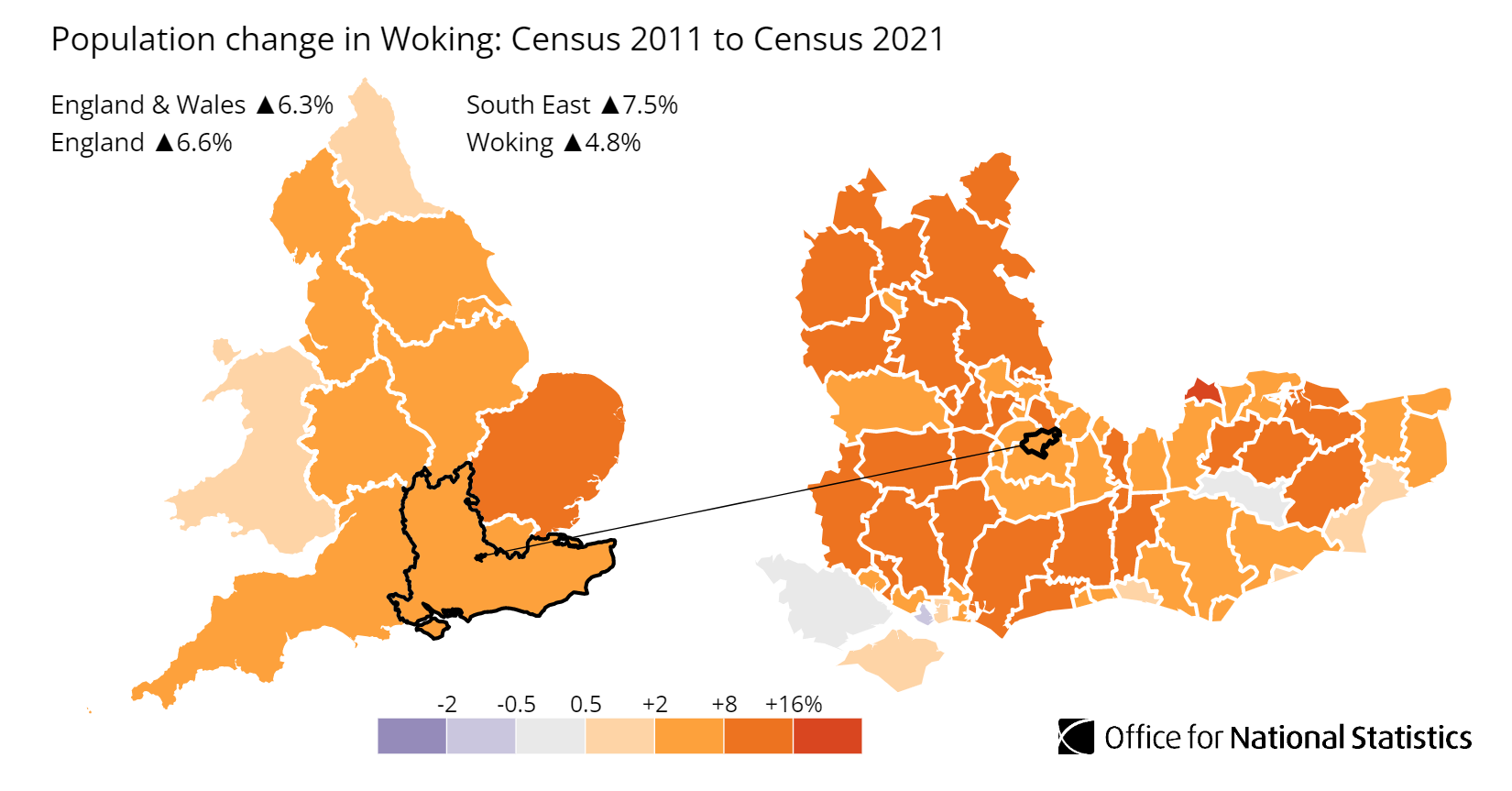
Woking is a town in Surrey, in the south-east of England. Woking's average sold price of £445,943 on the HM Land Registry index sits 53.8% above the England average of £289,946 and 17.8% above the South East regional average of £378,515. That places Woking near the top of the Surrey commuter belt: entry costs run well ahead of the typical buy-to-let market, and the numbers work hardest at the cheaper end. The borough's population grew 4.78% between the 2011 and 2021 censuses, from 99,198 to 103,943 residents.
The price premium is underwritten by earnings. Median gross weekly pay for Woking residents is £840.80, which works out at £43,719 a year, 11.7% above the Great Britain median and above the South East too. Those are commuter salaries, and they support genuine local rental demand. For investors the spread runs from GU21 at £436,904 to GU23 at £735,745, a £298,841 gap that creates two very different markets inside one borough. The higher yields sit with the cheaper postcodes, not the premium village ones.
This guide covers the borough of Woking (ONS code E07000217) across postcodes GU21, GU22, GU23, GU24, and KT14. Woking sits in the South East, 24 miles south-west of central London with a fast train to Waterloo in around 24 minutes. Investors comparing options across the county can also look at nearby Crawley, or browse all our best buy-to-let areas.
Article updated: July 2026
Why Invest in Woking?
Woking's population reached 103,943 in the 2021 Census, up 4.78% from 99,198 in 2011. That growth rate sits below the England and Wales average of 6.3%, which fits a settled, densely built borough where Green Belt boundaries on three sides limit how much new housing can come forward. Woking's pull is straightforward: a fast, direct commute to London on a Surrey address, with green space and family housing that inner London cannot match at the price.
The local employment rate is 83.7%, above the South East and Great Britain averages, and the median gross weekly wage of £840.80 is 5.1% above the South East median of £800.30 and 11.7% above the Great Britain median of £752.40. Those are the wages of a commuter town rather than a regional employment centre. The fast train to Waterloo is the economic anchor, and it puts Woking in direct competition with London for professional tenants who want more space for the money.
Local employment leans on financial services, technology, and professional services, with several employers headquartered in the borough, including McLaren Group in GU21. Heathrow Airport is around 30 minutes by road, which adds corporate relocation demand from international businesses to the resident commuter base.
Woking Economic Summary
- Population: 103,943 (2021 Census). Growth of 4.78% from 2011.
- Median annual salary: £43,719 (local), £41,616 (South East), £39,125 (Great Britain)
- Employment rate: 83.7% (local)
- Unemployment rate: Not available for this local authority
- Key employment sectors: Financial services, technology, professional services, automotive (McLaren)
Source: ONS Census 2021, Nomis Labour Market Profile (ASHE 2025)
Regeneration and Investment in Woking
More than £700 million went into Woking's town centre through the Victoria Place development, and the Sheerwater programme is delivering 472 homes. That capital was committed alongside a council financial crisis that led Woking Borough Council to issue a Section 114 notice in June 2023, after debts passed £1.2 billion. The schemes below are already built or in delivery, so the spend is on the ground rather than on paper.
- Victoria Place (Complete, £700m+): The town centre was rebuilt around this mixed-use scheme, with two residential towers of 34 and 32 storeys, a 23-storey Hilton Hotel, and retail anchored by a flagship Marks & Spencer. It completed in August 2022 and added several hundred homes plus the hotel to the centre of GU21. Updates at Woking Borough Council.
- Sheerwater Regeneration (Underway, 472 homes): This neighbourhood programme has delivered 472 homes, 49% of them affordable, a new leisure centre with a swimming pool, a 3G football pitch, and 29,000 sq ft of commercial space. The council is now refurbishing up to 110 more properties for social housing. Updates at Woking Borough Council.
- West Hall, West Byfleet (Proposed, 461 homes): Barratt David Wilson Homes has proposed 461 houses and 15 traveller pitches on a former Green Belt site near West Byfleet in the KT14 postcode, with more than £4.5 million in community infrastructure contributions. The scheme went to public exhibition in February 2024. Updates at Surrey Live.
Source: Office for National Statistics - Population for Woking
Woking Property Market Analysis
A £79,274 home in Woking in January 1995 would average £445,943 today, a 462.5% climb over 31 years. What follows walks that rise cycle by cycle, then drops down to the postcode level for sold prices, price per square foot, asking prices, growth, and monthly transaction volumes.
When was the last house price crash in Woking?
Woking is its own local authority, so all sold prices from HM Land Registry are recorded at borough level. The index runs from January 1995 to March 2026, covering 31 years of the market's cycles.
The 1995 to 2007 boom: Woking started at £79,274 in January 1995. By December 2000 the average had reached £152,608, nearly doubling in six years as interest rates fell and mortgage lending expanded. The pace held through the mid-2000s, with London commuter demand pushing prices to £240,288 by December 2005 and on towards the pre-crash high.
2008 to 2009, the financial crisis: Prices peaked at £290,174 in January 2008, then fell to a trough of £232,631 by June 2009. That is a drop of 19.8% over 17 months. The worst year-on-year reading was -16.2% in July 2009. Woking's fall was close to the South East's 20.0% correction and slightly steeper than England's 18.2%. As a higher-value commuter market, Woking fell more steeply than lower-priced regions when credit tightened.
2010 to 2013, the recovery: Prices climbed back off the June 2009 trough rather than stagnating for years. By December 2010 the average stood at £265,753, already above the 2008 peak, and Woking spent the next three years grinding higher as London overspill demand returned ahead of the wider country.
2014 to 2016, the acceleration: Growth turned sharp. Prices rose from around £305,000 in early 2014 to £386,114 by December 2015, then £387,451 by March 2016, as Help to Buy and buyers priced out of London chased the fast rail line into Surrey.
2017 to 2019, the pre-pandemic plateau: The 2016 stamp duty surcharge and Brexit uncertainty cooled the top of the market. Prices drifted rather than surged, reaching the low £400,000s by the end of 2019 with only single-digit annual growth.
2020 to 2022, the pandemic surge: The stamp duty holiday and the shift to home working, which made a bigger house an easy trade for a longer commute, pushed Woking to its all-time high of £473,223 in October 2022.
2023 to present: Higher mortgage rates unwound part of that surge. Prices eased back through 2023 and 2024 and stand at £445,943 by the latest March 2026 reading, with annual change of -0.4%. That is 5.8% below the October 2022 peak, so Woking has given back some of the pandemic gains without a full correction.
Long-term growth summary:
- 5 years (March 2021 to March 2026): 6.8% growth (£417,556 to £445,943)
- 10 years (December 2015 to March 2026): 15.5% growth (£386,114 to £445,943)
- 15 years (December 2010 to March 2026): 67.8% growth (£265,753 to £445,943)
- 20 years (December 2005 to March 2026): 85.6% growth (£240,288 to £445,943)
- 30 years (January 1995 to March 2026): 462.5% growth (£79,274 to £445,943)
Woking's 19.8% crash was in line with the South East and a touch deeper than England, and the 30-year return of 462.5% shows the pull of a commuter town on the fast line to London. The more recent record is flatter: five-year growth of 6.8% and a current annual reading of -0.4% describe a market that ran hard in the pandemic and has since levelled off just below its high. An investor who bought at the exact October 2022 peak would be sitting 5.8% down on the Land Registry average today.
- All property types
- Detached
- Semi-detached
- Terraced
- Flats
- All property types
- Detached
- Semi-detached
- Terraced
- Flats
Source: HM Land Registry House Price Index for Woking, January 1995 to March 2026.
Sold House Prices in Woking
Woking's average sold price of £445,943 sits 53.8% above the England average of £289,946. That £155,997 premium is the mark of a high-demand commuter town rather than a typical buy-to-let market. Against its own region Woking is 17.8% above the South East average of £378,515, so the premium holds even before you leave the county.
The gap over England is widest at the top of the market and narrowest at the bottom. Detached houses cost roughly double the England figure; flats carry the smallest premium. That compression at the flat end is where investors are most likely to find numbers that work.
| Property Type | Woking Average | England Average | Difference |
|---|---|---|---|
| Detached houses | £940,945 | £470,492 | +100.0% |
| Semi-detached houses | £490,688 | £288,185 | +70.3% |
| Terraced houses | £388,466 | £243,788 | +59.3% |
| Flats and maisonettes | £257,553 | £214,563 | +20.0% |
| All property types | £445,943 | £289,946 | +53.8% |
Detached houses average £940,945, exactly double the England figure of £470,492. This stock sits in villages like Horsell, Pyrford, and the rural GU23 and GU24 postcodes, where large plots and period homes push prices into seven figures. Annual change for detached property is +0.4%, so this part of the market has steadied after the correction.
Semi-detached houses average £490,688, 70.3% above England's £288,185. These are concentrated in the established residential streets of GU21 and GU22. Semi-detached stock is recording +1.4% annual change, the strongest reading of any type in the borough.
Terraced houses average £388,466, 59.3% above England's £243,788. Terraces are relatively scarce in Woking compared with a northern city, and the ones that trade cluster in the town-centre and older suburban streets. Annual change is +0.5%, broadly flat.
Flats and maisonettes average £257,553, a 20.0% premium over England's £214,563. This is the narrowest gap of any property type and the lowest sold price by type in the borough. Woking's flat stock includes the Victoria Place towers and the purpose-built blocks near the station. Annual change is -3.1%, the only property type still falling, which reads against the new-build supply that landed in the town centre.
Price Per Square Foot in Woking
Transaction-based sold prices per square foot in Woking run from £482 in GU22 to £558 in GU23. Price per square foot strips out the size of the home and shows what a buyer pays for the space itself, so it is a fairer like-for-like read across postcodes than the headline asking price. The £76 spread here is narrow for a five-postcode borough, which points to comparable build quality across most of Woking, with the rural village stock in GU23 the outlier.
| Rank | Area | Price Per Sq Ft |
|---|---|---|
| 1 | GU22 (Old Woking, Pyrford) | £482 |
| 2 | GU21 (Town Centre, Horsell) | £483 |
| 3 | KT14 (Byfleet, West Byfleet) | £492 |
| 4 | GU24 (Chobham, Bisley) | £533 |
| 5 | GU23 (Ripley, Send) | £558 |
GU22 and GU21 are within £1 of each other at £482 and £483, the cheapest per square foot in Woking. GU21 carries the town-centre flats and smaller units around the station, which keep the figure down despite it being the busiest postcode. GU23 and GU24, the two rural postcodes weighted towards larger detached homes, top the table at £558 and £533. The £76 gap between cheapest and most expensive is tight, so buyers are paying a fairly consistent rate for space across most of the borough.
For Sale Asking Prices in Woking
Asking prices across Woking run from £436,904 in GU21 to £735,745 in GU23, with a mean of £587,833 across all five postcodes. That mean sits well above the Land Registry sold-price average of £445,943, because asking prices track current listings rather than completed sales, and Woking's live stock skews towards the larger family homes in the outer village postcodes.
| Rank | Area | Asking Price |
|---|---|---|
| 1 | GU21 (Town Centre, Horsell) | £436,904 |
| 2 | KT14 (Byfleet, West Byfleet) | £518,660 |
| 3 | GU22 (Old Woking, Pyrford) | £558,430 |
| 4 | GU24 (Chobham, Bisley) | £689,424 |
| 5 | GU23 (Ripley, Send) | £735,745 |
The £298,841 gap between GU21 (£436,904) and GU23 (£735,745) is really two markets under one borough name. GU21 holds the town centre, its apartment stock, and the smaller terraced streets, and it clears 45 sales a month. GU23 covers the villages of Ripley and Send, where detached homes on large plots dominate the listings and only about 4 sales complete a month. For a buy-to-let purchase, GU21's lower asking price and far higher transaction volume make it the more liquid of the two.

House Price Growth in Woking
Every Woking postcode shows negative one-year growth, from -2.2% in GU22 to -20.7% in GU23. This is a broad-based easing rather than a one-postcode story. Over five years the picture is mixed: GU21 is up 0.6% and the rest range from -0.9% in GU22 down to -5.4% in GU23. The steepest falls track the thinnest markets, where a handful of sales can swing the average.
| Area | 1 Year | 3 Years | 5 Years |
|---|---|---|---|
| GU21 (Town Centre, Horsell) | -3.1% | -0.4% | +0.6% |
| GU22 (Old Woking, Pyrford) | -2.2% | -0.4% | -0.9% |
| GU24 (Chobham, Bisley) | -2.5% | -4.5% | -1.8% |
| KT14 (Byfleet, West Byfleet) | -4.3% | -7.1% | -4.5% |
| GU23 (Ripley, Send) | -20.7% | -12.1% | -5.4% |
GU23 (Ripley, Send) shows -20.7% over one year and -5.4% over five, the weakest profile in the borough. GU23 is a rural village postcode with the highest asking price at £735,745 and only about 4 sales a month, so a small number of high-value transactions moves the reading sharply. A figure this volatile says more about a thin market than a falling one.
GU21 (Town Centre, Horsell) is the only postcode with positive five-year growth, at +0.6%. The town-centre postcode has the deepest transaction base in Woking, the widest mix of housing types, and station proximity, and that liquidity is what keeps its longer-run figure just in the black while the outer postcodes are all negative over five years.
Monthly Property Sales in Woking
GU21 records 45 sales a month, more than the other four postcodes combined (60 across GU22, GU23, GU24, and KT14). Sales volume matters to a landlord because it feeds two things at once: an easier exit when you sell, and more reliable price data going in. A postcode that trades often is a postcode you can read.
| Area | Sales Per Month | Turnover | Asking Price |
|---|---|---|---|
| GU21 (Town Centre, Horsell) | 45 | 18% | £436,904 |
| GU22 (Old Woking, Pyrford) | 30 | 11% | £558,430 |
| KT14 (Byfleet, West Byfleet) | 14 | 10% | £518,660 |
| GU24 (Chobham, Bisley) | 12 | 9% | £689,424 |
| GU23 (Ripley, Send) | 4 | 4% | £735,745 |
GU21 turns over 18% of its stock a year, the highest churn in the borough, on the lowest asking price. That combination of volume and lower entry cost is what makes it the working postcode for buy-to-let. GU23 at 4% turnover and about 4 sales a month is the other extreme: a small, slow, high-value market where the growth and price figures carry the most uncertainty and can swing hard from quarter to quarter.
How Long Properties Take to Sell in Woking
Selling speed splits Woking sharply: GU21 (Town Centre, Horsell) clears fastest at about 169 days, while GU23 (Ripley, Send) is slowest at roughly 761 days. Days on market is the typical number of days a home is up for sale before it sells, and months of unsold stock shows how much for-sale supply is sitting there at the current rate of sales. A shorter number on both counts means a quicker, more certain exit.
| Area | Avg Days to Sell | Months of Unsold Stock | Market |
|---|---|---|---|
| GU21 (Town Centre, Horsell) | 169 | 5.6 | Seller's market |
| GU22 (Old Woking, Pyrford) | 277 | 9.1 | Balanced market |
| KT14 (Byfleet, West Byfleet) | 304 | 10.0 | Balanced market |
| GU24 (Chobham, Bisley) | 338 | 11.1 | Balanced market |
| GU23 (Ripley, Send) | 761 | 25.0 | Buyer's market |
GU21 is the only postcode where sellers hold the upper hand, with 5.6 months of unsold stock against 25.0 months in GU23. That is the difference between listing a town-centre flat and finding a buyer inside six months, and holding a high-value village home for two years while it finds its price. Two postcodes can show a similar headline number, but the one that moves faster carries far less risk when you come to sell.
What Type of Property Can You Buy in Woking?
Detached homes are the largest single category in every Woking postcode, from 47.1% of stock in GU22 to 54.0% in GU24, while terraces and flats are concentrated in GU21 and KT14. The mix of housing stock shapes which strategies fit where. The figures below come from 2021 Census records for each postcode.
| Area | Detached | Semi-detached | Terraced | Flats |
|---|---|---|---|---|
| GU21 (Town Centre, Horsell) | 47.5% | 23.0% | 14.6% | 14.9% |
| GU22 (Old Woking, Pyrford) | 47.1% | 26.2% | 9.3% | 16.5% |
| GU23 (Ripley, Send) | 48.5% | 29.5% | 8.7% | 9.6% |
| GU24 (Chobham, Bisley) | 54.0% | 27.5% | 11.2% | 7.1% |
| KT14 (Byfleet, West Byfleet) | 47.5% | 24.1% | 13.8% | 14.6% |
GU21 and KT14 hold the largest shares of flats, around 15% each once purpose-built and converted units are combined, alongside the borough's higher terraced shares at 14.6% and 13.8%. That smaller-unit stock is what usually forms the buy-to-let market, and in GU21 it lines up with the lowest asking price and the top yield. Town-centre flats suit single lets and professional sharers, while the terraced stock offers lower-cost family lets.
GU24 is the most detached-dominated postcode at 54.0%, with the smallest flat share at 7.1%. Detached and semi-detached houses together make up more than 80% of stock in GU24 and GU23, which matches their premium asking prices and lower yields. The housing out here is weighted towards owner-occupier family homes rather than the smaller units that drive rental income.
Flats combine purpose-built and converted units. A small share of mobile and temporary dwellings is not shown, so rows may not total 100%.
Woking Rental Market Analysis
Monthly rents in Woking run from £1,573 in GU21 to £1,922 in GU24, with gross yields from 3.3% to 4.3% across the four postcodes that carry rental data. For investors weighing whether buy-to-let is worth it in Woking, the sections below break down rents, yields, and tenant affordability postcode by postcode. If you are working out how to build a property portfolio in the South East, Woking pairs a high-earning tenant base with a fast line into London, which underpins steady rental demand. Browse current buy-to-let homes for sale across the region.
Average Rent & Gross Rental Yields in Woking
Gross rental yields in Woking range from 3.3% in GU24 to 4.3% in GU21. The cheapest postcode delivers the highest yield: GU21 pairs the lowest asking price with a £1,573 rent to top the table. GU24 charges the highest rent at £1,922 a month but ranks last on yield, because its £689,424 asking price is 58% above GU21's. GU23 is left out of the yield ranking entirely, as there are too few rental listings there to read a reliable figure.
| Area | Average Monthly Rent | Asking Price | Gross Yield |
|---|---|---|---|
| GU21 (Town Centre, Horsell) | £1,573 | £436,904 | 4.3% |
| KT14 (Byfleet, West Byfleet) | £1,668 | £518,660 | 3.9% |
| GU22 (Old Woking, Pyrford) | £1,662 | £558,430 | 3.6% |
| GU24 (Chobham, Bisley) | £1,922 | £689,424 | 3.3% |
| GU23 (Ripley, Send) | Not enough data | £735,745 | Not enough data |
GU21 at 4.3% combines the lowest asking price in the borough with a mid-range rent, and that is what puts it top of the yield table. A 30% deposit of £131,071 buys into the highest-yielding and most liquid postcode in Woking.
GU24 at 3.3% sits at the bottom. Its £1,922 rent is the highest of the four, but the £689,424 asking price means the income return is still the thinnest. In the rural postcodes the premium price does more for the rent than for the yield.
GU23 is not shown above because its rental market is too thin to price reliably, with only around 4 sales a month and a similarly sparse pool of lettings. Rather than publish a yield built on a handful of adverts, it is left out.
Gross Rental Yield by Postcode
Is Woking Rent High?
Monthly rents in Woking take between 43.2% and 52.7% of the local median gross monthly salary. The widely cited affordability line is 30% of gross income, and every Woking postcode sits above it. That reflects the location rather than a stretched local tenant: the households renting in a Surrey commuter town typically earn well above the borough median, especially the professional couples and corporate relocations the town draws.
The median gross weekly salary in Woking is £840.80, which equates to £3,643 per month or £43,719 per year. This is above the South East regional median of £800.30 per week and the Great Britain median of £752.40 per week. Data from the Nomis Labour Market Profile (ASHE 2025).
| Rank | Area | Rent as % of Income |
|---|---|---|
| 1 | GU24 (Chobham, Bisley) | 52.7% |
| 2 | KT14 (Byfleet, West Byfleet) | 45.8% |
| 3 | GU22 (Old Woking, Pyrford) | 45.6% |
| 4 | GU21 (Town Centre, Horsell) | 43.2% |
| 5 | GU23 (Ripley, Send) | Not enough data |
GU24 at 52.7% is the least affordable against the median, but the £1,922 rent reflects large detached homes in Chobham and Bisley. Those are let to dual-income professional households whose earnings sit well above the borough median, not to a single earner on the median wage. The same logic runs through the other postcodes.
GU21, GU22, and KT14 cluster between 43.2% and 45.8%. These are more representative of the mainstream Woking rental market, where professional singles and couples working in London make up the bulk of lettings demand. In GU21 specifically, the rental market is the tightest in the borough: around 95 homes on the market letting in roughly 37 days on average, which points to steady tenant demand rather than a supply glut.
How Big Is Woking's Private Rented Sector?
The private rented sector is deepest in KT14 and GU24, where it accounts for 21.1% and 20.0% of households, and shallowest in GU21 and GU22 at 15.7% and 15.9%. The share of homes already let privately points to the depth of the standing tenant pool, and it does not track yield, so it is worth reading separately. Household tenure across the five postcodes breaks down as follows.
| Area | Owned Outright | Owned with Mortgage | Private Rented | Social Rented |
|---|---|---|---|---|
| KT14 (Byfleet, West Byfleet) | 37.9% | 35.9% | 21.1% | 4.8% |
| GU24 (Chobham, Bisley) | 38.2% | 37.5% | 20.0% | 3.5% |
| GU23 (Ripley, Send) | 41.7% | 33.1% | 19.6% | 4.6% |
| GU22 (Old Woking, Pyrford) | 41.1% | 35.8% | 15.9% | 6.8% |
| GU21 (Town Centre, Horsell) | 39.8% | 36.7% | 15.7% | 7.2% |
KT14, GU24, and GU23 carry the deepest private rented sectors, around a fifth of all households, a sign of an active lettings market with a wider pool of sitting tenants. GU21 and GU22 have the smallest rented shares but the highest social-rented figures, at 7.2% and 6.8%. The pattern is not the usual town-centre-leads picture: the outer postcodes carry proportionally more private renting, while GU21's rental market is driven by high transaction volume rather than a large standing rented sector. Of the borough's postcodes, only GU21 and GU22 have enough homes advertised to rent to read the market with confidence, and in GU21 the balance currently sits with landlords, with lettings turning over quickly.
Local Housing Allowance Rates in Woking
Woking straddles two Broad Rental Market Areas: GU21, GU22, GU23, and GU24 fall in the Guildford area, while KT14 (Byfleet, West Byfleet) sits in the Walton area. Local Housing Allowance sets the maximum housing support a tenant on benefits can receive, so it acts as a rent floor for landlords letting to that part of the market. Because the borough spans two areas, the rates differ slightly at the smaller end. To check the current rate for a specific address, you can use the government's official Local Housing Allowance calculator.
| Property Size | Guildford BRMA (weekly) | Walton BRMA, KT14 (weekly) |
|---|---|---|
| Shared accommodation | £118.52 | £142.68 |
| 1 bedroom | £218.63 | £218.63 |
| 2 bedrooms | £281.92 | £278.93 |
| 3 bedrooms | £340.60 | £333.70 |
| 4 bedrooms | £455.21 | £454.52 |
The two-bedroom Guildford rate of £281.92 a week works out at about £1,222 a month, which sits below the £1,573 to £1,922 open-market rents recorded across Woking. A benefit-backed tenancy at the LHA rate therefore comes in under Woking's market rents, so the stock that fits within these rates is concentrated at the cheaper end of GU21. The KT14 shared-accommodation rate of £142.68 is the one figure where the Walton area runs meaningfully higher than Guildford, worth noting for anyone letting rooms in Byfleet or West Byfleet. Rates are reviewed every April, so check the calculator above for the live figure.
Buy-to-Let Considerations
Are House Prices High in Woking? Price-to-Earnings Ratios
Buying in Woking takes between 10.0 and 16.8 times the median annual salary. This is based on the Nomis Labour Market Profile for Woking, which puts the median gross annual income for Woking residents at £43,719.
The national benchmark is 7.4x, England's average sold price of £289,946 divided by the Great Britain median salary of £39,125. Every Woking postcode sits above it. GU21 at 10.0x is the closest to the national figure; GU23 at 16.8x is more than double it.
| Rank | Area | Price-to-Earnings Ratio |
|---|---|---|
| 1 | GU21 (Town Centre, Horsell) | 10.0x |
| 2 | KT14 (Byfleet, West Byfleet) | 11.9x |
| 3 | GU22 (Old Woking, Pyrford) | 12.8x |
| 4 | GU24 (Chobham, Bisley) | 15.8x |
| 5 | GU23 (Ripley, Send) | 16.8x |
Even the most affordable postcode, GU21 at 10.0x, runs a third above the national benchmark of 7.4x. That is characteristic of Surrey: the high local wage takes some of the sting out of the price, but Woking stays a market where serviceability on borrowed money at current rates is a real hurdle for an investor using finance. GU23 at 16.8x is a village postcode priced for cash buyers rather than leveraged ones.
Deposit Requirements in Woking
A 30% deposit in Woking ranges from £131,071 in GU21 to £220,723 in GU23. These are large capital requirements. For context, a 30% deposit on the average England property is £86,984 (30% of £289,946). Woking's cheapest way in, GU21, still needs roughly 51% more capital than the national average.
Investors weighing up the outlay can work through the upfront numbers using our stamp duty calculator and the full breakdown of what a buy-to-let costs to run.
| Rank | Area | 30% Deposit Required |
|---|---|---|
| 1 | GU21 (Town Centre, Horsell) | £131,071 |
| 2 | KT14 (Byfleet, West Byfleet) | £155,598 |
| 3 | GU22 (Old Woking, Pyrford) | £167,529 |
| 4 | GU24 (Chobham, Bisley) | £206,827 |
| 5 | GU23 (Ripley, Send) | £220,723 |
The step from GU21 to KT14 is £24,527. That extra capital buys into a postcode with more private renting and M25 access, but a slower market and weaker recent growth. Investors looking to keep the upfront outlay down can read our guide on buying with no deposit, or look at repossessed houses for sale where pricing can sit below the postcode average.
What the Woking Data Tells Buy-to-Let Investors
In Woking the cheapest way in is also the highest-yielding and most liquid postcode. GU21 (Town Centre, Horsell) has the top yield at 4.3%, the lowest asking price for buying an investment property in Woking at £436,904, the busiest market at 45 sales a month, and the only positive five-year growth reading at +0.6%. A 30% deposit there is £131,071, the lowest in the borough, for a home renting at £1,573 a month.
The outer village postcodes work the other way round. GU24 (Chobham, Bisley) and GU23 (Ripley, Send) carry the highest asking prices, at £689,424 and £735,745, on 3.3% and unpriced yields, with thin transaction volumes of 12 and 4 sales a month. GU23 in particular is a slow, high-value market where a home can take two years to sell. These are postcodes for cash-rich buyers who want a Surrey village address and rental income rather than a quick or liquid trade.
Woking's current annual price change of -0.4% is close to England's and the South East's, but its five-year growth of 6.8% has largely levelled off since the pandemic high. Prices stand 5.8% below the October 2022 peak of £473,223, so for investors looking at off-market property in Woking, the softer postcodes may hold motivated sellers, and the correction leaves room to buy renovation property where below-average condition stock trades at a discount to the postcode average.
Woking has no selective licensing scheme for standard private landlords, though the council does run mandatory and additional HMO licensing covering smaller shared houses, so anyone letting rooms should check the scheme before buying. With an 83.7% employment rate, wages above the national median, and a 24-minute line into London, Woking reads as a high-cost, low-yield commuter market with a resilient tenant base underneath it.
How Woking Compares
Woking's mean asking price of £587,833 is the second highest of five South East commuter markets compared here, and its top yield of 4.3% is the lowest of the group. The comparison below sets Woking alongside four nearby locations, each with a different investor profile. Mean asking price and mean monthly rent are simple averages across all postcodes with data; top gross yield is the single highest postcode yield in each location.
| Location | Mean Asking Price | Mean Monthly Rent | Mean Gross Yield | Top Yield (postcode) |
|---|---|---|---|---|
| Crawley | £407,518 | £1,492 | 4.4% | 5.0% (RH11) |
| Reading | £419,047 | £1,536 | 4.4% | 6.2% (RG1) |
| Slough | £444,990 | £1,504 | 4.1% | 4.8% (SL1) |
| Woking | £587,833 | £1,706 | 3.5% | 4.3% (GU21) |
| Guildford | £703,240 | £2,189 | 3.7% | 5.3% (GU2) |
Reading tops the group on yield at 6.2%, on a mean asking price of £419,047, well below Woking's £587,833. Crawley is the cheapest way in at £407,518 with a 5.0% top yield, and Slough sits close behind at £444,990 and 4.8%. All three deliver a higher top yield than Woking at a lower entry cost. Guildford is the only location dearer than Woking, at £703,240, but it still out-yields it at 5.3%, helped by the University of Surrey student market that Woking does not have.
Woking's mean monthly rent of £1,706 is second only to Guildford's £2,189, so the rental income is genuinely strong. What holds the numbers back is the combination of the highest mean asking price of the four cheaper options and the lowest top yield in the group. Investors comparing options can browse our top buy-to-let locations or search for below market value properties across the South East.
Frequently Asked Questions
Is Woking a good place to invest in property?
The numbers describe a high-cost, low-yield commuter market. Woking's average sold price is £445,943, which is 53.8% above the England average, gross yields run from 3.3% to 4.3% across the four postcodes with rental data, and prices are broadly flat, with annual change at -0.4% and every postcode negative over one year.
Underneath those figures sits a strong tenant base. Local median earnings of £43,719 are 11.7% above the national median, the employment rate is 83.7%, and the fast line to Waterloo keeps professional demand steady. GU21 (Town Centre, Horsell) has the lowest asking price at £436,904, the busiest market at 45 sales a month, and the highest yield at 4.3%, while the outer village postcodes ask far more for a thinner return.
What are the best areas to live in Woking?
Each of the borough's postcodes has its own character and price point. The town centre and Horsell make up GU21, which has the lowest asking prices and by far the most transactions. Old Woking and Pyrford form GU22, an established residential area of family homes at £558,430.
GU23 is the villages of Ripley and Send, where larger homes average £735,745 on a slow, thin market. GU24 covers Chobham and Bisley, the most detached-dominated postcode at £689,424, where rents reach £1,922 a month. KT14 is Byfleet and West Byfleet, with good M25 access at £518,660. Each attracts a different tenant, from professionals near the station in GU21 to families and rural households in the outer postcodes.
What are average house prices and rental yields in Woking?
On the Land Registry index, the average sold price across Woking is £445,943, which is 53.8% above the England average of £289,946 as of March 2026. Asking prices by postcode run from £436,904 in GU21 (Town Centre, Horsell) up to £735,745 in GU23 (Ripley, Send), with a borough-wide mean of £587,833. By type, detached homes average £940,945, semi-detached £490,688, terraced £388,466, and flats £257,553.
Gross rental yields run from 3.3% in GU24 to 4.3% in GU21, on monthly rents between £1,573 and £1,922. GU21 pairs the lowest asking price with the top yield, so through a buy-to-let lens it is the cheapest entry and the strongest income return. GU23 has too few lettings to price a reliable yield.
How does Woking compare to Guildford for buy-to-let?
Guildford is the pricier of the two. Its mean asking price of £703,240 is around 20% above Woking's £587,833, and mean monthly rents are £2,189 against Woking's £1,706. Guildford's top yield of 5.3% is a full point above Woking's 4.3%, helped by the University of Surrey adding a student lettings market that Woking does not have.
Both are fast-rail commuter towns with wealthy tenant bases, so the choice is less about tenant quality and more about the numbers. Guildford asks for more capital up front but returns a higher yield; Woking comes in cheaper on the mean but with the thinner return. See our full Guildford buy-to-let guide for the detail.
Are there new build houses and flats for sale in Woking?
Most of the recent new-build activity has landed in the town centre. The Victoria Place scheme added two residential towers of 34 and 32 storeys and completed in August 2022, and the Sheerwater regeneration has delivered 472 new homes across the borough with a further 110 being refurbished for social housing. The proposed West Hall scheme in KT14 would add 461 houses near West Byfleet if it is approved.
Flats and maisonettes are the cheapest way in by type, averaging £257,553, though they are the one property type still falling, at -3.1% a year, which reads against the new-build supply that landed in the centre. GU21 is the most active market for both new and existing stock.
Is West Byfleet a good area for buy-to-let in Woking?
West Byfleet and neighbouring Byfleet make up the KT14 postcode on the eastern edge of the borough. It carries an average asking price of £518,660, a gross yield of 3.9%, and rents of £1,668 a month, and it has the deepest private rented sector in Woking at 21.1% of households, so there is an established tenant pool. At around 14 sales a month and 304 days to sell, though, the market moves slowly.
One-year growth is -4.3% and five-year growth is -4.5%, weaker than GU21 (+0.6% over five years) but the postcode has the pull of M25 access and the proposed West Hall development of 461 homes, which would add supply if approved. A 30% deposit in KT14 is £155,598, and it is the one Woking postcode that falls in the Walton rather than the Guildford Broad Rental Market Area for Local Housing Allowance.
What happened to Woking Borough Council's finances?
Woking Borough Council issued a Section 114 notice in June 2023 after debts passed £1.2 billion, built up through a commercial investment strategy that included the £700m+ Victoria Place development. A Section 114 notice is a formal declaration that a council cannot balance its budget, and government commissioners were appointed to oversee its finances.
The major regeneration projects, Victoria Place and Sheerwater, were already underway before the notice, and construction has continued since. Details on the council's recovery plans are on the Woking Borough Council website.
What are the Local Housing Allowance rates in Woking?
Woking spans two Broad Rental Market Areas, so the rates are not uniform. GU21, GU22, GU23, and GU24 fall in the Guildford area, where as of June 2026 Local Housing Allowance runs at £118.52 a week for a shared room, £218.63 for a one-bed, £281.92 for two beds, £340.60 for three, and £455.21 for four. KT14 (Byfleet, West Byfleet) sits in the Walton area, where the shared-room rate is higher at £142.68 and the larger sizes are a few pounds lower. Those figures are the most a tenant on housing support can claim towards rent.
How do I buy an investment property in Woking?
Start by deciding whether you are buying for income or for a Surrey village address, because that points you at different ends of the borough. GU21 (Town Centre, Horsell) has the lowest asking price at £436,904 and the highest yield at 4.3%, in the most liquid market. The outer postcodes, GU23 and GU24, ask £735,745 and £689,424, on thinner yields and slower sales. Budget for a 30% deposit, which runs from £131,071 in GU21 to £220,723 in GU23.
Beyond what is listed openly, experienced investors often buy below asking through off-market property in Woking and below market value properties. To see what is available now, browse investment properties or buy-to-let homes for sale.
Ready to buy property?
Access off-market investment properties with an average 8%+ annual gross yield (beating the UK's typical 3-5%).
Get property alerts