
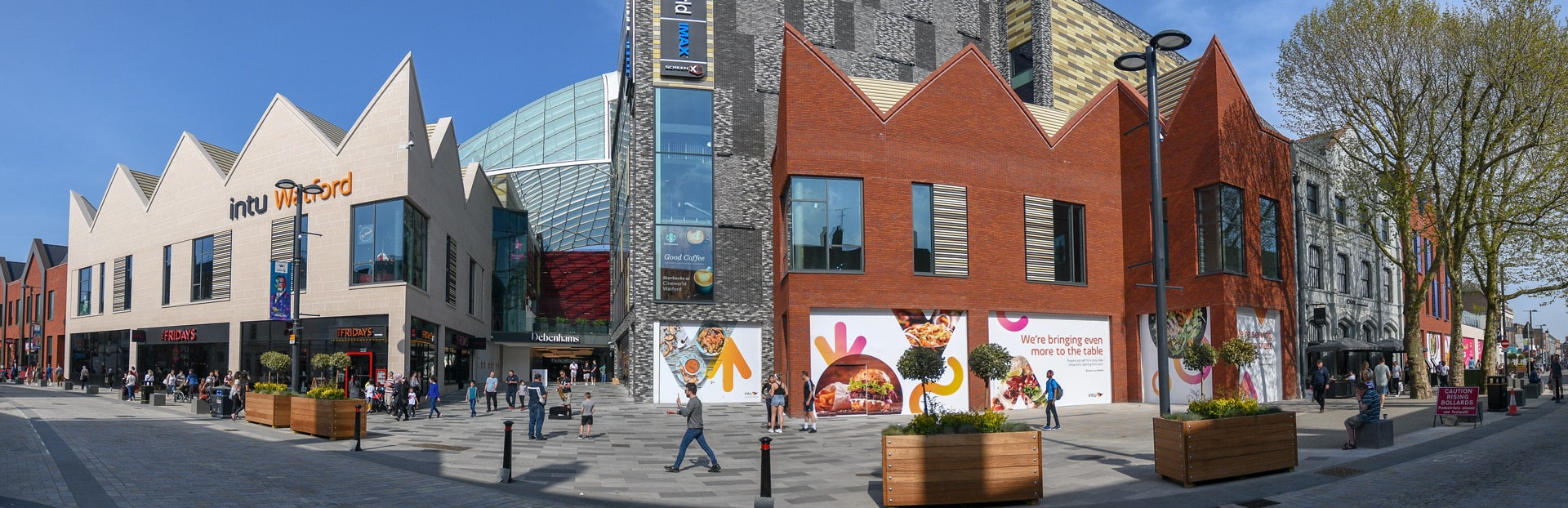
Watford is a town in Hertfordshire, in the East of England. The average sold price in Watford is £381,977 on the HM Land Registry House Price Index, 31.7% above the England average of £289,946 and 13.3% above the East of England's £337,182. Watford sits at the point where London's prices tail off, so it is dearer than most of the country but a step down from the capital it feeds. Every property type in the town sells above the national figure, from flats at 16.1% over England to detached houses at 86.7% over. For an investor, the way in is the flat and terraced end, where the premium to England is smallest and the yields hold up.
The distinctive feature of Watford's buy-to-let market is that its cheapest postcode is also its highest-yielding. WD18 (West Watford) has the lowest asking price at £358,106 and the top gross yield at 5.5%, while the more expensive northern and southern postcodes settle between 3.9% and 4.6%. Across the five postcodes the mean asking price is £450,831 and rents run from £1,554 to £1,829 a month. Watford's pull is the commute: fast trains into London Euston, the M1 and M25 on the doorstep, and a large local jobs base of its own.
This guide covers the borough of Watford (ONS code E07000103) across postcodes WD17, WD18, WD19, WD24, and WD25. Watford is in Hertfordshire, about 15 miles north-west of central London and administered by its own council, Watford Borough Council. The wider Hertfordshire buy-to-let market runs from here out through the commuter belt to St Albans, Hemel Hempstead, and Stevenage.
Article updated: July 2026
Why Invest in Watford?
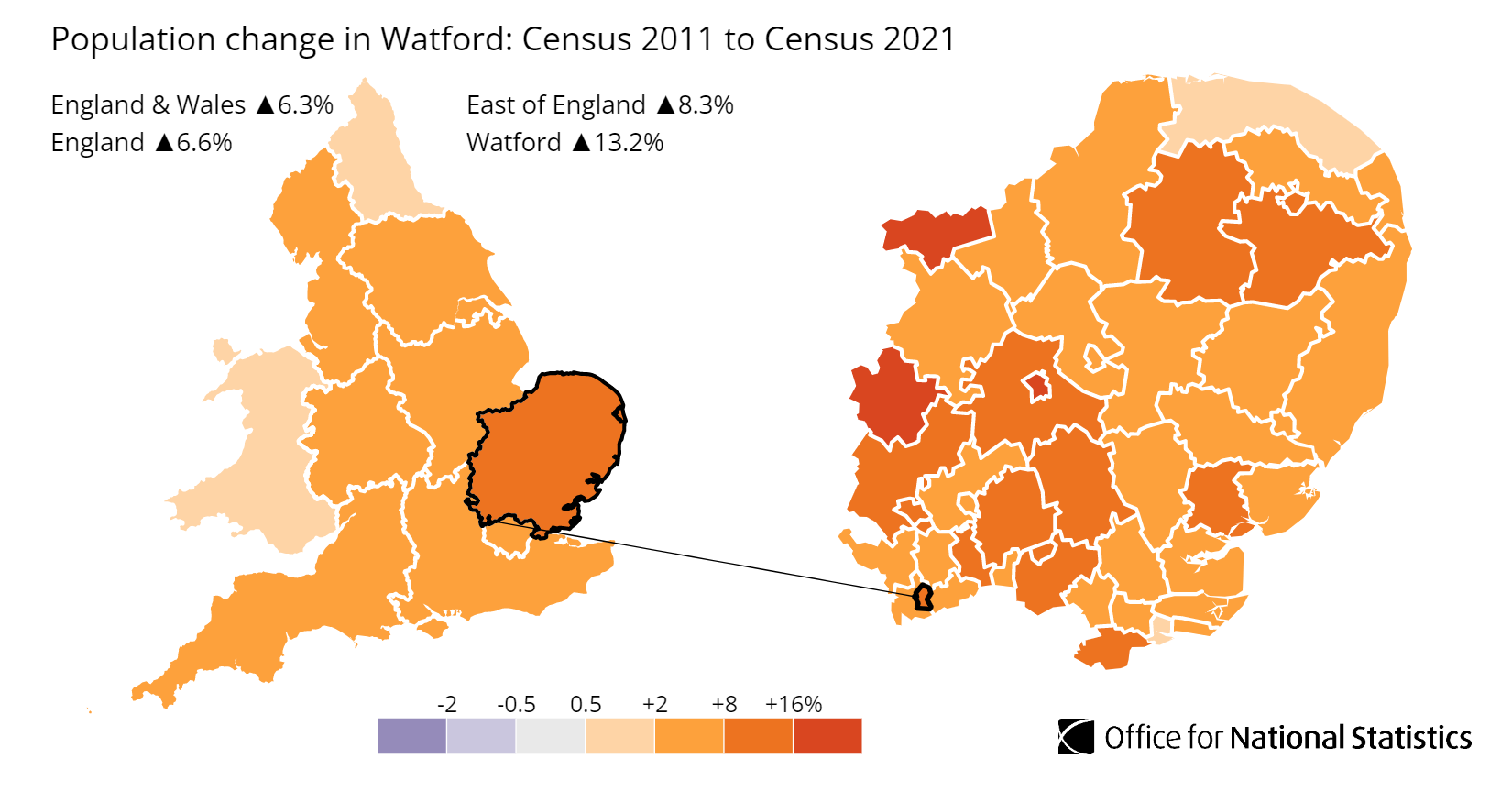
Watford's population grew 13.23% between the 2011 and 2021 censuses, from 90,301 to 102,246 residents, more than double the England and Wales average of 6.3%. That is fast growth for a borough of Watford's size, and it reflects the town's draw as a place to live within reach of London without London prices. Watford packs that population into a compact borough, one of the most densely settled outside the capital, which keeps tenant demand tight against a limited supply of new homes.
The pull is the commute. The fastest train from Watford Junction reaches London Euston in about 20 minutes, and the borough sits between the M1 and the M25, so it works for people whose jobs are in the capital and for those working across the wider South East. Watford also holds a large jobs base of its own: it is a regional retail centre anchored by a major shopping mall, and headquarters and offices for national names in retail, leisure, and professional services sit in and around the town. The Warner Bros. Studios at nearby Leavesden, where the Harry Potter films were made, add a year-round tourism and studio economy on the borough's northern edge.
Median gross weekly earnings for people working in Watford are £831.10, which is 5.8% above the East of England median of £785.80 and 10.5% above the Great Britain median of £752.40. On an annual basis that is £43,219. Higher local wages mean tenants can carry higher rents, and Watford's mix of professional, commuter, and retail employment spreads that demand across several tenant types rather than leaning on one employer.
Watford Economic Summary
- Population (Watford): 102,246 (2021 Census). Growth of 13.23% from 2011.
- Median annual salary: £43,219 (local), £40,862 (East of England), £39,125 (Great Britain)
- Median weekly pay: £831.10 (local), £785.80 (East of England), £752.40 (Great Britain)
- Employment rate: 74.9% (local)
- Key employment sectors: Wholesale and retail, professional and business services, financial services, health, creative media, and hospitality
Source: ONS Census 2021, Nomis Labour Market Profile (ASHE 2025)
Regeneration and Investment in Watford
Watford Riverwell has already delivered 580 new homes on its way to a 1,000-home masterplan, and the town centre is working through a 20-year strategic framework alongside it. The borough's regeneration is spread across several sites rather than one flagship scheme, which is what you would expect in a town where land is scarce and demand is steady.
- Watford Riverwell (1,000-home masterplan, 580 delivered): A joint venture between Kier Property and Watford Borough Council, south of the town centre around Watford General Hospital. The scheme has delivered 580 homes so far, more than two acres of green space, and a £15 million link road, with around £40 million of infrastructure investment overall. The next phase, Avenues Phase Two, adds 47 family homes for rent with construction expected to start in early 2026, and Riverwell Square is bringing a hotel, food stores, and public space alongside it. Updates at Watford Borough Council.
- Watford Town Centre Strategic Framework (20-year plan, approved March 2023): A blueprint to reshape the town centre over two decades, developed after a year of public consultation. Greenery, places to eat and socialise, and better public transport were the priorities residents put first. It sets the planning backdrop for housing and mixed-use development in and around the High Street. Details at Watford Borough Council.
- Town Hall Quarter (10-year programme): Seven linked projects around the Town Hall, Watford Colosseum, and the museum, delivered through a joint venture to renew the civic and cultural heart of the town. Updates at Watford Borough Council.
Watford Property Market Analysis
A home that sold for £66,091 in Watford in January 1995 changed hands for £381,977 by March 2026, a 478.0% climb over three decades. The sections below trace that path cycle by cycle, then drill into current postcode-level data for sold prices, price per square foot, asking prices, growth trends, and monthly transaction volumes.
When was the last house price crash in Watford?
Watford's sold prices are recorded at borough level by HM Land Registry, and the index runs from January 1995 to the latest reading in March 2026, covering 31 years of the market. Because Watford sits on London's edge, its cycle tracks the capital's more closely than the national average does, with sharper swings up and down.
The 1995 to 2007 climb: Watford started at £66,091 in January 1995. By December 2000 the average had reached £119,966, and the early-2000s boom carried it to £196,427 by December 2005. Prices kept rising to a pre-crash peak of £241,382 in August 2007, close to a fourfold gain over twelve years.
2008 to 2009, the financial crisis: From that August 2007 peak, prices fell to a trough of £191,429 in April 2009, a drop of 20.7% in twenty months. The worst year-on-year reading was -15.1% in April 2009. Watford's fall was deeper than England's 18% national decline, in line with a market that had run harder on the way up.
Recovery, 2010 to 2013: Prices bounced off the April 2009 trough and climbed steadily. The average passed its August 2007 pre-crash peak in August 2013, at £242,156, a recovery of just under six years. That was quicker than many markets managed, helped by Watford's proximity to a London market that led the national rebound.
2014 to 2019, the London-ripple boom: This was Watford's strongest stretch. Prices rose from £239,797 in December 2013 to £326,463 by April 2016 and £355,202 by December 2019, as buyers priced out of north-west London looked one stop further out. Annual growth ran into double digits in the middle of this period before cooling towards the end of the decade.
2020 to 2022, the pandemic surge: The stamp duty holiday and the race for space pushed prices from £362,385 in June 2020 to £389,061 by December 2021 and on to an all-time high of £422,350 in October 2022. Watford's borough average had roughly tripled from its 2009 trough.
2023 to present, the rate-era easing: Higher mortgage rates cooled the market from that October 2022 high. Prices eased to £394,296 by December 2023, ticked back up to £402,634 by December 2024, then slipped again to £381,977 by March 2026, with the latest annual reading at -5.1%. The current average sits 9.6% below the October 2022 peak and 58.2% above the August 2007 pre-crash peak.
Long-term growth summary:
- 5 years (March 2021 to March 2026): 1.2% growth (£377,587 to £381,977)
- 10 years (March 2016 to March 2026): 14.9% growth (£332,530 to £381,977)
- 15 years (March 2011 to March 2026): 79.6% growth (£212,630 to £381,977)
- 20 years (March 2006 to March 2026): 94.4% growth (£196,448 to £381,977)
- 30 years (January 1995 to March 2026): 478.0% growth (£66,091 to £381,977)
Watford's long-run return is strong, with a 478.0% gain over 30 years, but the shorter windows show a market that has been marking time since the pandemic peak. The five-year figure of 1.2% covers a run-up to October 2022 and a give-back since, so an investor who bought at the 2022 high is currently below water on the Land Registry average, while one who bought at the 2007 peak is up 58.2%. The two charts below break the borough average down by property type, first in pounds and then as year-on-year change.
- All property types
- Detached
- Semi-detached
- Terraced
- Flats
- All property types
- Detached
- Semi-detached
- Terraced
- Flats
Sold House Prices in Watford
The average sold price across all property types in Watford is £381,977, which is 31.7% above the England average of £289,946 as of March 2026. The premium runs through every property type, but it is far from even. Detached houses sit 86.7% above England, while flats are only 16.1% above. That spread is the story of Watford's stock: a small, in-demand set of large family houses at London-fringe prices, and a flat market that stays closer to the national figure.
| Property Type | Watford Average | England Average | Difference |
|---|---|---|---|
| Detached houses | £878,198 | £470,492 | +86.7% |
| Semi-detached houses | £503,364 | £288,185 | +74.7% |
| Terraced houses | £406,913 | £243,788 | +66.9% |
| Flats and maisonettes | £249,054 | £214,563 | +16.1% |
| All property types | £381,977 | £289,946 | +31.7% |
Detached houses at £878,198 carry the largest premium at 86.7% above England's £470,492. This is the scarcest and priciest stock in the borough, concentrated in the leafier northern fringes and the older streets around Cassiobury. Annual change of -3.4% shows the top of the market cooling with the rest of it. For most buy-to-let budgets this is owner-occupier territory rather than a rental play.
Semi-detached houses at £503,364 sit 74.7% above England's £288,185. The three-bedroom semi is the everyday family home of Watford's suburbs, spread across North Watford, Garston, and the western streets, and it is the type that letting agents handle most. Annual change of -2.9% puts semis broadly in line with the borough as a whole.
Terraced houses at £406,913 are 66.9% above England's £243,788. Watford has a deep stock of Victorian and inter-war terraces, particularly in West Watford and the streets close to the town centre, and this is where a lot of shared and family rental demand sits. Annual change of -3.5% tracks the wider softening.
Flats and maisonettes at £249,054 carry the smallest premium at 16.1% above England's £214,563, and this is the natural buy-to-let entry point. New apartment blocks around the town centre and Watford Junction sit alongside older converted flats, so there is genuine choice at the lower end. Annual change of -7.9% is the sharpest fall of any type, so the flat market has softened most since the peak.
Price Per Square Foot in Watford
Just £68 per square foot separates Watford's cheapest postcode from its most expensive, with WD18 at £461 and WD19 at £529. Price per square foot strips out the effect of property size and gives a cleaner read on location value. WD19 (South Oxhey, Carpenders Park) commands the top rate, followed closely by WD17 in the town centre and Cassiobury.
| Rank | Area | Price Per Sq Ft |
|---|---|---|
| 1 | WD18 (West Watford) | £461 |
| 2 | WD24 (North Watford) | £491 |
| 3 | WD25 (Garston, Leavesden) | £498 |
| 4 | WD17 (Town Centre, Cassiobury) | £523 |
| 5 | WD19 (South Oxhey, Carpenders Park) | £529 |
WD18 at £461 per square foot is the cheapest postcode for bricks-and-mortar value, based on 399 transactions analysed. West Watford holds a good share of terraced and older flat stock near the town centre and the General Hospital, which pulls the per-foot rate down and lines up with WD18 carrying the lowest asking price and the highest yield in the borough.
WD19 at £529 per square foot tops the table off 435 transactions analysed. South Oxhey and Carpenders Park run along the borough's southern edge towards the Metropolitan line, and the semi-detached-heavy stock there commands the highest per-foot value of the five postcodes, 15% above WD18.
For Sale Asking Prices in Watford
WD18 at £358,106 and WD25 at £512,743 sit 43.2% apart, the widest asking-price gap across Watford's five postcodes. That range mirrors the sold-price hierarchy but is tighter than in cities with a bigger spread of stock. The mean asking price across all five Watford postcodes is £450,831.
| Rank | Area | Asking Price |
|---|---|---|
| 1 | WD18 (West Watford) | £358,106 |
| 2 | WD24 (North Watford) | £401,973 |
| 3 | WD17 (Town Centre, Cassiobury) | £481,561 |
| 4 | WD19 (South Oxhey, Carpenders Park) | £499,771 |
| 5 | WD25 (Garston, Leavesden) | £512,743 |
WD18 at £358,106 is the lowest asking price in the borough and the only postcode below the town-wide Land Registry average of £381,977. The step up from WD18 to WD24 is around £44,000, and then a larger £80,000 jump to the WD17, WD19, and WD25 band. For an investor with a fixed budget, WD18 buys the most property for the money and the lowest barrier to entry.
WD25 at £512,743 is the most expensive postcode, covering Garston and Leavesden on the northern edge near the Warner Bros. Studios. The higher asking price there reflects a stock weighted towards larger semi-detached and detached family houses, which is confirmed by the yield and property-type data further down this guide.
House Price Growth in Watford
Every Watford postcode posted positive growth over five years, from 3.6% in WD18 to 13.0% in WD17, but the one-year picture is mixed. WD17 leads the five-year table and also has the strongest one-year figure at 11.6%, while WD19 and WD25 both slipped over the past year despite solid medium-term returns.
| Area | 1 Year | 3 Years | 5 Years |
|---|---|---|---|
| WD17 (Town Centre, Cassiobury) | 11.6% | 3.4% | 13.0% |
| WD19 (South Oxhey, Carpenders Park) | -2.0% | 4.3% | 11.4% |
| WD25 (Garston, Leavesden) | -0.9% | 4.6% | 10.9% |
| WD24 (North Watford) | 4.0% | 5.2% | 10.8% |
| WD18 (West Watford) | 3.5% | 3.9% | 3.6% |
WD17 at 13.0% five-year growth leads the borough and pairs it with the strongest one-year reading at 11.6%. The town centre and Cassiobury cover both apartment stock near the stations and the sought-after older streets around Cassiobury Park, and demand for that mix has held up better than elsewhere over the past year.
WD24 at 10.8% over five years has the most even record of the group, positive across one year, three years, and five. North Watford's more affordable family stock has seen steady demand rather than the sharper swings recorded in the pricier southern postcodes.
WD18 at 3.6% over five years is the weakest of the five, even though it is the cheapest postcode. West Watford's terraced and flat stock has held its ground over one and three years but has lagged the borough on the longer view, which is part of why its yield sits highest.
Monthly Property Sales in Watford
Monthly sales across Watford's postcodes run from 13 in WD18 to 20 in WD19, with turnover rates between 6% and 8%. WD19 is the busiest market, and WD18 the quietest, though the range is narrow. Turnover, the share of homes that change hands in a year, is fairly even across the borough.
| Area | Sales Per Month | Turnover | Asking Price |
|---|---|---|---|
| WD19 (South Oxhey, Carpenders Park) | 20 | 8% | £499,771 |
| WD25 (Garston, Leavesden) | 15 | 8% | £512,743 |
| WD17 (Town Centre, Cassiobury) | 14 | 7% | £481,561 |
| WD24 (North Watford) | 14 | 7% | £401,973 |
| WD18 (West Watford) | 13 | 6% | £358,106 |
WD19 records the most transactions at 20 a month and shares the highest turnover at 8% with WD25. South Oxhey and Carpenders Park hold a deep pool of family stock along the southern edge of the borough, so homes there change hands more often than in the tighter town-centre market.
WD18 sees the fewest sales at 13 a month and the lowest turnover at 6%. West Watford's smaller and cheaper stock changes hands a little less freely, which is worth weighing against its higher yield: the postcode that pays the best income is also the least active market when it comes time to sell.
How Long Properties Take to Sell in Watford
Every Watford postcode currently reads as a buyer's market, with homes taking between about 380 and 507 days to sell. Days on market is the typical number of days a home is up for sale before it sells; the months of unsold stock shows how much for-sale supply is sitting there at the current rate of sales. The long selling times across the borough reflect a market that has cooled since 2022 and where supply now outpaces buyer urgency.
| Area | Avg Days to Sell | Months of Unsold Stock | Market |
|---|---|---|---|
| WD19 (South Oxhey, Carpenders Park) | 380 | 12.5 | Buyer's market |
| WD25 (Garston, Leavesden) | 380 | 12.5 | Buyer's market |
| WD24 (North Watford) | 435 | 14.3 | Buyer's market |
| WD17 (Town Centre, Cassiobury) | 507 | 16.7 | Buyer's market |
| WD18 (West Watford) | 507 | 16.7 | Buyer's market |
A yield number says nothing about how quickly you can get back out. WD19 and WD25 clear fastest at around 380 days and 12.5 months of unsold stock, while WD17 and WD18 sit at roughly 507 days and 16.7 months. For a buyer, a longer selling time cuts both ways: more room to negotiate on the way in, but a slower exit when the time comes to sell.
What Type of Property Can You Buy in Watford?
The stock mix flips across the borough: flats are the largest single category in WD18 at 40.8%, while semi-detached houses dominate WD19 at 43.9%. That contrast shapes which strategies fit where. The figures below are drawn from 2021 Census records for each postcode.
| Area | Detached | Semi-detached | Terraced | Flats |
|---|---|---|---|---|
| WD17 (Town Centre, Cassiobury) | 28.6% | 18.0% | 17.8% | 35.5% |
| WD18 (West Watford) | 12.0% | 17.6% | 29.1% | 40.8% |
| WD19 (South Oxhey, Carpenders Park) | 16.8% | 43.9% | 21.8% | 17.3% |
| WD24 (North Watford) | 20.5% | 32.6% | 16.1% | 30.7% |
| WD25 (Garston, Leavesden) | 22.0% | 32.8% | 17.8% | 25.3% |
WD18 holds the largest share of flats at 40.8% and terraced houses at 29.1%. That is the smaller-unit stock that usually drives the buy-to-let market, and it lines up with WD18 carrying the lowest asking price and the highest gross yield in the borough. West Watford's flats suit single lets and sharers, while its terraces offer family lets near the town centre and the hospital.
WD19 is the most house-heavy postcode, with semi-detached homes at 43.9% and the smallest flat share at 17.3%. Detached and semi-detached houses together make up more than 60% of the stock in South Oxhey and Carpenders Park, which matches its higher per-foot value and points towards family-house lets rather than the smaller units that push income up.
Flats combine purpose-built and converted units. A small share of mobile and temporary dwellings is not shown, so rows may not total 100%.
Watford Rental Market Analysis
Monthly rents in Watford range from £1,554 in WD24 to £1,829 in WD19, with gross rental yields from 3.9% to 5.5% across the five postcodes. For investors asking is buy to let worth it in Watford, the sections below break down rents, yields, and tenant affordability postcode by postcode. If you are working out how to build a property portfolio in the commuter belt, Watford's mix of London-adjacent demand and above-average local wages gives a broad tenant base to let to. Browse current buy-to-let homes for sale across the region.
Average Rent & Gross Rental Yields in Watford
Gross rental yields in Watford range from 3.9% in WD17 to 5.5% in WD18. The cheapest postcode delivers the highest yield and the priciest sits near the bottom. WD19 charges the highest rent at £1,829 a month, but its £499,771 asking price holds its yield to 4.4%, while WD18's lower rent on a lower price produces the strongest return.
| Area | Average Monthly Rent | Asking Price | Gross Yield |
|---|---|---|---|
| WD18 (West Watford) | £1,649 | £358,106 | 5.5% |
| WD24 (North Watford) | £1,554 | £401,973 | 4.6% |
| WD19 (South Oxhey, Carpenders Park) | £1,829 | £499,771 | 4.4% |
| WD25 (Garston, Leavesden) | £1,771 | £512,743 | 4.1% |
| WD17 (Town Centre, Cassiobury) | £1,573 | £481,561 | 3.9% |
WD18 at 5.5% combines the lowest asking price with a mid-range rent of £1,649 to produce the best return in the borough. A 30% deposit of £107,432 gets an investor into the highest-yielding postcode, and West Watford's flat and terraced stock is where the buy-to-let numbers work hardest.
WD24 at 4.6% is the second-highest yield, pairing the second-lowest asking price with a £1,554 rent. North Watford spreads its tenant demand across family houses and flats, which gives it a settled rental base without the premium prices further south.
WD17 at 3.9% sits at the bottom of the yield table despite a solid £1,573 rent, because its £481,561 asking price is among the highest in the borough. In the town centre and Cassiobury, the price is doing more for capital value than for income.
Gross Rental Yield by Postcode
Is Watford Rent High?
Monthly rents in Watford consume between 43.1% and 50.8% of the local median gross monthly salary. The widely cited threshold for rent affordability is 30% of gross income, and every Watford postcode sits well above it. That is the London-fringe reality: rents here are set by proximity to the capital as much as by local wages, so even a solid Watford salary is stretched by the going rent.
The median gross weekly salary for people working in Watford is £831.10, which equates to £3,602 per month or £43,219 per year. This is above the East of England median of £785.80 per week and the Great Britain median of £752.40 per week. Data from the Nomis Labour Market Profile (ASHE 2025).
| Rank | Area | Rent as % of Income |
|---|---|---|
| 1 | WD19 (South Oxhey, Carpenders Park) | 50.8% |
| 2 | WD25 (Garston, Leavesden) | 49.2% |
| 3 | WD18 (West Watford) | 45.8% |
| 4 | WD17 (Town Centre, Cassiobury) | 43.7% |
| 5 | WD24 (North Watford) | 43.1% |
WD24 at 43.1% is the most affordable postcode for tenants, though it is still well above the 30% mark. North Watford's £1,554 rent against a £3,602 monthly salary is the tightest fit in a borough where every reading is stretched, and affordable-by-Watford-standards rents tend to bring longer tenancies and fewer arrears.
WD19 at 50.8% is the least affordable, where a £1,829 rent takes just over half the median monthly wage. Tenants at that level in South Oxhey and Carpenders Park are typically dual-income households or commuters on London salaries rather than single earners on the local median, which is what allows the higher rent to clear.
How Big Is Watford's Private Rented Sector?
The private rented sector runs deepest in WD18 at 28.1% of households and in WD17 at 24.8%, and shallowest in WD19 at 12.0%. The share of homes already rented privately is a guide to the size of the established tenant pool and the local lettings market. The table below shows household tenure by postcode.
| Area | Owned Outright | Owned with Mortgage | Private Rented | Social Rented |
|---|---|---|---|---|
| WD18 (West Watford) | 20.5% | 27.4% | 28.1% | 22.0% |
| WD17 (Town Centre, Cassiobury) | 29.4% | 30.7% | 24.8% | 13.4% |
| WD24 (North Watford) | 30.5% | 33.3% | 23.6% | 11.9% |
| WD25 (Garston, Leavesden) | 28.8% | 33.6% | 20.6% | 14.9% |
| WD19 (South Oxhey, Carpenders Park) | 31.9% | 37.5% | 12.0% | 18.1% |
WD18 has the largest private rented sector in Watford at 28.1% of households, and it pairs that depth with the highest gross yield at 5.5%, so the postcode with the most existing tenants is also the one where the buy-to-let numbers work best. WD17 and WD24 follow at 24.8% and 23.6%, both active lettings markets, with WD24 backing its rented sector with the second-highest yield at 4.6%. WD19 sits at the other end with just 12.0% private rented and the highest owner-occupation, a family-house postcode where fewer homes are already let.
Across the town, the rental market currently favours landlords: in the three postcodes with enough live rental listings to read, homes were taking roughly 43 to 54 days to let, which points to steady tenant demand rather than a glut of empty stock. WD25 and WD19 had too few listings advertised at any one time to read reliably.
Local Housing Allowance Rates in Watford
All five Watford postcodes fall within the South West Herts Broad Rental Market Area, where Local Housing Allowance runs from £115.37 a week for a shared room to £460.27 a week for a four-bedroom home. Local Housing Allowance sets the maximum housing support a tenant on benefits can receive, so it acts as a rent floor for landlords letting to that part of the market. The rates below apply across the whole of Watford. To check the current rate for a specific address, you can use the government's official Local Housing Allowance calculator.
| Property Size | Weekly LHA Rate | Monthly Equivalent |
|---|---|---|
| Shared accommodation | £115.37 | £500 |
| 1 bedroom | £218.63 | £948 |
| 2 bedrooms | £287.67 | £1,247 |
| 3 bedrooms | £345.21 | £1,496 |
| 4 bedrooms | £460.27 | £1,995 |
The two-bedroom LHA rate of £287.67 a week works out at about £1,247 a month, below the £1,554 to £1,829 open-market rents recorded across Watford's postcodes. A benefit-backed tenancy at the LHA rate therefore sits under the going market rent, and the stock that fits within these rates is concentrated in WD18 and WD24, where both asking prices and rents are lowest. The rates are identical in every Watford postcode because they are set across the whole South West Herts market area.
Buy-to-Let Considerations
Are House Prices High in Watford? Price-to-Earnings Ratios
Buying a property in Watford requires between 8.3 and 11.9 times the median annual salary. This is based on the Nomis Labour Market Profile for Watford showing the median gross annual income for people working in Watford is £43,219.
For a national yardstick, England's average sold price of £289,946 works out at 7.4 times the Great Britain median salary of £39,125. Every Watford postcode sits above that mark, which tells you the borough is expensive relative to local incomes, in line with a market priced off London demand.
| Rank | Area | Price-to-Earnings Ratio |
|---|---|---|
| 1 | WD18 (West Watford) | 8.3x |
| 2 | WD24 (North Watford) | 9.3x |
| 3 | WD17 (Town Centre, Cassiobury) | 11.1x |
| 4 | WD19 (South Oxhey, Carpenders Park) | 11.6x |
| 5 | WD25 (Garston, Leavesden) | 11.9x |
WD18 at 8.3x is the most affordable entry in Watford relative to local earnings, though still above the national 7.4x benchmark. West Watford's cheaper terraced and flat stock keeps it within reach of a wider set of buyers, which supports both its resale demand and its position as the yield leader.
WD25 at 11.9x sits at the top of the range. At nearly twelve times local earnings, Garston and Leavesden are firmly in family-owner-occupier territory, priced by the appeal of larger houses near the studios and the M1. For an investor, that ratio compresses the yield and lengthens the payback.
Deposit Requirements in Watford
A 30% deposit on a buy-to-let property in Watford ranges from £107,432 in WD18 to £153,823 in WD25. The gap between the cheapest and most expensive deposit is £46,391. These are large deposits by national standards, a direct consequence of Watford's London-fringe prices, so the capital needed to enter here is well above most of the country.
Beyond the deposit, the stamp duty calculation and other buy-to-let running costs affect the total capital required.
| Rank | Area | 30% Deposit Required |
|---|---|---|
| 1 | WD18 (West Watford) | £107,432 |
| 2 | WD24 (North Watford) | £120,592 |
| 3 | WD17 (Town Centre, Cassiobury) | £144,468 |
| 4 | WD19 (South Oxhey, Carpenders Park) | £149,931 |
| 5 | WD25 (Garston, Leavesden) | £153,823 |
WD18 is the cheapest way into Watford, at a £107,432 deposit, and it also carries the highest yield at 5.5%, so the lowest capital outlay buys the best income return. That is the postcode where the buy-to-let sums stack up most cleanly.
Stepping up to WD24 costs roughly £13,000 more on the deposit and still leaves an investor in the second-highest-yielding postcode at 4.6%, with North Watford's steadier five-year growth record of 10.8% behind it. The premium postcodes, WD17, WD19, and WD25, all demand deposits above £144,000 for lower yields, so the extra capital there is buying location and capital value rather than income.
What the Watford Data Tells Buy-to-Let Investors
In Watford the cheapest way in is also the highest-yielding postcode. WD18 (West Watford) has the top yield at 5.5%, the lowest asking price for buying an investment property at £358,106, and the most affordable prices against local earnings at 8.3 times income. A 30% deposit there is £107,432, the lowest in the borough, for a home renting at £1,649 a month, and its flat-and-terrace stock is the natural buy-to-let entry point.
WD24 (North Watford) is the steady middle option: the second-highest yield at 4.6%, the second-lowest deposit at £120,592, and the most even growth record in the borough, positive across one, three, and five years. WD17 (Town Centre, Cassiobury) leads on growth, up 13.0% over five years and 11.6% over the past year, but its 3.9% yield is the lowest, so the town centre is where capital value has done the work rather than income.
The two southern postcodes read differently. WD19 (South Oxhey, Carpenders Park) charges the highest rent at £1,829 a month and runs the busiest, fastest-selling market, but its £499,771 price holds the yield to 4.4%. WD25 (Garston, Leavesden) is the most expensive postcode at £512,743 with the lowest yield after WD17, so the premium there is paying for larger family houses near the studios and the motorways. Buyers who want to come in below asking often look through off-market property in Watford channels.
Watford has no selective licensing scheme for private landlords, so a standard single let needs no council licence, though larger shared houses fall under mandatory HMO licensing through Watford Borough Council. With above-average local wages, a broad jobs base, and a 20-minute train into Euston, Watford reads as a London-commuter market: high prices and stretched affordability, but deep and durable tenant demand underneath.
How Watford Compares
Watford's mean asking price of £450,831 sits in the middle of five Hertfordshire commuter locations, yet its top yield of 5.5% is the highest of the group. The comparison below places Watford alongside four nearby locations, each with a different investor profile. The mean asking price and mean monthly rent are simple averages across all postcodes with data. Top gross yield is the single highest postcode yield in each location.
| Location | Mean Asking Price | Mean Monthly Rent | Mean Gross Yield | Top Yield (postcode) |
|---|---|---|---|---|
| Luton | £404,481 | £1,457 | 4.3% | 5.1% (LU3) |
| Watford | £450,831 | £1,675 | 4.5% | 5.5% (WD18) |
| Stevenage | £459,009 | £1,459 | 3.8% | 4.8% (SG1) |
| Hemel Hempstead | £538,635 | £1,579 | 3.5% | 4.4% (HP2) |
| St Albans | £719,692 | £2,220 | 3.7% | 4.7% (AL2) |
Watford is the second-cheapest location in this comparison at £450,831 mean asking price, yet it delivers the highest top yield at 5.5%. That combination, a mid-range price with the strongest income return of the group, is what sets it apart from its neighbours, most of which pair higher prices with lower yields.
For investors prioritising the lowest asking price, Luton at £404,481 comes in cheapest and yields a close 5.1%. Stevenage sits just above Watford on price with a lower 4.8% top yield. At the premium end, Hemel Hempstead and St Albans command much higher prices for yields of 4.4% and 4.7%, with St Albans the dearest in the group by a wide margin. For a data-driven comparison across the whole country, see our highest-yielding areas guide.
Frequently Asked Questions
Is Watford a good place to live for buy-to-let tenants?
Watford works for tenants mainly because of the commute. The fastest train from Watford Junction reaches London Euston in about 20 minutes, and the M1 and M25 are on the doorstep, so it suits people whose jobs are in the capital but who want more space and lower rent than inner London. That pull keeps demand steady across professional commuters, local retail and office workers, and families.
Local wages back that up. People working in Watford earn a median of £831.10 a week, above both the East of England and the national figure, so tenants here generally have a bit more room to carry the rent. The trade-off is that rents are high in absolute terms, taking 43% to 51% of the median local wage, so affordability is stretched even on a decent salary.
What are the best areas in Watford for property investment?
It splits fairly cleanly by what you want the money to do. WD18 (West Watford) is the cheapest way in at £358,106 and the highest-yielding at 5.5%, with a flat-and-terrace stock that suits income-focused buy-to-let. WD24 (North Watford) is the steadier all-rounder, the second-highest yield at 4.6% on the second-lowest deposit, with growth that has stayed positive across one, three, and five years.
At the pricier end, WD17 (Town Centre, Cassiobury) has led on capital growth, up 13.0% over five years, but yields just 3.9%. WD19 and WD25, on the southern and northern edges, charge the highest rents but sit around 4.1% to 4.4% because their asking prices are higher. So if income is the priority, WD18 leads; if recent growth matters more, WD17 has done the most.
How does Watford compare to Luton for buy-to-let?
They are close on the numbers but different in feel. Luton is a little cheaper, with a mean asking price of £404,481 against Watford's £450,831, and its top yield of 5.1% is just below Watford's 5.5%. Both trade on the London commute, but Watford sits closer in, with faster trains into Euston and the Metropolitan line running through the borough.
Watford's local wages are higher and its tenant base leans more towards professional commuters, while Luton offers a lower asking price and an airport-and-logistics jobs base of its own. Which fits depends on whether you are optimising for the lowest capital outlay or for the tenant profile and connectivity that Watford's position closer to London brings.
Is there demand for student and shared housing in Watford?
Watford has no large university campus, so it is not a classic student-let town in the way of a city with a big higher-education population. The shared-housing demand that exists comes more from young professionals and commuters sharing to keep costs down, particularly around the town centre and West Watford where the smaller, cheaper stock sits.
On the HMO side, a sample of current WD18 room adverts puts a double room with a shared bathroom at around £168 a week, with most between £138 and £196 (the middle 80% of 34 adverts). That was the only room type with enough live adverts for a reliable figure, so ensuite and single-room rents in Watford are harder to pin down. Larger shared houses need a mandatory HMO licence, and for how the numbers work on a shared house, see our HMO investment guide.
Can I find buy-to-let property under £360,000 in Watford?
Only in the cheapest postcode, on average. WD18 (West Watford) has the lowest asking price at £358,106, so the borough as a whole sits just below and above that mark depending on the postcode. The way in below the average is by property type rather than postcode: flats across Watford average £249,054 on the Land Registry index, and terraced stock in WD18 sits under the postcode average too.
If a lower asking price is the target, WD18 flats and terraces are where to look, or explore below market value properties to come in under asking.
When will the Riverwell development affect Watford property prices?
Riverwell is already well underway rather than a future promise. It has delivered 580 homes on its way to a 1,000-home masterplan, with the next phase of 47 family homes for rent due to start construction in early 2026. Because it adds new supply steadily over years, its effect on prices is gradual, and it is concentrated south of the town centre near Watford General Hospital.
For an investor, the more useful read is the infrastructure it brings: around £40 million of investment including a £15 million link road, plus a new hotel, shops, and public space at Riverwell Square. That kind of place-making tends to support the surrounding rental market over time rather than move headline prices sharply.
What are average house prices in Watford?
The average sold price in Watford is £381,977 on the Land Registry index, about 31.7% above the England average of £289,946 as of March 2026. Asking prices by postcode run from £358,106 in WD18 (West Watford) up to £512,743 in WD25 (Garston, Leavesden), with a borough-wide mean of £450,831. By type, detached homes average £878,198, semi-detached £503,364, terraced £406,913, and flats £249,054.
Through a buy-to-let lens, WD18 is the cheapest entry and the highest-yielding at 5.5%, while WD17 in the town centre is the lowest-yielding at 3.9% despite strong recent capital growth.
What are the Local Housing Allowance rates in Watford?
All five Watford postcodes fall in the South West Herts Broad Rental Market Area, so they share one set of rates. As of June 2026, Local Housing Allowance runs at £115.37 a week for a shared room, £218.63 for a one-bed, £287.67 for two beds, £345.21 for three, and £460.27 for four. That figure is the most a tenant on housing support can claim towards rent, so for that part of the market it effectively sets a floor.
What type of property is most common in Watford?
It varies by postcode, which is unusual. Flats are the largest single category in WD18 (West Watford) at 39.8% and in the town-centre WD17 at 34.3%, while semi-detached houses dominate WD19 (South Oxhey, Carpenders Park) at 43.9%. The smaller units that usually suit buy-to-let, flats and terraces, are most concentrated in WD18, which is also the cheapest and highest-yielding postcode.
How do I buy an investment property in Watford?
Start by deciding whether you are buying for income or for growth, because that points you at a different postcode. WD18 (West Watford) is the cheapest entry at £358,106 and the highest-yielding at 5.5%. WD24 (North Watford) pairs a 4.6% yield with the steadiest growth record. Budget for a 30% deposit, which runs from £107,432 in WD18 to £153,823 in WD25.
Beyond what is listed openly, plenty of experienced investors buy below asking through off market properties and BMV property. To see what is available now, browse investment properties in Watford or current buy-to-let opportunities.
Ready to buy property?
Access off-market investment properties with an average 8%+ annual gross yield (beating the UK's typical 3-5%).
Get property alerts