

Stevenage is a town in Hertfordshire, in the East of England. The average sold price in Stevenage is £312,898 on the HM Land Registry House Price Index, 7.9% above the England average of £289,946 but 7.2% below the East of England regional figure of £337,182. That places Stevenage in the middle band of a premium region, priced above the England line yet at a discount to neighbouring Hertfordshire commuter towns. The town's population grew 6.6% between the 2011 and 2021 censuses, from 83,957 to 89,495 residents.
Stevenage was Britain's first designated New Town, planned from scratch in 1946, so the housing stock is unusually consistent: post-war terraces, semi-detached houses and low-rise flats rather than a patchwork of period conversions. For investors that means easier comparables and fewer survey surprises. The median gross weekly salary here is £811.50, above both the East of England figure of £785.80 and the Great Britain median of £752.40, which gives the local tenant base genuine spending power beyond the London commuter pool.
This guide covers the borough of Stevenage (ONS code E07000243) across postcodes SG1, SG2, SG3 and SG4. Stevenage sits in the East of England, 27 miles north of London with trains reaching King's Cross in around 25 minutes. The wider Hertfordshire buy-to-let region includes the more expensive towns of St Albans and Welwyn Garden City to the south.
Article updated: July 2026
Why Invest in Stevenage?
Stevenage grew its population 6.6% between the 2011 and 2021 censuses, from 83,957 to 89,495 residents. That is broadly in line with the England and Wales average of 6.3%. The median age is 38, younger than most of the surrounding Hertfordshire towns, which points to a working-age tenant base rather than a retirement market.
What separates Stevenage from a standard dormitory town is that people commute into it as well as out of it. The median gross weekly salary of £811.50 sits above the East of England figure of £785.80 and the Great Britain median of £752.40, and local workplace wages run higher still. That reflects the calibre of the employers based here: GSK's global research and development headquarters, Airbus Defence and Space, and MBDA all pay to attract technical staff, and those staff need somewhere to rent while they decide whether to buy.
The Lister Hospital anchors a large share of local health employment, and manufacturing runs well above the national average thanks to the aerospace and defence base. The result is a rental market with two demand drivers rather than one. London-bound commuters are the obvious tenant pool, but relocating professionals give the market a floor that is not tied to a train timetable. You can see the full employment breakdown via the Nomis Labour Market Profile for Stevenage.
Stevenage Economic Summary
- Population (Stevenage): 89,495 (2021 Census). Growth of 6.6% from 2011.
- Median annual salary: £42,200 (local), based on £811.50 per week, against £785.80 across the East of England and £752.40 for Great Britain
- Employment rate: 73.2% (local)
- Key employment sectors: Pharmaceuticals and life sciences, aerospace and defence, health and social work, manufacturing, retail
Source: ONS Census 2021, Nomis Labour Market Profile (ASHE 2025)
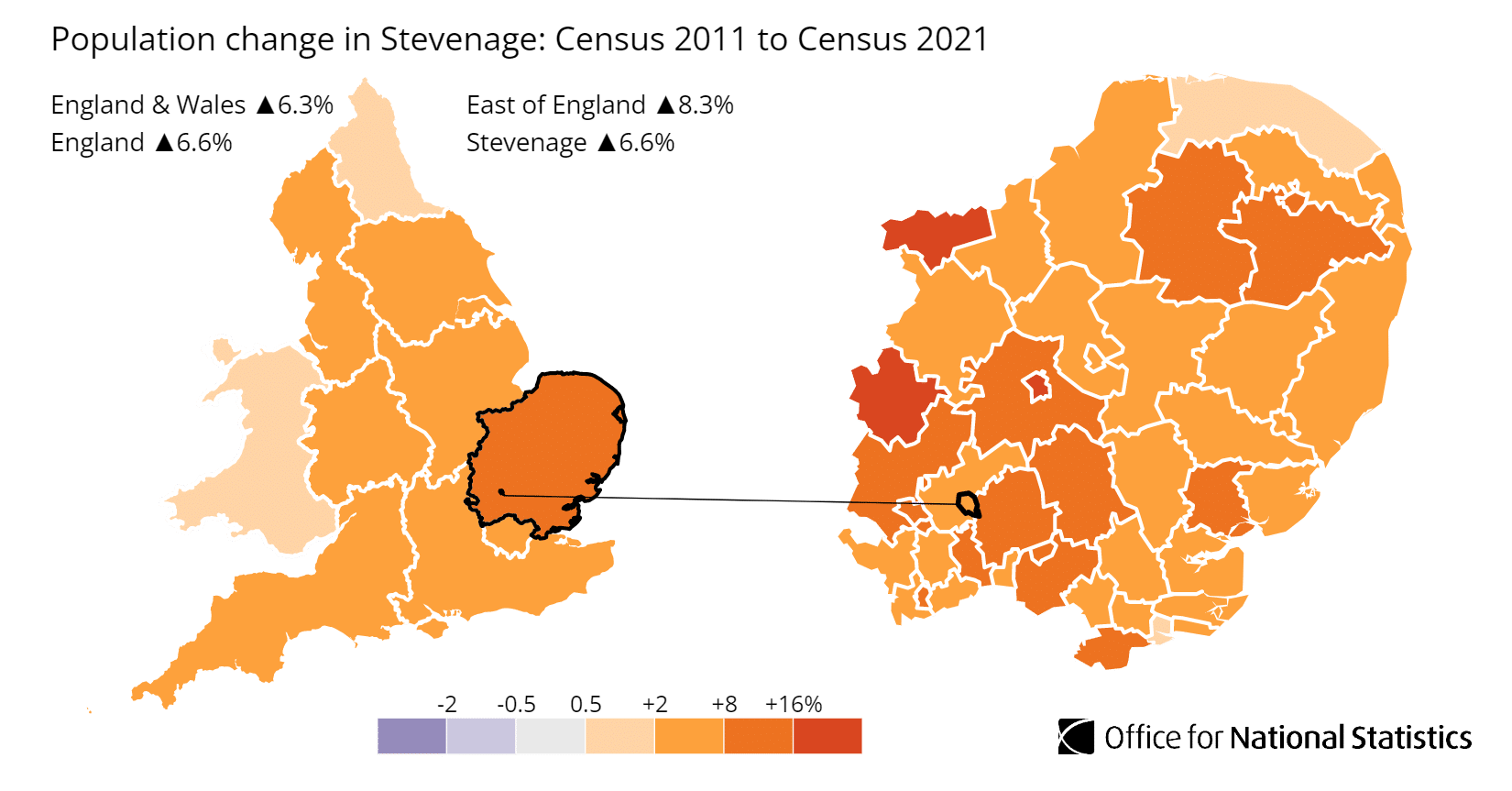
Source: Office for National Statistics - Population for Stevenage
Regeneration and Investment in Stevenage
Stevenage is part-way through a £1 billion, 20-year town centre regeneration, with the life sciences campus the piece most likely to shift rental demand. The value for an investor is not in speculative promises but in schemes already delivering jobs. The town already hosts one of the world's largest cell and gene therapy clusters, and the expansion around it is funded and underway.
- Life Sciences Campus (expansion underway): Stevenage is home to the Stevenage Bioscience Catalyst, next to GSK's global research and development headquarters. Investment is going into developing adjacent land for laboratory and office space, with the potential for several thousand new scientific jobs over the coming decade. The Autolus manufacturing facility is already operational on the site. For landlords, relocating lab technicians, researchers and pharmaceutical staff typically earn above the local median and expect higher-spec accommodation. More at Stevenage Bioscience Catalyst.
- Station Gateway (up to 1,000 homes): Stevenage Borough Council formalised a partnership in 2025 to develop the area around the railway station, covering up to 30 acres and potentially delivering around 1,000 new homes alongside workspace, retail and a hotel. The scheme is positioned as a new front door for the town, better connecting the station to the centre. Updates at English Cities Fund - Station Gateway Stevenage.
- Town centre residential: Multiple housing schemes are progressing in the town centre core, adding several hundred new homes on former retail and bus-station sites, with electric vehicle charging and cycle storage built into the new parking.
New housing supply and a growing jobs base pull in different directions for a landlord. More homes could soften rental growth in SG1 over the medium term; the life sciences pipeline is the counterweight, since higher-earning tenants relocating for those roles broaden demand rather than just add to supply.
Stevenage Property Market Analysis
A Stevenage home worth £48,728 in January 1995 is worth £312,898 on the latest Land Registry reading, a 542.1% gain over 31 years. The sections below trace that climb cycle by cycle, then drill into current postcode-level data for sold prices, price per square foot, asking prices, growth trends and monthly transaction volumes.
When was the last house price crash in Stevenage?
All sold prices for Stevenage from HM Land Registry are recorded at borough level. The Land Registry House Price Index tracks average prices from January 1995 to the latest reading in March 2026, covering 31 years of market cycles.
The 1995 to 2007 boom: Stevenage started at £48,728 in January 1995. Low interest rates and rising mortgage availability lifted prices steadily, and the town's fast London link made it a prime beneficiary. By December 2005 the average had reached £151,762, and it kept climbing into 2007.
2008 to 2009, the financial crisis: Prices peaked at £182,841 in January 2008, then fell to a trough of £152,924 by December 2008, a decline of 16.4% inside a single year. As a commuter town tied to London sentiment, Stevenage fell more steeply than lower-priced regions further from the capital.
The 2010 to 2013 plateau: Prices bounced off the trough but then drifted in a narrow band. The average oscillated between roughly £160,000 and £170,000 for several years, unable to push clear of the pre-crash peak.
Recovery, 2014: Prices first surpassed the January 2008 peak of £182,841 in February 2014, at £183,828. That recovery took just over six years, a slower return than markets with less exposure to the 2008 correction.
2015 to 2019, pre-pandemic growth: Growth returned with force as London's affordability squeeze pushed buyers along the rail corridor. Prices climbed through the £200,000s and into the £270,000s, one of the strongest runs of the whole series.
2020 to 2022, the pandemic surge: The stamp duty holiday and a shift towards commuter-belt space drove prices to an all-time high of £335,157 in November 2022.
2023 onwards: Higher mortgage rates cooled the market from that November 2022 high. The latest reading of £312,898 in March 2026 sits 6.6% below the peak, having stabilised over the past year with a 1.0% annual change.
Long-term property value growth in Stevenage
For buy-to-let investors focused on capital preservation, the long-term trajectory shows the scale of the gains behind the current price:
- 5 years (March 2021 to March 2026): 12.8% growth (£277,334 to £312,898)
- 10 years (March 2016 to March 2026): 28.3% growth (£243,832 to £312,898)
- 15 years (March 2011 to March 2026): 86.3% growth (£167,947 to £312,898)
- 20 years (March 2006 to March 2026): 97.3% growth (£158,592 to £312,898)
- 30 years (January 1995 to March 2026): 542.1% growth (£48,728 to £312,898)
The 16.4% fall in 2008 and the six-year recovery that followed show Stevenage's character as a commuter-belt market: it tracks London sentiment more closely than markets further from the capital, so the swings run sharper in both directions. An investor who bought at the exact January 2008 peak would have waited until 2014 to break even, then seen the price rise to 71.1% above that peak by March 2026.
- All property types
- Detached
- Semi-detached
- Terraced
- Flats
- All property types
- Detached
- Semi-detached
- Terraced
- Flats
Sold House Prices in Stevenage
The average sold price across all property types in Stevenage is £312,898, which is 7.9% above the England average of £289,946 as of March 2026. That premium is not spread evenly. Houses of every type sit above the England line, while flats trade at a 20.8% discount, which tells you Stevenage's premium is concentrated in its family housing rather than its apartment stock.
| Property Type | Stevenage Average | England Average | Difference |
|---|---|---|---|
| Detached houses | £645,073 | £470,492 | +37.1% |
| Semi-detached houses | £391,247 | £288,185 | +35.8% |
| Terraced houses | £309,724 | £243,788 | +27.0% |
| Flats and maisonettes | £170,036 | £214,563 | -20.8% |
| All property types | £312,898 | £289,946 | +7.9% |
Detached houses at £645,073 carry the largest premium, 37.1% above England's £470,492. These are concentrated in the village postcodes SG3 and SG4, where owner-occupier demand dominates and rental stock is thin. This is the part of the Stevenage market that trades on lifestyle rather than yield.
Semi-detached houses at £391,247 sit 35.8% above England's £288,185. The semi-detached stock is the workhorse of the New Town, spread across SG1 and SG2, and it is where much of the family-let market operates. It carries a similar premium to detached houses without the six-figure step up in price.
Terraced houses at £309,724 are 27.0% above England's £243,788. Terraces are most common in SG1, the town centre and Old Town, and they sit close to the town-wide average price. For a buy-to-let purchase, this is the stock that pairs a reasonable purchase price with the town's stronger yields.
Flats and maisonettes at £170,036 are the only property type below the England line, at a 20.8% discount to £214,563. Stevenage is not a flat-heavy market; the low-rise apartment stock built into the New Town plan sits at the lowest entry point in the town and reflects local demand rather than any institutional investor premium.
Price Per Square Foot in Stevenage
Just £124 per square foot separates Stevenage's cheapest postcode from its most expensive, with SG1 at £375 and SG4 at £499. Price per square foot strips out the effect of property size and gives a cleaner read on location value. The village postcodes command the premium, and the town-centre postcodes offer the most space for the money.
| Rank | Area | Price Per Sq Ft |
|---|---|---|
| 1 | SG1 (Town Centre, Old Town) | £375 |
| 2 | SG2 (Stevenage South, Shephall) | £398 |
| 3 | SG3 (Knebworth) | £476 |
| 4 | SG4 (Hitchin Rural, Kimpton) | £499 |
SG1 at £375 per square foot is the cheapest postcode for bricks-and-mortar value, based on 760 transactions analysed. This is the town centre and Old Town, where post-war terraces and low-rise flats give the most floor space per pound and where the town's rental market is concentrated.
SG4 at £499 per square foot tops the table, based on 581 transactions. This postcode reaches out into the rural fringe around Kimpton, where period cottages and larger plots pull the rate up. Buyers here are paying for village character and land rather than for the raw square footage a rental calculation cares about.
For Sale Asking Prices in Stevenage
SG1 at £351,086 and SG3 at £540,871 sit 54.1% apart, the widest asking-price gap across Stevenage's four postcodes. That spread mirrors the town-village divide in the sold-price data. Note that SG3 and SG4 reach beyond the town boundary into surrounding villages, but are included for investors considering the wider area. The mean asking price across all four postcodes is £459,009.
| Rank | Area | Asking Price |
|---|---|---|
| 1 | SG1 (Town Centre, Old Town) | £351,086 |
| 2 | SG2 (Stevenage South, Shephall) | £421,385 |
| 3 | SG4 (Hitchin Rural, Kimpton) | £522,695 |
| 4 | SG3 (Knebworth) | £540,871 |
SG1 at £351,086 is the lowest asking price and the core of Stevenage's rental market. It covers the town centre, Old Town and northern suburbs, and it is where the higher yields sit, driven by affordable terraces and flats within reach of the station. The gap up to SG2 is £70,299, and beyond that the two village postcodes step well clear of the town.
SG3 at £540,871 is the most expensive postcode, covering Knebworth, where period properties, good schools and a fast commuter link push prices well above the New Town core. SG4 at £522,695 covers the rural fringe towards Kimpton. Both are owner-occupier territory rather than landlord territory, which the rental yield data in the sections below confirms.

House Price Growth in Stevenage
Three of Stevenage's four postcodes delivered positive five-year growth, but only SG2 held up across all three timeframes. The five-year returns run from 14.2% in SG1 down to a near-flat -0.2% in SG4, and the one-year readings are negative in three of the four postcodes as the market digested higher mortgage rates.
| Area | 1 Year | 3 Years | 5 Years |
|---|---|---|---|
| SG1 (Town Centre, Old Town) | -1.6% | +1.6% | +14.2% |
| SG2 (Stevenage South, Shephall) | +0.9% | +1.9% | +13.1% |
| SG3 (Knebworth) | -4.0% | +7.0% | +12.2% |
| SG4 (Hitchin Rural, Kimpton) | -9.0% | -0.3% | -0.2% |
SG1 posted the strongest five-year return at 14.2%, with a positive three-year reading of 1.6% and only a shallow -1.6% over the past year. The town-centre postcode has tracked the regeneration and the life sciences employment base rather than any village premium, which is what a yield-focused investor wants to see behind the growth.
SG2 is the steadiest of the four, the only postcode positive across both the one-year and three-year windows at 0.9% and 1.9%, with a 13.1% five-year return. Its family-oriented stock in Shephall and Great Ashby has held up without the sharp swings seen at the top of the price range.
SG3 shows a 12.2% five-year return but a -4.0% one-year reading. With so few transactions in Knebworth, a handful of premium sales can swing the averages, so its figures move around more than the core postcodes. SG4 is the weakest, essentially flat over five years at -0.2% and down 9.0% over the past year, where prices above half a million have run into affordability limits.
Note: These figures cover all property types and blend properties for sale with sold prices. Seven-year data was not available for these postcodes.
Monthly Property Sales in Stevenage
Exit liquidity varies across Stevenage, with monthly sales ranging from 6 transactions in SG3 to 34 in SG1, and turnover from 9% to 13%. The core town postcodes trade actively; the village postcodes are thinner and slower to move.
| Area | Sales Per Month | Turnover | Asking Price |
|---|---|---|---|
| SG1 (Town Centre, Old Town) | 34 | 10% | £351,086 |
| SG4 (Hitchin Rural, Kimpton) | 32 | 13% | £522,695 |
| SG2 (Stevenage South, Shephall) | 28 | 11% | £421,385 |
| SG3 (Knebworth) | 6 | 9% | £540,871 |
SG1 records the most transactions at 34 a month, so the town-centre market gives a buy-to-let investor a realistic exit route when the time comes to sell. That volume, paired with a deep pool of mid-priced stock, is what makes accurate valuations and confident refinancing possible, which matters for a buy, refurbish, refinance approach where exit speed affects the return on capital.
SG3 sits at the other end with just 6 sales a month in Knebworth. When a postcode shows 12.2% five-year growth on that few transactions, a small number of premium sales can skew the averages, so the growth figure is worth reading with caution. It is a market where negotiating with sellers can be easier but finding tenants is harder.
How Long Properties Take to Sell in Stevenage
Selling speed splits Stevenage clearly: SG4 clears fastest at about 234 days, while SG3 (Knebworth) is slowest at roughly 338 days. Days on market is the typical number of days a home is up for sale before it sells; months of unsold stock shows how much for-sale supply is sitting there at the current rate of sales.
| Area | Avg Days to Sell | Months of Unsold Stock | Market |
|---|---|---|---|
| SG4 (Hitchin Rural, Kimpton) | 234 | 7.7 | Balanced market |
| SG2 (Stevenage South, Shephall) | 277 | 9.1 | Balanced market |
| SG1 (Town Centre, Old Town) | 304 | 10.0 | Balanced market |
| SG3 (Knebworth) | 338 | 11.1 | Balanced market |
A yield figure says nothing about how quickly you can get back out. SG1 carries the town's strongest yields but also the most for-sale supply at 10.0 months, so a sale there can take longer to complete than the headline yield might suggest. SG3's 11.1 months of unsold stock in Knebworth is the slowest of the four, which fits its thin transaction volume. Every postcode reads as a balanced market, so none is currently tilted heavily towards buyers or sellers.
What Type of Property Can You Buy in Stevenage?
The housing mix flips between the town core and the villages: terraced houses and flats make up more than half of SG1's stock, while detached houses dominate SG2, SG3 and SG4. That mix shapes which strategy fits each postcode. The figures below are drawn from 2021 Census records for each postcode.
| Area | Detached | Semi-detached | Terraced | Flats |
|---|---|---|---|---|
| SG1 (Town Centre, Old Town) | 18.8% | 19.0% | 30.3% | 31.5% |
| SG2 (Stevenage South, Shephall) | 42.7% | 26.9% | 25.5% | 4.9% |
| SG3 (Knebworth) | 48.2% | 24.1% | 14.9% | 12.8% |
| SG4 (Hitchin Rural, Kimpton) | 41.0% | 28.6% | 18.3% | 10.8% |
SG1 holds by far the largest share of terraced houses at 30.3% and flats at 31.5%, so more than six in ten homes are the smaller-unit stock that usually forms the buy-to-let market. That lines up with SG1 carrying the lowest asking price and the highest yield in the town: town-centre flats suit single lets and sharers, while the terraces suit lower-cost family lets close to the station.
SG3 is the most detached-dominated postcode at 48.2%, with SG2 and SG4 not far behind at 42.7% and 41.0%. Across the three outer postcodes, detached and semi-detached houses together account for around two-thirds of the stock, which matches their higher prices and thinner rental markets. The housing here leans towards owner-occupier family homes rather than the smaller units that drive rental income.
Flats combine purpose-built and converted units. A small share of mobile and temporary dwellings is not shown, so rows may not total 100%.
Stevenage Rental Market Analysis
Monthly rents in Stevenage cluster tightly between £1,409 in SG1 and £1,495 in SG2, with gross yields from 3.4% to 4.8% depending on how far the purchase price runs ahead of the rent. For investors asking is buy to let worth it in Stevenage, the sections below break down rents, yields and tenant affordability postcode by postcode. If you are looking at how to build a property portfolio in the commuter belt, Stevenage pairs a life sciences employment base with fast trains to London. Browse current buy-to-let homes for sale across the region.
Average Rent & Gross Rental Yields in Stevenage
Gross rental yields in Stevenage run from 3.4% in SG4 to 4.8% in SG1. Rents barely move across the town, so the yield gap is driven almost entirely by the purchase price. SG1 pairs the lowest asking price with a mid-range rent to reach the top yield, while SG4's rent is broadly the same but sits on a price nearly £172,000 higher.
| Area | Average Monthly Rent | Asking Price | Gross Yield |
|---|---|---|---|
| SG1 (Town Centre, Old Town) | £1,409 | £351,086 | 4.8% |
| SG2 (Stevenage South, Shephall) | £1,495 | £421,385 | 4.3% |
| SG4 (Hitchin Rural, Kimpton) | £1,473 | £522,695 | 3.4% |
| SG3 (Knebworth) | Not enough data | £540,871 | Not enough data |
SG1 at 4.8% combines the lowest asking price with a £1,409 monthly rent to deliver the best return in the town. A 30% deposit of £105,326 gets an investor into the highest-yielding postcode, in the town centre where tenant demand comes from both London commuters and staff relocating for the life sciences roles.
SG2 at 4.3% actually charges the highest rent in the town at £1,495, on the back of larger family stock in Shephall and Great Ashby, but the £421,385 asking price pulls the yield below SG1's. SG4 at 3.4% is the lowest, where the £522,695 price for the rural fringe means a £1,473 rent no longer scales. SG3 has too few rental listings in Knebworth to calculate a reliable rent or yield, which fits its predominantly owner-occupier character.
Gross Rental Yield by Postcode
Is Stevenage Rent High?
Monthly rents in Stevenage consume between 40.1% and 42.5% of the local median gross monthly salary, above the widely cited 30% affordability threshold in all three postcodes with rental data. Rents here are high enough to generate reasonable yields, but they stretch a tenant on the median local wage, which shapes who actually rents.
The median gross weekly salary in Stevenage is £811.50, which equates to £3,516 per month or £42,200 per year. This is above the East of England regional median of £785.80 per week and the Great Britain median of £752.40 per week. Data from the Nomis Labour Market Profile (ASHE 2025).
| Rank | Area | Rent as % of Income |
|---|---|---|
| 1 | SG2 (Stevenage South, Shephall) | 42.5% |
| 2 | SG4 (Hitchin Rural, Kimpton) | 41.9% |
| 3 | SG1 (Town Centre, Old Town) | 40.1% |
| 4 | SG3 (Knebworth) | Not enough data |
SG1 at 40.1% is the most affordable of the three postcodes with data, though still well above the 30% mark. In practice, the tenant pool that absorbs these rents skews towards dual-income households and life sciences professionals earning above the local median, which is what sustains the rent levels rather than the single-earner median figure implies.
SG2 at 42.5% and SG4 at 41.9% are the least affordable, reflecting the larger family stock in those postcodes. The higher earners relocating for the growing science roles are the tenants best placed to carry these costs, which is a demand signal a landlord in the core town postcodes can lean on.
How Big Is Stevenage's Private Rented Sector?
The private rented sector is deepest in SG4 and SG1, at 23.0% and 18.0% of households, and shallowest in SG3 at 12.8%. The share of homes already rented privately points to how large the established tenant pool is in each postcode. The tenure split for all four is set out below.
| Area | Owned Outright | Owned with Mortgage | Private Rented | Social Rented |
|---|---|---|---|---|
| SG4 (Hitchin Rural, Kimpton) | 35.7% | 28.9% | 23.0% | 10.8% |
| SG1 (Town Centre, Old Town) | 26.1% | 27.9% | 18.0% | 19.9% |
| SG2 (Stevenage South, Shephall) | 39.1% | 33.9% | 13.8% | 12.4% |
| SG3 (Knebworth) | 43.2% | 31.8% | 12.8% | 12.0% |
SG1 pairs a mid-sized private rented sector of 18.0% with the largest social rented share in the town at 19.9%, which reflects the town-centre and Old Town estates. For a landlord, that mix points to steady demand from a broad tenant base rather than a market driven by any single tenant type. SG4's 23.0% private rented share is the deepest of the four, spread across the rural fringe.
Only SG1 has enough homes advertised to rent to read the rental market with any confidence, and there the balance currently sits with landlords rather than tenants. Around 71 homes were on the rental market, taking about 40 days to let on average, which points to firm demand relative to supply. The other three postcodes have too few rental listings at any one time to read reliably.
Local Housing Allowance Rates in Stevenage
All four Stevenage postcodes fall within the Stevenage & North Herts Broad Rental Market Area, where Local Housing Allowance runs from £100.38 a week for a shared room to £368.22 a week for a four-bedroom home. Local Housing Allowance sets the maximum housing support a tenant on benefits can receive, so it acts as a rent floor for landlords letting to that part of the market. The rates below apply across the whole of Stevenage. To check the current rate for a specific address, you can use the government's official Local Housing Allowance calculator.
| Property Size | Weekly LHA Rate | Monthly Equivalent |
|---|---|---|
| Shared accommodation | £100.38 | £435 |
| 1 bedroom | £178.36 | £773 |
| 2 bedrooms | £224.38 | £972 |
| 3 bedrooms | £287.67 | £1,247 |
| 4 bedrooms | £368.22 | £1,596 |
The two-bedroom LHA rate of £224.38 a week works out at about £972 a month, below the £1,409 to £1,495 open-market rents recorded across Stevenage's postcodes. A benefit-backed tenancy therefore sits under the town's market rents, and the stock that fits within these rates is concentrated in SG1, where both asking prices and rents are lowest. The rates are identical in every Stevenage postcode because they are set across the whole Stevenage & North Herts market area.
Buy-to-Let Considerations
Are House Prices High in Stevenage? Price-to-Earnings Ratios
Purchasing a property in Stevenage requires between 8.3 and 12.8 times the median annual salary. This is based on the Nomis Labour Market Profile for Stevenage showing the median gross annual income for Stevenage residents is £42,200.
As a yardstick, the England average sold price of £289,946 works out at 7.4 times the £39,125 Great Britain median salary. All four Stevenage postcodes run above that figure, which is what the commuter-belt premium on prices relative to local wages looks like in practice.
| Rank | Area | Price-to-Earnings Ratio |
|---|---|---|
| 1 | SG1 (Town Centre, Old Town) | 8.3x |
| 2 | SG2 (Stevenage South, Shephall) | 10.0x |
| 3 | SG4 (Hitchin Rural, Kimpton) | 12.4x |
| 4 | SG3 (Knebworth) | 12.8x |
SG1 at 8.3x is the most accessible entry point in Stevenage, though still above the 7.4x national benchmark. At a little over eight times local earnings, SG1 keeps a healthy tenant pool of people who could buy but choose to rent for flexibility or to stay near the station.
SG3 at 12.8x and SG4 at 12.4x sit well above the benchmark, but that reflects larger detached properties in Knebworth and the rural fringe rather than investor territory. At more than twelve times the local median salary, these postcodes are firmly owner-occupier markets where the elevated ratio compresses any rental return.
Deposit Requirements in Stevenage
A 30% deposit on a buy-to-let property in Stevenage ranges from £105,326 in SG1 to £162,261 in SG3. The gap between the cheapest and most expensive deposit is £56,935, enough to make a meaningful start on a second deposit in the town-centre postcode.
Beyond the deposit, the stamp duty calculation and other running costs of buy-to-let affect the total capital required.
| Rank | Area | 30% Deposit Required |
|---|---|---|
| 1 | SG1 (Town Centre, Old Town) | £105,326 |
| 2 | SG2 (Stevenage South, Shephall) | £126,415 |
| 3 | SG4 (Hitchin Rural, Kimpton) | £156,808 |
| 4 | SG3 (Knebworth) | £162,261 |
SG1 is the cheapest way into Stevenage at a £105,326 deposit, and it is also the highest-yielding postcode, so the smallest outlay lines up with the best return. Stepping up to SG2 costs roughly £21,000 more and buys larger family stock in Shephall and Great Ashby that appeals to longer-term tenants, at a 4.3% yield.
The village postcodes SG3 and SG4 both require deposits above £156,000, which enters territory where the same capital could secure an SG1 property with a substantial sum left over towards a second purchase. Unless the Knebworth or rural-fringe lifestyle market is the specific target, the numbers favour concentrating on the core town postcodes where the yield works harder.
What the Stevenage Data Tells Buy-to-Let Investors
In Stevenage the cheapest way in is also the highest-yielding postcode. SG1 has the top yield at 4.8%, the lowest asking price for buying an investment property at £351,086, and the most affordable prices against local earnings at 8.3 times income. A 30% deposit there is £105,326, the lowest in the town, for a home renting at £1,409 a month.
SG1 also delivered the strongest five-year growth at 14.2%, so the town-centre postcode has combined the best yield with the best capital record. SG2 is the steadier hold, positive across the one-year and three-year windows where most postcodes dipped, on a 4.3% yield and a £126,415 deposit. It is where income and a calmer growth profile meet rather than where either one peaks.
SG3 and SG4 are the village postcodes, priced above half a million, thin on rental listings and the weakest on recent growth. SG4 charges a £1,473 rent on a £522,695 price, so its yield trails the town core at 3.4%. SG3 has too few lets to read reliably at all. Buyers who want to come in below asking in either market often look through off-market property in Stevenage channels.
Stevenage has no selective licensing scheme for private landlords, so a standard let does not need a council licence, though larger shared houses fall under Stevenage Borough Council's HMO licensing. With a life sciences employment base, fast trains to King's Cross and above-average local wages, the town reads as a lower-yield commuter market with a tenant floor that is not tied to the London job market alone.
How Stevenage Compares
Stevenage's mean asking price of £459,009 sits mid-table among five commuter-belt locations, and its top yield of 4.8% lands between the higher-yielding towns to the north and the pricier Hertfordshire market to the south. The comparison below places Stevenage alongside four nearby locations, each with a different investor profile. Mean asking price and mean monthly rent are simple averages across all postcodes with data. Top gross yield is the single highest postcode yield in each location.
| Location | Mean Asking Price | Mean Monthly Rent | Mean Gross Yield | Top Yield (postcode) |
|---|---|---|---|---|
| Peterborough | £283,870 | £1,084 | 4.6% | 5.5% (PE1, PE4) |
| Luton | £404,481 | £1,457 | 4.3% | 5.1% (LU3) |
| Watford | £450,831 | £1,675 | 4.5% | 5.5% (WD18) |
| Stevenage | £459,009 | £1,459 | 3.8% | 4.8% (SG1) |
| Cambridge | £501,183 | £1,690 | 4.0% | 4.7% (CB2) |
Stevenage is the second most expensive location in this comparison at £459,009 mean asking price, and its top yield of 4.8% sits just above Cambridge's 4.7% at the bottom of the table. Both reflect the same pattern: higher-value commuter markets where the price runs ahead of the rent.
For investors prioritising income, Peterborough at 5.5% offers the lowest asking price in the table with fast trains to King's Cross, and Watford matches that 5.5% top yield closer to London. Luton at 5.1% sits between the two on price and yield. Cambridge is the priciest here, where the tech-cluster premium compresses the yield much as Stevenage's life sciences base and London link do. For a data-driven comparison across all UK locations, see our guide to the highest-yielding areas.
Frequently Asked Questions
Is Stevenage a good place to live for buy-to-let tenants?
It works for tenants because of jobs and connectivity. Trains reach King's Cross in around 25 minutes, and the town has its own employment base in life sciences, aerospace and defence, with the median local wage of £811.50 a week running above both the regional and national figures. Tenants can commute to London or work locally, which widens the pool a landlord is letting to.
The New Town layout also makes it a practical place to rent, with separated residential neighbourhoods, cycle paths and a pedestrianised centre. That tends to suit working families and professionals who want space and a fast commute rather than a city-centre lifestyle.
What are the best areas in Stevenage for property investment?
Stevenage's four postcodes split cleanly for an investor. SG1 (Town Centre, Old Town) is the cheapest way in at £351,086 and carries the highest yield at 4.8%, and it holds the town's largest share of the terraces and flats that suit renting. SG2 (Stevenage South, Shephall) is the steadier hold, the only postcode positive across one and three years, on a 4.3% yield.
SG3 (Knebworth) and SG4 (Hitchin Rural, Kimpton) are the village postcodes, priced above half a million with thin rental markets, so they read as owner-occupier territory. If income is the priority, SG1 leads on yield and asking price; SG2 offers a calmer growth profile if you want to trade some yield for stability.
How does Stevenage compare to Luton for buy-to-let?
Luton is the higher-yield, lower-cost option. Its mean asking price of £404,481 is around £55,000 below Stevenage's £459,009, and its top yield of 5.1% beats Stevenage's 4.8%. Luton's demand leans on its airport and its own employment base, with a different tenant profile from Stevenage's science-and-commuter mix.
Stevenage trades some of that yield for the life sciences jobs pipeline and the fast, direct King's Cross link. Luton carries the higher headline return; Stevenage carries the deeper employment base and the faster London commute behind its tenant demand.
Is there demand for student accommodation in Stevenage?
Stevenage does not have a large university presence, so it is not a classic student-let market in the way a city like Cambridge is. The rental demand here comes from working tenants: London commuters and staff relocating for the life sciences and aerospace roles, rather than undergraduates.
On the shared-house side, a sample of current SG1 room adverts puts a double ensuite at around £195 a week and a double with a shared bathroom at around £155. SG1 is the only postcode with enough live adverts to read, so shared-room rents elsewhere in the town are harder to pin down. For how the numbers work on a shared house, see our guide to HMO property.
Can I find buy-to-let property under £350,000 in Stevenage?
On average only in SG1 (Town Centre, Old Town), where the asking price of £351,086 sits just above that line and the postcode carries the town's highest yield at 4.8%. The way in below it is by property type rather than postcode: terraced houses average £309,724 and flats average £170,036 on the Land Registry index, both well under the town-wide average.
The other three postcodes all sit above £420,000, so for a sub-£350,000 purchase, SG1 terraces and flats are where to look, or explore below market value properties.
How will the life sciences expansion affect Stevenage rental demand?
The direction is towards more tenants earning above the local median. Stevenage already hosts one of the world's largest cell and gene therapy clusters, and the expansion around the Stevenage Bioscience Catalyst is adding laboratory and office space next to GSK's headquarters, with the potential for several thousand scientific jobs over the coming decade.
Relocating researchers and technicians typically rent before they buy and expect higher-spec accommodation, which broadens demand beyond the London commuter pool. That is the counterweight to the new housing being built at the Station Gateway: more supply, but more higher-earning tenants to absorb it.
What are average house prices in Stevenage?
On the Land Registry index the average sold price in Stevenage is £312,898, about 7.9% above the England average of £289,946 as of March 2026. Asking prices by postcode run from £351,086 in SG1 (Town Centre, Old Town) up to £540,871 in SG3 (Knebworth), with a town-wide mean of £459,009. By type, detached homes average £645,073, semi-detached £391,247, terraced £309,724 and flats £170,036.
Through a buy-to-let lens, SG1 is the cheapest way in and the highest-yielding at 4.8%, while SG4 is the lowest-yielding at 3.4%.
What are the Local Housing Allowance rates in Stevenage?
All four Stevenage postcodes fall in the Stevenage & North Herts Broad Rental Market Area, so they share one set of rates. As of June 2026, Local Housing Allowance runs at £100.38 a week for a shared room, £178.36 for a one-bed, £224.38 for two beds, £287.67 for three and £368.22 for four. That figure is the most a tenant on housing support can claim towards rent, so for that part of the market it effectively sets a floor.
What type of property is most common in Stevenage?
That depends on which postcode you look at. In SG1, the town centre, terraced houses and flats dominate at 30.3% and 31.5% of the stock, which is why it is the town's main buy-to-let market. In SG2, SG3 and SG4, detached houses are the largest single category, running from 41.0% up to 48.2%, so the outer postcodes lean towards family homes rather than the smaller units that suit renting.
How do I buy an investment property in Stevenage?
Start by deciding whether you are buying for income or for growth, because it points you at a different postcode. SG1 (Town Centre, Old Town) is the cheapest way in at £351,086 and the highest-yielding at 4.8%. SG2 (Stevenage South, Shephall) pairs a 4.3% yield with the steadiest recent growth record. Budget for a 30% deposit, which runs from £105,326 in SG1 up to £162,261 in SG3.
Beyond what is listed openly, plenty of experienced investors buy below asking through off market property in Stevenage and BMV property. To see what is available now, browse investment properties or buy-to-let homes for sale.
Ready to buy property?
Access off-market investment properties with an average 8%+ annual gross yield (beating the UK's typical 3-5%).
Get property alerts