

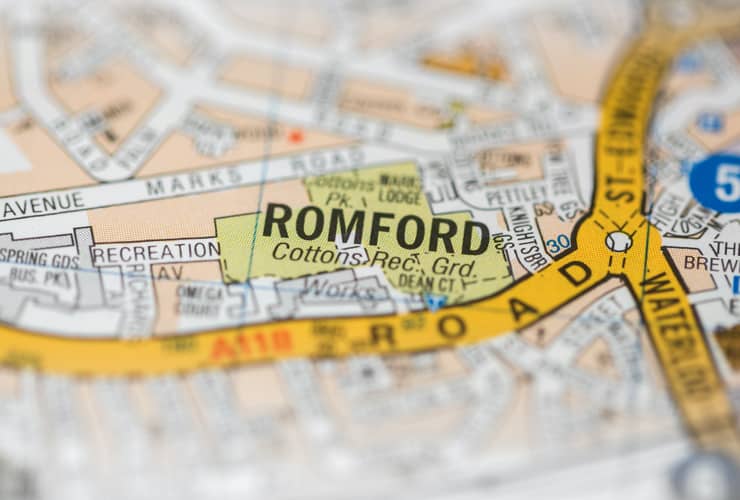
Romford is a market town in the London Borough of Havering, in east London. Average sold prices across Havering sit at £441,241 on the HM Land Registry House Price Index, 52.2% above the England average of £289,946 and below the London average of £542,378. That places Romford in outer-London pricing: full London money on the houses, but at the affordable end of the capital rather than the middle. The detail an income investor cares about is a rare inversion. RM3 (Harold Hill) is the cheapest postcode to buy at £406,702, yet it also carries the highest rent at £2,071 a month and the top gross yield at 6.1%, while the dearest postcode, RM4 (Noak Hill, Havering-atte-Bower) at £878,636, sits so thin on rental data it does not register a yield at all.
What holds those rents up is the Elizabeth line. Its trains stop at Romford, Gidea Park and Harold Wood, cutting the journey into the City and the West End and pulling in renters who work centrally but cannot pay central rents. Median gross earnings across Havering are £46,045 a year, just below the London median of £46,414 and 17.7% above the Great Britain figure. That wage base supports the £1,623 to £2,071 monthly rents recorded across the ten postcodes. For investors, the spread between RM3 at £406,702 and RM4 at £878,636 opens a wide two-tier market, where the cheaper postcodes towards the borough's edges carry the higher yields and the leafier ones towards Upminster carry the lower.
This guide covers the London Borough of Havering (ONS code E09000016) across ten Romford postcodes: RM1, RM2, RM3, RM4, RM5, RM6, RM7, RM11, RM12 and RM14. Romford sits on the eastern edge of Greater London, 14 miles from the City, with Essex immediately beyond. The wider Essex buy-to-let region takes in Brentwood and Basildon further east along the line.
Article updated: July 2026
Why Invest in Romford?
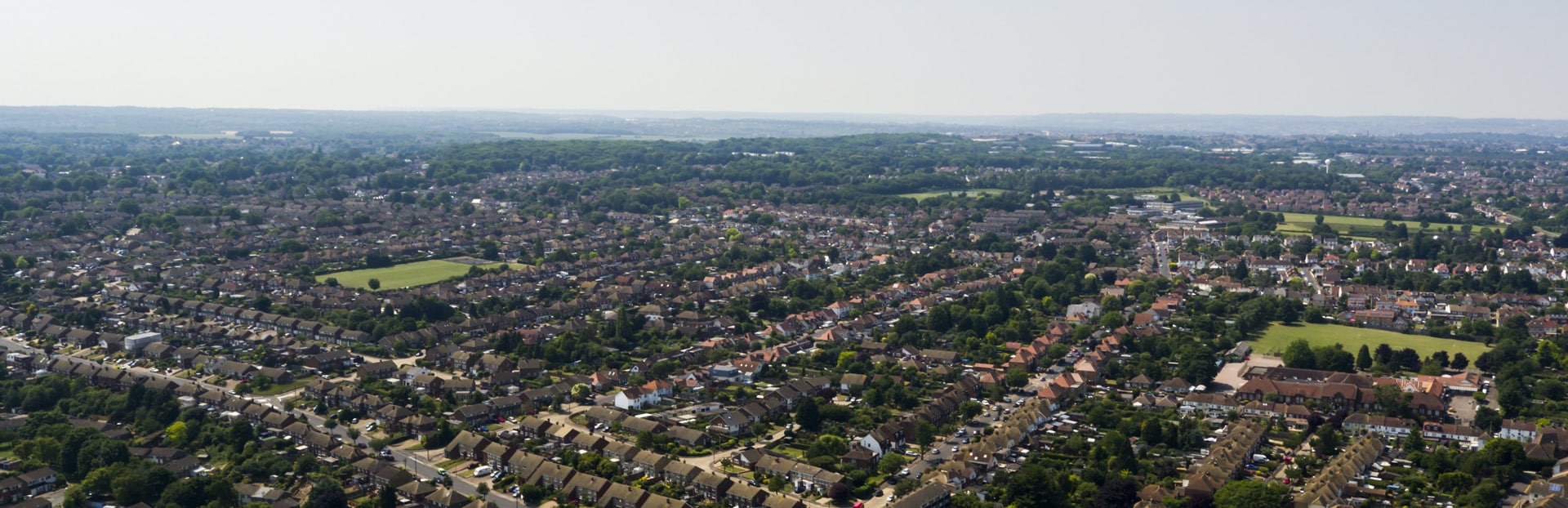
Havering, the borough Romford anchors, grew its population 10.46% between the 2011 and 2021 censuses, from 237,232 to 262,052 residents, well ahead of the 6.3% England and Wales average. Romford is the borough's commercial heart, a market town with a shopping centre and a night-time economy that pull in workers and spending from across the eastern fringe of the capital and out into Essex. The rest of Havering runs from dense outer-London suburbs in the south to semi-rural pockets around Havering-atte-Bower in the north, which is part of what draws households wanting more space than the inner boroughs allow.
The local employment rate of 78.8% runs above both the London average of 74.9% and Great Britain's 75.6%. Romford's economy leans on retail and the town centre, health and social work, logistics and distribution along the A12 and A13 corridors, and construction. Queen's Hospital in Romford is one of the borough's largest single employers, and the retail and leisure pull of the town keeps a broad base of service-sector jobs close to where tenants live.
Median gross annual earnings in Havering are £46,045, which sits just below the London median of £46,414 and runs 17.7% above the Great Britain median of £39,125. Wages at that level let tenants carry the rents that come with London pricing. The Elizabeth line is the piece that ties it together: fast, direct trains from Romford into Liverpool Street, the West End and out towards Heathrow give the town a commuter pull that a market town this far out would not otherwise have, and that connectivity underpins demand from renters who work in the centre.
Romford Economic Summary
- Population (Havering): 262,052 (2021 Census). Growth of 10.46% from 2011.
- Median annual salary: £46,045 (local), £46,414 (London), £39,125 (Great Britain)
- Employment rate: 78.8% (local), 74.9% (London), 75.6% (Great Britain)
- Unemployment rate: 6.4% (local)
- Key employment sectors: Wholesale and retail, health and social work, transport and storage, construction, public administration
Source: ONS Census 2021, Nomis Labour Market Profile (ASHE 2025, Employment Oct 2024-Sep 2025)
Regeneration and Investment in Romford
Romford's biggest investment story is its own town-centre masterplan, which targets thousands of new homes around the Elizabeth line station, alongside Beam Park to the south adding several thousand more on former industrial land. The borough's growth is concentrated where the trains are: density around the Romford interchange, and riverside housing along the Thames in the south of Havering.
- Romford Town Centre Masterplan (Active): Havering Council's plan for Romford targets thousands of new homes around the town centre and the Elizabeth line station, alongside upgraded public spaces and retail. Faster central services from Romford make the town a focus for commuter-led residential demand, and new-build density around the station adds rental stock close to the transport that drives it. Updates at Masterplan for Romford.
- Beam Park (Under construction, thousands of homes): A mixed-use development straddling the boundary between Havering and Barking and Dagenham, delivering new homes, a primary school, health facilities and public space on former industrial land within the wider London Riverside Opportunity Area. The scheme sits closest to RM12 and RM13 in the south of the borough. Updates at London Borough of Havering.
- London Riverside Opportunity Area (Active): The Greater London Authority designated London Riverside, covering the southern reaches of Havering and Barking and Dagenham along the Thames, as a major growth zone for new homes and jobs. It is a long-term focus for housing delivery on the eastern edge of the capital. Updates at the Greater London Authority.
Source: Office for National Statistics - Population for Havering
Romford Property Market Analysis
Average property prices in Havering have risen 539.7% since January 1995, from £68,980 to £441,241. The sections below trace that journey cycle by cycle, then drill into current postcode-level data for sold prices, price per square foot, asking prices, growth trends, and monthly transaction volumes.
When was the last house price crash in Romford?
Romford's sold prices are recorded by HM Land Registry at the level of the London Borough of Havering, so the figures below cover the whole borough rather than the town alone. The House Price Index runs from January 1995 to March 2026, which is 31 years of market cycles to read from.
The 1995 to 2008 boom: Havering started at £68,980 in January 1995. By December 2000 the average had reached £118,019, a 71.1% rise in six years as cheap credit and easy mortgage lending fed straight into the outer-London market. Growth ran hard through the early 2000s, hitting £207,542 by December 2005, and the market topped out at £248,274 in January 2008.
2008 to 2009, the financial crisis: Prices fell from the January 2008 peak of £248,274 to a trough of £202,716 in June 2009, a drop of 18.3% over 17 months. The worst single year-on-year reading was -16.5% in January 2009. That correction was steep, on a par with the wider London market where buyers who depended on credit stepped back hardest.
2010 to 2013, the recovery grind: Prices bounced off the June 2009 trough and clawed their way back. The average stood at £224,760 by December 2010 and reached £239,615 by December 2013, gaining ground steadily rather than surging, while London's wider market stayed cautious.
2014 to 2016, the London surge: The capital's mid-decade boom pulled Havering up with it. The March 2014 reading of £248,636 was the first time the average passed the January 2008 pre-crash peak, a recovery that took just over six years. From there growth accelerated, reaching £336,080 by March 2016 as buyers priced out of inner London looked east along what would become the Elizabeth line.
2017 to 2019, the plateau: After the surge the market cooled. The average drifted in a narrow band, from around £371,208 in December 2017 to £369,965 by December 2019, with annual growth falling back to low single figures as London's wider market paused.
2020 to 2022, the pandemic surge: The stamp duty holiday and the race for space favoured outer boroughs with gardens and rail links. Prices rose from £376,403 in June 2020 to £399,278 by December 2021, then jumped to £439,314 by December 2022, a 10.0% annual gain.
2023, the rate shock: Higher mortgage rates cooled the market. The average eased to £422,933 by June 2023 and £414,139 by December 2023, a -5.7% annual fall as London's more leveraged buyers felt the squeeze.
2024 to present: The market recovered to £429,195 by December 2024 and reached an all-time high of £447,672 in December 2025, before easing to £441,241 by the latest reading in March 2026. That is 77.7% above the January 2008 pre-crash peak.
Long-term growth summary:
- 5 years (March 2021 to March 2026): 14.9% growth (£384,019 to £441,241)
- 10 years (March 2016 to March 2026): 31.3% growth (£336,080 to £441,241)
- 15 years (March 2011 to March 2026): 102.0% growth (£218,428 to £441,241)
- 20 years (March 2006 to March 2026): 111.1% growth (£209,020 to £441,241)
- 30 years (January 1995 to March 2026): 539.7% growth (£68,980 to £441,241)
Havering's 18.3% crash was a shade deeper than England's, a reminder of how exposed outer-London buyers were to tighter credit. Recovery to the pre-crash peak took just over six years, quicker than many regions managed, and the 30-year return of 539.7% shows the long pull of the capital under it all. A buyer who bought at the exact January 2008 peak would be sitting on a 77.7% gain on the Land Registry average today.
- All property types
- Detached
- Semi-detached
- Terraced
- Flats
- All property types
- Detached
- Semi-detached
- Terraced
- Flats
Sold House Prices in Havering
The average sold price across all property types in Havering is £441,241, which is 52.2% above the England average of £289,946 as of March 2026. That premium is what a London postcode costs, but it does not fall evenly across the housing stock. The houses carry it in full while the flats sit much closer to the national figure. Detached, semi-detached and terraced homes all run between 75% and 85% above England, whereas flats are only 15.2% higher. That gap is the clearest read on where the borough's affordable entry point sits.
| Property Type | Havering Average | England Average | Difference |
|---|---|---|---|
| Detached houses | £824,914 | £470,492 | +75.3% |
| Semi-detached houses | £531,798 | £288,185 | +84.5% |
| Terraced houses | £428,925 | £243,788 | +75.9% |
| Flats and maisonettes | £247,198 | £214,563 | +15.2% |
| All property types | £441,241 | £289,946 | +52.2% |
Detached houses at £824,914 sit 75.3% above England's £470,492 and cluster in the borough's leafier corners: the Upminster and Cranham streets of RM14 and the rural fringe around RM4 towards Havering-atte-Bower. Annual growth of 1.0% points to a steady owner-occupier market rather than one chasing gains.
Semi-detached houses at £531,798 carry the widest premium of any type, 84.5% above England's £288,185. The interwar and post-war semis that fill much of Gidea Park, Emerson Park and the RM2 and RM11 streets are the backbone of the borough's stock, and that depth of demand keeps prices firm. Annual growth of 1.5% is the strongest of the four types.
Terraced houses at £428,925 stand 75.9% above England's £243,788. Terraced stock is most common in the older streets around Romford town centre and out towards RM7 in Rush Green, where it tends to suit family lets and first-time landlords. Annual growth of 0.4% shows a market holding roughly flat over the year.
Flats and maisonettes at £247,198 show by far the smallest premium, 15.2% above England's £214,563. Havering is not a flat-heavy borough, and the apartment stock that exists concentrates in Romford town centre and around the Elizabeth line stations. That smaller, suburban flat market trades close to the national average, and annual change of -4.2% marks it as the softest corner of the borough right now.
Price Per Square Foot in Romford
Just £89 per square foot separates Romford's cheapest space from its dearest, with RM3 at £453 and RM14 at £528. Measuring by the square foot takes property size out of the comparison, so it reads the value of the location rather than the size of the house. RM14 (Upminster, Cranham) commands the top rate, which fits its detached-heavy stock and semi-rural streets on the Essex edge.
| Rank | Area | Price Per Sq Ft |
|---|---|---|
| 1 | RM3 (Harold Hill) | £453 |
| 2 | RM7 (Rush Green, Mawneys) | £454 |
| 3 | RM1 (Romford Town) | £457 |
| 4 | RM6 (Chadwell Heath) | £459 |
| 5 | RM5 (Collier Row) | £468 |
| 6 | RM2 (Gidea Park) | £483 |
| 7 | RM12 (Hornchurch) | £490 |
| 8 | RM11 (Emerson Park) | £494 |
| 9 | RM14 (Upminster, Cranham) | £528 |
| 10 | RM4 (Noak Hill, Havering-atte-Bower) | £541 |
RM3 at £453 per square foot is the cheapest space in Romford, from 637 transactions analysed. Harold Hill sits at the northern edge of the borough, built out as a post-war estate, and its smaller, more affordable stock keeps the per-foot rate down. That same affordability is what lifts its rental yield to the top of the table.
RM14 at £528 per square foot is the priciest bricks-and-mortar in the borough despite RM4 nudging ahead on a much thinner 71-transaction sample. Upminster and Cranham are Havering's most sought-after streets, close to the Essex countryside with a fast line into Fenchurch Street, and buyers there pay for the location as much as the space. From 474 transactions analysed, RM14's per-foot rate runs 17% above RM3's.
For Sale Asking Prices in Romford
RM3 at £406,702 and RM4 at £878,636 sit 116% apart, the widest asking-price gap across Romford's ten postcodes. That hierarchy tracks the sold prices but stretches them further, from the post-war estates in the north to the rural fringe on the borough's edge. The mean asking price across all ten postcodes is £534,469.
| Rank | Area | Asking Price |
|---|---|---|
| 1 | RM3 (Harold Hill) | £406,702 |
| 2 | RM7 (Rush Green, Mawneys) | £413,151 |
| 3 | RM1 (Romford Town) | £430,500 |
| 4 | RM6 (Chadwell Heath) | £438,409 |
| 5 | RM5 (Collier Row) | £473,817 |
| 6 | RM12 (Hornchurch) | £489,315 |
| 7 | RM2 (Gidea Park) | £558,167 |
| 8 | RM11 (Emerson Park) | £610,288 |
| 9 | RM14 (Upminster, Cranham) | £645,710 |
| 10 | RM4 (Noak Hill, Havering-atte-Bower) | £878,636 |
RM3 at £406,702 is the lowest barrier to entry in Romford and the only postcode where the asking price sits well below the £441,241 borough sold-price average. Harold Hill's estate stock is the reason: smaller houses and a run of former council homes that keep prices down. For an investor working to a budget, RM3 puts the most property within reach and, unusually, pairs that with the highest yield in the table.
RM4 at £878,636 is an outlier in every sense. Noak Hill and Havering-atte-Bower are the borough's rural top corner, where large detached homes on big plots pull the average up, and only three sales a month change hands. With almost no rental listings, it does not register a yield, so RM4 reads as an owner-occupier postcode rather than a buy-to-let one. It is priced at more than double RM3.
House Price Growth in Romford
Every Romford postcode posted positive five-year growth, and five of the ten grew across all three timeframes: RM1, RM4, RM6, RM7 and RM12. The one-year column is where the split shows, with those five up over the year while RM2, RM3, RM5, RM11 and RM14 are down. The five-year returns run from 3.1% in RM14 to 20.5% in RM1.
| Area | 1 Year | 3 Years | 5 Years |
|---|---|---|---|
| RM1 (Romford Town) | 5.8% | 9.2% | 20.5% |
| RM7 (Rush Green, Mawneys) | 0.8% | 3.8% | 19.3% |
| RM4 (Noak Hill, Havering-atte-Bower) | 3.2% | 25.6% | 17.2% |
| RM5 (Collier Row) | -2.3% | -1.2% | 15.7% |
| RM12 (Hornchurch) | 3.3% | 4.9% | 14.2% |
| RM3 (Harold Hill) | -1.1% | 2.2% | 12.9% |
| RM6 (Chadwell Heath) | 4.6% | 1.3% | 11.6% |
| RM2 (Gidea Park) | -4.8% | 10.6% | 10.8% |
| RM11 (Emerson Park) | -1.7% | 0.6% | 7.5% |
| RM14 (Upminster, Cranham) | -3.2% | -6.0% | 3.1% |
RM1 at 20.5% has the strongest five-year growth in Romford, and it is one of only a handful of postcodes still positive over the year at 5.8%. Romford Town has been the direct beneficiary of the Elizabeth line and the town-centre masterplan, with new-build density and improved transport concentrated around the station. That is the postcode where the regeneration story has already shown up in the numbers.
RM14 at 3.1% has the weakest five-year growth and is down 6.0% over three years and 3.2% over one. Upminster and Cranham sit at the premium, detached end of the borough, and the higher-value stock there has softened where the cheaper postcodes have held firmer, a pattern common across London's dearer suburbs since the 2022 peak.
Monthly Property Sales in Romford
Monthly sales range from 3 transactions in RM4 to 34 in RM3, with turnover from 4% to 20% across the ten postcodes. Most of the market moves at a steady clip, with the busier postcodes clustered around Romford Town and Hornchurch. RM4 stands apart, where a thin, high-value stock changes hands only a few times a month.
| Area | Sales Per Month | Turnover | Asking Price |
|---|---|---|---|
| RM3 (Harold Hill) | 34 | 13% | £406,702 |
| RM12 (Hornchurch) | 33 | 16% | £489,315 |
| RM11 (Emerson Park) | 30 | 11% | £610,288 |
| RM1 (Romford Town) | 25 | 14% | £430,500 |
| RM7 (Rush Green, Mawneys) | 23 | 14% | £413,151 |
| RM14 (Upminster, Cranham) | 19 | 13% | £645,710 |
| RM5 (Collier Row) | 16 | 20% | £473,817 |
| RM6 (Chadwell Heath) | 15 | 12% | £438,409 |
| RM2 (Gidea Park) | 13 | 12% | £558,167 |
| RM4 (Noak Hill, Havering-atte-Bower) | 3 | 4% | £878,636 |
RM5 at 20% turnover has the highest share of stock changing hands in Romford, well ahead of the 11% to 16% across the rest of the borough. Collier Row's mid-priced family stock moves often, and for a landlord a higher turnover points to an easier exit when the time comes to sell. RM3 records the most transactions at 34 a month on a 13% turnover, the busiest raw volume in the borough.
RM4 sits at the other extreme, 3 sales a month and 4% turnover. Noak Hill and Havering-atte-Bower hold a small pool of expensive rural homes that rarely come to market, so both the volume and the turnover stay low. A postcode that trades this thinly is slower to enter and slower to exit.
How Long Properties Take to Sell in Romford
Selling speed splits Romford wide: RM5 (Collier Row) clears fastest at about 152 days, while RM4 (Noak Hill, Havering-atte-Bower) sits for roughly 761 days. Days on market is the typical time a home is listed before it sells, and months of unsold stock measures how much for-sale supply is queued at the current rate of sales. On both counts the borough runs from brisk to sluggish depending on the postcode.
| Area | Avg Days to Sell | Months of Unsold Stock | Market |
|---|---|---|---|
| RM5 (Collier Row) | 152 | 5.0 | Seller's market |
| RM12 (Hornchurch) | 190 | 6.3 | Balanced market |
| RM1 (Romford Town) | 217 | 7.1 | Balanced market |
| RM7 (Rush Green, Mawneys) | 217 | 7.1 | Balanced market |
| RM14 (Upminster, Cranham) | 234 | 7.7 | Balanced market |
| RM3 (Harold Hill) | 234 | 7.7 | Balanced market |
| RM2 (Gidea Park) | 254 | 8.3 | Balanced market |
| RM6 (Chadwell Heath) | 254 | 8.3 | Balanced market |
| RM11 (Emerson Park) | 277 | 9.1 | Balanced market |
| RM4 (Noak Hill, Havering-atte-Bower) | 761 | 25.0 | Buyer's market |
A headline yield tells you nothing about how long your money sits tied up when you sell. RM5's 5.0 months of unsold stock means a far quicker exit than RM4's 25.0, and that difference is a real holding cost the rent column never shows. In practice, the estate and family stock in Collier Row and Hornchurch turns over quickly, while the thin rural market in RM4 leaves a seller waiting the best part of two years.
What Type of Property Can You Buy in Romford?
The housing mix flips across the borough, from detached-dominated RM4 at 49.7% to terraced-and-flat RM6, where semis, terraces and flats together make up nearly 90% of the stock. That mix decides which strategies fit where. The figures below come from 2021 Census records for each postcode.
| Area | Detached | Semi-detached | Terraced | Flats |
|---|---|---|---|---|
| RM1 (Romford Town) | 19.8% | 33.1% | 15.4% | 31.6% |
| RM2 (Gidea Park) | 24.4% | 29.6% | 9.7% | 36.2% |
| RM3 (Harold Hill) | 12.2% | 47.8% | 23.4% | 14.5% |
| RM4 (Noak Hill, Havering-atte-Bower) | 49.7% | 29.7% | 10.8% | 6.5% |
| RM5 (Collier Row) | 9.5% | 44.4% | 26.9% | 19.1% |
| RM6 (Chadwell Heath) | 9.8% | 28.9% | 22.5% | 38.8% |
| RM7 (Rush Green, Mawneys) | 6.7% | 31.1% | 28.6% | 33.6% |
| RM11 (Emerson Park) | 29.4% | 35.9% | 17.6% | 17.1% |
| RM12 (Hornchurch) | 7.5% | 52.1% | 26.9% | 13.5% |
| RM14 (Upminster, Cranham) | 46.9% | 31.2% | 11.9% | 7.0% |
RM6 (Chadwell Heath) and RM7 (Rush Green) hold the largest flat shares at 38.8% and 33.6%, alongside heavy terraced stock. That is the smaller-unit housing that usually anchors a buy-to-let market, and it lines up with both postcodes carrying above-average yields, RM6 at 5.3% and RM7 at 5.0%. Flats and terraces here suit single lets and sharers within reach of the town centre and the trains.
RM4 (Noak Hill) is the most detached-dominated postcode at 49.7%, with RM14 (Upminster) close behind at 46.9% and the smallest flat shares in the borough. Detached and semi-detached houses together make up around 80% of the stock in both, which matches their premium asking prices and their lower yields. The housing there is weighted towards owner-occupier family homes rather than the smaller units that drive rental income.
Flats cover both purpose-built blocks and converted units, and a small share of mobile and temporary dwellings is left out, so rows may not add to 100%.
Romford Rental Market Analysis
Monthly rents in Romford run from £1,623 in RM2 to £2,071 in RM3, with gross rental yields from 3.4% to 6.1% across the nine postcodes that carry rental data. For investors asking is buy to let worth it in Romford, the sections below break rents, yields and tenant affordability down postcode by postcode. If you are working out how to build a property portfolio around London's edge, Romford pairs Elizabeth-line demand with yields that outer London rarely offers. Browse current buy-to-let homes for sale across the area.
Average Rent & Gross Rental Yields in Romford
Gross rental yields in Romford run from 3.4% in RM11 to 6.1% in RM3. The cheapest postcode delivers the highest yield, and here it also charges the highest rent. RM3 (Harold Hill) commands £2,071 a month against an asking price of £406,702, and that combination of the lowest price and the top rent is what puts it 2.7 points clear of the bottom of the table.
| Area | Average Monthly Rent | Asking Price | Gross Yield |
|---|---|---|---|
| RM3 (Harold Hill) | £2,071 | £406,702 | 6.1% |
| RM6 (Chadwell Heath) | £1,927 | £438,409 | 5.3% |
| RM7 (Rush Green, Mawneys) | £1,736 | £413,151 | 5.0% |
| RM1 (Romford Town) | £1,625 | £430,500 | 4.5% |
| RM5 (Collier Row) | £1,769 | £473,817 | 4.5% |
| RM12 (Hornchurch) | £1,645 | £489,315 | 4.0% |
| RM2 (Gidea Park) | £1,623 | £558,167 | 3.5% |
| RM14 (Upminster, Cranham) | £1,892 | £645,710 | 3.5% |
| RM11 (Emerson Park) | £1,736 | £610,288 | 3.4% |
| RM4 (Noak Hill, Havering-atte-Bower) | Not enough data | £878,636 | Not enough data |
RM3 at 6.1% pairs the lowest asking price in the borough with the highest rent, and that is a genuinely unusual combination. A 30% deposit of £122,011 buys into the top-yielding postcode in Romford, where a Harold Hill let earns £2,071 a month. The estate stock keeps the purchase price down while proximity to the town centre and the Elizabeth line holds the rent up.
RM11 at 3.4% sits at the bottom of the yield table. Emerson Park is one of the borough's more prestigious addresses, and the £610,288 asking price means even a £1,736 rent leaves the income return compressed. In RM11 the premium price does far more for the address than for the yield.
Gross Rental Yield by Postcode
Is Romford Rent High?
Monthly rents in Romford take between 42.3% and 54.0% of the local median gross monthly salary. The widely used affordability threshold is 30% of gross income, and every Romford postcode sits well above it. That is London for you: rents priced against a tenant base that often earns more than the local median, or splits the cost across a household.
The median gross weekly salary in Havering is £885.48, which works out at £3,837 per month or £46,045 per year. That is just below the London median of £46,414 a year and 17.7% above the Great Britain figure. Data from the Nomis Labour Market Profile (ASHE 2025).
| Rank | Area | Rent as % of Income |
|---|---|---|
| 1 | RM3 (Harold Hill) | 54.0% |
| 2 | RM6 (Chadwell Heath) | 50.2% |
| 3 | RM14 (Upminster, Cranham) | 49.3% |
| 4 | RM5 (Collier Row) | 46.1% |
| 5 | RM7 (Rush Green, Mawneys) | 45.2% |
| 6 | RM11 (Emerson Park) | 45.2% |
| 7 | RM12 (Hornchurch) | 42.9% |
| 8 | RM1 (Romford Town) | 42.4% |
| 9 | RM2 (Gidea Park) | 42.3% |
| - | RM4 (Noak Hill, Havering-atte-Bower) | Not enough data |
RM2 at 42.3% is the least stretched against the local median wage, which reflects its lower rent of £1,623 rather than any real affordability. RM1 (Romford Town) sits just behind at 42.4%, where town-centre flats keep rents at the lower end of the borough. Even the most affordable postcodes here run well above the 30% mark, which is the norm across London rather than a Romford quirk.
RM3 at 54.0% is the least affordable on a single local salary, even though it is the cheapest postcode to buy. The £2,071 rent that drives its 6.1% yield is also what pushes its rent-to-income ratio to the top, and that rent is typically carried by a sharing household or a dual income rather than one median earner.
How Big Is Romford's Private Rented Sector?
The private rented sector is deepest in RM2 and RM14 at 22.7% and 21.7% of households, and shallowest in RM12 and RM3 at 11.7% and 12.5%. The share of homes already let privately is a guide to the size of the established tenant pool and how tested the local lettings market is. The table below shows household tenure by postcode.
| Area | Owned Outright | Owned with Mortgage | Private Rented | Social Rented |
|---|---|---|---|---|
| RM6 (Chadwell Heath) | 20.3% | 30.5% | 35.2% | 13.6% |
| RM2 (Gidea Park) | 31.7% | 33.1% | 22.7% | 10.6% |
| RM7 (Rush Green, Mawneys) | 25.1% | 32.6% | 22.6% | 17.8% |
| RM14 (Upminster, Cranham) | 42.7% | 34.0% | 21.7% | 1.6% |
| RM1 (Romford Town) | 33.2% | 33.3% | 21.4% | 10.2% |
| RM4 (Noak Hill, Havering-atte-Bower) | 42.5% | 31.2% | 19.0% | 7.0% |
| RM11 (Emerson Park) | 42.8% | 38.6% | 14.4% | 3.8% |
| RM5 (Collier Row) | 34.8% | 36.6% | 12.5% | 15.2% |
| RM3 (Harold Hill) | 33.3% | 35.1% | 12.5% | 18.4% |
| RM12 (Hornchurch) | 42.9% | 36.8% | 11.7% | 8.0% |
RM6 (Chadwell Heath) has by far the largest private rented sector in the borough at 35.2%, more than a third of all households and roughly three times the share in RM12. A rented sector that deep points to an active local lettings market and a wide pool of sitting tenants, which sits neatly alongside RM6 carrying one of the higher yields at 5.3%. RM2 and RM7 follow at around 22%, while the outer, owner-heavy postcodes like RM11 and RM12 lean towards outright and mortgaged ownership.
Where there are enough listings to read it, the rental market runs in the landlord's favour. In RM1 around 51 homes were on the rental market, letting in about 49 days on average, with RM6 and RM7 showing the same pattern at roughly 49 and 44 days. Quick lettings on a thin standing supply point to steady tenant demand, though the other postcodes have too few rental listings at any one time to measure reliably.
Local Housing Allowance Rates in Romford
All ten Romford postcodes fall within the Outer North East London Broad Rental Market Area, where Local Housing Allowance runs from £126.54 a week for a shared room to £414.25 a week for a four-bedroom home. Local Housing Allowance is the ceiling on the housing benefit a tenant can receive, so in practice it reads as a rent floor for a landlord letting to that part of the market. The rates below apply across the whole of Romford. To check the current rate for a specific address, you can use the government's official Local Housing Allowance calculator.
| Property Size | Weekly LHA Rate | Monthly Equivalent |
|---|---|---|
| Shared accommodation | £126.54 | £548 |
| 1 bedroom | £230.14 | £997 |
| 2 bedrooms | £287.67 | £1,247 |
| 3 bedrooms | £345.21 | £1,496 |
| 4 bedrooms | £414.25 | £1,795 |
The two-bedroom rate of £287.67 a week works out at about £1,247 a month, below the £1,623 to £2,071 open-market rents recorded across Romford's postcodes. A benefit-backed tenancy at the LHA rate therefore sits under the town's market rents, and the stock that fits within it concentrates in the cheaper northern postcodes, RM3 and RM7, where both asking prices and estate housing keep the entry cost down. The rates are identical in every Romford postcode because they are set across the whole Outer North East London market area.
Buy-to-Let Considerations
Are House Prices High in Romford? Price-to-Earnings Ratios
Buying a property in Romford takes between 8.8 and 19.1 times the local median annual salary. This is based on the Nomis Labour Market Profile for Havering, which puts the median gross annual income for Havering residents at £46,045.
The national benchmark for price-to-earnings is 7.4x (England's average sold price of £289,946 divided by the Great Britain median annual salary of £39,125). Every Romford postcode sits above that benchmark, which is what a London borough looks like against local incomes, even one at the affordable end of the capital.
| Rank | Area | Price-to-Earnings Ratio |
|---|---|---|
| 1 | RM3 (Harold Hill) | 8.8x |
| 2 | RM7 (Rush Green, Mawneys) | 9.0x |
| 3 | RM1 (Romford Town) | 9.3x |
| 4 | RM6 (Chadwell Heath) | 9.5x |
| 5 | RM5 (Collier Row) | 10.3x |
| 6 | RM12 (Hornchurch) | 10.6x |
| 7 | RM2 (Gidea Park) | 12.1x |
| 8 | RM11 (Emerson Park) | 13.3x |
| 9 | RM14 (Upminster, Cranham) | 14.0x |
| 10 | RM4 (Noak Hill, Havering-atte-Bower) | 19.1x |
RM3 at 8.8x is the lowest ratio in Romford, so it is the most affordable postcode relative to local earnings, even though it still sits well above the 7.4x national benchmark. Harold Hill's estate stock keeps the asking price down, and that same affordability is what carries its yield to the top of the table.
RM4 at 19.1x sits far above everything else. At more than 19 times the local median salary, Noak Hill and Havering-atte-Bower are firmly out of local-earnings reach, bought by households whose income comes from elsewhere or who are trading rural space for it. For an investor, that ratio stretches the payback period well beyond the rest of the borough.
Deposit Requirements in Romford
A 30% deposit on a buy-to-let in Romford ranges from £122,011 in RM3 to £263,591 in RM4. The gap between the cheapest and dearest deposit is £141,580, more than a whole second deposit in RM3. For investors weighing Romford against other outer-London boroughs, these deposits sit at the affordable end of the capital but well above most of the North and Midlands.
Beyond the deposit, the stamp duty calculation and the ongoing costs of buy-to-let shape the total capital you need.
| Rank | Area | 30% Deposit Required |
|---|---|---|
| 1 | RM3 (Harold Hill) | £122,011 |
| 2 | RM7 (Rush Green, Mawneys) | £123,945 |
| 3 | RM1 (Romford Town) | £129,150 |
| 4 | RM6 (Chadwell Heath) | £131,523 |
| 5 | RM5 (Collier Row) | £142,145 |
| 6 | RM12 (Hornchurch) | £146,794 |
| 7 | RM2 (Gidea Park) | £167,450 |
| 8 | RM11 (Emerson Park) | £183,086 |
| 9 | RM14 (Upminster, Cranham) | £193,713 |
| 10 | RM4 (Noak Hill, Havering-atte-Bower) | £263,591 |
RM3 is the cheapest way into Romford at a £122,011 deposit, and it is the one place in the borough where the lowest deposit buys the highest yield. A Harold Hill let at £2,071 a month on that deposit is where the income case is strongest. Stepping up to RM7 or RM1 costs only a few thousand pounds more and buys a slightly different postcode without much change to the maths.
At the top, RM3 and RM11 are separated by £61,075 of deposit, and the two sit at opposite ends of the yield table: RM3 at 6.1% on the borough's lowest price, RM11 at 3.4% on one of the highest. The extra outlay in Emerson Park buys a more prestigious address and detached-heavy stock, not a stronger income return.
What the Romford Data Tells Buy-to-Let Investors
In Romford the cheapest postcode to buy is also the highest-yielding, which is the reverse of how most markets work. RM3 (Harold Hill) has the top yield at 6.1%, the lowest asking price for an investment property in Romford at £406,702, the highest rent at £2,071 a month, and the most affordable price against local earnings at 8.8 times income. A 30% deposit there is £122,011, the lowest in the borough.
The higher-yielding postcodes cluster at the borough's northern and western edges, where estate and terraced stock keeps prices down: RM3 at 6.1%, RM6 at 5.3% and RM7 at 5.0%. The lower-yielding ones run towards Upminster and Emerson Park, where detached homes and prestige addresses lift the price faster than the rent, so RM11 and RM14 both land at 3.4% to 3.5% despite charging solid rents.
RM1 (Romford Town) is the growth story rather than the income one, up 20.5% over five years and still positive over the year at 5.8%, on the back of the Elizabeth line and the town-centre masterplan. RM4 (Noak Hill) stands apart entirely, a thin rural market at £878,636 that sells three homes a month and does not register a yield. Buyers who want to come in below asking often work the off-market property in Romford route, before a home reaches the portals.
Romford has no selective licensing scheme covering private landlords across the whole borough, though Havering runs selective and additional HMO licensing in designated wards, set out on the London Borough of Havering's property licensing pages. With Elizabeth-line access, an employment rate above the London average and wages just under the London median, it reads as the outer-London borough that still pairs commuter demand with yields the inner boroughs cannot match.
How Romford Compares
Romford's mean asking price of £534,469 sits mid-table among five neighbouring outer-London boroughs, while its top yield of 6.1% matches Havering's and beats the pricier Redbridge and Bromley below it. The comparison below places Romford alongside four nearby boroughs, each with a different investor profile. The mean asking price and mean monthly rent are simple averages across all postcodes with data, and the top gross yield is the single highest postcode yield in each location.
| Location | Mean Asking Price | Mean Monthly Rent | Mean Gross Yield | Top Yield (postcode) |
|---|---|---|---|---|
| Bexley | £428,037 | £1,762 | 4.9% | 6.3% (SE28) |
| Havering | £519,544 | £1,727 | 4.0% | 6.1% (RM3) |
| Romford | £534,469 | £1,780 | 4.0% | 6.1% (RM3) |
| Redbridge | £538,319 | £1,947 | 4.3% | 5.5% (E12, IG1) |
| Bromley | £544,449 | £1,830 | 4.0% | 5.4% (SE20) |
Bexley is the cheapest location in this group at £428,037 and edges the top yield at 6.3%, while Romford and its parent borough of Havering both top out at 6.1%. Romford's figures run slightly ahead of Havering's borough-wide average because the town's cheaper northern postcodes lift the yield above the leafier southern stretches the borough number folds in.
For investors weighing the neighbours, Redbridge at 5.5% charges the highest mean rent in the group at £1,947 but on a higher price, and Bromley at 5.4% is the dearest to buy while yielding the least. Bexley is the lower-priced way into the same east-and-south-east London edge. For a data-led comparison across every UK location, see our highest-yielding areas guide.
Frequently Asked Questions
Is Romford a good place to live for buy-to-let tenants?
It rents well, and the reason is the trains. The Elizabeth line stops at Romford, Gidea Park and Harold Wood, giving tenants fast, direct services into Liverpool Street and the West End, so the town pulls renters who work centrally but want more space and lower rents than the inner boroughs. Havering's employment rate is 78.8%, above both the London and Great Britain averages, and the typical wage is £885 a week, just below the London median.
Romford itself brings a working town centre, a long-standing market and a night-time economy, which suits professional renters and sharers who want amenities on the doorstep rather than a quiet commuter suburb.
What are the best areas in Romford for property investment?
The ten postcodes split fairly cleanly by goal. RM3 (Harold Hill) is the cheapest way in at £406,702 and carries both the highest rent at £2,071 and the top yield at 6.1%, with RM6 (Chadwell Heath) at 5.3% and RM7 (Rush Green) at 5.0% close behind, so the income sits in the borough's northern and western estate stock. At the other end, RM11 (Emerson Park) and RM14 (Upminster) are the premium addresses at £610,288 and £645,710, where yields fall to 3.4% and 3.5%.
RM1 (Romford Town) is the postcode where growth has shown up, up 20.5% over five years on the back of the Elizabeth line and the town-centre masterplan. So if income is the priority, RM3 leads on both yield and price; if capital growth is the aim, RM1 has the clearest recent record.
How does Romford compare to Havering as a whole for buy-to-let?
Romford is the higher-yielding slice of its own borough. The town's mean asking price of £534,469 sits just above Havering's borough-wide £519,544, but its top yield of 6.1% matches the borough figure because Romford's cheaper northern postcodes, RM3, RM6 and RM7, do the heavy lifting on income. The wider borough number folds in the leafier southern and rural stretches that pull the average yield down.
Sold prices are recorded at borough level, so the £441,241 Land Registry average and the crash-and-recovery history above cover all of Havering. For the borough-wide view across all thirteen Havering postcodes, see our Havering buy-to-let guide.
Is there demand for HMO and shared-room lets in Romford?
There is, mostly in the cheaper, flat-heavy postcodes. A sample of current room adverts puts a double with a shared bathroom at around £180 a week in RM12 (Hornchurch), £177 in RM6 (Chadwell Heath) and £175 in RM7 (Rush Green), with most falling between roughly £127 and £219. Those were the only room types with enough live adverts to give a reliable figure, so ensuite and single-room rents in Romford are harder to pin down.
The rental market in RM1, RM6 and RM7 currently favours landlords, with homes letting in around 44 to 49 days, which points to steady sharer demand near the town centre and the trains. For how the numbers work on a shared house, see our complete guide to investing in HMOs.
Can I find buy-to-let property under £450,000 in Romford?
Yes, in the northern and western postcodes. RM3 (Harold Hill) at £406,702, RM7 (Rush Green) at £413,151, RM1 (Romford Town) at £430,500 and RM6 (Chadwell Heath) at £438,409 all average below £450,000, and RM3 pairs that lowest price with the top yield at 6.1%. Below those averages, the way in is by property type: flats across Havering average £247,198 on the Land Registry index and terraced houses £428,925, so town-centre flats and the terraced stock around Romford and Rush Green sit under the postcode averages. For the cheaper end, explore below market value property.
When will the Elizabeth line and town-centre plans affect Romford prices?
The Elizabeth line is already in the numbers. Its full through-services opened in 2022, and RM1 (Romford Town) has since posted the strongest five-year growth in the borough at 20.5%, with the improved connectivity a big part of why. The town-centre masterplan is the longer story, delivering new homes around the station over years rather than months, so its effect on prices builds gradually as the schemes complete.
What is done is what counts most for a buyer today: the trains run, and the demand they bring is already showing in RM1's rents and prices rather than being priced in on a promise.
What are average house prices in Romford?
Sold prices are recorded at Havering borough level, where the average is £441,241 on the Land Registry index, about 52.2% above the England average of £289,946 as of March 2026 and below the London average of £542,378. Asking prices by postcode run from £406,702 in RM3 (Harold Hill) up to £878,636 in RM4 (Noak Hill), with a Romford-wide mean of £534,469. By type across Havering, detached homes average £824,914, semi-detached £531,798, terraced £428,925 and flats £247,198.
Through a buy-to-let lens, RM3 is the cheapest entry and the highest-yielding at 6.1%, while RM11 and RM14 are the dearest and lowest-yielding.
What are the Local Housing Allowance rates in Romford?
All ten Romford postcodes fall in the Outer North East London Broad Rental Market Area, so they share one set of rates. As of June 2026, Local Housing Allowance runs at £126.54 a week for a shared room, £230.14 for a one-bed, £287.67 for two beds, £345.21 for three and £414.25 for four. That is the most a tenant on housing support can claim towards rent, so for that part of the market it effectively sets a floor.
What type of property is most common in Romford?
It varies sharply by postcode. Semi-detached houses lead in most of the borough, up to 52.1% of the stock in RM12 (Hornchurch), while detached homes dominate the rural edges, at 49.7% in RM4 (Noak Hill) and 46.9% in RM14 (Upminster). The smaller units that usually suit buy-to-let, flats and terraces, are most concentrated in RM6 (Chadwell Heath) and RM7 (Rush Green), where flats alone make up 38.8% and 33.6% of the stock.
How do I buy an investment property in Romford?
Start by settling whether you are buying for income or for growth, because in Romford the two point at different postcodes. RM3 (Harold Hill) is the cheapest entry at £406,702 and the highest-yielding at 6.1%, so it leads for income. RM1 (Romford Town) has the strongest five-year growth at 20.5% on the back of the Elizabeth line. Budget for a 30% deposit, which runs from £122,011 in RM3 to £263,591 in RM4.
Beyond what is listed openly, plenty of investors buy under asking through off market property and BMV property. To see what is available now, browse investment properties or buy-to-let homes for sale.
Ready to buy property?
Access off-market investment properties with an average 8%+ annual gross yield (beating the UK's typical 3-5%).
Get property alerts