
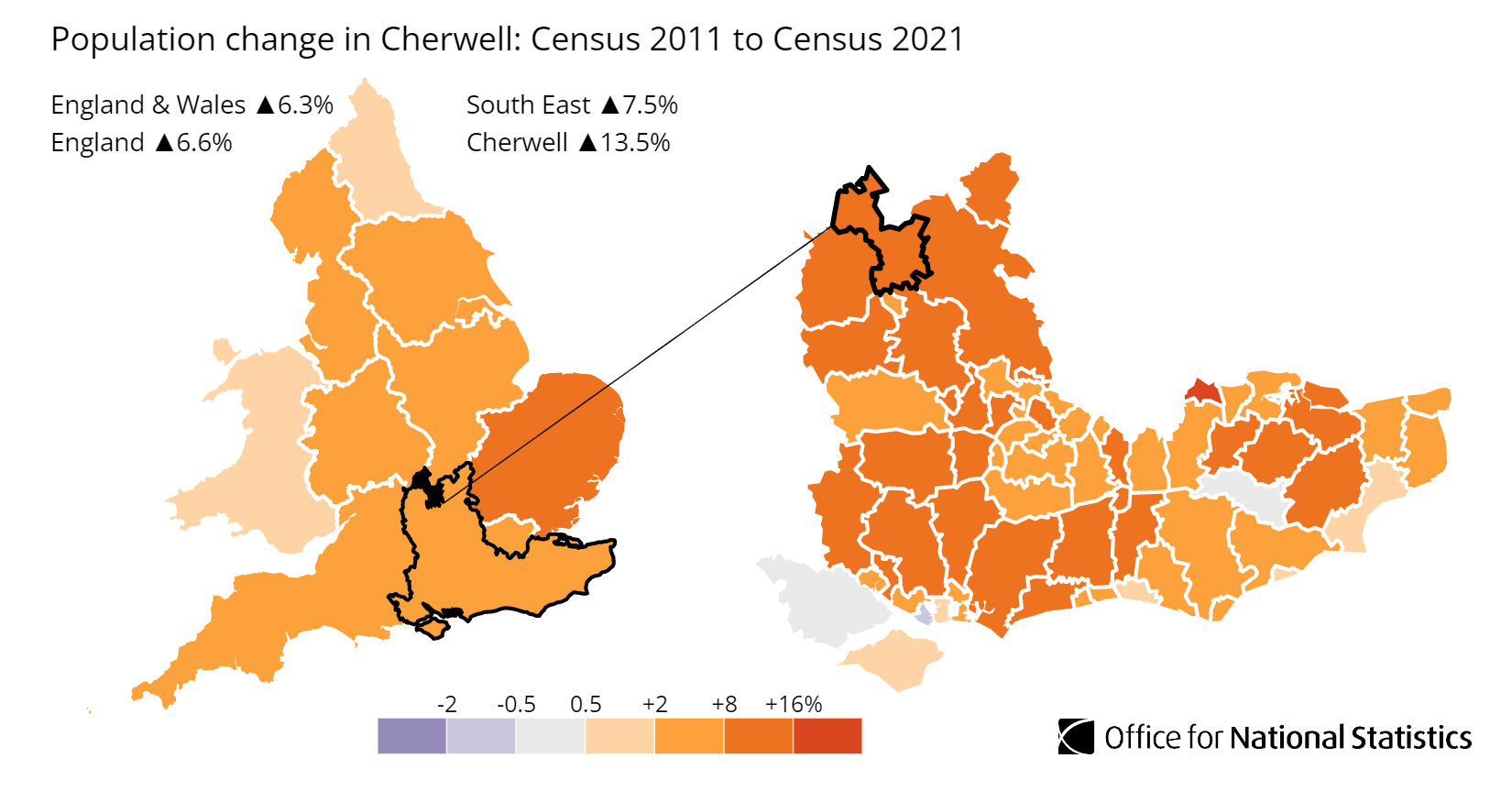
Bicester is a market town in the Cherwell district of Oxfordshire, in the South East of England. Average sold prices across Cherwell sit at £351,051 on the HM Land Registry House Price Index, 21.1% above England's £289,946 and 7.3% below the South East regional average of £378,515. That puts Bicester in the upper band of the buy-to-let locations in this series, one of a small number where sold prices exceed the national figure rather than sit below it. The Cherwell district population grew 13.5% between the 2011 and 2021 censuses, from 141,868 to 161,016 residents, more than double the England average.
Bicester's premium is anchored to connectivity. The town sits on the M40 corridor with direct trains to London Marylebone in under an hour, and Oxford is 15 miles down the road. All three of its postcodes now carry rental data, and the spread between them is wide: OX26 in the town centre is the cheapest way in at a £392,990 asking price, while OX27 in the surrounding villages carries the highest gross yield at 5.1%. That gap between the affordable entry point and the top yield is the first thing a buyer here has to weigh.
This guide covers the Cherwell district (ONS code E07000177) across postcodes OX25, OX26, and OX27. Cherwell includes Bicester, Banbury, Kidlington, and the surrounding rural parishes, so HM Land Registry sold prices are reported at district level rather than for Bicester alone. Investors comparing options in the region may also weigh Oxford, Milton Keynes, Reading, and Swindon, or browse buy-to-let homes for sale across the country.
Article updated: July 2026
Why Invest in Bicester?
Cherwell's population grew 13.5% between the 2011 and 2021 censuses, from 141,868 to 161,016, more than double England's 6.6%, and the district's employment rate of 85.1% sits well above the national 75.4%. Bicester's case rests on where it is and what connects it, not on a cheap way in. The town is on the M40, direct trains reach London Marylebone in under an hour, and Oxford is a short hop away. That combination of Oxford proximity and London commuter access is a demand profile most market towns cannot match.
Bicester Village draws over 7 million visitors a year, one of the UK's most-visited retail destinations outside central London, and its shopping and hospitality economy is a large local employer. Beyond retail, Bicester Motion is turning the former RAF Bicester site into a technology and innovation campus, with YASA, a Mercedes-Benz Group company, relocating its 400-strong team to a new headquarters there.
The population growth reflects Bicester's place in the Oxford-Cambridge Arc, the government-backed growth corridor running from Oxford through Milton Keynes to Cambridge. New housing is a large part of that story: the designated North West Bicester eco-town alone targets several thousand homes over the coming decades, so the district's residential base is set to keep expanding.
Earnings back the prices up. The median gross annual salary across Cherwell is £42,147, above both the South East regional median of £41,616 and the Great Britain median of £39,125. Higher local wages mean tenants can absorb the rents that a premium market like this asks. The employment picture is strong too: at 85.1%, Cherwell's employment rate runs nearly ten points above the Great Britain figure. A district with high employment and above-average earnings gives landlords a tenant base that lower-wage locations do not.
Bicester Economic Summary
- Population: 161,016 (2021 Census). Growth of 13.5% from 2011. Cherwell district figure.
- Median annual salary: £42,147 (Cherwell), £41,616 (South East), £39,125 (Great Britain)
- Employment rate: 85.1% (Cherwell), 75.4% (Great Britain)
- Median weekly earnings: £810.50 (Cherwell), £800.30 (South East), £752.40 (Great Britain)
- Key employment sectors: Retail and hospitality (Bicester Village), automotive technology (Bicester Motion), logistics and distribution (M40 corridor), professional services
Source: ONS Census 2021, Nomis Labour Market Profile (ASHE 2025)
Regeneration and Investment in Bicester
Three projects are reshaping Bicester: a £26.8m technology campus at the former RAF base, a designated zero-carbon eco-town to the north-west, and a £5.1m town centre regeneration. The common thread is Bicester's shift from a traditional market town toward a technology and housing-growth hub inside the Oxford-Cambridge Arc.
- Bicester Motion (under construction, £26.8m funding secured): The former RAF Bicester airfield is being developed into an innovation campus for automotive and mobility technology. YASA, owned by Mercedes-Benz Group, is relocating its 400-strong team to a new headquarters in Phase 1, with four further high-specification buildings planned for Phase 2. Updates at Oxfordshire LEP.
- North West Bicester Eco Town (in development, several thousand homes): One of the government's designated eco-towns, North West Bicester is a zero-carbon development on land to the north-west of the town. Its full masterplan targets several thousand homes over the coming decades, with the most recent phase adding 530 homes on appeal. Updates at Oxfordshire Live.
- Bicester Market Square Regeneration (approved, £5.1m): Cherwell District Council's town centre scheme redesigns the public square with improved pedestrian access and space for events and markets, backed by £5.131m plus £881,000 in S106 funding. The concept design was approved in September 2025, with physical work in the square expected to begin in summer 2026. Updates at Cherwell District Council.
Source: Office for National Statistics - Population for Cherwell
Bicester Property Market Analysis
Average prices across Cherwell have risen 520.6% since January 1995, from £56,569 to £351,051. The sections below trace that journey cycle by cycle, then drill into current postcode-level data for sold prices, price per square foot, asking prices, growth, and monthly transaction volumes.
When Was the Last House Price Crash in Bicester?
Bicester sits within the Cherwell district, so all sold prices from HM Land Registry are recorded at that level. The Land Registry House Price Index tracks average prices from January 1995 to the latest reading, covering 31 years of market cycles.
The 1995 to 2007 climb: Cherwell started at £56,569 in January 1995 and nearly doubled to £101,688 by January 2000. Growth accelerated through the early 2000s, reaching £185,326 by March 2005 as cheap credit and the South East's structural demand drove the market. Prices peaked at £230,850 in November 2007, up 308.1% from the 1995 start.
2008 to 2009, the financial crisis: From the November 2007 peak of £230,850 to the March 2009 trough of £184,043, Cherwell lost 20.3% of its value in 16 months. The worst annual reading was -16.0% in February 2009. By property type, flats fell hardest at -21.0%, followed by terraced (-20.7%), semi-detached (-20.4%), and detached (-19.1%). Cherwell's fall was slightly steeper than England overall (-18.2%) and in line with the South East. A higher-value market fell more steeply than lower-priced regions when credit tightened.
Recovery, 2009 to 2013: Cherwell bounced quickly off the trough, back to £217,370 by mid-2010, then settled around £210,000 to £215,000 through 2011 and 2012. Prices first passed the pre-crash peak of £230,850 in November 2013 at £231,744. That recovery took six years from the peak, faster than many northern markets, reflecting the South East's deeper demand base.
2014 to 2019, growth then a pause: Prices climbed through the mid-2010s, reaching £258,144 by March 2015 as Help to Buy and low rates pushed the South East hard. Growth then flattened, and the district saw a shallow correction in 2018 and 2019 as Brexit uncertainty hit the commuter belt.
2020 to 2022, the pandemic surge: The stamp duty holiday and the shift to remote working reversed the pause sharply. From £291,884 in March 2020, prices ran up to £349,719 by December 2022, growth of 19.8% in under three years. Bicester's appeal as a commuter town with space and green surroundings benefited directly.
2023, the rate shock: Higher mortgage rates cooled the market. Prices eased from £349,719 in December 2022 to £332,153 by December 2023, a fall of 5.0% and sharper than the national dip, consistent with the South East pattern of deeper corrections in premium markets.
2024 to present: Prices recovered again, reaching an all-time high of £354,887 in November 2025 before easing gently to £351,051 by the latest March 2026 reading, with annual growth of 1.6%. Cherwell now sits 52.1% above its November 2007 pre-crash peak.
Long-Term Property Value Growth in Cherwell
- 5 years (2021-2026): +17.0% (£300,152 to £351,051)
- 10 years (2016-2026): +24.0% (£283,142 to £351,051)
- 15 years (2011-2026): +67.5% (£209,594 to £351,051)
- 20 years (2006-2026): +80.6% (£194,327 to £351,051)
- 30 years (1995-2026): +520.6% (£56,569 to £351,051)
The 2008 crash is the reference point for downside risk. A 20.3% fall took six years to recover, and the pre-pandemic pause showed that even a premium location can lose ground when sentiment shifts. What differs today is structural: the Oxford-Cambridge Arc designation, Bicester Motion, the North West Bicester eco-town, and improved rail all sit under the demand base in a way they did not in 2007.
- All property types
- Detached
- Semi-detached
- Terraced
- Flats
- All property types
- Detached
- Semi-detached
- Terraced
- Flats
Source: HM Land Registry House Price Index for Cherwell, January 1995 to March 2026.
Sold House Prices in Bicester
Bicester is one of the few locations in this series where sold prices sit above the national figure. Cherwell's average sold price of £351,051 is 21.1% above England's £289,946 and 7.3% below the South East regional average of £378,515. Expensive by national standards, then, but relatively affordable inside its own region.
The spread across property types shows one clear exception. Every house type sits above England, but flats do not.
| Property Type | Cherwell Average | England Average | Difference |
|---|---|---|---|
| Detached houses | £566,289 | £470,492 | +20.4% |
| Semi-detached houses | £350,404 | £288,185 | +21.6% |
| Terraced houses | £289,658 | £243,788 | +18.8% |
| Flats and maisonettes | £168,654 | £214,563 | -21.4% |
| All property types | £351,051 | £289,946 | +21.1% |
Detached houses average £566,289, 20.4% above the England figure but 17.0% below the South East detached average of £682,213. Cherwell's detached stock is expensive against the country and a relative discount against its own region. These are not typical buy-to-let purchases, but the gap places the district in the wider South East context and, at 2.0% annual growth, it is the type moving most in step with the headline.
Semi-detached houses carry the largest premium at £350,404, 21.6% above England. Semis are the core family stock across Bicester's residential streets and the surrounding villages, and the premium reflects steady demand from families commuting to Oxford, London, and the M40 employers. Annual growth for semis is +2.7%, the strongest of the four types.
Terraced houses at £289,658 carry the smallest house premium at +18.8%. Terraced stock in the town centre is the more affordable end of the local market and the type most likely to appeal to buy-to-let investors. Annual growth for terraced homes is +1.8%.
Flats are the outlier. At £168,654, they sit 21.4% below the England average of £214,563. They are the only property type in Cherwell cheaper than the national figure, and the only one with a negative annual change at -3.1%. The flat market in a largely rural district lacks the density and urban demand that support flat prices in city centres, which puts them well below the headline Cherwell average. Browse renovation opportunities across the South East.
Price Per Square Foot in Bicester
Bicester's price per square foot runs from £372 in OX25 to £407 in OX26, a spread of just £35 across the three postcodes. Price per square foot strips out the size bias in average prices: one postcode can look cheaper simply because its homes are smaller. This measure is built from transaction data rather than listing estimates.
That narrow band tells you per-foot land values across the Bicester area are broadly similar, with the variation you see in headline prices driven more by property size than by which postcode a home sits in. Most locations in this series show a wider gap.
| Rank | Area | Price Per Sq Ft |
|---|---|---|
| 1 | OX25 (Upper Heyford, Ambrosden) | £372 |
| 2 | OX27 (Fringford, Stratton Audley) | £379 |
| 3 | OX26 (Bicester Town Centre) | £407 |
OX26 at £407 per square foot is the most expensive space in the Bicester area. The town centre postcode commands a premium per foot because smaller homes, terraced houses and flats, make up more of its housing mix, and smaller properties typically cost more per foot than larger detached homes on rural plots.
OX25 at £372 and OX27 at £379 are near-identical. Both are predominantly rural postcodes with larger properties on larger plots, and the matching per-foot values confirm the villages and hamlets trade at comparable rates. OX25 takes in Upper Heyford, where the former USAF base has been redeveloped into a mixed residential community, while OX27 covers Fringford and Stratton Audley.
Figures reflect averages across all property types and ages. Individual values depend on condition, location within the postcode, and building age.
Houses for Sale: Asking Prices in Bicester
Bicester's asking prices run from £392,990 in OX26 to £523,136 in OX25, with the mean across all three postcodes at £465,648. Asking prices are what sellers list at, not what buyers pay. In a premium market like Bicester, sellers test the upper edge of what the market will bear, so asking prices can sit well above completed sold values.
| Rank | Area | Asking Price |
|---|---|---|
| 1 | OX26 (Bicester Town Centre) | £392,990 |
| 2 | OX27 (Fringford, Stratton Audley) | £480,818 |
| 3 | OX25 (Upper Heyford, Ambrosden) | £523,136 |
OX26 at £392,990 is the only postcode listing below £400,000. It is also the town centre, the postcode with the most transactions and the deepest rental market. The £87,828 gap up to OX27 buys rural character and larger homes, and OX27 is the postcode with the highest yield, so the choice between the two comes down to whether the priority is the lower asking price or the higher rental return.
OX25 at £523,136 is the most expensive asking price in the area. Upper Heyford's redevelopment and the surrounding Oxfordshire villages carry asking prices set by lifestyle demand from Oxford commuters, and at that level the yield is the lowest of the three at 4.2%. Watching repossession listings in the area could surface stock below these asking averages.
The mean asking price across all three postcodes is £465,648. That figure feeds the comparison section below, where Bicester is measured against Oxford, Milton Keynes, Reading, and Swindon. The gap between OX26's asking price and Cherwell's £351,051 average sold price points to room for negotiation in the town centre. Browse below market value listings across the South East.

House Price Growth in Bicester
Five-year growth runs from +19.6% in OX25 to -3.6% in OX27, with OX26 at +4.6%. One-year figures can swing on a handful of transactions in low-volume rural postcodes, so the five-year read captures a fuller cycle.
OX26 is the only postcode growing over one year at +2.5%, while OX25 is flat (0.0%) and OX27 is falling sharply (-9.4%). The divergence between three adjacent areas is sharper than you might expect.
| Area | 1 Year | 3 Years | 5 Years |
|---|---|---|---|
| OX25 (Upper Heyford, Ambrosden) | 0.0% | +4.1% | +19.6% |
| OX26 (Bicester Town Centre) | +2.5% | -5.1% | +4.6% |
| OX27 (Fringford, Stratton Audley) | -9.4% | -5.4% | -3.6% |
OX26 shows negative three-year growth (-5.1%) but positive one-year (+2.5%) and five-year (+4.6%). That shape traces the pandemic run-up, the 2023 correction when rates rose, and a recent turn back upward. The one-year figure is a more current read than the three-year number.
OX25 posted the strongest five-year performance at +19.6% but has since gone flat over one year (0.0%). Upper Heyford's new-build supply can hold prices steady as the initial marketing premium fades and resale values settle.
OX27 at -3.6% over five years is the weakest performer and the steepest recent faller (-9.4% over one year). With only 3 sales a month, a small number of lower-value transactions can drag the average down disproportionately. Rural Oxfordshire villages like Fringford trade on a narrow buyer pool, and when that pool thins, prices move more sharply than in higher-volume areas.
Monthly Property Sales in Bicester
Bicester's combined monthly sales total 42 across the three postcodes, with OX26 accounting for 32 of those, or 76% of every transaction. Transaction volume shapes your exit. When it comes time to sell, the practical question is how many buyers are active in that postcode.
OX26 is the only postcode with the liquidity to buy and sell with reasonable confidence. The two rural postcodes trade in a much thinner market.
| Area | Sales Per Month | Turnover | Asking Price |
|---|---|---|---|
| OX26 (Bicester Town Centre) | 32 | 10% | £392,990 |
| OX25 (Upper Heyford, Ambrosden) | 7 | 5% | £523,136 |
| OX27 (Fringford, Stratton Audley) | 3 | 3% | £480,818 |
OX26 at 32 sales a month is the only postcode with genuine liquidity. A 10% turnover rate means a steady share of available stock changes hands each month, which for a market town is healthy and gives an investor the exit route the other two lack.
OX25 records 7 sales a month at 5% turnover. Upper Heyford's development adds stock, but the surrounding villages see few transactions, so a buyer here needs a long time horizon and acceptance that a sale may take months rather than weeks.
OX27's 3 sales a month is the thinnest market of the three. A handful of listings means limited buyer competition when you come to sell, and pricing has to be right from the outset for a property to move at all.

Bicester Rental Market Analysis
Bicester's rental market splits three ways, and all three postcodes carry data this month, which is unusual for a market with rural postcodes this thin. OX27 gives the highest yield at 5.1% on rents of £2,057, OX26 gives the easiest town-centre route in at 4.4% on £1,444, and OX25 is held back by the area's highest asking prices at 4.2% on £1,837. Read more on whether rental property earns its place in a portfolio.
If you are working toward building a rental portfolio in the South East, the postcode-level detail is what tells those yields apart, so the sections below break rent, yield, and affordability down area by area.
Average Rent & Gross Rental Yields in Bicester
OX27 delivers Bicester's top gross yield at 5.1%, where monthly rents of £2,057 meet an asking price of £480,818. Gross yield does not account for void periods, maintenance, management fees, or mortgage costs. It is a starting point for comparison, not a profit forecast.
The yields sit in a tight band between 4.2% and 5.1%, modest against higher-yielding locations further from London. That is the shape of a premium South East market: lower yields alongside higher-earning tenants and the district's long-run capital growth record. The counterintuitive detail is that OX27, the highest-priced yield reading, tops the table because its rents run higher still, while OX26's lower asking price does not translate into a higher return.
| Area | Average Monthly Rent | Asking Price | Gross Yield |
|---|---|---|---|
| OX27 (Fringford, Stratton Audley) | £2,057 | £480,818 | 5.1% |
| OX26 (Bicester Town Centre) | £1,444 | £392,990 | 4.4% |
| OX25 (Upper Heyford, Ambrosden) | £1,837 | £523,136 | 4.2% |
OX26's 4.4% yield comes with the lowest asking price and the deepest sales market. The town centre postcode trades the top yield for liquidity: it is the easiest of the three to buy into and out of, and its rents are supported by the town centre's employment base rather than by a small pool of higher-value village lets.
OX25 at 4.2% is the lowest yield of the three despite the strongest five-year price growth. Its £523,136 asking price is the highest in the area, and the rent it commands does not stretch far enough to lift the yield. For an income-focused decision, the asking price works against it; for a capital-growth read, its five-year record is the strongest in Bicester.
Gross Rental Yield by Postcode
Is Bicester Rent High?
OX26 rent of £1,444 a month is 41.1% of the local median gross monthly salary of £3,512, rising to 58.6% for OX27's £2,057. The 30% mark is where affordability starts to stretch, so on the district-wide median every Bicester postcode sits above it. Areas where rent takes a smaller share of income tend to produce steadier tenants and fewer arrears.
The median gross weekly salary in Cherwell is £810.50, which works out at £3,512 per month or £42,147 per year. That is above the South East regional median of £800.30 per week and above the Great Britain median of £752.40 per week. Data from the Nomis Labour Market Profile (ASHE 2025).
| Rank | Area | Rent as % of Income |
|---|---|---|
| 1 | OX27 (Fringford, Stratton Audley) | 58.6% |
| 2 | OX25 (Upper Heyford, Ambrosden) | 52.3% |
| 3 | OX26 (Bicester Town Centre) | 41.1% |
Those ratios read high, but the district-wide median flatters them downward and the postcode picture upward. The Cherwell median takes in lower-paid rural workers across the whole district, while tenants renting in Bicester, and especially those in the higher-rent village postcodes, typically earn above that figure. A professional renter choosing Bicester for its transport links is not paying 40% or more of their own income on rent.
For a landlord, the takeaway is that Bicester's tenants tend to come from a higher-earning slice of the local workforce. An affordability ratio calculated against district-wide earnings overstates the real stretch on the tenants who actually let here.
Buy-to-Let Considerations
Are Bicester House Prices High? Price-to-Earnings Ratios
Every Bicester postcode clears the national price-to-earnings benchmark of 7.4x, from 9.3x in OX26 to 12.4x in OX25. The benchmark sets England's £289,946 average sold price against Great Britain's £39,125 median annual salary.
Measured against the Cherwell median gross annual income of £42,147 (Nomis Labour Market Profile), a Bicester purchase takes between 9.3 and 12.4 times the local median salary. OX26 at 9.3x is the least stretched, OX25 at 12.4x the most. That is the shape of a South East market, where the question is less whether prices are affordable in absolute terms and more whether structural demand holds these levels over time.
| Rank | Area | Price-to-Earnings Ratio |
|---|---|---|
| 1 | OX26 (Bicester Town Centre) | 9.3x |
| 2 | OX27 (Fringford, Stratton Audley) | 11.4x |
| 3 | OX25 (Upper Heyford, Ambrosden) | 12.4x |
OX26 at 9.3x needs the lowest multiple of local income. The 3.1x gap up to OX25 (12.4x) is roughly £130,000 more capital for the rural postcode, and OX25 also carries the lowest yield of the three.
Every postcode clearing 7.4x tells a consistent story about market type. Bicester is not a value market. A buyer here is paying for a location premium backed by transport, employment, and Oxford proximity, and that premium held through the 2018-19 pause and the 2023 correction and recovered from both.
Deposit Requirements in Bicester
At 30%, Bicester's deposits run from £117,897 in OX26 to £156,941 in OX25, with no sub-£100,000 way in. Buy-to-let lenders typically want a deposit of at least a quarter of the price, but putting down 30% usually unlocks better rates, and in a market where yields sit near 5% those rate savings matter for cash flow.
Even the lowest deposit here exceeds what many northern cities ask for a whole property. That is the price of a South East commuter location, and the capital commitment is significant across all three postcodes.
| Rank | Area | 30% Deposit Required |
|---|---|---|
| 1 | OX26 (Bicester Town Centre) | £117,897 |
| 2 | OX27 (Fringford, Stratton Audley) | £144,245 |
| 3 | OX25 (Upper Heyford, Ambrosden) | £156,941 |
The £39,044 gap between OX26 and OX25 deposits buys a different investment profile. OX26 at £117,897 comes with the lowest asking price, the deepest sales market (32 a month), and positive one-year growth. OX25 at £156,941 has the strongest five-year price record but the lowest yield and only 7 sales a month.
All three deposits fall in a band between £118,000 and £157,000. That relatively narrow range reflects Bicester's nature as a market town rather than a city with wide postcode variation. There is no budget entry point; the capital ask is heavy across the board.
The deposit is only part of the upfront cost. Budget for stamp duty (our stamp duty calculator gives an accurate figure), legal fees, and survey costs. For the full picture, see our guide to buy-to-let running costs. Investors weighing lower-capital routes may also want to read about investing with no deposit.
What the Bicester Data Tells Buy-to-Let Investors
The Bicester decision comes down to a trade-off between OX26 and OX27. OX26 in the town centre has the lowest asking price (£392,990), the lowest deposit at £117,897, and the deepest sales market (32 a month, three-quarters of every transaction), with positive one-year growth of +2.5% on a 4.4% yield. OX27 in the villages carries the top yield at 5.1% on the highest rents (£2,057), but a thinner market of 3 sales a month and the steepest recent price fall (-9.4% over one year). If liquidity and a lower entry matter most, the data points to OX26; if the priority is the headline yield, OX27 leads.
Across all three postcodes the yields sit in a 4.2% to 5.1% band, so income here is modest against locations further from London. A buyer in Bicester is positioning in a South East commuter town where demand from Oxford, London commuters, and the Bicester Village and Bicester Motion employment base underpins prices. Cherwell's +17.0% five-year growth in the Land Registry data is the record that context rests on, though the recent easing from the November 2025 high shows the premium is not one-way.
OX25 rounds out the picture as the capital-growth read. Its +19.6% five-year growth is the strongest in Bicester, but its £523,136 asking price gives it the lowest yield (4.2%) and its 7 sales a month make it a slow market to exit. It is a postcode where the price record and the income maths pull in different directions.
For buyers weighing Bicester against higher-yielding off-market opportunities elsewhere in the UK, the trade-off is clear: lower yield and a heavier capital commitment, in exchange for the location quality and structural demand that most higher-yielding areas cannot offer. Any specific investment property can be benchmarked against the postcode figures above.

How Bicester Buy-to-Let Compares to Nearby Areas
Bicester's top yield of 5.1% sits mid-pack in this five-location comparison, below Milton Keynes (7.0%), Reading (6.2%), and Swindon (5.2%), but above Oxford (4.8%). The table compares Bicester against four nearby areas on the same basis: mean asking price across all postcodes, mean monthly rent across postcodes with data, and top single-postcode gross yield.
| Location | Mean Asking Price | Mean Monthly Rent | Mean Gross Yield | Top Yield (postcode) |
|---|---|---|---|---|
| Swindon | £349,254 | £1,194 | 4.1% | 5.2% (SN2) |
| Milton Keynes | £392,949 | £1,393 | 4.3% | 7.0% (MK9) |
| Reading | £419,047 | £1,536 | 4.4% | 6.2% (RG1) |
| Bicester | £465,648 | £1,779 | 4.6% | 5.1% (OX27) |
| Oxford | £535,752 | £1,828 | 4.1% | 4.8% (OX4) |
Bicester's mean asking price of £465,648 is the second-highest in the group, behind only Oxford. Its rents are high too, second only to Oxford's, but the combination of high prices and high rents lands its top yield mid-table. Bicester is the priciest way into this group short of Oxford itself.
Milton Keynes tops the group on yield at 7.0% with a mean asking price of £392,949, over £70,000 below Bicester. Its new-town infrastructure and larger rental market make it the strongest yield play nearby. Reading at 6.2% and £419,047 has deeper rental data across more postcodes, and Swindon at £349,254 is the value entry point in this comparison, cheapest to buy into and a 5.2% top yield.
Oxford at £535,752 shows where Bicester's premium positioning is heading. Oxford commands higher rents (£1,828) but a lower top yield (4.8%), the trade-off of the most expensive market in the group. Its university-driven rental demand creates a density of activity that Bicester's market-town profile does not match, but it comes at a higher price and a lower headline return.
See our guide to the best places to invest in buy-to-let across the UK.
Frequently Asked Questions
What are the best areas to invest in Bicester?
The three postcodes split by what you are after. OX27 (Fringford, Stratton Audley) carries the top gross yield at 5.1% on rents of £2,057, though it trades in a thin market of 3 sales a month. OX26 (Bicester Town Centre) has the lowest asking price at £392,990, the deepest sales market at 32 a month, and positive one-year growth of +2.5% on a 4.4% yield. OX25 (Upper Heyford, Ambrosden) posted the strongest five-year price growth at +19.6% but the lowest yield at 4.2%. If income is the priority, OX27 leads; if a lower entry and liquidity matter more, OX26 does.
What are average house prices and rental yields in Bicester?
Cherwell's average sold price is £351,051 on the HM Land Registry index, 21.1% above the England average of £289,946 and 7.3% below the South East regional figure. Asking prices run higher, from £392,990 in OX26 to £523,136 in OX25, a mean of £465,648. Monthly rents range from £1,444 in OX26 to £2,057 in OX27. Gross yields sit in a 4.2% to 5.1% band across the three postcodes, modest for the region because prices are high relative to rents.
How does Bicester compare to Oxford for buy-to-let?
Oxford is the more expensive market, with a mean asking price of £535,752 against Bicester's £465,648, so its 30% deposit is roughly £21,000 higher. Oxford's rents are higher too (£1,828 mean against £1,444 for Bicester's OX26), but its top yield is lower at 4.8% against Bicester's 5.1%, and its rental demand is driven by its universities across more postcodes. Bicester offers direct London Marylebone rail; Oxford's London service is slower or needs a change. Both sit in the same regional economy.
What is the most common type of property in Bicester?
Cherwell's stock spans detached houses averaging £566,289, semi-detached at £350,404, terraced at £289,658, and flats at £168,654. Every house type sits above the England average, but flats are 21.4% below it and the only type with a negative annual change (-3.1%). Terraced houses in OX26 form the most affordable end and are the type most likely to suit buy-to-let, while semis are the core family stock across the town and villages.
How do I buy an investment property in Bicester?
Start by matching a postcode to your goal: OX26 for a lower asking price and a liquid market, OX27 for the top yield, OX25 for the strongest five-year price record. Benchmark any individual property against the postcode figures in this guide, budget the 30% deposit (from £117,897 in OX26) plus stamp duty, legal, and survey costs, and factor in that yields here are modest, so the maths lean toward capital growth over day-one income. You can also review off-market opportunities and compare against the highest-yielding areas elsewhere in the UK.
Is Bicester an expensive place to invest, and can you buy under £300,000?
By national standards Bicester is expensive: Cherwell's £351,051 average sold price is 21.1% above England, and asking prices run from £392,990 to £523,136. That said, individual flats and smaller terraced homes in OX26 do list below £300,000, even though the postcode averages sit higher. Cherwell's average flat price of £168,654 on the Land Registry confirms cheaper stock exists at the district level, where a 30% deposit would be around £90,000. Flats are the only property type in Cherwell currently losing value (-3.1% annual change), so lease length, service charges, and building condition all matter at the more affordable end.
Does Bicester Village affect local property prices?
Bicester Village draws over 7 million visitors a year and employs thousands in retail and hospitality, an employment base concentrated in and around OX26 in the town centre. That local employment supports the town centre's rental demand, and OX26 records 32 of Bicester's 42 monthly sales along with the deepest rental market. The shopping village also lifts Bicester's national profile, which feeds the wider commuter-town demand behind the whole district's prices.
What is the Oxford-Cambridge Arc and how does it affect Bicester?
The Oxford-Cambridge Arc is a government-backed growth corridor running from Oxford through Milton Keynes to Cambridge, aimed at delivering large-scale housing and infrastructure investment. Bicester sits at the western end. The North West Bicester eco-town and the Bicester Motion technology campus are both part of that growth strategy, and East West Rail, which will eventually link Oxford to Cambridge via Bicester, is the largest infrastructure project directly affecting the town. The timeline runs in decades rather than years.
Ready to buy property?
Browse investment properties with prices and gross yields shown for each opportunity.
Get property alerts