

Lancaster is a city in Lancashire, north-west England. Lancaster's average sold price of £194,114 sits 33.1% below England's £289,946 and 9.6% below the North West, making this one of the most affordable districts in the region. The Land Registry figure runs across the whole Lancaster local authority, from the university city itself out to Morecambe, Carnforth and the Yorkshire Dales fringe. That low base is the starting point for the postcode-level detail below.
This guide covers all seven Lancaster postcodes, LA1 to LA6 plus PR3, under Lancaster City Council (ONS code E07000121). One council holds three different markets here: the student-driven city centre where the yields sit, the seaside affordability of Morecambe, and the Dales-fringe rural postcodes that trade rental demand for lifestyle. The district reaches from Morecambe Bay in the west to Kirkby Lonsdale on the Yorkshire Dales border. If you are weighing Lancashire property investment more widely, investors here often also look at Blackpool, Preston or Carlisle.
Article updated: July 2026

Why Invest in Lancaster?
Two universities, around 16,000 students and an NHS hospital anchor an 79.6% employment rate in Lancaster, above the North West's 74.2% and the national 75.6%. Lancaster University sits just south of the city and consistently ranks among the UK's top 15. The University of Cumbria adds a city centre campus. Together they create a student and academic population that underpins letting demand in LA1, where second and third-year students move from halls into private rented houses and shared homes.
The district is more than the city. Morecambe, the seaside town three miles west, is a different housing market entirely. LA3 and LA4 cover Morecambe and Heysham, where lower prices and a seafront regeneration push are slowly shifting the investment profile. Morecambe Bay also draws interest from investors weighing up buying a holiday let. Carnforth (LA5) and Kirkby Lonsdale (LA6) sit further out in rural settings, while PR3 reaches south to Garstang and Longridge.
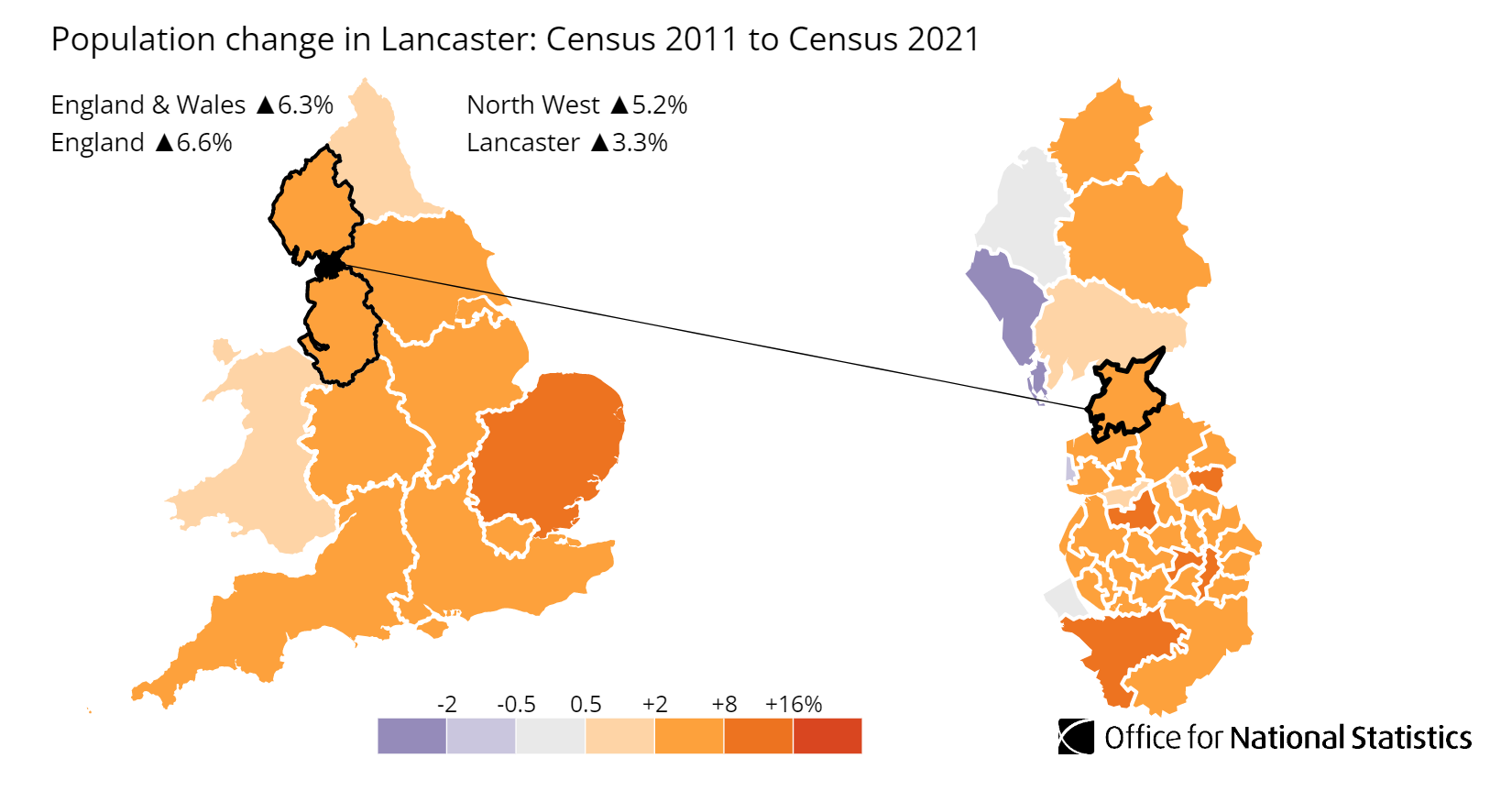
Between the 2011 and 2021 censuses, Lancaster's population grew from 138,375 to 142,934, a rise of 3.3%. That is below the England average of 6.6%, but it is growth backed by two universities and the NHS rather than speculative housebuilding.
Earnings sit below both the regional and national averages. The median annual salary in Lancaster is £34,890, against £37,445 across the North West and £39,125 for Great Britain. Lower local wages paired with affordable house prices keep yields competitive even where absolute rents are modest. The Royal Lancaster Infirmary is the district's largest NHS employer, and Lancaster's position on the West Coast Main Line gives direct trains to Manchester and London Euston.
Lancaster Economic Summary
- Population: 142,934 (2021 Census). Growth of 3.3% from 2011.
- Median annual salary: £34,890 (Lancaster), £37,445 (North West), £39,125 (Great Britain)
- Employment rate: 79.6% (Lancaster), 74.2% (North West), 75.6% (Great Britain)
- Key employment sectors: Higher education, healthcare, public administration, tourism, agriculture
Source: ONS Census 2021, Nomis Labour Market Profile (ASHE 2025, Employment Oct 2024-Sep 2025)
Lancaster's 79.6% employment rate sits comfortably above the regional and national figures. Unemployment data for the district is suppressed in the Annual Population Survey because of the small sample size, which is common for smaller districts. The high employment rate is the more reliable read here, and it points to a labour market held up by stable public-sector employers rather than a single dominant industry.
Regeneration and Investment in Lancaster
More than £100 million of active regeneration is reshaping Lancaster's city centre and Morecambe seafront. The Canal Quarter programme is transforming the former brewery district with new housing, commercial space and a hotel, while Morecambe's seafront work adds a second investment story to the district.
- Canal Quarter, Brewery Lane (site clearance underway, £100 million): Axis-RE and Marco Living acquired the three-acre Mitchell's Brewery site in May 2025 and plan a mixed-use scheme including a 125-key hotel, residential units, student accommodation and a restored brewery venue. £100m of private capital flowing into Lancaster's compact city centre carries directly into surrounding property values. Updates at Beyond Radio.
- Canal Quarter Housing, Nelson Street (approved, 233 homes planned): The residential component of the wider Canal Quarter programme, with 39 homes approved on the Nelson Street car park and a longer-term vision for 233 homes across Nelson Street and St Leonardgate. Funded through the Brownfield Land Release Fund, it adds new housing supply to a constrained city centre. Updates at Beyond Radio.
- Mainway Estate Regeneration (seeking delivery partner, planning consent secured): Lancaster City Council holds planning consent to regenerate the Mainway Estate on the banks of the River Lune, replacing 1960s council housing with around 400 new homes, a net increase of roughly 150. Consent already in place removes a key delivery risk. Updates at Place North West.
Source: Office for National Statistics - Population for Lancaster
Lancaster Property Market Analysis
Average property prices in Lancaster have risen 334.2% since January 1995, from £44,710 to £194,114. The sections below trace that journey cycle by cycle, then drill into current postcode-level data for sold prices, price per square foot, asking prices, growth trends and monthly transaction volumes.
When was the last house price crash in Lancaster?
Lancaster's sold prices come from the HM Land Registry House Price Index, recorded at local-authority level across all seven postcodes. The series runs from January 1995 to March 2026, covering 31 years of market cycles.
The 1995 to 2007 boom: Lancaster began 1995 at £44,710. Prices barely moved for the first five years, sitting at £46,802 by January 2000 while London and the South East raced ahead. Growth then accelerated sharply, with the average more than tripling to a peak of £149,549 in November 2007. The steepest gains came in 2004 and 2005, driven by cheap credit and demand that pushed prices well beyond what local wages could support.
2008 to 2009, the financial crisis: From the November 2007 peak of £149,549, prices fell to a trough of £116,790 by February 2009, a decline of 21.9% in 15 months. The worst year-on-year reading was -17.7% in January 2009. Lancaster's 21.9% fall was deeper than both the North West and England, where the national decline ran closer to 18%. A smaller, less diversified local economy gave the district less of a buffer than higher-value markets.
The long recovery, 2010 to 2016: Prices bounced to £128,948 by January 2010, then drifted in a £120,000 to £130,000 band for four years, with negative annual readings returning through 2010 and 2011. By December 2013 the average was still £127,443, some 14.8% below the pre-crash peak. Growth returned at 2% to 4% a year from 2014, reaching £138,953 by December 2016, but the market was still 7.1% short of its 2007 high.
Back to the peak, 2017 to 2019: Steady single-digit growth carried prices from £138,953 in December 2016 to £150,669 by December 2019. Lancaster first passed its November 2007 peak in October 2019 at £150,793, a full 12 years after the crash, one of the slower recoveries among North West markets.
2020 to 2022, the pandemic surge: Prices jumped from £145,687 in March 2020 to £192,667 by December 2022, growth of 32.2% in under three years. The stamp duty holiday and the shift to remote working suited Lancaster's blend of rural space and university-city amenities.
2023 to present: The market then held remarkably steady. December 2023 came in at £194,460, just 0.9% above the year before, and prices reached an all-time high of £200,503 in November 2024. Since then they have eased gently to £194,114 by March 2026, an annual reading of -0.4%. The current price is 29.8% above the pre-crash peak.
Long-term growth summary:
- 5 years (March 2021 to March 2026): 16.8% growth (£166,168 to £194,114)
- 10 years (March 2016 to March 2026): 44.8% growth (£134,058 to £194,114)
- 15 years (March 2011 to March 2026): 56.8% growth (£123,792 to £194,114)
- 20 years (March 2006 to March 2026): 58.7% growth (£122,330 to £194,114)
- 30 years (January 1995 to March 2026): 334.2% growth (£44,710 to £194,114)
The 2008 crash is the key reference point for anyone weighing downside risk in Lancaster. A 21.9% fall took 12 years to recover, slower than the national average and a reflection of the district's smaller economic base. The recovery did come, and the structural footing is broader now than in 2007. Two universities, an NHS hospital and £100m of Canal Quarter regeneration sit underneath the market in a way the credit-fuelled boom of the mid-2000s did not.
- All property types
- Detached
- Semi-detached
- Terraced
- Flats
- All property types
- Detached
- Semi-detached
- Terraced
- Flats
Source: HM Land Registry House Price Index for Lancaster, January 1995 to March 2026.
Sold House Prices in Lancaster
Lancaster's average sold price of £194,114 sits 33.1% below England's £289,946 and 9.6% below the North West's £214,678. The discount varies sharply by property type, from 25.1% on semi-detached houses to 48.5% on flats.
The spread between the cheapest and most expensive property types in Lancaster is £222,576. That gap tells you this is a market with genuinely different propositions depending on what you buy, from sub-£111,000 flats to detached homes above £330,000.
| Property Type | Lancaster Average | England Average | Difference |
|---|---|---|---|
| Detached houses | £333,183 | £470,492 | -29.2% |
| Semi-detached houses | £215,920 | £288,185 | -25.1% |
| Terraced houses | £173,658 | £243,788 | -28.8% |
| Flats and maisonettes | £110,607 | £214,563 | -48.5% |
| All property types | £194,114 | £289,946 | -33.1% |
Detached houses average £333,183, a 29.2% discount to England. The rural postcodes of LA2, LA5, LA6 and PR3 hold most of this stock, where detached homes make up more than half of all properties. These are not typical buy-to-let purchases, and three of those four postcodes carry no rental data, which tells you the letting market for detached homes on Lancaster's rural fringe is thin. Detached values were broadly flat over the past year at 0.2%.
Semi-detached houses show the narrowest gap at 25.1% below England, averaging £215,920. Semis sit across every Lancaster postcode and attract owner-occupier families, and that owner-occupier competition keeps prices closer to the national average than any other type. The semi-detached market grew 0.7% over the past year, the strongest of the four types.
Terraced houses average £173,658, a 28.8% discount. Terraces are the backbone of Lancaster's rental market, concentrated in the city centre (LA1) and Morecambe (LA3, LA4). They pair low asking prices with the tenant demand most buy-to-let investors look for, and values held steady over the past year at 0.1%.
Flats and maisonettes average £110,607, a 48.5% discount to England's £214,563 and the deepest gap in the table. Lancaster's flat stock is largely older conversions rather than purpose-built blocks, concentrated in the city centre (LA1) and Morecambe (LA3, LA4). Flat values eased 5.1% over the past year, the only type to fall, so the entry point here is lower again than it was twelve months ago.
Price Per Square Foot in Lancaster
Space in Lancaster runs from £207 per square foot in LA4 to £293 in LA6, a 42% spread across the seven postcodes. Price per square foot strips out the size of a property and shows what each postcode costs per unit of floor area, which is a cleaner way to compare a small city-centre flat against a large rural home.
| Rank | Area | Price Per Sq Ft |
|---|---|---|
| 1 | LA4 (Morecambe) | £207 |
| 2 | LA3 (Morecambe (Heysham)) | £212 |
| 3 | LA1 (City Centre) | £222 |
| 4 | PR3 (Garstang, Longridge) | £249 |
| 5 | LA5 (Bolton-le-Sands, Carnforth) | £262 |
| 6 | LA2 (Lancaster (Rural), Galgate) | £263 |
| 7 | LA6 (Kirkby Lonsdale) | £293 |
LA4 and LA3 in Morecambe hold the cheapest space in the district at £207 and £212 per square foot. These are the seaside postcodes where older terraced stock and former guesthouse conversions keep the per-foot cost low, and LA4 pairs that with the second-highest yield among postcodes that carry rental data. For an income buyer, this is where a pound buys the most floor.
LA1 City Centre sits in the middle at £222 per square foot despite its low £208,452 asking price. The student and young-professional market means smaller units per listing, so the per-foot figure runs higher than the headline asking price alone would suggest.
LA6 Kirkby Lonsdale is the most expensive at £293 per square foot, the Yorkshire Dales fringe premium. This is lifestyle pricing on larger period homes that has little to do with rental returns. LA6 carries no rental data and just 11 sales a month.
Figures reflect averages across all property types and ages. Individual values depend on condition, location within the postcode and building age.

For Sale Asking Prices in Lancaster
Lancaster's cheapest postcode is LA4 Morecambe at £202,653, while LA6 Kirkby Lonsdale asks £356,257 at the other end, a £153,605 gap. The three urban postcodes (LA1, LA3, LA4) all sit below £220,000. The four rural and semi-rural postcodes (LA2, LA5, LA6, PR3) all sit above £310,000. It is a clean split between urban buy-to-let territory and rural lifestyle markets within one district.
| Rank | Area | Asking Price |
|---|---|---|
| 1 | LA4 (Morecambe) | £202,653 |
| 2 | LA1 (City Centre) | £208,452 |
| 3 | LA3 (Morecambe (Heysham)) | £217,372 |
| 4 | LA5 (Bolton-le-Sands, Carnforth) | £313,837 |
| 5 | LA2 (Lancaster (Rural), Galgate) | £326,740 |
| 6 | PR3 (Garstang, Longridge) | £331,733 |
| 7 | LA6 (Kirkby Lonsdale) | £356,257 |
LA4 Morecambe at £202,653 is the lowest entry point in the district. Paired with a 4.9% gross yield and 18.0% five-year growth, it delivers across several measures from the cheapest starting position. LA1 City Centre at £208,452 sits just above and brings the university tenant pool on top.
The jump from LA3 to LA5 is £96,465. That gap marks the boundary between Lancaster's urban buy-to-let postcodes and its rural fringe. LA5, LA2, PR3 and LA6 are all above £310,000 and three of the four carry no rental data, so the figures in these postcodes show capital values, with yield largely unmeasurable. For anyone hunting a keener number than the asking price, below market value properties tend to surface most often in the higher-turnover urban postcodes.
The mean asking price across all seven Lancaster postcodes is £279,578, a figure pulled up by the rural fringe. That district-wide number appears in the comparison section later, where Lancaster is measured against Blackpool, Blackburn, Preston and Carlisle.
House Price Growth in Lancaster
Lancaster's three cheapest postcodes delivered the strongest five-year growth: LA3 at 25.9%, LA4 at 18.0% and LA1 at 14.0%. An investor who bought in LA3 five years ago, when the typical home there was worth roughly £173,000, would be holding a property now asking £217,372, well over £40,000 of equity from one of Lancaster's most affordable starting points. The five-year window matters most for buy-to-let because it captures a full cycle and filters out short-term noise.
| Area | 1 Year | 3 Years | 5 Years |
|---|---|---|---|
| LA3 (Morecambe (Heysham)) | 1.6% | 10.9% | 25.9% |
| LA4 (Morecambe) | 2.7% | 9.8% | 18.0% |
| LA1 (City Centre) | -3.4% | 0.9% | 14.0% |
| LA5 (Bolton-le-Sands, Carnforth) | 5.7% | -1.8% | 12.3% |
| PR3 (Garstang, Longridge) | -2.9% | -3.0% | 7.3% |
| LA2 (Lancaster (Rural), Galgate) | 3.1% | 8.4% | 4.2% |
| LA6 (Kirkby Lonsdale) | -14.1% | -9.8% | -2.4% |
LA3 Morecambe leads on five-year growth at 25.9%, with LA4 close behind at 18.0%. Both pair that growth with the lowest asking prices in the district, the combination that builds equity fastest from a small starting outlay. The seafront regeneration push is the most likely driver showing up in the Morecambe numbers.
LA6 Kirkby Lonsdale stands out at the bottom, with -2.4% over five years and -14.1% over one. A double-digit annual fall in a rural postcode with just 11 monthly sales can be driven by a small number of lower-value transactions, so the figure is noisy, but even the five-year reading shows the postcode going backwards in real terms. On the data, prices here have fallen rather than risen.
LA5 shows the opposite of LA6: 5.7% over one year against -1.8% over three. Rural Bolton-le-Sands and Carnforth lagged through the pandemic surge and look to be in a catch-up phase, though a thin transaction count makes any single reading less reliable than the urban postcodes.
Monthly Property Sales in Lancaster
Exit liquidity varies widely across Lancaster, from 53 sales a month in LA1 City Centre down to 11 in LA6 Kirkby Lonsdale. If you ever need to sell a buy-to-let, transaction volume shapes how quickly you can get out, and LA1 alone handles more sales than any two rural postcodes combined.
| Area | Sales Per Month | Turnover | Asking Price |
|---|---|---|---|
| LA1 (City Centre) | 53 | 13% | £208,452 |
| PR3 (Garstang, Longridge) | 43 | 8% | £331,733 |
| LA3 (Morecambe (Heysham)) | 32 | 10% | £217,372 |
| LA4 (Morecambe) | 25 | 7% | £202,653 |
| LA2 (Lancaster (Rural), Galgate) | 18 | 5% | £326,740 |
| LA5 (Bolton-le-Sands, Carnforth) | 13 | 8% | £313,837 |
| LA6 (Kirkby Lonsdale) | 11 | 4% | £356,257 |
LA1 City Centre records the most sales at 53 a month against a 13% turnover rate. The city centre carries the deepest buyer pool in the district, so when the time comes to sell, LA1 offers the clearest exit. LA3 Morecambe follows the same pattern on a smaller scale, with 32 sales a month and a 10% turnover.
LA4 Morecambe turns over just 7% despite 25 sales a month. That points to a large pool of stock that rarely comes to market, with owners holding for the long term. Combined with LA4's position as the cheapest postcode and its second-highest yield, the low turnover suggests other investors have spotted the same value and are sitting tight. At the other end, LA6 and LA2 at 4% and 5% turnover are the least liquid postcodes, so selling there can take longer.
How Long Properties Take to Sell in Lancaster
Selling speed splits Lancaster sharply: LA1 City Centre clears fastest at around 277 days, while LA6 Kirkby Lonsdale is slowest at roughly 761 days. Days on market is the typical time a home is up for sale before it sells, and the months of unsold stock shows how much for-sale supply is sitting there at the current rate of sales.
| Area | Avg Days to Sell | Months of Unsold Stock | Market |
|---|---|---|---|
| LA1 (City Centre) | 277 | 9.1 | Balanced market |
| LA3 (Morecambe (Heysham)) | 380 | 12.5 | Buyer's market |
| PR3 (Garstang, Longridge) | 380 | 12.5 | Buyer's market |
| LA4 (Morecambe) | 435 | 14.3 | Buyer's market |
| LA5 (Bolton-le-Sands, Carnforth) | 435 | 14.3 | Buyer's market |
| LA2 (Lancaster (Rural), Galgate) | 608 | 20.0 | Buyer's market |
| LA6 (Kirkby Lonsdale) | 761 | 25.0 | Buyer's market |
A yield figure says nothing about how fast you can get back out. LA1 City Centre at 9.1 months of unsold stock is the closest thing Lancaster has to a balanced market, and a far quicker exit than LA6's 25 months. Across the rural postcodes the balance currently sits with buyers, so a seller there should plan for a long marketing period rather than a quick sale.
What Type of Property Can You Buy in Lancaster?
Detached homes dominate the rural postcodes, from 56.4% of stock in PR3 to 59.1% in LA2, while terraced houses and flats concentrate in the city centre (LA1) and Morecambe (LA4). The mix of housing shapes which strategies fit each postcode. The figures below are drawn from 2021 Census records for each postcode.
| Area | Detached | Semi-detached | Terraced | Flats |
|---|---|---|---|---|
| LA1 (City Centre) | 32.6% | 28.8% | 23.9% | 14.4% |
| LA2 (Lancaster (Rural), Galgate) | 59.1% | 24.5% | 11.9% | 3.2% |
| LA3 (Morecambe (Heysham)) | 28.7% | 38.6% | 13.0% | 6.5% |
| LA4 (Morecambe) | 8.8% | 47.6% | 17.7% | 24.7% |
| LA5 (Bolton-le-Sands, Carnforth) | 42.1% | 36.6% | 12.9% | 6.8% |
| LA6 (Kirkby Lonsdale) | 56.6% | 22.9% | 14.5% | 3.5% |
| PR3 (Garstang, Longridge) | 56.4% | 25.3% | 11.1% | 3.1% |
LA1 holds the largest share of terraced houses at 23.9% and flats at 14.4%, the smaller-unit stock that typically forms a buy-to-let market, and it lines up with LA1 carrying the second-lowest asking price and the highest gross yield in the district. City-centre flats suit single lets and student sharers, while LA4 Morecambe pairs the highest flat share at 24.7% with the most affordable entry point in Lancaster.
The rural postcodes look very different. LA2 and LA6 are more than half detached, with flats below 4%, which matches their premium asking prices and limited rental evidence. The housing here is weighted towards owner-occupier family homes rather than the smaller units that drive rental income.
Flats combine purpose-built and converted units. A small share of mobile and temporary dwellings is not shown, so rows may not total 100%.
Lancaster Rental Market Analysis
Monthly rents in Lancaster range from £829 in LA4 to £1,082 in PR3, with gross rental yields from 3.9% to 5.4% across the four postcodes that carry rental data. For investors asking whether buy to let is worth it in Lancaster, the sections below break down rents, yields and tenant affordability postcode by postcode. If you are looking at how to build a property portfolio in the North West, Lancaster pairs university-driven demand with some of the most affordable asking prices in the region. You can also browse current buy-to-let homes for sale across the area.
Average Rent & Gross Rental Yields in Lancaster
LA1 delivers Lancaster's highest gross yield at 5.4%, where monthly rents of £940 meet asking prices of £208,452. At the other end, PR3 returns 3.9% as its £1,082 rents are spread across asking prices of £331,733. The yield spread across postcodes with data is 1.5 percentage points. Gross yield does not account for void periods, maintenance, management fees or mortgage costs, so it is a starting point for comparison rather than a profit forecast.
| Area | Average Monthly Rent | Asking Price | Gross Yield |
|---|---|---|---|
| LA1 (City Centre) | £940 | £208,452 | 5.4% |
| LA4 (Morecambe) | £829 | £202,653 | 4.9% |
| LA3 (Morecambe (Heysham)) | £865 | £217,372 | 4.8% |
| PR3 (Garstang, Longridge) | £1,082 | £331,733 | 3.9% |
| LA2 (Lancaster (Rural), Galgate) | Not enough data | £326,740 | Not enough data |
| LA5 (Bolton-le-Sands, Carnforth) | Not enough data | £313,837 | Not enough data |
| LA6 (Kirkby Lonsdale) | Not enough data | £356,257 | Not enough data |
LA1 at 5.4% is the clear yield leader. Lancaster University drives steady letting demand in the city centre, where students, academic staff and young professionals support rents of £940 a month against asking prices that sit below the district average. That mix of affordable entry and reliable demand is what lifts the yield above the rest.
LA4 and LA3 in Morecambe sit close behind at 4.9% and 4.8%. LA4 reaches its 4.9% from the cheapest asking price in the district at £202,653, so the income holds up despite modest rents of £829. LA3 charges slightly more at £865 but on a higher £217,372 entry, which trims the yield a fraction. Both are seaside postcodes with a different tenant base from the student-led city centre.
PR3 commands the highest rent at £1,082 a month yet returns only 3.9%. Garstang and Longridge draw professional families and rural commuters who pay a premium, but the £331,733 asking price compresses the yield. Investors here are buying for tenant profile and long-term appreciation rather than cash flow.
Gross Rental Yield by Postcode
Is Lancaster Rent High?
Rents in Lancaster run from 28.5% to 37.2% of the local median gross monthly salary across the four postcodes with data. The common benchmark is that rent starts to look stretched above 30% of gross income. Three of Lancaster's four data postcodes sit below that line and one sits above it. For landlords, areas where rent takes a smaller share of local income tend to produce more reliable tenants and fewer arrears.
The median gross weekly salary in Lancaster is £671.00, which works out at £2,908 a month or £34,890 a year. That is below the North West regional median of £720.10 a week and the Great Britain median of £752.40 a week. Data from the Nomis Labour Market Profile (ASHE 2025).
| Rank | Area | Rent as % of Income |
|---|---|---|
| 1 | PR3 (Garstang, Longridge) | 37.2% |
| 2 | LA1 (City Centre) | 32.3% |
| 3 | LA3 (Morecambe (Heysham)) | 29.7% |
| 4 | LA4 (Morecambe) | 28.5% |
| - | LA2 (Lancaster (Rural), Galgate) | Not enough data |
| - | LA5 (Bolton-le-Sands, Carnforth) | Not enough data |
| - | LA6 (Kirkby Lonsdale) | Not enough data |
PR3 at 37.2% looks the most stretched on paper. Garstang and Longridge, though, draw tenants who tend to earn above the Lancaster district median, so the district-wide salary figure understates what people in this postcode actually take home. The headline ratio overstates the real affordability pressure here.
LA3 and LA4 in Morecambe both sit below the 30% line at 29.7% and 28.5%. Tenants in these areas can sustain rent from local wages without overreaching, which means lower arrears risk even where the headline yields are more modest. For an income-focused investor, rent a tenant can comfortably pay every month is worth more than a stretched figure that breeds voids.

How Big Is Lancaster's Private Rented Sector?
The private rented sector is deepest in LA4 Morecambe, at 26.1% of households, and in LA2 at 22.4%, and shallowest in LA5 at 11.5%. For a landlord that gap is the difference between buying into a working lettings market and building one: Morecambe already has the tenant pool, the agents and the turnover that fill a unit quickly, while the rural LA5 and PR3 postcodes lean owner-occupier, where rental demand has to be found rather than assumed. The table below shows household tenure by postcode.
| Area | Owned Outright | Owned with Mortgage | Private Rented | Social Rented |
|---|---|---|---|---|
| LA4 (Morecambe) | 39.0% | 23.4% | 26.1% | 10.6% |
| LA2 (Lancaster (Rural), Galgate) | 51.0% | 23.8% | 22.4% | 2.2% |
| LA6 (Kirkby Lonsdale) | 55.4% | 21.5% | 20.5% | 2.0% |
| LA1 (City Centre) | 37.7% | 32.0% | 18.3% | 10.7% |
| LA3 (Morecambe (Heysham)) | 49.3% | 29.5% | 16.1% | 4.3% |
| PR3 (Garstang, Longridge) | 49.6% | 30.5% | 14.7% | 4.5% |
| LA5 (Bolton-le-Sands, Carnforth) | 53.6% | 25.0% | 11.5% | 9.2% |
LA4 Morecambe has the largest private rented sector in the district at 26.1% of households, an active lettings market that lines up with its low asking prices and a solid 4.9% yield. LA1 City Centre sits lower at 18.3% private rented but pairs it with the highest mortgaged ownership at 32.0%, the footprint of a city centre with a working-age, mobile population. The rural postcodes lean heavily on outright ownership, with LA5 and LA6 both above half their homes owned outright.
Of all seven postcodes, only LA1 has enough homes advertised to rent to read the rental market with any confidence, and there the balance currently sits with tenants rather than landlords. Around 109 homes were on the rental market, taking about 203 days to let on average, which points to steady supply rather than a shortage. The other six postcodes carry too few rental listings at any one time to read reliably.
Local Housing Allowance Rates in Lancaster
Lancaster's seven postcodes fall across three Broad Rental Market Areas, so Local Housing Allowance is not a single figure here as it is in most districts. Local Housing Allowance sets the maximum housing support a tenant on benefits can receive, so it acts as a rent floor for landlords letting to that part of the market. Five postcodes (LA1 to LA5) sit in the Lancaster BRMA, LA6 falls in the Kendal BRMA, and PR3 sits in the Central Lancashire BRMA. The rates below are the June 2026 weekly figures for each area. To check the current rate for a specific address, use the government's official Local Housing Allowance calculator.
| Property Size | Lancaster BRMA (LA1-LA5) | Kendal BRMA (LA6) | Central Lancs BRMA (PR3) |
|---|---|---|---|
| Shared accommodation | £90.75 | £75.00 | £70.00 |
| 1 bedroom | £109.32 | £132.33 | £103.56 |
| 2 bedrooms | £132.33 | £149.59 | £132.33 |
| 3 bedrooms | £149.59 | £178.36 | £149.59 |
| 4 bedrooms | £166.85 | £228.99 | £212.88 |
For the urban buy-to-let postcodes that matter most here, the Lancaster BRMA two-bedroom rate of £132.33 a week works out at roughly £573 a month, well below the £829 to £940 open-market rents recorded in LA1, LA3 and LA4. A benefit-backed tenancy at the LHA rate therefore sits under Lancaster's market rents, and the stock that fits within those rates concentrates in the cheaper Morecambe and city-centre postcodes. The Kendal and Central Lancashire rates are higher at the larger end, reflecting the rural family homes those areas cover, but they apply to only one postcode each.
Buy-to-Let Considerations
Are Lancaster House Prices High? Price-to-Earnings Ratios
Three of Lancaster's seven postcodes sit below the national price-to-earnings benchmark of 7.4x, with LA4 at 5.8x the most affordable relative to local wages. The price-to-earnings ratio measures a postcode's asking price against the local median annual salary. The national benchmark of 7.4x comes from England's average sold price of £289,946 set against Great Britain's median annual salary of £39,125.
Buying in Lancaster takes between 5.8 and 10.2 times the local median annual salary of £34,890. That salary figure comes from the Nomis Labour Market Profile for Lancaster (ASHE 2025). LA4, LA1 and LA3 all come in at 6.2x or below, the same three postcodes where rental data is available and yields are strongest. The four rural and semi-rural postcodes all sit above 9.0x, where prices are driven by lifestyle demand rather than local wages.
| Rank | Area | Price-to-Earnings Ratio |
|---|---|---|
| 1 | LA4 (Morecambe) | 5.8x |
| 2 | LA1 (City Centre) | 6.0x |
| 3 | LA3 (Morecambe (Heysham)) | 6.2x |
| 4 | LA5 (Bolton-le-Sands, Carnforth) | 9.0x |
| 5 | LA2 (Lancaster (Rural), Galgate) | 9.4x |
| 6 | PR3 (Garstang, Longridge) | 9.5x |
| 7 | LA6 (Kirkby Lonsdale) | 10.2x |
LA4 at 5.8x and LA1 at 6.0x are the most accessible entry points relative to local wages. Both sit well below the national benchmark. LA4 also offers a 4.9% yield and the lowest deposit in the district, while LA1 delivers the top 5.4% yield. These are the postcodes where the numbers stack up most cleanly for buy-to-let.
LA6 at 10.2x is completely detached from local incomes. Kirkby Lonsdale's prices answer to lifestyle buyers from outside the district, not to what Lancaster residents earn. LA5, LA2 and PR3 cluster between 9.0x and 9.5x. These rural postcodes are priced for owner-occupiers, not for rental-income investors.
Deposit Requirements in Lancaster
A 30% deposit in Lancaster starts at £60,796 in LA4 and £62,536 in LA1, putting the two highest-yielding postcodes within reach from under £63,000. The table uses a 30% deposit to reflect the rates and products available at higher loan-to-value ratios, which is the level that matters most for cash flow on a buy-to-let. The four rural postcodes all require deposits above £94,000.
| Rank | Area | 30% Deposit Required |
|---|---|---|
| 1 | LA4 (Morecambe) | £60,796 |
| 2 | LA1 (City Centre) | £62,536 |
| 3 | LA3 (Morecambe (Heysham)) | £65,212 |
| 4 | LA5 (Bolton-le-Sands, Carnforth) | £94,151 |
| 5 | LA2 (Lancaster (Rural), Galgate) | £98,022 |
| 6 | PR3 (Garstang, Longridge) | £99,520 |
| 7 | LA6 (Kirkby Lonsdale) | £106,877 |
The £1,740 difference between the LA4 and LA1 deposits buys access to a higher yield. LA4 at £60,796 returns 4.9% gross. LA1 at £62,536 returns 5.4% and adds the university tenant pool. That small step up in deposit translates to a stronger income return per pound invested in LA1.
A clear gap separates the sub-£66,000 tier from the rest. LA4, LA1 and LA3 all require deposits under £66,000. The next rung is LA5 at £94,151, a jump of nearly £29,000. For an investor working with limited capital, those three cheapest postcodes cover the entire urban buy-to-let market across Lancaster and Morecambe.
Deposit is only part of the upfront cost. Budget for stamp duty (use our stamp duty calculator for an accurate figure), legal fees and survey costs. For a full breakdown, see our guide to buy-to-let running costs.
What the Lancaster Data Tells Buy-to-Let Investors
Lancaster's data splits the district in two: three urban postcodes with yields up to 5.4%, deposits under £66,000 and active rental markets, against four rural postcodes priced above £310,000 with limited letting evidence. The numbers tell distinct stories depending on where in the district you look.
For yield, the numbers favour LA1 at 5.4% and LA4 at 4.9%. Both sit at 6.0x or below on price-to-earnings with 30% deposits under £63,000. LA1 draws on Lancaster University's student and academic tenant pool, while LA4 in Morecambe offers the cheapest entry point in the district. Between them they cover two distinct tenant demographics from very similar price points.
For growth, LA3 and LA4 in Morecambe have delivered the strongest five-year returns at 25.9% and 18.0%. These are the postcodes where the seafront regeneration story is starting to show in the data, combining low asking prices, reasonable yields and the strongest growth trajectory in the district. An investor weighing this against the wider market can compare it across our best buy-to-let areas.
LA2, LA5, LA6 and PR3 sit in a different bracket. All four carry asking prices above £310,000, deposits above £94,000, and three of the four have no rental data. LA6 Kirkby Lonsdale shows negative one-year, three-year and five-year growth on just 11 monthly sales. PR3 commands the highest rent at £1,082 but its £331,733 prices compress the yield to 3.9%. These postcodes suit investors with larger capital seeking rural homes, but the rental-income case is thin.
Investors looking to buy below published asking prices may find opportunities through off-market deals, particularly in the urban postcodes where stock turnover is higher.
Lancaster does not operate a selective licensing scheme at the time of writing, though Morecambe has historically been discussed as a candidate for additional licensing. Check Lancaster City Council's property licensing pages for the current position and any HMO licence you need.
How Lancaster Compares
Lancaster's mean asking price of £279,578 is the highest of these five North West areas, but that figure is pulled up by the rural fringe. Strip out LA2, LA5, LA6 and PR3 and the three urban postcodes average £209,492, which would place Lancaster between Blackpool and Blackburn for affordability. Investors comparing Lancaster as an investment property usually look at these neighbouring markets too. The table below uses the same method for each: mean asking price across all postcodes, mean monthly rent across postcodes with data, and the top single-postcode gross yield.
| Location | Mean Asking Price | Mean Monthly Rent | Mean Gross Yield | Top Yield (postcode) |
|---|---|---|---|---|
| Blackpool | £204,149 | £755 | 4.4% | 6.6% (FY1) |
| Blackburn | £223,233 | £821 | 4.4% | 5.0% (PR5) |
| Preston | £253,591 | £982 | 4.6% | 6.3% (PR1) |
| Carlisle | £282,462 | £753 | 3.2% | 5.4% (CA2) |
| Lancaster | £279,578 | £929 | 4.0% | 5.4% (LA1) |
Blackpool and Preston both show higher top yields, at 6.6% and 6.3%. Blackpool offers the lowest asking prices in the group but carries a different tenant and stock profile, while Preston brings a larger, more diverse economy with stronger motorway links. Lancaster matches Carlisle on top yield at 5.4% but adds the university economy that neither Carlisle nor Blackpool can match.
Lancaster's mean monthly rent of £929 is second only to Preston in this group, lifted by the PR3 premium. Its urban postcodes achieve rents closer to Blackburn's. The case for Lancaster rests less on a headline yield figure and more on the stability of university and NHS employment under the tenant base. For a data-driven comparison across every UK location, see our guide to the best places to invest in buy-to-let.
Frequently Asked Questions
What are the best areas in Lancaster for buy-to-let?
It comes down to three postcodes, all in the urban core. LA1 covers the city centre, where university demand drives the highest yield at 5.4% on a £208,452 asking price. LA3 and LA4 cover Morecambe and Heysham, where lower asking prices from £202,653 and seafront regeneration offer a different profile, with yields of 4.8% and 4.9%. The rural postcodes (LA2, LA5, LA6, PR3) serve mainly owner-occupier and lifestyle markets and carry little rental data.
Is Lancaster a good place to live for families?
The data backs the reputation. The district pairs a historic city with coast and countryside, reaching from Morecambe Bay to the edge of the Lake District and Yorkshire Dales, and its population grew 3.3% to 142,934 between 2011 and 2021. Two universities give it cultural and social infrastructure beyond what a district of its size would normally support. For investors, that liveability shows up as steady demand from professionals and families who choose to live in the district rather than commute out, backed by a 79.6% employment rate above the regional and national figures.
Is student accommodation a good investment in Lancaster?
Mostly in LA1, and the demand is real. Lancaster University has around 16,000 students and ranks among the UK's top 15, underpinning the 5.4% gross yield in the city centre. The campus south of the city holds a large share of first-year students, but many second and third-years move into private rented houses and shared homes in LA1, and the University of Cumbria adds a city centre campus on top. For a wider view of the sector, see our guide to student property investment.
How does Lancaster compare to Preston for property investment?
They suit different investors. Preston offers a higher top yield at 6.3% against Lancaster's 5.4%, on a lower mean asking price of £253,591 versus £279,578, with a larger, more diverse economy and stronger transport links via the M6, M55 and West Coast Main Line. Lancaster's urban postcodes average closer to £209,000, which narrows the gap, and its edge is the university economy and a smaller, more contained market. Both sit in Lancashire, with Preston the busier city carrying more stock and higher transaction volumes.
What are average house prices and rents in Lancaster?
Both sit well below the national average. The average sold price across Lancaster is £194,114, which is 33.1% under England, while postcode asking prices range from £202,653 in LA4 Morecambe to £356,257 in LA6 Kirkby Lonsdale. Monthly rents in the four postcodes with reliable data run from £829 in LA4 to £1,082 in PR3, producing gross yields between 3.9% and 5.4%. The cheaper urban postcodes deliver the strongest yields, with LA1 leading at 5.4%.
What type of property is most common in Lancaster?
It depends entirely on which part of the district you look at. Detached homes dominate the rural postcodes, making up 59.1% of stock in LA2 and 56.4% in PR3, while the city centre (LA1) holds the largest share of terraced houses at 23.9% and flats at 14.4%. LA4 Morecambe has the highest flat share in the district at 24.7%, the smaller-unit stock that typically forms the buy-to-let market. Figures are drawn from 2021 Census records for each postcode.
How do I buy an investment property in Lancaster?
Start by matching a postcode to your goal: LA1 and LA4 for yield and affordable entry, LA3 and LA4 for recent growth, the rural postcodes for larger lifestyle homes. Once you have a target area, line up a buy-to-let mortgage in principle, budget for a 30% deposit plus stamp duty and legal costs, and check whether the property needs a licence to let. Investors buying below the published asking price often look at off-market deals in the higher-turnover urban postcodes. You can also explore current investment property across the region.
What is the population of Lancaster?
At the 2021 Census it was 142,934, up 3.3% from 138,375 in 2011, according to the ONS Census 2021. The district covers not just the city of Lancaster but Morecambe, Heysham, Carnforth and rural areas stretching to Kirkby Lonsdale, with the university student population adding seasonal demand on top of the resident base.
Ready to buy property?
Access off-market investment properties with an average 8%+ annual gross yield (beating the UK's typical 3-5%).
Get property alerts