
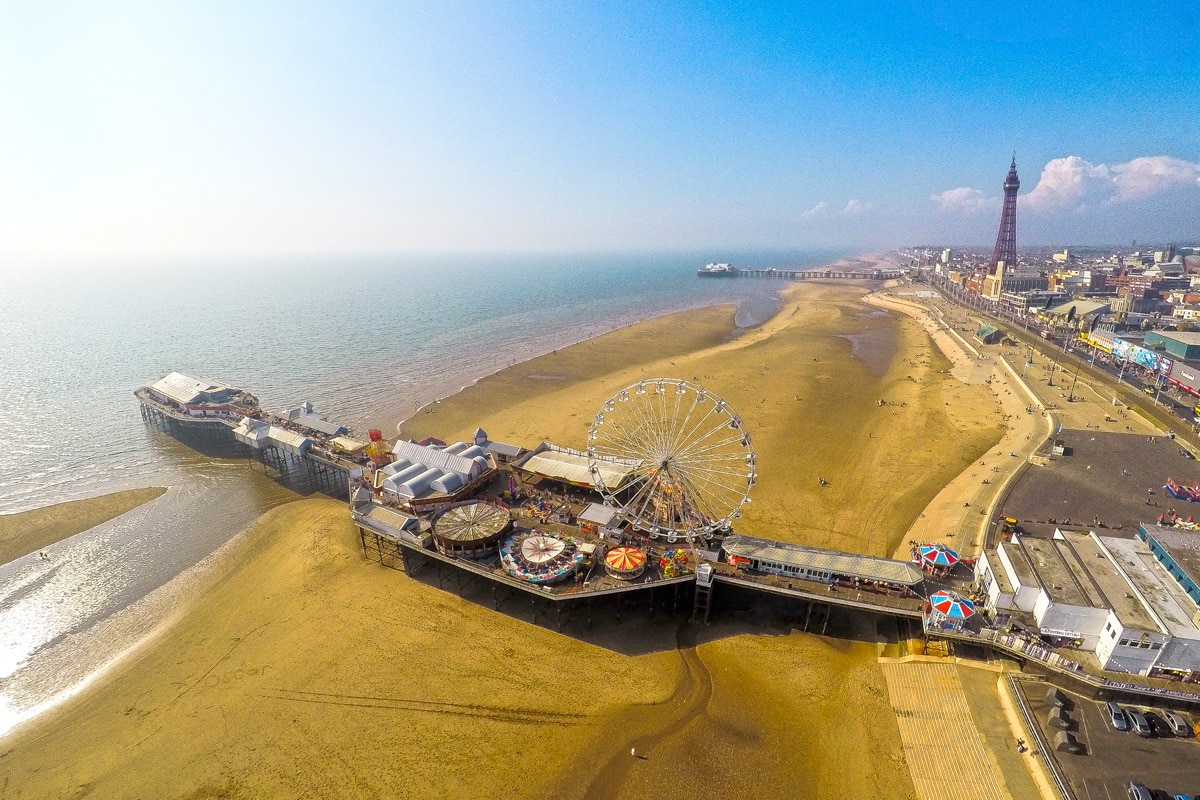
Blackpool is a seaside town on the Lancashire coast, in north-west England. Average sold prices in Blackpool sit at £135,792 on the HM Land Registry House Price Index, 53.2% below England's £289,946 and 36.7% under the North West regional average of £214,678. That makes Blackpool one of the cheapest places to buy a home anywhere in the country, and it is the price, not the rent, that defines this market. When the purchase number is this low, even modest rents turn into yields the rest of the North West cannot match.
The trade-off is written into the rest of the data. Blackpool's median weekly wage is £612.70, below both the North West's £720.10 and the Great Britain figure of £752.40, and the working-age employment rate of 70.9% sits under the regional and national marks. The result is high rental yields on a low-wage local economy, with modest capital growth. For investors, the seven postcodes split into a clear two-tier town: FY1 in the centre at a £111,172 asking price and a 6.6% yield, against the inland and coastal-north stock in FY6 and FY8 that runs past £290,000 with yields nearer 3%.
This guide covers the unitary authority of Blackpool (ONS code E06000009) across postcodes FY1, FY2, FY3, FY4, FY5, FY6, and FY8. Blackpool sits on the Lancashire coast in the North West region, about 17 miles west of Preston. The wider Lancashire buy-to-let region also takes in Preston and the inland mill towns.
Article updated: July 2026
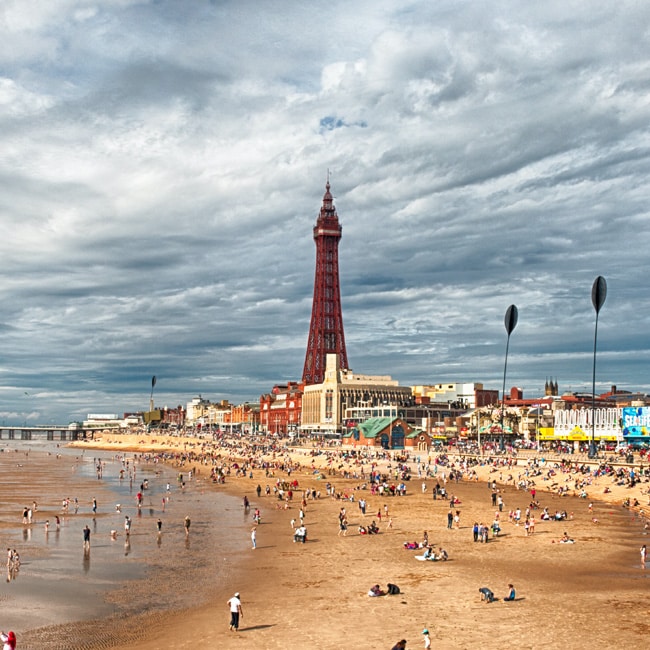
Why Invest in Blackpool?
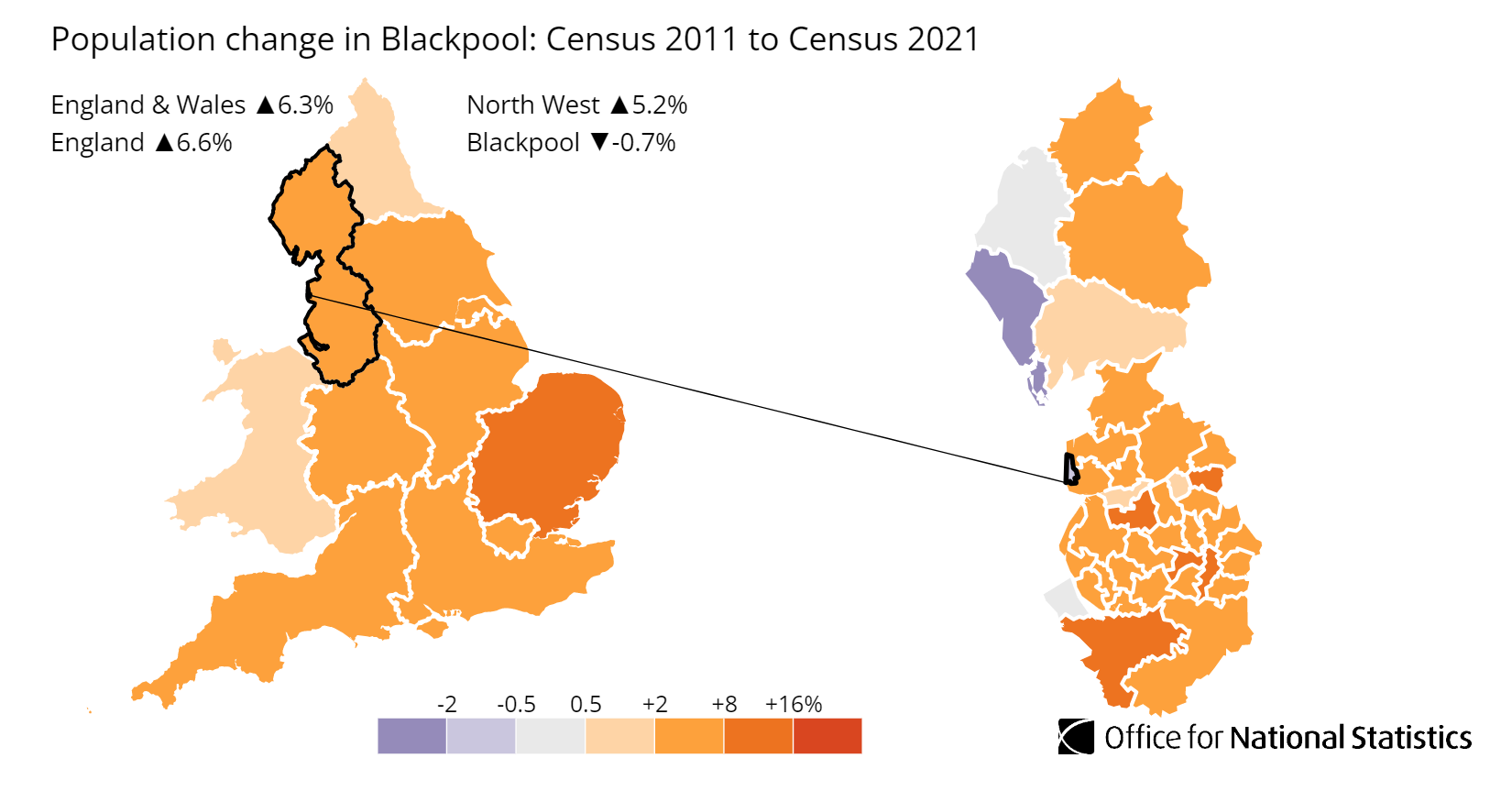
Blackpool's population was 141,036 at the 2021 Census, down 0.72% on the 142,065 recorded in 2011, making it one of the few English areas to shrink over the decade. While England and Wales grew 6.3%, Blackpool went backwards. The town's draw has always been the visitor economy rather than population growth, and the resident base reflects that: a tight, mostly low-rise town packed against the sea, with the centre carrying a far higher share of small flats and rented homes than the inland suburbs.
The local economy leans on tourism, hospitality, health and the public sector. The recent arrival of more than 3,000 civil service jobs in the town centre is the single biggest shift in that mix in years, anchoring a band of stable, salaried renters around FY1 and FY2 that the resort economy on its own never provided. Outside that, employment is weighted towards seasonal and service work, which is part of why local wages trail the region.
Median gross annual earnings in Blackpool are £31,858, which is 18.6% below the North West regional median of £37,445 and 18.6% under the Great Britain median of £39,125. Lower wages cap what most tenants can pay, so open-market rents here are modest in cash terms even where yields are high. It also means a larger share of the local rental market is underpinned by housing benefit, which turns the Local Housing Allowance rate into a real floor under rents rather than a footnote.
Blackpool Economic Summary
- Population (Blackpool): 141,036 (2021 Census). A fall of 0.72% from 2011.
- Median annual salary: £31,858 (local), £37,445 (North West), £39,125 (Great Britain)
- Employment rate: 70.9% (local), 74.2% (North West), 75.6% (Great Britain)
- Unemployment rate: 4.4% (local)
- Key employment sectors: Accommodation and food, health and social work, retail, public administration, the new central civil service hub
Source: ONS Census 2021, Nomis Labour Market Profile (ASHE 2025)
Regeneration and Investment in Blackpool
Blackpool's regeneration runs on public and government money rather than private speculation, with a completed £100 million civil service hub, a £300 million leisure site being relaunched, and £90 million of government funding aimed at the town's worst housing. For a buy-to-let investor the housing money matters most, because it targets exactly the low-quality inner-town stock that has held prices down for years.
- Talbot Gateway Phase 3, Civil Service Hub (Completed, £100 million): The seven-storey, 215,000 sq ft hub opened in 2025 and now houses more than 3,000 Department for Work and Pensions staff relocated into Blackpool town centre. It forms phase three of the wider £350 million Talbot Gateway programme. For the rental market around FY1 and FY2, several thousand salaried, year-round workers is a structural change from a town that ran largely on seasonal employment. Updates at Muse.
- Blackpool Central (Site relaunch, £300 million): The 10-acre site off the Golden Mile, in the shadow of Blackpool Tower, was placed back on the market in late 2025 after the original developer, Nikal, went into administration in 2024 having delivered only a multi-storey car park. The council has appointed advisers to draw up a fresh masterplan for indoor attractions, hotels and restaurants. The scheme is real but early, so any effect on the surrounding market is years out. Updates at Lancashire Business View.
- Inner Blackpool Housing Regeneration (Funded, £90 million): Government funding through Homes England's Brownfield Infrastructure Land programme is aimed at clearing poor-quality housing in inner Blackpool and replacing it with new homes, alongside an enforcement pilot pushing landlords of substandard properties to improve or sell. This is concentrated in the FY1 and FY2 wards that carry the town's deepest rented sector. Updates at GOV.UK.
Source: Office for National Statistics - Population for Blackpool
Blackpool Property Market Analysis
Average property prices in Blackpool have risen 247.2% since January 1995, from £39,105 to £135,792. That is real long-term growth, but it has come with a deeper crash and a far slower recovery than most of England. The sections below trace the cycle, then drill into postcode-level data for sold prices, price per square foot, asking prices, growth, transaction volumes and how long homes take to sell.
When was the last house price crash in Blackpool?
Blackpool is a unitary authority, so all sold prices from HM Land Registry are recorded at the town level. The House Price Index tracks average prices from January 1995 to March 2026, covering 31 years of market cycles.
The 1995 to 2007 boom: Blackpool started at £39,105 in January 1995. By December 2000 the average had reached £44,321, then growth accelerated sharply through the early 2000s, hitting £109,715 by December 2005. The market peaked at £119,650 in October 2007.
2008 to 2013, the long decline: This is where Blackpool's story diverges from a typical English town. Prices did not just dip and recover. From the October 2007 peak of £119,650 they fell to a trough of £88,456 in March 2013, a drop of 26.1% spread over more than five years. The worst single year-on-year reading was -15.9% in March 2009. The combination of a low-wage local economy and a large stock of older, low-value housing meant Blackpool had no buffer when credit tightened, and the bottom took far longer to arrive than the 2009 trough most regions saw.
2014 to 2020, a slow climb: Recovery was gradual rather than sharp. Prices were still only £92,179 by March 2016 and £102,032 by December 2019, edging up year by year without ever running hot. The town spent most of the decade rebuilding ground lost in the crash rather than setting new highs.
2021 to 2022, the pandemic catch-up: The stamp duty holiday and a national scramble for cheaper homes finally pushed Blackpool past its old peak. Prices reached £111,224 by March 2021 and £131,925 by December 2022. It was September 2021, almost fourteen years after the October 2007 peak, before the average price first climbed back above £119,650. That is one of the longest recoveries of any English market.
2023 to present: Higher mortgage rates cooled the market to £128,091 by December 2023, then prices ground back up to an all-time high of £136,182 in January 2026 before easing slightly to £135,792 by March 2026. The current price is 13.5% above the October 2007 pre-crash peak, a far thinner premium than most of England carries.
Long-term growth summary:
- 5 years (March 2021 to March 2026): 22.1% growth (£111,224 to £135,792)
- 10 years (March 2016 to March 2026): 47.3% growth (£92,179 to £135,792)
- 15 years (March 2011 to March 2026): 48.5% growth (£91,466 to £135,792)
- 20 years (March 2006 to March 2026): 20.9% growth (£112,314 to £135,792)
- 30 years (January 1995 to March 2026): 247.2% growth (£39,105 to £135,792)
Two figures in that table tell the real story. The 30-year return of 247.2% confirms Blackpool does build wealth over a long hold. But the 20-year return of only 20.9% shows how much of the past two decades was spent recovering from the crash rather than growing, because March 2006 was already near the top of the boom. An investor who bought at the exact October 2007 peak waited until late 2021 just to break even on the Land Registry average. Blackpool rewards income and patience, not a quick exit.
- All property types
- Detached
- Semi-detached
- Terraced
- Flats
- All property types
- Detached
- Semi-detached
- Terraced
- Flats
Sold House Prices in Blackpool
The average sold price across all property types in Blackpool is £135,792, which is 53.2% below the England average of £289,946 as of March 2026. That deep discount runs through every property type, but it widens as the homes get smaller. Detached houses are exactly half the England price, while flats sell for barely a third of theirs. The pattern tells you where the cheap end of this market sits: in the small, older coastal stock, not the family houses.
| Property Type | Blackpool Average | England Average | Difference |
|---|---|---|---|
| Detached houses | £235,744 | £470,492 | -49.9% |
| Semi-detached houses | £159,065 | £288,185 | -44.8% |
| Terraced houses | £119,337 | £243,788 | -51.0% |
| Flats and maisonettes | £75,209 | £214,563 | -64.9% |
| All property types | £135,792 | £289,946 | -53.2% |
Detached houses at £235,744 carry the narrowest gap to England at 49.9% below, and they concentrate in the inland and coastal-north postcodes, FY6 (Poulton-le-Fylde) and FY8 (Lytham St Annes), where the larger family stock sits. Annual growth of 2.7% points to steady owner-occupier demand rather than investor heat.
Semi-detached houses at £159,065 hold the smallest discount of all at 44.8% below England's £288,185, and they are the most evenly spread type across the town. With 3.1% annual growth, the strongest of any type here, the semi is the workhorse of Blackpool's suburban lettings market in FY2, FY5 and FY3.
Terraced houses at £119,337 sit 51.0% under England's £243,788. The terraced stock is the backbone of the inner town, heavily concentrated in FY1 and FY4, and at 2.9% annual growth it tracks the semis closely. These are the lower-cost family and sharer lets that pair with the town's higher-yielding postcodes.
Flats and maisonettes at £75,209 show the deepest discount anywhere at 64.9% below England's £214,563, and they are unusually central to this market: half of all homes in FY1 are flats. Annual change of -2.9% is the one negative reading in the table, reflecting an oversupplied, older flat market in the town centre rather than the institutional new-build stock that lifts flat prices in Manchester or Leeds.
Price Per Square Foot in Blackpool
£144 per square foot separates Blackpool's cheapest postcode from its dearest, with FY1 at £101 and FY8 at £245. Measuring by the square foot strips out how big the homes are and shows what the location itself commands. FY8 (Lytham St Annes) tops the table by a clear margin, which fits its status as the genteel, higher-value end of the Fylde coast.
| Rank | Area | Price Per Sq Ft |
|---|---|---|
| 1 | FY1 (Town Centre, North Shore) | £101 |
| 2 | FY3 (Layton, Stanley Park) | £152 |
| 3 | FY4 (South Shore, Marton) | £158 |
| 4 | FY2 (Bispham) | £162 |
| 5 | FY5 (Cleveleys, Thornton) | £199 |
| 6 | FY6 (Poulton-le-Fylde) | £241 |
| 7 | FY8 (Lytham St Annes) | £245 |
FY1 at £101 per square foot is the cheapest bricks-and-mortar value not just in Blackpool but in much of the country. This covers the town centre and North Shore, where small flats and converted period terraces dominate. The figure is built on 661 transactions, the deepest sample in the town, and it sits 59% below FY8's. At this price an investor is buying floor space about as cheaply as anywhere in England.
FY8 at £245 per square foot tops the table, with FY6 just behind at £241. When buyers pay this much per square foot they are paying for location: Lytham St Annes and Poulton-le-Fylde are the established, affluent edges of the Fylde coast, physically and economically separate from the resort core. The 1,040 FY8 transactions analysed show a consistent premium over the rest of the town.
For Sale Asking Prices in Blackpool
FY1 at £111,172 and FY8 at £318,173 sit 186% apart, a spread that effectively splits Blackpool into two different markets. The hierarchy follows the price-per-square-foot table almost exactly. The mean asking price across all seven postcodes is £204,149.
| Rank | Area | Asking Price |
|---|---|---|
| 1 | FY1 (Town Centre, North Shore) | £111,172 |
| 2 | FY3 (Layton, Stanley Park) | £156,161 |
| 3 | FY4 (South Shore, Marton) | £166,009 |
| 4 | FY2 (Bispham) | £175,876 |
| 5 | FY5 (Cleveleys, Thornton) | £206,937 |
| 6 | FY6 (Poulton-le-Fylde) | £294,713 |
| 7 | FY8 (Lytham St Annes) | £318,173 |
FY1 at £111,172 is the lowest entry point in the town and one of the lowest in England, well under half the £294,713 and £318,173 of the FY6 and FY8 top end. For an investor working to a fixed budget, two FY1 purchases cost less than a single home in Lytham St Annes. This is the postcode that makes Blackpool a yield story.
FY8's £318,173 is the outlier. Lytham St Annes prices like a separate, more prosperous town that happens to share the FY postcode area, and the rental yield data below confirms that the premium buys lifestyle, not income. The four mid-table postcodes, FY3 through FY5, fill the gap between the two ends and offer the broadest mix of family stock.
House Price Growth in Blackpool
Every Blackpool postcode posted positive five-year growth, from 10.5% in FY6 to 15.9% in FY3, but the one-year and three-year readings are far more mixed. FY6 (Poulton-le-Fylde) is the standout warning here: a strong 5.1% over three years but down 4.7% over the past year, the weakest recent reading in the town. No postcode grew across all three timeframes, which is the recurring shape of a market still finding its footing.
| Area | 1 Year | 3 Years | 5 Years |
|---|---|---|---|
| FY3 (Layton, Stanley Park) | 1.5% | 4.9% | 15.9% |
| FY2 (Bispham) | 3.5% | 3.6% | 15.0% |
| FY5 (Cleveleys, Thornton) | 0.2% | -1.6% | 13.9% |
| FY8 (Lytham St Annes) | 1.9% | 3.5% | 12.7% |
| FY4 (South Shore, Marton) | 4.9% | 1.4% | 11.8% |
| FY1 (Town Centre, North Shore) | 0.0% | -4.2% | 11.6% |
| FY6 (Poulton-le-Fylde) | -4.7% | 5.1% | 10.5% |
FY3 at 15.9% over five years leads the town, paired with positive readings over one and three years too, which makes Layton and Stanley Park the most consistent growth pocket in Blackpool. FY2 (Bispham) is close behind at 15.0% with the same all-positive shape. Both are settled inland suburbs rather than resort-front stock, which tends to move more steadily.
FY1's flat 0.0% one-year and -4.2% three-year readings sit at the bottom on recent momentum, even though its 11.6% five-year figure is healthy. The town-centre stock that delivers the best yield is also the most volatile on capital value, a familiar pairing in a market where the cheapest homes carry the highest income and the softest growth.
Monthly Property Sales in Blackpool
Transaction volumes vary widely across Blackpool, from 23 sales a month in FY2 up to 57 in FY5, with turnover rates running from 6% in FY6 to 13% in FY3 and FY4. Even the slower postcodes see steady monthly turnover, but the headline difference is between the busy suburban markets and the quieter premium edges.
| Area | Sales Per Month | Turnover | Asking Price |
|---|---|---|---|
| FY5 (Cleveleys, Thornton) | 57 | 11% | £206,937 |
| FY8 (Lytham St Annes) | 53 | 8% | £318,173 |
| FY4 (South Shore, Marton) | 48 | 13% | £166,009 |
| FY1 (Town Centre, North Shore) | 36 | 12% | £111,172 |
| FY3 (Layton, Stanley Park) | 31 | 13% | £156,161 |
| FY6 (Poulton-le-Fylde) | 29 | 6% | £294,713 |
| FY2 (Bispham) | 23 | 11% | £175,876 |
FY3 and FY4 share the highest turnover at 13%, meaning a larger share of their homes change hands each year. For a landlord that liquidity matters as much as yield, because it signals a postcode where there are usually buyers around when you want to sell. FY4's mix of mid-priced South Shore family stock keeps it moving.
FY6 records the lowest turnover at 6% despite a high asking price, the mark of a premium suburb where homes are held longer and sell slowly. FY5 logs the most transactions at 57 a month, but on a larger housing base that still works out to an average 11% turnover. The pattern is consistent: the cheaper and mid-priced postcodes move more freely than the dear ones.
How Long Properties Take to Sell in Blackpool
FY3 (Layton, Stanley Park) clears fastest at about 234 days, while FY6 (Poulton-le-Fylde) drags out to roughly 507 days, with no postcode in the town reaching a seller's market. Days on market is the typical time a home is listed before it sells, and months of unsold stock shows how much for-sale supply is queued at the current sales rate. In Blackpool both numbers run high, which is the holding-cost catch that a yield figure on its own never shows.
| Area | Avg Days to Sell | Months of Unsold Stock | Market |
|---|---|---|---|
| FY3 (Layton, Stanley Park) | 234 | 7.7 | Balanced market |
| FY1 (Town Centre, North Shore) | 254 | 8.3 | Balanced market |
| FY4 (South Shore, Marton) | 254 | 8.3 | Balanced market |
| FY2 (Bispham) | 277 | 9.1 | Balanced market |
| FY5 (Cleveleys, Thornton) | 277 | 9.1 | Balanced market |
| FY8 (Lytham St Annes) | 380 | 12.5 | Buyer's market |
| FY6 (Poulton-le-Fylde) | 507 | 16.7 | Buyer's market |
Even Blackpool's quickest postcode takes around eight months to sell, and the two premium areas sit in a buyer's market where homes can take well over a year to shift. FY6's 16.7 months of unsold stock is a long time to carry a property you are trying to move on, especially against the income you give up while it sits. The high yield in FY1 comes with a slow exit everywhere, so the market favours holding and earning over a quick trade.
What Type of Property Can You Buy in Blackpool?
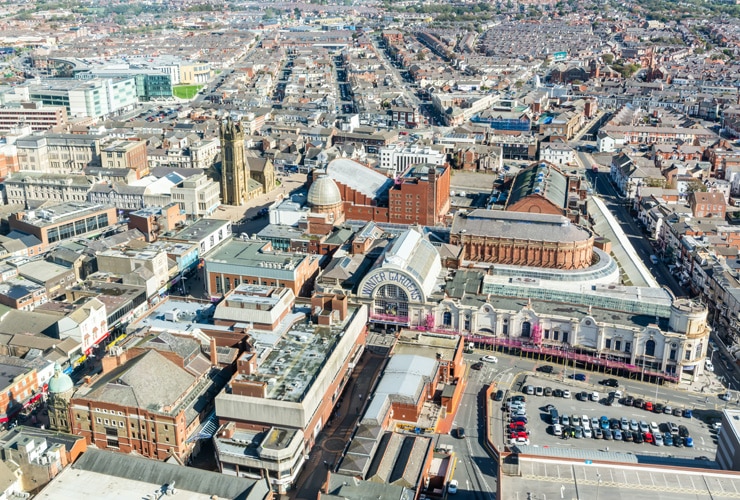
The housing mix flips completely across the town: flats make up half of all homes in FY1, while detached houses make up half in FY8. No two postcodes here look alike, and the stock profile is the clearest guide to which strategy fits where. The figures below are drawn from 2021 Census records for each postcode.
| Area | Detached | Semi-detached | Terraced | Flats |
|---|---|---|---|---|
| FY1 (Town Centre, North Shore) | 3.6% | 14.5% | 31.9% | 50.0% |
| FY2 (Bispham) | 13.9% | 53.9% | 17.9% | 14.4% |
| FY3 (Layton, Stanley Park) | 27.4% | 35.0% | 27.2% | 8.7% |
| FY4 (South Shore, Marton) | 25.9% | 31.5% | 22.1% | 18.1% |
| FY5 (Cleveleys, Thornton) | 30.9% | 47.7% | 11.2% | 10.2% |
| FY6 (Poulton-le-Fylde) | 48.4% | 27.7% | 9.9% | 3.4% |
| FY8 (Lytham St Annes) | 51.4% | 27.8% | 7.7% | 12.2% |
FY1 is built for the rental market, with flats at 50.0% and terraces at 31.9% making up more than four in five homes, and barely any detached stock at 3.6%. That is the small-unit profile that pairs with the lowest asking price and the highest yield in the town. The flats suit single lets and the terraces lower-cost family and sharer lets, which is exactly the part of the market the £90 million inner-town housing programme is targeting.
FY6 and FY8 sit at the opposite pole, with detached houses at 48.4% and 51.4% and flats down at 3.4% and 12.2%. Poulton-le-Fylde and Lytham St Annes are owner-occupier territory weighted towards larger family homes, which matches their premium prices and their lowest-in-town yields. FY2 stands out for its 53.9% semi-detached share, the suburban pocket that gives Bispham its steady, family-let character.
The flats figure covers both purpose-built blocks and conversions, and a small share of mobile and temporary dwellings is excluded, so rows may not total 100%.
Blackpool Rental Market Analysis
Monthly rents in Blackpool range from £610 in FY1 to £939 in FY6, with gross rental yields running from 3.1% to 6.6% across the seven postcodes. For investors asking is buy to let a good investment in Blackpool, the sections below break down rents, yields and tenant affordability postcode by postcode. If you are looking at how to start a property business on the Lancashire coast, Blackpool's appeal is income: low asking prices turning ordinary rents into strong yields. Browse current buy-to-let property for sale across the region.
Average Rent & Gross Rental Yields in Blackpool
Gross rental yields in Blackpool range from 3.1% in FY8 to 6.6% in FY1. The relationship is the cleanest you will find: the cheapest postcode delivers the highest yield, the dearest delivers the lowest, in almost perfect order. FY1 turns the town's lowest rent of £610 a month into the top yield because its £111,172 asking price is so low.
| Area | Average Monthly Rent | Asking Price | Gross Yield |
|---|---|---|---|
| FY1 (Town Centre, North Shore) | £610 | £111,172 | 6.6% |
| FY3 (Layton, Stanley Park) | £813 | £156,161 | 6.2% |
| FY7 (Fleetwood, Cleveleys edge) | £758 | £154,007 | 5.9% |
| FY2 (Bispham) | £710 | £175,876 | 4.8% |
| FY4 (South Shore, Marton) | £656 | £166,009 | 4.7% |
| FY5 (Cleveleys, Thornton) | £725 | £206,937 | 4.2% |
| FY6 (Poulton-le-Fylde) | £939 | £294,713 | 3.8% |
| FY8 (Lytham St Annes) | £832 | £318,173 | 3.1% |
FY1 at 6.6% combines the lowest asking price with the lowest rent yet still delivers the best return in the town. A 30% deposit of £33,352 buys into the highest-yielding postcode, the smallest cash commitment of anywhere in this guide. FY3 at 6.2% is the next tier, pairing a slightly higher rent with the town's strongest five-year growth, which makes Layton and Stanley Park the closest thing here to income and growth in one postcode.
FY8 at 3.1% sits at the bottom of the yield table. The £832 monthly rent is solid, but against a £318,173 asking price the income return is thin. In Lytham St Annes, as in FY6, the premium price does far more for capital value and tenant quality than it does for yield.
Gross Rental Yield by Postcode
Is Blackpool Rent High?
Monthly rents in Blackpool take between 23.0% and 35.4% of the local median gross salary. The widely cited threshold for rent affordability is 30% of gross income. Five of the seven postcodes fall below that line, which is a more affordable spread than most of England and reflects how low Blackpool's cash rents are even where yields are high.
A typical Blackpool wage is £612.70 a week, or about £2,655 in the hand each month and £31,858 a year. That trails the North West's £720.10 a week and Great Britain's £752.40, and it is the ceiling most local tenants are working against. Figures from the Nomis Labour Market Profile (ASHE 2025).
| Rank | Area | Rent as % of Income |
|---|---|---|
| 1 | FY6 (Poulton-le-Fylde) | 35.4% |
| 2 | FY8 (Lytham St Annes) | 31.3% |
| 3 | FY3 (Layton, Stanley Park) | 30.6% |
| 4 | FY5 (Cleveleys, Thornton) | 27.3% |
| 5 | FY2 (Bispham) | 26.8% |
| 6 | FY4 (South Shore, Marton) | 24.7% |
| 7 | FY1 (Town Centre, North Shore) | 23.0% |
FY1 at 23.0% is comfortably the most affordable for tenants, with a £610 rent against a £2,655 monthly salary leaving real headroom. Affordable rents tend to correlate with lower voids and fewer arrears, because tenants who are not stretched stay put, and that matters more in a low-wage town than in a high-earning one.
FY6 at 35.4% is the only postcode where rent sits well above the 30% mark, but the context is that Poulton-le-Fylde tenants paying £939 a month are typically dual-income or professional households rather than someone on the town's median wage. The premium postcodes ask more of income because they draw a wealthier renter.
How Big Is Blackpool's Private Rented Sector?
The private rented sector dominates FY1, where 52.9% of households rent privately, more than four times the 13.0% in FY6 and FY8. The share of homes already let privately is a read on how big and how established the local tenant pool is, and few places in England show a split this stark inside one town. The table below shows household tenure by postcode.
| Area | Owned Outright | Owned with Mortgage | Private Rented | Social Rented |
|---|---|---|---|---|
| FY1 (Town Centre, North Shore) | 20.9% | 15.1% | 52.9% | 10.4% |
| FY4 (South Shore, Marton) | 35.6% | 33.4% | 24.7% | 6.0% |
| FY3 (Layton, Stanley Park) | 37.8% | 32.4% | 23.1% | 6.5% |
| FY2 (Bispham) | 38.1% | 31.6% | 21.2% | 8.5% |
| FY5 (Cleveleys, Thornton) | 43.1% | 32.7% | 18.8% | 4.6% |
| FY6 (Poulton-le-Fylde) | 52.2% | 30.3% | 13.0% | 3.8% |
| FY8 (Lytham St Annes) | 50.5% | 32.3% | 13.0% | 4.0% |
FY1's 52.9% private rented share is the deepest established tenant market in the town by a wide margin, the proven, ready-made lettings demand that comes with the highest yield. It is also the most reliant on renting of any kind, with home ownership well below half, which is the flip side of the same coin: a transient, lower-income population that needs careful tenant management and is exactly what the inner-town housing regeneration is trying to reshape.
FY6 and FY8 sit at the other end on 13.0% private rented and over half owned outright, the settled owner-occupier suburbs where a landlord competes for a smaller, thinner pool of tenants. On the rental supply side, FY8 currently reads as a landlord's market, with around 48 homes advertised to let taking roughly 62 days to find a tenant, a faster let than FY1's balanced reading of about 86 homes on the market at around 87 days. The other five postcodes have too few rental listings at any one time to read with confidence.
Local Housing Allowance Rates in Blackpool
All seven Blackpool postcodes fall within the Fylde Coast Broad Rental Market Area, where Local Housing Allowance runs from £80.75 a week for a shared room to £170.88 a week for a four-bedroom home. Local Housing Allowance is the most a tenant on housing benefit can claim towards rent, so in a town where a large share of the inner-market lettings run on benefits, it acts as a genuine floor under what those homes can charge. The rates below apply across the whole of Blackpool. To check the current rate for a specific address, you can use the government's official Local Housing Allowance calculator.
| Property Size | Weekly LHA Rate | Monthly Equivalent |
|---|---|---|
| Shared accommodation | £80.75 | £350 |
| 1 bedroom | £92.05 | £399 |
| 2 bedrooms | £124.73 | £540 |
| 3 bedrooms | £143.84 | £623 |
| 4 bedrooms | £170.88 | £740 |
The two-bedroom Fylde Coast rate of £124.73 a week works out at about £540 a month, which lands close to the £610 to £939 open-market rents recorded across the town and almost level with FY1's £610. In a postcode like FY1, where benefit-backed tenancies are common and the gap between LHA and market rent is small, the allowance effectively underpins a large slice of the lettings market. The rate is identical in every Blackpool postcode because it is set across the whole Fylde Coast area.
Buy-to-Let Considerations
Are House Prices High in Blackpool? Price-to-Earnings Ratios
Buying a property in Blackpool takes between 3.5 and 10.0 times the median annual salary. This is based on the Nomis Labour Market Profile for Blackpool showing the median gross annual income for Blackpool residents is £31,858.
The national benchmark for price-to-earnings is 7.4x (England's average sold price of £289,946 divided by the Great Britain median annual salary of £39,125). Five of Blackpool's seven postcodes sit below that national benchmark, meaning they are more affordable relative to local incomes than the England average is relative to national incomes.
| Rank | Area | Price-to-Earnings Ratio |
|---|---|---|
| 1 | FY1 (Town Centre, North Shore) | 3.5x |
| 2 | FY3 (Layton, Stanley Park) | 4.9x |
| 3 | FY4 (South Shore, Marton) | 5.2x |
| 4 | FY2 (Bispham) | 5.5x |
| 5 | FY5 (Cleveleys, Thornton) | 6.5x |
| 6 | FY6 (Poulton-le-Fylde) | 9.3x |
| 7 | FY8 (Lytham St Annes) | 10.0x |
FY1 at 3.5x is less than half the national benchmark of 7.4x and the most affordable entry point in this guide. At three and a half times local earnings, the town-centre stock is about as accessible as anywhere in England relative to income, though the low ratio reflects low local wages as much as low prices.
FY8 at 10.0x and FY6 at 9.3x sit well above the benchmark. Lytham St Annes and Poulton-le-Fylde price at roughly ten and nine times the town's median salary, firmly into the premium band where buyers are dual-income or incomers from dearer areas. For investors the high ratio is what compresses the yields in those two postcodes.
Deposit Requirements in Blackpool
A 30% deposit on a buy-to-let property in Blackpool ranges from £33,352 in FY1 to £95,452 in FY8. The gap between the cheapest and most expensive deposit is £62,100, enough to fund nearly two more FY1 deposits. For investors comparing Blackpool with the rest of the North West, the FY1 entry is among the lowest deposits available anywhere in the region.
Beyond the deposit, the stamp duty land tax calculator and the costs of buy to let affect the total capital required.
| Rank | Area | 30% Deposit Required |
|---|---|---|
| 1 | FY1 (Town Centre, North Shore) | £33,352 |
| 2 | FY3 (Layton, Stanley Park) | £46,848 |
| 3 | FY4 (South Shore, Marton) | £49,803 |
| 4 | FY2 (Bispham) | £52,763 |
| 5 | FY5 (Cleveleys, Thornton) | £62,081 |
| 6 | FY6 (Poulton-le-Fylde) | £88,414 |
| 7 | FY8 (Lytham St Annes) | £95,452 |
FY1 is the cheapest way into Blackpool at a £33,352 deposit, and it buys the highest yield in the town at 6.6%. Stepping up to FY3 costs around £13,000 more, and the extra is not just a bigger number. Layton and Stanley Park still yield a strong 6.2%, but they add the town's best five-year growth at 15.9% and its joint-highest turnover at 13% for an easier sale. FY1 keeps the entry cost and the management bar low; FY3 trades a touch of yield for stronger growth and easier resale.
At the top, FY6 and FY8 are within £7,038 of each other on the deposit, but they sell at very different speeds. FY8 lets faster, currently reading as a landlord's market, while FY6 carries the slowest sale in the town at over 500 days and a 6% turnover. Similar capital, but FY8 is the more liquid of the two premium postcodes if exit matters.
What the Blackpool Data Tells Buy-to-Let Investors
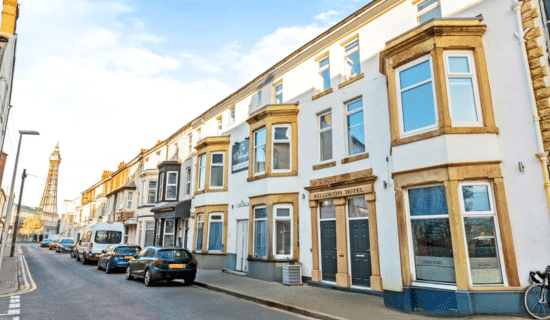
In Blackpool the cheapest way in is also the highest-yielding, by a wide margin. FY1 has the top yield at 6.6%, the lowest asking price for buying an investment property at £111,172, and the most affordable prices against local earnings at 3.5 times income. A 30% deposit there is £33,352, the smallest in the town, for a home renting at £610 a month in the postcode with the deepest private rented sector in Blackpool at 52.9%.
FY3 is the postcode that comes closest to doing two jobs at once. It still yields 6.2%, close to FY1, but it adds the town's strongest five-year growth at 15.9% and an easier exit through its joint-highest turnover of 13%. It costs about £13,000 more in deposit than FY1, and that buys down the management intensity of the town centre for steadier growth and a more settled tenant base in Layton and Stanley Park.
The premium postcodes tell the opposite story. FY8 (Lytham St Annes) and FY6 (Poulton-le-Fylde) carry asking prices over £290,000 and yields of 3.1% and 3.8%, with FY6 down 4.7% over the past year and sitting on the market for over 500 days. The price buys location and tenant quality, not income or liquidity. Investors who want to come in below asking in any of these postcodes often work the off-market properties route, which matters more in a town where so much stock sells slowly.
The town-wide picture is a high-yield income market with a low-wage base, a deep benefits-backed rental sector and a slow exit everywhere. The data shows strong cash returns up front, with modest and uneven capital growth and a slow resale market. The £100 million civil service hub and the £90 million inner-town housing programme are two recent public investments in the FY1 and FY2 areas.
How Blackpool Compares
Blackpool's mean asking price of £204,149 is the lowest of five North West locations compared here, yet its top yield of 6.6% beats every one of them. The comparison below places Blackpool alongside four nearby locations, each with a different investor profile. The mean asking price and mean monthly rent are simple averages across all postcodes with data. Top gross yield is the single highest postcode yield in each location.
| Location | Mean Asking Price | Mean Monthly Rent | Mean Gross Yield | Top Yield (postcode) |
|---|---|---|---|---|
| Blackpool | £204,149 | £755 | 4.4% | 6.6% (FY1) |
| Liverpool | £207,760 | £870 | 5.0% | 7.4% (L20) |
| Stoke-on-Trent | £239,223 | £828 | 4.2% | 6.7% (ST1) |
| Manchester | £266,893 | £1,308 | 5.9% | 7.8% (M14) |
| Warrington | £311,729 | £1,068 | 4.1% | 4.7% (WA5) |
Blackpool is the cheapest entry in this comparison at a £204,149 mean asking price, and its 6.6% top yield sits in the same high-income band as Liverpool and Stoke-on-Trent rather than the lower-yielding Cheshire markets. Where it differs from those two is the depth of the discount and the slow exit: Blackpool's prices and rents are the lowest of the five, which is what carries the yield, but its homes also take longer to sell than the regional norm.
For investors prioritising income, Liverpool at 7.4% and Manchester at 7.8% edge ahead on headline yield with deeper, more liquid markets. Stoke-on-Trent offers a similar low-cost, high-yield profile inland. For investors who want a more affluent tenant base and steadier values, Warrington sits at the Cheshire-premium end with the lowest yield in the table. For a data-driven comparison across all UK locations, see our best buy-to-let areas guide.
Frequently Asked Questions
Is Blackpool a good place to invest in buy-to-let?
It is one of the strongest income markets in England, with the trade-offs that come with that. The pull is the price: at a £135,792 average sold price, 53.2% below the England figure, ordinary rents turn into yields up to 6.6% in FY1. The catch is a low-wage local economy, with median earnings of £31,858 against a £39,125 national figure, and a slow resale market across the whole town.
The profile is cash flow held over years rather than a quick trade, with little on offer to anyone banking on fast capital growth or a fast exit.
What are the best areas in Blackpool for property investment?
It depends whether you are after income or a steadier hold. FY1 (Town Centre and North Shore) is the cheapest way in at £111,172 and the highest-yielding at 6.6%, with the deepest rented sector in the town, so it leans hard towards income but needs more hands-on management. FY3 (Layton and Stanley Park) pairs a 6.2% yield with the best five-year growth at 15.9% and easier resale, which makes it the most balanced postcode.
At the top end, FY6 (Poulton-le-Fylde) and FY8 (Lytham St Annes) ask over £290,000 for yields of 3.8% and 3.1%, so they suit buyers who value tenant quality and location over income. If yield is the goal, FY1 and FY3 lead.
How does Blackpool compare to Liverpool for buy-to-let?
They are close on yield but different in depth. Liverpool's top yield of 7.4% edges Blackpool's 6.6%, on a near-identical mean asking price of £207,760 against £204,149. The real gap is liquidity: Liverpool is a much larger, busier market with many more postcodes and a deep student sector, while Blackpool's homes take longer to sell, with even the quickest postcode around eight months.
Blackpool's edge is the rock-bottom entry in FY1, the cheapest in either town. Liverpool offers more choice and a faster exit; Blackpool offers the lowest possible buy-in for a high yield. Which wins comes down to whether you value liquidity or the cheapest entry.
Can I find buy-to-let property under £150,000 in Blackpool?
Yes, more easily than almost anywhere in England. FY1 (Town Centre, North Shore) averages just £111,172, comfortably under £150,000, and FY7's neighbouring stock and FY3 are not far above it. By property type the entry is lower still: terraced houses across Blackpool average £119,337 and flats £75,209 on the Land Registry index. For sub-£150,000 buying, FY1 flats and terraces are the obvious hunting ground, or look at below market value property.
Is there demand for HMO and shared housing in Blackpool?
There is, concentrated in FY1, though the live room-rent data is thin. The town centre's mix of 50% flats and a 52.9% private rented sector is the classic profile for shared and multi-let housing, and the lowest prices in the town make the numbers work on paper. There were not enough current room adverts in any FY postcode to publish a reliable single-room or ensuite rent, so model HMO income carefully against local agents rather than headline figures. For how the numbers stack up on a shared house, see our complete guide to investing in HMOs.
What are average house prices in Blackpool?
The average sold price across Blackpool is £135,792 on the Land Registry index, about 53.2% below the England average of £289,946 as of March 2026. Asking prices by postcode run from £111,172 in FY1 (Town Centre, North Shore) up to £318,173 in FY8 (Lytham St Annes), with a town-wide mean of £204,149. By type, detached homes average £235,744, semi-detached £159,065, terraced £119,337 and flats £75,209.
Through a buy-to-let lens, FY1 is the cheapest entry and the highest-yielding at 6.6%, while FY8 is the dearest and lowest-yielding at 3.1%.
What are the Local Housing Allowance rates in Blackpool?
All seven Blackpool postcodes fall in the Fylde Coast Broad Rental Market Area, so they share one set of rates. As of June 2026, Local Housing Allowance runs at £80.75 a week for a shared room, £92.05 for a one-bed, £124.73 for two beds, £143.84 for three and £170.88 for four. In a town where a large share of the inner-market lettings run on benefits, that figure is the most a tenant on housing support can claim, so it effectively sets a floor under those rents.
What type of property is most common in Blackpool?
It depends entirely on the postcode, which is unusual. In FY1 (Town Centre, North Shore) half of all homes are flats, at 50.0%, with terraces another 31.9%. Move out to FY6 (Poulton-le-Fylde) or FY8 (Lytham St Annes) and the picture flips, with detached houses at 48.4% and 51.4% and flats down at 3.4% and 12.2%. FY2 (Bispham) is the semi-detached suburb, with 53.9% of its stock semis.
How do I buy an investment property in Blackpool?
Decide first whether you are buying for income or for a steadier hold, because that points you at a different postcode. FY1 (Town Centre, North Shore) is the cheapest entry at £111,172 and the highest-yielding at 6.6%, but the most management-heavy. FY3 (Layton, Stanley Park) pairs a 6.2% yield with the town's best growth and easier resale. Budget for a 30% deposit, which runs from £33,352 in FY1 to £95,452 in FY8.
Because so much Blackpool stock sells slowly, plenty of experienced investors buy below asking through off market properties and below market value. To see what is available now, browse investment properties or buy-to-let homes for sale.
Ready to buy property?
Access off-market investment properties with an average 8%+ annual gross yield (beating the UK's typical 3-5%).
Get property alerts