
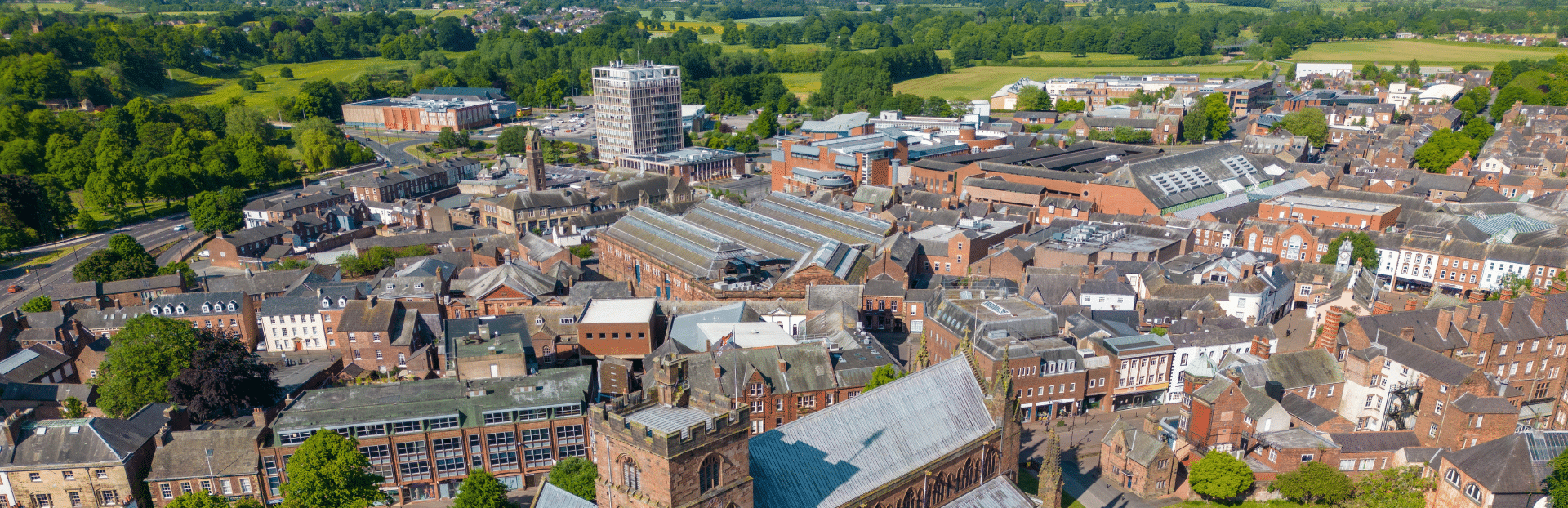
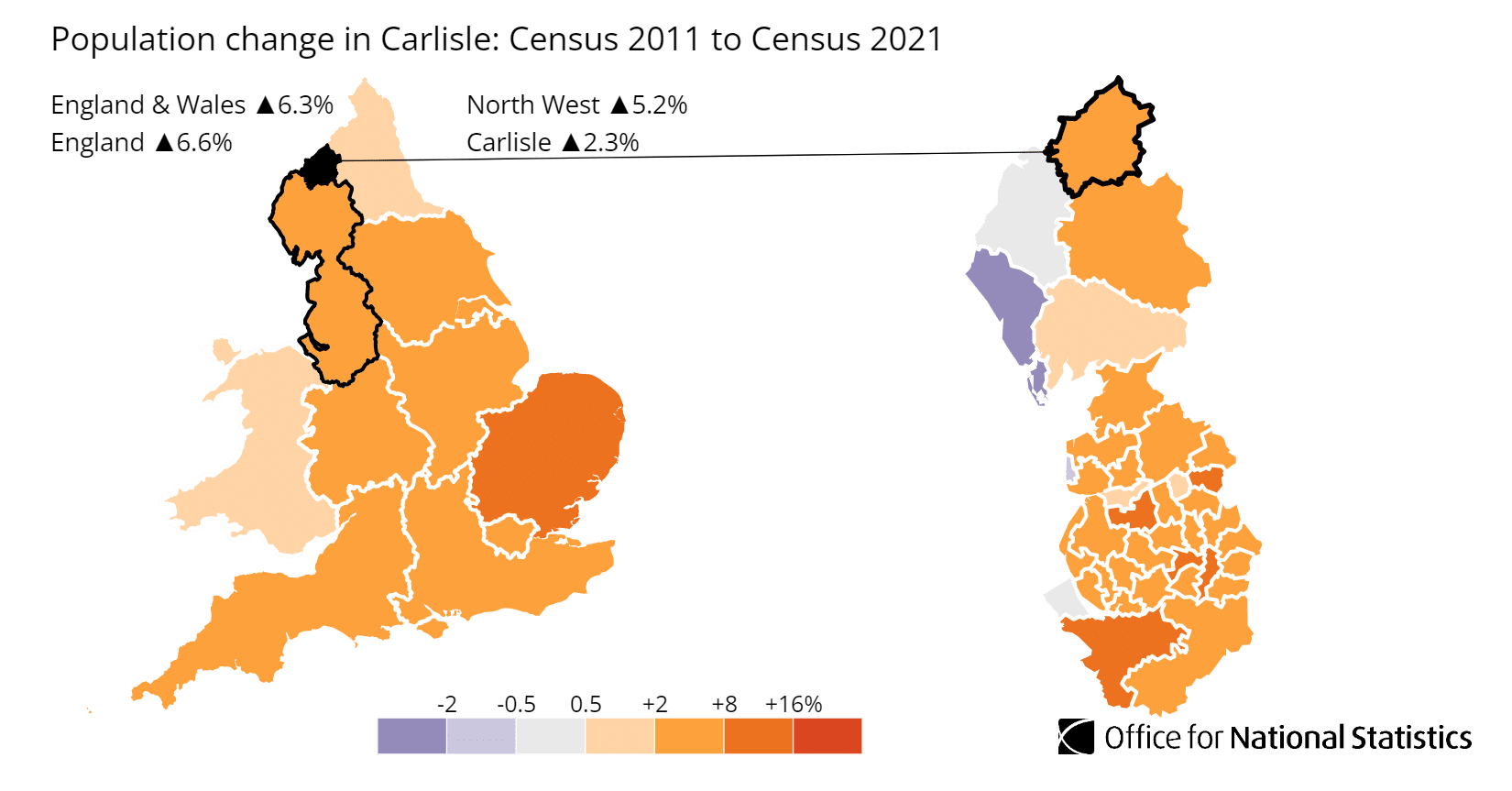
Carlisle is the main city of Cumberland, in north-west England. Average sold prices across Cumberland sit at £169,707 on the HM Land Registry House Price Index, 41.5% below England's £289,946 and 20.9% below the North West regional average of £214,678. That places Carlisle among the most affordable markets in England, cheaper than Sunderland or Durham on the by-type figures once you strip out the rural postcodes. The population of Carlisle grew 2.33% between the 2011 and 2021 censuses, from 107,524 to 110,024 residents, steady rather than fast.
Carlisle's affordability is sharpened by local pay that runs ahead of the region. The median gross weekly salary across Cumberland is £816.60, against £720.10 across the North West and £752.40 for Great Britain. Low prices meeting above-average wages give the two urban postcodes some of the lowest price-to-earnings ratios in the country: 4.0 times income in CA1 and 4.1 in CA2. The rental case sits with those same two postcodes, where the letting market is deep enough to read.
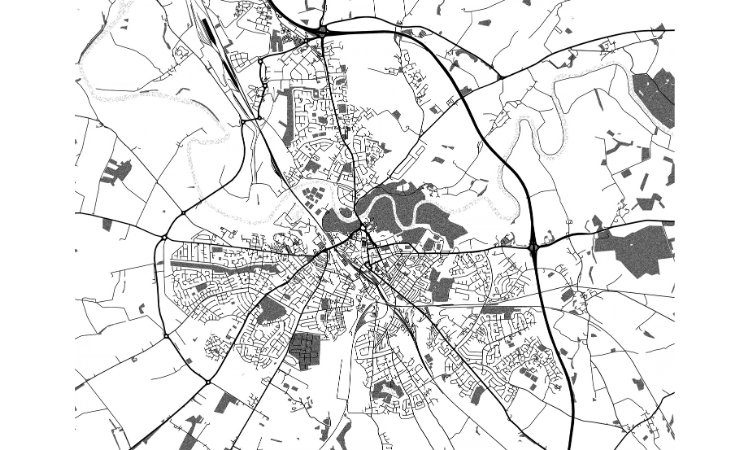
This guide covers the eight CA postcodes from CA1 to CA8 that make up the Carlisle part of the Cumberland unitary authority (ONS code E07000028 for the former Carlisle district). Cumberland was formed in April 2023 from the old Carlisle, Copeland and Allerdale districts, so the Land Registry sold-price figures are recorded at that wider authority level. Carlisle sits in the North West, at the junction of the M6 and A69, with the Lake District to the south and the Scottish Borders to the north. Investors weighing the wider region often also look at Durham, Sunderland, Blackpool and Lancaster, which the comparison later sets out.
Article updated: July 2026
Why Invest in Carlisle?
Carlisle's population grew 2.33% between the 2011 and 2021 censuses, from 107,524 to 110,024 residents. That is slower than the England and Wales average of 6.3%, but it comes without the boom-and-bust that faster-growing places can bring. Carlisle is the main city in Cumbria and the administrative centre for Cumberland Council, sitting where the M6 meets the A69, which makes it a natural base for distribution and logistics across the North of England and the Scottish Borders.
The local employment rate of 76.7% is above both the North West average of 74.2% and Great Britain's 75.6%, while unemployment at 3.6% sits below the regional and national rates. Kingmoor Park, one of the largest commercial estates in the region, houses distribution, manufacturing and food processing. Cumberland Infirmary is the acute hospital for the area and a steady source of NHS employment, and the University of Cumbria brings a student population that leans on the city-centre postcodes. Proximity to the Lake District supports a holiday let market in the rural postcodes around the city.
Median gross annual earnings across Cumberland are £42,461, which is 13.4% above the North West regional median of £37,445 and 8.5% above the Great Britain median of £39,125. Higher local wages against low prices are the whole story here: they hold rent-to-income ratios down and give tenants headroom, which tends to show up as fewer arrears and longer tenancies.
Carlisle Economic Summary
- Population (Carlisle): 110,024 (2021 Census). Growth of 2.33% from 2011.
- Median annual salary: £42,461 (Cumberland), £37,445 (North West), £39,125 (Great Britain)
- Employment rate: 76.7% (Cumberland), 74.2% (North West), 75.6% (Great Britain)
- Unemployment rate: 3.6% (Cumberland), 4.1% (North West), 4.3% (Great Britain)
- Key employment sectors: Distribution and logistics, public administration, manufacturing, healthcare, food processing, education
Source: ONS Census 2021, Nomis Labour Market Profile (ASHE 2025, Employment Oct 2024-Sep 2025)
Regeneration and Investment in Carlisle
Cumberland Council's regeneration programme centres on three projects that together represent more than £340 million of investment into Carlisle and its transport network. The largest of them unlocks land for up to 10,000 new homes on the southern edge of the city.
- Carlisle Southern Link Road and St Cuthbert's Garden Village (under construction, £225.4m): The £225.4m link road opens in Spring 2026 and provides direct road access to land allocated for St Cuthbert's Garden Village, planned for up to 10,000 homes over the long term. That makes it one of the largest housing allocations in the North of England, and a supply story an investor needs to weigh as much as any demand driver. Updates at Cumberland Council CSLR Project.
- University of Cumbria Citadels Campus (under construction, £78.7m): A new centralised city-centre campus in the historic Citadels buildings, drawing the University of Cumbria's Carlisle presence into one site. It concentrates a permanent student population in the centre, which feeds the CA1 rental market most directly. Updates at University of Cumbria.
- Carlisle Station Gateway (under construction, £40.5m): Part of the Borderlands Inclusive Growth Deal, reworking Carlisle Station and its surroundings with £27m from the Borderlands Deal and £13.5m from the Department for Transport. Works begin Spring 2026 with completion expected February 2027. Updates at Cumberland Council.
Source: Office for National Statistics - Population for Carlisle
Carlisle Property Market Analysis
Average property prices in Cumberland have risen 321.2% since January 1995, from £40,294 to £169,707. The sections below walk through that journey, one cycle at a time, then drill into current postcode-level data for sold prices, price per square foot, asking prices, growth trends and monthly transaction volumes.
When was the last house price crash in Carlisle?
Carlisle sits within Cumberland, so all sold prices from HM Land Registry are recorded at that authority level rather than for the city alone. The Land Registry House Price Index tracks average prices from January 1995 to March 2026, covering 31 years of market cycles, and Cumberland's defining feature is how long its recovery took.
The 1995 to 2000 slow start: Cumberland began January 1995 at £40,294. Prices actually slipped in 1996, and by January 2000 the average had reached only £45,187. Five years of near-stagnation while southern England was already accelerating.
The 2000 to 2007 boom: From £45,187 in January 2000, prices climbed to a peak of £132,667 in October 2007, close to tripling in seven years. The sharpest run came in the mid-2000s, with cheap credit pushing prices well beyond what local wages had historically supported.
2008 to 2009, the financial crisis: Prices fell from the October 2007 peak of £132,667 to a trough of £111,800 in May 2009, a decline of 15.7% over 19 months, with the worst year-on-year reading of -12.2% in May 2009. That fall was shallower than both the North West and England, each down around 18% over the same downturn.
The 2010 to 2015 stagnation: Prices bounced off the trough but then went flat. The average sat at £115,585 in March 2011 and was still only £124,622 by March 2016. Cumberland spent years unable to push back to its pre-crash level while most of England had moved on.
Recovery, 2020: Prices did not pass the October 2007 peak of £132,667 until November 2020, when the average reached £134,710. That is a 13-year recovery, one of the longest in England, and the single most important number in Cumberland's history for anyone judging how long a downturn here can last.
2020 to 2022, the pandemic surge: Once it turned, it turned quickly. The stamp duty holiday and a shift towards space and rural access pushed the average to £158,097 by December 2022, up 11.9% on the year.
The 2023 rate shock: Higher mortgage rates cooled the market to a near-standstill rather than a fall. December 2023 recorded £159,694, up just 1.0% on the year.
2024 to present: Growth resumed. The average reached an all-time high of £173,370 in December 2025 before easing back to £169,707 by March 2026, with the latest year-on-year reading at +1.5%. Cumberland now sits 28.0% above its October 2007 peak.
Long-term growth summary:
- 5 years (March 2021 to March 2026): 23.5% growth (£137,433 to £169,707)
- 10 years (March 2016 to March 2026): 36.2% growth (£124,622 to £169,707)
- 15 years (March 2011 to March 2026): 46.8% growth (£115,585 to £169,707)
- 20 years (March 2006 to March 2026): 51.7% growth (£111,841 to £169,707)
- 30 years (January 1995 to March 2026): 321.2% growth (£40,294 to £169,707)
The 13-year gap between the pre-crash peak and recovery is the reference point for judging downside here: the market does recover, but it can take a long time to do it. An investor who bought at the exact peak in October 2007 waited until late 2020 just to break even on the Land Registry average, and would now be sitting 28.0% ahead of that peak.
- All property types
- Detached
- Semi-detached
- Terraced
- Flats
- All property types
- Detached
- Semi-detached
- Terraced
- Flats
Sold House Prices in Carlisle
The average sold price across all property types in Cumberland is £169,707, which is 41.5% below the England average of £289,946 as of March 2026. That is one of the widest discounts to the national average anywhere in England, and it holds across every property type, though the size of the gap moves with the type of home. The figures below are recorded at Cumberland authority level, so they cover the rural stock as well as the city.
| Property Type | Cumberland Average | England Average | Difference |
|---|---|---|---|
| Detached houses | £282,091 | £470,492 | -40.0% |
| Semi-detached houses | £176,777 | £288,185 | -38.7% |
| Terraced houses | £139,972 | £243,788 | -42.6% |
| Flats and maisonettes | £92,870 | £214,563 | -56.7% |
| All property types | £169,707 | £289,946 | -41.5% |
Detached houses average £282,091, a 40.0% discount to England's £470,492. Cumberland is a largely rural authority, so detached homes make up a big share of the stock and the average stays lower than in places where detached houses are scarce and command a premium. Annual growth of 1.5% points to a steady market rather than a hot one.
Semi-detached houses at £176,777 sit 38.7% below England's £288,185, and this is the core of Carlisle's rental stock. Semis fill the suburban streets of CA2 and CA3, and at 2.2% annual growth they are the firmest of the four types over the past year.
Terraced houses average £139,972, a 42.6% discount to England's £243,788. The Victorian and Edwardian terraces of CA1 are the traditional buy-to-let stock in the city, and at this price a modest rent still produces a yield worth having. Annual growth of 1.5% matches the market as a whole.
Flats and maisonettes at £92,870 carry the deepest discount at 56.7% below England's £214,563. Average flat prices under £100,000 are rare in England, and they reflect a stock of converted terraces and small blocks rather than the new-build apartment towers that lift flat values in bigger cities. Annual change of -3.9% is the one soft reading in the table, so the flat market here is easing where the houses are holding.
Price Per Square Foot in Carlisle
Carlisle's price per square foot runs from £153 in CA1 to £236 in CA4, a spread of 54% across the eight postcodes. Price per square foot strips out the effect of property size and gives a cleaner read on what a location itself is worth. The urban core is the cheapest space, and the rural postcodes command more per foot despite larger homes, a premium on land and period stock rather than on market depth.
| Rank | Area | Price Per Sq Ft |
|---|---|---|
| 1 | CA1 (City Centre, Botcherby) | £153 |
| 2 | CA2 (Carlisle West, Morton) | £162 |
| 3 | CA7 (Wigton) | £200 |
| 4 | CA6 (Longtown, Brampton) | £211 |
| 5 | CA8 (Brampton) | £213 |
| 6 | CA3 (Stanwix, Kingstown) | £223 |
| 7 | CA5 (Dalston, Burgh by Sands) | £230 |
| 8 | CA4 (Wetheral, Armathwaite) | £236 |
CA1 at £153 per square foot is the cheapest space in Carlisle, covering the city centre and Botcherby where terraced stock dominates. CA2 at £162 sits just behind. These are the same two postcodes that carry the only rental data in the area, so cheap space and proven letting demand line up in one place, which is where the buy-to-let case is strongest.
CA4 tops the table at £236 per square foot, in the villages of Wetheral and Armathwaite between Carlisle and the North Pennines. The high per-foot cost reflects period homes and larger plots in a thin, low-volume market, not underlying rental strength. CA3 (Stanwix) at £223 is the premium suburban postcode next to the city, a short walk from the centre and favoured by owner-occupiers.
For Sale Asking Prices in Carlisle
CA1 at £169,169 and CA4 at £382,771 sit 126% apart, the gap between the affordable urban core and the rural hinterland. The market splits between CA2 at £173,972 and CA3 at £246,306: below that line, the two urban postcodes; above it, the villages and market towns where prices run 40% to 130% higher. The mean asking price across all eight Carlisle postcodes is £282,462, pulled well up by the rural stock.
| Rank | Area | Asking Price |
|---|---|---|
| 1 | CA1 (City Centre, Botcherby) | £169,169 |
| 2 | CA2 (Carlisle West, Morton) | £173,972 |
| 3 | CA3 (Stanwix, Kingstown) | £246,306 |
| 4 | CA7 (Wigton) | £262,488 |
| 5 | CA6 (Longtown, Brampton) | £275,591 |
| 6 | CA8 (Brampton) | £368,686 |
| 7 | CA5 (Dalston, Burgh by Sands) | £380,716 |
| 8 | CA4 (Wetheral, Armathwaite) | £382,771 |
CA1 and CA2 cluster within £4,800 of each other, so for an investor the entry cost is effectively the same across both. The choice between them comes down to tenant profile and growth trajectory rather than price: CA2 has stronger five-year growth at 20.1% against CA1's 10.7%, while CA1 carries the cheapest space and the busier turnover.
CA3 Stanwix at £246,306 is the most accessible of the non-urban postcodes, Carlisle's premium residential area and popular with owner-occupiers and families. It has no rental data, which limits its use for an income buyer, but it posted the strongest three-year growth among the urban-edge postcodes at 11.1%. Above CA3, the rural postcodes reach £382,771 in CA4, where a Carlisle asking price starts to look like a very different kind of purchase.
House Price Growth in Carlisle
Five-year growth ranges from 0.2% in CA8 to 20.9% in CA6, with every postcode in positive territory over that window. One-year and three-year readings swing far more, because most of these postcodes turn over only a handful of homes a month and a couple of larger sales can move the average. The two urban postcodes, CA1 and CA2, are the steadiest read: 10.7% and 20.1% over five years on a much deeper base of transactions.
| Area | 1 Year | 3 Years | 5 Years |
|---|---|---|---|
| CA6 (Longtown, Brampton) | -5.5% | 13.2% | 20.9% |
| CA2 (Carlisle West, Morton) | 3.5% | 9.3% | 20.1% |
| CA3 (Stanwix, Kingstown) | 5.9% | 11.1% | 19.5% |
| CA4 (Wetheral, Armathwaite) | 9.1% | 4.1% | 13.0% |
| CA1 (City Centre, Botcherby) | 6.5% | 1.2% | 10.7% |
| CA5 (Dalston, Burgh by Sands) | 0.8% | -0.6% | 9.5% |
| CA7 (Wigton) | -7.1% | -1.1% | 7.3% |
| CA8 (Brampton) | -7.6% | -9.4% | 0.2% |
CA6 Longtown tops the five-year table at 20.9%, but the reading needs context: at 10 sales a month, a few higher-value transactions move the average, and the -5.5% one-year figure shows how far it can swing. The three-year gain of 13.2% suggests the medium-term trend is genuine, but a thin market carries more noise than CA1 or CA2.
Among the two investable postcodes, CA2 is the stronger performer at 20.1% over five years on 41 monthly sales, a liquid market with consistent appreciation. CA1 at 10.7% over five years has grown more slowly, and its three-year figure of 1.2% shows that most of the five-year gain landed early, during the pandemic-era stamp duty holiday. Its 6.5% one-year reading points to more recent momentum.
Three postcodes are negative over one year. CA6 (-5.5%), CA7 (-7.1%) and CA8 (-7.6%) are all rural or market-town areas on 10 or fewer sales a month, where the average shifts on a handful of deals. CA8 is the only postcode close to flat across all three windows, up just 0.2% over five years.
Monthly Property Sales in Carlisle
Carlisle records around 138 property transactions a month across the eight postcodes, with CA2 (41 sales) and CA1 (30 sales) accounting for half of them. The other six postcodes range from 7 to 16 sales a month. For a buy-to-let investor, transaction volume is really a question about the exit: a liquid market means you can sell when you need to.
| Area | Sales Per Month | Turnover | Asking Price |
|---|---|---|---|
| CA2 (Carlisle West, Morton) | 41 | 32% | £173,972 |
| CA1 (City Centre, Botcherby) | 30 | 40% | £169,169 |
| CA7 (Wigton) | 16 | 8% | £262,488 |
| CA3 (Stanwix, Kingstown) | 15 | 28% | £246,306 |
| CA6 (Longtown, Brampton) | 10 | 11% | £275,591 |
| CA8 (Brampton) | 10 | 11% | £368,686 |
| CA4 (Wetheral, Armathwaite) | 9 | 9% | £382,771 |
| CA5 (Dalston, Burgh by Sands) | 7 | 9% | £380,716 |
CA1 has the highest turnover at 40% despite fewer sales than CA2, so stock in the city centre changes hands relatively quickly. CA2 records the most sales at 41 a month on a lower 32% turnover, because its larger, mid-priced housing base spreads those sales across more homes. For an investor planning an exit, these two are the only postcodes where a reasonable timeframe to sell is a fair assumption.
At the other end, CA7 Wigton turns over just 8% of its stock a year and CA5 and CA4 sit at 9%. Seven to sixteen sales a month in a market town or village means homes come to market slowly and sell slowly, so an investor there is trading liquidity for the lower headline prices per foot that the rural postcodes rarely actually deliver.
How Long Properties Take to Sell in Carlisle
Selling speed splits Carlisle sharply: CA1 clears fastest at about 71 days, while CA6 (Longtown, Brampton) is slowest at roughly 435. Days on market is the typical number of days a home is up for sale before it sells; the months of unsold stock shows how much for-sale supply is sitting there at the current rate of sales.
| Area | Avg Days to Sell | Months of Unsold Stock | Market |
|---|---|---|---|
| CA1 (City Centre, Botcherby) | 71 | 2.3 | Seller's market |
| CA2 (Carlisle West, Morton) | 101 | 3.3 | Seller's market |
| CA3 (Stanwix, Kingstown) | 109 | 3.6 | Seller's market |
| CA5 (Dalston, Burgh by Sands) | 277 | 9.1 | Balanced market |
| CA8 (Brampton) | 277 | 9.1 | Balanced market |
| CA7 (Wigton) | 338 | 11.1 | Balanced market |
| CA4 (Wetheral, Armathwaite) | 380 | 12.5 | Buyer's market |
| CA6 (Longtown, Brampton) | 435 | 14.3 | Buyer's market |
A yield number tells you nothing about how quickly you can get back out. CA1 at 2.3 months of unsold stock is a genuine seller's market, where a home in the city centre finds a buyer in a little over two months. Step out to the rural postcodes and CA6's 14.3 months means a property there can sit for well over a year, so the same money buys a very different exit.
What Type of Property Can You Buy in Carlisle?
The stock flips completely between the city and the countryside: terraced houses and flats dominate CA1, while detached homes make up more than 60% of most rural postcodes. The mix of housing stock shapes which strategy fits each postcode. The figures below are drawn from 2021 Census records for each postcode.
| Area | Detached | Semi-detached | Terraced | Flats |
|---|---|---|---|---|
| CA1 (City Centre, Botcherby) | 15.0% | 31.3% | 32.0% | 21.6% |
| CA2 (Carlisle West, Morton) | 22.1% | 39.1% | 24.6% | 13.6% |
| CA3 (Stanwix, Kingstown) | 33.3% | 29.4% | 15.5% | 20.3% |
| CA4 (Wetheral, Armathwaite) | 59.2% | 26.5% | 9.9% | 1.8% |
| CA5 (Dalston, Burgh by Sands) | 71.5% | 21.5% | 4.8% | 1.8% |
| CA6 (Longtown, Brampton) | 68.5% | 21.3% | 7.6% | 1.8% |
| CA7 (Wigton) | 63.2% | 21.6% | 12.7% | 1.4% |
| CA8 (Brampton) | 62.6% | 22.4% | 13.1% | 1.7% |
CA1 holds the largest share of terraced houses at 32.0% and flats at 21.6%, the smaller-unit stock that usually forms the buy-to-let market, and it lines up with CA1 carrying the lowest asking price and the highest turnover in the city. City-centre flats suit single lets and student sharers, while the terraces of Botcherby offer lower-cost family lets. CA2 leans more to semis at 39.1%, the standard suburban family home.
The rural postcodes are the mirror image. CA5 is 71.5% detached with terraces and flats together under 7%, and CA4, CA6, CA7 and CA8 all run above 60% detached. That is owner-occupier and lifestyle-buyer stock rather than the smaller units that drive rental income, which is part of why the letting market outside CA1 and CA2 is too thin to read.
Flats combine purpose-built and converted units. A small share of mobile and temporary dwellings is not shown, so rows may not total 100%.
Carlisle Rental Market Analysis
Monthly rents in Carlisle's two active postcodes are £723 in CA1 and £782 in CA2, with gross yields of 5.1% and 5.4%. For investors weighing up whether buy-to-let is a worthwhile investment in Carlisle, the sections below break down rents, yields and tenant affordability across the postcodes that have enough letting activity to read. If you are working out how to start a property investment business in the North West, Carlisle pairs low asking prices with above-average local wages, which keeps affordability comfortable for tenants. Browse current buy-to-let investments for sale across the region.
Average Rent & Gross Rental Yields in Carlisle
Gross rental yields in Carlisle run to 5.4% in CA2 and 5.1% in CA1, the only two postcodes with enough rental listings to read. The two rents are close, £782 in CA2 and £723 in CA1, and CA2 edges the yield because its rent is higher against an asking price only £4,800 above CA1's. Six of the eight postcodes have no reliable rental data at all.
| Area | Average Monthly Rent | Asking Price | Gross Yield |
|---|---|---|---|
| CA2 (Carlisle West, Morton) | £782 | £173,972 | 5.4% |
| CA1 (City Centre, Botcherby) | £723 | £169,169 | 5.1% |
| CA3 (Stanwix, Kingstown) | Not enough data | £246,306 | Not enough data |
| CA4 (Wetheral, Armathwaite) | Not enough data | £382,771 | Not enough data |
| CA5 (Dalston, Burgh by Sands) | Not enough data | £380,716 | Not enough data |
| CA6 (Longtown, Brampton) | Not enough data | £275,591 | Not enough data |
| CA7 (Wigton) | Not enough data | £262,488 | Not enough data |
| CA8 (Brampton) | Not enough data | £368,686 | Not enough data |
CA2 at 5.4% pairs the higher rent of the two with a still-modest £173,972 asking price, and it does so in the busiest market in the city at 41 sales a month. A 30% deposit of £52,192 buys into the top-yielding postcode in Carlisle.
CA1 at 5.1% carries the lowest asking price and the cheapest space at £153 per square foot. Its tenant base is mixed, with city-centre flats drawing University of Cumbria students and young professionals, and the terraces of Botcherby taking working households, which spreads void risk across more than one type of tenant.
The gap between the two is small and comes almost entirely from the £59-a-month difference in rent. The absence of data in the other six postcodes is itself the point: outside CA1 and CA2, the lettings market is too thin to produce a figure worth quoting.
Gross Rental Yield by Postcode
Is Carlisle Rent High?
Rent in Carlisle's two active postcodes takes 20.4% of local median monthly pay in CA1 and 22.1% in CA2. The widely cited threshold for rent affordability is 30% of gross income, and both postcodes sit well under it. That is unusually comfortable, and it comes from the same combination that runs through this whole guide: modest rents meeting above-average local earnings.
The median gross weekly salary in Cumberland is £816.60, which equates to £3,538 per month or £42,461 per year. That is above the North West regional median of £720.10 per week and the Great Britain median of £752.40 per week. Data from the Nomis Labour Market Profile (ASHE 2025).
| Rank | Area | Rent as % of Income |
|---|---|---|
| 1 | CA2 (Carlisle West, Morton) | 22.1% |
| 2 | CA1 (City Centre, Botcherby) | 20.4% |
| - | CA3 (Stanwix, Kingstown) | Not enough data |
| - | CA4 (Wetheral, Armathwaite) | Not enough data |
| - | CA5 (Dalston, Burgh by Sands) | Not enough data |
| - | CA6 (Longtown, Brampton) | Not enough data |
| - | CA7 (Wigton) | Not enough data |
| - | CA8 (Brampton) | Not enough data |
Around a fifth of gross income on rent is one of the lowest ratios in any of our location guides. Most northern cities show rent taking a quarter to a third of gross pay, so Carlisle's headroom stands out, and it is a direct product of low rents sitting against Cumberland's higher-than-regional earnings.
That headroom matters to a landlord as much as a tenant. A household spending 20% of gross income on rent has more of a buffer against an income shock than one spending 35%, which does not remove void or arrears risk but does reduce it. For anyone running cash-flow projections, a low rent-to-income ratio is a margin of safety that the higher-yielding but tighter markets do not offer.
How Big Is Carlisle's Private Rented Sector?
The private rented sector is deepest in CA1, at 27.3% of households, and thinnest in the rural postcodes, down to 13.4% in CA7. The share of homes already rented privately is a guide to the size of the established tenant pool and how active the local lettings market is. The table below shows household tenure by postcode.
| Area | Owned Outright | Owned with Mortgage | Private Rented | Social Rented |
|---|---|---|---|---|
| CA1 (City Centre, Botcherby) | 29.2% | 28.4% | 27.3% | 14.4% |
| CA3 (Stanwix, Kingstown) | 42.9% | 26.4% | 23.9% | 5.3% |
| CA6 (Longtown, Brampton) | 49.8% | 28.0% | 19.9% | 1.5% |
| CA2 (Carlisle West, Morton) | 36.5% | 31.5% | 18.6% | 12.9% |
| CA8 (Brampton) | 52.9% | 25.1% | 17.5% | 3.8% |
| CA4 (Wetheral, Armathwaite) | 54.9% | 26.2% | 15.7% | 2.6% |
| CA5 (Dalston, Burgh by Sands) | 55.9% | 27.4% | 14.3% | 2.1% |
| CA7 (Wigton) | 58.4% | 23.9% | 13.4% | 3.9% |
CA1 has the deepest private rented sector in Carlisle at 27.3% of households, more than a quarter, which fits its role as the city-centre and student postcode and matches the letting activity that gives it a readable rent. A larger rented sector points to an active market and a wider pool of existing tenants, a different signal from yield. CA2 sits lower at 18.6% despite being the other investable postcode, so its rental case rests on a steady suburban tenant base rather than a large existing rented stock.
The rural postcodes cluster between 13% and 20%, with high outright ownership: CA7 Wigton is 58.4% owned outright and just 13.4% privately rented. Those are owner-occupier communities where letting is a minor share of the market, which is the same story the missing rental data tells from another angle.
Local Housing Allowance Rates in Carlisle
All eight Carlisle postcodes fall within the North Cumbria Broad Rental Market Area, where Local Housing Allowance runs from £73.60 a week for a shared room to £170.30 a week for a four-bedroom home. Local Housing Allowance sets the maximum housing support a tenant on benefits can receive, so for that part of the market it works as a rent floor for landlords. The rates below apply across the whole of Carlisle. To check the current rate for a specific address, you can use the government's official Local Housing Allowance calculator.
| Property Size | Weekly LHA Rate | Monthly Equivalent |
|---|---|---|
| Shared accommodation | £73.60 | £319 |
| 1 bedroom | £90.90 | £394 |
| 2 bedrooms | £109.32 | £474 |
| 3 bedrooms | £135.78 | £588 |
| 4 bedrooms | £170.30 | £738 |
The two-bedroom LHA rate of £109.32 a week works out at about £474 a month, below the £723 to £782 market rents recorded in CA1 and CA2. A benefit-backed tenancy at the LHA rate therefore sits under Carlisle's open-market rents, and the stock that fits within those rates is concentrated in CA1, where both asking prices and rents are lowest. The rates are identical in every Carlisle postcode because they are set across the whole North Cumbria market area.
Buy-to-Let Considerations
Are House Prices High in Carlisle? Price-to-Earnings Ratios
Buying a property in Carlisle takes between 4.0 and 9.0 times the local median annual salary. This is based on the Nomis Labour Market Profile for Cumberland showing the median gross annual income across Cumberland is £42,461.
Set that against the national picture: England's average sold price of £289,946 is 7.4 times the Great Britain median salary of £39,125. Five of Carlisle's eight postcodes come in under that 7.4x mark, so they buy more house per year of local income than the country does as a whole.
| Rank | Area | Price-to-Earnings Ratio |
|---|---|---|
| 1 | CA1 (City Centre, Botcherby) | 4.0x |
| 2 | CA2 (Carlisle West, Morton) | 4.1x |
| 3 | CA3 (Stanwix, Kingstown) | 5.8x |
| 4 | CA7 (Wigton) | 6.2x |
| 5 | CA6 (Longtown, Brampton) | 6.5x |
| 6 | CA8 (Brampton) | 8.7x |
| 7 | CA5 (Dalston, Burgh by Sands) | 9.0x |
| 8 | CA4 (Wetheral, Armathwaite) | 9.0x |
CA1 at 4.0x is the product of low asking prices meeting high local earnings. A median earner in Cumberland could buy the average CA1 property for four years' gross salary, a level of affordability that is rare in England and one that supports steady rental demand because prices have not run ahead of what local wages can carry.
CA4, CA5 and CA8 exceed the benchmark at 9.0x, 9.0x and 8.7x. All three are rural or market-town postcodes where prices are set by lifestyle demand rather than local wages, so buyers there tend to be relocators or second-home purchasers rather than the local workforce that underpins the urban rental market.
Deposit Requirements in Carlisle
A 30% deposit on a buy-to-let property in Carlisle ranges from £50,751 in CA1 to £114,831 in CA4. The two investable postcodes both need deposits around £51,000, among the lowest in this series. The gap between the cheapest and most expensive deposit is £64,080, which in CA1 terms is more than the whole deposit again.
Beyond the deposit, the stamp duty owed and other buy-to-let running costs affect the total capital required.
| Rank | Area | 30% Deposit Required |
|---|---|---|
| 1 | CA1 (City Centre, Botcherby) | £50,751 |
| 2 | CA2 (Carlisle West, Morton) | £52,192 |
| 3 | CA3 (Stanwix, Kingstown) | £73,892 |
| 4 | CA7 (Wigton) | £78,746 |
| 5 | CA6 (Longtown, Brampton) | £82,677 |
| 6 | CA8 (Brampton) | £110,606 |
| 7 | CA5 (Dalston, Burgh by Sands) | £114,215 |
| 8 | CA4 (Wetheral, Armathwaite) | £114,831 |
The £1,441 gap between CA1 at £50,751 and CA2 at £52,192 is negligible. Both deliver yields above 5%, both sit at close to 4x local earnings, and the deposit difference is a rounding error, so the choice between them is about growth against yield: CA2 has grown 20.1% over five years, CA1 delivers the cheapest way in and the busiest turnover.
A clear step separates the urban pair from the rest. CA3 at £73,892 is 46% more than CA1, and it comes without any rental data. The further you move from Carlisle's core, the higher the capital required and the thinner the evidence of rental demand, which is the trade-off the rural postcodes ask you to accept.
What the Carlisle Data Tells Buy-to-Let Investors
In Carlisle the rental evidence sits with two postcodes, CA1 and CA2, and both come in cheap against local wages. CA2 has the top yield at 5.4% and the strongest five-year growth of the pair at 20.1%, for a 30% deposit of £52,192. CA1 is the cheapest way in for buying an investment property in Carlisle, at a £50,751 deposit and £153 per square foot, with the fastest sale times in the city at 71 days.
The rents are close, £782 in CA2 and £723 in CA1, and both take around a fifth of local median pay. That low rent-to-income ratio is Carlisle's distinctive feature: it comes from Cumberland's above-average earnings meeting some of the lowest prices in England, and it tends to show up as steadier tenancies rather than as a headline yield.
The rural postcodes tell a different story. CA6 posted 20.9% five-year growth and CA4 has the highest price per square foot, but none of them carries rental data, most turn over fewer than 16 homes a month, and deposits run past £80,000. The growth figures in those thin markets swing on a handful of sales, so they read as noise more than signal for an income buyer. Investors who want to come in below asking often look through off-market property in Carlisle.
Carlisle has no selective licensing scheme, and Cumberland Council confirms it operates only mandatory HMO licensing across the area. With above-average local earnings, low prices and a 13-year post-crash recovery on record, Carlisle reads as an affordability market: the numbers work on price and rent cover, with the caveat that a downturn here has historically taken a long time to unwind.
How Carlisle Compares
Carlisle's mean asking price of £282,462 is the highest of five North West and North East locations compared here, but the figure is skewed by six rural postcodes; its top yield of 5.4% ties Lancaster's. The comparison below places Carlisle alongside four nearby locations. Mean asking price and mean monthly rent are simple averages across the postcodes with data; top gross yield is the single highest postcode yield in each location.
| Location | Mean Asking Price | Mean Monthly Rent | Mean Gross Yield | Top Yield (postcode) |
|---|---|---|---|---|
| Sunderland | £163,026 | £698 | 5.1% | 12.0% (SR1) |
| Durham | £190,986 | £793 | 5.0% | 5.5% (DH7, DH9) |
| Blackpool | £204,149 | £755 | 4.4% | 6.6% (FY1) |
| Lancaster | £279,578 | £929 | 4.0% | 5.4% (LA1) |
| Carlisle | £282,462 | £753 | 3.2% | 5.4% (CA2) |
Carlisle's £282,462 mean asking price looks expensive in this group, but it is misleading. That average is pulled up by six rural postcodes priced from £246,306 to £382,771. The two investable postcodes, CA1 at £169,169 and CA2 at £173,972, sit close to Sunderland's mean and below Durham's, so the real entry cost for a Carlisle buy-to-let is nearer the bottom of this table than the top.
Blackpool at 6.6% and Sunderland at 12.0% (a thin city-centre reading) show higher top yields, but those come with more affordability pressure on tenants, where Carlisle's rent takes just over a fifth of local pay. Lancaster is the closest match in character: a similar northern city with a university and strong local employment, and near-identical mean asking prices. Lancaster charges more rent (£929 against £753) but ties Carlisle on top yield at 5.4%, because Carlisle's entry-level postcodes are cheaper. For a data-led comparison across the country, see our guide to the highest-yielding areas.
Frequently Asked Questions
Is Carlisle a good place to live for buy-to-let tenants?
For a tenant, the numbers are kind. Rent in the two active postcodes takes about a fifth of the local median wage, well inside the 30% mark most people use for affordability, because rents of £723 to £782 sit against Cumberland pay of £816.60 a week, ahead of both the region and Great Britain.
It is also a workable place to rent in day to day. Carlisle has direct rail to Edinburgh, Manchester and Newcastle, the Lake District on the doorstep, and steady employment across logistics, the NHS, manufacturing and the university. That mix tends to suit renters who settle rather than move on each year.
What are the best areas in Carlisle for property investment?
It comes down to two postcodes, because they are the only ones with rental data. CA1 (City Centre and Botcherby) is the cheapest way in at £169,169, with the lowest space cost at £153 per square foot and the fastest sales in the city at 71 days, on a 5.1% yield. CA2 (Carlisle West and Morton) charges a little more rent for a 5.4% yield and has grown 20.1% over five years in the busiest market in the city.
So if income is the priority, CA2 leads on yield while CA1 keeps the entry cost lowest. The other six postcodes are predominantly owner-occupier and rural, without enough letting activity to read a reliable rent.
How does Carlisle compare to Lancaster for buy-to-let?
They are close cousins. Both are northern cities with a university and steady local employment, and their mean asking prices are near-identical at £282,462 for Carlisle and £279,578 for Lancaster. Lancaster charges more rent, £929 a month against Carlisle's £753, driven by a larger student market.
Carlisle's top yield of 5.4% still ties Lancaster's, because its entry-level postcodes are cheaper: CA1 at £169,169 undercuts Lancaster's lowest stock. The clearest difference is affordability against local wages. Cumberland's £42,461 median income gives CA1 a 4.0x price-to-earnings ratio, a level that is hard to find in Lancaster or most other northern cities.
Is there demand for student accommodation in Carlisle?
Student demand in Carlisle concentrates in CA1, fed by the University of Cumbria's city-centre presence and the shared-house and flat market around it. The new £78.7m Citadels campus is drawing that presence into one central site, which should focus student footfall on CA1 further. It is a smaller market than in the big university cities, with the summer voids and heavier management that student lets bring, so it works as a niche rather than the main event.
Current room adverts in CA1 and CA2 are too few to put a reliable figure on a room rent, so treat the HMO angle as a small, hands-on part of the market rather than a headline number. For the purpose-built end, see our guide to student property investment, and for how the sums work on a shared house, our guide to how HMO investment works.
Can I find buy-to-let property under £175,000 in Carlisle?
Yes, and that is the point of the city. Both investable postcodes sit below it: CA1 averages £169,169 and CA2 £173,972 on asking prices, so a standard buy-to-let in Carlisle's rental core comes in under £175,000. By property type across Cumberland, terraced houses average £139,972 and flats £92,870 on the Land Registry index, so the entry point drops further again for the smaller stock.
If you want to come in below even those figures, that is where below market value stock is worth a look. The rural postcodes are where prices climb, from £246,306 in CA3 up to £382,771 in CA4.
Will the Citadels Campus and Southern Link Road affect Carlisle property prices?
The two projects pull in different directions. The £78.7m Citadels campus centralises the university in the city centre, adding permanent student footfall and rental demand in CA1 over the next few years, which is the nearer-term of the two effects.
The £225.4m Southern Link Road opens in Spring 2026 and unlocks land for St Cuthbert's Garden Village, planned for up to 10,000 homes. That is a long-term supply story that will take many years to build out, and a large new pipeline of homes is something an investor should weigh as a counterweight to demand rather than a straightforward boost.
What are average house prices in Carlisle?
On the Land Registry index, the average sold price across Cumberland is £169,707, about 41.5% below the England average of £289,946 as of March 2026. Asking prices by postcode run from £169,169 in CA1 up to £382,771 in CA4, with a mean across the eight of £282,462 that the rural postcodes push well up. By type across Cumberland, detached homes average £282,091, semi-detached £176,777, terraced £139,972 and flats £92,870.
Through a buy-to-let lens, CA1 and CA2 are the entry postcodes at around £170,000, and CA2 is the top-yielding at 5.4%.
What are the Local Housing Allowance rates in Carlisle?
All eight Carlisle postcodes fall in the North Cumbria Broad Rental Market Area, so they share one set of rates. As of June 2026, Local Housing Allowance runs at £73.60 a week for a shared room, £90.90 for a one-bed, £109.32 for two beds, £135.78 for three and £170.30 for four. That figure is the most a tenant on housing support can claim towards rent, so for that part of the market it effectively sets a floor.
What type of property is most common in Carlisle?
It depends entirely on where you look. In the city, CA1 is weighted to terraces at 32.0% and flats at 21.6%, the smaller stock that usually suits buy-to-let, while CA2 leans to semis at 39.1%. Step out to the rural postcodes and detached houses take over, above 60% of the stock in CA5, CA6, CA7 and CA8, with terraces and flats barely present. The split between city and countryside is as sharp in the housing mix as it is in the prices.
How do I buy an investment property in Carlisle?
Start with the two postcodes that have rental evidence, then decide between yield and growth. CA1 (City Centre, Botcherby) is the cheapest entry at £169,169 and yields 5.1%; CA2 (Carlisle West, Morton) yields 5.4% and has grown 20.1% over five years. Budget for a 30% deposit, which is £50,751 in CA1 and £52,192 in CA2, plus stamp duty and buying costs.
Beyond what is listed openly, experienced investors often buy below asking through off market property and BMV property. To see what is available now, browse investment properties in Carlisle or buy-to-let homes for sale.
Ready to buy property?
Access off-market investment properties with an average 8%+ annual gross yield (beating the UK's typical 3-5%).
Get property alerts