
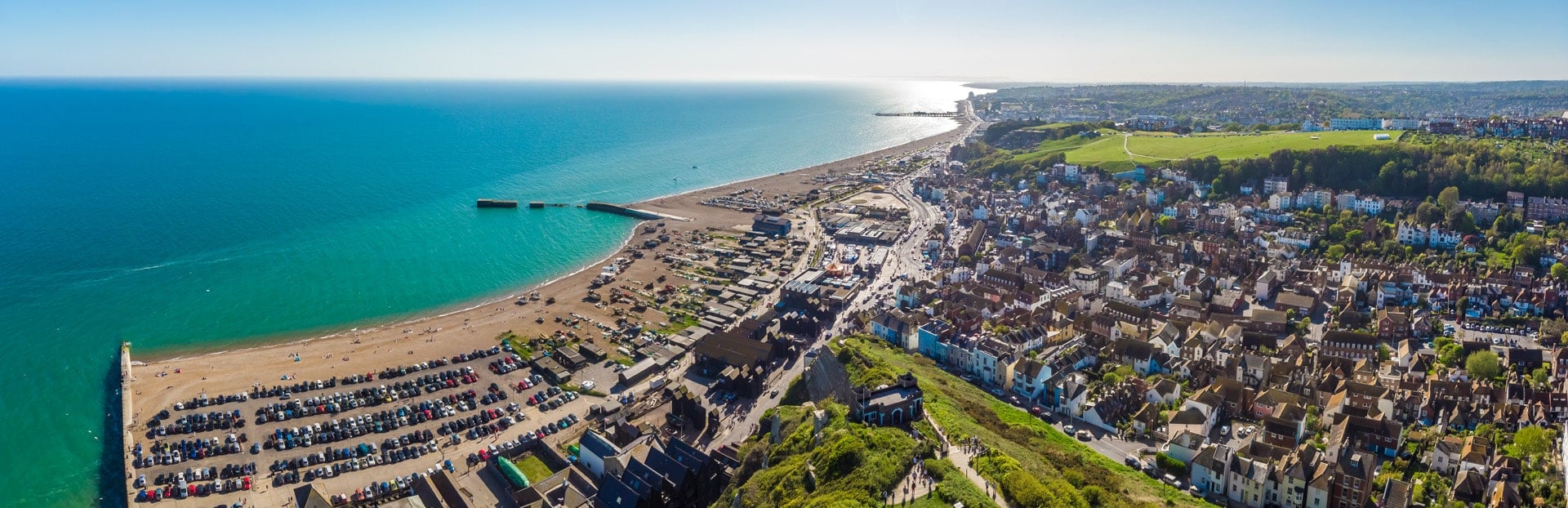
Hastings is a coastal town in East Sussex, in south-east England. The average sold price in Hastings is £236,670 on the HM Land Registry House Price Index, 18.4% below the England average of £289,946 and 37.5% below the South East regional average of £378,515. That is a rare thing in the South East: a coastal town where the price sits well under both the national and the regional figure. The other half of the story is the direction of travel. Hastings ran up to an all-time high of £283,459 in September 2022, then eased to £236,670 by March 2026, a 16.5% fall from the peak, and the latest annual reading is still negative at -5.0%.
This is a buyer's market on the numbers. Every one of the six postcodes shows more homes for sale than the local sales rate is clearing, and asking prices run from £292,139 in TN38 (St Leonards) up to £548,624 in TN33 (Battle, Robertsbridge), a rural outcode that sits mostly in neighbouring Rother. Local wages are part of the picture too: the median gross salary across Hastings is £667.60 a week, below the South East's £800.30, so the affordable asking prices come with a tenant base earning less than the regional average.
This guide covers the borough of Hastings (ONS code E07000062) in East Sussex across postcodes TN33, TN34, TN35, TN37, TN38 and TN39. Hastings sits on the South East coast, roughly 60 miles south-east of London. Two of the postcodes, TN33 and TN39, straddle the boundary with neighbouring Rother, so their figures lean towards Battle, Robertsbridge and Bexhill rather than Hastings town itself. The wider Sussex buy-to-let region also takes in Brighton and Eastbourne along the same coast.
Article updated: July 2026

Why Invest in Hastings?
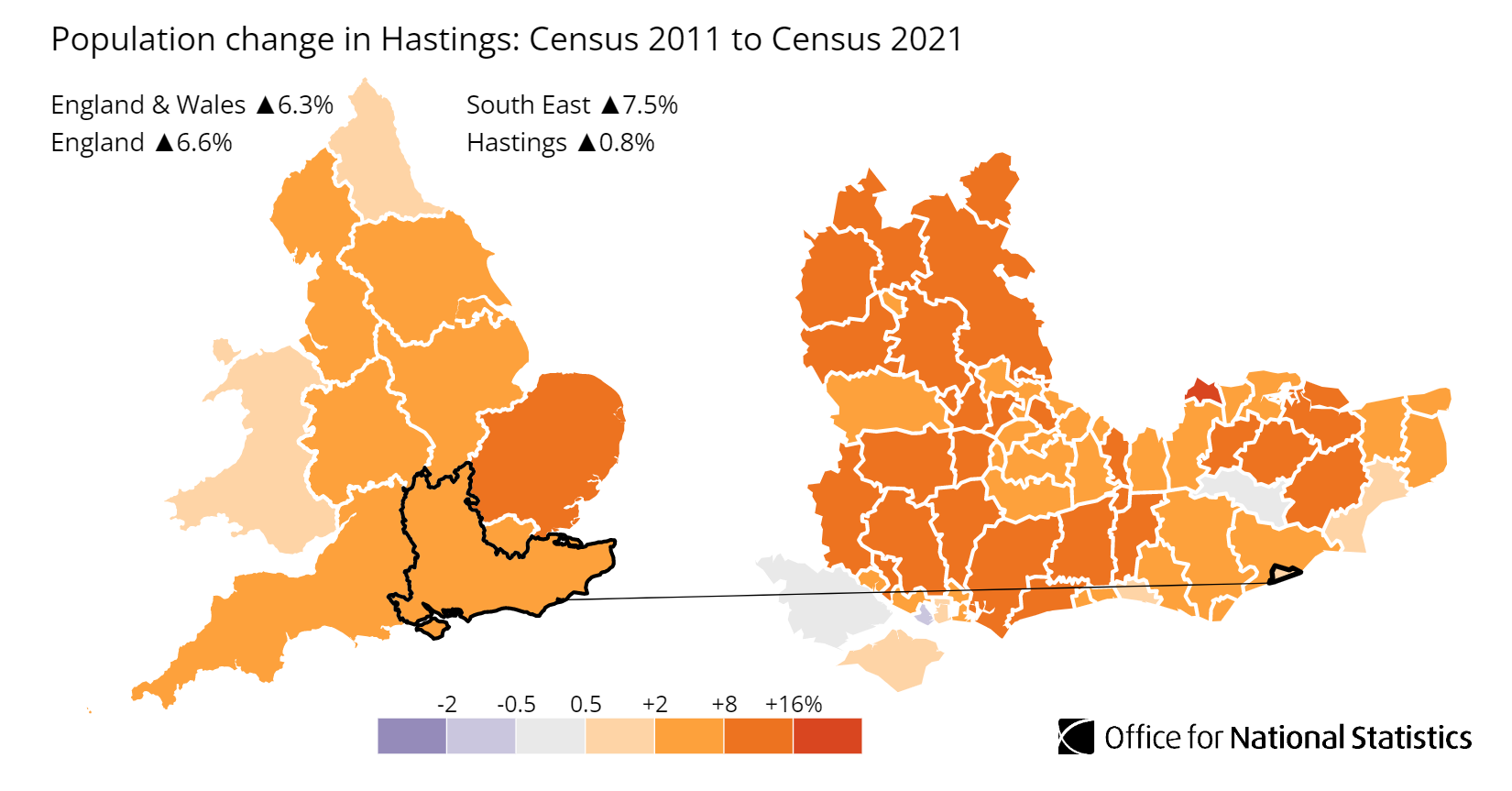
Hastings is one of the more affordable spots on the South East coast, with an average sold price 37.5% below the regional figure, but it is also one of its lower-waged, with median earnings of £667.60 a week against £800.30 across the South East. The borough's population was largely flat between the 2011 and 2021 censuses, rising just 0.82% from 90,254 to 90,995 residents, well behind the England and Wales average of 6.3%. Hastings is a settled coastal town rather than a growth hotspot, with its appeal rooted in the seafront, the Old Town, and an established creative and arts scene that has drawn people out from London over the past decade.
The local employment rate of 65.8% sits below the Great Britain average of 75.6%, and median annual earnings of £34,714 are below both the South East and national figures. That wage base is the single most important number for a Hastings landlord, because it shapes both what tenants can pay and how the affordability sums work out. Hastings' economy leans on health and social work, retail, education, and a tourism and hospitality sector tied to the seafront. The town's relative affordability against London and Brighton has also drawn in commuters and remote workers using the direct rail line to the capital.
Median gross annual earnings across Hastings are £34,714, which is below the South East and Great Britain medians. Lower local wages mean rents are capped by what tenants can realistically afford, which is why several Hastings postcodes show rents taking a large share of the median salary. The flip side is that the lower asking prices keep the deposit and the borrowing within reach for an investor, even where the yield is modest.
Hastings Economic Summary
- Population (Hastings): 90,995 (2021 Census). Growth of 0.82% from 2011.
- Median annual salary: £34,714 (local), against a South East weekly median of £800.30 and a Great Britain median of £752.40
- Employment rate: 65.8% (local), 75.6% (Great Britain)
- Median gross weekly pay: £667.60 (local), £800.30 (South East), £752.40 (Great Britain)
- Key employment sectors: Health and social work, wholesale and retail, education, accommodation and food, public administration
Source: ONS Census 2021, Nomis Labour Market Profile (ASHE 2025)
Regeneration and Investment in Hastings
Hastings is in line for a £20 million slice of a £40 million Levelling Up Partnership shared with Rother, on top of the Town Deal work reshaping the town centre around the station. The money is going into housing, the high street, and the seafront economy rather than a single landmark scheme, which fits a town whose town centre alone sustains around 6,000 jobs.
- Levelling Up Partnership for Hastings and Rother (£40 million, In progress): The government allocated £40 million across Hastings and neighbouring Rother, £20 million each, with over £13 million earmarked for affordable housing in Hastings plus funding for skills, the high street, and community facilities. New housing supply and a stronger local economy both feed the rental market over time. Details at GOV.UK.
- Hastings Town Centre Regeneration (Town Deal, In progress): The Town Deal programme is focused on the town centre core around Hastings station, reactivating vacant buildings including the former Debenhams and New Look units and improving public spaces. Hastings Borough Council partnered with Homes England and Sea Change Sussex to bring forward town centre sites and convert empty commercial property into new homes. The town centre covers around 550 non-residential premises and sustains roughly 6,000 jobs. Updates at Hastings Town Centre Regeneration.
- Homes England town centre partnership (In progress): A strategic partnership between Homes England, Hastings Borough Council and Sea Change Sussex to regenerate town centre sites, convert vacant commercial buildings and deliver new housing. The focus on bringing empty commercial stock back into residential use is the kind of supply-side change that gradually shifts a town centre's tenant mix. Background at GOV.UK.
Source: Office for National Statistics - Population for Hastings
Hastings Property Market Analysis
Average property prices in Hastings have risen 615.4% since January 1995, from £33,083 to £236,670, but the most recent move has been downwards, off a September 2022 peak of £283,459. The sections below trace that journey cycle by cycle, then drill into current postcode-level data for sold prices, price per square foot, asking prices, growth trends, and monthly transaction volumes.
When was the last house price crash in Hastings?
Hastings is its own local authority, so all sold property prices from HM Land Registry are recorded at borough level. The index runs from January 1995 to the latest reading in March 2026, covering 31 years of market cycles. The standout feature of the Hastings series is that its sharpest recent correction is not the 2008 crash but the pullback since 2022.
The 1995 to 2007 boom: Hastings started at £33,083 in January 1995. By December 2000 the average had reached £59,746, and the early 2000s ran hot, with prices passing £127,000 by March 2006. The market peaked at £155,267 in December 2007, having more than quadrupled in 13 years on cheap credit and London buyers looking down the coast.
2008 to 2009, the financial crisis: Hastings fell hard. Prices dropped from the December 2007 peak of £155,267 to a trough of £117,468 in June 2009, a decline of 24.3% in 18 months. The worst annual reading was -21.3% in January 2009. That was a steeper fall than England saw nationally, reflecting a lower-waged coastal market with thinner buyer demand when credit dried up.
The 2010 to 2013 recovery grind: Prices clawed back to £133,146 by December 2010 but then drifted, sitting at £134,782 by December 2012. Hastings spent the early 2010s recovering slowly, held back by weak local wage growth and a national market that did not properly turn until later in the decade.
Recovery to the old peak, 2014 to 2016: Growth returned, with prices rising from £151,960 in December 2014 to £156,026 by April 2015, the first month back above the December 2007 pre-crash peak of £155,267. It took seven and a half years to recover. By December 2016 the average had reached £191,542, helped by London buyers priced out of the capital looking to the coast.
2017 to 2019, steady growth: Prices moved up from £200,497 in December 2017 to £210,914 by December 2019, with annual growth easing back to the low single digits after the sharp mid-decade gains.
2020 to 2022, the pandemic surge: The race for space and the stamp duty holiday hit coastal towns like Hastings hard. Prices jumped from £207,536 in June 2020 to £223,223 by December 2020, then £254,980 by December 2021 (14.2% annual growth), peaking at the all-time high of £283,459 in September 2022.
2023 to present, the correction: Higher mortgage rates and the unwinding of the pandemic premium pulled Hastings back. Prices fell to £252,993 by December 2023 (-7.2% annual), £250,134 by December 2024, and £239,488 by December 2025. The latest reading of £236,670 in March 2026 is 16.5% below the September 2022 peak, with annual growth still at -5.0%. An investor who bought at the exact top in September 2022 would be holding a paper loss today.
Long-term growth summary:
- 5 years (March 2021 to March 2026): 3.1% growth (£229,591 to £236,670)
- 10 years (March 2016 to March 2026): 31.1% growth (£180,558 to £236,670)
- 15 years (March 2011 to March 2026): 78.1% growth (£132,850 to £236,670)
- 20 years (December 2005 to March 2026): 83.2% growth (£129,218 to £236,670)
- 30 years (January 1995 to March 2026): 615.4% growth (£33,083 to £236,670)
The 30-year return of 615.4% is strong, but it hides a flat five years: at 3.1% growth since March 2021, Hastings has gone roughly nowhere over half a decade once the pandemic spike and its unwind cancel out. The 24.3% drop in 2008 to 2009 was deeper than the national fall, and the seven-and-a-half-year wait to recover the old peak was a long one. Hastings has delivered long-run capital growth, but it has done so in big swings rather than a steady line.
- All property types
- Detached
- Semi-detached
- Terraced
- Flats
- All property types
- Detached
- Semi-detached
- Terraced
- Flats
Sold House Prices in Hastings
The average sold price across all property types in Hastings is £236,670, which is 18.4% below the England average of £289,946 as of March 2026. That headline discount masks a split by property type. Detached and semi-detached houses actually sell at or above the England average, while flats sit more than a third below it. The all-types figure is dragged down by Hastings' large stock of terraced houses and flats in the coastal core, where the cheaper end of the market lives.
| Property Type | Hastings Average | England Average | Difference |
|---|---|---|---|
| Detached houses | £474,755 | £470,492 | +0.9% |
| Semi-detached houses | £323,453 | £288,185 | +12.2% |
| Terraced houses | £253,887 | £243,788 | +4.1% |
| Flats and maisonettes | £139,975 | £214,563 | -34.8% |
| All property types | £236,670 | £289,946 | -18.4% |
Detached houses at £474,755 sit 0.9% above England's £470,492. The detached stock here is weighted towards the rural fringe in TN33 and TN39 around Battle and Bexhill, where larger period and village homes pull the average up to commuter-belt levels. Annual change of -3.5% shows this end of the market easing back along with the rest.
Semi-detached houses at £323,453 are 12.2% above England's £288,185, the widest premium of any type. This reflects the same rural and Bexhill-edge influence on the borough's larger family stock rather than anything cheap about Hastings town itself. Annual change of -2.9% is the shallowest fall of the four types.
Terraced houses at £253,887 sit 4.1% above England's £243,788. Terraced housing is the backbone of central Hastings and St Leonards, from Victorian seafront streets to the densely built Old Town fringes, and it is the stock most investors will be buying. Annual change of -3.7% tracks the borough-wide correction.
Flats and maisonettes at £139,975 show the deepest discount at 34.8% below England's £214,563. Hastings has no large institutional flat market to lift values, and its apartment stock is mostly conversions and seafront blocks selling on local demand alone. Annual change of -8.3% is the sharpest fall of any type, which is where the borough-wide correction is biting hardest.
Price Per Square Foot in Hastings
Just £69 per square foot separates Hastings' cheapest postcode from its dearest, with TN37 at £303 and TN33 at £372. Measuring by the square foot strips out how big the homes are and gives a cleaner read on what each location commands. TN33 (Battle, Robertsbridge) tops the table, which fits its rural Rother-fringe character and larger period houses rather than anything about Hastings town.
| Rank | Area | Price Per Sq Ft |
|---|---|---|
| 1 | TN37 (Silverhill, Hollington) | £303 |
| 2 | TN34 (Hastings Town, Ore) | £309 |
| 3 | TN38 (St Leonards, Maze Hill) | £319 |
| 4 | TN35 (Ore Valley, Fairlight) | £324 |
| 5 | TN39 (Bexhill) | £332 |
| 6 | TN33 (Battle, Robertsbridge) | £372 |
TN37 at £303 per square foot is the cheapest space in the borough, drawn from 341 transactions analysed. Silverhill and Hollington are inland residential areas to the north of the town, away from the seafront premium, which keeps the per-square-foot rate down.
TN33 at £372 per square foot tops the table, 23% above TN37, based on 178 transactions analysed. The premium here is paying for rural East Sussex around Battle and Robertsbridge, an outcode that sits largely outside Hastings town in neighbouring Rother, so its figures describe a different, more expensive village market.
For Sale Asking Prices in Hastings
TN38 at £292,139 and TN33 at £548,624 sit 87.8% apart, the widest asking-price gap among Hastings' six postcodes. That spread reflects the difference between the coastal core and the rural fringe rather than two parts of the same town. The mean asking price across all six postcodes is £375,731.
| Rank | Area | Asking Price |
|---|---|---|
| 1 | TN38 (St Leonards, Maze Hill) | £292,139 |
| 2 | TN37 (Silverhill, Hollington) | £295,636 |
| 3 | TN34 (Hastings Town, Ore) | £325,774 |
| 4 | TN35 (Ore Valley, Fairlight) | £386,108 |
| 5 | TN39 (Bexhill) | £406,104 |
| 6 | TN33 (Battle, Robertsbridge) | £548,624 |
TN38 at £292,139 is the lowest asking price in the borough and the natural entry point for a buy-to-let purchase. St Leonards and Maze Hill carry the kind of terraced and flat stock that lets readily, and the asking price here is below the £325,774 in central TN34, so for a fixed budget TN38 buys the most property for the money.
TN33's £548,624 asking price is an outlier and worth treating with care. Battle and Robertsbridge sit in rural Rother rather than Hastings town, so this figure describes a village market of large period homes, not the coastal stock most Hastings investors are weighing. Stripping TN33 out, the working range for Hastings town runs from £292,139 to £406,104.
House Price Growth in Hastings
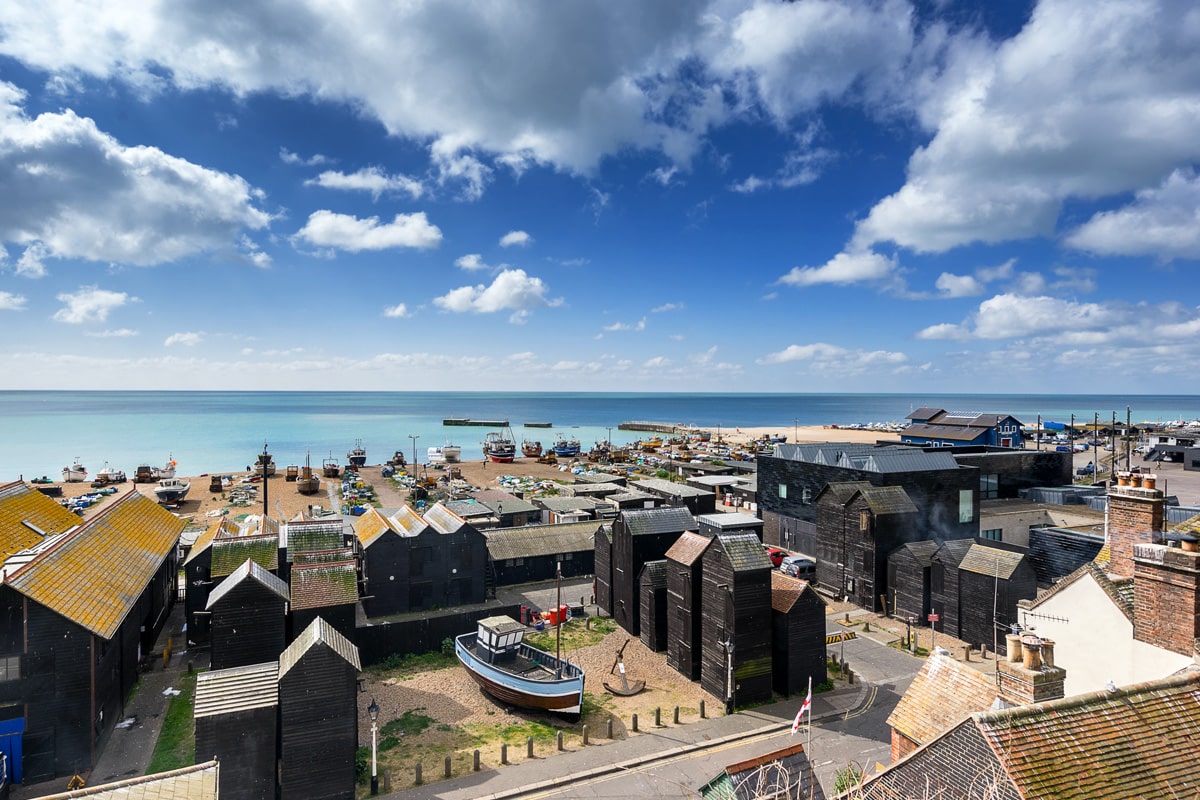
Five of Hastings' six postcodes posted positive five-year growth, led by TN37 at 15.1%, but three of them are negative over both one and three years as the recent correction works through. The five-year figures still carry the tail end of the pandemic surge; the shorter windows show the pullback since 2022. TN33 is the exception, down 3.6% over five years on its rural Rother-fringe stock.
| Area | 1 Year | 3 Years | 5 Years |
|---|---|---|---|
| TN37 (Silverhill, Hollington) | -2.8% | 0.8% | 15.1% |
| TN38 (St Leonards, Maze Hill) | -1.0% | -5.4% | 12.2% |
| TN35 (Ore Valley, Fairlight) | 5.7% | -4.7% | 11.7% |
| TN39 (Bexhill) | 0.4% | 2.4% | 9.4% |
| TN34 (Hastings Town, Ore) | 0.0% | -1.5% | 2.1% |
| TN33 (Battle, Robertsbridge) | 0.3% | 7.3% | -3.6% |
TN37 at 15.1% over five years has the strongest five-year return in the borough, though the -2.8% one-year reading shows it has joined the recent slide. Silverhill and Hollington saw a strong pandemic-era run as inland value plays for buyers priced out of the seafront.
TN35 has the strongest one-year figure at 5.7% but a -4.7% three-year reading, a pattern that points to a recent bounce off a softer medium-term base around Ore Valley and Fairlight. TN39 (Bexhill) is the steadiest of the set, the only postcode positive across all three windows at 0.4%, 2.4% and 9.4%.
TN34, central Hastings town, has the weakest five-year return of the coastal postcodes at 2.1%, with a flat one-year reading. TN33 is the only postcode down over five years at -3.6%, despite a positive three-year figure, reflecting the swings in its thinly traded village market.
Monthly Property Sales in Hastings
Monthly sales range from 10 transactions in TN33 up to 34 in central TN34, with turnover rates between 5% and 8% across the borough. Even the busiest postcode turns over a modest share of its stock each year, which is typical of a settled coastal town rather than a high-churn city market.
| Area | Sales Per Month | Turnover | Asking Price |
|---|---|---|---|
| TN34 (Hastings Town, Ore) | 34 | 8% | £325,774 |
| TN39 (Bexhill) | 29 | 6% | £406,104 |
| TN38 (St Leonards, Maze Hill) | 25 | 7% | £292,139 |
| TN37 (Silverhill, Hollington) | 17 | 6% | £295,636 |
| TN35 (Ore Valley, Fairlight) | 16 | 6% | £386,108 |
| TN33 (Battle, Robertsbridge) | 10 | 5% | £548,624 |
TN34 records the most sales at 34 a month on an 8% turnover rate, the highest in the borough. Central Hastings and Ore hold the deepest pool of mid-priced stock, so homes change hands more often there than anywhere else, which points to an easier resale when an investor comes to exit.
TN33 sits at the other end with 10 sales a month and a 5% turnover rate. The rural village stock around Battle and Robertsbridge is more expensive and more thinly traded, so a property there can sit longer between buyers. For an investor, lower turnover is a reminder that exit speed varies a lot across these six postcodes.
How Long Properties Take to Sell in Hastings
Every Hastings postcode is a buyer's market on the data, with days on market running from about 435 in the central and St Leonards postcodes up to 608 in the thinner rural and valley areas. Days on market is the typical time a home is listed before it sells, and months of unsold stock shows how much for-sale supply is sitting there at the current sales rate. Across the borough there is more for sale than is clearing, which is what a correction looks like on the ground.
| Area | Avg Days to Sell | Months of Unsold Stock | Market |
|---|---|---|---|
| TN34 (Hastings Town, Ore) | 435 | 14.3 | Buyer's market |
| TN37 (Silverhill, Hollington) | 435 | 14.3 | Buyer's market |
| TN38 (St Leonards, Maze Hill) | 435 | 14.3 | Buyer's market |
| TN39 (Bexhill) | 507 | 16.7 | Buyer's market |
| TN35 (Ore Valley, Fairlight) | 608 | 20.0 | Buyer's market |
| TN33 (Battle, Robertsbridge) | 608 | 20.0 | Buyer's market |
How long a property takes to sell is the holding cost that never shows up in a yield figure, and in Hastings right now it is high everywhere. Even the quickest postcodes take well over a year to sell on average, and TN35 and TN33 carry 20 months of unsold stock at the current rate. For a buyer that supply is leverage on price; for anyone selling, it means budgeting for a long marketing period and a property tied up while it finds a buyer.
What Type of Property Can You Buy in Hastings?
Detached houses lead the rural postcodes at over 61% of stock in TN33 and TN39, while central TN34 is the most flat-and-terrace-heavy at 34.5% detached and 25% flats and terraces combined. The mix of housing stock shapes which strategies fit each postcode. The figures below are drawn from 2021 Census records for each postcode.
| Area | Detached | Semi-detached | Terraced | Flats |
|---|---|---|---|---|
| TN33 (Battle, Robertsbridge) | 61.3% | 24.9% | 7.1% | 4.8% |
| TN34 (Hastings Town, Ore) | 34.5% | 22.0% | 17.9% | 25.5% |
| TN35 (Ore Valley, Fairlight) | 58.0% | 18.9% | 11.4% | 6.4% |
| TN37 (Silverhill, Hollington) | 42.7% | 21.2% | 13.0% | 21.1% |
| TN38 (St Leonards, Maze Hill) | 43.1% | 22.5% | 16.8% | 16.9% |
| TN39 (Bexhill) | 61.3% | 17.9% | 7.7% | 13.0% |
TN34 holds the largest share of flats at 25.5% and terraced houses at 17.9%, the smaller-unit stock that typically forms the buy-to-let market. That lines up with central Hastings and Ore being the busiest sales market and a natural home for single lets and shared housing close to the town and seafront.
TN33 and TN39 are the most detached-dominated postcodes at 61.3% each, with much smaller terraced shares. That weighting towards larger family and village homes matches their higher asking prices and lower yields, and it is the kind of owner-occupier stock that suits longer-hold family lets rather than higher-income rental strategies.
Flats here combine purpose-built blocks and converted units, and a small share of mobile and temporary dwellings is left out, so the rows may not add to 100%.
Hastings Rental Market Analysis
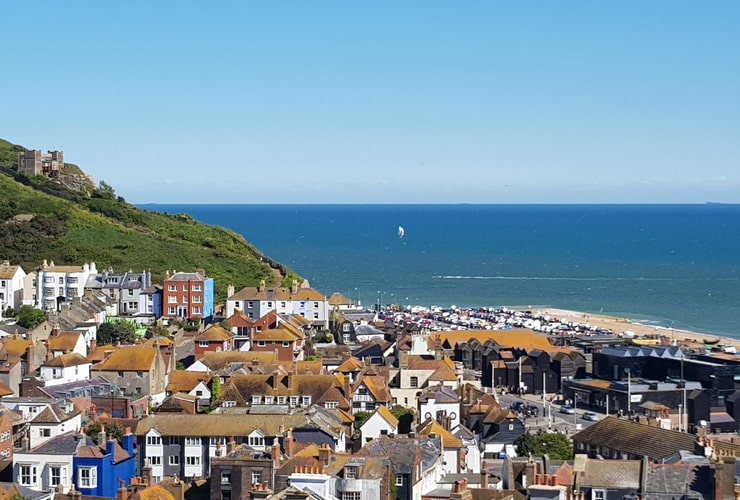
Monthly rents in Hastings run from £1,064 in central TN34 to £1,303 in TN35, with gross rental yields from 3.5% to 4.7% across the five postcodes that carry rental data. For investors asking is buy to let worth it in Hastings, the sections below break down rents, yields, and tenant affordability postcode by postcode. If you are weighing how to build a property portfolio on the South East coast, Hastings offers a lower asking price than most of the region, set against lower local wages. Browse current buy-to-let property for sale across the region.
Average Rent & Gross Rental Yields in Hastings
Gross rental yields in Hastings range from 3.5% in TN39 to 4.7% in TN38. The cheapest core postcode delivers the highest yield, the familiar pattern where a lower asking price does more for the return than a higher rent. TN35 charges the highest rent at £1,303 but lands mid-table on yield at 4.0% because its £386,108 asking price is well above TN38's. TN33 carries too few rental listings to show a reliable rent or yield, so those cells read as not enough data.
| Area | Average Monthly Rent | Asking Price | Gross Yield |
|---|---|---|---|
| TN38 (St Leonards, Maze Hill) | £1,151 | £292,139 | 4.7% |
| TN37 (Silverhill, Hollington) | £1,082 | £295,636 | 4.4% |
| TN35 (Ore Valley, Fairlight) | £1,303 | £386,108 | 4.0% |
| TN34 (Hastings Town, Ore) | £1,064 | £325,774 | 3.9% |
| TN39 (Bexhill) | £1,175 | £406,104 | 3.5% |
| TN33 (Battle, Robertsbridge) | Not enough data | £548,624 | Not enough data |
TN38 at 4.7% pairs the lowest asking price in the borough, £292,139, with a £1,151 monthly rent to give the best yield. A 30% deposit of £87,642 buys into the highest-yielding postcode, in the St Leonards stock that lets most readily.
TN39 (Bexhill) at 3.5% sits at the bottom of the yield table. The £1,175 rent is respectable, but the £406,104 asking price compresses the return, and the postcode sits in Rother rather than Hastings town. TN34, central Hastings, is close behind at 3.9%, where a mid-range rent meets a mid-range price.
Gross Rental Yield by Postcode
Three of the central postcodes, TN34, TN37 and TN38, currently read as landlord's markets on rental supply, with relatively few homes advertised to let at any one time. That is the one part of the Hastings market where demand sits ahead of supply, in contrast to the buyer's market on the sales side.
Is Hastings Rent High?
Monthly rents in Hastings take between 36.8% and 45.0% of the local median gross monthly salary. The widely cited threshold for rent affordability is 30% of gross income, and every Hastings postcode with rental data sits above it. That is a direct consequence of the borough's low wages: rents are not especially high in cash terms, but they are high relative to what local earners take home.
The median gross weekly salary in Hastings is £667.60, which equates to £2,893 per month or £34,714 per year. This is below the South East regional median of £800.30 per week and the Great Britain median of £752.40 per week. Data from the Nomis Labour Market Profile (ASHE 2025).
| Rank | Area | Rent as % of Income |
|---|---|---|
| 1 | TN35 (Ore Valley, Fairlight) | 45.0% |
| 2 | TN39 (Bexhill) | 40.6% |
| 3 | TN38 (St Leonards, Maze Hill) | 39.8% |
| 4 | TN37 (Silverhill, Hollington) | 37.4% |
| 5 | TN34 (Hastings Town, Ore) | 36.8% |
| — | TN33 (Battle, Robertsbridge) | Not enough data |
TN34 at 36.8% is the most affordable for tenants, where the borough's lowest rent of £1,064 meets the median salary. Even so, it sits above the 30% mark, so a single earner on the median wage is stretched, and many Hastings lets work on two incomes or on housing support rather than one local salary.
TN35 at 45.0% is the least affordable, with a £1,303 rent against a £2,893 monthly salary. Rents at that level in Ore Valley and Fairlight typically depend on dual-income households or tenants who have moved in from outside the area, rather than the local median earner.
How Big Is Hastings' Private Rented Sector?
The private rented sector is deepest in central TN34 at 19.5% of households and shallowest in the rural postcodes TN35 and TN39 at around 12%. The share of homes already rented privately is a guide to the size of the established tenant pool. The table below shows household tenure by postcode.
| Area | Owned Outright | Owned with Mortgage | Private Rented | Social Rented |
|---|---|---|---|---|
| TN34 (Hastings Town, Ore) | 38.8% | 25.2% | 19.5% | 15.4% |
| TN37 (Silverhill, Hollington) | 39.4% | 31.0% | 18.6% | 10.3% |
| TN38 (St Leonards, Maze Hill) | 37.1% | 34.4% | 17.9% | 10.1% |
| TN33 (Battle, Robertsbridge) | 49.8% | 27.9% | 17.6% | 4.1% |
| TN39 (Bexhill) | 54.6% | 26.5% | 11.8% | 6.2% |
| TN35 (Ore Valley, Fairlight) | 56.5% | 26.0% | 11.6% | 5.2% |
TN34, TN37 and TN38, the central Hastings and St Leonards postcodes, have the deepest private rented sectors at 17.9% to 19.5% of households. A larger rented sector points to an active local lettings market and a wider pool of existing tenants, and it lines up with these being the postcodes where rental supply currently runs tight. TN34 also carries the highest social rented share at 15.4%, a marker of the lower-income profile in the town centre.
TN39 (Bexhill) and TN35 have the smallest private rented sectors at around 12%, with much higher outright ownership, TN35 at 56.5%. These are owner-occupier and retirement-leaning areas where the rental market is thinner, which is part of why TN33 and TN39 also show patchy rental data.
Local Housing Allowance Rates in Hastings
All six Hastings postcodes fall within the Sussex East Broad Rental Market Area, where Local Housing Allowance runs from £83.08 a week for a shared room to £264.66 a week for a four-bedroom home. Local Housing Allowance sets the maximum housing support a tenant on benefits can receive, so for that part of the market it acts as a floor under the rent. The rates below apply across the whole of Hastings. To check the current rate for a specific address, you can use the government's official Local Housing Allowance calculator.
| Property Size | Weekly LHA Rate | Monthly Equivalent |
|---|---|---|
| Shared accommodation | £83.08 | £360 |
| 1 bedroom | £136.93 | £593 |
| 2 bedrooms | £172.60 | £748 |
| 3 bedrooms | £218.63 | £947 |
| 4 bedrooms | £264.66 | £1,147 |
The two-bedroom LHA rate of £172.60 a week works out at about £748 a month, against open-market rents of £1,064 to £1,303 across Hastings. In a low-wage town a benefit-backed tenancy at the LHA rate is a meaningful slice of the rental market, and the rate matters more here than in higher-income areas. The figure is identical in every Hastings postcode because it is set across the whole Sussex East market area, and LHA rates are reviewed each April.
Buy-to-Let Considerations
Are House Prices High in Hastings? Price-to-Earnings Ratios
Buying a property in Hastings takes between 8.4 and 15.8 times the median local annual salary. This is based on the Nomis Labour Market Profile for Hastings showing the median gross annual income for Hastings residents is £34,714.
The national benchmark for price-to-earnings is 7.4x (England's average sold price of £289,946 divided by the Great Britain median annual salary of £39,125). Every Hastings postcode sits above that benchmark, which is the arithmetic of South East prices meeting below-average local wages. Even the cheapest postcode costs more relative to local earnings than the England average does relative to national earnings.
| Rank | Area | Price-to-Earnings Ratio |
|---|---|---|
| 1 | TN38 (St Leonards, Maze Hill) | 8.4x |
| 2 | TN37 (Silverhill, Hollington) | 8.5x |
| 3 | TN34 (Hastings Town, Ore) | 9.4x |
| 4 | TN35 (Ore Valley, Fairlight) | 11.1x |
| 5 | TN39 (Bexhill) | 11.7x |
| 6 | TN33 (Battle, Robertsbridge) | 15.8x |
TN38 at 8.4x is the most affordable entry in Hastings relative to local pay, though it still sits a full point above the 7.4x national benchmark. For an investor that ratio is a reminder that local owner-occupier demand is constrained by wages, which is part of why the rental market is comparatively active in these central postcodes.
TN33 at 15.8x sits at the far end. At nearly sixteen times the local median salary, the Battle and Robertsbridge market runs on buyers from outside the area and equity from elsewhere rather than local earnings, which fits its rural Rother character rather than Hastings town.
Deposit Requirements in Hastings
A 30% deposit on a buy-to-let property in Hastings ranges from £87,642 in TN38 to £164,587 in TN33. The gap between the cheapest and most expensive deposit is £76,945, which is most of a second deposit in TN38. Stripping out the rural TN33 outlier, the working range for Hastings town runs from £87,642 to £121,831, below the deposit you would need across most of the wider South East.
Beyond the deposit, the stamp duty calculation and other buy to let costs affect the total capital required.
| Rank | Area | 30% Deposit Required |
|---|---|---|
| 1 | TN38 (St Leonards, Maze Hill) | £87,642 |
| 2 | TN37 (Silverhill, Hollington) | £88,691 |
| 3 | TN34 (Hastings Town, Ore) | £97,732 |
| 4 | TN35 (Ore Valley, Fairlight) | £115,832 |
| 5 | TN39 (Bexhill) | £121,831 |
| 6 | TN33 (Battle, Robertsbridge) | £164,587 |
TN38 is the cheapest way into Hastings at an £87,642 deposit, and it is also the highest-yielding postcode, so the lowest entry cost and the best income return sit together in St Leonards. Stepping up to TN37 costs barely £1,000 more and buys a similar profile inland at Silverhill and Hollington.
At the upper end, TN35 and TN39 are roughly £6,000 apart on the deposit but earn their keep differently. TN35 (Ore Valley, Fairlight) carries the higher rent at £1,303 and a 4.0% yield, while TN39 (Bexhill) sits in Rother with a steadier growth record but the lowest yield in the borough at 3.5%. Similar capital, two different bets.
What the Hastings Data Tells Buy-to-Let Investors
In Hastings the cheapest core postcode is also the highest-yielding. TN38 (St Leonards, Maze Hill) has the top yield at 4.7%. It is also the lowest asking price for buying an investment property at £292,139, which keeps the deposit down to £87,642, the lowest in the borough, on a home renting at £1,151 a month. TN37 next door offers much the same profile inland.
The wider picture is a market in correction. Hastings has fallen 16.5% from its September 2022 peak, the latest annual reading is -5.0%, and every postcode is a buyer's market with well over a year of typical selling time. Five of the six postcodes are still positive over five years, led by TN37 at 15.1%, but three are negative over both one and three years as the pandemic premium unwinds. For a buyer, the long selling times and the supply overhang are pricing leverage; for anyone selling, they are a warning that exits are slow right now.
The rural postcodes need a clear eye. TN33 (Battle, Robertsbridge) and TN39 (Bexhill) sit mostly in neighbouring Rother, carry the highest prices and the lowest yields, and skew the borough averages upwards. Stripping them out, Hastings town itself runs from £292,139 to £386,108 on asking price with yields of 3.9% to 4.7%. Buyers who want to come in below those figures often look through off market property channels, which matters more in a soft market where sellers are open to a deal.
The tenant base is the thing to weigh against the affordable entry. Median local earnings of £34,714 and a 65.8% employment rate are both below the national picture, rents already take 37% to 45% of the median local salary, and the Local Housing Allowance market is a real part of demand here. Hastings offers a low price for the South East, but it pairs that with a lower-income tenant base than the regional average, and the data reads accordingly. Hastings runs a selective licensing scheme in several wards, so a privately let home may need a council licence depending on where it sits. Check whether a specific address falls in a designated ward on Hastings Borough Council's landlord licensing pages before buying.
How Hastings Compares
Hastings' mean asking price of £375,731 is the second-lowest of five South East locations compared here, behind only Eastbourne, but its top yield of 4.7% sits in the middle of the group. The comparison below places Hastings alongside four nearby South East locations, each with a different investor profile. The mean asking price and mean monthly rent are simple averages across all postcodes with data. Top gross yield is the single highest postcode yield in each location.
| Location | Mean Asking Price | Mean Monthly Rent | Mean Gross Yield | Top Yield (postcode) |
|---|---|---|---|---|
| Eastbourne | £331,156 | £1,349 | 4.9% | 5.8% (BN24) |
| Hastings | £375,731 | £1,155 | 3.7% | 4.7% (TN38) |
| Crawley | £407,518 | £1,492 | 4.4% | 5.0% (RH11) |
| Maidstone | £491,082 | £1,520 | 3.7% | 4.8% (ME20) |
| Chichester | £543,257 | £1,496 | 3.3% | 4.3% (PO19) |
Hastings is the second-cheapest location in this group at £375,731 mean asking price, behind Eastbourne at £331,156, but its mean monthly rent of £1,155 is the lowest of the five, which is what pulls its top yield down to 4.7%. Eastbourne, the next-door coastal neighbour, manages a lower price and a higher rent, so it posts the strongest top yield in the table at 5.8%.
For investors prioritising income, Eastbourne at 5.8% and Crawley at 5.0% lead the group, while Chichester at £543,257 and a 4.3% top yield sits at the premium, lower-yielding end. Maidstone at £491,082 occupies the middle of the pack on price with a 4.8% yield. Hastings competes on a low asking price for the coast rather than on yield, set against the lowest rents and the lowest local wages in the group. For a data-driven comparison across all UK locations, see our best buy-to-let areas guide.
Frequently Asked Questions
Is Hastings a good place to live for buy-to-let tenants?
It is an easy place to rent in, but the wages are the catch. Hastings is a settled coastal town with a strong Old Town and seafront, a creative scene, and a direct rail line to London, which has drawn in commuters and remote workers over the past decade. That is the demand side.
The pay side is weaker. Median earnings are £667.60 a week against £800.30 across the South East, and the employment rate of 65.8% is below the national 75.6%. So tenant demand is real, but a lot of it sits at the affordable end, with rents already taking 37% to 45% of the local median salary and the benefit-funded market a meaningful part of the picture.
What are the best areas in Hastings for property investment?
The postcodes split between the coastal core and the rural fringe. TN38 (St Leonards) is the cheapest way in at £292,139 and the highest-yielding at 4.7%, with TN37 (Silverhill, Hollington) close behind inland at 4.4%, so the central postcodes lean towards income. TN34 (Hastings Town, Ore) is the busiest sales market and the most flat-and-terrace-heavy, which suits smaller lets.
The rural postcodes are a different market. TN33 (Battle, Robertsbridge) and TN39 (Bexhill) sit mostly in neighbouring Rother, carry the highest prices and lowest yields, and behave like village and retirement markets rather than Hastings town. So if income matters most, the core St Leonards and Silverhill postcodes lead on yield and price.
How does Hastings compare to Eastbourne for buy-to-let?
Eastbourne does better on the income numbers. Its mean asking price of £331,156 is lower than Hastings' £375,731, and its mean rent of £1,349 is higher than Hastings' £1,155, so Eastbourne's top yield of 5.8% comfortably beats Hastings' 4.7%. They are next-door coastal neighbours in East Sussex, but on the current data Eastbourne is the stronger cash-flow play.
Where Hastings competes is on the entry point for the wider coast and the regeneration money now flowing into the town centre. Historically both towns have moved with the same coastal cycle, so the choice comes down to whether the lower yield in Hastings is offset by where you think the town centre work takes it.
Why have Hastings house prices fallen?
It is the pandemic premium unwinding. Hastings, like a lot of coastal towns, ran up fast in 2020 to 2022 as buyers chased space and the stamp duty holiday, peaking at £283,459 in September 2022. Higher mortgage rates since then have pulled it back to £236,670 by March 2026, a 16.5% fall from the peak, with the latest annual reading still at -5.0%.
On the ground that shows up as a buyer's market in every postcode, with typical selling times well over a year and a lot of unsold stock. For a buyer that is pricing leverage; the flip side is that selling is slow right now, so it is a market to enter with a long hold in mind rather than a quick flip.
Can I find buy-to-let property under £250,000 in Hastings?
Not far under, on average, but it is closer than most of the South East. The cheapest postcode is TN38 (St Leonards) at a £292,139 asking price, so the town as a whole sits above £250,000 on asking. The way in below that is by property type rather than postcode: flats across Hastings average £139,975 on the Land Registry index, and terraced houses sit around £253,887. If sub-£250,000 is the target, St Leonards flats and central terraces are where to look, or explore below market value stock, which is easier to find in a soft market.
What are average house prices in Hastings?
The average sold price across Hastings is £236,670 on the Land Registry index, about 18.4% below the England average of £289,946 and 37.5% below the South East regional figure as of March 2026. Asking prices by postcode run from £292,139 in TN38 (St Leonards) up to £548,624 in the rural TN33 (Battle, Robertsbridge), with a borough-wide mean of £375,731. By type, detached homes average £474,755, semi-detached £323,453, terraced £253,887 and flats £139,975.
Through a buy-to-let lens, TN38 is the cheapest core entry and the highest-yielding at 4.7%, while the rural TN39 (Bexhill) is the lowest-yielding at 3.5%.
What are the Local Housing Allowance rates in Hastings?
All six Hastings postcodes fall in the Sussex East Broad Rental Market Area, so they share one set of rates. As of June 2026, Local Housing Allowance runs at £83.08 a week for a shared room, £136.93 for a one-bed, £172.60 for two beds, £218.63 for three and £264.66 for four. That figure is the most a tenant on housing support can claim towards rent, so for that part of the market it effectively sets a floor, which matters more in a lower-waged town like Hastings.
What type of property is most common in Hastings?
Detached houses overall, but the mix swings hard between the coast and the fringe. The rural postcodes TN33 and TN39 are over 61% detached, while central TN34 (Hastings Town, Ore) is only 34.5% detached and carries the most flats in the borough at 25.5%. The smaller homes that usually suit buy-to-let, flats and terraces, are concentrated in TN34 and the St Leonards postcode TN38.
How do I buy an investment property in Hastings?
Decide first whether you are buying for income or for a longer-term hold, because that points you at a different part of the borough. TN38 (St Leonards) is the cheapest core entry at £292,139 and the highest-yielding at 4.7%, while the rural TN39 and TN33 are higher-priced, lower-yield, longer-hold markets. At 30% down, the deposit runs from £87,642 in TN38 to £164,587 in the rural TN33.
Beyond what is listed openly, plenty of experienced investors buy below asking through off market properties and BMV property, and that route is more productive while the market sits soft. To see what is available now, browse investment properties or buy-to-let homes for sale.
Ready to buy property?
Access off-market investment properties with an average 8%+ annual gross yield (beating the UK's typical 3-5%).
Get property alerts