
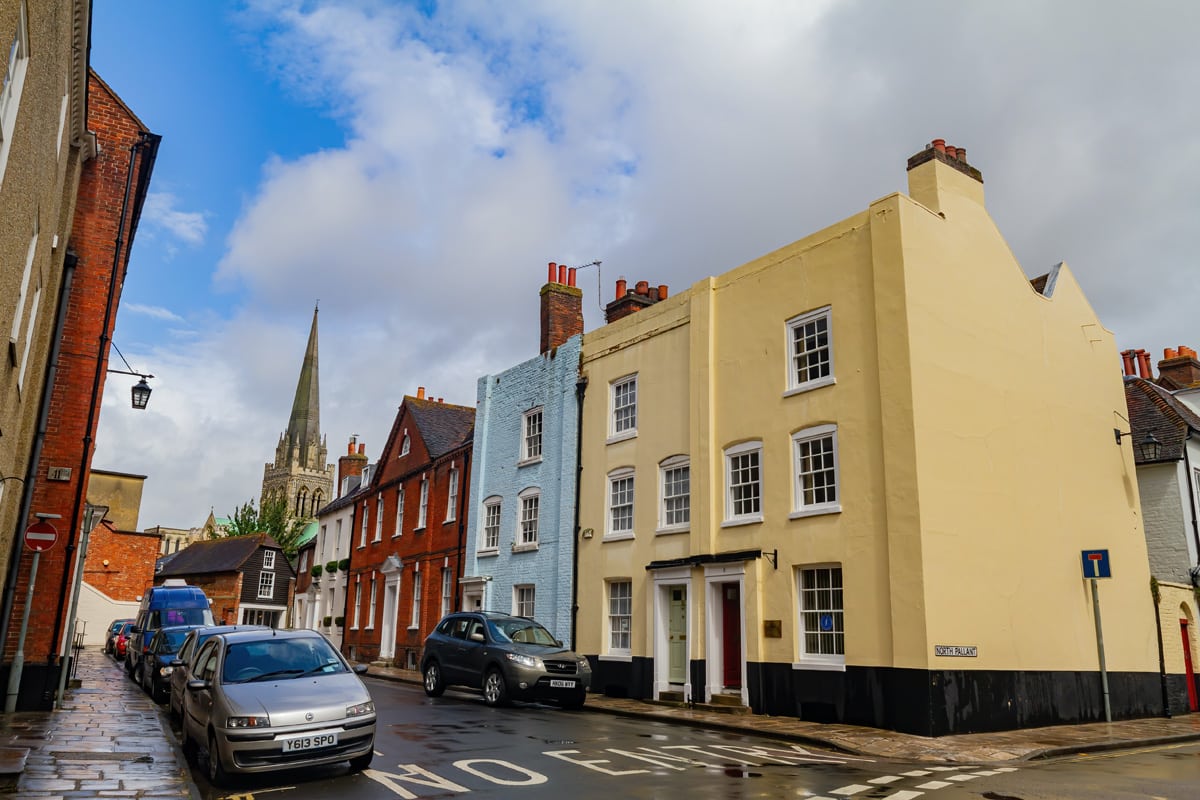
Chichester is a cathedral city in West Sussex, on the south coast of England, and this guide covers the wider Chichester district around it. The average sold home across the Chichester district is £426,958 on the HM Land Registry House Price Index, 47.3% above the England average of £289,946 as of March 2026. That is a high-value, coastal-and-Downs corner of West Sussex where price drives the investment case far more than yield. Even the cheapest postcode, PO19 in the cathedral city itself, sits at £399,934, well above the typical English home.
This is a capital-led market, not a cash-flow one. Gross yields top out at 4.3% in PO19 and fall to 2.6% in GU27 around Haslemere, because asking prices run from £399,934 to £691,438 while rents move in a much tighter band. Local wages add the twist: the median annual salary in the Chichester district is £35,264, below the wider South East, so prices sit at 11 to 20 times earnings and an investor is buying into the area's desirability rather than a high rent multiple. The eight postcodes split the district between the city, the Manhood peninsula coast, and the South Downs villages.
This guide covers the local authority district of Chichester (ONS code E07000225) across postcodes BN18, GU27, GU28, GU29, PO10, PO18, PO19, and PO20. The district spans the cathedral city plus a large rural and coastal area, from Selsey and the Witterings on the coast up through the South Downs around Midhurst and Petworth. Chichester sits on the South Coast, with direct trains to London Victoria in around 1 hour 35 minutes. The wider West Sussex buy-to-let region also includes Crawley and Worthing.
Article updated: July 2026
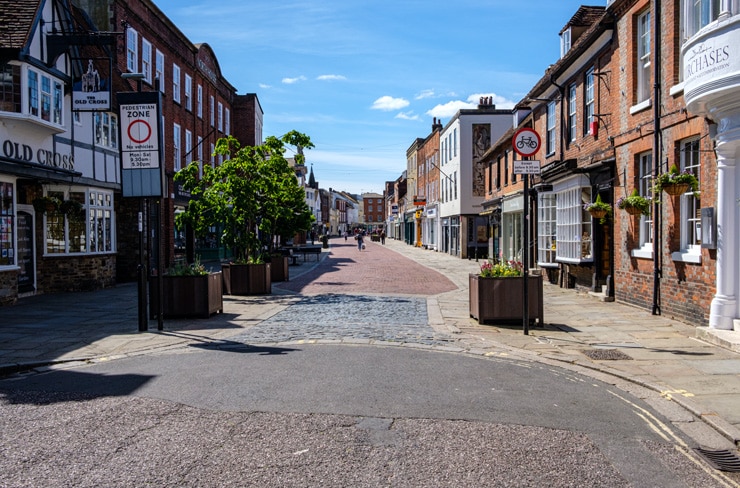
Why Invest in Chichester?
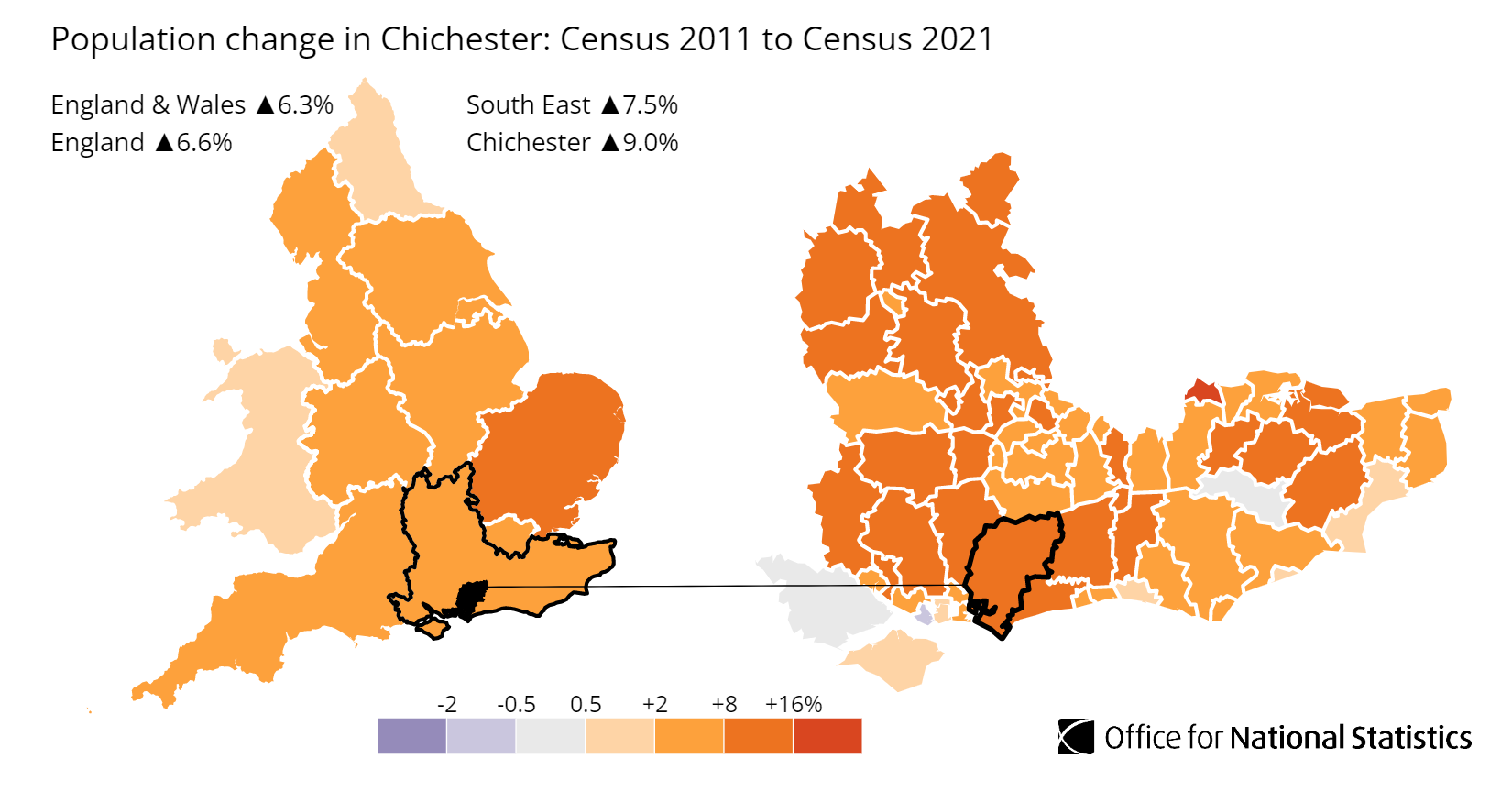
The Chichester district grew its population 9.03% between the 2011 and 2021 censuses, from 113,794 to 124,068 residents. That is faster than the England and Wales average of 6.3%, in a district where most land falls inside the South Downs National Park and new housing supply is tightly constrained. The cathedral city is the compact economic and cultural anchor, around a Norman cathedral and the Chichester Festival Theatre, with the Goodwood estate, the coast, and the Downs drawing in residents, visitors, and second-home demand.
The local employment rate is 84.9%, well above the Great Britain average of 75.6%. The district's economy leans on health and social care, retail, education, tourism and hospitality, and agriculture, with the festival theatre and the Goodwood motorsport and racing calendar adding a seasonal visitor economy on top. That visitor demand also supports holiday let investment along the coast and in the Downs villages.
Median gross annual earnings across the Chichester district are £35,264, which is below the South East regional median. This is the defining feature of the local market: house prices are pushed up by lifestyle and amenity demand rather than by local incomes, so the gap between what homes cost and what residents earn is unusually wide. For a landlord, that means a tenant base weighted towards professionals, commuters, retirees, and second-home owners rather than a high-volume, high-yield rental city.
Chichester Economic Summary
- Population (Chichester district): 124,068 (2021 Census). Growth of 9.03% from 2011.
- Median annual salary: £35,264 (local), £39,125 (Great Britain)
- Employment rate: 84.9% (local), 75.6% (Great Britain)
- Key employment sectors: Health and social care, wholesale and retail, education, accommodation and food, agriculture
Source: ONS Census 2021, Nomis Labour Market Profile (ASHE 2025)
Regeneration and Investment in Chichester
With most of the district protected as National Park, the new housing and commercial investment is concentrated on a handful of strategic sites in and around the city.
- Southern Gateway (Masterplanning, around 365 homes): Chichester District Council's flagship regeneration scheme covers a 30-acre area south of the city centre, with a masterplan for around 365 new homes alongside commercial and leisure space and an integrated transport hub. The council's 2026/27 capital programme earmarks Community Infrastructure Levy money towards the transport hub and public realm, with Henry Boot Developments selected as preferred development partner. Updates at Invest Chichester.
- West of Chichester (Under construction, 1,600 homes): The district's largest housing site delivers 1,600 homes in two phases on the western edge of the city. Phase 1 of 750 homes is nearing completion, and the 850-home second phase, including 30% affordable housing, received outline approval in July 2024, with Miller Homes and Vistry Group as developers. The scheme adds a significant volume of new stock to a supply-constrained district. Updates at West of Chichester.
- University of Chichester student accommodation (Under construction, completion 2027): A consortium led by Uliving is delivering and refurbishing student accommodation across the university's two campuses, with 349 new beds planned at the Bishop Otter campus in Chichester and practical completion targeted for September 2027. The expanded campus supports the city-centre rental market in PO19. Updates at The Construction Index.
Chichester Property Market Analysis
Average property prices across the Chichester district have risen 432.9% since January 1995, from £80,122 to £426,958. The sections below trace that long arc cycle by cycle, then drill into postcode-level sold prices, price per square foot, asking prices, growth, and monthly transaction volumes.
When was the last house price crash in Chichester?
All sold prices come from HM Land Registry at the Chichester district level, covering the cathedral city plus its rural and coastal hinterland. The House Price Index tracks average prices from January 1995 to March 2026, a span of 31 years and several full cycles.
The 1995 to 2007 boom: The district started at £80,122 in January 1995. By December 2000 prices had reached £151,635, almost doubling in six years as cheap credit and rising mortgage availability fed the market. Growth carried on through the early 2000s to £242,516 by December 2005, and the cycle peaked at £295,643 in October 2007.
2008 to 2009, the financial crisis: Prices fell from the October 2007 peak of £295,643 to a trough of £232,224 in March 2009, a decline of 21.5% over 17 months. The worst year-on-year reading was -15.7% in March 2009. Chichester's fall was steeper than many lower-priced markets, because higher-value areas had further to drop when mortgage finance dried up, and the district's reliance on discretionary, lifestyle-led demand left it exposed when buyers paused.
The 2010 to 2012 stagnation: Prices bounced off the March 2009 trough but then drifted sideways. By December 2010 the average stood at £274,255, and the market spent close to three years oscillating below its pre-crash high without pushing through it.
Recovery, 2012 to 2013: Prices first passed the October 2007 peak of £295,643 in September 2012, at £298,295. It took just under five years to recover the pre-crash level. By December 2013 the average had reached £318,377, and momentum was building again.
The 2014 to 2019 pre-pandemic growth: Steady growth ran through the middle of the decade, lifted by South East commuter demand and the area's amenity appeal. Prices climbed from the mid-£300,000s towards £383,751 by December 2019, with annual growth mostly in the low single digits.
2020 to 2022, the pandemic surge: The stamp duty holiday and a rush for coastal and countryside living turbocharged Chichester. Prices jumped to £412,060 by June 2020 and £406,544 by December 2020, then ran on to £423,604 by December 2021. The district hit its all-time high of £466,419 in October 2022, with annual growth of 10.4%.
The 2023 rate shock: Higher mortgage rates cooled the top of the market hardest. Prices eased back to £440,142 by December 2023, recording -4.1% annual growth as the pandemic premium unwound.
2024 to present: The softening continued through 2024 and 2025, with prices at £441,729 by December 2024 and £426,958 by the latest reading in March 2026, a -5.0% annual change. The current price is 8.5% below the October 2022 peak but still 44.4% above the October 2007 pre-crash high.
Long-term growth summary:
- 5 years (March 2021 to March 2026): 4.8% growth (£407,357 to £426,958)
- 10 years (March 2016 to March 2026): 22.5% growth (£348,583 to £426,958)
- 15 years (March 2011 to March 2026): 51.9% growth (£281,092 to £426,958)
- 20 years (March 2006 to March 2026): 72.4% growth (£247,611 to £426,958)
- 30 years (January 1995 to March 2026): 432.9% growth (£80,122 to £426,958)
Chichester's crash was deeper than the national average, and its recent correction from the 2022 peak has been sharper than lower-priced markets, both signs that a high-value, lifestyle-led market moves more with sentiment and finance costs. Against that, the 30-year return of 432.9% is strong, and an investor who bought at the exact October 2007 peak would still be sitting on a 44.4% gain on the Land Registry average. The recent easing has pulled prices off their high rather than into a slump.
- All property types
- Detached
- Semi-detached
- Terraced
- Flats
- All property types
- Detached
- Semi-detached
- Terraced
- Flats
Sold House Prices in Chichester
The average sold price across all property types in the Chichester district is £426,958, which is 47.3% above the England average of £289,946 as of March 2026. That premium runs through every house type, but it falls away sharply for flats. Detached houses, semis, and terraces all sit around 40% to 46% above their England equivalents, while flats are level with the national figure, a split that tells you where the area's value really concentrates.
| Property Type | Chichester Average | England Average | Difference |
|---|---|---|---|
| Detached houses | £677,458 | £470,492 | +44.0% |
| Semi-detached houses | £421,471 | £288,185 | +46.3% |
| Terraced houses | £341,825 | £243,788 | +40.2% |
| Flats and maisonettes | £215,246 | £214,563 | +0.3% |
| All property types | £426,958 | £289,946 | +47.3% |
Detached houses at £677,458 carry a 44.0% premium over England's £470,492. This is the engine of the district's headline price, the large period and village homes around Goodwood, the Downs villages near Midhurst and Petworth, and the waterside settlements around Bosham. Annual change of -4.5% shows the top end has given back some of its pandemic gains rather than held them.
Semi-detached houses at £421,471 sit 46.3% above England's £288,185, the widest premium of any type here. Semis are the workhorse stock of the district's family market, common across the city fringes and the larger villages, and at this level a semi in Chichester costs almost as much as a detached home in much of the country. Annual change of -3.8% tracks the wider softening.
Terraced houses at £341,825 are 40.2% above England's £243,788. Terraces concentrate in the city itself, in PO19, and in the older cores of the coastal towns, and they are the closest thing the district has to an entry-level house. Even so, the cheapest house type still costs well over the typical English home, with annual change of -4.7%.
Flats and maisonettes at £215,246 are the one type priced in line with the rest of the country, just 0.3% above England's £214,563. The flat stock is thin and clusters in PO19 and the coastal towns, so prices reflect local demand rather than the institutional, city-centre apartment premium seen in larger cities. Annual change of -8.8% is the weakest reading of any type, which is where the buy-to-let entry point and the highest yields sit.
Price Per Square Foot in Chichester
£132 per square foot separates the cheapest postcode from the dearest, with BN18 around Arundel at £382 and GU27 around Haslemere at £514. Measuring by the square foot strips out how big the homes are, so it compares what the location itself commands rather than the size of the house. The Downs-edge and commuter postcodes in the north of the district carry the highest rates; the coastal postcodes in the south are cheaper per foot.
| Rank | Area | Price Per Sq Ft |
|---|---|---|
| 1 | BN18 (Arundel) | £382 |
| 2 | PO20 (Selsey, Witterings) | £385 |
| 3 | PO19 (Chichester City Centre) | £397 |
| 4 | PO10 (Emsworth) | £415 |
| 5 | PO18 (Bosham, Boxgrove) | £423 |
| 6 | GU29 (Midhurst) | £429 |
| 7 | GU28 (Petworth) | £450 |
| 8 | GU27 (Haslemere) | £514 |
BN18 around Arundel is the cheapest space in the district at £382 per square foot, based on 347 transactions analysed. The cheaper per-foot rate reflects a wider stock of family housing rather than a discount on quality, and it sits close to the coastal PO20 figure of £385. For a buyer focused on bricks-and-mortar value, the southern and coastal postcodes give more floor area for the money.
GU27 around Haslemere tops the table at £514 per square foot, 35% above BN18, drawn from 331 transactions. This is the commuter-belt north of the district, where proximity to the railway and the Surrey border pushes per-foot values to the highest level here. When buyers pay this much per foot they are paying for the location and the commute, not extra space.
For Sale Asking Prices in Chichester
PO19 in the cathedral city at £399,934 and GU28 around Petworth at £691,438 sit 72.9% apart, the full width of an eight-postcode district. That hierarchy follows the per-foot ranking, with the city and coast at the affordable end and the Downs villages at the top. The mean asking price across all eight postcodes is £543,257.
| Rank | Area | Asking Price |
|---|---|---|
| 1 | PO19 (Chichester City Centre) | £399,934 |
| 2 | PO20 (Selsey, Witterings) | £475,921 |
| 3 | PO10 (Emsworth) | £484,802 |
| 4 | GU29 (Midhurst) | £507,041 |
| 5 | BN18 (Arundel) | £507,771 |
| 6 | PO18 (Bosham, Boxgrove) | £600,862 |
| 7 | GU27 (Haslemere) | £678,285 |
| 8 | GU28 (Petworth) | £691,438 |
PO19 at £399,934 is the only postcode below the district's £426,958 Land Registry average and the natural entry point for a buy-to-let purchase. It covers the cathedral city, with the most terraces and flats and the deepest pool of rental demand from professionals and university students. For an investor working to a budget, PO19 offers the most property for the money and the lowest barrier into the district.
GU28 around Petworth at £691,438 is the most expensive, 72.9% above PO19. Petworth and the surrounding South Downs villages are premium owner-occupier and second-home territory, with a small, expensive housing stock that turns over slowly. The rental data below confirms that the dearest postcodes carry the lowest yields and the thinnest lettings markets.
House Price Growth in Chichester
GU28 around Petworth leads five-year growth at 12.9%, just ahead of PO18 around Bosham at 12.7%, while two postcodes posted negative five-year returns. The spread is wide and the recent picture is mixed, with most postcodes down over one and three years as the market has cooled from its 2022 peak. The five-year column still captures the pandemic run-up, which is why it stays positive in six of eight postcodes.
| Area | 1 Year | 3 Years | 5 Years |
|---|---|---|---|
| GU28 (Petworth) | -5.5% | -3.1% | 12.9% |
| PO18 (Bosham, Boxgrove) | 2.0% | -2.7% | 12.7% |
| GU27 (Haslemere) | 3.8% | -0.6% | 9.5% |
| PO10 (Emsworth) | -3.9% | -7.5% | 8.6% |
| PO19 (Chichester City Centre) | -1.3% | -8.4% | 6.5% |
| PO20 (Selsey, Witterings) | 3.5% | -1.9% | 3.5% |
| BN18 (Arundel) | -1.9% | -6.6% | -0.4% |
| GU29 (Midhurst) | -4.5% | -6.5% | -0.7% |
GU28 around Petworth has the strongest five-year return at 12.9%, even though it is down 5.5% over the past year. The premium village stock rode the pandemic countryside surge hardest and has given back some of that gain since, a pattern of strong medium-term growth followed by recent softening that runs through the dearer postcodes.
PO18 around Bosham pairs positive one-year growth at 2.0% with a strong 12.7% five-year return, one of three postcodes back in positive one-year territory alongside GU27 at 3.8% and PO20 at 3.5%, a sign the waterside and coastal markets have steadied earlier than most. At the other end, BN18 around Arundel and GU29 around Midhurst are the two postcodes with negative five-year readings, where the recent cooling has fully unwound their pandemic gains.
Monthly Property Sales in Chichester
Transaction volumes span a wide range, from 5 sales a month in GU28 around Petworth to 43 in PO20 on the coast. The busiest postcodes are the cheaper ones, where a larger, more affordable housing stock changes hands more often. Turnover rates are modest across the board, between 4% and 7%, reflecting a district where owners tend to stay put.
| Area | Sales Per Month | Turnover | Asking Price |
|---|---|---|---|
| PO20 (Selsey, Witterings) | 43 | 7% | £475,921 |
| PO19 (Chichester City Centre) | 29 | 7% | £399,934 |
| BN18 (Arundel) | 15 | 6% | £507,771 |
| GU27 (Haslemere) | 15 | 7% | £678,285 |
| PO10 (Emsworth) | 15 | 7% | £484,802 |
| PO18 (Bosham, Boxgrove) | 10 | 4% | £600,862 |
| GU29 (Midhurst) | 9 | 5% | £507,041 |
| GU28 (Petworth) | 5 | 7% | £691,438 |
PO20 on the coast records the most transactions at 43 a month, almost half the district's total activity, with PO19 in the city next at 29. These are the two postcodes with the largest and most affordable stock, and the steady flow of sales means a buy-to-let investor there has both more to choose from and an easier route back out when the time comes to sell.
GU28 around Petworth sees just 5 sales a month, the quietest in the district, despite a 7% turnover rate on its small stock. The premium Downs villages have few homes and few of them trade in any given month, so a buyer waiting for the right property may wait a while, and a seller may take longer to find a buyer.
How Long Properties Take to Sell in Chichester
PO20 on the coast clears fastest at about 380 days, while PO18 around Bosham is slowest at roughly 761 days, twice as long. Days on market is the typical time a home is listed before it sells; the months of unsold stock shows how much for-sale supply is sitting there at the current sales rate. Across the district every postcode reads as a buyer's market, with long average selling times that an investor should treat as a real holding cost.
| Area | Avg Days to Sell | Months of Unsold Stock | Market |
|---|---|---|---|
| PO20 (Selsey, Witterings) | 380 | 12.5 | Buyer's market |
| GU27 (Haslemere) | 435 | 14.3 | Buyer's market |
| GU28 (Petworth) | 435 | 14.3 | Buyer's market |
| PO10 (Emsworth) | 435 | 14.3 | Buyer's market |
| PO19 (Chichester City Centre) | 435 | 14.3 | Buyer's market |
| BN18 (Arundel) | 507 | 16.7 | Buyer's market |
| GU29 (Midhurst) | 608 | 20.0 | Buyer's market |
| PO18 (Bosham, Boxgrove) | 761 | 25.0 | Buyer's market |
How long your money is tied up at the end is the figure these selling times put a number on. Even the quickest postcode here takes more than a year to sell on average, and PO18's 25 months of unsold stock means a sale there can stretch far longer than in a faster market. For an investor, a postcode that moves quickly is one where you are not carrying a property you are trying to exit, which is why the busier coastal and city postcodes are the more practical place to hold.
What Type of Property Can You Buy in Chichester?
Detached homes are the single largest category in every postcode bar PO19, ranging from 30.0% of stock in the city up to 62.3% in GU27 around Haslemere, while terraces and flats cluster in PO19. The mix of housing shapes which strategies fit each postcode. The figures below are drawn from 2021 Census records for each postcode.
| Area | Detached | Semi-detached | Terraced | Flats |
|---|---|---|---|---|
| BN18 (Arundel) | 43.4% | 30.9% | 13.7% | 8.1% |
| GU27 (Haslemere) | 62.3% | 24.2% | 6.6% | 6.7% |
| GU28 (Petworth) | 56.8% | 30.2% | 7.9% | 5.2% |
| GU29 (Midhurst) | 54.1% | 30.3% | 9.5% | 6.1% |
| PO10 (Emsworth) | 48.6% | 26.5% | 13.1% | 5.3% |
| PO18 (Bosham, Boxgrove) | 47.3% | 32.4% | 12.9% | 6.7% |
| PO19 (Chichester City Centre) | 30.0% | 24.4% | 20.0% | 25.5% |
| PO20 (Selsey, Witterings) | 52.1% | 25.3% | 9.8% | 6.8% |
PO19 in the city holds by far the largest share of flats at 25.5% and terraces at 20.0%, the smaller-unit stock that usually drives buy-to-let. That mix lines up with PO19 carrying the lowest asking price and the highest yield in the district. City-centre flats suit professional singles, couples, and student sharers, while the terraces offer lower-cost family lets close to the cathedral and the station.
GU27 around Haslemere is the most detached-heavy postcode at 62.3%, with terraces at just 6.6%. Detached and semi-detached homes together make up more than 85% of the stock, which matches its top-of-table prices and its lowest yield. The housing here is weighted towards large owner-occupier homes rather than the smaller units that produce rental income.
Flats combine purpose-built blocks and conversions, and a small share of mobile and temporary dwellings is left out, so rows may not add to 100%.

Chichester Rental Market Analysis
Monthly rents in Chichester run from £1,378 in PO20 on the coast to £1,697 in PO18 around Bosham, with gross yields from 2.6% to 4.3% across the six postcodes that have rental data. For investors asking is buy-to-let worth it in Chichester, the sections below break down rents, yields, and tenant affordability postcode by postcode. If you are looking at starting a property business in the South East, Chichester offers a stable, higher-income tenant base rather than a high-yield play. Browse current buy-to-let property for sale across the region.
Average Rent & Gross Rental Yields in Chichester
Gross rental yields in Chichester range from 2.6% in GU27 around Haslemere to 4.3% in PO19 in the city. The cheapest postcode delivers the highest yield, and the most expensive delivers the lowest, the same pattern that runs through high-value markets. PO18 around Bosham charges the highest rent at £1,697 a month but yields only 3.4%, because its £600,862 asking price absorbs that rent and more.
| Area | Average Monthly Rent | Asking Price | Gross Yield |
|---|---|---|---|
| PO19 (Chichester City Centre) | £1,432 | £399,934 | 4.3% |
| BN18 (Arundel) | £1,606 | £507,771 | 3.8% |
| PO10 (Emsworth) | £1,402 | £484,802 | 3.5% |
| PO20 (Selsey, Witterings) | £1,378 | £475,921 | 3.5% |
| PO18 (Bosham, Boxgrove) | £1,697 | £600,862 | 3.4% |
| GU27 (Haslemere) | £1,462 | £678,285 | 2.6% |
| GU29 (Midhurst) | Not enough data | £507,041 | Not enough data |
| GU28 (Petworth) | Not enough data | £691,438 | Not enough data |
PO19 at 4.3% pairs the lowest asking price with a mid-range rent of £1,432 to give the best return in the district. A 30% deposit of £119,980 buys into the highest-yielding postcode, which is also the one with the deepest rental stock and the broadest tenant base of professionals and students. It is the closest Chichester comes to a conventional buy-to-let proposition.
GU27 around Haslemere sits at the bottom of the ranked yields at 2.6%. The £1,462 monthly rent is healthy, but the £678,285 asking price is so high that the income return is heavily compressed. In the premium commuter postcodes the price buys capital exposure and tenant quality rather than yield. GU28 around Petworth and GU29 around Midhurst have too few rental listings at any one time to read their rent and yield reliably, so their asking prices are recorded but the rental side is shown as not enough data.
Gross Rental Yield by Postcode
Is Chichester Rent High?
Monthly rents in Chichester consume between 46.9% and 57.7% of the local median gross monthly salary, well above the affordability mark. The widely cited threshold for rent affordability is 30% of gross income, and every postcode with rental data sits far above it. This is the clearest sign of the gap between local wages and local property: rents are set by what the housing market commands, not by what the median resident earns.
The median gross weekly salary in the Chichester district is £678.20, which equates to £2,939 per month or £35,264 per year. This is below the South East regional median and the Great Britain median of £752.40 per week. Data from the Nomis Labour Market Profile (ASHE 2025).
| Rank | Area | Rent as % of Income |
|---|---|---|
| 1 | PO18 (Bosham, Boxgrove) | 57.7% |
| 2 | BN18 (Arundel) | 54.6% |
| 3 | GU27 (Haslemere) | 49.8% |
| 4 | PO19 (Chichester City Centre) | 48.7% |
| 5 | PO10 (Emsworth) | 47.7% |
| 6 | PO20 (Selsey, Witterings) | 46.9% |
| — | GU29 (Midhurst) | Not enough data |
| — | GU28 (Petworth) | Not enough data |
PO20 on the coast is the least stretched at 46.9%, with a £1,378 monthly rent against a £2,939 median monthly salary. Even so, that figure is well above the 30% benchmark, and it points to a rental market where tenants are typically dual-income households, commuters, or incomers rather than single earners on the district median.
PO18 around Bosham is the most stretched at 57.7%, where the £1,697 rent is the highest in the district. Tenants at that level are usually professional or dual-income households drawn to the waterside setting, and for a landlord the practical read is that rents this far above local median income narrow the pool of tenants who can comfortably afford them.
How Big Is Chichester's Private Rented Sector?
The private rented sector is deepest in GU28 around Petworth and PO18 around Bosham, at 28.7% and 26.8% of households, and shallowest in PO10 around Emsworth at 14.5%. The share of homes already let privately is a guide to how established the local tenant pool is. The table below shows household tenure by postcode.
| Area | Owned Outright | Owned with Mortgage | Private Rented | Social Rented |
|---|---|---|---|---|
| GU28 (Petworth) | 41.8% | 23.1% | 28.7% | 6.3% |
| PO18 (Bosham, Boxgrove) | 43.6% | 19.5% | 26.8% | 9.1% |
| GU29 (Midhurst) | 41.4% | 24.0% | 24.3% | 9.6% |
| PO19 (Chichester City Centre) | 43.3% | 20.3% | 20.6% | 14.2% |
| BN18 (Arundel) | 46.0% | 27.6% | 18.2% | 7.4% |
| PO20 (Selsey, Witterings) | 49.5% | 24.6% | 17.8% | 6.8% |
| GU27 (Haslemere) | 45.2% | 35.7% | 15.9% | 2.8% |
| PO10 (Emsworth) | 49.5% | 27.0% | 14.5% | 7.7% |
GU28 around Petworth has the deepest private rented sector at 28.7%, despite being the most expensive and least-traded postcode. A large rented share in a premium village points to second homes and let cottages rather than a high-volume professional lettings market, the kind of stock that turns over slowly and lets to a narrow tenant base. PO18 nearby reads similarly at 26.8%.
PO19 in the city has a 20.6% private rented share alongside the district's highest social-rented figure at 14.2%, the most mixed tenure profile here. That combination of city-centre rental demand, student housing, and a broader social mix is why PO19 supports the deepest and most active conventional lettings market in the district, even though its private rented share sits in the middle of the table.
Local Housing Allowance Rates in Chichester
Chichester straddles two Broad Rental Market Areas: seven of its postcodes fall in the Chichester BRMA, where Local Housing Allowance runs from £103.56 a week for a shared room to £368.22 for a four-bedroom home, while GU27 around Haslemere falls in the higher Guildford BRMA. Local Housing Allowance is the most a tenant on housing benefit can claim towards rent, so for that part of the market it sets an effective floor. Because the district crosses a BRMA boundary, the rate a benefit-backed tenancy can command depends on which side of it a property sits. To check the current rate for a specific address, you can use the government's official Local Housing Allowance calculator.
| Property Size | Chichester BRMA (Weekly) | Guildford BRMA (Weekly) |
|---|---|---|
| Shared accommodation | £103.56 | £118.52 |
| 1 bedroom | £181.35 | £218.63 |
| 2 bedrooms | £218.63 | £281.92 |
| 3 bedrooms | £281.92 | £340.60 |
| 4 bedrooms | £368.22 | £455.21 |
In the Chichester BRMA, which covers PO19 and the coastal and Downs postcodes, the two-bedroom rate of £218.63 a week works out at about £948 a month, well below the £1,378 to £1,697 open-market rents recorded across the district. A benefit-backed tenancy therefore sits some way under market rent here, and the stock that fits within these rates is concentrated in PO19, where both asking prices and rents are lowest. In GU27 around Haslemere the Guildford BRMA rates run higher across every property size, reflecting the commuter-belt rents on the Surrey border.
Buy-to-Let Considerations
Are House Prices High in Chichester? Price-to-Earnings Ratios
Purchasing a property in Chichester requires between 11.3 and 19.6 times the median annual salary. This is based on the Nomis Labour Market Profile for Chichester showing the median gross annual income for district residents is £35,264.
The national benchmark for price-to-earnings is 7.4x (England's average sold price of £289,946 divided by the Great Britain median annual salary of £39,125). Every Chichester postcode sits above that benchmark, and the cheapest, PO19 at 11.3x, is still well clear of it. This is the most demanding affordability profile in the South East mainstream, a direct consequence of high prices meeting below-regional wages.
| Rank | Area | Price-to-Earnings Ratio |
|---|---|---|
| 1 | PO19 (Chichester City Centre) | 11.3x |
| 2 | PO20 (Selsey, Witterings) | 13.5x |
| 3 | PO10 (Emsworth) | 13.7x |
| 4 | GU29 (Midhurst) | 14.4x |
| 5 | BN18 (Arundel) | 14.4x |
| 6 | PO18 (Bosham, Boxgrove) | 17.0x |
| 7 | GU27 (Haslemere) | 19.2x |
| 8 | GU28 (Petworth) | 19.6x |
PO19 at 11.3x is the most affordable postcode relative to local earnings, and it is the only one near the lower end of the range. Even here a buyer needs more than eleven times the district's median salary, which is why so much of the local market depends on equity from elsewhere, retirees, and incomers rather than first-time local buyers.
GU28 around Petworth at 19.6x sits at nearly twenty times local earnings, the deepest stretch in the district. At that level the postcode is firmly second-home and equity-buyer territory, and the elevated ratio is the clearest single number behind its 2.6%-region yields and slow transaction pace.
Deposit Requirements in Chichester
A 30% deposit on a buy-to-let property in Chichester ranges from £119,980 in PO19 to £207,431 in GU28 around Petworth. The gap between the cheapest and dearest deposit is £87,451, more than enough to fund a second deposit in PO19. These are substantial sums by national standards, and they put Chichester among the higher-capital entry points in the South East outside the immediate London commuter zone.
Beyond the deposit, the SDLT calculator and other buy to let costs affect the total capital required.
| Rank | Area | 30% Deposit Required |
|---|---|---|
| 1 | PO19 (Chichester City Centre) | £119,980 |
| 2 | PO20 (Selsey, Witterings) | £142,776 |
| 3 | PO10 (Emsworth) | £145,440 |
| 4 | GU29 (Midhurst) | £152,112 |
| 5 | BN18 (Arundel) | £152,331 |
| 6 | PO18 (Bosham, Boxgrove) | £180,259 |
| 7 | GU27 (Haslemere) | £203,485 |
| 8 | GU28 (Petworth) | £207,431 |
PO19 is the cheapest way into the district at a £119,980 deposit, and it is also the highest-yielding postcode, so the lowest capital outlay and the best income return sit in the same place. Stepping up to PO20 on the coast costs around £23,000 more for a similar yield in a busier sales market.
At the top, GU27 and GU28 require deposits north of £200,000, more than the full purchase price of a home in many parts of the country. That capital buys premium commuter and village stock with the district's lowest yields, so the case for those postcodes rests on capital exposure and location rather than rental return.
What the Chichester Data Tells Buy-to-Let Investors
In Chichester the entry point and the best return sit in the same postcode: PO19. The cathedral-city postcode has the top yield at 4.3%, the lowest asking price for buying an investment property at £399,934, the most affordable price-to-earnings ratio at 11.3x, and the deepest pool of rental stock, with the most flats and terraces in the district. A 30% deposit there is £119,980, the lowest in the area, for a home renting at £1,432 a month.
Beyond PO19, the district is a price-led rather than a yield-led market. Yields fall away as prices climb, from 3.8% in BN18 around Arundel down to 2.6% in GU27 around Haslemere, while the premium Downs villages of GU28 and GU29 are so thinly traded that they barely register a reliable rental figure. The five-year growth leaders, GU28 at 12.9% and PO18 at 12.7%, captured the pandemic countryside surge, but most postcodes are now down over one and three years as that premium unwinds.
Selling times are long across the whole district, from about 380 days in PO20 to 761 in PO18, so exit liquidity is a genuine cost to weigh against the capital growth case. Buyers who want to come in below asking in a slow market like this often look through off market properties and BMV property, where stock moves before it reaches the open portals.
Chichester has no selective licensing for private landlords, though HMOs still need a licence and the current position is set out on Chichester District Council's property licensing pages. With a high employment rate, strong amenity demand, and a tightly supply-constrained district inside the South Downs National Park, it reads as a capital-preservation and lifestyle market: lower yields and high entry costs, set against a desirable location that holds long-term value.
How Chichester Compares
Chichester's mean asking price of £543,257 is the highest of four South East locations compared here, while its top yield of 4.3% is the lowest, the classic price-up, yield-down trade-off. The comparison below places Chichester alongside three nearby locations with different investor profiles. Mean asking price and mean monthly rent are simple averages across all postcodes with data; top gross yield is the single highest postcode yield in each location.
| Location | Mean Asking Price | Mean Monthly Rent | Mean Gross Yield | Top Yield (postcode) |
|---|---|---|---|---|
| Portsmouth | £288,764 | £1,330 | 5.5% | 6.7% (PO4) |
| Crawley | £407,518 | £1,492 | 4.4% | 5.0% (RH11) |
| Brighton | £438,933 | £1,792 | 4.9% | 6.0% (BN2) |
| Chichester | £543,257 | £1,496 | 3.3% | 4.3% (PO19) |
Chichester is the most expensive location in this group at £543,257 mean asking price, and its 4.3% top yield is the lowest, a profile shaped by high prices, below-regional wages, and a supply-constrained National Park district. The mean rent of £1,496 is well below Brighton's £1,792 despite the higher prices, which is exactly why the yields compress.
For investors prioritising income, Portsmouth at 6.7% offers the cheapest entry and the highest yield in the table, with a dense urban rental market and a large student population. Crawley at 5.0% trades on Gatwick and commuter demand at a lower price point than Chichester. Brighton at 6.0% is the closest comparison on price and lifestyle appeal, but with a deeper, faster-moving coastal rental market. Chichester competes for the same lifestyle capital as Brighton while leaning further towards capital value than cash flow. For a data-driven comparison across all UK locations, see our best buy-to-let areas guide.
Frequently Asked Questions
Is Chichester a good place to invest in buy-to-let?
Chichester is a high-value, supply-constrained district where the average home sold for £426,958 in March 2026, 47.3% above the England average. The market favours holding a desirable asset rather than chasing income. Yields top out at 4.3% in PO19 and fall away in the pricier postcodes, and selling times run long, so it is a capital and lifestyle market more than a cash-flow one.
The fundamentals underneath are solid: an 84.9% employment rate, strong amenity demand, and very tight new housing supply across a district that is mostly National Park. That tends to support values over the long term, but it does not produce the rental returns a higher-yield city would.
What are the best areas in Chichester for property investment?
For a conventional buy-to-let, PO19 in the cathedral city is the clear lead. It has the lowest asking price at £399,934, the highest yield at 4.3%, the most affordable price-to-earnings ratio at 11.3x, and the deepest stock of flats and terraces, plus the broadest tenant base of professionals and university students. PO20 on the coast around Selsey and the Witterings is the next most active, with the most monthly sales and a 3.5% yield.
The premium northern postcodes tell a different story. GU27 around Haslemere, GU28 around Petworth, and GU29 around Midhurst carry the highest prices, the lowest yields, and the thinnest, slowest-moving markets, so they lean towards capital and lifestyle buyers rather than income investors.
What are average house prices and rents in Chichester?
The average sold price across the Chichester district is £426,958 on the Land Registry index, about 47.3% above the England average of £289,946 as of March 2026. Asking prices by postcode run from £399,934 in PO19 up to £691,438 in GU28 around Petworth, with a district-wide mean of £543,257. By type, detached homes average £677,458, semis £421,471, terraces £341,825 and flats £215,246.
Monthly rents range from £1,378 in PO20 to £1,697 in PO18, which works out at gross yields of 2.6% to 4.3%. Because rents sit in a tight band while prices vary widely, the cheapest postcode, PO19, also delivers the highest yield.
What type of property is most common in Chichester?
Detached houses are the largest category in every postcode except PO19, running from 43.4% of the stock in BN18 up to 62.3% in GU27 around Haslemere. The smaller homes that usually suit buy-to-let, terraces and flats, are concentrated in PO19 in the city, where flats make up 25.5% of stock and terraces 20.0%, by far the highest in the district.
That stock mix is why PO19 supports the most active conventional rental strategy in the district: it has the units that let well, the tenant demand to fill them, and the lowest prices in the area.
How do I buy an investment property in Chichester?
Decide first whether you are buying for income or for capital, because in Chichester the two pull in opposite directions. If income matters most, PO19 is the practical choice: the lowest entry at £399,934, the best yield at 4.3%, and the deepest rental stock. If you are buying primarily for a desirable long-term asset, the pricier village and coastal postcodes offer that at the cost of yield. Budget for a 30% deposit, which runs from £119,980 in PO19 to £207,431 in GU28 around Petworth.
In a slow-selling district like this, plenty of experienced investors look beyond the open portals through off-market property sales and BMV properties. To see what is available now, browse investment properties or buy-to-let homes for sale.
Why are rental yields in Chichester lower than other areas?
Because prices are high relative to the rents they support. The average home costs 47.3% more than the England average, but rents sit in a £1,378 to £1,697 band that does not stretch in proportion, so the income return is squeezed. Local wages add to it: the median salary of £35,264 is below the wider South East, which means prices are driven by amenity and incomer demand rather than by what residents earn, pushing price-to-earnings ratios to 11x to 20x.
The practical effect is that even the highest-yielding postcode, PO19 at 4.3%, returns less than a typical higher-yield city, and the premium postcodes return less again. Investors here are generally buying for the location and long-term value rather than monthly cash flow.
How does Chichester compare to Brighton for buy-to-let?
They are the two coastal South East lifestyle markets, but they sit at different points. Brighton has a higher top yield at 5.0% against Chichester's 4.3%, a higher mean rent at £2,008 a month against £1,496, and a far deeper, faster-moving rental market built on students, professionals, and a large private rented sector. Chichester is the more expensive of the two on the mean asking price, £543,257 against Brighton's £466,815, with a smaller and slower rental market spread across a rural and coastal district.
In short, Brighton leans more towards rental income and liquidity, while Chichester leans further towards capital value, scarcity, and a quieter, higher-income tenant base. Which fits depends on whether you are buying primarily for cash flow or for the asset.
How long do properties take to sell in Chichester?
Longer than in most markets, which matters when you come to exit. Every postcode in the district currently reads as a buyer's market, with average selling times from around 380 days in PO20 on the coast up to roughly 761 days in PO18 around Bosham. The premium, thinly-traded village postcodes such as GU29 around Midhurst sit at the slow end, with about 20 months of unsold stock.
For a landlord, that long exit is a real holding cost to factor in. The busier coastal and city postcodes, PO20 and PO19, move fastest and see the most monthly sales, so they are the more practical place to hold if you want a clearer route back out.
Ready to buy property?
Access off-market investment properties with an average 8%+ annual gross yield (beating the UK's typical 3-5%).
Get property alerts