
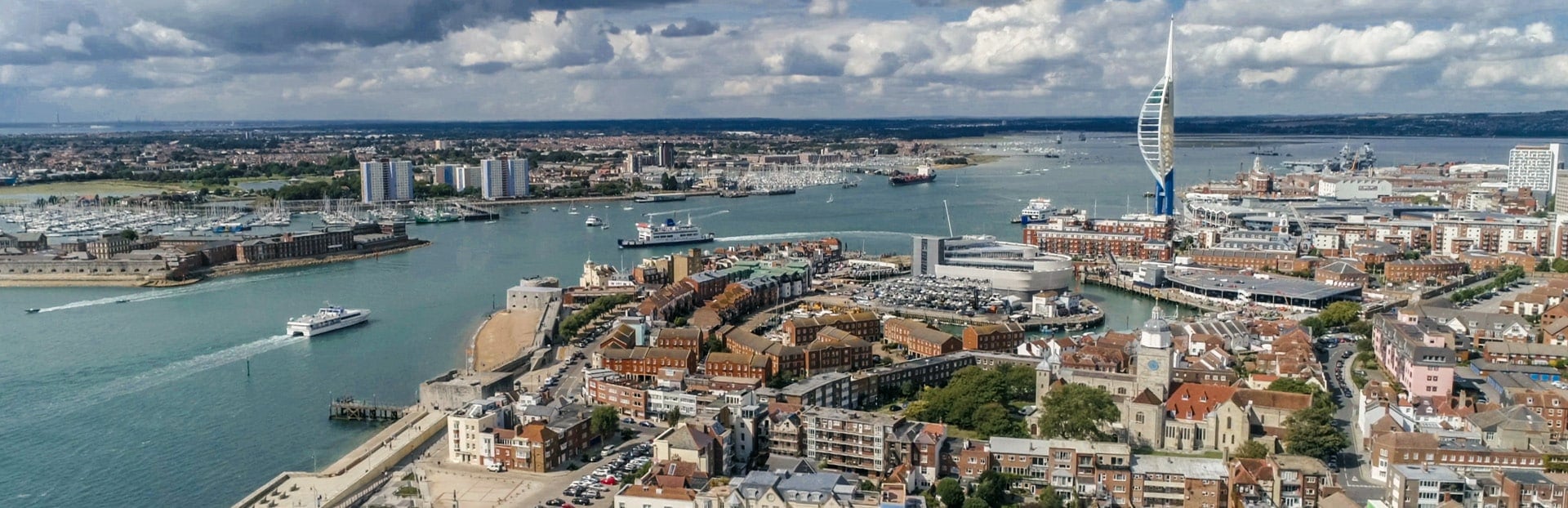
Portsmouth is a city on the Hampshire coast, in the South East of England. Average sold prices in Portsmouth sit at £249,557 on the HM Land Registry House Price Index, 13.9% below the England average of £289,946 and a full 34.1% below the wider South East region's £378,515. That headline discount hides an unusual split: Portsmouth's houses carry a premium over England while its flats trade at a deep discount, and the flat-heavy housing stock pulls the city-wide average down. The result is a coastal city in the expensive South East where asking prices stay within reach and gross yields run as high as 6.7%.
The discount is a story about what Portsmouth builds, not how weak its market is. Detached houses average £516,549, which is 9.8% above the England figure, and semi-detached homes at £347,651 sit 20.6% above. Flats, by contrast, average £165,753, some 22.7% below England, and they make up a large share of the stock on a city packed onto Portsea Island. For an investor, that means the smaller units that drive rental income are where Portsmouth is genuinely cheap relative to the rest of the country.
This guide covers the unitary authority of Portsmouth (ONS code E06000044) across postcodes PO1, PO2, PO3, PO4, PO5, and PO6. Portsmouth sits in the South East region, about 20 miles south-east of Southampton and 70 miles south-west of London. The wider Hampshire buy-to-let region also covers Southampton, Winchester and the Isle of Wight.
Article updated: July 2026
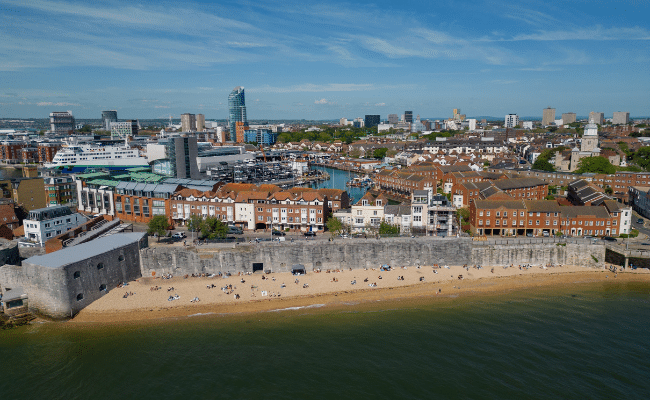
Why Invest in Portsmouth?
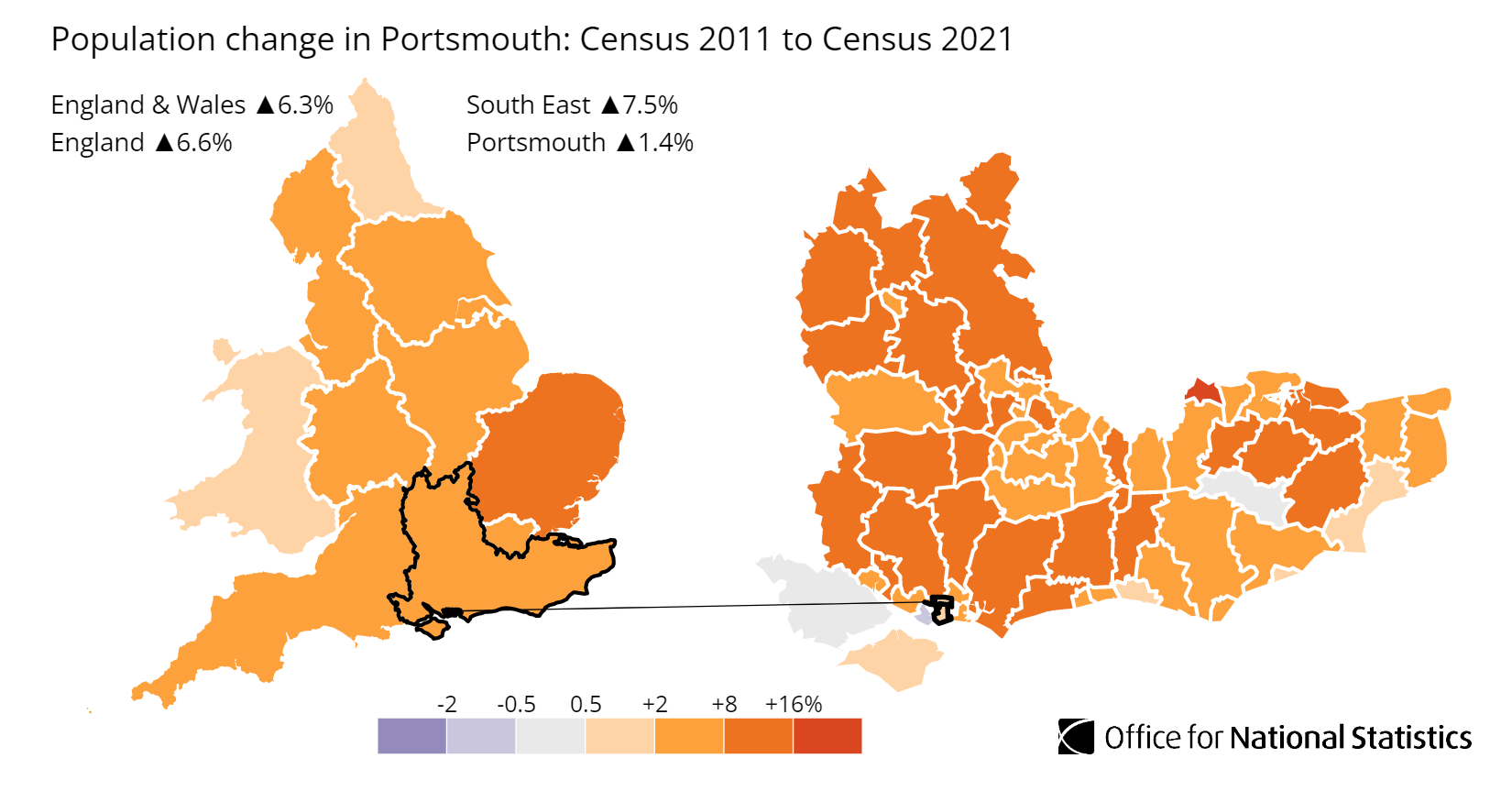
Portsmouth's 208,003 residents are squeezed onto Portsea Island, which makes it the most densely populated city in the United Kingdom outside London and leaves almost no room for the city to build its way out of a housing shortage. The 2021 Census put the population up just 1.44% on 2011's 205,056, well below the 6.3% England and Wales average, but that figure reflects a city that is physically full rather than one that people are leaving. When land runs out, supply stays tight and existing homes hold their tenant demand.
Two institutions anchor that demand. The Royal Navy bases its surface fleet at HMNB Portsmouth, the home port for the aircraft carriers HMS Queen Elizabeth and HMS Prince of Wales, and the base and its defence supply chain employ thousands across the city. Military and civilian defence staff need housing year-round, on contracts that do not track the economic cycle. The University of Portsmouth is the second engine, with around 30,000 students concentrated around the city centre, feeding a steady flow of renters into PO1 and the postcodes around it.
Local wages tell the other half of the story. The median gross weekly salary in Portsmouth is £692.70, which works out at £36,020 a year. That sits below both the South East median of £800.30 a week and the Great Britain figure of £752.40, and it is the reason yields here read higher than the affluent commuter belt around it: rents are set by a deep tenant base while purchase prices stay anchored to local incomes. Employment runs at 77.1% with unemployment at 4.6%, a labour market that is softer than the wider South East but underpinned by the two institutional employers.
Portsmouth Economic Summary
- Population: 208,003 (2021 Census). Growth of 1.44% from 2011.
- Median annual salary: £36,020 (Portsmouth), £41,616 (South East), £39,125 (Great Britain)
- Employment rate: 77.1% (Portsmouth), 78.7% (South East), 75.6% (Great Britain)
- Unemployment rate: 4.6% (Portsmouth)
- Key employment sectors: Defence and naval, higher education, healthcare, marine engineering, accommodation and food
Source: ONS Census 2021, Nomis Labour Market Profile (ASHE 2025, Employment Oct 2024-Sep 2025)
Regeneration and Investment in Portsmouth
Portsmouth's regeneration pairs a £2.2 billion naval base upgrade with a city centre rebuild aimed at delivering more than 2,000 new homes, the only realistic way to add housing supply on a full island. Defence money secures the jobs; the residential schemes try to ease the squeeze on a market where new stock is scarce.
- City Centre North (underway, £1bn+ programme): A full redevelopment of Portsmouth's city centre core, planned to deliver around 2,300 new homes and an estimated 9,700 jobs across commercial, retail and public space over multiple phases. For investors, the scheme reshapes PO1 from a secondary shopping centre into a mixed-use residential quarter, adding the kind of city-centre rental stock the postcode currently lacks. Updates at Invest Portsmouth.
- HMNB Portsmouth Defence Investment (underway, £2.2bn): A major upgrade to the naval base's infrastructure to support the carrier fleet and future capabilities, securing thousands of defence jobs at the base for decades. That sustained military employment underpins rental demand across every Portsmouth postcode, not just the ones near the dockyard. Updates at Stephen Morgan MP.
- Victory Quay (under construction, 835 homes): A waterfront development by Vivid Housing on the former HMS Victory Business Park site near the Historic Dockyard, backed by a £19.8m grant from Homes England. New housing at this scale on Portsea Island is rare, and the government funding signals a commitment to easing the city's supply shortage. Updates at Invest Portsmouth.
Source: Office for National Statistics - Portsmouth
Portsmouth Property Market Analysis
Average property prices in Portsmouth have risen 444.1% since January 1995, from £45,869 to £249,557. The sections below trace that path cycle by cycle, then break down current postcode-level data for sold prices, price per square foot, asking prices, growth trends, and monthly transaction volumes.
When was the last house price crash in Portsmouth?
All sold property prices for Portsmouth come from HM Land Registry at unitary-authority level, tracked monthly from January 1995 to March 2026, which covers 31 years of market cycles.
The 1995 to 2007 boom: Portsmouth started at £45,869 in January 1995 and reached £77,498 by December 2000. The fastest gains came in 2002 and 2003, when annual growth peaked above 29% in March 2003 as the island's tight supply met surging buy-to-let and owner-occupier demand. Prices climbed to a pre-crash peak of £168,097 in July 2007.
2008 to 2009, the financial crisis: Prices fell from the July 2007 peak of £168,097 to a trough of £129,683 in March 2009, a drop of 22.9% over 20 months, with the worst year-on-year reading at -21.7% in March 2009. That decline was steeper than both England's 18.2% fall (from £183,883 in September 2007 to £150,438 in March 2009) and the wider correction across the South East. The island market that amplified the gains on the way up amplified the losses on the way down.
The 2010 to 2013 stagnation: Portsmouth bounced off the trough quickly but then stalled. The average sat at £147,369 by December 2010 and was still only £147,811 by December 2011, drifting in a narrow band for four years and staying below the pre-crash peak.
Recovery, 2014 to 2016: Growth returned with annual changes of 7% to 9%. Prices passed the July 2007 peak of £168,097 in October 2014, when the average hit £168,169, a recovery that took seven years and three months. By December 2016, prices had reached £193,874.
The 2017 to 2019 pre-pandemic growth: Prices climbed from £194,088 in January 2017 to £211,951 by December 2019, with annual growth easing from around 7% to under 1% as affordability limits and wider uncertainty weighed on the market.
2020 to 2022, the pandemic surge: The stamp duty holiday and the shift to remote working lifted Portsmouth's coastal, relatively affordable market. Prices jumped from £210,161 in June 2020 to an all-time high of £259,945 in December 2022, growth of about 22% in two and a half years.
2023 to present: Higher mortgage rates cooled the market. Prices eased from the December 2022 high of £259,945 to £247,399 by December 2023, recovered to £256,339 by December 2024, then settled at £249,557 by the latest reading in March 2026. Portsmouth is one of the markets still trading below its 2022 peak, down 4.0% from that high, while remaining 48.5% above the pre-crash 2007 peak.
Long-term growth summary:
- 5 years (March 2021 to March 2026): 12.2% growth (£222,337 to £249,557)
- 10 years (March 2016 to March 2026): 35.8% growth (£183,724 to £249,557)
- 15 years (March 2011 to March 2026): 72.5% growth (£144,685 to £249,557)
- 20 years (March 2006 to March 2026): 68.6% growth (£148,032 to £249,557)
- 30 years (January 1995 to March 2026): 444.1% growth (£45,869 to £249,557)
Portsmouth's 22.9% crash was deeper than the national average, and the recovery to the old peak took over seven years, both signs of how sharply this market moves when sentiment turns. Set against that, the 30-year return of 444.1% is strong, and an investor who bought at the exact July 2007 peak would still be 48.5% ahead on the Land Registry average. The distinctive recent feature is that the December 2022 high has not yet been recovered, so the market is buying back in below its own record.
- All property types
- Detached
- Semi-detached
- Terraced
- Flats
- All property types
- Detached
- Semi-detached
- Terraced
- Flats
Sold House Prices in Portsmouth
The average sold price across all property types in Portsmouth is £249,557, which is 13.9% below the England average of £289,946 as of March 2026, yet that discount is carried entirely by flats. The houses themselves trade above England: detached homes are 9.8% above and semi-detached 20.6% above. Only when the city's large stock of flats is folded in does the all-type average fall below the national figure. The table below shows the split by type.
| Property Type | Portsmouth Average | England Average | Difference |
|---|---|---|---|
| Detached houses | £516,549 | £470,492 | +9.8% |
| Semi-detached houses | £347,651 | £288,185 | +20.6% |
| Terraced houses | £273,351 | £243,788 | +12.1% |
| Flats and maisonettes | £165,753 | £214,563 | -22.7% |
| All property types | £249,557 | £289,946 | -13.9% |
Detached houses at £516,549 carry a 9.8% premium over England's £470,492. The island has very little room for large detached stock, so the few homes that exist trade at a scarcity premium, concentrated in the mainland postcode PO6 around Drayton and Cosham. Annual growth of 0.2% points to a market that is holding its level rather than moving.
Semi-detached houses at £347,651 sit 20.6% above England's £288,185, the widest premium of any type here. Family-sized homes are in short supply on a city built mostly for terraces and flats, and the limited semi-detached stock in PO3 and PO6 commands the strongest relative prices. Annual growth of 1.3% is the firmest of the four types.
Terraced houses at £273,351 are 12.1% above England's £243,788. Portsmouth is a terraced city by design, and these are the workhorses of its buy-to-let market, packed densely across PO2, PO3 and PO4. Annual growth of 0.4% reflects steady, unremarkable demand.
Flats and maisonettes at £165,753 show the only discount, 22.7% below England's £214,563. This is where the city is genuinely cheap. The large purpose-built and converted flat stock, heaviest in PO1 and PO5, reflects local demand without the institutional investor premium that lifts flat values in larger cities. Annual change of -4.2% is the one negative reading, dragging the all-type average down.
Price Per Square Foot in Portsmouth
Just £62 per square foot separates Portsmouth's cheapest postcode from its dearest, with PO2 at £253 and PO6 at £315. Measuring by the square foot strips out how big the homes are and gives a cleaner read on what each location commands. PO6 (Cosham, Paulsgrove, Drayton) tops the table, reflecting its mainland position and the larger family stock that sits off the island.
| Rank | Area | Price Per Sq Ft |
|---|---|---|
| 1 | PO2 (North End, Hilsea) | £253 |
| 2 | PO1 (City Centre, Gunwharf Quays) | £278 |
| 3 | PO5 (Southsea) | £286 |
| 4 | PO3 (Hilsea, Anchorage Park) | £296 |
| 5 | PO4 (Southsea, Eastney) | £299 |
| 6 | PO6 (Cosham, Paulsgrove, Drayton) | £315 |
PO2 at £253 per square foot is the cheapest space in Portsmouth. North End and Hilsea are dense terraced neighbourhoods north of the city centre, and the figure draws on 719 transactions, the second-largest sample in the city. For an investor buying on a budget, PO2 buys the most floor area for the money.
PO6 at £315 per square foot is the dearest. The mainland postcode of Cosham, Paulsgrove and Drayton carries the larger detached and semi-detached stock, and from 584 transactions its per-foot rate sits 24% above PO2's. Paying more per square foot here buys a different kind of home: family houses with gardens rather than the flats and terraces that dominate the island.
For Sale Asking Prices in Portsmouth
PO2 at £249,679 and PO6 at £378,030 sit 51.4% apart, the widest asking-price gap in the city. That spread follows the island-versus-mainland divide more than anything else. The mean asking price across all six Portsmouth postcodes is £288,764.
| Rank | Area | Asking Price |
|---|---|---|
| 1 | PO2 (North End, Hilsea) | £249,679 |
| 2 | PO1 (City Centre, Gunwharf Quays) | £264,809 |
| 3 | PO4 (Southsea, Eastney) | £276,809 |
| 4 | PO3 (Hilsea, Anchorage Park) | £278,430 |
| 5 | PO5 (Southsea) | £284,828 |
| 6 | PO6 (Cosham, Paulsgrove, Drayton) | £378,030 |
PO2 at £249,679 is the cheapest way into Portsmouth and the only postcode whose asking price falls in line with the city-wide Land Registry sold average of £249,557. North End and Hilsea offer dense terraced stock at the lowest prices on the island, and for a fixed budget that is where the money stretches furthest.
PO6's £378,030 asking price is the clear outlier, 51.4% above PO2. The gap reflects the fact that PO6 is the one postcode physically off Portsea Island, in Cosham, Paulsgrove and Drayton, where larger family homes with land push the average up. Five of the six postcodes cluster between £249,679 and £284,828, so PO6 is the exception rather than the top of a smooth ladder.
House Price Growth in Portsmouth
PO3 is the only Portsmouth postcode with positive growth across all three timeframes, at 2.3% (one-year), 3.7% (three-year), and 16.0% (five-year). Every postcode delivered a positive five-year return, but the shorter horizons split the city. PO5 (Southsea) posted the strongest one-year figure at 5.3% yet a negative three-year reading, while PO6 (Cosham, Paulsgrove, Drayton) is positive over one year but negative over three and five.
| Area | 1 Year | 3 Years | 5 Years |
|---|---|---|---|
| PO2 (North End, Hilsea) | -1.3% | -1.7% | 16.2% |
| PO3 (Hilsea, Anchorage Park) | 2.3% | 3.7% | 16.0% |
| PO4 (Southsea, Eastney) | 0.3% | -0.4% | 16.0% |
| PO1 (City Centre, Gunwharf Quays) | -3.7% | -3.7% | 11.2% |
| PO6 (Cosham, Paulsgrove, Drayton) | 0.3% | -3.8% | 10.6% |
| PO5 (Southsea) | 5.3% | -2.9% | 7.1% |
PO3 at 16.0% five-year growth pairs that return with the only set of positive readings across one, three and five years. Hilsea and Anchorage Park form a settled residential pocket on the northern edge of the island, and that steady demand shows up as growth that has not reversed in any window. PO2 just edges it on the five-year figure at 16.2%, but its one and three-year readings are both negative, so the recent trend has softened.
PO1's -3.7% one-year and -3.7% three-year readings are the weakest in the city. The city centre's flat-heavy stock has seen the sharpest recent correction, in line with the -4.2% city-wide flat figure, though the 11.2% five-year return remains positive. PO5 shows the opposite shape, with the strongest one-year reading at 5.3% sitting on top of a -2.9% three-year figure, a recent rebound rather than a steady climb.
Monthly Property Sales in Portsmouth
Transaction volumes range from 17 sales a month in PO1 to 41 in PO4, with 157 changing hands across the city each month. Even the quietest postcodes see steady activity, but turnover, the share of homes that sell in a year, varies more, from 5% in PO5 to 16% in PO3.
| Area | Sales Per Month | Turnover | Asking Price |
|---|---|---|---|
| PO4 (Southsea, Eastney) | 41 | 10% | £276,809 |
| PO2 (North End, Hilsea) | 33 | 13% | £249,679 |
| PO6 (Cosham, Paulsgrove, Drayton) | 28 | 10% | £378,030 |
| PO5 (Southsea) | 20 | 5% | £284,828 |
| PO3 (Hilsea, Anchorage Park) | 18 | 16% | £278,430 |
| PO1 (City Centre, Gunwharf Quays) | 17 | 7% | £264,809 |
PO4 records the most transactions at 41 a month, well ahead of the rest of the city. Southsea and Eastney hold a deep pool of mid-priced terraces and flats that change hands often, which for a buy-to-let investor signals an easier exit when the time comes to sell. PO3's 16% and PO2's 13% turnover rates are the highest shares, so a larger slice of their stock moves each year.
PO5 and PO1 sit at the quiet end, with 5% and 7% turnover. Southsea's PO5 carries a large flat market that sits longer before selling, and the city centre's PO1 shows the same pattern. Lower turnover does not mean no demand, but it does point to a slower exit, which matters when you plan to sell on.
How Long Properties Take to Sell in Portsmouth
PO3 (Hilsea, Anchorage Park) clears fastest at about 203 days, while PO5 (Southsea) is slowest at roughly 608 days, more than a year on the market on average. Days on market is the typical time a home is listed before it sells, and months of unsold stock measures how much for-sale supply is queued at the current rate of sales. Those two figures vary more widely in Portsmouth than the price tables do.
| Area | Avg Days to Sell | Months of Unsold Stock | Market |
|---|---|---|---|
| PO3 (Hilsea, Anchorage Park) | 203 | 6.7 | Balanced market |
| PO2 (North End, Hilsea) | 217 | 7.1 | Balanced market |
| PO4 (Southsea, Eastney) | 277 | 9.1 | Balanced market |
| PO6 (Cosham, Paulsgrove, Drayton) | 304 | 10.0 | Balanced market |
| PO1 (City Centre, Gunwharf Quays) | 435 | 14.3 | Buyer's market |
| PO5 (Southsea) | 608 | 20.0 | Buyer's market |
How long your money stays tied up at the end is the figure most yield tables leave out, and in Portsmouth it swings hard. PO5's 20.0 months of unsold stock means a far slower exit than PO3's 6.7, even though both sit on the same island. The flat-heavy postcodes, PO1 and PO5, carry the longest queues to sell, so a higher headline yield there comes with the trade-off of a slower route back out.
What Type of Property Can You Buy in Portsmouth?
Flats and terraced houses dominate Portsmouth's island postcodes, with purpose-built flats making up 64.9% of stock in PO1, while detached and semi-detached homes are concentrated in mainland PO6. The mix shapes which strategies fit each postcode. The figures below are drawn from 2021 Census records for each postcode.
| Area | Detached | Semi-detached | Terraced | Flats |
|---|---|---|---|---|
| PO1 (City Centre, Gunwharf Quays) | 1.7% | 3.3% | 19.6% | 75.3% |
| PO2 (North End, Hilsea) | 3.2% | 12.3% | 53.9% | 30.5% |
| PO3 (Hilsea, Anchorage Park) | 5.8% | 24.2% | 49.2% | 19.8% |
| PO4 (Southsea, Eastney) | 4.9% | 13.9% | 42.7% | 36.5% |
| PO5 (Southsea) | 3.0% | 9.2% | 23.2% | 64.6% |
| PO6 (Cosham, Paulsgrove, Drayton) | 14.3% | 39.0% | 29.9% | 15.0% |
PO1 is overwhelmingly a flat market, at 75.3% of stock once purpose-built and converted units are combined, with detached and semi-detached homes barely registering. That lines up with PO1's role as the city centre and student belt, where flats suit single lets and sharers, and it explains the postcode's lower per-square-foot price. PO5 in Southsea is the second flat-heavy postcode at 64.6%.
PO6 is the outlier in reverse, the only postcode where detached and semi-detached houses together make up more than half the stock, at 53.3%. That mainland profile of family housing matches its higher asking prices and its position as the postcode least like the rest of the island. PO2 and PO3 sit in between, dominated by the terraced housing that defines Portsmouth's residential core.
The flats figure combines purpose-built blocks and conversions, and a small share of non-standard dwellings is left out, so rows may not total 100%.

Portsmouth Rental Market Analysis
Monthly rents in Portsmouth range from £1,115 in PO2 to £1,554 in PO4, with gross rental yields running from 4.3% to 6.7% across the six postcodes. For investors weighing up whether buy-to-let is worth it in Portsmouth, the sections below break down rents, yields, and tenant affordability postcode by postcode. If you are working out how to start a property business in the South East, Portsmouth offers higher yields than most of the region on the back of its naval and student tenant base. Browse current buy-to-let investments for sale across the region.
Average Rent & Gross Rental Yields in Portsmouth
Gross rental yields in Portsmouth range from 4.3% in PO6 to 6.7% in PO4. The southern, island postcodes deliver the strongest returns, where seafront rental demand in Southsea pushes rents up against still-affordable asking prices. PO6 on the mainland sits at the bottom of the yield table because its higher house prices are not matched by proportionally higher rents.
| Area | Average Monthly Rent | Asking Price | Gross Yield |
|---|---|---|---|
| PO4 (Southsea, Eastney) | £1,554 | £276,809 | 6.7% |
| PO1 (City Centre, Gunwharf Quays) | £1,387 | £264,809 | 6.3% |
| PO5 (Southsea) | £1,316 | £284,828 | 5.5% |
| PO2 (North End, Hilsea) | £1,115 | £249,679 | 5.4% |
| PO3 (Hilsea, Anchorage Park) | £1,264 | £278,430 | 5.4% |
| PO6 (Cosham, Paulsgrove, Drayton) | £1,346 | £378,030 | 4.3% |
PO4 at 6.7% leads Portsmouth on yield. Southsea and Eastney command the city's highest rents at £1,554 a month from seafront demand, on a £276,809 asking price that keeps the return strong. A 30% deposit of £83,043 buys into the top-yielding postcode in the city.
The tenant profile in PO4 is broad. The eastern seafront draws naval personnel, young professionals and couples sharing a flat, which spreads void risk across more than one tenant group. PO6 at 4.3% sits at the bottom of the table, where the £378,030 mainland asking price outweighs a £1,346 rent that is only mid-range for the city.
Gross Rental Yield by Postcode
Is Portsmouth Rent High?
Monthly rents in Portsmouth take between 37.2% and 51.7% of the local median gross monthly salary, with every postcode above the widely cited 30% affordability mark. That is a direct consequence of wages here sitting below the regional average while rents are held up by deep tenant demand. Across the city, the gap between what tenants earn and what they pay is wider than in much of the South East.
The median gross weekly salary in Portsmouth is £692.70, which equates to £3,002 per month or £36,020 per year. This is below the South East regional median of £800.30 per week and the Great Britain median of £752.40 per week. Data from the Nomis Labour Market Profile (ASHE 2025).
| Rank | Area | Rent as % of Income |
|---|---|---|
| 1 | PO4 (Southsea, Eastney) | 51.7% |
| 2 | PO1 (City Centre, Gunwharf Quays) | 46.2% |
| 3 | PO6 (Cosham, Paulsgrove, Drayton) | 44.9% |
| 4 | PO5 (Southsea) | 43.8% |
| 5 | PO3 (Hilsea, Anchorage Park) | 42.1% |
| 6 | PO2 (North End, Hilsea) | 37.2% |
PO2 at 37.2% is the most affordable postcode for tenants on the local median wage, with a £1,115 rent against a £3,002 monthly salary. It is still above the 30% guideline, but it leaves the most headroom in the city, which tends to correlate with lower arrears and longer tenancies. The figure points to why North End and Hilsea attract steady, working-household renters.
PO4 at 51.7% is the most stretched on paper, but the seafront rents in Southsea are not paid by single earners on the city-wide median. Naval officers, dual-income couples and professionals sharing the cost of a flat make up much of that tenant base, so the headline ratio overstates the strain on a typical PO4 household.
How Big Is Portsmouth's Private Rented Sector?
The private rented sector is deepest in PO5 and PO1, where it accounts for 41.8% and 37.2% of households, and shallowest in PO6 at 15.1%. The share of homes already rented privately is a guide to how large and how established the local tenant pool is. The table below shows household tenure by postcode.
| Area | Owned Outright | Owned with Mortgage | Private Rented | Social Rented |
|---|---|---|---|---|
| PO5 (Southsea) | 18.1% | 16.5% | 41.8% | 22.3% |
| PO1 (City Centre, Gunwharf Quays) | 10.7% | 8.0% | 37.2% | 42.8% |
| PO4 (Southsea, Eastney) | 25.3% | 23.1% | 35.4% | 14.0% |
| PO2 (North End, Hilsea) | 23.2% | 27.9% | 24.6% | 23.5% |
| PO3 (Hilsea, Anchorage Park) | 34.6% | 33.2% | 19.8% | 11.2% |
| PO6 (Cosham, Paulsgrove, Drayton) | 34.9% | 33.4% | 15.1% | 15.7% |
PO5 and PO1 have the largest private rented sectors in Portsmouth, with more than a third of homes already let privately. A deep rented share like that points to an active lettings market with a wide pool of existing tenants and ready demand. PO1 also carries the city's highest social-rented share at 42.8%, leaving owner-occupation at under a fifth, a sign of a postcode where renting is the norm rather than the exception.
PO6 has the smallest private rented sector at 15.1%, paired with the highest combined ownership in the city. The mainland family postcode is dominated by owner-occupiers, which fits its lower yield and its profile as the least island-like part of Portsmouth. On the rental-demand side, PO1, PO2, PO4 and PO5 all read as landlord's or balanced markets, where listed homes let within two to three months, while PO3 and PO6 have too few rental listings at any one time to read with confidence.
Local Housing Allowance Rates in Portsmouth
All six Portsmouth postcodes fall within the Portsmouth Broad Rental Market Area, where Local Housing Allowance runs from £97.31 a week for a shared room to £299.18 a week for a four-bedroom home. Local Housing Allowance is the most a tenant on housing support can claim towards rent, so for that part of the market it works as an effective rent floor. The rates below apply across the whole city. To check the current rate for a specific address, you can use the government's official Local Housing Allowance calculator.
| Property Size | Weekly LHA Rate | Monthly Equivalent |
|---|---|---|
| Shared accommodation | £97.31 | £422 |
| 1 bedroom | £159.95 | £693 |
| 2 bedrooms | £194.47 | £843 |
| 3 bedrooms | £230.14 | £997 |
| 4 bedrooms | £299.18 | £1,296 |
The two-bedroom LHA rate of £194.47 a week works out at about £843 a month, well below the £1,115 to £1,554 open-market rents recorded across Portsmouth's postcodes. A benefit-backed tenancy at that rate therefore sits under the city's open-market rents, and the stock that fits within it is concentrated in PO2, where both asking prices and rents are lowest. The rates are identical in every Portsmouth postcode because they are set across the single Portsmouth market area.
Buy-to-Let Considerations
Are House Prices High in Portsmouth? Price-to-Earnings Ratios
Buying in Portsmouth costs between 6.9 and 10.5 times the median annual salary. This is based on the Nomis Labour Market Profile for Portsmouth, which puts the median gross annual income for Portsmouth residents at £36,020.
The national benchmark for price-to-earnings is 7.4x (England's average sold price of £289,946 divided by the Great Britain median annual salary of £39,125). One of Portsmouth's six postcodes (PO2) sits below that national benchmark, meaning it is more affordable relative to local incomes than the England average is relative to national incomes.
| Rank | Area | Price-to-Earnings Ratio |
|---|---|---|
| 1 | PO2 (North End, Hilsea) | 6.9x |
| 2 | PO1 (City Centre, Gunwharf Quays) | 7.4x |
| 3 | PO4 (Southsea, Eastney) | 7.7x |
| 4 | PO3 (Hilsea, Anchorage Park) | 7.7x |
| 5 | PO5 (Southsea) | 7.9x |
| 6 | PO6 (Cosham, Paulsgrove, Drayton) | 10.5x |
PO2 at 6.9x is the most affordable postcode relative to local earnings and pairs that with a 5.4% yield. North End and Hilsea offer the lowest asking price in the city on a terraced stock that keeps prices anchored to what local households earn. It is the closest Portsmouth comes to an entry point that local incomes can comfortably support.
PO6 at 10.5x sits well above the national benchmark. At more than ten times the local median salary, the mainland family postcode of Cosham, Paulsgrove and Drayton is the city's premium tier, bought largely by owner-occupiers rather than investors. For a landlord, that elevated ratio is what compresses the postcode's yield to the lowest in Portsmouth.
Deposit Requirements in Portsmouth
A 30% deposit on a buy-to-let property in Portsmouth ranges from £74,904 in PO2 to £113,409 in PO6. The gap between the cheapest and most expensive deposit is £38,505. For investors comparing Portsmouth with the rest of the South East, these deposits are modest for the region: the cheapest sit below £75,000 in a part of the country where six-figure deposits are common.
Beyond the deposit, the stamp duty on a buy-to-let and other running costs of buy-to-let affect the total capital required.
| Rank | Area | 30% Deposit Required |
|---|---|---|
| 1 | PO2 (North End, Hilsea) | £74,904 |
| 2 | PO1 (City Centre, Gunwharf Quays) | £79,443 |
| 3 | PO4 (Southsea, Eastney) | £83,043 |
| 4 | PO3 (Hilsea, Anchorage Park) | £83,529 |
| 5 | PO5 (Southsea) | £85,448 |
| 6 | PO6 (Cosham, Paulsgrove, Drayton) | £113,409 |
PO2 is the cheapest way into Portsmouth, at a £74,904 deposit. Stepping up to PO4 costs roughly £8,000 more, and that outlay buys the city's top yield at 6.7% rather than just a different address. PO2 keeps the entry cost down on a 5.4% yield; PO4 trades a slightly larger deposit for the strongest rental return and the busiest sales market in the city.
At the other end, four of the six postcodes cluster between £74,904 and £85,448, within £10,544 of each other, so the real decision across most of Portsmouth is about postcode character rather than deposit size. PO6 is the exception, where a £113,409 deposit buys into the mainland family market at the city's lowest yield, a different kind of investment from the island postcodes around it.
What the Portsmouth Data Tells Buy-to-Let Investors
In Portsmouth the strongest yields sit on the southern half of the island, not at the cheapest entry point. PO4 (Southsea, Eastney) has the top yield at 6.7%, a £1,554 monthly rent and the busiest sales market in the city at 41 transactions a month. A 30% deposit there is £83,043, for buying an investment property on the seafront where rental demand from naval personnel and professionals runs deep.
PO2 (North End, Hilsea) is the cheapest way in, at a £74,904 deposit, the lowest price-to-earnings ratio at 6.9x and a 5.4% yield. PO1 (City Centre, Gunwharf Quays) pairs the second-highest yield at 6.3% with strong student and waterfront demand, though its flat-heavy stock has seen the sharpest recent price falls and the slowest sales. The income postcodes here all share the island's flat-and-terrace character.
PO3 (Hilsea, Anchorage Park) is the one postcode that grew across every timeframe, up 2.3% over a year, 3.7% over three years and 16.0% over five, so it leans towards steady growth on a 5.4% yield. PO6 on the mainland carries the highest prices and the lowest yield at 4.3%, an owner-occupier postcode more than an investor one. Buyers who want to come in below the asking prices in this guide tend to work the off market property route, before homes reach the open portals.
Portsmouth runs no selective licensing scheme covering the whole city, though it does license HMOs across the city, so landlords should always check the current designations on Portsmouth City Council's property licensing pages before letting. With two institutional employers, a constrained island supply and yields above most of the South East, it reads differently from the region around it: higher returns, set against wages below the regional average and a market still trading below its 2022 peak.
How Portsmouth Compares
Portsmouth's mean asking price of £288,764 is the second-lowest of five South East locations compared here, while its 6.7% top yield trails only Southampton among them. The comparison below sets Portsmouth alongside four nearby locations, each with a different investor profile. The mean asking price and mean monthly rent are simple averages across all postcodes with data, and the top gross yield is the single highest postcode yield in each location.
| Location | Mean Asking Price | Mean Monthly Rent | Mean Gross Yield | Top Yield (postcode) |
|---|---|---|---|---|
| Southampton | £260,743 | £1,270 | 5.8% | 7.7% (SO17) |
| Portsmouth | £288,764 | £1,330 | 5.5% | 6.7% (PO4) |
| Bournemouth | £357,582 | £1,385 | 4.6% | 7.4% (BH9) |
| Brighton | £438,933 | £1,792 | 4.9% | 6.0% (BN2) |
| Winchester | £550,646 | £1,784 | 3.9% | 4.5% (SO22) |
Portsmouth sits second-cheapest in this group on mean asking price at £288,764, just above neighbouring Southampton at £260,743. Southampton edges it on top yield, 7.7% against Portsmouth's 6.7%, while the two cities sit close on mean rent. They are the value end of this stretch of the South East coast, and an investor weighing the two is choosing between Southampton's slightly higher headline return and Portsmouth's tighter island supply.
Above them, Bournemouth at 7.4% pairs a higher top yield with a higher mean asking price, while Brighton and Winchester are the premium end, where mean asking prices above £438,000 push yields down to 6.0% and 4.5%. For investors prioritising income on a smaller deposit, Portsmouth and Southampton are where the South East stays affordable. For a data-driven comparison across the country, see our guide to the best places to invest in buy-to-let.
Frequently Asked Questions
Is Portsmouth a good place to live for buy-to-let tenants?
For renters, yes, and it comes down to two things that do not move much: the Royal Navy and the University of Portsmouth. The naval base employs thousands on year-round contracts, and the university brings around 30,000 students into the city, so there is a steady stream of people needing somewhere to rent regardless of the wider economy.
The catch for tenants is affordability. Local wages, at £692.70 a week, sit below the South East average, while rents are held up by that demand, so the typical Portsmouth rent takes 37% to 52% of the local median salary. That is a tighter squeeze than most of the region, which is part of why a deep, reliable tenant base exists for landlords in the first place.
What are the best areas in Portsmouth for property investment?
The postcodes split fairly cleanly between the island and the mainland. For income, PO4 (Southsea, Eastney) leads on yield at 6.7% with the busiest sales market in the city, and PO1 (City Centre, Gunwharf Quays) follows at 6.3% on the back of student and waterfront demand. PO2 (North End, Hilsea) is the cheapest entry at a £74,904 deposit and the most affordable against local wages.
For steadier growth, PO3 (Hilsea, Anchorage Park) is the only postcode that rose across one, three and five years, on a 5.4% yield. PO6 (Cosham, Paulsgrove, Drayton), the one mainland postcode, is the premium family tier at the lowest yield of 4.3%, so it suits a different kind of buyer. If income matters most, look at PO4 and PO1; if you want growth that has held up across every timeframe, PO3 is the one.
How does Portsmouth compare to Southampton for buy-to-let?
They are close cousins, both the value end of the South East coast. Southampton has a slightly lower mean asking price (£260,743 against Portsmouth's £288,764) and a higher top yield (7.7% against 6.7%), with a larger and more varied housing market across more postcodes. On rent the two are similar, at £1,270 a month against Portsmouth's £1,330.
Portsmouth's edge is its geography. Being built on an island leaves almost no room for new supply, which supports prices over the long run, and the naval base plus the university give it two institutional tenant sources that do not depend on the wider economy. Southampton offers a marginally higher headline return and more choice; Portsmouth offers tighter supply and structural demand. For a closer look, see our Southampton buy-to-let guide.
Is there demand for student accommodation in Portsmouth?
Yes, and it is heavily concentrated around the city centre. The University of Portsmouth's main campus sits in PO1, and its roughly 30,000 students fuel rental demand around the Guildhall and Landport areas of PO1, where average rents of £1,387 a month and the city's flat-heavy stock make shared student lets workable. Student lets do bring summer voids and more hands-on management than a standard tenancy, so factor that in.
On the HMO side, a sample of current room adverts puts a double room with a shared bathroom at around £138 a week in PO1 (the middle 80% running £113 to £156, from 24 adverts), and PO2's double-ensuite rooms average about £167 a week. Those are the room types with enough live listings to read reliably. For how the numbers work on a shared house, see our guide to HMO property, and for the purpose-built end, our guide to student property investment.
Can I find buy-to-let property under £250,000 in Portsmouth?
Yes, just about. The cheapest postcode by asking price is PO2 (North End, Hilsea), at £249,679, so it sits right on the £250,000 line, and the city-wide sold average is £249,557. Below that, the route in is by property type rather than postcode: flats across Portsmouth average £165,753 on the Land Registry index, and the terraced stock in PO2 and PO5 includes plenty under the postcode averages.
If sub-£250,000 is the target, the flats in PO1 and PO5 and the terraces in PO2 are where to look, or you can explore below market value properties to come in under asking.
What is the population of Portsmouth?
At the last count, the 2021 Census recorded 208,003 residents in Portsmouth, up just 1.44% from 205,056 in 2011. That is slow growth by national standards, where England and Wales averaged 6.3%, but it reflects a city that is physically full rather than one losing people. Most of Portsmouth sits on Portsea Island, which makes it the most densely populated city in the UK outside London. For the wider county picture, see our Hampshire population and investment guide.
What are average house prices in Portsmouth?
Across the city, the average sold price is £249,557 on the Land Registry index, about 13.9% below the England average of £289,946 as of March 2026. Asking prices by postcode run from £249,679 in PO2 (North End, Hilsea) up to £378,030 in PO6 (Cosham, Paulsgrove, Drayton), with a city-wide mean of £288,764. By type, detached homes average £516,549, semi-detached £347,651, terraced £273,351 and flats £165,753.
The unusual feature is that Portsmouth's houses trade above England while its flats trade well below, so the city-wide discount is really a story about its flat-heavy housing mix. Through a buy-to-let lens, PO4 is the highest-yielding postcode at 6.7%, while PO6 is the dearest and lowest-yielding.
What are the Local Housing Allowance rates in Portsmouth?
All six Portsmouth postcodes fall in the Portsmouth Broad Rental Market Area, so they share one set of rates. As of June 2026, Local Housing Allowance runs at £97.31 a week for a shared room, £159.95 for a one-bed, £194.47 for two beds, £230.14 for three and £299.18 for four. That figure is the most a tenant on housing support can claim towards rent, so for that part of the market it sets an effective floor.
What type of property is most common in Portsmouth?
Flats and terraced houses, by a wide margin, which is what you would expect on a densely built island. Flats dominate the city centre and Southsea, making up 75.3% of stock in PO1 and 64.6% in PO5, while terraced houses are the largest type in PO2 (53.9%) and PO3 (49.2%). Detached and semi-detached family homes are scarce on the island and concentrate in the mainland postcode PO6, where they make up over half the stock.
How do I buy an investment property in Portsmouth?
Decide first whether you are buying for income or for growth, because the two point at different postcodes. PO4 (Southsea, Eastney) is the highest-yielding at 6.7% and the busiest sales market, while PO3 (Hilsea, Anchorage Park) offers the steadiest growth on a 5.4% yield. Budget for a 30% deposit, which runs from £74,904 in PO2 up to £113,409 in PO6.
Beyond what is listed openly, plenty of experienced investors buy below asking through off market property and BMV property. To see what is available now, browse investment properties in Portsmouth or available buy-to-let property.
Ready to buy property?
Access off-market investment properties with an average 8%+ annual gross yield (beating the UK's typical 3-5%).
Get property alerts