
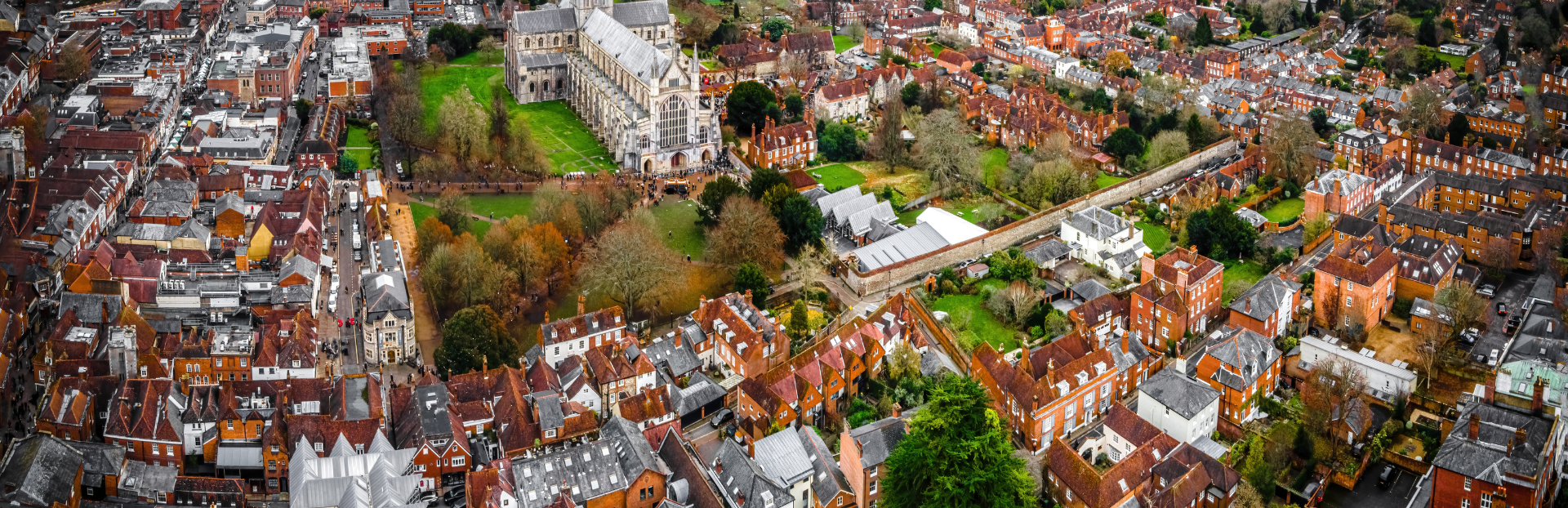
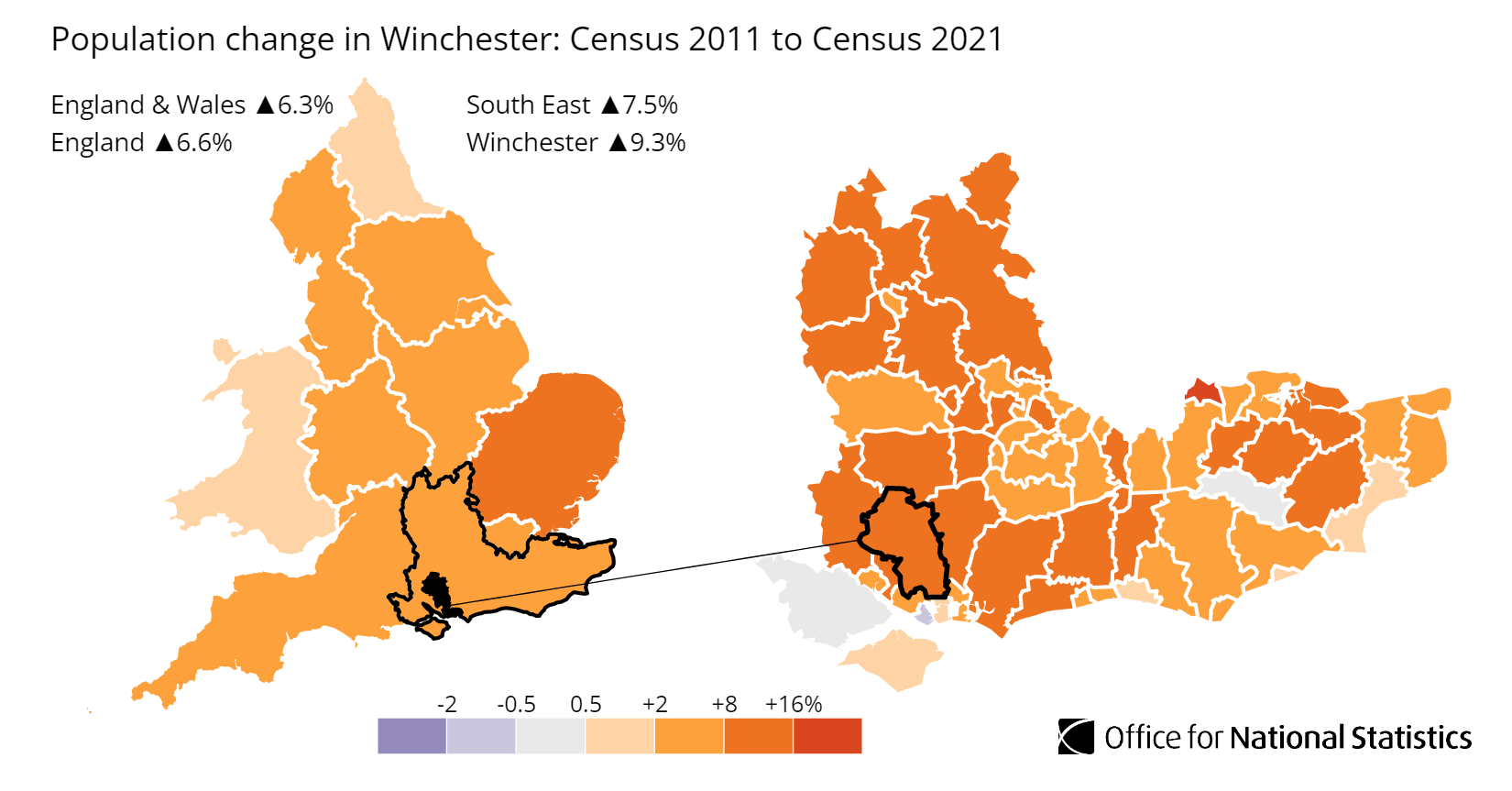
Winchester is a cathedral city in Hampshire, in the south-east of England. Average sold prices in Winchester sit at £471,136 on the HM Land Registry House Price Index, 62.5% above the England average of £289,946 and among the highest of any district in Hampshire. That premium is structural, built on high local incomes, tight planning in a historic city, and a fast rail line to London. The district's population grew 9.3% between the 2011 and 2021 censuses, from 116,595 to 127,444, well ahead of England's 6.6%.
Winchester's price premium rests on earnings that outstrip the region. The median gross annual salary across the district is £45,766, against £41,616 across the South East and £39,125 for Great Britain. Those wages support strong absolute rents, so tenants in Winchester's yield-bearing postcodes pay £1,417 to £2,123 a month. What the premium does not do is stretch to yield: asking prices run from £438,948 in PO17 to £641,063 in SO24, and gross yields top out at 4.5% in SO22, where £2,065 monthly rents meet a £545,844 asking price.
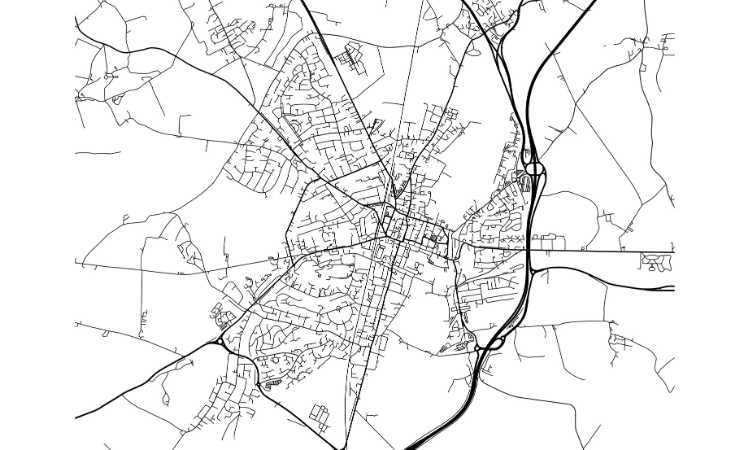
This guide covers Winchester City Council (ONS code E07000094) across six postcodes: PO17, SO21, SO22, SO23, SO24 and SO32. Winchester sits in the South East, roughly 60 miles south-west of London and 15 minutes by train from Southampton. Four of the six postcodes carry rental data. Investors comparing the wider region may also weigh up Southampton, Portsmouth, Salisbury and Chichester.
Article updated: July 2026
Why Invest in Winchester?
Winchester's median annual salary of £45,766 is 17.0% above the Great Britain average, and its economy pulls on public sector employment, professional services, and London commuter income that most provincial cities do not have. Hampshire County Council is headquartered in the city, so local government is the single largest employer. Add Winchester City Council, the Crown Court, the prison, and the Royal Hampshire County Hospital, and the district carries a deep, stable public sector wage base underneath its private sector jobs.
The University of Winchester has around 8,000 students, which is a fraction of Southampton's 30,000-plus or Portsmouth's 25,000-plus. That scale matters for landlords: student demand concentrates in SO22 and SO23, the postcodes nearest the main campus and the West Downs site, but it does not underpin the kind of large HMO market those bigger university cities support. In practice, Winchester lettings to students tend to be individual tenants or small sharers rather than licensed multi-occupancy houses. For the purpose-built end of the sector, see our guide to student property investment.
Between the 2011 and 2021 censuses, Winchester's population grew from 116,595 to 127,444, a rise of 9.3%. That rate sits well above the England average of 6.6% and reflects sustained demand from professionals drawn to the city's schools, heritage and connectivity. Winchester is roughly 60 minutes from London Waterloo by train and 15 minutes from Southampton, so residents reach two distinct employment markets.
Higher local wages support higher absolute rents, which is why Winchester tenants pay between £1,417 and £2,123 a month across the four postcodes with rental data. The median annual salary of £45,766 compares with £41,616 across the South East and £39,125 for Great Britain. That 17.0% gap over the national wage is part of why prices can hold a 62.5% premium over England without affordability collapsing entirely.
Winchester's employment rate is 78.4%, above the Great Britain rate of 75.6%. The unemployment rate is not published for the district because the sample is too small for a reliable estimate, which in practice tends to accompany very low rates.
Winchester Economic Summary
- Population: 127,444 (2021 Census). Growth of 9.3% from 2011.
- Median annual salary: £45,766 (Winchester), £41,616 (South East), £39,125 (Great Britain)
- Employment rate: 78.4% (Winchester), 75.6% (Great Britain)
- Unemployment rate: Not published (sample too small for reliable estimate)
- Key employment sectors: Public administration, education, healthcare, professional services, tourism
Source: ONS Census 2021, Nomis Labour Market Profile (ASHE 2025)
Regeneration and Investment in Winchester
Winchester's largest scheme is Kings Barton, a 2,000-home development on the northern edge of the city and the biggest housing project in its history. Unlike industrial cities running large-scale infrastructure programmes, regeneration here is about densification and placemaking within a constrained historic setting.
- Central Winchester Regeneration (planning stage, mixed-use): A redevelopment of the Kings Walk, Friarsgate and bus station area in the city centre, led by Jigsaw (Partnerships and Places) with Winchester City Council. The scheme is set to deliver new homes, retail, office and community space, with public engagement running through early 2026. Updates at Winchester City Council.
- Kings Barton (under construction, 2,000 homes): A 2,000-home development by CALA Homes, including 800 affordable homes at 40%, with 24 hectares of recreational space and a 32-hectare nature reserve. It is one of the largest housing developments in Winchester's history and is actively adding supply into the district. Updates at CALA Homes.
- Station Approach (concept masterplan approved, June 2025): Regeneration of the gateway around Winchester railway station, which handles roughly 8,000 daily pedestrians. The masterplan by Design Engine Architects covers five sites, including the Gladstone Street and Cattlemarket car parks, reshaping the arrival into the city from the south. Updates at Winchester City Council.
Source: Office for National Statistics - Population for Winchester
Winchester Property Market Analysis
Average property prices in Winchester have risen 444.5% since March 1996, from £86,872 to £471,136. The sections below trace that path cycle by cycle, then drill into current postcode-level data for sold prices, price per square foot, asking prices, growth, and monthly transaction volumes.
When Was the Last House Price Crash in Winchester?
Winchester is a district-level local authority, so all sold prices from HM Land Registry are recorded for the whole Winchester City Council area. The Land Registry House Price Index runs from January 1995 to March 2026, covering 31 years of market cycles.
The 1995 to 2007 boom: Winchester started 1995 at £86,523. As a premium southern-England market, it caught the late-1990s upswing early and hard, reaching £139,278 by January 2000 with annual growth already at 13.8%. The 2000s cheap-credit era pushed prices to a peak of £331,572 in November 2007, with annual change touching 19.0% at the top. Cheap borrowing and London commuter demand carried Winchester prices well above what local wages alone could support.
2007 to 2009, the financial crisis: From the November 2007 peak of £331,572 to the trough of £243,882 in February 2009, Winchester lost 26.4% of its value in 15 months, with the worst annual reading of -21.4% in January 2009. That decline was deeper than both the South East and England, which is the pattern in premium markets. When credit tightens, the buyers who stretch to afford a place like Winchester are the first to step back.
Recovery, 2009 to 2014: Winchester bounced fast off the trough, back above £294,000 by January 2010 on 16.9% annual growth, then traded broadly sideways between roughly £294,000 and £310,000 for three years. It regained the November 2007 pre-crash peak in February 2014 at £339,891, a recovery of just over six years, faster than many provincial cities but slower than prime London.
2015 to 2019, growth then plateau: Prices ran from £364,086 in March 2015 to £403,178 by March 2016, then flattened. Through 2017 to 2019 annual change barely cleared 1%, as Brexit uncertainty and the second-home stamp duty surcharge cooled the top of the market.
2020 to 2022, the pandemic surge: Winchester's mix of space, schools and connectivity made it a prime beneficiary of the lifestyle shift, and the stamp duty holiday accelerated transactions. Prices climbed from £425,176 in March 2020 to an all-time high of £493,584 in August 2022.
2023 to present: Higher mortgage rates cooled the market. From the August 2022 high, prices eased back to £470,088 by March 2024 (-3.2% annual) and £467,189 by March 2025 (-0.6%), before steadying at £471,136 in March 2026, an annual change of +0.8%. Winchester has given back part of its pandemic peak and is now moving broadly sideways.
Long-term growth summary:
- 5 years (March 2021 to March 2026): 10.5% growth (£426,279 to £471,136)
- 10 years (March 2016 to March 2026): 16.9% growth (£403,178 to £471,136)
- 15 years (March 2011 to March 2026): 62.0% growth (£290,869 to £471,136)
- 20 years (March 2006 to March 2026): 72.5% growth (£273,079 to £471,136)
- 30 years (March 1996 to March 2026): 444.5% growth (£86,872 to £471,136)
The 2008 crash is the reference point for anyone weighing Winchester's downside. A 26.4% fall took just over six years to recover, deeper than England and the South East, which is the trade-off in a premium market: it amplifies both the upside and the downside. The five-year figure of 10.5% reflects a market that surged during the pandemic and has since eased back to a plateau. Over 30 years the return of 444.5% is strong, and the current +0.8% reading points to a market that has finished repricing rather than one still falling.
- All property types
- Detached
- Semi-detached
- Terraced
- Flats
- All property types
- Detached
- Semi-detached
- Terraced
- Flats
Source: HM Land Registry House Price Index for Winchester, January 1995 to March 2026.
Sold House Prices in Winchester
Winchester's sold prices sit above the national average across every property type, but the size of the premium swings sharply by type. The headline figure of £471,136 is 62.5% above England's £289,946 and among the highest in Hampshire. That premium is not spread evenly, and where it thins out is exactly where a buy-to-let investor should look.
Detached houses in Winchester average £757,304, a 61.0% premium over England's £470,492. Detached stock dominates the rural and market-town postcodes, SO24 (Alresford) and SO21 (Sutton Scotney), where large village homes trade on lifestyle demand as much as on investment maths. Winchester's detached prices are up 1.2% over the year to March 2026, the firmest of any type.
Semi-detached houses average £477,732, a 65.8% premium and the widest of any type. Semis are the core family stock in postcodes like SO22 (Weeke and Harestock), where professional families competing for school catchments and city-centre proximity push prices proportionally higher than anywhere else. Semi-detached values rose 2.1% over the year, the strongest annual move in the district.
Terraced houses average £398,882, a 63.6% premium over England's £243,788. Winchester's terraces cluster in the city centre and surrounding villages, and period terraces in SO23 (City Centre, St Cross) command a further premium for proximity to the cathedral quarter and the high street. Terraced prices are up 2.0% over the year. This is not a market where the terraced end is the affordable one.
Flats average £233,910, where the premium almost disappears at 9.0% above England's £214,563. No other type comes close to that narrow gap. Winchester lacks the volume of new-build apartment schemes that inflate flat prices in cities like Reading or Guildford, so the flat stock is smaller, older and priced near the national norm. Flats are the one type down over the year, at -2.9%. For an investor, that compression means flat-based returns look more favourable than the headline district premium suggests.
| Property Type | Winchester Average | England Average | Difference |
|---|---|---|---|
| Detached houses | £757,304 | £470,492 | +61.0% |
| Semi-detached houses | £477,732 | £288,185 | +65.8% |
| Terraced houses | £398,882 | £243,788 | +63.6% |
| Flats and maisonettes | £233,910 | £214,563 | +9.0% |
| All property types | £471,136 | £289,946 | +62.5% |
Price Per Square Foot in Winchester
Asking prices tell you what a postcode costs. Price per square foot tells you what you are paying for space, stripping out the size bias that makes a postcode look dear simply because its homes are larger. Winchester's transaction-based price per square foot runs from £348 in PO17 to £494 in SO23, a spread of 42% across six postcodes.
| Rank | Area | Price Per Sq Ft |
|---|---|---|
| 1 | PO17 (Wickham) | £348 |
| 2 | SO32 (Bishops Waltham, Swanmore) | £393 |
| 3 | SO21 (Winchester Rural, Sutton Scotney) | £460 |
| 4 | SO24 (Alresford) | £474 |
| 5 | SO22 (Weeke/Harestock) | £491 |
| 6 | SO23 (City Centre, St Cross) | £494 |
PO17 at £348 per square foot is the cheapest space in the district. Wickham sits on the southern fringe, closer to Fareham than to Winchester city centre, and that distance from the core is what shows up in the rate. PO17 also carries the lowest asking price at £438,948, so the per-foot cost lines up with the wider picture of a peripheral postcode.
SO22 and SO23 top the table within £3 of each other, at £491 and £494. These are the two postcodes closest to the city centre, and the price of space here is nearly identical despite different headline prices (SO22 at £545,844 asking, SO23 at £527,217). The gap in asking price comes down to property mix and size, not to what a square foot costs.
SO21 at £460 sits mid-table despite the district's second-highest asking price at £633,214. Rural Winchester and Sutton Scotney run to larger homes, and a bigger footprint spreads the per-foot cost more thinly, which is why an expensive-looking postcode lands in the middle of this table.
Figures reflect averages across all property types and ages. Individual values depend on condition, location within the postcode, and building age.
For Sale Asking Prices in Winchester
Winchester's asking prices run from £438,948 in PO17 to £641,063 in SO24, a spread of £202,115 across six postcodes. Asking prices reflect what sellers and agents expect the market to pay, which is not the same as sold prices, the figure buyers actually pay. In a market that has been easing off its pandemic high, asking prices can sit above what eventually transacts.
Only PO17 falls below £500,000; the other five postcodes all sit above it.
| Rank | Area | Asking Price |
|---|---|---|
| 1 | PO17 (Wickham) | £438,948 |
| 2 | SO32 (Bishops Waltham, Swanmore) | £517,591 |
| 3 | SO23 (City Centre, St Cross) | £527,217 |
| 4 | SO22 (Weeke/Harestock) | £545,844 |
| 5 | SO21 (Winchester Rural, Sutton Scotney) | £633,214 |
| 6 | SO24 (Alresford) | £641,063 |
PO17 Wickham at £438,948 is the entry tier on its own, £78,643 below the next cheapest postcode. That gap reflects Wickham's position on the district boundary, closer to Fareham and the M27 corridor than to Winchester city centre. For an investor looking at Winchester's lowest asking prices, PO17 stands apart, though it is the one yield-bearing-adjacent postcode with no rental figure to pair against it.
SO21 and SO24 form the top tier above £630,000. These are the rural and market-town postcodes where larger village homes dominate the stock. SO24 Alresford carries the district's highest asking price at £641,063 alongside the lowest sales volume at 9 a month, making it the thinnest and most expensive segment of Winchester's market.
The mean asking price across all six postcodes is £550,646. That figure carries into the comparison section below, where Winchester is measured against Southampton, Portsmouth, Salisbury and Chichester.

House Price Growth in Winchester
Winchester's asking-price growth splits the district in two. SO24 leads at 16.5% over five years, while PO17 sits at -18.0%, a 34.5-percentage-point gap within a single local authority. The pattern rewards the rural and city-centre postcodes over the peripheral one.
| Area | 1 Year | 3 Years | 5 Years |
|---|---|---|---|
| SO24 (Alresford) | 0.1% | 2.3% | 16.5% |
| SO23 (City Centre, St Cross) | 0.8% | -3.7% | 7.2% |
| SO32 (Bishops Waltham, Swanmore) | 3.6% | -4.4% | 4.1% |
| SO21 (Winchester Rural, Sutton Scotney) | -15.1% | -12.7% | 1.3% |
| SO22 (Weeke/Harestock) | -2.9% | -5.7% | -7.8% |
| PO17 (Wickham) | -2.1% | -8.4% | -18.0% |
SO24 Alresford leads on five-year growth at 16.5% and has held roughly flat over the past year at 0.1%. Alresford's market-town appeal to buyers coming from outside the area has supported values where more peripheral postcodes have slipped. Read alongside the yield data, SO24 pairs that growth with the district's highest asking price and no current rental figure, so it reads as a capital-led rather than income-led postcode.
SO32 Bishops Waltham posted the strongest one-year move at +3.6%, and SO23 held positive at +0.8%. These two, along with SO24, are the postcodes where recent momentum has turned back up. The rest of the district is still working through the correction that followed the pandemic surge.
PO17 Wickham at -18.0% over five years is the outlier. A buyer who paid the asking price five years ago would be down nearly a fifth on paper. With only 4 sales a month, PO17 is a thin market where individual transactions swing the average, so the five-year figure may overstate the decline for typical stock, but the direction is clear. In postcodes with sustained price falls, repossessed homes occasionally surface below market price, though volumes across Winchester stay low.
Monthly Property Sales in Winchester
Transaction volumes show which postcodes have the deepest buyer pools, and for a landlord that is an exit question: if you need to sell, how quickly can you find a buyer? Winchester's monthly sales run from 4 in PO17 to 27 in SO32, with 102 transactions a month across all six postcodes.
| Area | Sales Per Month | Turnover | Asking Price |
|---|---|---|---|
| SO32 (Bishops Waltham, Swanmore) | 27 | 10% | £517,591 |
| SO22 (Weeke/Harestock) | 26 | 10% | £545,844 |
| SO23 (City Centre, St Cross) | 23 | 11% | £527,217 |
| SO21 (Winchester Rural, Sutton Scotney) | 13 | 8% | £633,214 |
| SO24 (Alresford) | 9 | 8% | £641,063 |
| PO17 (Wickham) | 4 | 4% | £438,948 |
SO32, SO22 and SO23 are the busiest markets, at 23 to 27 sales a month. These three cluster around and just outside the city centre, and they are where the most stock changes hands. For an investor weighing liquidity alongside returns, SO22 stands out: it combines that transaction depth with the district's highest yield at 4.5% and highest rent at £2,065.
PO17 Wickham at 4 sales a month and 4% turnover is the thinnest market in the district. Its 761 days on market, the longest of any postcode, confirms how few homes trade there. For exit planning, PO17 is a postcode to enter with a long horizon rather than a quick resale in mind.
SO24 Alresford at 9 sales a month pairs low volume with the highest asking price. Properties here trade infrequently and at premium levels, so an investor in SO24 is buying into capital growth and scarcity rather than a liquid resale market.

How Long Properties Take to Sell in Winchester
Selling speed swings widely across Winchester: SO23 (City Centre, St Cross) clears fastest at roughly 277 days, while PO17 (Wickham) is slowest at about 761 days. Days on market is the typical time a home is up for sale before it sells, and months of unsold stock shows how much for-sale supply is sitting there at the current pace of sales.
| Area | Avg Days to Sell | Months of Unsold Stock | Market |
|---|---|---|---|
| SO23 (City Centre, St Cross) | 277 | 9.1 | Balanced market |
| SO22 (Weeke/Harestock) | 304 | 10.0 | Balanced market |
| SO32 (Bishops Waltham, Swanmore) | 304 | 10.0 | Balanced market |
| SO21 (Winchester Rural, Sutton Scotney) | 380 | 12.5 | Buyer's market |
| SO24 (Alresford) | 380 | 12.5 | Buyer's market |
| PO17 (Wickham) | 761 | 25.0 | Buyer's market |
A yield figure says nothing about how fast you can get back out. SO23's 9.1 months of unsold stock means a quicker route to a sale than SO21 or SO24 at 12.5, and PO17's 25.0 months puts it in a category of its own. The three city-adjacent postcodes sit in balanced-market territory; the rural and peripheral ones lean towards buyers, which is worth weighing when you plan the exit.
What Type of Property Can You Buy in Winchester?
Detached homes are the largest single category in four of the six postcodes, from 24.1% of stock in SO23 to 59.4% in SO24, while terraced houses and flats concentrate in the two city-centre postcodes. The mix of housing stock shapes which strategy fits each postcode. The figures below are drawn from 2021 Census records for each postcode.
| Area | Detached | Semi-detached | Terraced | Flats |
|---|---|---|---|---|
| PO17 (Wickham) | 49.9% | 29.7% | 8.0% | 4.6% |
| SO21 (Winchester Rural, Sutton Scotney) | 49.8% | 29.7% | 11.7% | 6.5% |
| SO22 (Weeke/Harestock) | 35.6% | 26.1% | 19.8% | 17.9% |
| SO23 (City Centre, St Cross) | 24.1% | 21.5% | 30.0% | 24.3% |
| SO24 (Alresford) | 59.4% | 29.8% | 8.0% | 2.2% |
| SO32 (Bishops Waltham, Swanmore) | 57.9% | 25.5% | 10.0% | 4.7% |
SO23 holds the district's largest share of terraced houses at 30.0% and flats at 24.3%. That is the smaller-unit stock that usually forms the buy-to-let market, and it lines up with SO23's role as one of the two city-centre postcodes where rental demand and transaction volumes are strongest. City-centre flats and period terraces here suit single lets, professional couples and student sharers.
SO24 Alresford is the most detached-dominated postcode at 59.4%, with the smallest flat share at 2.2%. Detached and semi-detached houses together make up nearly 90% of its stock, which matches its premium asking prices and its role as a capital-led rather than income-led postcode. SO22 sits in between, with a meaningful 17.9% flat share that supports its position as the district's top-yielding postcode.
Flats combine purpose-built and converted units. A small share of mobile and temporary dwellings is not shown, so rows may not total 100%.
Winchester Rental Market Analysis
Monthly rents in Winchester run from £1,417 in SO32 to £2,123 in SO21, with gross yields from 3.3% to 4.5% across the four postcodes that carry rental data. For investors weighing whether buy-to-let is worth it in Winchester, the sections below break down rents, yields and tenant affordability postcode by postcode. If you are working out how to build a property portfolio in the South East, Winchester's high-income tenant base and long-run capital growth sit at the opposite end of the spectrum from the low-entry, high-yield markets that dominate buy-to-let content. To compare Winchester against more affordable areas, browse current buy-to-let homes for sale across the UK.
Average Rent & Gross Rental Yields in Winchester
Gross yields in Winchester range from 3.3% in SO32 to 4.5% in SO22, a spread of 1.2 percentage points across the four postcodes with rental data. The calculation divides annual rent by asking price and does not account for void periods, maintenance, management fees or mortgage costs. It is a starting point for comparison, not a profit forecast. PO17 and SO24 carry asking prices but too few current rental listings to show a reliable yield.
SO22 delivers Winchester's highest yield at 4.5%, where £2,065 monthly rents meet a £545,844 asking price. At the other end, SO32 at 3.3% pairs the lowest rent in the group (£1,417) with a £517,591 asking price. Every yield-bearing postcode in Winchester sits below the national average, which is the defining feature of a premium market.
| Area | Average Monthly Rent | Asking Price | Gross Yield |
|---|---|---|---|
| SO22 (Weeke/Harestock) | £2,065 | £545,844 | 4.5% |
| SO21 (Winchester Rural, Sutton Scotney) | £2,123 | £633,214 | 4.0% |
| SO23 (City Centre, St Cross) | £1,533 | £527,217 | 3.5% |
| SO32 (Bishops Waltham, Swanmore) | £1,417 | £517,591 | 3.3% |
| PO17 (Wickham) | Not enough data | £438,948 | Not enough data |
| SO24 (Alresford) | Not enough data | £641,063 | Not enough data |
SO22 at 4.5% is the only Winchester postcode where the yield exceeds 4% on a firm rental sample. Its £2,065 monthly rent sits close to the top of the district, and its position near the city centre and the university draws professionals, academics and families, keeping demand deep enough to support both rent and transaction volume.
SO21 charges the highest rent at £2,123 but yields 4.0%, because its £633,214 asking price is the second-highest in the district. Rural Sutton Scotney and the villages around it attract tenants who want space and access to both London and Southampton via Micheldever Station, so the rent is strong in absolute terms even as the high asking price holds the yield down.
SO32 at 3.3% marks the floor of the yield table. Bishops Waltham and Swanmore pair a £1,417 rent with a £517,591 asking price, and that combination puts income return at the bottom of the group. After void periods and management costs, the gross figure would narrow further in a lower-density market.
Gross Rental Yield by Postcode
Is Winchester Rent High?
Monthly rents in Winchester's yield-bearing postcodes consume between 37.1% and 55.7% of the local median gross monthly salary. The widely cited affordability threshold is 30% of gross income, and all four postcodes with rental data sit above it. That reflects a high-rent market resting on a high-income tenant base rather than genuine affordability pressure on low-wage renters.
The median gross weekly salary in Winchester is £880.10, which equates to £3,814 per month or £45,766 per year. This is above the South East regional median of £800.30 a week and the Great Britain median of £752.40 a week. Data from the Nomis Labour Market Profile (ASHE 2025).
| Rank | Area | Rent as % of Income |
|---|---|---|
| 1 | SO21 (Winchester Rural, Sutton Scotney) | 55.7% |
| 2 | SO22 (Weeke/Harestock) | 54.2% |
| 3 | SO23 (City Centre, St Cross) | 40.2% |
| 4 | SO32 (Bishops Waltham, Swanmore) | 37.1% |
| — | PO17 (Wickham) | Not enough data |
| — | SO24 (Alresford) | Not enough data |
SO21 at 55.7% and SO22 at 54.2% are the most stretched postcodes on paper. A £2,123 or £2,065 rent against a district median monthly salary of £3,814 is a high ratio, but the tenants renting these homes are rarely on the district median. Rural SO21 and city-adjacent SO22 draw professionals, dual-income households and families whose actual incomes sit well above the median.
SO32 at 37.1% is the least stretched of the four. Its £1,417 rent is the lowest in the group, which supports payment reliability, and it pairs that with the district's second-busiest sales market. For a landlord, lower rent-to-income ratios tend to correlate with fewer arrears and longer tenancies.
The district-wide read is of a high-rent market carried by high incomes. Winchester's £45,766 median salary is 17.0% above the Great Britain figure, so the ratios that look stretched reflect a tenant pool earning more than the national norm, a different risk profile from a city where 40%-plus ratios signal genuine affordability strain.
How Big Is Winchester's Private Rented Sector?
The private rented sector is deepest in SO21 and SO24, where it accounts for 24.5% and 22.4% of households, and shallowest in SO32 and SO22 at 15.0% and 16.8%. The share of homes already rented privately is a guide to the size of the established tenant pool and the local lettings market. The table below shows household tenure by postcode.
| Area | Owned Outright | Owned with Mortgage | Private Rented | Social Rented |
|---|---|---|---|---|
| SO21 (Winchester Rural, Sutton Scotney) | 38.3% | 29.1% | 24.5% | 7.2% |
| SO24 (Alresford) | 41.8% | 28.2% | 22.4% | 7.0% |
| SO23 (City Centre, St Cross) | 25.9% | 27.5% | 20.1% | 22.5% |
| PO17 (Wickham) | 45.7% | 25.9% | 20.1% | 7.1% |
| SO22 (Weeke/Harestock) | 30.1% | 32.2% | 16.8% | 18.3% |
| SO32 (Bishops Waltham, Swanmore) | 46.2% | 32.0% | 15.0% | 5.8% |
SO21 and SO24 carry the largest private rented sectors, close to a quarter of all households, pointing to an active local lettings market and a wider pool of existing tenants. That is a different signal from yield: SO21 pairs its deep rented sector with a mid-table 4.0% yield, while SO24 has a substantial rented share but no current rental listings to price. SO23 stands out for its high social rented share at 22.5%, the largest in the district, alongside a fifth of homes in the private rented sector.
Of the two postcodes with enough rental listings to read reliably, SO23 currently balances between landlords and tenants, with around 74 homes advertised to let and a typical 115 days to find a tenant, while SO22 leans towards tenants, with about 99 homes on the market taking roughly 230 days to let. The other four postcodes carry too few rental listings at any one time to read with confidence.
Local Housing Allowance Rates in Winchester
Five of Winchester's six postcodes fall within the Winchester Broad Rental Market Area, where Local Housing Allowance runs from £120.82 a week for a shared room to £391.23 a week for a four-bedroom home; PO17 (Wickham) sits in the neighbouring Portsmouth market area, where rates are lower. Local Housing Allowance sets the maximum housing support a tenant on benefits can receive, so it acts as a rent floor for landlords letting to that part of the market. The rates below apply across the Winchester area; to check the current rate for a specific address, use the government's official Local Housing Allowance calculator.
| Property Size | Weekly LHA Rate | Monthly Equivalent |
|---|---|---|
| Shared accommodation | £120.82 | £524 |
| 1 bedroom | £189.86 | £823 |
| 2 bedrooms | £241.64 | £1,047 |
| 3 bedrooms | £293.42 | £1,271 |
| 4 bedrooms | £391.23 | £1,695 |
The two-bedroom Winchester rate of £241.64 a week works out at about £1,047 a month, below the £1,417 to £2,123 open-market rents recorded across the district. A benefit-backed tenancy at the LHA rate therefore sits under Winchester's market rents, and the stock that fits within these rates is thinnest in a market priced this high. PO17 is the exception to the district's shared rate: as part of the Portsmouth Broad Rental Market Area, its LHA runs lower, from £97.31 a week for a shared room to £299.18 for four bedrooms.
Buy-to-Let Considerations
Are House Prices High in Winchester? Price-to-Earnings Ratios
Purchasing a property in Winchester requires between 9.6 and 14.0 times the median annual salary. This is based on the Nomis Labour Market Profile for Winchester showing the median gross annual income for Winchester residents is £45,766.
As a yardstick, England's £289,946 average sold price works out at 7.4 times the Great Britain median salary of £39,125. Every Winchester postcode clears that yardstick comfortably, so there is no part of the district where prices land at or below the national affordability norm.
| Rank | Area | Price-to-Earnings Ratio |
|---|---|---|
| 1 | PO17 (Wickham) | 9.6x |
| 2 | SO32 (Bishops Waltham, Swanmore) | 11.3x |
| 3 | SO23 (City Centre, St Cross) | 11.5x |
| 4 | SO22 (Weeke/Harestock) | 11.9x |
| 5 | SO21 (Winchester Rural, Sutton Scotney) | 13.8x |
| 6 | SO24 (Alresford) | 14.0x |
PO17 at 9.6x is the closest the district comes to the benchmark, but it is still 30% above the national 7.4x. The £438,948 asking price divided by Winchester's £45,766 median salary produces a ratio that would be unremarkable in many South East locations yet is the lowest Winchester offers.
SO24 and SO21 at 14.0x and 13.8x are the most stretched. Asking prices above £630,000 in both are driven by village and rural stock, where demand from buyers relocating with outside earnings sets the floor rather than local wages. Ratios in that range are typical of commuter-belt postcodes where London incomes, not district salaries, price the market.
Deposit Requirements in Winchester
A 30% deposit in Winchester runs from £131,684 in PO17 to £192,319 in SO24. The gap between the cheapest and most expensive deposit is £60,635. Even the lowest entry point demands a deposit above £130,000, which alone would cover the full asking price of a buy-to-let property in some northern English cities. Winchester is a market where the capital commitment is substantial at every price point.
Beyond the deposit, the stamp duty calculation and other buy-to-let running costs shape the total capital required.
| Rank | Area | 30% Deposit Required |
|---|---|---|
| 1 | PO17 (Wickham) | £131,684 |
| 2 | SO32 (Bishops Waltham, Swanmore) | £155,277 |
| 3 | SO23 (City Centre, St Cross) | £158,165 |
| 4 | SO22 (Weeke/Harestock) | £163,753 |
| 5 | SO21 (Winchester Rural, Sutton Scotney) | £189,964 |
| 6 | SO24 (Alresford) | £192,319 |
SO32, SO23 and SO22 form a middle tier between £155,277 and £163,753. Stepping up from PO17 costs an extra £24,000 to £32,000, and that money buys access to markedly different markets: SO23 delivers positive five-year growth at 7.2% and a 3.5% yield, while SO22 pairs the district's top yield at 4.5% with its highest rent at £2,065. The deposit premium between these three postcodes is modest relative to the differences in rental income and growth.
SO21 and SO24 both require deposits above £189,000. At that level the capital deployed is comparable to buying a complete property outright in cities like Plymouth or Stoke-on-Trent, so an investor here is making a deliberate choice to concentrate in a premium market rather than spread across several lower-cost homes. Winchester's premium pricing limits discounted opportunities to the flat segment or individual distressed sales. For those with limited upfront capital, our guide to investment property with no deposit covers alternative financing structures.

What the Winchester Data Tells Buy-to-Let Investors
For income, the numbers point to SO22 at 4.5%, with £2,065 monthly rent and one of the busiest markets in the district at 26 sales a month. SO21 follows at 4.0% on the highest rent (£2,123), then SO23 at 3.5% and SO32 at 3.3%. The spread between top and bottom yield is 1.2 percentage points, and in a market this compressed that still translates into meaningfully different cash flow. PO17 and SO24 carry asking prices but no current rental figure, so they sit outside the income comparison.
For growth, SO24 leads at 16.5% over five years, with SO23 (7.2%) and SO32 (4.1%) also positive. SO21 is marginally positive at 1.3%, while SO22 and PO17 are down over five years, PO17 sharply so at -18.0%. Winchester's growth data does not follow a single pattern: it splits between the rural and city-centre postcodes that have held or grown and the peripheral ones that gave back their pandemic gains.
Every postcode sits above the national price-to-earnings benchmark of 7.4x, with ratios from 9.6x to 14.0x, and deposits start at £131,684 in PO17. The minimum capital commitment in Winchester would fund a complete investment property in a lower-priced city further north. This is a market for investors who have already built capital and want exposure to a high-income, structurally resilient district rather than the best yield per pound of deposit. Winchester runs no selective licensing scheme for private landlords; only the standard mandatory HMO licence applies, for larger shared houses of five or more occupants. Investors who prefer to look beyond openly marketed stock can view off-market property in Winchester.
How Winchester Compares
Winchester's mean asking price of £550,646 is the highest of five nearby areas compared here, and its top yield of 4.5% sits mid-table, above Salisbury and level with Chichester but far below the port cities. The comparison places Winchester alongside four nearby locations, each with a different investor profile. Mean asking price and mean monthly rent are simple averages across all postcodes with data; top gross yield is the single highest postcode yield in each location.
| Location | Mean Asking Price | Mean Monthly Rent | Mean Gross Yield | Top Yield (postcode) |
|---|---|---|---|---|
| Southampton | £260,743 | £1,270 | 5.8% | 7.7% (SO17) |
| Portsmouth | £288,764 | £1,330 | 5.5% | 6.7% (PO4) |
| Salisbury | £437,020 | £1,304 | 3.6% | 4.6% (SP1) |
| Chichester | £543,257 | £1,496 | 3.3% | 4.3% (PO19) |
| Winchester | £550,646 | £1,784 | 3.9% | 4.5% (SO22) |
Winchester is the most expensive entry point in this group and delivers the highest mean rent. Its £550,646 mean asking price is £289,903 above Southampton and £261,882 above Portsmouth. Winchester does lead on mean monthly rent at £1,784, but the £514 gap over Southampton's rent is a fraction of the gap in price.
Southampton and Portsmouth deliver far higher top yields, 7.7% and 6.7%, at roughly half Winchester's entry cost. These are fundamentally different markets: yield-driven port cities with student and service-sector tenant bases, against Winchester's income-driven market where high rents are offset by even higher prices.
Chichester is the closest comparison. Its £543,257 mean asking price sits just 1% below Winchester's, top yields are within 0.2 points (4.3% against 4.5%), and both are premium cathedral cities with affluent populations and compressed returns. Winchester carries the higher mean rent and a stronger population growth rate; Chichester spans a wider geographic area. The choice between them is more geographic than data-driven.
Salisbury sits in between. A lower £437,020 mean asking price with a similar top yield (4.6%) and lower mean rent (£1,304). For an investor weighing premium markets under a capital constraint, Salisbury needs roughly 20% less capital than Winchester for a comparable yield profile. To compare all South East options, browse our guide to the best buy-to-let areas across the UK.
Frequently Asked Questions
Is Winchester a good place to live for buy-to-let tenants?
It suits a professional, higher-earning tenant, and that comes down to jobs and wages. Winchester's employment rate is 78.4%, above the national 75.6%, and the typical wage is £880.10 a week against £752.40 across Great Britain. A big public sector base, Hampshire County Council, the hospital, the courts, plus fast trains to London and Southampton, keeps demand steady from tenants in stable work.
It is an easy place to rent in a compact, historic city with strong schools, but rents are high in absolute terms, so the tenant pool skews towards professionals and dual-income households rather than lower-wage renters.
What are the best areas in Winchester for property investment?
The postcodes split by what you want the money to do. SO22 (Weeke and Harestock) carries the district's highest yield at 4.5% and its highest rent among the busy postcodes at £2,065, so it leans towards income, with a decent flat share to let. SO24 (Alresford) has grown fastest over five years at 16.5% but has no current rental figure and the highest asking price, so it leans towards capital growth.
In the middle, SO23 (City Centre, St Cross) pairs a 3.5% yield with positive five-year growth of 7.2% and the fastest selling times in the district, while SO21 (Sutton Scotney) offers a 4.0% yield on the highest rent but the second-highest asking price. So if income is the priority, SO22 leads; if you want growth that has shown up over five years, SO24 and SO23 are the ones.
Why is Winchester so expensive compared to nearby cities?
Three things drive the premium: local incomes, with a £45,766 median salary against £39,125 for Great Britain; proximity to London, roughly 60 minutes by train to Waterloo; and tight housing supply in a historic city with strict planning. Together they hold sold prices 62.5% above the England average, among the highest in Hampshire. Southampton is 15 minutes away by train yet has a mean asking price of £260,743, less than half Winchester's £550,646. That gap is structural and has held for decades.
What are average house prices, rents and yields in Winchester?
They run high across the board. The average sold price across Winchester is £471,136 on the Land Registry index, 62.5% above the England average of £289,946 as of March 2026. By type, detached homes average £757,304, semi-detached £477,732, terraced £398,882 and flats £233,910. Asking prices by postcode run from £438,948 in PO17 up to £641,063 in SO24, with a district mean of £550,646. On the rental side, monthly rents run from £1,417 in SO32 to £2,123 in SO21, and gross yields top out at 4.5% in SO22. Prices have levelled off after easing from an August 2022 high of £493,584, up 0.8% over the past year and 10.5% over five years.
Is Winchester a university city for student rentals?
It has a university, but a small one for the purpose. The University of Winchester has around 8,000 students, well below Southampton (30,000-plus) or Portsmouth (25,000-plus), so the student rental market is limited in scale. Demand concentrates in SO22 and SO23, the postcodes nearest the main campus. Winchester does not carry the large-scale HMO market of bigger university cities, so student lettings here tend to be individual tenants or small sharers rather than licensed multi-occupancy houses.
What type of property can you buy in Winchester under £400,000?
Mostly flats. No full postcode averages below £400,000, since the cheapest is PO17 (Wickham) at £438,948, so the way in below that price is by property type rather than postcode. Flats across Winchester average £233,910 on the Land Registry index, a fraction of the £471,136 district figure, and at that level a 30% deposit is around £70,000. Sub-£400,000 stock is mostly one and two-bedroom flats, concentrated in the city-centre postcodes SO22 and SO23, which also hold the district's largest flat shares at 17.9% and 24.3%. To look beyond openly listed stock, explore BMV property.
What are the Local Housing Allowance rates in Winchester?
Most of the district shares one set of rates. Five of the six postcodes fall in the Winchester Broad Rental Market Area, where, as of June 2026, Local Housing Allowance runs at £120.82 a week for a shared room, £189.86 for a one-bed, £241.64 for two beds, £293.42 for three and £391.23 for four. PO17 (Wickham) is the exception, sitting in the Portsmouth market area with lower rates from £97.31 for a shared room to £299.18 for four bedrooms. The LHA figure is the most a tenant on housing support can claim towards rent.
What postcode covers Micheldever in Winchester?
The village of Micheldever falls within SO21, which covers rural Winchester and Sutton Scotney. SO21 has an asking price of £633,214, a 4.0% gross yield and £2,123 average monthly rent, the highest rent in the district. With 13 sales a month it is a lower-volume market than the city-centre postcodes. Micheldever Station, on the London Waterloo to Southampton line, gives residents direct rail access to both cities, and SO21 has delivered 1.3% five-year growth despite a sharp -15.1% move over the past year in a thin market.
How do I buy an investment property in Winchester?
Start by deciding whether you are buying for income or for growth, because that points you at a different postcode. SO22 (Weeke, Harestock) carries the top yield at 4.5% on a £545,844 asking price. SO24 (Alresford) has the strongest five-year growth at 16.5% but a higher entry cost and no current rental figure. Budget for a 30% deposit, which runs from £131,684 in PO17 to £192,319 in SO24, plus stamp duty and buying costs. Beyond what is listed openly, experienced investors buy below asking through off-market property and below market value property. To see what is available now, browse investment properties or buy-to-let homes for sale.
Ready to buy property?
Access off-market investment properties with an average 8%+ annual gross yield (beating the UK's typical 3-5%).
Get property alerts