

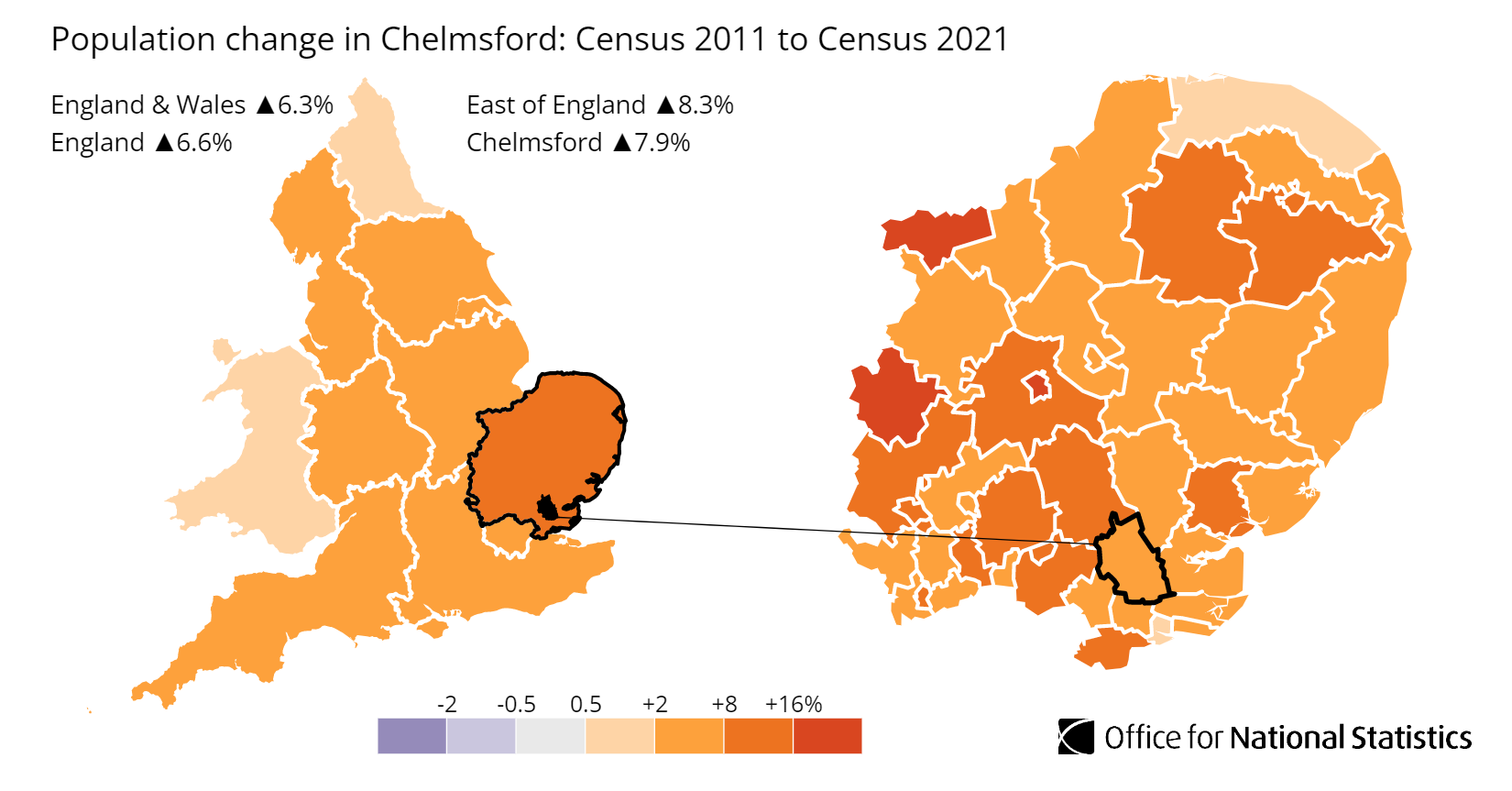
Chelmsford is a city in Essex, in the East of England, and the county town of Essex. Average sold prices across Chelmsford sit at £375,996 on the HM Land Registry House Price Index, 29.7% above the England average of £289,946 and 11.5% above the East of England regional figure of £337,182. That premium is the defining fact of the Chelmsford market. The price sits on London-commuter demand rather than on yield, and it shapes every postcode decision an investor makes here. Chelmsford grew its population 7.85% between the 2011 and 2021 censuses, from 168,310 to 181,523 residents.
The premium is paid for in capital and earnings, not in rental return. Median gross weekly pay for people working in Chelmsford is £888.10, which is 13.0% above the East of England figure of £785.80 and 18.0% above the Great Britain figure of £752.40, and many residents commute into higher-paid London jobs on top of that. For investors, the spread runs from CM2 at £397,282 up to CM4 at £733,456, an 84.6% gap across nine postcodes, with the higher yields sitting in the cheaper outer postcodes rather than the premium ones nearer the city.
This guide covers the local authority of Chelmsford (ONS code E07000070) across postcodes CM1, CM2, CM3, CM4, CM5, CM6, CM9, CM11, and CM77. Chelmsford sits in the East of England, 32 miles north-east of London with a 34-minute train into Liverpool Street. The wider Essex buy-to-let area also takes in Colchester to the north-east and the Thames-side towns to the south.
Article updated: July 2026
Why Invest in Chelmsford?
Chelmsford grew its population 7.85% between the 2011 and 2021 censuses, from 168,310 to 181,523 residents. That is faster than the England and Wales average of 6.3%, and it reflects a city pulling in residents who want a quicker commute into London than the capital's own outer boroughs offer at the same price. Chelmsford became a city in 2012, and its draw is practical: a 34-minute train into Liverpool Street, a compact retail core, and good schools across the surrounding villages.
The local economy leans on services rather than industry. The largest sector by employee jobs is human health and social work at 17.5%, followed by wholesale and retail at 14.4%, professional, scientific and technical services at 10.3%, public administration and defence at 9.3%, and education at 8.2%. Anglia Ruskin University has a Chelmsford campus, and the city hosts financial and insurance employers alongside its public-sector base. The employment rate is 74.3% and the model-based unemployment rate is 4.8%.
Median gross annual earnings for people working in Chelmsford are £46,179, which is 18.0% above the Great Britain median of £39,125. Higher local pay supports higher rents, and the commuter population earning London salaries widens the tenant base further. The result is a market where demand is strong and stable, but where the asking price has been bid up to a level that compresses the rental yield. That trade-off runs through the whole of this guide.
Chelmsford Economic Summary
- Population (Chelmsford): 181,523 (2021 Census). Growth of 7.85% from 2011.
- Median annual salary: £46,179 (local), £40,862 (East of England), £39,125 (Great Britain)
- Employment rate: 74.3% (local)
- Unemployment rate: 4.8% (local, model-based)
- Key employment sectors: Health and social work, wholesale and retail, professional and technical services, public administration, education
Source: ONS Census 2021, Nomis Labour Market Profile (ASHE 2025, model-based unemployment)
Regeneration and Investment in Chelmsford
Chelmsford's largest residential commitment is the Chelmsford Garden Community, a long-term plan for around 10,000 homes on the city's northern edge. The growth is concentrated north and east of the existing centre, where the council has allocated land for new neighbourhoods, schools, and link roads over the coming decades.
- Chelmsford Garden Community (Planned, ~10,000 homes): Chelmsford City Council's Local Plan sets out a series of garden neighbourhoods north of the city, delivered in phases over a multi-decade horizon with new schools, employment land, and green infrastructure. The scale of the allocation makes housing supply a long-term story in Chelmsford, and the early phases shape demand around CM1 and the northern edge of the city. Updates at Chelmsford City Council.
- Chelmer Waterside (Under way): The Chelmer Waterside regeneration is converting former industrial land close to the city centre and the river into new homes alongside public realm and waterside walkways. It adds apartment and townhouse stock within walking distance of the station, the part of the market the data below shows is the weakest by value, so the new supply lands in the softest segment. Updates at Chelmsford City Council.
- Beaulieu and the northern growth area (Under construction): The Beaulieu development north-east of the centre continues to deliver new homes, a relief road, and a new railway station, Beaulieu Park, on the Great Eastern Main Line. A second Chelmsford station shortens commutes from the northern neighbourhoods and is the kind of infrastructure that underpins the city's longer-term residential demand.
Source: Office for National Statistics - Population for Chelmsford
Chelmsford Property Market Analysis
Average property prices in Chelmsford have risen 535.4% since January 1995, from £59,177 to £375,996. The sections below walk that climb cycle by cycle, then drill into current postcode-level data for sold prices, price per square foot, asking prices, growth trends, transaction volumes, and selling times.
When was the last house price crash in Chelmsford?
Chelmsford is its own local authority, so all sold prices from HM Land Registry are recorded at the Chelmsford level. The Land Registry House Price Index tracks the average from January 1995 to the latest reading in March 2026, covering 31 years of market cycles.
The 1995 to 2007 climb: Chelmsford started at £59,177 in January 1995. By December 2000 the average had reached £106,168, and the early-2000s boom carried it to £193,474 by December 2005. Prices kept rising into the credit peak, reaching £227,679 in November 2007 before the market turned.
2008 to 2009, the financial crisis: The fall here was sharp. From the November 2007 peak of £227,679, prices dropped to a trough of £182,802 by March 2009, a decline of 19.7% in sixteen months. The worst year-on-year reading was -17.8% in March 2009. Chelmsford's correction was deeper than many northern markets because its prices sat closer to the London cycle, and London-facing commuter towns took the full force of the credit squeeze.
Recovery, 2010 to 2013: Prices climbed off the March 2009 trough and reached £211,712 by December 2010, then ground higher through the stagnation that followed. The average first passed the November 2007 pre-crash peak in December 2013, at £227,788. The recovery took just over six years, quicker than many regions, helped by Chelmsford's proximity to a London market that turned earlier.
The 2014 to 2016 surge: Growth then accelerated as London demand spilled outward. Prices rose from £227,788 in December 2013 to £280,481 by December 2015 and £303,357 by December 2016, with annual growth running above 8% in both 2015 and 2016. This was Chelmsford's strongest stretch, driven by buyers priced out of east and north-east London moving up the Liverpool Street line.
2017 to 2020, the plateau: The post-referendum slowdown that hit London's commuter belt showed up here too. Prices drifted, reaching £324,280 by December 2019 (a -0.3% annual reading) and £328,739 by December 2020. Chelmsford spent three years close to flat while parts of the country were still rising.
2021 to 2022, the pandemic run: The race for space reignited demand for a city with fast London access and a greener setting. Prices jumped to £357,620 by December 2021 (8.8% annual growth) and £384,813 by December 2022 (7.6% annual). Chelmsford recovered the ground it had lost in the plateau years and pushed to new highs.
The 2023 rate shock: Higher mortgage rates hit commuter-belt markets hard. Prices fell to £364,064 by December 2023, a -5.4% annual reading, the steepest correction since the financial crisis. Chelmsford's larger average loan sizes left it more exposed to rate rises than cheaper markets.
2024 to present: The market steadied, reaching £370,872 by December 2024 and an all-time high of £388,372 in June 2025. Since then it has eased back to £375,996 by the latest reading in March 2026, a gentle 3.2% step down from the peak. The current price is 65.1% above the November 2007 pre-crash peak of £227,679.
Long-term growth summary:
- 5 years (March 2021 to March 2026): 10.2% growth (£341,159 to £375,996)
- 10 years (March 2016 to March 2026): 28.3% growth (£293,021 to £375,996)
- 15 years (March 2011 to March 2026): 75.2% growth (£214,651 to £375,996)
- 20 years (March 2006 to March 2026): 91.8% growth (£196,045 to £375,996)
- 30 years (January 1995 to March 2026): 535.4% growth (£59,177 to £375,996)
Chelmsford's 19.7% crash was deeper than the national fall, a function of sitting in London's commuter belt where the credit cycle bit hardest. But the 30-year return of 535.4% is a strong long-term figure, and the recovery to the pre-crash peak took just over six years. An investor who bought at the exact November 2007 peak would now be sitting on a 65.1% gain on the Land Registry average. The recent easing from the June 2025 high is modest, and the five-year return of 10.2% is the softest of the long-term windows, a reminder that the bigger gains here came in the decade before the pandemic.
- All property types
- Detached
- Semi-detached
- Terraced
- Flats
- All property types
- Detached
- Semi-detached
- Terraced
- Flats
Sold House Prices in Chelmsford
The average sold price across all property types in Chelmsford is £375,996, which is 29.7% above the England average of £289,946 as of March 2026. The premium is not spread evenly, and the pattern is the reverse of many markets: Chelmsford's houses carry a large premium over England, while its flats sit slightly below. Detached homes are 43.9% above the England detached average, but flats are 3.3% below it. That tells you Chelmsford is a houses-and-families market, where the value is in the commuter house rather than the city-centre apartment.
| Property Type | Chelmsford Average | England Average | Difference |
|---|---|---|---|
| Detached houses | £676,941 | £470,492 | +43.9% |
| Semi-detached houses | £420,716 | £288,185 | +46.0% |
| Terraced houses | £337,597 | £243,788 | +38.5% |
| Flats and maisonettes | £207,509 | £214,563 | -3.3% |
| All property types | £375,996 | £289,946 | +29.7% |
Detached houses at £676,941 carry the steepest cash premium, 43.9% above England's £470,492. These are the family homes of the villages around the city, Danbury, Great Baddow, Ingatestone, and the rural fringe, bought by households trading London equity for space and a Liverpool Street commute. Annual growth of 1.2% shows a market that has settled rather than stalled after the rate shock.
Semi-detached houses at £420,716 carry the largest percentage premium of all, 46.0% above England's £288,185, and post the strongest annual growth at 2.2%. The semi is the workhorse of Chelmsford's lettings stock, concentrated in CM1 and CM2 close to the station and in the established suburbs. Its premium over England is wider than the detached premium, which says the mid-market commuter house is where demand is most intense.
Terraced houses at £337,597 are 38.5% above England's £243,788, with annual growth of 1.1%. Terraced stock clusters in the older parts of CM1 and CM2 near the city centre, the most rentable part of the market for single lets and small house shares aimed at younger commuters.
Flats and maisonettes at £207,509 are the one type below England, by 3.3%, and the only type to fall over the year at -3.3%. Chelmsford is not a flat city. The apartment stock is thin, weighted to recent conversions and station-side new builds, and without the institutional investor demand that lifts flat values in larger cities, the segment trades on local demand alone. That weakness matters: in Chelmsford the flat is the soft spot, not the value play.
Price Per Square Foot in Chelmsford
Chelmsford's cheapest and dearest postcodes are £175 per square foot apart, with CM77 at £373 and CM4 at £548. Measuring by the square foot takes property size out of the comparison, so it reads location value rather than house size. CM4 (Ingatestone, Blackmore) commands the top rate, the premium village belt south-west of the city where buyers pay most for the land.
| Rank | Area | Price Per Sq Ft |
|---|---|---|
| 1 | CM77 (Great Notley) | £373 |
| 2 | CM9 (Maldon, Heybridge) | £396 |
| 3 | CM6 (Great Dunmow, Felsted) | £397 |
| 4 | CM3 (South Woodham Ferrers, Danbury) | £420 |
| 5 | CM2 (Moulsham, Great Baddow) | £421 |
| 6 | CM1 (City Centre, Springfield) | £422 |
| 7 | CM11 (Billericay) | £451 |
| 8 | CM5 (Ongar) | £464 |
| 9 | CM4 (Ingatestone, Blackmore) | £548 |
CM77 at £373 per square foot is the best bricks-and-mortar value in Chelmsford. Great Notley is a planned community on the Braintree side of the district, with newer housing that costs less per square foot than the period and village stock elsewhere. The figure is based on 276 transactions analysed, and it sits 32% below CM4's rate.
CM4 at £548 per square foot is comfortably the most expensive, a third above CM77. Ingatestone and Blackmore are the affluent commuter villages on the London side of the district, with period homes, larger plots, and a fast train into the city. When buyers pay this much per square foot they are paying for the postcode and the commute, which is why CM4 also carries the lowest rental yield in the city. The figure is drawn from 215 transactions analysed.
For Sale Asking Prices in Chelmsford
CM2 at £397,282 and CM4 at £733,456 sit 84.6% apart, the widest asking-price gap across Chelmsford's nine postcodes. The hierarchy follows the commute and the village premium: the closer-in, denser postcodes are cheaper, and the rural commuter belt is dearer. The mean asking price across all nine postcodes is £538,633.
| Rank | Area | Asking Price |
|---|---|---|
| 1 | CM2 (Moulsham, Great Baddow) | £397,282 |
| 2 | CM1 (City Centre, Springfield) | £422,140 |
| 3 | CM9 (Maldon, Heybridge) | £432,450 |
| 4 | CM77 (Great Notley) | £469,002 |
| 5 | CM3 (South Woodham Ferrers, Danbury) | £540,918 |
| 6 | CM6 (Great Dunmow, Felsted) | £563,275 |
| 7 | CM11 (Billericay) | £609,383 |
| 8 | CM5 (Ongar) | £679,795 |
| 9 | CM4 (Ingatestone, Blackmore) | £733,456 |
CM2 at £397,282 is the cheapest way into Chelmsford and the only postcode below £400,000. Moulsham and Great Baddow are established suburbs south of the centre, within walking and cycling distance of the station, which is exactly the stock that lets well. Even so, the entry point here is high in absolute terms: CM2 is the floor of the market, not a bargain corner.
CM4 at £733,456 is the outlier at the top. To put it in context, you could fund the CM2 deposit nearly twice over before you reached CM4's asking price. This is owner-occupier village territory rather than buy-to-let territory, and the yield data below confirms it carries the lowest return in the city.
House Price Growth in Chelmsford
CM77 leads Chelmsford on growth across every timeframe, up 6.3% over one year, 1.3% over three years, and 13.9% over five. Every postcode posted a positive five-year return, but the recent picture is mixed: several of the dearer postcodes are negative over one and three years as the rate shock fed through. The premium village postcodes corrected hardest.
| Area | 1 Year | 3 Years | 5 Years |
|---|---|---|---|
| CM77 (Great Notley) | 6.3% | 1.3% | 13.9% |
| CM11 (Billericay) | 0.9% | -0.6% | 11.1% |
| CM3 (South Woodham Ferrers, Danbury) | -0.8% | -1.6% | 7.8% |
| CM1 (City Centre, Springfield) | 3.5% | 0.4% | 6.9% |
| CM9 (Maldon, Heybridge) | -3.8% | -2.1% | 6.9% |
| CM2 (Moulsham, Great Baddow) | 3.1% | 5.1% | 6.4% |
| CM4 (Ingatestone, Blackmore) | -3.7% | -7.6% | 6.4% |
| CM6 (Great Dunmow, Felsted) | -1.8% | -2.0% | 3.6% |
| CM5 (Ongar) | -7.8% | -5.5% | 1.1% |
CM77 at 13.9% five-year growth tops the table, and it is one of only two postcodes positive across all three windows. Great Notley's newer housing has held demand from families wanting a modern home with a Braintree-line commute, and the rounded growth path makes it the steadiest performer in the district.
CM2 is the other all-positive postcode, up 3.1% over one year, 5.1% over three, and 6.4% over five, and its three-year figure is the strongest in the city. Moulsham and Great Baddow combine the cheapest asking price with the most consistent recent record, which is an unusual pairing.
CM4's -7.6% three-year reading is the weakest in Chelmsford. The premium Ingatestone and Blackmore market ran furthest in the pandemic and gave most of it back in the rate shock, though the five-year return of 6.4% stays positive.
Monthly Property Sales in Chelmsford
Transaction volumes vary widely across Chelmsford, from 7 sales a month in CM4 to 63 in CM1, with turnover rates between 5% and 13%. The denser inner postcodes change hands far more often than the premium village belt, where a small, expensive housing stock sells slowly.
| Area | Sales Per Month | Turnover | Asking Price |
|---|---|---|---|
| CM1 (City Centre, Springfield) | 63 | 13% | £422,140 |
| CM2 (Moulsham, Great Baddow) | 57 | 12% | £397,282 |
| CM3 (South Woodham Ferrers, Danbury) | 45 | 9% | £540,918 |
| CM6 (Great Dunmow, Felsted) | 29 | 6% | £563,275 |
| CM9 (Maldon, Heybridge) | 26 | 8% | £432,450 |
| CM11 (Billericay) | 14 | 8% | £609,383 |
| CM5 (Ongar) | 10 | 6% | £679,795 |
| CM77 (Great Notley) | 10 | 7% | £469,002 |
| CM4 (Ingatestone, Blackmore) | 7 | 5% | £733,456 |
CM1 and CM2 are the busiest markets in Chelmsford, at 63 and 57 sales a month and the highest turnover at 13% and 12%. These are the inner postcodes with the deepest stock of the mid-priced houses that both owner-occupiers and landlords buy, so homes move through more readily. For a buy-to-let investor, that activity is the easier exit route when the time comes to sell.
CM4 records just 7 sales a month at a 5% turnover, the lowest in the city. The premium village stock is small in number and expensive, so a thin flow of sales represents a slow-moving market. CM6 and CM9 sit in the middle of the table, where village and small-town stock changes hands less often than the inner postcodes.
How Long Properties Take to Sell in Chelmsford
CM1 (City Centre, Springfield) clears fastest at about 234 days, while CM4 (Ingatestone, Blackmore) takes roughly 608 days, more than two and a half times as long. Days on market is the typical time a home is listed before it sells, and months of unsold stock measures how much for-sale supply is queued at the current rate of sales. Across most of Chelmsford the balance currently sits with buyers, not sellers.
| Area | Avg Days to Sell | Months of Unsold Stock | Market |
|---|---|---|---|
| CM1 (City Centre, Springfield) | 234 | 7.7 | Balanced market |
| CM2 (Moulsham, Great Baddow) | 254 | 8.3 | Balanced market |
| CM3 (South Woodham Ferrers, Danbury) | 338 | 11.1 | Balanced market |
| CM9 (Maldon, Heybridge) | 380 | 12.5 | Buyer's market |
| CM6 (Great Dunmow, Felsted) | 507 | 16.7 | Buyer's market |
| CM4 (Ingatestone, Blackmore) | 608 | 20.0 | Buyer's market |
The slow exit is the quiet cost of a high-priced market, and Chelmsford wears it more than most. Even the quickest postcode, CM1, takes about eight months to sell, and the premium villages take far longer: CM4's 20 months of unsold stock means a buyer there should plan to hold for years, not flip in a cycle. For an investor weighing two postcodes on yield alone, the months-of-stock column is the figure that changes the decision, because it is the difference between a clean exit and a property you carry while you wait for a buyer.
What Type of Property Can You Buy in Chelmsford?
Detached homes are the largest single category in every Chelmsford postcode, from 46.2% of stock in CM77 to 65.3% in CM11, while terraced houses and flats are most concentrated in the inner CM1 and CM2 postcodes. The mix of stock decides which strategy fits where, and Chelmsford's heavy detached weighting confirms it as a family-house market rather than a flats market. The figures below are drawn from 2021 Census records for each postcode.
| Area | Detached | Semi-detached | Terraced | Flats |
|---|---|---|---|---|
| CM1 (City Centre, Springfield) | 51.5% | 30.8% | 10.5% | 6.2% |
| CM2 (Moulsham, Great Baddow) | 48.4% | 28.9% | 9.4% | 12.1% |
| CM3 (South Woodham Ferrers, Danbury) | 56.5% | 28.2% | 7.0% | 5.6% |
| CM4 (Ingatestone, Blackmore) | 58.7% | 25.4% | 6.5% | 5.8% |
| CM5 (Ongar) | 51.9% | 35.7% | 6.7% | 3.0% |
| CM6 (Great Dunmow, Felsted) | 59.2% | 29.2% | 7.2% | 4.1% |
| CM9 (Maldon, Heybridge) | 61.3% | 24.6% | 8.0% | 3.9% |
| CM11 (Billericay) | 65.3% | 22.5% | 5.6% | 4.0% |
| CM77 (Great Notley) | 46.2% | 34.3% | 11.2% | 7.2% |
CM2 holds the largest share of flats at 12.1%, roughly twice the city norm, along with one of the higher terraced shares at 9.4%. That smaller-unit stock around Moulsham and the station is the part of Chelmsford that most resembles a conventional buy-to-let market, and it lines up with CM2 carrying the cheapest asking price. CM1 has the next-deepest pool of terraces and flats, suited to single lets and sharers near the centre.
CM11 is the most detached-dominated postcode at 65.3%, with terraces at just 5.6% and flats at 4.0%. Billericay is owner-occupier commuter territory, where detached and semi-detached houses together make up almost 88% of the stock. The smaller units that drive rental income barely feature, which is why the buy-to-let case in the outer postcodes rests on family lets rather than flats.
Flats cover both purpose-built blocks and conversions, and a small share of mobile and temporary homes is left out, so rows may not add to 100%.
Chelmsford Rental Market Analysis
Monthly rents in Chelmsford run from £1,363 in CM3 to £1,663 in CM6, with gross rental yields between 2.5% and 4.5% across the seven postcodes that carry rent data. For investors asking is buy-to-let worth it in Chelmsford, the sections below break down rents, yields, and tenant affordability postcode by postcode. If you are looking at how do I build a property portfolio in the East of England, Chelmsford's high wages and London-commuter demand give it a resilient tenant base, but its yields are modest, so the case rests more on capital and stability than on income. Browse current buy-to-let property for sale across the region.
Average Rent & Gross Rental Yields in Chelmsford
Gross rental yields in Chelmsford range from 2.5% in CM4 to 4.5% in CM9. The top of the table sits with the cheaper outer postcodes, not the premium villages, because high asking prices compress the return even where rents are strong. CM6 charges the highest rent in the city at £1,663 a month but yields 3.5%, while CM9 pairs a £1,625 rent with the lowest asking price among the outer postcodes to lead on yield.
| Area | Average Monthly Rent | Asking Price | Gross Yield |
|---|---|---|---|
| CM9 (Maldon, Heybridge) | £1,625 | £432,450 | 4.5% |
| CM1 (City Centre, Springfield) | £1,512 | £422,140 | 4.3% |
| CM2 (Moulsham, Great Baddow) | £1,373 | £397,282 | 4.1% |
| CM77 (Great Notley) | £1,611 | £469,002 | 4.1% |
| CM6 (Great Dunmow, Felsted) | £1,663 | £563,275 | 3.5% |
| CM3 (South Woodham Ferrers, Danbury) | £1,363 | £540,918 | 3.0% |
| CM4 (Ingatestone, Blackmore) | £1,556 | £733,456 | 2.5% |
| CM5 (Ongar) | Not enough data | £679,795 | Not enough data |
| CM11 (Billericay) | Not enough data | £609,383 | Not enough data |
CM9 at 4.5% leads the yield table. Maldon and Heybridge sit at the eastern edge of the district by the estuary, a separate small town in feel, where a £432,450 entry against a £1,625 rent gives the best income return in Chelmsford. A 30% deposit there is £129,735.
The tenant profile in CM9 is local rather than London-facing. Maldon's commute to the capital is longer than the city's own, so rents lean on the town's economy and on workers who want estuary living at a lower price than Chelmsford itself. That makes CM9 a different kind of bet from the inner postcodes.
CM4 at 2.5% sits firmly at the bottom. The £1,556 rent is healthy, but a £733,456 asking price means the income return barely registers. In CM4 the premium price works for capital and lifestyle, not for yield, which is the pattern across Chelmsford's dearest postcodes.
Gross Rental Yield by Postcode

Is Chelmsford Rent High?
Monthly rents in Chelmsford take between 35.4% and 43.2% of the local median gross monthly salary, so every postcode sits above the 30% affordability mark. The widely used threshold for rent affordability is 30% of gross income. None of Chelmsford's postcodes fall below it, which reflects a market where high asking prices feed through into high rents even against above-average local wages, and where many tenants are commuters earning London salaries the local figure does not capture.
The median gross weekly salary for people working in Chelmsford is £888.10, which equates to £3,848 per month or £46,179 per year. This is above the East of England median of £785.80 per week and the Great Britain median of £752.40 per week. Data from the Nomis Labour Market Profile (ASHE 2025).
| Rank | Area | Rent as % of Income |
|---|---|---|
| 1 | CM6 (Great Dunmow, Felsted) | 43.2% |
| 2 | CM9 (Maldon, Heybridge) | 42.2% |
| 3 | CM77 (Great Notley) | 41.9% |
| 4 | CM4 (Ingatestone, Blackmore) | 40.4% |
| 5 | CM1 (City Centre, Springfield) | 39.3% |
| 6 | CM2 (Moulsham, Great Baddow) | 35.7% |
| 7 | CM3 (South Woodham Ferrers, Danbury) | 35.4% |
| — | CM5 (Ongar) | Not enough data |
| — | CM11 (Billericay) | Not enough data |
CM3 at 35.4% and CM2 at 35.7% are the most affordable for tenants on the local median wage, and they sit at the cheaper, inner end of the market. Lower rent-to-income ratios tend to mean fewer arrears and longer tenancies, because a tenant who is not stretched stays put. Even here, though, rent takes more than a third of local pay, which is why so many Chelmsford tenancies rely on commuter incomes rather than the local salary alone.
CM6 at 43.2% is the least affordable against the local figure, but the context is that Great Dunmow and Felsted draw higher-earning village renters, often dual-income households or London commuters, rather than tenants on the median Chelmsford salary.
How Big Is Chelmsford's Private Rented Sector?
The private rented sector is largest in CM6 at 16.4% of households and CM1 at 15.0%, and smallest in CM11 at 11.8% and CM9 at 12.4%. The share of homes already let privately is a read on how established the local tenant market is. Across Chelmsford the rented share is moderate, a sign of a market weighted to owner-occupiers, which fits the family-house profile. The table below shows household tenure by postcode.
| Area | Owned Outright | Owned with Mortgage | Private Rented | Social Rented |
|---|---|---|---|---|
| CM6 (Great Dunmow, Felsted) | 40.3% | 34.7% | 16.4% | 7.6% |
| CM1 (City Centre, Springfield) | 41.1% | 34.2% | 15.0% | 8.5% |
| CM4 (Ingatestone, Blackmore) | 47.9% | 32.1% | 14.9% | 4.7% |
| CM5 (Ongar) | 41.5% | 34.6% | 14.6% | 8.2% |
| CM3 (South Woodham Ferrers, Danbury) | 44.0% | 33.3% | 13.9% | 7.9% |
| CM77 (Great Notley) | 40.6% | 36.2% | 13.5% | 8.8% |
| CM2 (Moulsham, Great Baddow) | 42.5% | 35.4% | 13.2% | 7.8% |
| CM9 (Maldon, Heybridge) | 50.1% | 30.7% | 12.4% | 6.4% |
| CM11 (Billericay) | 47.8% | 37.3% | 11.8% | 3.0% |
CM1 and CM6 carry the deepest private rented sectors in Chelmsford, around one home in six, which points to the most active lettings markets in the district. CM1 is the inner city-centre postcode where renting near the station is normal, and CM6's higher share reflects village renting in Great Dunmow and Felsted. CM9 and CM11 sit at the other end with the highest outright ownership, CM9 at 50.1%, the mark of settled owner-occupier towns where rental stock is thinner on the ground.
Of the postcodes with enough listings to read the live rental market, the picture leans towards landlords. Around 94 homes were on the rental market in CM1, letting in about 35 days on average, with CM2 and CM6 also showing quick lets at around 51 days. That points to steady tenant demand and a shortage of available stock rather than a glut. The remaining postcodes have too few rental listings at any one time to read reliably.
Local Housing Allowance Rates in Chelmsford
Chelmsford's postcodes span three Broad Rental Market Areas, so the Local Housing Allowance rate depends on where in the district a property sits. Most of the city falls in the Chelmsford BRMA, but CM11 (Billericay) sits in the South West Essex BRMA and CM5 and CM6 fall in the Harlow & Stortford BRMA. Local Housing Allowance is the maximum housing support a tenant on benefits can claim, so it acts as a rent floor for landlords letting to that part of the market. The rates below are for June 2026. To check the current rate for a specific address, you can use the government's official Local Housing Allowance calculator.
| Property Size | Chelmsford BRMA (weekly) | South West Essex BRMA (weekly) | Harlow & Stortford BRMA (weekly) |
|---|---|---|---|
| Shared accommodation | £98.11 | £109.62 | £103.87 |
| 1 bedroom | £182.96 | £178.36 | £186.41 |
| 2 bedrooms | £218.63 | £218.63 | £235.89 |
| 3 bedrooms | £276.16 | £276.16 | £278.47 |
| 4 bedrooms | £333.70 | £345.21 | £316.44 |
In the main Chelmsford BRMA, the two-bedroom rate of £218.63 a week works out at about £947 a month, well below the £1,363 to £1,663 market rents recorded across the district. A benefit-backed tenancy therefore sits a long way under Chelmsford's open-market rents, and the stock that fits within the LHA rate is concentrated in the cheaper inner postcodes around CM1 and CM2. The rates differ by only a few pounds between the three market areas, with the Harlow & Stortford rate highest at the two and three-bedroom sizes and the South West Essex rate highest for a shared room and a four-bed.
Buy-to-Let Considerations
Are House Prices High in Chelmsford? Price-to-Earnings Ratios
Buying a property in Chelmsford takes between 8.6 and 15.9 times the median annual salary. This is based on the Nomis Labour Market Profile for Chelmsford, which shows the median gross annual income for people working in Chelmsford is £46,179.
The national benchmark for price-to-earnings is 7.4x (England's average sold price of £289,946 divided by the Great Britain median annual salary of £39,125). Every Chelmsford postcode sits above that benchmark, including the cheapest. Even with local wages running 18% above the national figure, the city's asking prices have outrun them, which is the clearest sign of how much London-commuter demand is priced in.
| Rank | Area | Price-to-Earnings Ratio |
|---|---|---|
| 1 | CM2 (Moulsham, Great Baddow) | 8.6x |
| 2 | CM1 (City Centre, Springfield) | 9.1x |
| 3 | CM9 (Maldon, Heybridge) | 9.4x |
| 4 | CM77 (Great Notley) | 10.2x |
| 5 | CM3 (South Woodham Ferrers, Danbury) | 11.7x |
| 6 | CM6 (Great Dunmow, Felsted) | 12.2x |
| 7 | CM11 (Billericay) | 13.2x |
| 8 | CM5 (Ongar) | 14.7x |
| 9 | CM4 (Ingatestone, Blackmore) | 15.9x |
CM2 at 8.6x is the most affordable entry in Chelmsford relative to local earnings, but it still sits above the 7.4x national benchmark. That is the headline of the Chelmsford market: there is no postcode where the house price is cheap against income, only postcodes that are less expensive than the rest.
CM4 at 15.9x is more than twice the national benchmark. At nearly sixteen times the local median salary, Ingatestone and Blackmore are firmly in premium owner-occupier territory, bought by households with London equity or high commuter salaries rather than by anyone on the local median wage. For an investor, that ratio compresses the yield and stretches the payback period.
Deposit Requirements in Chelmsford
A 30% deposit on a buy-to-let property in Chelmsford ranges from £119,184 in CM2 to £220,037 in CM4. The gap between the cheapest and most expensive deposit is £100,853, more than a whole second deposit in CM2. For investors comparing Chelmsford with other Essex locations, these deposit requirements sit well above Colchester and Southend, reflecting Chelmsford's position as the most expensive market in the county.
Beyond the deposit, the stamp duty calculator buy to let and other buy to let expenses affect the total capital required.
| Rank | Area | 30% Deposit Required |
|---|---|---|
| 1 | CM2 (Moulsham, Great Baddow) | £119,184 |
| 2 | CM1 (City Centre, Springfield) | £126,642 |
| 3 | CM9 (Maldon, Heybridge) | £129,735 |
| 4 | CM77 (Great Notley) | £140,701 |
| 5 | CM3 (South Woodham Ferrers, Danbury) | £162,275 |
| 6 | CM6 (Great Dunmow, Felsted) | £168,982 |
| 7 | CM11 (Billericay) | £182,815 |
| 8 | CM5 (Ongar) | £203,938 |
| 9 | CM4 (Ingatestone, Blackmore) | £220,037 |
CM2 is the cheapest way into Chelmsford at a £119,184 deposit, and it is also where the recent growth record is steadiest, up 5.1% over three years. Stepping up to CM1 costs about £7,500 more and buys the highest-turnover, deepest rental market in the city, closest to the station. The two inner postcodes are where a first Chelmsford purchase makes most sense, because they pair the lowest entry costs with the most active markets.
At the higher end, CM9 and CM77 are within about £11,000 of each other on the deposit, but they earn their keep differently. CM9 (Maldon, Heybridge) leads the city on yield at 4.5% on a £1,625 rent, while CM77 (Great Notley) leads on growth, up 13.9% over five years and positive across every window. One is the income pick of the outer postcodes, the other the growth pick, on a similar amount of capital.
What the Chelmsford Data Tells Buy-to-Let Investors
In Chelmsford the income return and the asking price pull in opposite directions, and the higher yields sit with the cheaper outer postcodes. CM9 (Maldon, Heybridge) leads on yield at 4.5% on a £432,450 entry. CM2 (Moulsham, Great Baddow) is the cheapest way in at £397,282, on a £119,184 deposit, with the most consistent recent growth behind it. Neither figure is a high yield by national standards, which is the honest starting point for any buying investment property decision here.
CM77 (Great Notley) is the growth pick, up 13.9% over five years and positive across one, three, and five-year windows, the steadiest record in the district on a 4.1% yield. CM1 (City Centre, Springfield) is the engine room: the busiest market, the deepest rental demand, and the closest stock to the Liverpool Street line, on a 4.3% yield. These four inner and value postcodes are where the buy-to-let case is strongest.
At the top, CM4 (Ingatestone, Blackmore) carries a £733,456 asking price, a 2.5% yield, and a 15.9x price-to-earnings ratio, with a market that takes around 608 days to sell. That is owner-occupier territory where the premium price does far more for capital and lifestyle than for return. Across most of Chelmsford the balance currently favours buyers, so investors who want to come in below asking often look through BMV properties for sale and off-market property sales channels.
Chelmsford reads as a capital-and-stability market rather than an income one: above-average wages, strong London-commuter demand, and a heavy weighting to family houses, set against modest yields and slow exit times. For an investor, the trade is a resilient tenant base and durable long-term growth in exchange for a high asking price and a return that the cheaper end of the country comfortably beats.
How Chelmsford Compares
Chelmsford's mean asking price of £538,633 is the highest of five Essex locations compared here, yet its top yield of 4.5% is the lowest in the table. The comparison below places Chelmsford alongside four nearby Essex markets, each with a different investor profile. The mean asking price and mean monthly rent are simple averages across all postcodes with data. Top gross yield is the single highest postcode yield in each location.
| Location | Mean Asking Price | Mean Monthly Rent | Mean Gross Yield | Top Yield (postcode) |
|---|---|---|---|---|
| Colchester | £367,298 | £1,299 | 4.2% | 5.4% (CO1, CO2) |
| Southend-on-Sea | £375,500 | £1,313 | 4.2% | 4.9% (SS2) |
| Basildon | £417,382 | £1,501 | 4.3% | 6.1% (SS13, SS14) |
| Harlow | £431,182 | £1,516 | 4.2% | 5.6% (CM20) |
| Chelmsford | £538,633 | £1,529 | 3.4% | 4.5% (CM9) |
Chelmsford is the most expensive location in this comparison at £538,633 mean asking price, around £107,000 above the next-dearest, and its top yield of 4.5% is the lowest of the five. That is the commuter-belt premium in one line: the most affluent tenant base and the fastest train to London, bought at the lowest income return.
For investors prioritising income, Basildon at 6.1% and Harlow at 5.6% deliver materially higher top-line yields at lower asking prices. Colchester at 5.4% offers the cheapest mean asking price in the table, and Southend-on-Sea at 4.9% sits between the two. For investors who want the strongest wages, the deepest commuter demand, and a heritage city setting, Chelmsford competes on stability rather than yield. For a data-driven comparison across all UK locations, see our best buy-to-let areas guide.
Frequently Asked Questions
Is Chelmsford a good place to invest in buy-to-let?
Chelmsford is one of the most expensive markets in Essex, with sold prices 29.7% above the England average and a top yield of just 4.5%, so the income return is modest. The offsetting strengths are stability and growth: median local pay of £888.10 a week, strong London-commuter demand on a 34-minute train into Liverpool Street, and a 535.4% capital return over 30 years.
On the data, the profile is weighted toward long-term capital growth and a well-paid, resilient tenant base rather than headline yield, while the cheaper towns elsewhere in Essex carry higher rental yields.
What are the best areas in Chelmsford for property investment?
The income and value end sits in the inner and outer-town postcodes, not the premium villages. CM2 (Moulsham, Great Baddow) is the cheapest way in at £397,282 and has grown most consistently, up 5.1% over three years. CM9 (Maldon, Heybridge) carries the highest yield at 4.5%, and CM77 (Great Notley) leads on growth, up 13.9% over five years and positive across every timeframe.
CM1 (City Centre, Springfield) is the busiest market with the deepest rental demand, closest to the station. The premium villages, CM4 (Ingatestone, Blackmore) above all, are owner-occupier territory: high prices, low yields, slow sales. So for buy-to-let, the case is strongest in CM1, CM2, CM9, and CM77.
What are average house prices in Chelmsford?
The average sold price across Chelmsford is £375,996 on the Land Registry index, about 29.7% above the England average of £289,946 as of March 2026. Asking prices by postcode run from £397,282 in CM2 (Moulsham, Great Baddow) up to £733,456 in CM4 (Ingatestone, Blackmore), with a city-wide mean of £538,633. By type, detached homes average £676,941, semi-detached £420,716, terraced £337,597, and flats £207,509.
Through a buy-to-let lens, CM2 is the cheapest entry and CM9 the highest-yielding at 4.5%, while CM4 is the dearest and lowest-yielding at 2.5%.
What rental yields can you get in Chelmsford?
Gross yields run from 2.5% in CM4 (Ingatestone, Blackmore) up to 4.5% in CM9 (Maldon, Heybridge), with most inner postcodes around 4.1% to 4.3%. By national standards these are modest, and that is the trade-off for buying in a high-priced commuter market: the asking price absorbs most of the rent.
The pattern is that the cheaper outer postcodes yield more than the premium villages, because high asking prices compress the return even where rents are strong. CM6 charges the city's highest rent at £1,663 a month yet yields only 3.5%, because its £563,275 asking price is so high.
What type of property is most common in Chelmsford?
Detached houses, by a wide margin, and in every postcode. They run from 46.2% of the stock in CM77 (Great Notley) up to 65.3% in CM11 (Billericay). The smaller homes that usually suit buy-to-let, terraces and flats, are most concentrated in the inner postcodes: CM2 (Moulsham, Great Baddow) has the highest flat share at 12.1%, and CM1 has the next-deepest pool of terraces and flats.
That heavy detached weighting confirms Chelmsford as a family-house and commuter market rather than a flats city, which is also why its flat values are the one segment sitting below the England average.
How long do properties take to sell in Chelmsford?
Longer than most markets, and that is the quiet cost of high prices here. The fastest postcode, CM1 (City Centre, Springfield), takes about 234 days, while the premium villages are far slower: CM4 (Ingatestone, Blackmore) runs to roughly 608 days with 20 months of unsold stock. Across most of the district the balance currently sits with buyers rather than sellers.
For an investor that matters at the exit. A property in a slow postcode is one you carry while you wait for a buyer, so the months-of-stock figure is worth weighing alongside the yield before you commit.
What are the Local Housing Allowance rates in Chelmsford?
Chelmsford spans three Broad Rental Market Areas, so the rate depends on the postcode. Most of the district is in the Chelmsford BRMA, where as of June 2026 Local Housing Allowance runs at £98.11 a week for a shared room, £182.96 for a one-bed, £218.63 for two beds, £276.16 for three, and £333.70 for four. CM11 (Billericay) sits in the South West Essex BRMA and CM5 and CM6 in the Harlow & Stortford BRMA, where the rates differ by a few pounds at each size.
The LHA figure is the most a tenant on housing support can claim towards rent, so for that part of the market it sets an effective floor. The stock that fits within it sits in the cheaper inner postcodes.
How do I buy an investment property in Chelmsford?
Decide first whether you are buying for income or for growth, because in Chelmsford they point to different postcodes. CM9 (Maldon, Heybridge) leads on yield at 4.5%, while CM77 (Great Notley) leads on five-year growth at 13.9%. CM2 (Moulsham, Great Baddow) is the cheapest, steadiest entry at £397,282. Budget for a 30% deposit, which runs from £119,184 in CM2 to £220,037 in CM4.
Beyond what is openly listed, plenty of investors buy below asking through off market property and below market value property, which matters more in a buyer's market like Chelmsford's. To see what is available now, browse investment properties or buy-to-let homes for sale.
Ready to buy property?
Access off-market investment properties with an average 8%+ annual gross yield (beating the UK's typical 3-5%).
Get property alerts