

St Davids is a cathedral city in Pembrokeshire, in south-west Wales. Average sold prices across Pembrokeshire sit at £218,377 on the HM Land Registry House Price Index, 2.4% above the Wales average of £213,240, which is unusual for a rural county and comes entirely from the mix rather than any premium. St Davids is the smallest city in the United Kingdom, home to around 1,800 people around its cathedral, so its market has to be read at the county level: the sold-price and growth figures below cover Pembrokeshire as a whole, the local authority St Davids sits within, while the postcode tables stay specific to the SA61, SA62 and SA64 areas.
The reason Pembrokeshire's average clears the Wales figure is worth spelling out, because it flatters the county. Break the sold prices down by type and every one comes in below the Wales average: detached houses 5.2% under, semi-detached 6.3% under, terraced 1.7% under and flats 9.1% under. The county average still lands on top only because two-thirds of the stock is detached, and detached homes are the dearest type. So this is a cheaper market than the headline suggests, dressed up by a house mix skewed toward large rural and coastal houses.
For an investor, the honest headline is that St Davids is a thin market rather than a yield engine. The city's own postcode, SA62, carries a £369,449 average asking price on around twelve sales a month, and it holds no reliable rental data at all. The rental income in this part of Pembrokeshire sits inland in SA61 around Haverfordwest, where a £212,127 asking price against roughly £669 a month produces the only measurable gross yield in the guide at 3.8%. Note that these SA postcodes stretch well beyond the city itself: SA61 is Haverfordwest, fifteen miles east, and SA64 is Goodwick and Fishguard on the north coast, so a "St Davids" postcode search pulls in a good slice of northern Pembrokeshire.
This guide covers the local authority of Pembrokeshire (ONS code W06000009) across the SA61, SA62 and SA64 postcodes. St Davids sits on the St Davids Peninsula at the western tip of Wales, inside the Pembrokeshire Coast National Park, with no railway station of its own; the nearest stations are at Haverfordwest and Fishguard. Both neighbouring coastal and market-town markets share the same Pembrokeshire county data.
Article updated: July 2026
Why Invest in St Davids?
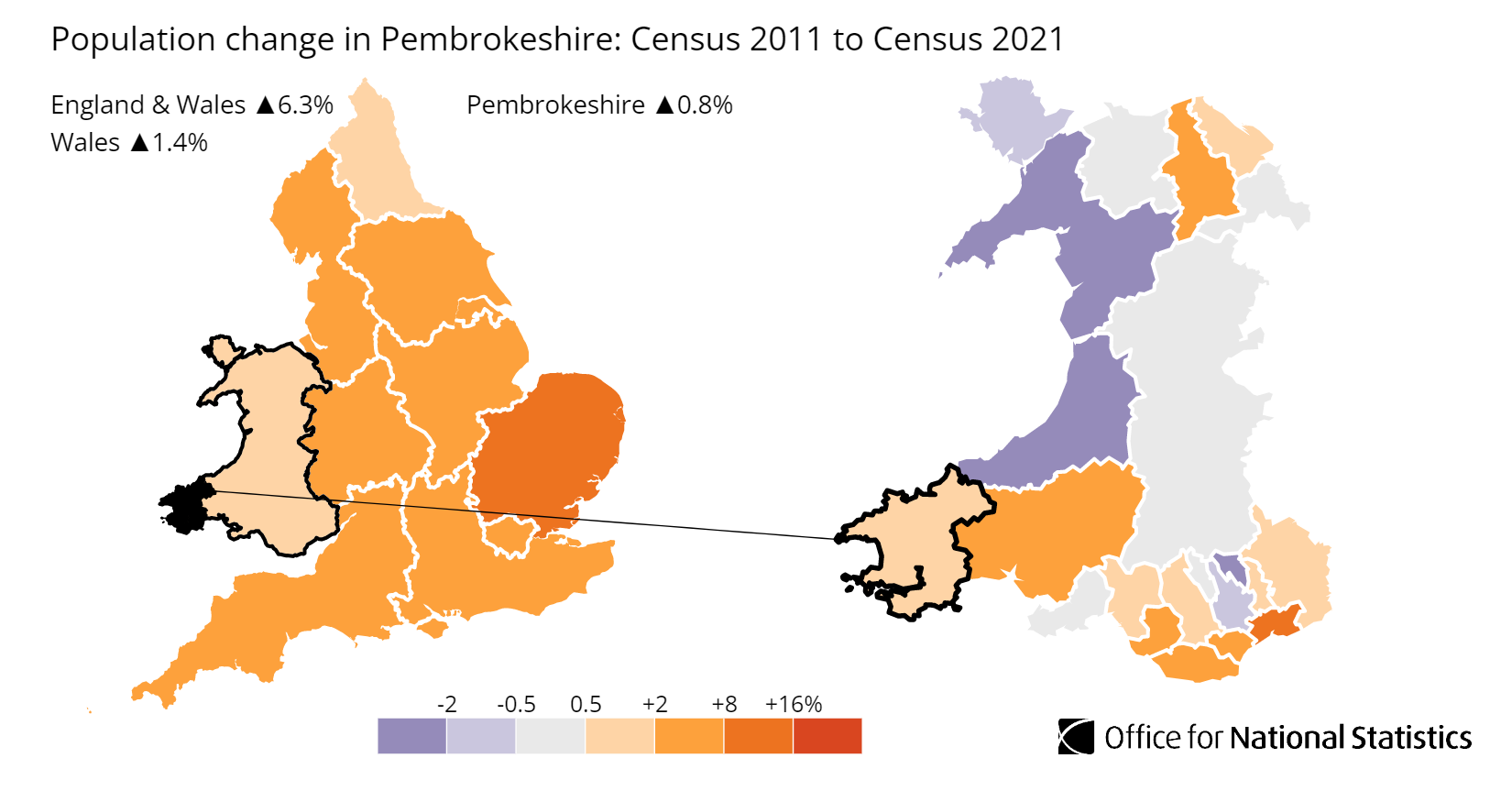
Pembrokeshire, the local authority St Davids sits within, grew its population just 0.75% between the 2011 and 2021 censuses, from 122,439 to 123,360 residents. That is far below the 6.3% England and Wales average, the near-flat profile of a rural county at the far western edge of the country, and it points to a settled resident base rather than a wave of incoming demand. St Davids itself is tiny within that total, a cathedral city of about 1,800 people that regained city status in 1994, so its rental market is a niche within the wider Pembrokeshire coast rather than a market in its own right.
The local economy leans on tourism, agriculture, the energy sector around Milford Haven and public services rather than a broad urban jobs base. St Davids anchors the western end of the Pembrokeshire Coast National Park, and its draw for visitors is exactly what makes it a tricky buy-to-let: the cathedral, the coast path and the beaches pull holiday demand, which pushes owners toward short-let and second-home use rather than the year-round tenancies that produce a standard rental yield. What the peninsula does not have is a university or a single large employer, so long-term rental demand is thinner and more seasonal than in a city like Swansea or Cardiff.
Median gross annual earnings across Pembrokeshire are £36,438, which is almost exactly level with the Wales median of £36,353 but 6.9% below the Great Britain median of £39,125. Local wages here are close to the Welsh average rather than especially low, but they still cap how far open-market rents can stretch against second-home-inflated prices. Set against Pembrokeshire's mix-flattered average, that ordinary wage base is a large part of why the yields here are modest: buyers are competing with holiday-home money on price, while rents answer to local incomes.
Pembrokeshire Economic Summary
- Population (Pembrokeshire): 123,360 (2021 Census). Growth of 0.75% from 2011.
- Median annual salary: £36,438 (local), £36,353 (Wales), £39,125 (Great Britain)
- Employment rate: 76.6% (local), 75.6% (Great Britain)
- Key employment sectors: Tourism and hospitality, agriculture, energy and petrochemicals, human health and social work, public administration
Source: ONS Census 2021, Nomis Labour Market Profile (ASHE 2025)
Regeneration and Investment in St Davids
The largest investment signal in this corner of Wales is the £8.4 billion Celtic Freeport centred on Milford Haven, about twenty miles south of St Davids. St Davids itself is too small and too tightly protected by the national park to attract headline schemes, so the regeneration story for an investor here is a county one, concentrated at Milford Haven and the market town of Haverfordwest that anchors the SA61 postcode.
- Celtic Freeport (Active, £8.4 billion projected): A green investment corridor spanning the ports of Milford Haven in Pembrokeshire and Port Talbot, given the government green light in March 2023 and targeting floating offshore wind, hydrogen and cleaner industry across South-West Wales. It is projected to draw £8.4 billion of inward investment and create around 11,500 jobs across the region. For a small county like Pembrokeshire the value is the wider economic pull along the M4 and A40 rather than a single local scheme. Updates at Celtic Freeport.
- Western Quayside, Haverfordwest (Complete): The former Ocky White department store on the Haverfordwest riverside has been rebuilt as Western Quayside, a three-storey food emporium, restaurant and rooftop terrace funded through Welsh Government Transforming Towns and county capital, with a final foundry element completing in early 2026. It sits in the SA61 postcode that carries the only measurable rental yield in this guide, and a stronger Haverfordwest town centre supports the inland rental market that does the income work here. Updates at Western Quayside, Haverfordwest.
- Haverfordwest Public Transport Interchange (Under construction): A new bus station with seven bays and a roughly 320-space multi-storey car park, funded through the Welsh Government Local Transport Fund as part of the Swansea Bay and West Wales Metro, is being built in Haverfordwest across an eighteen-month to two-year programme. Better transport into the SA61 town centre supports the same inland rental catchment that carries this guide's yield. Updates at Haverfordwest Public Transport Interchange.
Source: Office for National Statistics - Population for Pembrokeshire
St Davids Property Market Analysis
Average property prices in Pembrokeshire have risen 406.6% since January 1995, from £43,104 to £218,377. Because St Davids's own sales are too few to index reliably, the market analysis below is measured at the Pembrokeshire county level, then drills down to the SA61, SA62 and SA64 postcodes for asking prices, growth, transaction volumes and rental data.
When was the last house price crash in St Davids?
St Davids sits within the unitary authority of Pembrokeshire, so all sold property prices from HM Land Registry are recorded at that level. The Land Registry House Price Index tracks the Pembrokeshire average from January 1995 to March 2026, covering 31 years of market cycles across the whole county and coast.
The 1995 to 2007 boom: Pembrokeshire started at £43,104 in January 1995. By December 2000, prices had reached £58,700, and growth then ran hard through the early 2000s as second-home and holiday demand poured into the coast, reaching £144,924 by March 2006. The market peaked at £172,321 in November 2007, a fourfold rise on the 1995 base in a little over a decade.
2008 to 2013, a long, shallow crash: Prices fell from the November 2007 peak of £172,321 to a trough of £136,502 in May 2013, a decline of 20.8% spread over more than five years. The worst year-on-year reading was -13.8% in April 2009. Like much of coastal Wales, Pembrokeshire had little in the way of a broad local jobs base to cushion the fall, and prices ground sideways at the bottom for years rather than bouncing.
Recovery, 2013 to 2020: Getting back to par took the best part of a decade. Prices did not clear the November 2007 peak of £172,321 until September 2020, at £178,124, almost thirteen years after the top. That thirteen-year round trip is the single most important fact in the Pembrokeshire cycle: a remote coastal county can hold an investor underwater for a very long time after a downturn.
2020 to 2022, the pandemic surge: The stamp duty holiday and a national rush for coast and countryside lifted the county sharply. Prices moved from £178,124 in September 2020 to £204,384 by December 2021, and reached an all-time high of £227,734 in October 2022 as buyers paid up for space, sea air and second homes.
2023 to present: Higher mortgage rates and the second-home council tax premium cooled the market. Prices eased to £216,151 by December 2023, recovered to £220,928 by December 2024, and have since drifted to £218,377 by the latest reading in March 2026. The current price is 26.7% above the 2007 pre-crash peak and 4.1% below the October 2022 high.
Long-term growth summary:
- 5 years (March 2021 to March 2026): 20.0% growth (£181,986 to £218,377)
- 10 years (March 2016 to March 2026): 43.0% growth (£152,721 to £218,377)
- 15 years (March 2011 to March 2026): 44.6% growth (£151,043 to £218,377)
- 20 years (March 2006 to March 2026): 50.7% growth (£144,924 to £218,377)
- 30 years (January 1995 to March 2026): 406.6% growth (£43,104 to £218,377)
Pembrokeshire's 20.8% crash was deeper than the Welsh average, and its near-thirteen-year recovery was among the slowest of any market we cover. A headline 30-year return of 406.6% sounds handsome, but almost all of it was earned in two bursts, before 2007 and after 2020, with a lost decade wedged in the middle. Someone who bought at the exact November 2007 top waited thirteen years just to get their money back, and only now sits on a 26.7% gain against the Land Registry average, which is why the entry point matters more here than the long-run number.
- All property types
- Detached
- Semi-detached
- Terraced
- Flats
- All property types
- Detached
- Semi-detached
- Terraced
- Flats
Sold House Prices in Pembrokeshire
The average sold price across all property types in Pembrokeshire is £218,377, which is 2.4% above the Wales average of £213,240 as of March 2026. That headline flatters the county, because the picture reverses the moment the average is split by type: every single property type sells below the Wales figure, and the county only lands on top because so much of its stock is detached, the dearest type of all. This is what a cheaper market with an expensive house mix looks like on the index.
| Property Type | Pembrokeshire Average | Wales Average | Difference |
|---|---|---|---|
| Detached houses | £317,242 | £334,744 | -5.2% |
| Semi-detached houses | £199,411 | £212,913 | -6.3% |
| Terraced houses | £167,976 | £170,907 | -1.7% |
| Flats and maisonettes | £114,639 | £126,165 | -9.1% |
| All property types | £218,377 | £213,240 | 2.4% |
Detached houses at £317,242 sit 5.2% below the Wales average of £334,744, and they are the backbone of this market: detached stock makes up around two-thirds of the housing across the SA62 and SA64 coastal postcodes and drives the whole county's above-average headline. Annual growth was flat at -0.1%, in keeping with the recent easing off the 2022 high.
Semi-detached houses at £199,411 are 6.3% below the Wales average of £212,913 and posted the only positive annual growth of any type at 0.3%. These are the mid-market family homes spread through Haverfordwest, Fishguard and the larger villages, and they are where most local owner-occupier demand concentrates rather than holiday money.
Terraced houses at £167,976 are 1.7% below the Wales average of £170,907, the narrowest discount of any type. The terraced stock is concentrated in the older cores of Haverfordwest and Fishguard rather than in St Davids itself, and with -0.4% annual growth it is the affordable, income-friendly end of the county: the type most likely to sit inside a working buy-to-let budget.
Flats and maisonettes at £114,639 show the deepest discount at 9.1% below the Wales average of £126,165, and they are the type falling fastest, down 5.5% over the year. Pembrokeshire's flat stock is thin and mostly in Haverfordwest and the coastal towns, where small blocks and conversions make up the cheapest way into the county. A £114,639 flat that is losing value and hard to sell on is a trap dressed as a bargain, and the falling flat price here is a warning that cheap does not equal a working investment.
Price Per Square Foot in St Davids
Price per square foot runs from £185 in SA61 to £233 in SA62, a £48 gap across the three postcodes. Pricing by the square foot controls for how big the homes are, so it compares the locations against each other rather than the house types. SA62, the St Davids and Broad Haven area, commands the top rate, reflecting the coastal-national-park setting and the second-home premium, while inland SA61 around Haverfordwest sits at the value end.
| Rank | Area | Price Per Sq Ft |
|---|---|---|
| 1 | SA61 (Haverfordwest) | £185 |
| 2 | SA64 (Fishguard, Goodwick) | £198 |
| 3 | SA62 (St Davids, Broad Haven) | £233 |
SA61 at £185 per square foot is the cheapest space in the county, covering Haverfordwest, where a denser mix of terraced and market-town stock keeps the bricks-and-mortar rate down. Haverfordwest keeps turning up at the cheap end of every table in this guide, and it is no coincidence: the same market-town stock that makes it the best-value space is also what gives it the only measurable yield. SA64 around Fishguard sits close behind at £198.
SA62 at £233 per square foot tops the table, around 26% above SA61. When buyers pay that much more per square foot here, they are paying for the St Davids and Broad Haven coastal setting rather than for extra space, which is exactly what the per-square-foot measure is built to isolate. It confirms the St Davids postcode as the priciest, and thinnest, of the three markets.
For Sale Asking Prices in St Davids
SA61 at £212,127 and SA62 at £369,449 sit 74.2% apart across the three postcodes. The hierarchy follows the per-square-foot picture: inland Haverfordwest stock at the bottom, the St Davids coastal market at the top. Averaged across the three, the guide's mean asking price lands at £291,875, pulled well up by the coast.
| Rank | Area | Asking Price |
|---|---|---|
| 1 | SA61 (Haverfordwest) | £212,127 |
| 2 | SA64 (Fishguard, Goodwick) | £294,050 |
| 3 | SA62 (St Davids, Broad Haven) | £369,449 |
SA61 at £212,127 is the cheapest postcode and the only one whose asking price sits close to the Pembrokeshire-wide Land Registry sold average of £218,377. It is no accident that the postcode offering the most house for the money is also the one where a rent actually produces a yield, and it is why every table in this guide keeps circling back to Haverfordwest.
SA62 at £369,449 is the St Davids postcode itself, and at nearly 1.75 times the SA61 figure it is by far the dearest of the three. The city's stock is dominated by detached and coastal homes bought by second-home owners and holiday-let operators rather than let out on standard tenancies, and with around twelve sales a month it is a small, slow market. For a buyer, that combination of a high asking price and no rental data makes SA62 a capital, lifestyle or holiday-let purchase rather than a standard income one.
House Price Growth in St Davids
Five-year growth ranges from 19.9% in SA64 down to 9.0% in SA62, with inland SA61 at 14.2%, but the shorter windows have all turned negative. With SA64 recording just two sales a month and SA62 twelve on a large stock base, a single high-value coastal sale can throw these percentages around, so read them as a direction rather than a precise number. The one and three-year columns show the recent cooling: SA62 has given back the most ground over three years, while SA64 alone is barely positive over the last twelve months.
| Area | 1 Year | 3 Years | 5 Years |
|---|---|---|---|
| SA64 (Fishguard, Goodwick) | 0.3% | 25.7% | 19.9% |
| SA61 (Haverfordwest) | -3.5% | -1.6% | 14.2% |
| SA62 (St Davids, Broad Haven) | -1.6% | -11.3% | 9.0% |
SA64 around Fishguard leads across every window, pairing 19.9% over five years with a positive one-year reading, though on just two sales a month those figures ride on a handful of transactions and should be read with caution. SA61 at Haverfordwest holds the middle at 14.2% over five years off the deepest sales base, but its negative one and three-year readings show the recent slowdown reaching the county's busiest market.
SA62 at St Davids sits at the bottom on growth, up 9.0% over five years but down 11.3% over three, the sharpest medium-term fall of the three. It is a thin, detached and coastal market where a few high-value second-home sales can swing the average hard in either direction, and the three-year drop is the clearest sign of the post-2022 cooling working through the priciest peninsula stock.
Monthly Property Sales in St Davids
Transaction volumes range from 2 sales a month in SA64 to 13 in SA61, with turnover rates from 4% to 15%. Haverfordwest is where the market actually moves: SA61 alone accounts for the bulk of the sales across the three postcodes, while the St Davids and Fishguard markets are quiet by comparison.
| Area | Sales Per Month | Turnover | Asking Price |
|---|---|---|---|
| SA61 (Haverfordwest) | 13 | 15% | £212,127 |
| SA62 (St Davids, Broad Haven) | 12 | 4% | £369,449 |
| SA64 (Fishguard, Goodwick) | 2 | 6% | £294,050 |
SA61 is the busiest market at 13 sales a month and the highest turnover at 15%, the Haverfordwest postcode where a deep pool of mid-priced stock changes hands regularly. A 15% turnover means roughly one home in seven trades hands each year, so a Haverfordwest landlord who wants to exit has a genuine queue of buyers, which is not something the coastal postcodes can offer at four and six per cent.
SA62 at St Davids records a similar twelve sales a month, but on a far larger stock base its turnover is just 4%, so proportionally very little of the market changes hands in any given month. SA64 around Fishguard is the quietest of all at two sales a month, a handful of transactions across the whole postcode, which makes both its price and growth readings the least reliable of the three.
How Long Properties Take to Sell in St Davids
SA61 clears in about 277 days while SA62 sits on the market for roughly 1,014, close to three years, in a genuine buyer's market. A property that averages nearly three years to sell is the clearest number in this whole guide: the days-to-sell figure counts how long a typical sale takes, and 1,014 days is the kind of wait that quietly eats years of rent on a coastal second home. Haverfordwest's 277 days looks brisk only against that.
| Area | Avg Days to Sell | Months of Unsold Stock | Market |
|---|---|---|---|
| SA61 (Haverfordwest) | 277 | 9.1 | Balanced market |
| SA64 (Fishguard, Goodwick) | 435 | 14.3 | Buyer's market |
| SA62 (St Davids, Broad Haven) | 1,014 | 33.3 | Buyer's market |
SA61's 9.1 months of unsold stock means a Haverfordwest property finds a buyer far quicker than on the coast, where SA62's 33.3-month figure points to a market with years of supply queued at the current sales rate. That difference reinforces the pattern running through the guide: SA61 leads on liquidity as well as on yield, while SA62 and SA64 ask a buyer to accept a long wait both to buy well and to sell on, which is a serious consideration in a coastal second-home market.
What Type of Property Can You Buy in St Davids?
Detached homes dominate the coastal postcodes, at 67.4% of stock in SA64 and 66.2% in SA62, while inland SA61 around Haverfordwest has the most varied mix and the only meaningful flat and terraced share. A postcode that is two-thirds detached houses simply does not hold the smaller, lettable units a standard buy-to-let needs, which is the structural reason the coast produces no yield. Each postcode's housing breakdown below comes from the 2021 Census.
| Area | Detached | Semi-detached | Terraced | Flats |
|---|---|---|---|---|
| SA64 (Fishguard, Goodwick) | 67.4% | 26.1% | 4.7% | 1.3% |
| SA62 (St Davids, Broad Haven) | 66.2% | 22.3% | 5.8% | 2.8% |
| SA61 (Haverfordwest) | 45.9% | 30.1% | 13.8% | 8.6% |
SA64 around Fishguard and SA62 around St Davids are the most detached-dominated postcodes at 67.4% and 66.2%, with terraced and flat stock together under 10% in each. These are coastal and rural family houses, many of them second homes, rather than the smaller units that generate rental income, which is a large part of why the coastal postcodes carry no reliable rent or yield data.
SA61 around Haverfordwest breaks the pattern, and it is the one postcode whose stock suits letting: detached homes fall to 45.9% while terraced houses reach 13.8% and flats 8.6%, the highest small-unit share of the three. Terraces and flats in a working market town are exactly the homes tenants rent, so it is no surprise the same postcode also holds the lowest price, the busiest market and the guide's only yield.
The flats figure combines purpose-built and converted units, and a small share of non-standard dwellings is left out, so the rows may not add up to 100%.
St Davids Rental Market Analysis
Only one of the three postcodes, SA61 around Haverfordwest, carries enough rental listings to publish a reliable rent and yield: about £669 a month for a 3.8% gross yield. For investors asking is buy to let worth it around St Davids, the honest answer is that the year-round income case sits inland at Haverfordwest, not in the coastal city. If you are weighing how to build a property portfolio in West Wales, this is a market to enter with modest yield expectations. Browse current buy-to-let investments for sale across the region.
Average Rent & Gross Rental Yields in St Davids
SA61 is the only postcode with a measurable gross yield, at 3.8% on a £212,127 asking price and roughly £669 a month. The coastal St Davids and Fishguard postcodes carry too few long-term rental listings at any one time to publish a reliable figure, so they are shown for completeness without a yield. That gap is itself the finding: the standard rental market in this part of Pembrokeshire is an inland one, because the coast leans toward holiday lets.
| Area | Average Monthly Rent | Asking Price | Gross Yield |
|---|---|---|---|
| SA61 (Haverfordwest) | £669 | £212,127 | 3.8% |
| SA62 (St Davids, Broad Haven) | Not enough data | £369,449 | Not enough data |
| SA64 (Fishguard, Goodwick) | Not enough data | £294,050 | Not enough data |
The 3.8% in SA61 comes from the lowest asking price in the guide meeting a £669 monthly rent out of the Haverfordwest lettings pool. Measured against Swansea or Cardiff that is a thin return, held down by two things at once: a local wage that caps what rents can reach, and coastal second-home money that keeps pushing prices up regardless. At £63,638, the 30% deposit for SA61 is the entry ticket to the one Pembrokeshire postcode in this guide where rent actually covers a return.
SA62 and SA64 show no yield not because the rent is low but because there are too few homes let on standard tenancies to read the market with any confidence. Both are detached, coastal postcodes where much of the lettings activity is seasonal and holiday-driven, so an investor buying in St Davids or Fishguard for year-round rental income would be doing so without the reassurance of comparable local rents.
Is St Davids Rent High?
In SA61, the one postcode with rental data, a typical rent consumes about 22.0% of the local median gross monthly salary, comfortably inside the usual 30% affordability threshold. Housing is generally counted affordable at up to 30% of gross income, and a Haverfordwest rent taking barely over a fifth of the local wage leaves real slack. That slack fits a county where rents answer to ordinary local pay, while the coastal St Davids and Fishguard postcodes carry too little standard rental data to place on the scale.
The median gross weekly salary across Pembrokeshire is £700.70, which equates to £3,036 per month or £36,438 per year. This is almost exactly level with the Wales median of £36,353 and 6.9% below the Great Britain figure of £39,125 a year. Data from the Nomis Labour Market Profile (ASHE 2025).
| Rank | Area | Rent as % of Income |
|---|---|---|
| 1 | SA61 (Haverfordwest) | 22.0% |
| - | SA62 (St Davids, Broad Haven) | Not enough data |
| - | SA64 (Fishguard, Goodwick) | Not enough data |
SA61 at 22.0% is well within reach for a tenant on the local median salary, and a tenant who is not stretched is a tenant who tends to stay and pay, which is worth more to a small landlord than a headline yield. It also shows there is some headroom left in Haverfordwest rents, though the modest 3.8% yield tells you the ceiling on returns here comes from the price the coast has pushed up, not from the rent. The St Davids and Fishguard postcodes cannot be scored on affordability because their standard rental listings are too thin to produce a reliable rent.
How Big Is St Davids's Private Rented Sector?
The private rented sector is largest inland in SA61 at 17.4% of households and on the north coast in SA64 at 17.1%, and thinnest in the St Davids postcode SA62 at 14.8%. The privately-rented proportion tells you how deep and how tested the local tenant pool is, and in Pembrokeshire it lines up almost exactly with where a working yield exists. Household tenure by postcode is set out below.
| Area | Owned Outright | Owned with Mortgage | Private Rented | Social Rented |
|---|---|---|---|---|
| SA61 (Haverfordwest) | 48.4% | 23.8% | 17.4% | 10.0% |
| SA64 (Fishguard, Goodwick) | 60.5% | 17.5% | 17.1% | 4.8% |
| SA62 (St Davids, Broad Haven) | 54.5% | 23.2% | 14.8% | 7.0% |
SA61 has the largest private rented sector at 17.4% and also the largest social rented share at 10.0%, the profile of a working market town with a genuine year-round tenant base rather than a holiday economy. That deeper, more conventional tenant pool is the reason SA61 is the one postcode with a workable yield.
SA64 around Fishguard records a similar 17.1% privately rented, but sits on the largest owned-outright base of the three at 60.5%, the settled profile of a north-coast town where most homes are lived in rather than let. SA62 at St Davids has the smallest private rented share at 14.8%, consistent with a coastal city where a large slice of the housing is second homes and holiday lets rather than either owner-occupation or standard tenancies, which is why it produces no reliable long-term yield.
Local Housing Allowance Rates in St Davids
All three postcodes fall within the Pembrokeshire Broad Rental Market Area, where Local Housing Allowance runs from £68.45 a week for a shared room to £161.10 a week for a four-bedroom home. Local Housing Allowance is the ceiling on the housing benefit a tenant can receive, so for that part of the market it works as an effective rent floor for a landlord. The rates below cover the Pembrokeshire area; to check the rate for a specific address, you can use the government's official Local Housing Allowance calculator.
| Property Size | Weekly LHA Rate | Monthly Equivalent |
|---|---|---|
| Shared accommodation | £68.45 | £297 |
| 1 bedroom | £82.85 | £359 |
| 2 bedrooms | £105.86 | £459 |
| 3 bedrooms | £132.33 | £573 |
| 4 bedrooms | £161.10 | £698 |
At £105.86 a week, the two-bedroom Pembrokeshire rate comes to about £459 a month, a fair way under the roughly £669 open-market rent in SA61. So a benefit-supported let pays less than a private one, but it pays reliably, and the homes that fit the LHA figure cluster in the cheaper Haverfordwest terraces and flats. Inland, where much of the county's benefit-backed demand sits, that guaranteed floor is a real part of the income story, in a way it never is on the second-home coast.
Buy-to-Let Considerations
Are House Prices High in St Davids? Price-to-Earnings Ratios
Purchasing a property across these postcodes requires between 5.8 and 10.1 times the median annual salary. This is based on the Nomis Labour Market Profile for Pembrokeshire showing the median gross annual income for local residents is £36,438.
The national benchmark for price-to-earnings is 5.5x (the Wales average sold price of £213,240 divided by the Great Britain median annual salary of £39,125). All three postcodes sit above that benchmark, meaning property here is less affordable relative to local incomes than the Wales average is relative to national incomes, and on the coast that gap comes from second-home demand pushing prices past what local wages support.
| Rank | Area | Price-to-Earnings Ratio |
|---|---|---|
| 1 | SA61 (Haverfordwest) | 5.8x |
| 2 | SA64 (Fishguard, Goodwick) | 8.1x |
| 3 | SA62 (St Davids, Broad Haven) | 10.1x |
SA61 at 5.8x is the most affordable entry against local earnings, only a fraction above the 5.5x Wales benchmark, so Haverfordwest property costs local buyers roughly what the average Welsh home costs the average British earner. Once again the lowest ratio, the lowest price and the only working yield all land in the same postcode, which is why every road in this guide keeps leading back to SA61 for income.
SA62 at 10.1x is the least affordable, with the St Davids postcode asking more than ten times the local median salary. That ratio is the warning behind the city's high asking price and absent standard rental data: it is priced for second-home buyers and holiday-let operators who bring income from elsewhere, not for a local year-round rental return.
Deposit Requirements in St Davids
A 30% deposit across these postcodes ranges from £63,638 in SA61 to £110,835 in SA62. The gap between the cheapest and most expensive deposit is £47,197, which mirrors the wider point that Haverfordwest is the affordable, income-friendly entry and the St Davids coast the pricier one.
The deposit is only the first cheque. A Welsh buy-to-let purchase also carries Land Transaction Tax at the higher residential rates, which start at 5% up to £180,000 and rise through 8.5% and 10% on the portions above, so on a mid-priced SA61 home the tax alone runs to several thousand pounds; the Wales LTT calculator sizes it precisely, and it sits alongside the other costs of buy-to-let in the total capital needed.
| Rank | Area | 30% Deposit Required |
|---|---|---|
| 1 | SA61 (Haverfordwest) | £63,638 |
| 2 | SA64 (Fishguard, Goodwick) | £88,215 |
| 3 | SA62 (St Davids, Broad Haven) | £110,835 |
At £63,638, the SA61 deposit is not just the smallest of the three but the only one attached to a working yield and a market that actually moves. Put the same 30% down on the coast and it buys a slower, income-thin asset; put it in Haverfordwest and it buys the one Pembrokeshire postcode that behaves like a buy-to-let.
At the other end, SA62 demands £110,835 for a St Davids property with no standard rental data and a market that takes close to three years to sell. That capital buys a detached or coastal home in the smallest city in the country with genuine holiday-let and lifestyle appeal, but as a year-round rental proposition it is untested locally, which is a poor pairing of a high entry cost with an unproven income.

What the St Davids Data Tells Buy-to-Let Investors
The year-round income case around St Davids is an inland one, and it sits in SA61 at Haverfordwest rather than in the coastal city itself. SA61, covering Haverfordwest, has the lowest asking price at £212,127, the only measurable gross yield at 3.8%, the busiest resale market at 13 sales a month, the fastest sale at about 277 days, and the most affordable price-to-earnings ratio at 5.8x. Put £63,638 down as the 30% deposit and the home behind it rents at roughly £669 a month. For an investor buying for an investment property in St Davids and the wider Pembrokeshire coast, Haverfordwest is the postcode where the tables stop contradicting each other.
SA62 and SA64, the St Davids and Fishguard postcodes, tell a different story. Both are detached-dominated, coastal markets with high asking prices, slow sales and no reliable standard rental data, and SA62 in particular takes close to three years to sell. It carries the highest deposit at £110,835 and the highest price-to-earnings ratio at 10.1x for a property with no local long-term rental comparables at all. These are places to buy a home, a holiday let or a capital hold rather than a standard year-round yield.
Wales does not run England-style selective licensing at all; a landlord in Pembrokeshire instead registers with, and where self-managing licenses through, Rent Smart Wales, the national scheme that covers the whole country. Pull the threads together and St Davids is a modest-yield, income-thin market: a mix-flattered average price, ordinary local wages, a deep and slow post-2007 crash, and a standard rental market that lives inland at Haverfordwest rather than in the city that gives the guide its name. In a coastal market this slow, the sharpest discounts rarely reach the portals at all, so investors chasing a keener price tend to work the off-market property in St Davids route before a home is openly listed.
How St Davids Compares
St Davids's mean asking price of £291,875 is the highest of five Welsh markets compared here, while its top yield of 3.8% is the lowest in the group. The table below sets St Davids against four other Welsh markets, each with a different investor profile. Mean asking price and mean monthly rent are averaged across every postcode with data in each place, and the top gross yield is that location's single strongest postcode.
| Location | Mean Asking Price | Mean Monthly Rent | Mean Gross Yield | Top Yield (postcode) |
|---|---|---|---|---|
| Bangor | £273,052 | £921 | 4.0% | 4.8% (LL57) |
| St Asaph | £274,815 | £747 | 3.3% | 4.2% (LL18) |
| Newport | £276,613 | £1,012 | 4.4% | 5.1% (NP11, NP19) |
| St Davids | £291,875 | £669 | 2.8% | 3.8% (SA61) |
| Cardiff | £316,904 | £1,202 | 4.6% | 7.3% (CF10) |
St Davids has both the highest mean asking price and the lowest top yield of the four cheaper markets in the group, sitting only behind Cardiff on price. That combination is the whole story: the coastal peninsula and the second-home premium push the average price up, while the modest £669 SA61 rent keeps the yield down. Neighbouring Bangor and St Asaph both pair lower prices with higher yields, and Newport and Cardiff, on far deeper south Wales rental demand, clear St Davids on income comfortably.
For investors weighing the alternatives, Bangor brings a university rental market that St Davids entirely lacks, St Asaph offers a similar small-market North Wales foothold at a lower entry, and Newport and Cardiff along the M4 pair higher yields with rental demand St Davids cannot match. St Davids's case is the narrowest of the group: a small, low-yield market where the standard income sits only inland at Haverfordwest, best suited to a buyer who wants a Pembrokeshire coast foothold, a holiday let, or a long capital hold rather than a headline return. For a data-led view across every UK market, see our guide to the best places to invest in buy-to-let.
Frequently Asked Questions
Is St Davids a good place to invest in property?
The data points inland rather than to the coast. SA61 around Haverfordwest is the only postcode with a measurable yield, at 3.8% on a £212,127 asking price, and it has the busiest resale market and the most affordable 5.8x price-to-earnings ratio of the three. The St Davids postcode SA62 itself averages £369,449, produces no reliable standard rental figure, and takes close to three years to sell, so it reads as a lifestyle, holiday-let or capital purchase rather than a standard income one. Across Pembrokeshire prices have risen 20.0% over five years, though the peninsula's second-home premium sits above what local wages support.
What are the best areas in St Davids for property investment?
Haverfordwest, in the SA61 postcode, is the clear pick for a standard rental return and the only area with a working yield, at 3.8% on the lowest asking price of £212,127, the busiest market at 13 sales a month, and the fastest sale at around 277 days. The coastal SA62 (St Davids and Broad Haven) and SA64 (Fishguard and Goodwick) postcodes carry the highest prices and no reliable long-term rental data, so they suit a capital hold or a holiday let rather than a conventional buy-to-let. If yield is the priority, Haverfordwest is where the numbers hold together.
What are average house prices in St Davids?
Across Pembrokeshire, the local authority St Davids sits within, the average sold price is £218,377 on the Land Registry index, which is 2.4% above the Wales average of £213,240. By type, detached houses average £317,242, semi-detached £199,411, terraced £167,976 and flats £114,639, and every one of those sits below the Wales figure, so the county only clears the national average because so much of its stock is detached. On the ground, asking prices run from £212,127 in SA61 up to £369,449 in the SA62 St Davids postcode.
What are the rental yields like in St Davids?
Only the Haverfordwest market has enough long-term rental listings to publish a reliable figure, and it comes in at 3.8% gross on a £669 monthly rent in SA61. The coastal SA62 and SA64 postcodes, covering St Davids, Broad Haven and Fishguard, show no reliable yield because much of their lettings activity is seasonal and holiday-driven rather than year-round. That 3.8% is modest by Welsh standards, below Bangor at 4.8%, Newport at 5.1% and Cardiff at 7.3%, and it reflects a coast where second-home money lifts prices faster than rents.
What type of property is most common in St Davids?
Detached houses dominate, especially on the coast: they make up 67.4% of stock in SA64 around Fishguard and 66.2% in the SA62 St Davids postcode, with terraced and flat stock together under 10% in each. Inland SA61 around Haverfordwest is the exception and the only postcode with a varied mix, where detached homes fall to 45.9% while terraced houses reach 13.8% and flats 8.6%. That smaller-unit stock in Haverfordwest is the natural buy-to-let pool, which is a large part of why SA61 is the one postcode with a measurable yield.
Does St Davids have holiday-let potential rather than standard letting?
It is the clearest reason the coastal yields do not read on the standard measure. St Davids sits inside the Pembrokeshire Coast National Park with beaches, the cathedral and the coast path drawing year-round visitors, so a large share of the SA62 and SA64 stock is second homes and short-term holiday lets rather than long tenancies. That means the income potential on the coast can be real but is seasonal and management-heavy, and it does not show up in the standard rent-and-yield tables above, which measure conventional lettings. Investors weighing that route can read our guide on buying a holiday let in Wales.
How can I buy a lower-priced investment property in St Davids?
Haverfordwest holds the lowest conventional entry, in SA61, at a £212,127 average asking price, the only postcode near the Pembrokeshire sold average of £218,377 and the only one whose rental maths work. Beyond that, the route to a cheaper purchase is by property type: flats across Pembrokeshire average £114,639 on the Land Registry index and terraced houses £167,976, both well under the county average and concentrated in Haverfordwest and Fishguard. If a lower entry is the target, SA61 terraces and flats are where to look, or explore below market value properties across the region.
How do I buy an investment property in St Davids?
Start by accepting that the standard income case sits inland, not on the coast. For a year-round rental return, SA61 (Haverfordwest) is the only postcode that works, at a £212,127 asking price and a 3.8% yield, with a 30% deposit of £63,638. The coastal SA62 and SA64 postcodes are dearer, slower and short of standard rental data: their record shows price and capital movement alongside a holiday-let market, with no conventional long-term rental return recorded. Budget for a 30% deposit and for Welsh Land Transaction Tax at the higher rates on top, using the Wales LTT calculator to size it. Beyond what is listed openly, experienced investors often buy below asking through off-market property channels, which matter more in a thin market like this. To see what is available now, browse investment property or buy-to-let investments for sale.
Ready to buy property?
Access off-market investment properties with an average 8%+ annual gross yield (beating the UK's typical 3-5%).
Get property alerts