
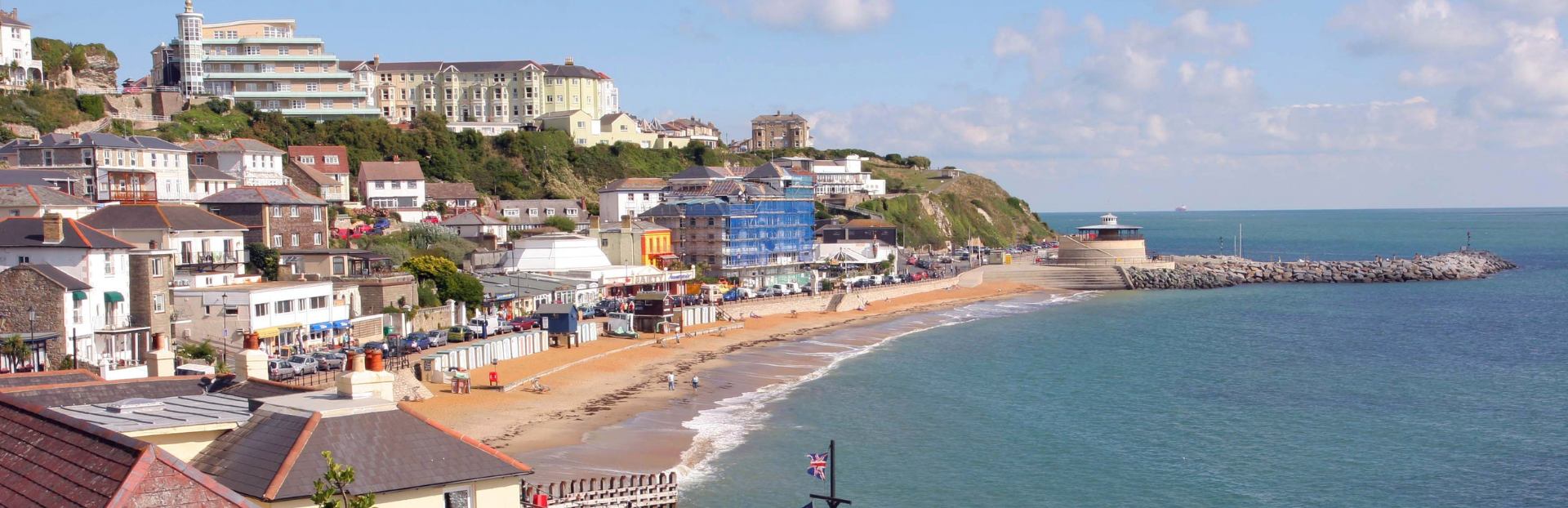
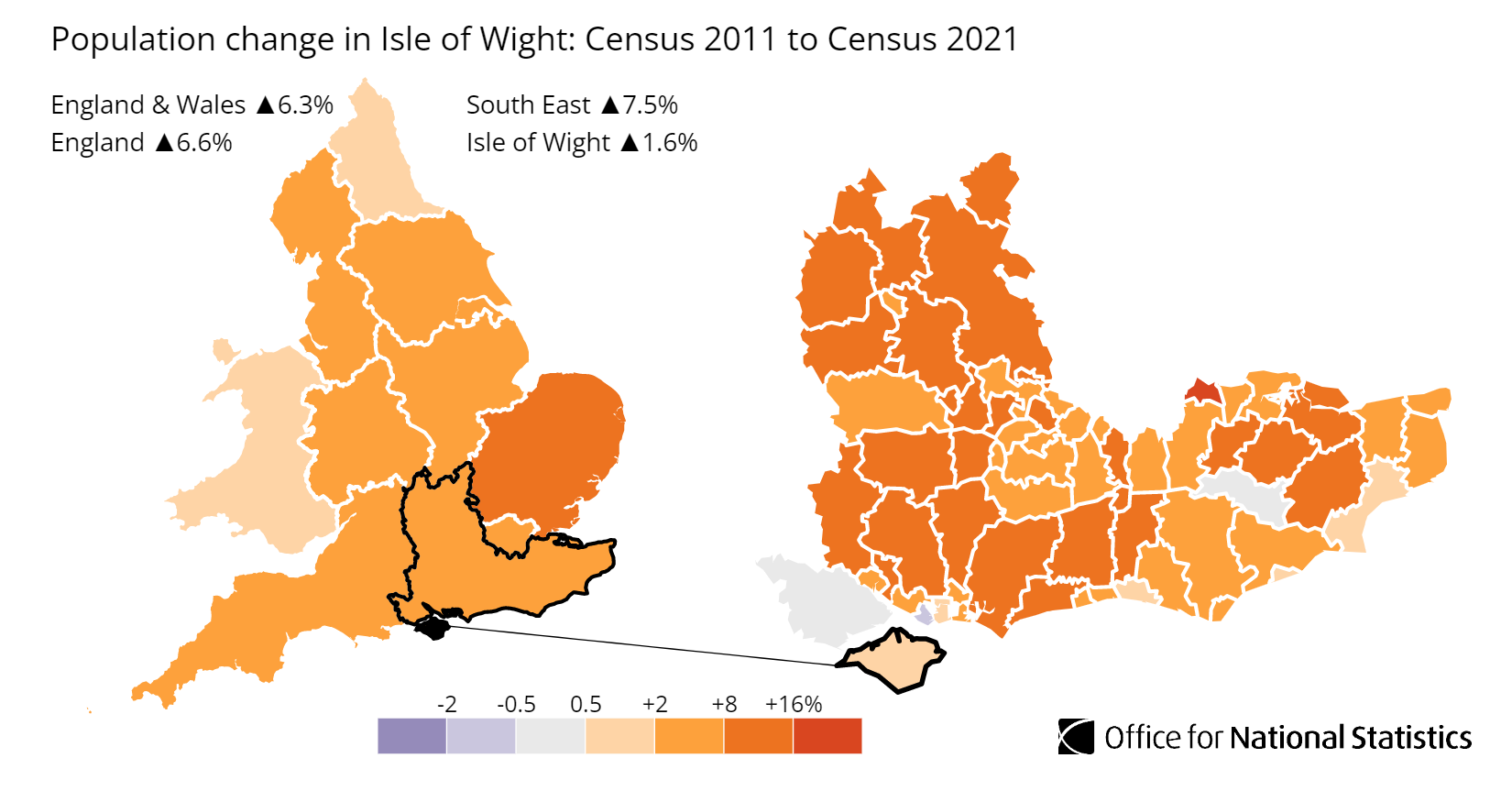
The Isle of Wight is an island off the south coast of England, in the South East region. The average sold price on the Isle of Wight is £240,291 on the HM Land Registry House Price Index, 17.1% below the England average of £289,946 and 36.5% below the South East regional average of £378,515. That double discount is the island's defining feature: it is the cheapest slice of one of England's most expensive regions, and the Solent crossing is the reason. The unitary authority's population grew 1.59% between the 2011 and 2021 censuses, from 138,265 to 140,459 residents.
The island splits into two markets that barely overlap. Four town-centre postcodes (PO32 East Cowes, PO30 Newport, PO33 Ryde, PO36 Sandown) carry asking prices between £237,738 and £289,212 and hold most of the rental activity. The premium coastal postcodes (PO34 Seaview, PO35 Bembridge, PO41 Yarmouth) run above £446,000 and record two to three sales a month, with too little letting volume for a reliable yield. Rental data exists for five of the twelve postcodes; PropertyData cannot produce estimates for the other seven.
This guide covers the unitary authority of the Isle of Wight (ONS code E06000046) across all twelve postcodes from PO30 to PO41. The island sits in the South East region, separated from the Hampshire coast by a short ferry crossing. Investors weighing the wider south coast can also read our guides to Portsmouth and Southampton. For a wider view, browse the best places to invest in buy-to-let across the UK.
Article updated: July 2026
Why Invest on the Isle of Wight?
The Isle of Wight is the only island unitary authority in this guide series, and its housing market runs on its own clock. A population of 140,459 lives across twelve postcode districts, from the administrative centre of Newport (PO30) to premium coastal villages like Seaview (PO34) and Bembridge (PO35). The 1.59% growth between the 2011 and 2021 censuses sits well below the England and Wales average of 6.3%, reflecting an island that adds residents slowly rather than through the churn of a growing city.
The island economy leans on three sectors: health and social work at 20.8% of employee jobs, wholesale and retail at 15.1%, and accommodation and food services at 13.2%. That third figure is the one that shapes the rental market. The Isle of Wight draws over two million visitors a year, and the hospitality workforce behind that tourism needs somewhere to live, alongside the year-round tenant base in Newport and Ryde. The local employment rate of 74.3% sits below the South East average of 78.7%, while the unemployment rate of 3.6% is lower than the Great Britain figure of 4.3%.
Local earnings are the number that explains the island's affordability profile. The median annual salary for Isle of Wight residents is £31,184, against £41,616 for the South East and £39,125 for Great Britain. Tenants earning a fifth less than the mainland average cannot support mainland rents, which is why the island records below-average rents alongside below-average prices. That earnings gap runs through every affordability ratio in this guide.
Isle of Wight Economic Summary
- Population: 140,459 (2021 Census). Growth of 1.59% from 2011.
- Median annual salary: £31,184 (local), £41,616 (South East), £39,125 (Great Britain)
- Employment rate: 74.3% (local), 78.7% (South East), 75.6% (Great Britain)
- Unemployment rate: 3.6% (local), 3.5% (South East), 4.3% (Great Britain)
- Key employment sectors: Health and social work, wholesale and retail, accommodation and food services, education
Source: ONS Census 2021, Nomis Labour Market Profile (ASHE 2025, Employment Oct 2023-Sep 2024)
Regeneration and Investment on the Isle of Wight
Over £35 million in confirmed public funding is directed at the island's two largest towns, Ryde and Newport. The money concentrates on high street renewal, cross-island transport, and heritage buildings rather than large-scale housebuilding, which fits an island where housing supply grows slowly.
- Ryde Long-Term Plan for Towns (Active, £20 million): Ryde is one of 55 towns receiving £20 million over ten years through the government's Long-Term Plan for Towns programme, with funding running from 2026 into the mid-2030s. The Town Board directs the money across high street regeneration, community safety, and transport connectivity in PO33. Updates at OnTheWight.
- Island Green Link (Funded, £13.6 million): Levelling Up Fund Round 3 is funding cross-island sustainable transport, including a bus corridor between Ryde and Yarmouth, the 13-mile West Wight Greenway between Freshwater and Newport, and cycling improvements through Newport town centre. Updates at OnTheWight.
- Newport and Ryde Heritage Action Zones (Delivered, £2.36 million): Historic England's High Streets Heritage Action Zone programme funded shopfront restoration, heritage skills training, and the reuse of empty buildings in both town centres, with £1.4 million for Newport (PO30) and £960,000 for Ryde (PO33). Updates at OnTheWight.
Source: Office for National Statistics - Population for Isle of Wight
Isle of Wight Property Market Analysis
Average prices on the Isle of Wight have risen 448.7% since January 1995, from £43,793 to £240,291. The sections below trace that path cycle by cycle, then drill into current postcode-level data for sold prices, price per square foot, asking prices, growth, and monthly transaction volumes.
When was the last house price crash on the Isle of Wight?
The Isle of Wight is its own unitary authority, so all sold prices from HM Land Registry are recorded at island level. The House Price Index tracks average prices from January 1995 to March 2026, covering 31 years of market cycles.
The 1995 to 2007 boom: The island started at £43,793 in January 1995. Prices roughly doubled to £86,000 by mid-2002 and kept climbing through the credit-fuelled early 2000s, reaching a peak of £181,967 in November 2007. That was a fourfold rise in twelve years, in line with the wider South East.
2008 to 2009, the financial crisis: Prices fell from the November 2007 peak of £181,967 to a trough of £147,185 in March 2009, a decline of 19.1% over sixteen months. The worst year-on-year reading was -14.9% in March 2009. Higher-value coastal markets fell more steeply than lower-priced regions, and the island's exposure to second-home and lifestyle buyers meant its correction ran deeper than England's 18.2% national fall.
The 2010 to 2013 stagnation: Prices bounced off the March 2009 trough but then drifted in a narrow band between £147,000 and £165,000. By December 2010 the average stood at £163,057. The island's recovery lagged the mainland, held back by its distance from the employment centres that pulled other South East markets forward.
Recovery, 2014 to 2016: Growth returned. Prices first climbed back past the November 2007 peak in July 2016, at £182,347. That recovery took seven years and four months from the trough, longer than most mainland South East markets needed.
The 2017 to 2019 pre-pandemic years: Steady appreciation continued, with the average moving up towards £215,000 by the end of 2019 as retirement and lifestyle demand built.
2020 to 2022, the pandemic surge: Remote working turned the island into a lifestyle-relocation target, and prices ran hard. The average rose from £226,347 in December 2020 to an all-time high of £273,014 in December 2022, a 20.6% jump in two years.
2023 to 2026, the correction: Higher mortgage rates cooled island demand faster than the mainland. Prices have eased 12.0% from the December 2022 high of £273,014 to £240,291 by the latest reading in March 2026, with an annual change of -4.3%. The island gave back more of its pandemic gain than most South East markets because more of that gain was lifestyle-driven rather than employment-driven.
Long-term growth summary:
- 5 years (March 2021 to March 2026): 5.4% growth (£228,026 to £240,291)
- 10 years (March 2016 to March 2026): 32.4% growth (£181,544 to £240,291)
- 15 years (March 2011 to March 2026): 47.6% growth (£162,762 to £240,291)
- 20 years (March 2006 to March 2026): 53.3% growth (£156,709 to £240,291)
- 30 years (January 1995 to March 2026): 448.7% growth (£43,793 to £240,291)
The pandemic surge and its unwinding are the story of the island's recent price history. The all-time high of £273,014 in December 2022 still sits 13.6% above today's average, so a buyer who bought at that peak is currently below water on the Land Registry figure. The 5.4% five-year return is the weakest of any window here, reflecting that the March 2021 starting point already sat well into the pandemic run-up.
- All property types
- Detached
- Semi-detached
- Terraced
- Flats
- All property types
- Detached
- Semi-detached
- Terraced
- Flats
Source: HM Land Registry House Price Index for the Isle of Wight, January 1995 to March 2026.
Sold House Prices on the Isle of Wight
The average sold price on the Isle of Wight is £240,291, which is £49,655 (17.1%) below the England average of £289,946. The discount runs wide across property types, from just 6.9% on semi-detached houses to 37.8% on flats.
| Property Type | Isle of Wight Average | England Average | Difference |
|---|---|---|---|
| Detached houses | £381,681 | £470,492 | -18.9% |
| Semi-detached houses | £268,208 | £288,185 | -6.9% |
| Terraced houses | £206,719 | £243,788 | -15.2% |
| Flats and maisonettes | £133,532 | £214,563 | -37.8% |
| All property types | £240,291 | £289,946 | -17.1% |
Detached houses average £381,681, which is 18.9% below England's £470,492. This is the island's premium tier. Detached homes in Bembridge (PO35) and Seaview (PO34) trade well above the island average, while detached stock in Newport and Sandown pulls the figure down. The 18.9% discount is the second-widest on the island, which tells you the coastal premium sits on top of an underlying island discount rather than closing it.
Semi-detached houses average £268,208, just 6.9% below England's £288,185. This is by far the narrowest gap of any property type, and it is where the island tracks the mainland most closely. The semi-detached stock concentrates in the established residential streets of Newport, Ryde, and Cowes, where family-buyer demand keeps prices close to mainland equivalents.
Terraced houses average £206,719, a 15.2% discount to England's £243,788. Victorian terraces in the town centres of Ryde and Newport make up much of this stock, and it is the type most investors target for the local rental market. At just over £200,000, a terraced house on the island sits below the price of a flat in much of the mainland South East.
Flats and maisonettes average £133,532, carrying the largest discount at 37.8% below England's £214,563. The island's flat stock clusters in the eastern resort towns of Sandown, Shanklin, and Ventnor, much of it converted Victorian seafront property or retirement development. Flats are also the one type where the annual change is sharpest, down 8.4% over the past year against the island's -4.3% overall.
Price Per Square Foot on the Isle of Wight
Price per square foot strips out the effect of property size and shows where buyers pay more for each square foot of living space. Isle of Wight prices run from £259/sq ft in PO37 (Shanklin) to £395/sq ft in PO34 (Seaview), a £136 gap between the cheapest and most expensive postcodes.
The table below ranks all twelve postcodes by transaction-based sold price per square foot.
| Rank | Area | Price Per Sq Ft |
|---|---|---|
| 1 | PO37 (Shanklin) | £259 |
| 2 | PO30 (Newport) | £264 |
| 3 | PO36 (Sandown) | £274 |
| 4 | PO32 (East Cowes) | £277 |
| 5 | PO33 (Ryde) | £277 |
| 6 | PO38 (Ventnor) | £297 |
| 7 | PO40 (Freshwater) | £303 |
| 8 | PO39 (Totland Bay) | £316 |
| 9 | PO31 (Cowes) | £317 |
| 10 | PO41 (Yarmouth) | £374 |
| 11 | PO35 (Bembridge) | £386 |
| 12 | PO34 (Seaview) | £395 |
The per-square-foot ranking maps the island's two-tier split cleanly. The town and eastern-resort postcodes where most rental activity sits (PO37 Shanklin, PO30 Newport, PO36 Sandown, PO32 East Cowes, PO33 Ryde) cluster between £259 and £277. The premium coastal postcodes (PO34 Seaview, PO35 Bembridge, PO41 Yarmouth) run between £374 and £395.
The £136 spread is driven by housing stock rather than location alone. The lower postcodes hold more terraces, flats, and ex-council stock, while the coastal top three are dominated by detached houses near sailing, walking, and sea-view amenities, which lifts the price of each square foot regardless of the overall size of the property.
For Sale Asking Prices on the Isle of Wight
What does it actually cost to buy on the island right now? The mean asking price across all twelve postcodes is £341,856, but that headline hides a £242,482 gap between East Cowes and Yarmouth. PO32 (East Cowes) at £237,738 and PO41 (Yarmouth) at £480,220 sit at opposite ends of the island's market. The mean sits well above the £240,291 Land Registry sold price because the premium coastal postcodes, with their large detached homes and slow turnover, pull the average of the current listings upward.
| Rank | Area | Asking Price |
|---|---|---|
| 1 | PO32 (East Cowes) | £237,738 |
| 2 | PO30 (Newport) | £281,164 |
| 3 | PO33 (Ryde) | £284,422 |
| 4 | PO36 (Sandown) | £289,212 |
| 5 | PO37 (Shanklin) | £308,882 |
| 6 | PO40 (Freshwater) | £313,806 |
| 7 | PO38 (Ventnor) | £321,986 |
| 8 | PO31 (Cowes) | £340,059 |
| 9 | PO39 (Totland Bay) | £340,097 |
| 10 | PO34 (Seaview) | £446,524 |
| 11 | PO35 (Bembridge) | £458,160 |
| 12 | PO41 (Yarmouth) | £480,220 |
Four postcodes carry asking prices under £290,000: PO32 (East Cowes), PO30 (Newport), PO33 (Ryde), and PO36 (Sandown). These are the island's most accessible entry points for buy-to-let investments for sale. All four are town-centre postcodes with higher transaction volumes, and three of them (PO30, PO33, PO36) also carry rental data, which makes them the most complete to underwrite.
At the top, PO41 (Yarmouth) at £480,220 and PO35 (Bembridge) at £458,160 sit in a different market. These postcodes record two to three sales a month and produce no rental yield estimate, so they read as second-home and lifestyle-buyer territory rather than a standard buy-to-let proposition.
House Price Growth on the Isle of Wight
Which postcodes held their value through the pandemic surge and the correction that followed? PO34 (Seaview) tops the five-year table at 23.3%, but the three-year column tells the harder story: eight of the twelve postcodes are down over that window.
Three postcodes (PO34, PO39, and PO41) record only two to three sales a month, so their growth figures are drawn from a thin sample and should be read as indicative rather than precise. All twelve are ranked below.
| Area | 1 Year | 3 Years | 5 Years |
|---|---|---|---|
| PO34 (Seaview) | 8.5% | -0.9% | 23.3% |
| PO32 (East Cowes) | 3.7% | -3.3% | 18.5% |
| PO31 (Cowes) | -2.9% | 3.2% | 16.7% |
| PO40 (Freshwater) | 5.7% | -12.4% | 16.0% |
| PO36 (Sandown) | 3.8% | -6.7% | 5.5% |
| PO33 (Ryde) | 2.5% | -1.2% | 4.8% |
| PO41 (Yarmouth) | -8.2% | -13.3% | 3.8% |
| PO30 (Newport) | -6.0% | -5.4% | 0.7% |
| PO35 (Bembridge) | -13.7% | -7.0% | -1.9% |
| PO37 (Shanklin) | -6.8% | -3.3% | -4.0% |
| PO39 (Totland Bay) | -17.3% | -20.7% | -8.5% |
| PO38 (Ventnor) | -14.6% | -14.7% | -13.0% |
The three-year column carries the clearest signal. Only PO31 (Cowes, +3.2%) is up over three years; the other eleven postcodes are flat or down, which confirms the post-pandemic correction is broad-based across the island rather than concentrated in a few areas.
Over five years, only PO35 (Bembridge, -1.9%), PO37 (Shanklin, -4.0%), PO39 (Totland Bay, -8.5%), and PO38 (Ventnor, -13.0%) are in negative territory. PO38 (Ventnor) is the standout drag, down across all three windows, an eastern resort postcode where the pandemic premium has fully unwound. At the other end, the higher five-year readings sit with the coastal and lower-volume postcodes where thin sales make single transactions swing the average.
Monthly Property Sales on the Isle of Wight
The whole island transacts about 144 homes a month across twelve postcodes. Ryde (PO33) and Newport (PO30) account for 63 of those between them, while the four smallest postcodes manage nine combined. Ryde's 32 sales a month reflect its role as the island's largest town and the site of the only train line, which runs to the Portsmouth ferry and gives it the closest mainland link.
| Area | Sales Per Month | Turnover | Asking Price |
|---|---|---|---|
| PO33 (Ryde) | 32 | 6% | £284,422 |
| PO30 (Newport) | 31 | 7% | £281,164 |
| PO31 (Cowes) | 17 | 5% | £340,059 |
| PO36 (Sandown) | 16 | 6% | £289,212 |
| PO38 (Ventnor) | 13 | 5% | £321,986 |
| PO37 (Shanklin) | 11 | 7% | £308,882 |
| PO32 (East Cowes) | 9 | 6% | £237,738 |
| PO40 (Freshwater) | 6 | 6% | £313,806 |
| PO35 (Bembridge) | 3 | 3% | £458,160 |
| PO34 (Seaview) | 2 | 3% | £446,524 |
| PO39 (Totland Bay) | 2 | 3% | £340,097 |
| PO41 (Yarmouth) | 2 | 3% | £480,220 |
The four busiest postcodes (PO33, PO30, PO31, PO36) account for 96 of the island's 144 monthly sales. These are where a buy-to-let investor finds the most liquid resale market and the widest choice of stock. Turnover across the island runs low, between 3% and 7%, which is a feature of a market with a high owner-occupier and second-home share rather than a churning rental base.
At the other end, PO34 (Seaview), PO39 (Totland Bay), and PO41 (Yarmouth) each record two sales a month at a 3% turnover rate. A postcode this thin is slow to buy into and slow to sell out of, and it is the same set of postcodes that produce no reliable rental yield.
How Long Properties Take to Sell on the Isle of Wight
Selling speed on the island runs long everywhere: the busiest postcodes take about 435 days to sell, and the thinnest coastal ones roughly 1,014 days. Days on market is the typical time a home is up for sale before it sells, and months of unsold stock shows how much for-sale supply is sitting there at the current rate of sales. Every island postcode currently reads as a buyer's market.
| Area | Avg Days to Sell | Months of Unsold Stock | Market |
|---|---|---|---|
| PO30 (Newport) | 435 | 14.3 | Buyer's market |
| PO32 (East Cowes) | 435 | 14.3 | Buyer's market |
| PO33 (Ryde) | 435 | 14.3 | Buyer's market |
| PO36 (Sandown) | 435 | 14.3 | Buyer's market |
| PO37 (Shanklin) | 507 | 16.7 | Buyer's market |
| PO40 (Freshwater) | 507 | 16.7 | Buyer's market |
| PO31 (Cowes) | 608 | 20.0 | Buyer's market |
| PO38 (Ventnor) | 761 | 25.0 | Buyer's market |
| PO34 (Seaview) | 1,014 | 33.3 | Buyer's market |
| PO35 (Bembridge) | 1,014 | 33.3 | Buyer's market |
| PO39 (Totland Bay) | 1,014 | 33.3 | Buyer's market |
A yield figure says nothing about how quickly you can get back out, and this is where the island demands the most patience. Even the fastest-moving town postcodes carry more than a year of unsold stock, and the premium coastal postcodes sit near three years' worth. For an investor, that means budgeting for a long sale when the time comes and weighting the town postcodes, where the exit is slow but at least the deepest, over the coastal ones where a resale can take years.
What Type of Property Can You Buy on the Isle of Wight?
Detached houses are the largest single category in almost every island postcode, peaking at 71.1% of stock in PO35 (Bembridge), while the smaller units that suit letting concentrate in PO37 (Shanklin) and PO32 (East Cowes). The mix of housing stock shapes which strategy fits each postcode. The figures below are drawn from 2021 Census records.
| Area | Detached | Semi-detached | Terraced | Flats |
|---|---|---|---|---|
| PO30 (Newport) | 53.4% | 29.6% | 7.6% | 6.4% |
| PO31 (Cowes) | 54.4% | 28.2% | 10.4% | 5.0% |
| PO32 (East Cowes) | 35.0% | 21.3% | 20.1% | 14.5% |
| PO33 (Ryde) | 55.2% | 24.1% | 4.9% | 12.5% |
| PO34 (Seaview) | 63.6% | 20.6% | 5.6% | 10.2% |
| PO35 (Bembridge) | 71.1% | 17.9% | 5.4% | 5.0% |
| PO36 (Sandown) | 59.3% | 22.7% | 10.7% | 5.8% |
| PO37 (Shanklin) | 50.2% | 12.8% | 5.1% | 31.6% |
| PO38 (Ventnor) | 59.2% | 26.2% | 8.3% | 4.7% |
| PO39 (Totland Bay) | 41.9% | 29.5% | 10.9% | 17.7% |
| PO40 (Freshwater) | 54.6% | 29.2% | 6.1% | 9.8% |
| PO41 (Yarmouth) | 63.8% | 25.2% | 5.2% | 3.4% |
PO37 (Shanklin) holds the largest share of flats at 31.6%, the highest of any postcode on the island by a wide margin, reflecting the converted seafront and retirement stock that lines the eastern resort coast. That flat-heavy mix lines up with Shanklin carrying the island's lowest price per square foot at £259. PO32 (East Cowes) is the most balanced postcode, with the lowest detached share at 35.0% and the highest terraced share at 20.1%, which matches its position as the cheapest entry point on the island.
At the other end, PO35 (Bembridge) is 71.1% detached with only 4.9% flats, and PO34 (Seaview) is 63.6% detached. These are owner-occupier and second-home postcodes where the stock is weighted towards large family houses rather than the smaller units that carry rental income, which is consistent with their premium prices and absent yield data.
Flats combine purpose-built and converted units. A small share of mobile and temporary dwellings is not shown, so rows may not total 100%.
Isle of Wight Rental Market Analysis
Monthly rents on the Isle of Wight run from £812 in PO37 (Shanklin) to £1,137 in PO31 (Cowes), with gross yields between 3.2% and 4.2% across the five postcodes that carry rental data. For investors weighing whether buy-to-let is worth it on the island, the sections below break down rents, yields, and tenant affordability postcode by postcode. Only five of the twelve postcodes produce enough letting activity for a reliable yield, so this is a market to underwrite on the town postcodes rather than the coastal ones. Browse current available buy-to-let property across the region.
Average Rent & Gross Rental Yields on the Isle of Wight
Of the five postcodes with rental data, PO30 (Newport) leads at 4.2%, on a monthly rent of £977 against an asking price of £281,164. The other seven postcodes (PO32, PO34, PO35, PO38, PO39, PO40, PO41) lack the letting volume for PropertyData to produce a yield. Newport takes the top spot because it pairs a solid rent with one of the island's lower asking prices, as the administrative centre with the deepest year-round tenant base.
| Area | Average Monthly Rent | Asking Price | Gross Yield |
|---|---|---|---|
| PO30 (Newport) | £977 | £281,164 | 4.2% |
| PO31 (Cowes) | £1,137 | £340,059 | 4.0% |
| PO36 (Sandown) | £883 | £289,212 | 3.7% |
| PO33 (Ryde) | £848 | £284,422 | 3.6% |
| PO37 (Shanklin) | £812 | £308,882 | 3.2% |
| PO32 (East Cowes) | Not enough data | ||
| PO34 (Seaview) | Not enough data | ||
| PO35 (Bembridge) | Not enough data | ||
| PO38 (Ventnor) | Not enough data | ||
| PO39 (Totland Bay) | Not enough data | ||
| PO40 (Freshwater) | Not enough data | ||
| PO41 (Yarmouth) | Not enough data | ||
The yield spread across the five postcodes with data is tight, a single percentage point from top to bottom. PO30 (Newport) at 4.2% and PO31 (Cowes) at 4.0% lead, and both lean on rent rather than cheap prices, with Cowes charging the island's highest rent at £1,137 a month.
PO36 (Sandown) at 3.7%, PO33 (Ryde) at 3.6%, and PO37 (Shanklin) at 3.2% sit lower not because they are dearer but because their rents are the softest on the island. Shanklin's £812 monthly rent is the lowest recorded here, and against a £308,882 asking price it produces the weakest yield of the five. On this island, higher yields track higher rents, not lower prices.
Gross Rental Yield by Postcode
Is Isle of Wight Rent High?
Monthly rents on the island consume between 31.2% and 43.7% of the local median gross monthly salary, depending on postcode. The widely cited threshold for rent affordability is 30% of gross income, and every island postcode with data sits above it. That is not because rents are high in absolute terms; they are among the lowest in the South East. It is because the island's median salary is a fifth below the mainland.
The median gross weekly salary on the Isle of Wight is £599.70, which equates to £2,599 per month or £31,184 per year. This is below the South East regional median of £800.30 per week and the Great Britain median of £752.40 per week. Data from the Nomis Labour Market Profile (ASHE 2025).
| Rank | Area | Rent as % of Income |
|---|---|---|
| 1 | PO31 (Cowes) | 43.7% |
| 2 | PO30 (Newport) | 37.6% |
| 3 | PO36 (Sandown) | 34.0% |
| 4 | PO33 (Ryde) | 32.6% |
| 5 | PO37 (Shanklin) | 31.2% |
| - | PO32 (East Cowes) | Not enough data |
| - | PO34 (Seaview) | Not enough data |
| - | PO35 (Bembridge) | Not enough data |
| - | PO38 (Ventnor) | Not enough data |
| - | PO39 (Totland Bay) | Not enough data |
| - | PO40 (Freshwater) | Not enough data |
| - | PO41 (Yarmouth) | Not enough data |
PO31 (Cowes) at 43.7% is the least affordable postcode for tenants. Its £1,137 monthly rent is the highest on the island, and against a £2,599 local monthly salary it takes the largest bite. Cowes tenants tend to be sailing and marina households rather than single earners on the median wage, so the ratio overstates the strain on the typical Cowes renter, but it does flag where rents have run ahead of local pay.
PO37 (Shanklin) at 31.2% and PO33 (Ryde) at 32.6% are the most affordable of the five, with the lowest rents in absolute terms at £812 and £848 a month. Even these sit above the 30% threshold, which is the clearest single measure of how far the island's low earnings shape its rental market.
How Big Is the Isle of Wight's Private Rented Sector?
The private rented sector is largest in PO33 (Ryde) and PO30 (Newport), at 19.2% and 18.1% of households, and smallest in the premium coastal postcodes of PO34 (Seaview) and PO40 (Freshwater), at 11.8% and 11.7%. A postcode where more homes are already let privately tends to have a broader base of sitting tenants and a busier lettings scene. Tenure across the twelve postcodes breaks down as follows.
| Area | Owned Outright | Owned with Mortgage | Private Rented | Social Rented |
|---|---|---|---|---|
| PO33 (Ryde) | 54.7% | 22.6% | 19.2% | 3.3% |
| PO30 (Newport) | 52.0% | 24.6% | 18.1% | 4.7% |
| PO37 (Shanklin) | 63.0% | 15.5% | 17.4% | 3.8% |
| PO39 (Totland Bay) | 58.2% | 17.6% | 16.8% | 7.0% |
| PO31 (Cowes) | 50.2% | 29.7% | 15.9% | 3.9% |
| PO38 (Ventnor) | 55.5% | 23.3% | 15.2% | 5.6% |
| PO32 (East Cowes) | 53.5% | 20.2% | 15.1% | 10.5% |
| PO35 (Bembridge) | 62.4% | 21.7% | 13.7% | 2.0% |
| PO41 (Yarmouth) | 57.5% | 23.1% | 13.1% | 5.6% |
| PO36 (Sandown) | 55.7% | 26.4% | 12.4% | 4.6% |
| PO34 (Seaview) | 59.8% | 23.4% | 11.8% | 4.8% |
| PO40 (Freshwater) | 63.0% | 17.6% | 11.7% | 6.2% |
PO33 (Ryde) and PO30 (Newport) hold the deepest private rented sectors on the island, near a fifth of all households. That is a different signal from yield: a larger rented sector points to an active local lettings market and a wider pool of existing tenants, and it is no coincidence that Ryde and Newport are also the two busiest sales markets and two of the five postcodes with a readable yield. PO37 (Shanklin) follows at 17.4%, its flat-heavy stock feeding an above-average rented share.
PO32 (East Cowes) stands out for a different reason: its 10.5% social-rented share is the highest on the island, more than double most other postcodes, which sits alongside its position as the cheapest entry point. The premium coastal postcodes of PO34 (Seaview) and PO40 (Freshwater) have the smallest rented sectors, near owner-occupier and retirement demand rather than a working tenant base.
Local Housing Allowance Rates on the Isle of Wight
The whole island sits within a single Broad Rental Market Area, so Local Housing Allowance is the same in every postcode, from £79.00 a week for a shared room to £228.99 a week for a four-bedroom home. Local Housing Allowance sets the maximum housing support a tenant on benefits can receive, so it acts as a rent floor for landlords letting to that part of the market. To check the current rate for a specific address, use the government's official Local Housing Allowance calculator.
| Property Size | Weekly LHA Rate | Monthly Equivalent |
|---|---|---|
| Shared accommodation | £79.00 | £342 |
| 1 bedroom | £118.52 | £514 |
| 2 bedrooms | £149.59 | £648 |
| 3 bedrooms | £187.56 | £813 |
| 4 bedrooms | £228.99 | £992 |
The two-bedroom LHA rate of £149.59 a week works out at about £648 a month, below the £812 to £1,137 open-market rents recorded across the island's five postcodes with data. A benefit-backed tenancy at the LHA rate therefore sits under island market rents, and the stock that fits within these rates concentrates in the cheaper town postcodes of East Cowes, Newport, and Ryde. Because the island is a single market area, the rates do not vary by postcode, which makes the LHA calculation the same wherever on the island a landlord buys.
Buy-to-Let Considerations
Are House Prices High on the Isle of Wight? Price-to-Earnings Ratios
Buying on the island takes between 7.6 and 15.4 times the median annual salary. This is based on the Nomis Labour Market Profile for Isle of Wight, which shows the median gross annual income for island residents is £31,184.
The mean price-to-earnings ratio across all twelve postcodes is 11.0x. For context, the England average sold price of £289,946 against the Great Britain median salary of £39,125 gives a national benchmark of roughly 7.4x.
| Rank | Area | Price-to-Earnings Ratio |
|---|---|---|
| 1 | PO32 (East Cowes) | 7.6x |
| 2 | PO30 (Newport) | 9.0x |
| 3 | PO33 (Ryde) | 9.1x |
| 4 | PO36 (Sandown) | 9.3x |
| 5 | PO37 (Shanklin) | 9.9x |
| 6 | PO40 (Freshwater) | 10.1x |
| 7 | PO38 (Ventnor) | 10.3x |
| 8 | PO31 (Cowes) | 10.9x |
| 9 | PO39 (Totland Bay) | 10.9x |
| 10 | PO34 (Seaview) | 14.3x |
| 11 | PO35 (Bembridge) | 14.7x |
| 12 | PO41 (Yarmouth) | 15.4x |
PO32 (East Cowes) at 7.6x is the only postcode near the national benchmark. Five postcodes (PO32, PO30, PO33, PO36, PO37) sit below 10x, and all five are town or eastern-resort postcodes with rental activity. The three premium coastal postcodes (PO34, PO35, PO41) all clear 14x.
These ratios are inflated by the island's low median salary rather than by exceptionally high prices. If island earnings matched the South East median of £41,616, the mean ratio would drop from 11.0x to about 8.3x. The price-to-earnings figures here measure local affordability against local pay, not a comparison to mainland markets with higher earnings.
Deposit Requirements on the Isle of Wight
Buy-to-let mortgages typically require a minimum 30% deposit. On the island that runs from £71,321 in PO32 (East Cowes) to £144,066 in PO41 (Yarmouth). The table below shows the 30% deposit for all twelve postcodes, ranked from lowest to highest.
| Rank | Area | 30% Deposit Required |
|---|---|---|
| 1 | PO32 (East Cowes) | £71,321 |
| 2 | PO30 (Newport) | £84,349 |
| 3 | PO33 (Ryde) | £85,327 |
| 4 | PO36 (Sandown) | £86,764 |
| 5 | PO37 (Shanklin) | £92,664 |
| 6 | PO40 (Freshwater) | £94,142 |
| 7 | PO38 (Ventnor) | £96,596 |
| 8 | PO31 (Cowes) | £102,018 |
| 9 | PO39 (Totland Bay) | £102,029 |
| 10 | PO34 (Seaview) | £133,957 |
| 11 | PO35 (Bembridge) | £137,448 |
| 12 | PO41 (Yarmouth) | £144,066 |
Four postcodes need a 30% deposit under £87,000: PO32 (East Cowes), PO30 (Newport), PO33 (Ryde), and PO36 (Sandown). PO32 is the cheapest way in at £71,321, but it carries no rental yield data, so it reads as a capital play rather than an income one. Of the four, PO30 (Newport) at £84,349 pairs a low entry with the island's top yield of 4.2%, and PO33 (Ryde) and PO36 (Sandown) both combine a sub-£87,000 deposit with a readable yield.
On top of the deposit, investors need to budget for buy-to-let running costs and stamp duty land tax. Buying below market value properties can reduce both the deposit and the stamp duty due.
What the Isle of Wight Data Tells Buy-to-Let Investors
PO30 (Newport) delivers the island's top gross yield at 4.2%, on a £281,164 asking price and a 30% deposit of £84,349. As the administrative centre with 31 sales a month, Newport has the deepest year-round rental market on the island, with a tenant base drawn from the health, retail, and education sectors. Its £977 monthly rent reflects its role as the main employment hub rather than a resort economy.
PO33 (Ryde) at a 3.6% yield combines accessible pricing (£284,422) with the island's busiest sales market at 32 sales a month. Ryde's train line to the Portsmouth ferry gives it the closest mainland link, which supports year-round tenant demand, and the £20 million Long-Term Plan for Towns is directed at its town centre and transport. It carries the island's largest private rented sector at 19.2%.
Seven of the island's twelve postcodes carry no rental yield data: PO32, PO34, PO35, PO38, PO39, PO40, and PO41. Several of these (PO34, PO39, and PO41) also record just two sales a month, which marks them as owner-occupier and second-home markets where letting transactions are too few to estimate a yield. Investors looking for an investment property on the island will find the most complete data picture in the town postcodes, while those sourcing off-market property on the Isle of Wight may find opportunities in the thinner coastal postcodes where fewer homes reach the open market. The tourism economy also supports a holiday let income on the Isle of Wight that runs alongside the standard rental market.
The Isle of Wight Council does not operate a selective licensing scheme, so there is no borough-wide licence requirement for standard private lets. Larger shared houses still need a mandatory HMO licence, and the council's houses in multiple occupation information page carries the current rules and application process.
How the Isle of Wight Compares
The Isle of Wight's mean asking price of £341,856 sits above the mainland port cities of Southampton and Portsmouth but below the Dorset and West Sussex coast. The table below compares the island against four nearby south coast locations on mean asking price, mean monthly rent, and top gross yield.
| Location | Mean Asking Price | Mean Monthly Rent | Mean Gross Yield | Top Yield (postcode) |
|---|---|---|---|---|
| Southampton | £260,743 | £1,270 | 5.8% | 7.7% (SO17) |
| Portsmouth | £288,764 | £1,330 | 5.5% | 6.7% (PO4) |
| Isle of Wight | £341,856 | £931 | 3.3% | 4.2% (PO30) |
| Bournemouth | £357,582 | £1,385 | 4.6% | 7.4% (BH9) |
| Chichester | £543,257 | £1,496 | 3.3% | 4.3% (PO19) |
At £931 a month, the island's mean rent is the lowest in this comparison by a wide margin. Southampton at £1,270 and Portsmouth at £1,330 both command higher rents on lower mean asking prices, which is why their top yields (7.7% and 6.7%) run well ahead of the island's 4.2%. The rent gap traces back to lower island earnings, £31,184 against £35,000 to £38,000 for the mainland cities, and the absence of a commuter link to a mainland employment centre.
The island's 4.2% top yield sits closest to Chichester's 4.3%, another lower-yield, higher-price coastal market. But the island reaches that figure from the opposite direction: Chichester on high rents and high prices, the Isle of Wight on low rents and moderate prices. It is a distinct market, with a smaller tenant pool, seasonal tourism demand, and a stock split between lettable town property and premium coastal homes. Investors comparing the island to its mainland neighbours can read our full guides to Portsmouth, Southampton, Bournemouth, and Chichester. For the highest-yielding areas nationally, see our guide to the best buy-to-let areas in the UK.
Frequently Asked Questions
What are the best areas on the Isle of Wight for property investment?
Newport (PO30) is where the numbers point first. As the island's administrative centre it holds the deepest year-round tenant base, and it records the top gross yield at 4.2% on a £977 monthly rent against a £281,164 asking price. PO33 (Ryde) yields 3.6% and runs the island's busiest sales market at 32 sales a month, with the only train link to the Portsmouth ferry. PO31 (Cowes) yields 4.0% on the island's highest rent at £1,137 a month. These three carry the most rental activity of the five postcodes with data.
Is the Isle of Wight an expensive place to buy property?
In absolute terms, no. The island's average sold price of £240,291 is 17.1% below the England average and 36.5% below the South East regional average. Asking prices in the four most accessible postcodes, PO32 (East Cowes), PO30 (Newport), PO33 (Ryde), and PO36 (Sandown), run from £237,738 to £289,212. The premium coastal postcodes of PO34 (Seaview), PO35 (Bembridge), and PO41 (Yarmouth) run above £446,000, closer to mainland South East pricing, but the island-wide figures reflect a substantial discount to the surrounding region.
How do Isle of Wight house prices, rent and yields compare to Portsmouth and Southampton?
On headline price the island looks dearer, but that is misleading. Its mean asking price of £341,856 is higher than both Portsmouth (£288,764) and Southampton (£260,743), pulled up by its premium coastal postcodes. Where the island falls behind is rental income: a mean monthly rent of £931 against £1,330 in Portsmouth and £1,270 in Southampton. That gap produces the island's 4.2% top yield versus 6.7% and 7.7% on the mainland. The port cities have larger tenant pools, higher local earnings, and direct rail links to London.
What is the cost of living on the Isle of Wight for tenants?
The median gross annual salary for island residents is £31,184, which is 20.3% below the Great Britain median of £39,125 and 25.1% below the South East median of £41,616. Monthly rents across the five postcodes with data run from £812 (PO37, Shanklin) to £1,137 (PO31, Cowes), taking between 31.2% and 43.7% of local gross monthly earnings. Island rents are lower in absolute terms than mainland South East locations, but the lower salary base means tenants feel a comparable affordability squeeze.
Are there holiday homes and holiday lets for sale on the Isle of Wight?
The island draws over two million visitors a year, and accommodation and food services account for 13.2% of island jobs, which supports a tourism rental market alongside the standard assured shorthold tenancy market. The rental data in this guide covers long-term tenancies only; holiday let returns depend on occupancy, seasonal pricing, and running costs that differ from standard buy-to-let metrics. The eastern resort postcodes of PO36 (Sandown), PO37 (Shanklin), and PO38 (Ventnor) have the most established visitor economies. Our guide to how a holiday let works on the Isle of Wight covers the numbers in more detail.
What type of property is most common on the Isle of Wight?
Detached houses are the largest single category in almost every island postcode, from 35.0% of stock in PO32 (East Cowes) to 71.1% in PO35 (Bembridge). The smaller units that typically suit letting concentrate in a few postcodes: PO37 (Shanklin) is 31.6% flats, the highest on the island, and PO32 (East Cowes) holds the most terraced stock at 20.1%. The premium coastal postcodes are heavily detached, which is one reason they carry higher prices and no reliable rental yield.
Does the Isle of Wight have a selective licensing scheme?
No. The Isle of Wight Council has not created any selective licensing areas, so there is no borough-wide licence requirement for standard private lets. Mandatory HMO licensing still applies to larger shared houses, and the council's licensable houses in multiple occupation page sets out which properties need a licence and how to apply. Landlords should check the council's current position before letting, as licensing rules can change.
How do I buy an investment property on the Isle of Wight?
Start with the town postcodes where the data is most complete: PO30 (Newport), PO33 (Ryde), and PO36 (Sandown) all combine sub-£87,000 deposits with a readable rental yield. Budget for a 30% deposit, stamp duty, and buy-to-let running costs, and factor in that island properties take a long time to sell, from about 435 days in the busiest postcodes upward. You can browse current investment property listings and read our guide to the costs of buy-to-let before committing.
Ready to buy property?
Access off-market investment properties with an average 8%+ annual gross yield (beating the UK's typical 3-5%).
Get property alerts