
Manchester Population | Growth, Density & Home Ownership Statistics
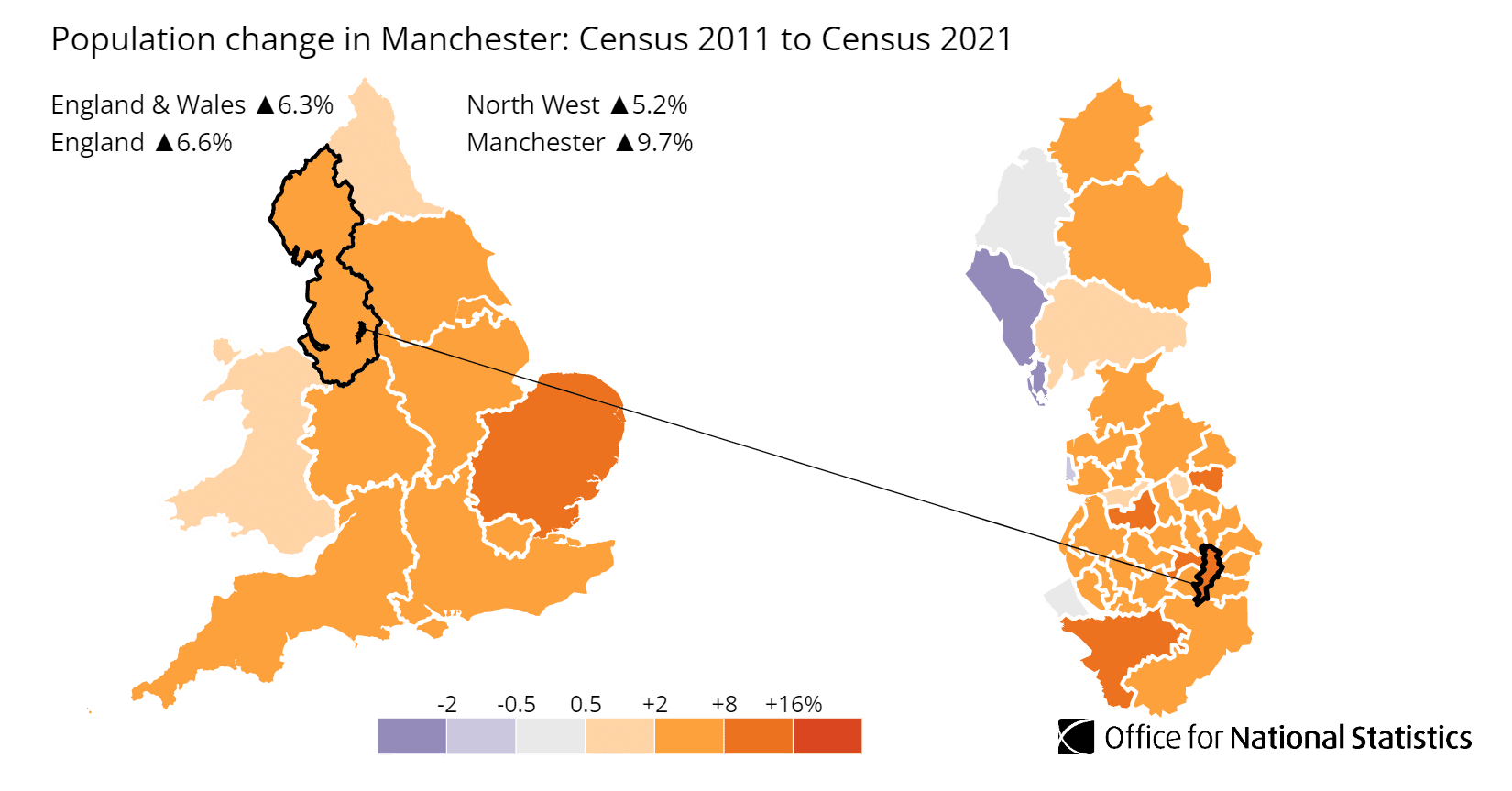
Manchester is one of the fastest-growing cities in the country, and the 2021 Census shows why landlords pay attention to it. The population reached 551,938, up 9.7% since 2011. That outpaced both the North West (5.2%) and England (6.6%), and the city centre has kept filling with apartments since.
What sets Manchester apart is how much of it rents. Just 38.0% of households own their home, well below the 62.3% England average, and 62.0% rent privately or socially. That is a higher rental share than London itself. For anyone running the numbers on buy-to-let in Manchester, that depth of tenant demand is the headline, and it shows up in the city's rental yields.
Article updated: July 2026
The city is also densely built, especially in central postcodes like M4, where apartment living packs people in tightly. The tables below break the 2021 Census down by every Manchester postcode, so you can see how the population, households and density shift across the city, whether you are weighing up the centre or the suburbs.
Manchester Population by Postcode
This table sets out the 2021 Census for every Manchester postcode, grouped by area of the city and ranked by population within each. The central postcodes carry the highest densities, with the Northern Quarter (M4) topping 25,000 people per square mile, while the outer areas spread similar numbers over more ground. Watch the density column to see where the city packs people in most tightly.
Central Manchester
| Postcode | Area | Population (2021) | Households | Density (per sq mile) |
|---|---|---|---|---|
| M1 | City Centre | 11,953 | 5,231 | 17,211 |
| M3 | City Centre | 11,725 | 6,606 | 16,506 |
| M4 | Northern Quarter | 10,600 | 6,030 | 25,848 |
| M2 | City Centre | 87 | 53 | — |
North Manchester
| Postcode | Area | Population (2021) | Households | Density (per sq mile) |
|---|---|---|---|---|
| M40 | Collyhurst | 40,888 | 18,049 | 11,050 |
| M9 | Blackley | 39,412 | 17,530 | 11,695 |
| M8 | Cheetham Hill | 30,934 | 11,246 | 18,289 |
East Manchester
| Postcode | Area | Population (2021) | Households | Density (per sq mile) |
|---|---|---|---|---|
| M18 | Gorton | 23,432 | 9,845 | 15,735 |
| M11 | Clayton | 20,273 | 8,591 | 11,447 |
| M12 | Ardwick | 15,739 | 6,040 | 12,212 |
South Manchester
| Postcode | Area | Population (2021) | Households | Density (per sq mile) |
|---|---|---|---|---|
| M14 | Fallowfield | 52,853 | 17,202 | 24,422 |
| M20 | Didsbury | 49,129 | 21,030 | 13,690 |
| M22 | Wythenshawe | 42,201 | 18,213 | 10,546 |
| M19 | Levenshulme | 34,838 | 13,482 | 15,394 |
| M23 | Wythenshawe | 30,902 | 13,690 | 10,165 |
| M21 | Chorlton | 29,233 | 12,290 | 12,279 |
| M13 | Ardwick | 22,705 | 6,756 | 21,855 |
| M15 | Hulme | 20,050 | 9,095 | 21,841 |
West Manchester
| Postcode | Area | Population (2021) | Households | Density (per sq mile) |
|---|---|---|---|---|
| M16 | Old Trafford | 35,559 | 13,805 | 16,358 |
Manchester Population Growth
The total population of Manchester was around 551,900 as of the 2021 Manchester Census.
Manchester's population has grown by 9.7%, rising from around 503,100 in 2011. This growth has driven house prices up recently across the city, however, there are still many affordable postcodes to live across Manchester.
This growth rate significantly outpaced both the North West region (5.2%) and England overall (6.6%), making it the third-largest percentage increase in the North West, behind only Salford (15.4%) and Chorley (9.9%).
The average (median) age in Manchester increased from 29 to 31 years between the two censuses. This indicates a notably younger demographic profile compared to both the North West region and England overall, which had median ages of 40 years. Despite the slight increase, Manchester maintained its position as having the lowest average age in the North West.
Notable age-related changes in Manchester's population between 2011 and 2021 include:
- The number of residents aged 50-64 years increased by approximately 16,900 (a 27.4% rise)
- The 20-24 age group decreased by around 5,100 (a 7.6% reduction)
- The proportion of residents aged 50-64 grew by 2.0 percentage points, now representing 14.3% of the population
Population density in Manchester has also increased, with the area now home to approximately 34.1 people per football pitch-sized piece of land, up from 31.1 in 2011. This makes Manchester the most densely populated local authority area across the North West.
This puts pressure on housing demand in already popular areas, and is one of the reasons the most expensive street in Manchester is well over £2 million per property sale. That population pressure is a big part of why Manchester features so heavily in our UK property investment guides.
Ready to buy property?
Access off-market investment properties with an average 8%+ annual gross yield (beating the UK's typical 3-5%).
Get property alerts