

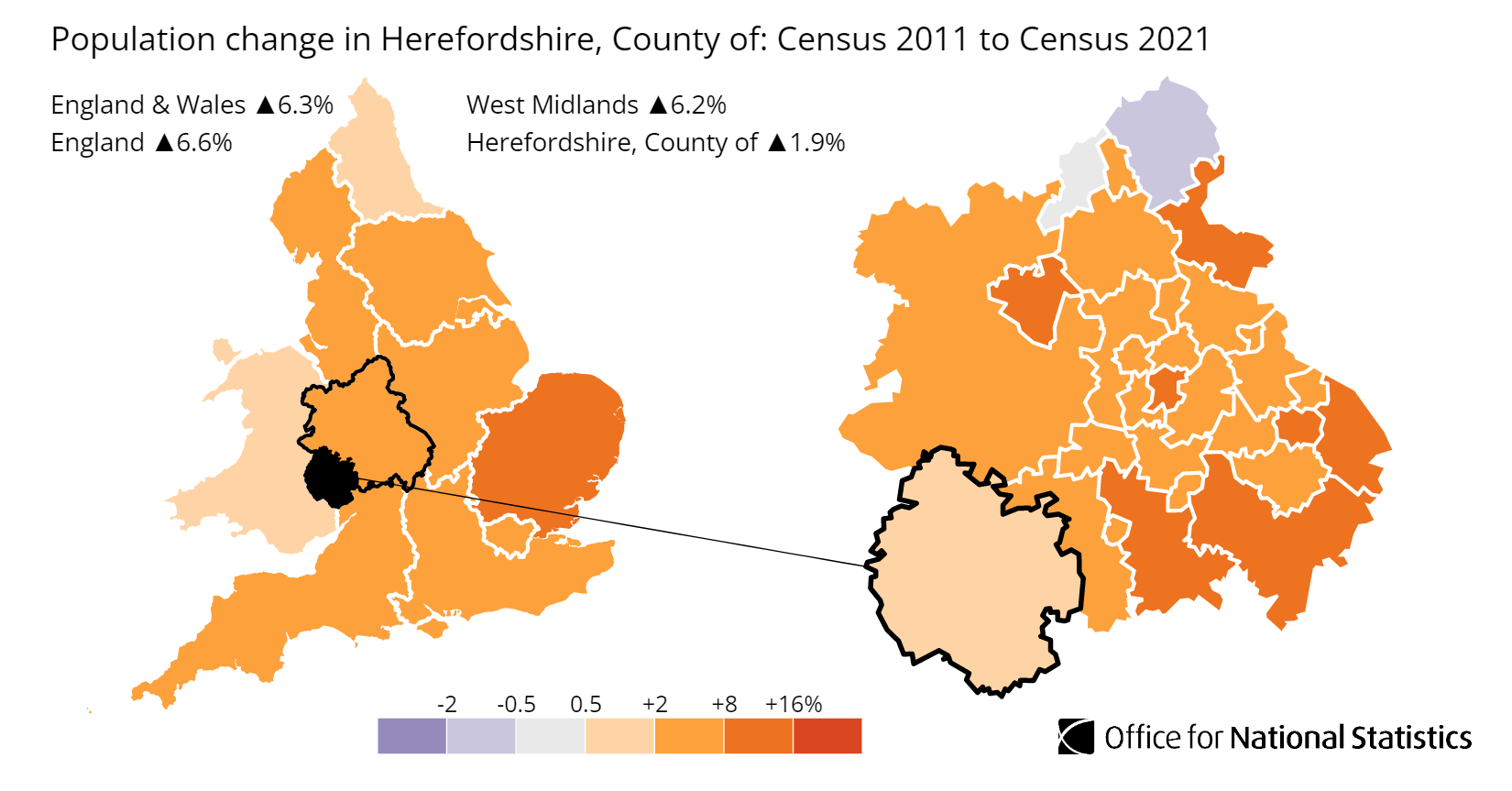
Hereford is a cathedral city in Herefordshire, in the West Midlands. Average sold prices across Herefordshire sit at £288,434 on the HM Land Registry House Price Index, 0.5% below the England average of £289,946 and well above the West Midlands regional average of £232,897. That is the shape of the Hereford market in one line: a rural county city that prices a little under England but sits near the top of its own region, with yields kept modest by local wages rather than by the price tag. The county's population grew 1.94% between the 2011 and 2021 censuses, from 183,477 to 187,034 residents, well behind the England and Wales average of 6.3%.
Hereford's prices are held in check by earnings rather than lifted by them. The median gross weekly wage across Herefordshire is £667.90, below both the West Midlands figure of £712.50 and the Great Britain median of £752.40, so this is a lower-wage county where rents track what local jobs pay. Across the three postcodes the asking price runs from £329,622 in HR4 down through to £381,845 in HR1, and the cheapest postcode is also the highest-yielding, which puts the income case in the south and west of the city rather than the north.
This guide covers the city of Hereford within the unitary authority of Herefordshire (ONS code E06000019), across postcodes HR1, HR2 and HR4. Hereford sits in the West Midlands on the River Wye, around 55 miles south-west of Birmingham and close to the Welsh border. The wider Midlands property investment region stretches north and east towards Worcester, Gloucester and the larger West Midlands cities.
Article updated: July 2026
Why Invest in Hereford?
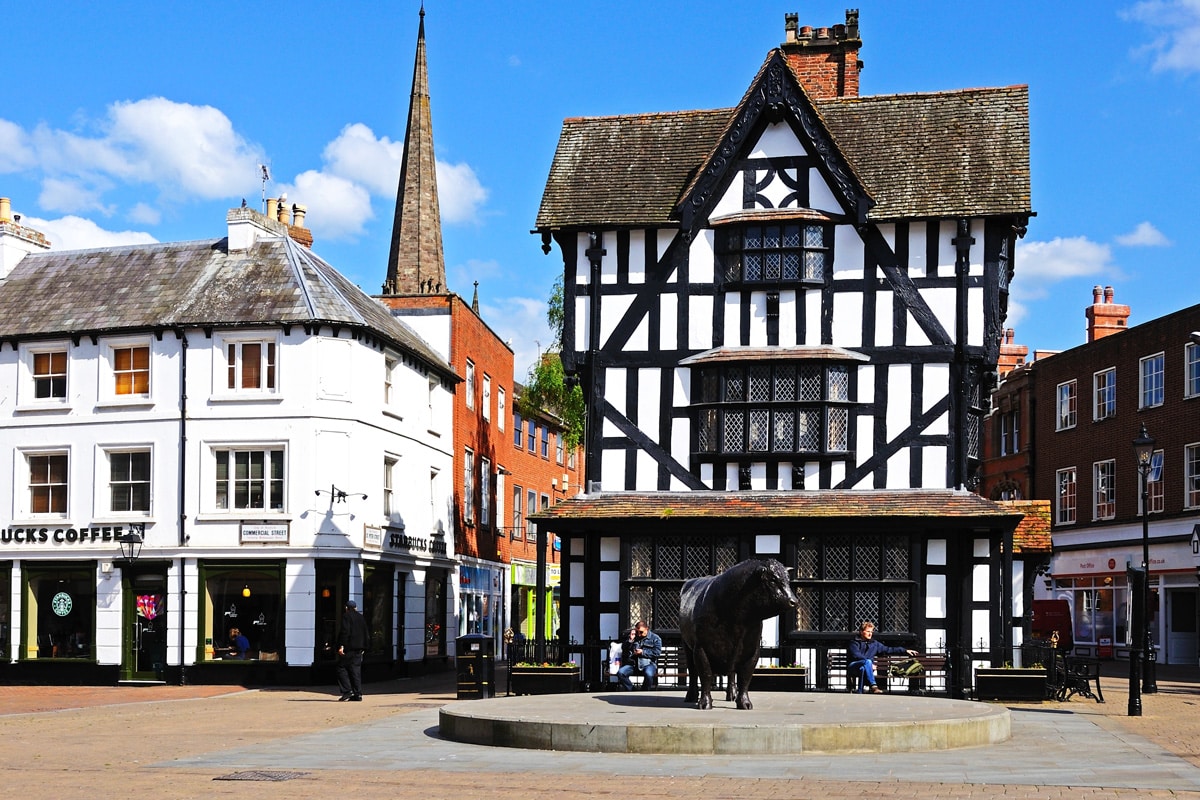
Herefordshire added just 3,557 residents between the 2011 and 2021 censuses, a 1.94% rise that came in at less than a third of the 6.3% England and Wales average. This is slow, steady growth rather than the urban churn that feeds a fast-moving rental market, and it fits the county's character: a rural area of 842 square miles with Hereford as its only city and main economic hub. The appeal here is a low-density market town setting, the cathedral, and a position on the River Wye with the Welsh border and the Black Mountains close by.
The local employment rate of 81.2% sits above the Great Britain figure of 75.6%, so people in Herefordshire are in work, but the wages those jobs pay are the more telling number. The county's economy leans on agriculture and food production, with the Hereford cattle name known worldwide, alongside defence and engineering, retail, and public-sector health and education employment. That base keeps people employed without pushing earnings up the way a city economy does.
Median gross annual earnings across Herefordshire are £34,730, which is below both the West Midlands regional median and the Great Britain median of £39,125. Lower wages mean tenants here cannot stretch to the rents seen in higher-earning areas, so the rental case rests on steady occupancy and a low asking price rather than on premium income. For a landlord, the read is a dependable but modest market, where the affordable postcodes do the heavy lifting on yield.
Hereford Economic Summary
- Population (Herefordshire): 187,034 (2021 Census). Growth of 1.94% from 2011.
- Median annual salary: £34,730 (local), £39,125 (Great Britain)
- Median weekly salary: £667.90 (local), £712.50 (West Midlands), £752.40 (Great Britain)
- Employment rate: 81.2% (local)
- Unemployment rate: 5.2% (local)
- Key employers and sectors: Agriculture and food production, defence and engineering, health and social care, retail, public-sector education
Source: ONS Census 2021, Nomis Labour Market Profile (ASHE 2025)
Regeneration and Investment in Hereford
Hereford's biggest single commitment is the £45 million first phase of the Hereford Bypass, with a contractor appointed in March 2026 and construction due to start by the end of the year. The investment is weighted towards transport and access, the two things a rural city with limited rail links most needs, and it sits alongside a new transport hub and a wider council framework for highways and public space.
- Hereford Western Bypass Phase One (Construction from late 2026, £45 million): Herefordshire Council appointed civil engineering firm Graham in March 2026 to lead detailed design and early works on a 3.6km single-carriageway road linking the A49 Ross Road and Rotherwas Access Road with the A465 Abergavenny Road and on to the B4349 Clehonger Road, including a new bridge over the Hereford to Newport railway line. The scheme is fully council-funded and opens up the southern and western edges of the city for future housing. Updates at Herefordshire Council.
- Hereford Transport Hub (In development, £24.5 million): An integrated transport hub at Hereford railway station, funded by £19.99 million of Levelling Up money plus £3.5 million from the council and £1 million of Active Travel funding. It brings together rail, bus, cycle and pedestrian links with indoor waiting space, an improved bus interchange and cycle parking, designed to lift connectivity in the HR1 city-centre postcode. Updates at Herefordshire Council.
- Herefordshire Highways and Public Realm Framework (From April 2026, £100 million): A council framework coming into force in April 2026 to fund road resurfacing, civil engineering, bridge and structural works, traffic signal upgrades, footway and cycleway improvements and public space landscaping across the county. The programme is aimed at liveability and maintenance rather than a single landmark scheme, underpinning the city's day-to-day infrastructure. Updates at Herefordshire Council.
Source: Office for National Statistics - Population for Herefordshire
Hereford Property Market Analysis
Average property prices across Herefordshire have risen 412.5% since January 1995, from £56,281 to £288,434. The sections below walk through that journey cycle by cycle, then break down current postcode-level data for sold prices, price per square foot, asking prices, growth, transaction volumes and selling times across HR1, HR2 and HR4.
When was the last house price crash in Hereford?
Hereford's sold prices are recorded by HM Land Registry at county level under Herefordshire, so the figures below cover the whole unitary authority rather than the city alone. The Land Registry House Price Index tracks the average from January 1995 to the latest reading in April 2026, more than three decades of market cycles.
The 1995 to 2007 climb: Herefordshire started at £56,281 in January 1995. By December 2000 the average had reached £86,079, and the early-2000s boom carried it past £170,000 by the end of 2005. The market pushed on to a pre-crash peak of £199,383 in September 2007, more than three times the 1995 level in twelve years.
2008 to 2009, the financial crisis: Prices fell from the September 2007 peak of £199,383 to a trough of £163,192 in April 2009, a drop of 18.2% over nineteen months. The worst year-on-year reading came in April 2009 at -14.4%. That decline was almost exactly in line with the England fall of 18.2% over the same crash, so Herefordshire neither escaped the downturn nor took a worse hit than the national market.
The 2010 to 2013 plateau: The recovery was slow. Prices bounced off the April 2009 trough but then drifted in a narrow band, sitting at £181,038 by March 2011 and £180,298 by the end of 2013, unable to push back above the old peak. Like much of rural England, Herefordshire needed the wider market to lead before it could move.
Recovery, 2015: Prices finally cleared the September 2007 peak in October 2015, when the average reached £199,986. That took just over eight years to get back to where the market had been before the crash, one of the longer recoveries among the towns in our guides and a reflection of how flat the early-2010s were here.
2016 to 2019, steady growth: Prices climbed at a measured pace through the second half of the decade, moving from £202,339 in March 2016 to £224,672 by December 2019. This was single-digit annual growth rather than a boom, in keeping with a county where wages set the ceiling on what buyers can pay.
2020 to 2022, the pandemic surge: The stamp duty holiday and the shift towards rural space lifted Herefordshire sharply. The average rose from £227,057 in June 2020 to £248,866 by December 2020 and on to £284,133 by December 2022, as buyers chasing room and countryside pushed demand in a county that offered both.
2023 to present: Higher mortgage rates cooled the run. Prices eased back through 2023, recovered to an all-time high of £291,637 in October 2025, then slipped to £288,434 by the latest reading in April 2026, a 1.1% step down from the peak. The current price is 44.7% above the September 2007 pre-crash peak.
Long-term growth summary:
- 5 years (April 2021 to April 2026): 20.9% growth (£238,507 to £288,434)
- 10 years (April 2016 to April 2026): 43.1% growth (£201,526 to £288,434)
- 15 years (April 2011 to April 2026): 56.8% growth (£183,911 to £288,434)
- 20 years (April 2006 to April 2026): 63.9% growth (£175,975 to £288,434)
- 30 years (January 1995 to April 2026): 412.5% growth (£56,281 to £288,434)
Herefordshire's 18.2% crash mirrored the national average rather than beating it, and the eight-year wait to recover was longer than many faster-moving markets needed. The 30-year return of 412.5% still points to solid long-term capital growth from a low base. Someone who bought at the exact September 2007 peak would now be 44.7% ahead on the Land Registry average, having sat through that long flat stretch in between.
- All property types
- Detached
- Semi-detached
- Terraced
- Flats
- All property types
- Detached
- Semi-detached
- Terraced
- Flats
Sold House Prices in Hereford
The average sold price across all property types in Herefordshire is £288,434, which is 0.5% below the England average of £289,946 as of April 2026. The discount is slim at the headline level, but it widens sharply by property type: detached and semi-detached homes sit only a little under England, while flats trade at a deep discount, which tells you this is a market built on houses rather than apartments.
| Property Type | Hereford Average | England Average | Difference |
|---|---|---|---|
| Detached houses | £442,461 | £470,492 | -6.0% |
| Semi-detached houses | £278,866 | £288,185 | -3.2% |
| Terraced houses | £209,650 | £243,788 | -14.0% |
| Flats and maisonettes | £125,584 | £214,563 | -41.5% |
| All property types | £288,434 | £289,946 | -0.5% |
Detached houses at £442,461 sit 6.0% below England's £470,492. These are the larger rural and village homes that dominate Herefordshire's stock, drawing buyers who want space and countryside near the Welsh border. Annual change of 5.7% shows a detached market moving again after a flat stretch through 2023 and 2024.
Semi-detached houses at £278,866 carry the narrowest gap to England in proportional terms, 3.2% below the national £288,185. This is the steadiest part of the market, the standard family stock found across HR1, HR2 and HR4, and it shows the strongest annual growth of the four types at 6.5%. For a buy-to-let investor, the semi-detached bracket is where price and tenant demand line up most reliably.
Terraced houses at £209,650 are 14.0% below England's £243,788 and the most affordable house type in the county. Terraces concentrate in the older parts of the city, particularly in HR1 and HR4, and they form the natural buy-to-let pool here: large enough for families, priced well under the detached and semi-detached brackets. Annual change of 6.1% puts terraces among the county's stronger performers over the past year.
Flats and maisonettes at £125,584 sit 41.5% below England's £214,563, by far the deepest discount of any type. Hereford is a house market, not a flat market, and without the city-centre apartment blocks that lift flat values in larger cities, prices here reflect thin local demand alone. The annual change of 0.5% is the weakest reading of the four types and confirms a small segment that moves more slowly than the county's houses.
Price Per Square Foot in Hereford
Just £21 per square foot separates Hereford's cheapest postcode from its dearest, with HR2 at £273 and HR1 at £294. Measuring by the square foot takes property size out of the comparison and isolates what each location commands for its space. HR1 (City Centre, Tupsley) tops the table, which fits its position covering the cathedral quarter and the more sought-after eastern suburbs of the city.
| Rank | Area | Price Per Sq Ft |
|---|---|---|
| 1 | HR2 (South Hereford, Belmont) | £273 |
| 2 | HR4 (West Hereford, Whitecross) | £287 |
| 3 | HR1 (City Centre, Tupsley) | £294 |
HR2 at £273 per square foot is the cheapest space in Hereford. The postcode covers the southern side of the city, including Belmont and the villages stretching out towards the Golden Valley, where more of the housing is standard family stock rather than premium period property. Based on 544 transactions analysed, HR2's per-square-foot rate sits 7% below HR1's.
HR1 at £294 per square foot is the most expensive. Covering the city centre, the cathedral quarter and Tupsley to the east, it holds the older, higher-value housing closest to the heart of Hereford. Across 553 transactions analysed, HR1 carries a consistent premium for that central position, though with only £21 a square foot between the dearest and cheapest postcode, the spread across the city is tight.
For Sale Asking Prices in Hereford
HR4 at £329,622 and HR1 at £381,845 sit 15.8% apart across Hereford's three postcodes. The asking-price order runs opposite to the per-square-foot table: HR1 is the dearest to buy outright because it holds the larger period homes, while HR4 carries the lowest asking price. The mean asking price across the three postcodes is £355,680.
| Rank | Area | Asking Price |
|---|---|---|
| 1 | HR4 (West Hereford, Whitecross) | £329,622 |
| 2 | HR2 (South Hereford, Belmont) | £355,572 |
| 3 | HR1 (City Centre, Tupsley) | £381,845 |
HR4 at £329,622 is the entry point into Hereford and the only postcode below the city's mean asking price. Covering the western side of the city around Whitecross and out towards the bypass route, it puts the most property within reach for an investor working to a budget. The £25,950 step up to HR2 buys a move to the southern side of the city rather than a different class of stock.
HR1 at £381,845 is the dearest of the three. The central and eastern postcode holds the cathedral-quarter housing and the larger homes in Tupsley, pushing its asking price 15.8% above HR4. As the rental sections show, that higher price does more for the asking figure than for the income return, which is why HR1 lands last on yield despite topping the asking table.

House Price Growth in Hereford
HR2 (South Hereford, Belmont) leads on five-year growth at 7.3%, just ahead of HR1 at 6.8%, while HR4 trails on 5.2% and is down 9.0% over three years. All three postcodes are positive over five years but down over the past one and three, in line with a market that has softened from its pandemic peak. The five-year picture is the more reliable read here, and it is positive across the board.
| Area | 1 Year | 3 Years | 5 Years |
|---|---|---|---|
| HR2 (South Hereford, Belmont) | -2.7% | -0.4% | 7.3% |
| HR1 (City Centre, Tupsley) | -7.4% | -0.3% | 6.8% |
| HR4 (West Hereford, Whitecross) | -9.7% | -9.0% | 5.2% |
HR2 at 7.3% over five years has held up best, and it is also the mildest over the past year at -2.7%. The southern side of the city, around Belmont and the surrounding villages, has carried steadier demand through the cooler market, with its small three-year dip of -0.4% leaving the medium-term record close to flat. Of the three postcodes, HR2 has given investors the most consistent capital story.
HR4 at 5.2% over five years is the weakest grower and the softest over three years at -9.0%. The western postcode around Whitecross ran up in the pandemic and has given more of it back since, so its recent record sits behind the rest of the city even though the five-year figure stays positive. HR1 lands in the middle, up 6.8% over five years but down 7.4% over the past one, a central postcode that has cooled noticeably from its peak.
Monthly Property Sales in Hereford
Hereford sees 98 sales a month across its three postcodes, with HR1 the busiest at 35 and HR4 the quietest at 29. Turnover sits in a tight band, from 9% in HR4 to 11% in HR1, so the share of stock changing hands is fairly even even though the headline volumes differ a little.
| Area | Sales Per Month | Turnover | Asking Price |
|---|---|---|---|
| HR1 (City Centre, Tupsley) | 35 | 11% | £381,845 |
| HR2 (South Hereford, Belmont) | 34 | 10% | £355,572 |
| HR4 (West Hereford, Whitecross) | 29 | 9% | £329,622 |
HR1's 11% turnover is the highest in Hereford, narrowly ahead of HR2 at 10% and HR4 at 9%. The central postcode pairs the most monthly sales with the largest share of its stock changing hands, which for a landlord points to a slightly easier resale when the time comes. The gaps are small, though, and across all three postcodes turnover sits at the lower end, a reminder that this is a steady rural market rather than a fast-churning city one.
HR4 records the fewest sales at 29 a month and the lowest turnover at 9%. The western postcode has the smallest housing base of the three and the slowest rate of homes coming to market, so an investor here should expect a quieter resale market alongside the lowest asking price. The selling-time section below shows how that plays out in days on the market.
How Long Properties Take to Sell in Hereford
HR1 (City Centre, Tupsley) clears fastest at about 277 days, while HR4 (West Hereford, Whitecross) is slowest at roughly 380 days, the difference between a balanced market and a buyer's one. The days-on-market figure is how long a typical home is listed before it sells; the months of unsold stock counts how much for-sale supply is queued up at the current rate of sales.
| Area | Avg Days to Sell | Months of Unsold Stock | Market |
|---|---|---|---|
| HR1 (City Centre, Tupsley) | 277 | 9.1 | Balanced market |
| HR2 (South Hereford, Belmont) | 338 | 11.1 | Balanced market |
| HR4 (West Hereford, Whitecross) | 380 | 12.5 | Buyer's market |
How quickly you can sell rarely makes it into a yield calculation, but in Hereford the exit is slow everywhere and slowest in the west. HR1's 9.1 months of unsold stock is the leanest in the city, yet it is still a long way from a quick sale, and HR4's 12.5 months tips it into buyer's-market territory, where supply outweighs demand. For an investor, the cheapest postcode to buy is also the slowest to leave, so the asking price and the exit time pull in opposite directions in HR4.
What Type of Property Can You Buy in Hereford?
Detached homes are the largest single category in every Hereford postcode, from 63.9% of stock in HR4 to 72.6% in HR2, while terraced houses and flats together make up little more than a tenth of the market. The mix is heavily weighted towards houses, which shapes the strategies that fit here. The figures below are drawn from 2021 Census records for each postcode.
| Area | Detached | Semi-detached | Terraced | Flats |
|---|---|---|---|---|
| HR1 (City Centre, Tupsley) | 64.6% | 21.3% | 6.8% | 6.0% |
| HR2 (South Hereford, Belmont) | 72.6% | 18.0% | 5.1% | 3.5% |
| HR4 (West Hereford, Whitecross) | 63.9% | 24.8% | 6.8% | 3.2% |
HR1 holds the largest share of flats at 6.0% and ties HR4 for the most terraced housing at 6.8%. That smaller-unit stock is the natural buy-to-let pool, and it lines up with HR1 being the city-centre postcode where the cathedral quarter and older streets sit. Even so, flats and terraces together are barely an eighth of the market here, so the buy-to-let opportunity in Hereford leans towards houses rather than apartments.
HR2 is the most detached-heavy postcode at 72.6%, with the smallest share of flats at 3.5%. Detached and semi-detached houses together account for more than 90% of HR2's stock, matching its position as a settled, family-housing part of the city to the south. HR4 carries the highest semi-detached share at 24.8%, which gives it a slightly larger pool of the mid-sized homes that work for standard family lets.
The flats figure covers both purpose-built blocks and converted units, and a small share of mobile and temporary dwellings is excluded, so the rows may not add up to exactly 100%.

Hereford Rental Market Analysis
Monthly rents in Hereford run from £1,038 in HR1 to £1,187 in HR2, with gross rental yields from 3.3% to 4.1% across the three postcodes. For investors asking is buy-to-let worth it in Hereford, the sections below break down rents, yields and tenant affordability postcode by postcode. If you are looking at how to build a property portfolio in the West Midlands, Hereford's steady occupancy and low asking price matter more than its headline yield, which sits below the higher-earning markets to the north. Browse current buy-to-let property for sale across the region.
Average Rent & Gross Rental Yields in Hereford
Gross rental yields in Hereford range from 3.3% in HR1 to 4.1% in HR4. The cheapest postcode delivers the best yield and the dearest delivers the worst, the familiar pattern where a higher asking price does more for the seller than for the landlord. HR2 charges the highest rent at £1,187 a month yet lands in the middle on yield, because its £355,572 asking price holds the return down.
| Area | Average Monthly Rent | Asking Price | Gross Yield |
|---|---|---|---|
| HR4 (West Hereford, Whitecross) | £1,139 | £329,622 | 4.1% |
| HR2 (South Hereford, Belmont) | £1,187 | £355,572 | 4.0% |
| HR1 (City Centre, Tupsley) | £1,038 | £381,845 | 3.3% |
HR4 at 4.1% combines the lowest asking price with a £1,139 rent to produce the best return in the city. A 30% deposit of £98,887 gets an investor into the highest-yielding postcode, and the western side of Hereford is where the income case is strongest, even if it is also the slowest to resell.
HR1 at 3.3% sits at the bottom of the yield table. Its £1,038 rent is the lowest of the three, and set against the highest asking price of £381,845, the income return is squeezed hardest. In the central postcode the period housing and the cathedral-quarter location do more for the price tag than for the rent, which is why HR1 lands last on yield despite leading on asking price.
Gross Rental Yield by Postcode
Is Hereford Rent High?
Monthly rents in Hereford take between 35.9% and 41.0% of the local median gross monthly salary. The commonly cited affordability line is 30% of gross income, and all three Hereford postcodes sit above it. That gap reflects the county's lower wages: rents here are not high in absolute terms, but they are high relative to what local jobs pay, which is the constraint that keeps Hereford yields modest.
The median gross weekly salary in Hereford is £667.90, which works out at £2,894 per month or £34,730 per year. That is below both the West Midlands median of £712.50 a week and the Great Britain median of £752.40. Data from the Nomis Labour Market Profile (ASHE 2025).
| Rank | Area | Rent as % of Income |
|---|---|---|
| 1 | HR2 (South Hereford, Belmont) | 41.0% |
| 2 | HR4 (West Hereford, Whitecross) | 39.3% |
| 3 | HR1 (City Centre, Tupsley) | 35.9% |
HR1 at 35.9% is the most affordable of the three for tenants, which fits its lower rent of £1,038 a month against the same local wage base. It is still above the 30% affordability mark, so even the easiest postcode here stretches the median earner, but it leaves the most headroom and tends to support steadier, longer tenancies.
HR2 at 41.0% is the least affordable, with the highest rent in the city set against the county median wage. Tenants paying that level in the southern suburbs are more likely to be dual-income households than single earners on the median salary, so a landlord targeting HR2 is leaning on the stronger end of the local tenant pool.
How Big Is Hereford's Private Rented Sector?
The private rented sector is deepest in HR4 at 21.6% of households and shallowest in HR1 at 18.6%, a narrow band across the three postcodes. The share of homes already rented privately is a read on how large and how established the local tenant pool is. The table below shows household tenure by postcode.
| Area | Owned Outright | Owned with Mortgage | Private Rented | Social Rented |
|---|---|---|---|---|
| HR4 (West Hereford, Whitecross) | 47.8% | 23.5% | 21.6% | 6.1% |
| HR2 (South Hereford, Belmont) | 52.8% | 23.3% | 19.1% | 4.3% |
| HR1 (City Centre, Tupsley) | 49.3% | 25.2% | 18.6% | 6.1% |
HR4 has the largest private rented sector in Hereford at 21.6% of households, a touch ahead of HR2 at 19.1% and HR1 at 18.6%. A deeper rented sector points to an active local lettings market and a wider pool of existing tenants, and here it lines up with HR4 carrying the best yield in the city. The spread is narrow, though, so no single postcode stands out as a markedly larger rental market than the others.
Across all three postcodes, owner-occupation is high, with outright and mortgaged ownership together accounting for roughly seven in ten households in HR1 and HR2 and a little less in HR4. That settled ownership base, with private renting in the high teens, reads as a stable rather than a renter-heavy market, the kind of place where tenant demand is dependable but not deep enough to absorb a sudden rush of new lettings stock.
Local Housing Allowance Rates in Hereford
All three Hereford postcodes fall within the Herefordshire Broad Rental Market Area, where Local Housing Allowance runs from £80.89 a week for a shared room to £224.38 a week for a four-bedroom home. Local Housing Allowance sets the most a tenant on housing support can claim towards rent, so for that part of the market it works as an effective floor. The rates below apply right across Hereford. To check the current rate for a specific address, you can use the government's official Local Housing Allowance calculator.
| Property Size | Weekly LHA Rate | Monthly Equivalent |
|---|---|---|
| Shared accommodation | £80.89 | £351 |
| 1 bedroom | £109.32 | £474 |
| 2 bedrooms | £138.08 | £598 |
| 3 bedrooms | £172.60 | £748 |
| 4 bedrooms | £224.38 | £972 |
The two-bedroom LHA rate of £138.08 a week works out at roughly £598 a month, which sits well below the £1,038 to £1,187 open-market rents recorded across Hereford's postcodes. A benefit-backed tenancy at the LHA rate therefore comes in a long way under the city's market rents, and the stock that fits within those rates is concentrated in the cheaper terraced housing of HR1 and HR4. The rates are identical in every Hereford postcode because they are set across the whole Herefordshire market area.
Buy-to-Let Considerations
Are House Prices High in Hereford? Price-to-Earnings Ratios
Buying in Hereford takes between 9.5 and 11.0 times the median local salary. This is based on the Nomis Labour Market Profile for Herefordshire showing the median gross annual income for Herefordshire residents is £34,730.
The national benchmark for price-to-earnings is 7.4x (England's average sold price of £289,946 divided by the Great Britain median annual salary of £39,125). Every Hereford postcode sits above that benchmark, which is what you would expect in a county where wages are below the national median while prices track close to it.
| Rank | Area | Price-to-Earnings Ratio |
|---|---|---|
| 1 | HR4 (West Hereford, Whitecross) | 9.5x |
| 2 | HR2 (South Hereford, Belmont) | 10.2x |
| 3 | HR1 (City Centre, Tupsley) | 11.0x |
HR4 at 9.5x is the most affordable entry relative to local earnings, though still well above the 7.4x national benchmark. The western postcode is where local wages and house prices come closest to lining up, which is part of why it carries the best yield in the city. Even so, at more than nine times the median salary, ownership is a stretch for a typical local earner, and that gap is exactly why so much of the demand here is rental.
HR1 at 11.0x sits furthest above the benchmark. The central and eastern postcode pairs the highest asking price with the same county wage base, so at eleven times median earnings it is the least affordable part of the city. For an investor, that elevated ratio is the flip side of HR1's low yield: the price has run ahead of what local incomes can support, which compresses the rental return.
Deposit Requirements in Hereford
A 30% deposit on a buy-to-let property in Hereford runs from £98,887 in HR4 to £114,553 in HR1. The gap between the cheapest and dearest deposit is £15,666, a tight spread that reflects how close the three postcodes sit on price. For investors comparing Hereford with the wider West Midlands, these deposits sit below the larger cities to the north on a percentage basis but above the cheapest northern markets, where the same money would stretch further on a lower-priced home.
Beyond the deposit, the stamp duty calculation and other buy to let costs add to the total capital required.
| Rank | Area | 30% Deposit Required |
|---|---|---|
| 1 | HR4 (West Hereford, Whitecross) | £98,887 |
| 2 | HR2 (South Hereford, Belmont) | £106,672 |
| 3 | HR1 (City Centre, Tupsley) | £114,553 |
HR4 is the cheapest way into Hereford at a £98,887 deposit, and it is also the postcode that earns its keep best, carrying the top yield at 4.1% and the deepest private rented sector at 21.6%. The trade-off is liquidity: HR4 is the slowest to sell at 380 days and the only buyer's market of the three, so the lower entry cost comes with a longer wait at the exit.
Stepping up to HR1 costs roughly £15,700 more on the deposit, and that money buys a central, period-housing postcode rather than just a bigger number on the table. HR1 sells fastest at 277 days and holds the cathedral-quarter location, but its yield drops to 3.3% and its price-to-earnings ratio is the highest in the city. The extra deposit goes into the postcode's profile and resale speed, not into the income return.
What the Hereford Data Tells Buy-to-Let Investors
In Hereford the cheapest way in is also the highest-yielding postcode, but the margins are tight. HR4 (West Hereford, Whitecross) has the top yield at 4.1%, the lowest asking price for buying an investment property at £329,622, and the deepest private rented sector at 21.6%. A 30% deposit there is £98,887, the lowest in the city, for a home renting at £1,139 a month. The catch is exit speed: HR4 is the slowest to sell at 380 days and the only buyer's market of the three.
HR2 (South Hereford, Belmont) runs HR4 close on the numbers, with a 4.0% yield, the strongest five-year growth at 7.3% and the highest rent in the city at £1,187 a month. It is the steadiest capital story of the three postcodes, holding its value better than HR4 over the medium term, which makes it the place where income and growth come closest to meeting. HR1 (City Centre, Tupsley) is the dearest and lowest-yielding at 3.3%, where the cathedral-quarter location and faster 277-day resale come at the cost of a squeezed return. Buyers who want to come in below the open-market price often work the off-market property route.
Hereford as a whole reads as a low-wage rural market: sold prices 0.5% below England, an 81.2% employment rate, and earnings under both the regional and national medians. That keeps yields in a 3.3% to 4.1% band rather than the higher returns seen in cheaper northern cities, so the case here rests on a low price, dependable occupancy and the slow, steady capital growth a county market tends to deliver, rather than on headline income.
How Hereford Compares
Hereford's mean asking price of £355,680 is the second-highest of five West Midlands and border locations compared here, yet its top yield of 4.1% is the lowest in the group. The comparison below places Hereford alongside four nearby locations, each with a different investor profile. The mean asking price and mean monthly rent are simple averages across all postcodes with data; the top gross yield is the single highest postcode yield in each location.
| Location | Mean Asking Price | Mean Monthly Rent | Mean Gross Yield | Top Yield (postcode) |
|---|---|---|---|---|
| Worcester | £295,727 | £953 | 3.9% | 5.0% (WR4) |
| Gloucester | £299,777 | £1,194 | 4.8% | 6.1% (GL1) |
| Telford | £327,780 | £1,021 | 3.7% | 5.1% (TF3) |
| Hereford | £355,680 | £1,121 | 3.8% | 4.1% (HR2, HR4) |
| Cheltenham | £448,418 | £1,400 | 3.7% | 4.7% (GL50) |
Hereford sits fourth of the five on price at £355,680, above the three cheaper markets and below cathedral-city Cheltenham, while its 4.1% top yield is the lowest in the group. The shape is clear: Hereford asks more than Worcester, Gloucester or Telford but returns less, the price of a rural county market where wages cap the rents that prices can be set against.
For investors prioritising income, Gloucester at 6.1% and Telford at 5.1% deliver the strongest top-line yields in this group, with Worcester close behind at 5.0% on the lowest asking price. Cheltenham at £448,418 is the most expensive and, like Hereford, trades a higher price for a lower yield, the Regency-town premium at work. Hereford's case is less about yield and more about a low-density county setting and slow, steady growth. For a data-driven comparison across all UK locations, see our best buy-to-let areas guide.
Frequently Asked Questions
Is Hereford a good place to invest in buy-to-let?
It works as a steady, low-yield rural market rather than a high-income one. Employment is solid at 81.2%, above the national rate, so tenants are in work, but local wages are below average at £667.90 a week, which caps what rents can do. Yields top out at 4.1% in HR4, well short of the 6% or 7% you would find in cheaper northern cities, and the exit is slow, with homes taking 277 to 380 days to sell.
The clearest case is in HR4 (West Hereford, Whitecross), where the cheapest asking price meets the best yield and the deepest rental market. If you want a low-density county setting with dependable occupancy and slow capital growth, rather than headline income, Hereford fits. If yield is the priority, the markets to the north and east do more.
What are the best areas in Hereford for property investment?
The three postcodes are close together, but they split on what they offer. HR4 (West Hereford, Whitecross) is the cheapest at £329,622 and the highest-yielding at 4.1%, with the deepest private rented sector, so it leans towards income, though it is the slowest to resell. HR2 (South Hereford, Belmont) has the strongest five-year growth at 7.3% and the highest rent at £1,187, making it the steadiest capital story.
HR1 (City Centre, Tupsley) is the dearest at £381,845 and the lowest-yielding at 3.3%, but it sells fastest and holds the central, cathedral-quarter location. So if income matters most, HR4 leads on yield and price; if you want capital that has held up best, HR2 is the one to weigh.
What are average house prices in Hereford?
On the Land Registry index the average sold price across Herefordshire is £288,434, about 0.5% below the England average of £289,946 as of April 2026, and well above the West Midlands regional average of £232,897. Asking prices by postcode run from £329,622 in HR4 (West Hereford, Whitecross) up to £381,845 in HR1 (City Centre, Tupsley), with a city-wide mean of £355,680. By type, detached homes average £442,461, semi-detached £278,866, terraced £209,650 and flats £125,584.
Through a buy-to-let lens, HR4 is the cheapest entry and the highest-yielding at 4.1%, while HR1 is the dearest and lowest-yielding.
Why are Hereford yields lower than other markets?
It comes down to wages rather than prices. Herefordshire's median salary is £34,730, below both the regional and national figures, while sold prices sit only 3.5% under England. When prices track the national level but local incomes do not, rents get capped by what tenants can actually pay, and the gap between rent and price keeps yields modest. That is why Hereford tops out at 4.1% while cheaper, higher-wage-relative markets reach 6% or more.
The same low-wage picture is why rents here take between 35.9% and 41.0% of the median local salary, all above the 30% affordability line. It is not that rents are high in cash terms, but that they are high against what Hereford jobs pay.
What type of property is most common in Hereford?
Detached houses, by a wide margin, and in every postcode. They run from 63.9% of the stock in HR4 up to 72.6% in HR2, a reflection of Herefordshire being a rural county of villages and larger homes rather than a flat-heavy city. The smaller homes that usually suit buy-to-let, terraces and flats, are most concentrated in HR1, but even there they make up only about an eighth of the market, so the buy-to-let pool here leans towards houses.
What are the Local Housing Allowance rates in Hereford?
All three Hereford postcodes fall in the Herefordshire Broad Rental Market Area, so they share one set of rates. As of June 2026, Local Housing Allowance runs at £80.89 a week for a shared room, £109.32 for a one-bed, £138.08 for two beds, £172.60 for three and £224.38 for four. That figure is the most a tenant on housing support can claim towards rent, so for that part of the market it sets an effective floor. The two-bed rate of about £598 a month sits well below the city's open-market rents.
Can I find buy-to-let property under £250,000 in Hereford?
Not on average by postcode, since the cheapest, HR4 (West Hereford, Whitecross), averages £329,622. The way in below £250,000 is by property type rather than location: terraced houses across Herefordshire average £209,650 on the Land Registry index and flats £125,584, both comfortably under that mark. So the sub-£250,000 entry points are in the terraced and flat stock, concentrated in HR1 and HR4, or through below market value property.
How do I buy an investment property in Hereford?
Decide first whether you are buying for income or for steady county-market growth, because that points you at a different postcode. HR4 (West Hereford, Whitecross) is the cheapest entry at £329,622 and the highest-yielding at 4.1%, so it leans towards income. HR2 (South Hereford, Belmont) pairs a 4.0% yield with the strongest five-year growth at 7.3%. At 30% down you need between £98,887 and £114,553 depending on the postcode.
Beyond what is listed openly, experienced investors often buy below asking through off market properties channels. To see what is available now, browse investment properties or buy-to-let homes for sale.
Ready to buy property?
Access off-market investment properties with an average 8%+ annual gross yield (beating the UK's typical 3-5%).
Get property alerts