
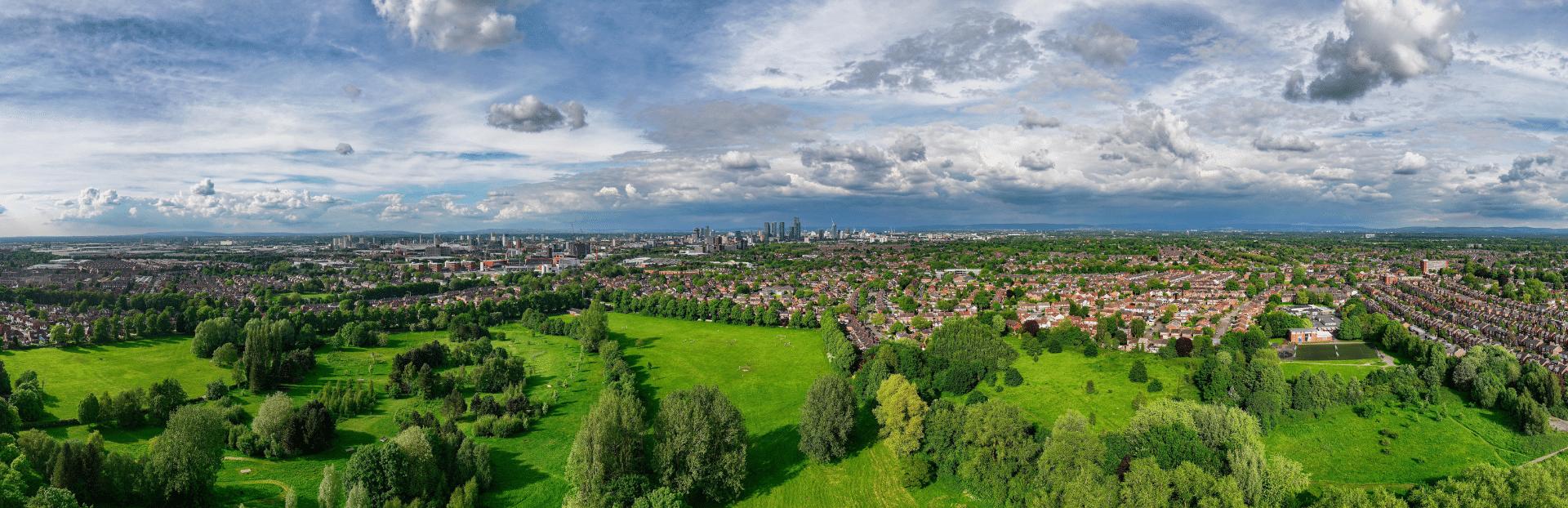
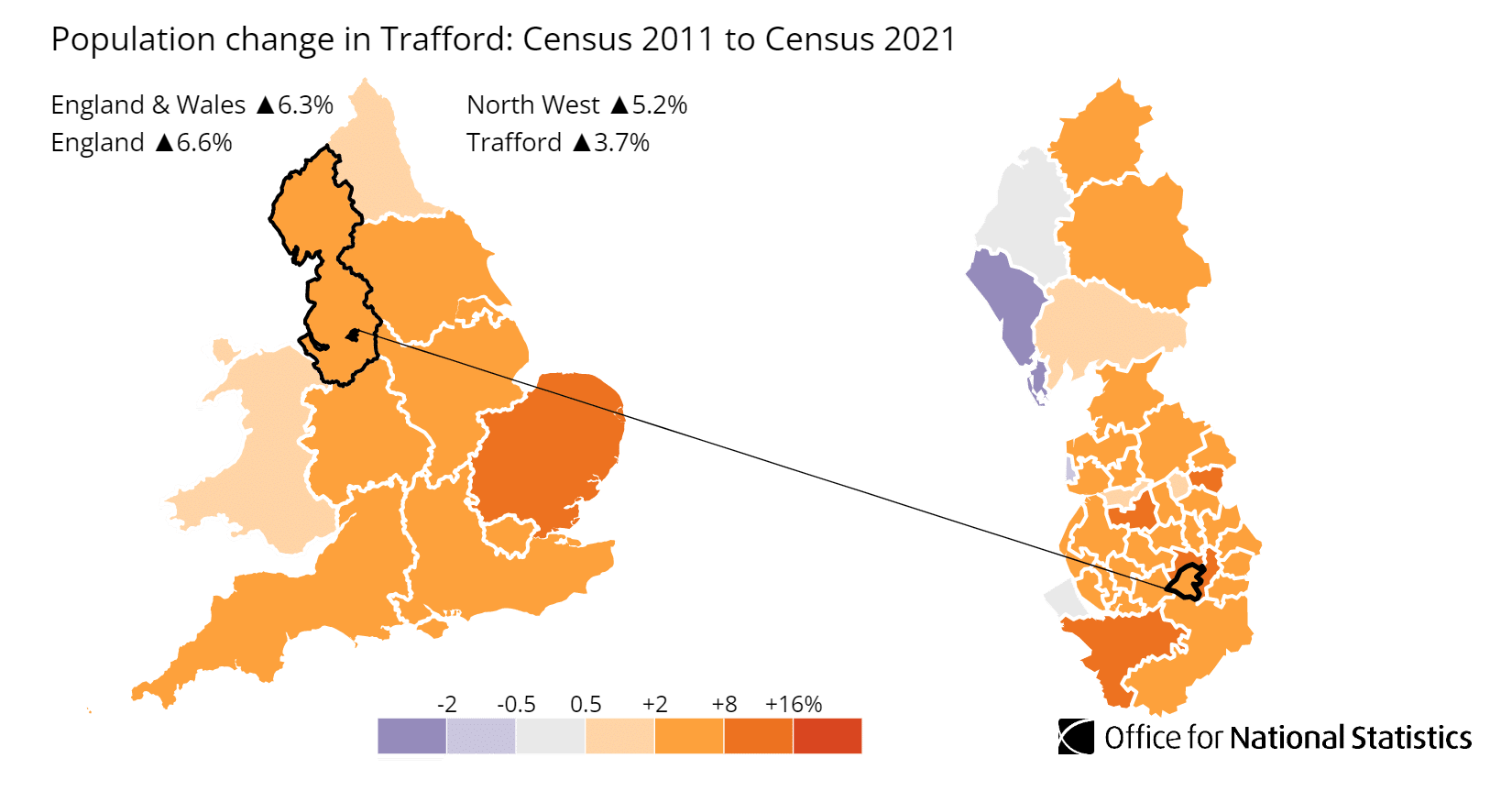
Trafford is a metropolitan borough of Greater Manchester, in north-west England. Average sold prices across Trafford stand at £380,289 on the HM Land Registry House Price Index, 31.2% above the England average of £289,946 and 77.1% above the North West regional average of £214,678. That makes Trafford the priciest borough in Greater Manchester, but the headline hides a split market. M17 (Trafford Park) and M23 (Baguley) carry asking prices under £280,000 and yields of 6.4% and 5.2%, while WA15 (Hale, Timperley) asks £638,191 for a 3.7% return. The borough's population grew 3.74% between the 2011 and 2021 censuses, from 226,578 to 235,052.
Trafford's price premium rests on earnings that outrun the region. The median gross weekly salary is £826.40, which is 14.8% above the North West figure of £720.10 and 9.8% above the Great Britain figure of £752.40. That wage base supports genuine tenant demand across a borough that runs from the terraced streets of Old Trafford in the north to the detached commuter belt of Hale in the south. For investors, the £413,473 gap between the cheapest and dearest postcode creates two distinct entry points into investment property under a single local authority.
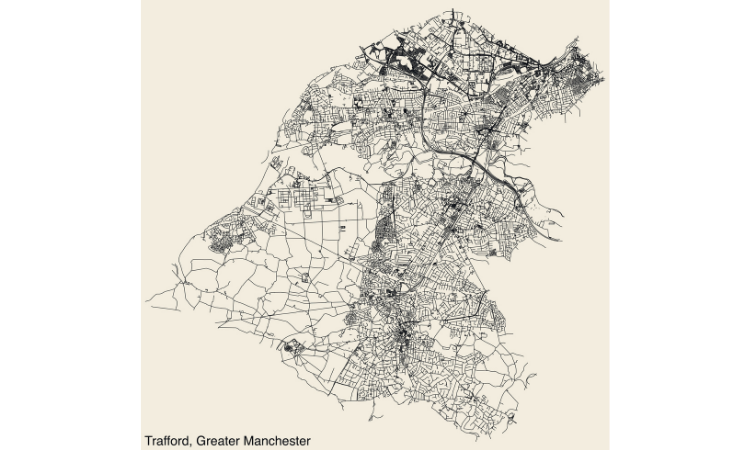
This guide covers the Metropolitan Borough of Trafford (ONS code E08000009) across ten postcode districts: M16, M17, M23, M31, M32, M33, M41, WA13, WA14 and WA15. Trafford sits in the North West, bordering Manchester to the east and Salford to the north. The wider Greater Manchester property market also includes Stockport and Salford, each covered in its own guide.
Article updated: July 2026
Why Invest in Trafford?
Trafford recorded a population of 235,052 in the 2021 Census, up 3.74% from 226,578 in 2011. That is below the England and Wales average of 6.3%, which reflects a fully built-out suburban borough where new supply comes from densification rather than expansion. Trafford's pull for tenants is its position rather than its growth rate. Metrolink tram stops link Old Trafford, Stretford, Sale and Altrincham to Manchester city centre in under 20 minutes, and the borough sits directly between the city's job market and the Cheshire commuter belt.
Median gross annual earnings in Trafford are £42,973, which is 14.8% above the North West regional median of £37,445 and 9.8% above the Great Britain median of £39,125. Higher local wages mean tenants can absorb higher rents, and they underpin a rental market where monthly rents run from £1,108 to £1,975 across the borough's postcodes. The employment rate is 79.4% with unemployment at 4.2%. The tenant base spans young professionals commuting into Manchester, families drawn by the borough's school catchments, and higher earners in the southern postcodes.
Trafford Economic Summary
- Population: 235,052 (2021 Census). Growth of 3.74% from 2011.
- Median annual salary: £42,973 (local), £37,445 (North West), £39,125 (Great Britain)
- Employment rate: 79.4% (local)
- Unemployment rate: 4.2% (local)
- Key employment sectors: Professional and technical services, healthcare, education, financial services, media
Source: ONS Census 2021, Nomis Labour Market Profile (ASHE 2025)
Regeneration and Investment in Trafford
Stretford is the focus of Trafford's largest housing programmes, with three overlapping schemes set to add more than 1,400 homes along the A56 corridor between Old Trafford and Sale. The area also carries Metrolink connectivity, which is what makes the concentration of development here matter for the M32 rental market.
- Stretford Civic Quarter (Masterplanning, around 1,200 homes): Far East Consortium has been selected by Trafford Council and the Greater Manchester Combined Authority to deliver about 1,200 homes and a 250-bed hotel on the 120-acre former Kellogg's and Greater Manchester Police headquarters site, with 25% affordable housing. A planning application is expected in spring 2026. Updates at Place North West.
- Stretford Town Centre Regeneration (Under construction, £50 million): Bruntwood Works and Trafford Council are converting Stretford Mall into an open-air high street and town square, backed by £17.6 million from the Future High Streets Fund. Phase 1 construction is underway. Updates at Place North West.
- Former B&Q Site Residential Development (Approved, 228 homes): Liverpool-based Brickland has planning permission for 228 homes on the former B&Q store on Great Stone Road, next to Old Trafford Cricket Ground, with £1.4 million towards affordable housing. The mix runs to 90 one-bed and 113 two-bed apartments plus larger units. Updates at Trafford Council.
Source: Office for National Statistics - Population for Trafford
Trafford Property Market Analysis
A home that sold for £57,745 in Trafford in January 1995 changed hands for £380,289 by March 2026, a 558.6% rise across three decades. The sections that follow walk through the market cycles behind that number, then break out the current postcode-level data on sold prices, price per square foot, asking prices, growth and transaction volumes.
When was the last house price crash in Trafford?
All sold property prices for Trafford come from the HM Land Registry House Price Index, recorded at borough level from January 1995 to March 2026. That gives 31 years of continuous data covering several full market cycles.
The 1995 to 2008 boom: Trafford started at £57,745 in January 1995 and climbed steadily through the early 2000s, passing £87,813 by December 2000 and reaching a pre-crash peak of £202,698 in January 2008. That was a 251% rise over 13 years, driven by cheap credit, employment growth along the Manchester corridor, and rising demand for the borough's school catchments.
2008 to 2009, the financial crisis: Prices fell from the January 2008 peak of £202,698 to a trough of £163,713 by April 2009, a decline of 19.2% over 15 months. The worst annual reading was -17.8% in March 2009. That was a steeper annual fall than the North West's worst of -14.0%, though milder than England's -15.5%. A higher-value borough like Trafford fell more sharply in percentage terms than lower-priced parts of the region, because there was more headroom to give back.
The 2010 to 2013 stagnation: Prices bounced off the April 2009 trough but then stalled. The average drifted in a band around £175,000 to £190,000 for close to four years, unable to reclaim the pre-crash peak as mortgage lending stayed tight and the wider North West market ground sideways.
Recovery, 2014 to 2016: Prices passed the pre-crash peak in May 2014 at £203,312, six years and four months after the January 2008 high. Manchester's job growth and commuter demand drove the recovery, and by December 2016 the average had reached £238,273.
The 2017 to 2019 pre-pandemic growth: Steady growth continued, with the average reaching £287,223 by December 2019. The maturing Metrolink network and Manchester's emergence as a major business hub supported demand across the borough.
2020 to 2022, the pandemic surge: The stamp duty holiday and the shift to remote working pushed prices from £298,259 in March 2020 to £359,848 by December 2022, as buyers chased Trafford's suburban housing and garden space.
The 2023 rate shock: Higher mortgage rates cooled the market. The December 2023 average of £358,412 was fractionally below where the borough had ended 2022, as rates above 5% took the heat out of demand.
2024 to present: Prices recovered through 2024 to £375,228 by December, then reached an all-time high of £383,718 in January 2026 before easing to £380,289 by the latest March 2026 reading, an annual change of 0.1%.
Long-term growth summary:
- 5 years (March 2021 to March 2026): 17.2% growth (£324,372 to £380,289)
- 10 years (March 2016 to March 2026): 59.6% growth (£238,273 to £380,289)
- 15 years (March 2011 to March 2026): 105.6% growth (£185,007 to £380,289)
- 20 years (March 2006 to March 2026): 116.8% growth (£175,385 to £380,289)
- 30 years (January 1995 to March 2026): 558.6% growth (£57,745 to £380,289)
Trafford's 19.2% peak-to-trough fall was deeper than the North West headline, and the recovery to the old peak took more than six years. The 558.6% return across three decades still marks it out as a strong long-term performer. An investor who bought at the exact January 2008 peak would now be sitting 87.6% above that price on the Land Registry average. The 18-year property cycle frames how those peaks, troughs and recoveries tend to repeat.
- All property types
- Detached
- Semi-detached
- Terraced
- Flats
- All property types
- Detached
- Semi-detached
- Terraced
- Flats
Sold House Prices in Trafford
The average sold price across all property types in Trafford is £380,289, which is 31.2% above the England average of £289,946 as of March 2026. Trafford is one of the few boroughs in our database where nearly every property type sells above the England equivalent. The premium is widest at the top of the market and narrows towards the bottom: detached houses sit 63.0% above England, while flats are the single exception at 2.7% below.
| Property Type | Trafford Average | England Average | Difference |
|---|---|---|---|
| Detached houses | £767,085 | £470,492 | +63.0% |
| Semi-detached houses | £430,553 | £288,185 | +49.4% |
| Terraced houses | £333,139 | £243,788 | +36.7% |
| Flats and maisonettes | £208,673 | £214,563 | -2.7% |
| All property types | £380,289 | £289,946 | +31.2% |
Detached houses at £767,085 carry the widest premium at 63.0% above England's £470,492. This is the concentration of large detached stock in the southern postcodes, where WA14 (Altrincham, Bowdon) and WA15 (Hale, Timperley) push individual sales past £1 million. Annual growth of 1.1% points to steady demand rather than a market running hot.
Semi-detached houses at £430,553 sit 49.4% above England's £288,185. The semi-detached home is the dominant stock type across Stretford, Sale and Urmston, and at 56.9% of homes in M32 it is the backbone of the borough's family lettings. Annual growth of 1.4% was the fastest of any house type over the year.
Terraced houses at £333,139 are 36.7% above England's £243,788. The terraced market concentrates in M16 (Old Trafford), M32 (Stretford) and M23 (Baguley), where the borough's more affordable housing sits, and those same postcodes carry the highest rental yields. Annual growth of 0.9% held broadly in line with the borough average.
Flats and maisonettes are the exception. At £208,673 they sit 2.7% below England's £214,563, the only property type where Trafford is cheaper than the national figure. The borough's stock is overwhelmingly houses, and the thin new-build flat supply keeps values below what inner-city Manchester achieves. Annual change of -3.7% was the only negative reading across the four types.
Price Per Square Foot in Trafford
Sold prices per square foot in Trafford run from £264 in M31 (Partington, Carrington) to £449 in WA15 (Hale, Timperley), a 70% gap across a single borough. Price per square foot strips out the size of the home, so it compares the cost of space itself rather than the headline price of a bigger or smaller house. Figures are available for nine of the ten postcodes; M17 (Trafford Park) has too few recent transactions to calculate one.
| Rank | Area | Price Per Sq Ft |
|---|---|---|
| 1 | M31 (Partington, Carrington) | £264 |
| 2 | M23 (Baguley) | £309 |
| 3 | M16 (Old Trafford) | £311 |
| 4 | M32 (Stretford) | £314 |
| 5 | M41 (Urmston) | £359 |
| 6 | WA13 (Lymm) | £365 |
| 7 | M33 (Sale, Brooklands) | £390 |
| 8 | WA14 (Altrincham, Bowdon) | £422 |
| 9 | WA15 (Hale, Timperley) | £449 |
| - | M17 (Trafford Park) | Not enough data |
The four cheapest postcodes for space (M31, M23, M16 and M32) all sit between £264 and £314 per square foot, and they are the same northern and western postcodes that carry the borough's highest yields. M31 (Partington, Carrington) at £264 buys 70% more floor area per pound than WA15 (Hale, Timperley) at £449. For an investor pricing a refurbishment or comparing two homes of different sizes, that spread matters more than the asking price alone.
For Sale Asking Prices in Trafford
The mean asking price across all ten Trafford postcodes is £375,637, but the median postcode (M32 at £316,480) sits £59,157 below that mean. The asking price is what sellers are currently listing at, and the three WA postcodes at the top pull the borough average well above where most of the market actually trades. Six of the ten postcodes list below that £375,637 mean, so an investor does not need the headline figure to enter Trafford.
| Rank | Area | Asking Price |
|---|---|---|
| 1 | M17 (Trafford Park) | £224,718 |
| 2 | M31 (Partington, Carrington) | £245,132 |
| 3 | M16 (Old Trafford) | £267,896 |
| 4 | M23 (Baguley) | £279,650 |
| 5 | M32 (Stretford) | £316,480 |
| 6 | M41 (Urmston) | £375,004 |
| 7 | WA13 (Lymm) | £424,998 |
| 8 | M33 (Sale, Brooklands) | £431,436 |
| 9 | WA14 (Altrincham, Bowdon) | £552,864 |
| 10 | WA15 (Hale, Timperley) | £638,191 |
M17 (Trafford Park) offers the lowest asking price at £224,718, though Trafford Park is largely commercial and industrial land with limited residential stock, which explains both the low figure and the sparse data elsewhere for this postcode. M31 (Partington, Carrington) at £245,132 and M16 (Old Trafford) at £267,896 are the next most accessible. All three list well below the borough's median postcode.
The premium tier starts at M33 (Sale, Brooklands) at £431,436 and climbs to WA15 (Hale, Timperley) at £638,191. The £413,473 gap between the cheapest and dearest Trafford postcode is wider than the entire average asking price in many northern boroughs, which is what makes Trafford effectively two markets rather than one.
House Price Growth in Trafford
Growth in Trafford has run in the opposite direction to price. The cheaper northern postcodes have appreciated fastest over five years: M31 (Partington, Carrington) leads at 52.4% and M16 (Old Trafford) follows at 37.4%. The premium south lags, with WA14 (Altrincham, Bowdon) up 8.2% and WA13 (Lymm) up 15.4% over the same window. Growth figures are available for nine of the ten postcodes; M17 (Trafford Park) has too few transactions to calculate a reliable series.
| Area | 1 Year | 3 Years | 5 Years |
|---|---|---|---|
| M31 (Partington, Carrington) | -3.3% | 8.7% | 52.4% |
| M16 (Old Trafford) | 6.0% | 35.2% | 37.4% |
| M23 (Baguley) | -3.6% | 9.7% | 35.7% |
| M41 (Urmston) | 4.9% | 8.2% | 21.1% |
| M32 (Stretford) | 1.6% | 12.4% | 20.5% |
| M33 (Sale, Brooklands) | 4.6% | 5.4% | 20.1% |
| WA15 (Hale, Timperley) | 4.9% | 3.0% | 16.1% |
| WA13 (Lymm) | 4.4% | 5.7% | 15.4% |
| WA14 (Altrincham, Bowdon) | -2.9% | 0.2% | 8.2% |
| M17 (Trafford Park) | Not enough data | Not enough data | Not enough data |
M16 (Old Trafford) is the standout on the medium term, up 35.2% over three years and 37.4% over five, and still growing 6.0% in the last year. M31 (Partington, Carrington) posts the highest five-year figure at 52.4% but has slipped 3.3% over the past year, so its gains sit further back in the window. At the premium end, WA14 (Altrincham, Bowdon) has declined 2.9% over the year and is close to flat over three, the softest medium-term record in the borough.
Monthly Property Sales in Trafford
Sales volume shows which Trafford markets are liquid enough to sell out of quickly. M33 (Sale, Brooklands) leads with 53 transactions per month, followed by WA15 (Hale, Timperley) at 39 and WA14 (Altrincham, Bowdon) at 37. Turnover, the share of local stock that changes hands each year, tells a different story: M32 (Stretford) turns over 22% of its homes a year against WA15's 10%. Figures are available for all ten postcodes, though M17 (Trafford Park) records just 2 sales a month from a small residential base.
| Area | Sales Per Month | Turnover | Asking Price |
|---|---|---|---|
| M33 (Sale, Brooklands) | 53 | 17% | £431,436 |
| WA15 (Hale, Timperley) | 39 | 10% | £638,191 |
| WA14 (Altrincham, Bowdon) | 37 | 11% | £552,864 |
| M41 (Urmston) | 36 | 19% | £375,004 |
| M16 (Old Trafford) | 25 | 8% | £267,896 |
| M23 (Baguley) | 19 | 19% | £279,650 |
| M32 (Stretford) | 19 | 22% | £316,480 |
| WA13 (Lymm) | 10 | 12% | £424,998 |
| M31 (Partington, Carrington) | 5 | 20% | £245,132 |
| M17 (Trafford Park) | 2 | 6% | £224,718 |
M32 (Stretford) has the highest turnover in the borough at 22%, with M31 (Partington, Carrington) close behind at 20%. High turnover on a mid-priced postcode points to a market where stock moves and an exit is straightforward. M16 (Old Trafford) is the contrast: 25 sales a month but only 8% turnover, which reflects a large base of stock, much of it rented, relative to the number of homes actually trading in any year.
How Long Properties Take to Sell in Trafford
Selling speed maps the same north-south split: M41 (Urmston) clears fastest at about 145 days, while M17 (Trafford Park) is slowest at roughly 435 days. Days on market is the typical number of days a home is listed before it sells, and months of unsold stock shows how much for-sale supply is sitting there at the current pace of sales.
| Area | Avg Days to Sell | Months of Unsold Stock | Market |
|---|---|---|---|
| M41 (Urmston) | 145 | 4.8 | Seller's market |
| M23 (Baguley) | 152 | 5.0 | Seller's market |
| M33 (Sale, Brooklands) | 152 | 5.0 | Seller's market |
| M31 (Partington, Carrington) | 160 | 5.3 | Seller's market |
| M32 (Stretford) | 169 | 5.6 | Seller's market |
| WA13 (Lymm) | 234 | 7.7 | Balanced market |
| WA14 (Altrincham, Bowdon) | 277 | 9.1 | Balanced market |
| WA15 (Hale, Timperley) | 304 | 10.0 | Balanced market |
| M16 (Old Trafford) | 338 | 11.1 | Balanced market |
| M17 (Trafford Park) | 435 | 14.3 | Buyer's market |
The five northern and mid-priced postcodes (M41, M23, M33, M31 and M32) all clear inside 170 days, with under six months of unsold stock, which reads as steady sale-side demand. The premium WA postcodes take eight to ten months on average, a longer wait that comes with the higher price band. M17 (Trafford Park) sits apart at 435 days on 14.3 months of stock, which fits its thin, mostly commercial residential base rather than any borough-wide weakness.
What Type of Property Can You Buy in Trafford?
Semi-detached homes are the largest single category in most Trafford postcodes, running from 30.6% of stock in WA14 to 56.9% in M32, while WA13 and WA14 are the most detached and M16 holds the most flats. The mix of housing stock shapes which strategies fit each postcode. The figures below are drawn from 2021 Census records for each postcode.
| Area | Detached | Semi-detached | Terraced | Flats |
|---|---|---|---|---|
| M16 (Old Trafford) | 4.7% | 32.9% | 19.7% | 42.7% |
| M17 (Trafford Park) | 1.5% | 45.8% | 21.6% | 31.1% |
| M23 (Baguley) | 11.4% | 41.9% | 24.4% | 22.2% |
| M31 (Partington, Carrington) | 10.3% | 52.9% | 28.0% | 6.8% |
| M32 (Stretford) | 5.0% | 56.9% | 21.2% | 16.9% |
| M33 (Sale, Brooklands) | 22.4% | 43.6% | 15.6% | 18.3% |
| M41 (Urmston) | 13.1% | 54.0% | 17.1% | 15.6% |
| WA13 (Lymm) | 42.8% | 31.2% | 15.9% | 7.4% |
| WA14 (Altrincham, Bowdon) | 33.8% | 30.6% | 17.2% | 14.0% |
| WA15 (Hale, Timperley) | 27.0% | 39.4% | 17.8% | 15.8% |
M16 (Old Trafford) holds by far the highest share of flats at 42.7%, the smaller-unit stock that typically forms the buy-to-let market, and that lines up with M16 sitting among the borough's lowest asking prices and higher yields. City-fringe flats there suit single lets and sharers, while the terraced housing across M16, M23 and M31 offers lower-cost family lets.
WA13 (Lymm) is the most detached-dominated postcode at 42.8%, with just 7.4% flats, and WA14 (Altrincham, Bowdon) is close behind at 33.8% detached. Detached and semi-detached houses together make up close to three-quarters of the stock in both, which matches their premium asking prices and lower yields. The housing here is weighted towards owner-occupier family homes rather than the smaller units that drive rental income.
Flats combine purpose-built and converted units. A small share of mobile and temporary dwellings is not shown, so rows may not total 100%.
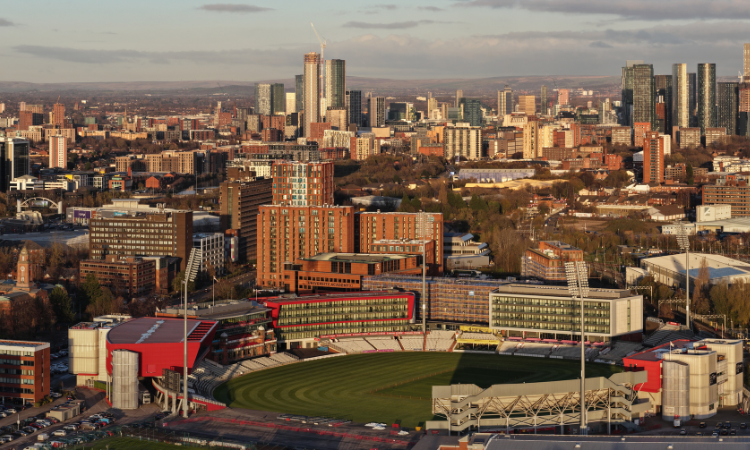
Trafford Rental Market Analysis
Monthly rents in Trafford range from £1,108 in M16 (Old Trafford) to £1,975 in WA15 (Hale, Timperley), with gross rental yields from 3.2% to 6.4% across the borough. For investors asking is buy to let worth it in Trafford, the sections below break down rents, yields and tenant affordability postcode by postcode. If you are working out how to build a property portfolio in Greater Manchester, Trafford's combination of premium tenant demand and low asking prices in the north gives two distinct routes under one borough. You can also browse current buy-to-let homes for sale across the region.
Average Rent & Gross Rental Yields in Trafford
M17 (Trafford Park) tops the yield table at 6.4%, pairing the borough's lowest asking price of £224,718 with a £1,202 monthly rent. M23 (Baguley) follows at 5.2% and M16 (Old Trafford) at 5.0%. The pattern reverses at the premium end: WA14 (Altrincham, Bowdon) returns 3.2% despite charging the second-highest rent, because a high purchase price compresses the yield even where the rent is strong. Rental data covers eight of the ten postcodes; M31 (Partington, Carrington) and WA13 (Lymm) have too few rental listings to calculate a figure.
| Area | Average Monthly Rent | Asking Price | Gross Yield |
|---|---|---|---|
| M17 (Trafford Park) | £1,202 | £224,718 | 6.4% |
| M23 (Baguley) | £1,206 | £279,650 | 5.2% |
| M16 (Old Trafford) | £1,108 | £267,896 | 5.0% |
| M32 (Stretford) | £1,220 | £316,480 | 4.6% |
| M41 (Urmston) | £1,196 | £375,004 | 3.8% |
| WA15 (Hale, Timperley) | £1,975 | £638,191 | 3.7% |
| M33 (Sale, Brooklands) | £1,262 | £431,436 | 3.5% |
| WA14 (Altrincham, Bowdon) | £1,462 | £552,864 | 3.2% |
| M31 (Partington, Carrington) | Not enough data | £245,132 | Not enough data |
| WA13 (Lymm) | Not enough data | £424,998 | Not enough data |
Three postcodes deliver yields at or above 5.0%: M17 at 6.4%, M23 at 5.2% and M16 at 5.0%. These are the borough's most affordable areas, with asking prices between £224,718 and £279,650. The remaining five postcodes with rental data sit between 3.2% and 4.6%. WA15 (Hale, Timperley) is the clearest illustration of the trade-off: it commands the highest rent in Trafford at £1,975 a month, but its £638,191 asking price pulls the yield down to 3.7%. The income is strong; the return on capital is not.
Gross Rental Yield by Postcode
Is Trafford Rent High?
Monthly rents in Trafford consume between 30.9% and 55.1% of the local median gross monthly salary. The widely cited threshold for rent affordability is 30% of gross income. Only M16 (Old Trafford) sits close to that line, at 30.9%, while WA15 (Hale, Timperley) at 55.1% reflects a premium rental market serving a very different income bracket from the borough median.
The median gross weekly salary in Trafford is £826.40, which equates to £3,581 per month or £42,973 per year. This is above the North West regional median of £720.10 per week and the Great Britain median of £752.40 per week. Data from the Nomis Labour Market Profile (ASHE 2025).
| Rank | Area | Rent as % of Income |
|---|---|---|
| 1 | WA15 (Hale, Timperley) | 55.1% |
| 2 | WA14 (Altrincham, Bowdon) | 40.8% |
| 3 | M33 (Sale, Brooklands) | 35.2% |
| 4 | M32 (Stretford) | 34.1% |
| 5 | M23 (Baguley) | 33.7% |
| 6 | M17 (Trafford Park) | 33.6% |
| 7 | M41 (Urmston) | 33.4% |
| 8 | M16 (Old Trafford) | 30.9% |
| - | M31 (Partington, Carrington) | Not enough data |
| - | WA13 (Lymm) | Not enough data |
WA15 (Hale, Timperley) at 55.1% stands well outside the rest of the borough. Its £1,975 monthly rent is the highest in Trafford, but the tenants paying it earn considerably more than the borough median, so the ratio reads high against a salary they do not sit on. Strip WA15 and WA14 out, and the remaining six postcodes cluster between 30.9% and 35.2%, which is typical for the Greater Manchester rental market.
How Big Is Trafford's Private Rented Sector?
The private rented sector is largest in M16 (Old Trafford) at 31.8% of households, and thinnest across the outer postcodes such as WA13 (Lymm) and M41 (Urmston) at 13.3% and 12.5%. The share of homes already let privately points to how deep the established tenant pool runs and how active the lettings market is. Tenure by postcode is set out below.
| Area | Owned Outright | Owned with Mortgage | Private Rented | Social Rented |
|---|---|---|---|---|
| M16 (Old Trafford) | 20.5% | 20.6% | 31.8% | 26.3% |
| M17 (Trafford Park) | 24.0% | 26.0% | 23.6% | 20.9% |
| WA15 (Hale, Timperley) | 30.6% | 31.1% | 19.3% | 18.5% |
| WA14 (Altrincham, Bowdon) | 36.0% | 31.4% | 17.0% | 14.9% |
| M33 (Sale, Brooklands) | 38.1% | 36.7% | 14.8% | 9.9% |
| M31 (Partington, Carrington) | 29.3% | 34.8% | 14.1% | 19.9% |
| M23 (Baguley) | 22.1% | 25.6% | 13.7% | 37.5% |
| WA13 (Lymm) | 43.2% | 32.4% | 13.3% | 10.0% |
| M41 (Urmston) | 39.9% | 34.7% | 12.5% | 11.7% |
| M32 (Stretford) | 27.1% | 34.0% | 11.7% | 22.8% |
M16 (Old Trafford) has the deepest private rented sector in Trafford, close to a third of all households, and it pairs that with the borough's highest flat share and one of its higher yields. A large rented sector points to an active lettings market and a broad pool of existing tenants, a different signal from yield alone. M23 (Baguley) is the outlier the other way: its private rented sector is modest at 13.7%, but social renting accounts for 37.5% of homes, the highest in the borough. The outer WA and Urmston postcodes have small rented sectors and high owner-occupation, with WA13 (Lymm) showing the highest outright ownership at 43.2%.
Only four postcodes carry enough homes advertised to rent to read the rental market with confidence, and in each the balance currently sits with landlords rather than tenants. In M16 around 143 homes were on the rental market and letting in roughly 51 days, while M33 (Sale, Brooklands), WA14 and WA15 were letting even faster, between 35 and 43 days. The other postcodes have too few rental listings at any one time to read reliably.
Local Housing Allowance Rates in Trafford
Trafford spans three Broad Rental Market Areas, so Local Housing Allowance rates are not the same across the borough: most northern postcodes fall in Central Greater Manchester, the southern belt in Southern Greater Manchester, and WA13 (Lymm) in North Cheshire. Local Housing Allowance sets the maximum housing support a tenant on benefits can receive, so it acts as a rent floor for landlords letting to that part of the market. Which area a property sits in changes the rate, so it is worth checking before buying to let at the benefit end. To check the current rate for a specific address, you can use the government's official Local Housing Allowance calculator.
| Property Size | Central Greater Manchester | Southern Greater Manchester | North Cheshire |
|---|---|---|---|
| Shared accommodation | £94.72 | £94.72 | £78.59 |
| 1 bedroom | £178.36 | £143.84 | £109.32 |
| 2 bedrooms | £201.37 | £172.60 | £135.78 |
| 3 bedrooms | £218.63 | £207.12 | £159.95 |
| 4 bedrooms | £310.68 | £322.19 | £230.14 |
The Central Greater Manchester area, which covers M16, M17, M32 and M41, carries the highest one and two-bedroom rates at £178.36 and £201.37 a week. The Southern Greater Manchester area, covering M23, M31, M33, WA14 and WA15, pays less on the smaller sizes but the most on a four-bed at £322.19. WA13 (Lymm) sits in North Cheshire, where every rate is lower. A two-bedroom LHA rate of £201.37 a week in the central area works out at about £873 a month, below the open-market rents recorded across Trafford, so a benefit-backed tenancy sits under the borough's market rents. The stock that fits within these rates is concentrated in the cheaper northern postcodes.
Buy-to-Let Considerations
Are House Prices High in Trafford? Price-to-Earnings Ratios
Purchasing a property in Trafford requires between 5.2 and 14.9 times the median annual salary. This is based on the Nomis Labour Market Profile for Trafford showing the median gross annual income for Trafford residents is £42,973.
As a yardstick, England's average sold price of £289,946 works out at 7.4 times the Great Britain median salary of £39,125. Four Trafford postcodes come in under that 7.4x mark, so relative to local pay they are cheaper than the typical English home is relative to national pay.
| Rank | Area | Price-to-Earnings Ratio |
|---|---|---|
| 1 | M17 (Trafford Park) | 5.2x |
| 2 | M31 (Partington, Carrington) | 5.7x |
| 3 | M16 (Old Trafford) | 6.2x |
| 4 | M23 (Baguley) | 6.5x |
| 5 | M32 (Stretford) | 7.4x |
| 6 | M41 (Urmston) | 8.7x |
| 7 | WA13 (Lymm) | 9.9x |
| 8 | M33 (Sale, Brooklands) | 10.0x |
| 9 | WA14 (Altrincham, Bowdon) | 12.9x |
| 10 | WA15 (Hale, Timperley) | 14.9x |
The four most affordable postcodes against local earnings (M17 at 5.2x, M31 at 5.7x, M16 at 6.2x and M23 at 6.5x) are the same ones that carry the highest yields and, in M16 and M23, the strongest medium-term growth. M32 (Stretford) at 7.4x lands exactly on the national benchmark. The southern WA postcodes run from 9.9x to 14.9x, with WA15 (Hale, Timperley) close to double the national figure, which is where the yield compression comes from.
Deposit Requirements in Trafford
A 30% deposit on a buy-to-let property in Trafford ranges from £67,415 in M17 (Trafford Park) to £191,457 in WA15 (Hale, Timperley). The gap between the cheapest and most expensive deposit is £124,042, more than the full deposit needed in most of the northern postcodes. For an investor weighing where the capital goes furthest, that spread is the first filter. Beyond the deposit, the stamp duty calculation and other running costs of buy-to-let affect the total capital required.
| Rank | Area | 30% Deposit Required |
|---|---|---|
| 1 | M17 (Trafford Park) | £67,415 |
| 2 | M31 (Partington, Carrington) | £73,540 |
| 3 | M16 (Old Trafford) | £80,369 |
| 4 | M23 (Baguley) | £83,895 |
| 5 | M32 (Stretford) | £94,944 |
| 6 | M41 (Urmston) | £112,501 |
| 7 | WA13 (Lymm) | £127,500 |
| 8 | M33 (Sale, Brooklands) | £129,431 |
| 9 | WA14 (Altrincham, Bowdon) | £165,859 |
| 10 | WA15 (Hale, Timperley) | £191,457 |
Five postcodes need a deposit below £100,000: M17 (£67,415), M31 (£73,540), M16 (£80,369), M23 (£83,895) and M32 (£94,944). That sub-£100,000 entry is notable for a borough where the mean asking price sits near £376,000, and it maps almost exactly onto the highest-yielding postcodes. Stepping up to M41 (Urmston) at £112,501 or M33 (Sale, Brooklands) at £129,431 buys a bigger, more settled family market but a lower yield. The two WA houses at the foot of the table need close to twice the capital for a return under 3.7%.
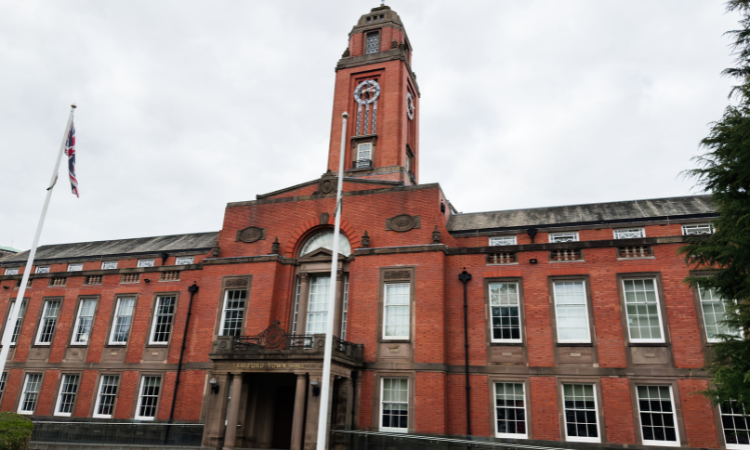
What the Trafford Data Tells Buy-to-Let Investors
In Trafford the cheapest way in is also the highest-yielding, and it clusters in the north of the borough. M17 (Trafford Park) tops the yield table at 6.4% on the lowest asking price of £224,718 and a £67,415 deposit. Its data is thin, though. There is no reliable growth series, it records just 2 sales a month, and homes take about 435 days to sell. M23 (Baguley) at 5.2% and M16 (Old Trafford) at 5.0% give the same affordability with far more market activity behind them.
M16 (Old Trafford) is where yield and growth line up with a deep tenant market. A 5.0% yield sits alongside 37.4% five-year growth and a 6.2x price-to-earnings ratio. The deposit is £80,369, and the private rented sector here is the largest in the borough at 31.8%. The tenant base here runs to young professionals commuting into Manchester and families using the borough's school catchments.
M32 (Stretford) is the postcode most exposed to the regeneration pipeline. The Civic Quarter, the Bruntwood town-centre programme and the 228-home B&Q scheme all sit in or next to M32. At a £316,480 asking price and a 4.6% yield, it is the transition postcode between the affordable north and the premium south, and its 22% turnover is the highest in Trafford, so stock moves.
The southern WA postcodes read differently. WA14 (Altrincham, Bowdon) has declined 2.9% over the year and is close to flat over three; WA13 (Lymm) and WA15 (Hale, Timperley) show the borough's lowest five-year growth at 15.4% and 16.1%. Yields run from 3.2% to 3.7%. The rents are high in cash terms, £1,462 to £1,975 a month, but the capital required pulls the return down. This is the part of Trafford where the rent does more for the tenant's address than for the landlord's yield.
Trafford does not run a borough-wide selective licensing scheme for private landlords, but shared houses that meet the criteria need an HMO licence. The rules are set out on Trafford Council's HMO licensing pages, and it is worth checking the current requirements before completing a purchase. Investors who want to come in below asking often look through off-market property in Trafford channels.
How Trafford Compares
Trafford's mean asking price of £375,637 is the highest of the six Greater Manchester locations compared here, yet its top yield of 6.4% sits mid-table. The comparison below places Trafford alongside five neighbouring boroughs, each with a different investor profile. The mean asking price and mean monthly rent are simple averages across all postcodes with data. Top gross yield is the single highest postcode yield in each location.
| Location | Mean Asking Price | Mean Monthly Rent | Mean Gross Yield | Top Yield (postcode) |
|---|---|---|---|---|
| Salford | £248,444 | £1,188 | 5.7% | 6.6% (M3, M6) |
| Bolton | £255,835 | £981 | 4.6% | 6.1% (M38) |
| Manchester | £268,032 | £1,312 | 5.9% | 8.1% (M14) |
| Stockport | £374,681 | £1,326 | 4.2% | 6.0% (SK1) |
| Trafford | £375,637 | £1,329 | 4.2% | 6.4% (M17) |
Trafford and Stockport are the two most expensive Greater Manchester boroughs, sitting within £1,000 of each other on both price and rent, and both trade a higher entry cost for a wealthier tenant base. Manchester offers the highest top yield in the table at 8.1% on a much lower average price, driven by its large student and young-professional rental market. Salford at 6.6% and Bolton at 6.1% deliver their top yields at lower entry points still. Trafford's affordable northern postcodes (M17, M23, M16) reach into that same yield range while offering access to the borough's school catchments and premium tenant pool, which is what an investor pays the higher average price for.
Frequently Asked Questions
Is Trafford a good place to live for buy-to-let tenants?
Better placed than most of Greater Manchester, and it comes down to jobs and wages. Trafford's employment rate is 79.4% and the typical wage is £826.40 a week, 14.8% above the North West average of £720.10. Tenants earning a little more, in steadier work, are generally better able to keep the rent paid.
It is also an easy borough to rent in. Metrolink trams connect Old Trafford, Stretford, Sale and Altrincham to Manchester city centre in under 20 minutes, which suits the professional renters and commuting families who make up much of the tenant base.
What are the best areas in Trafford for property investment?
The borough splits north-south. M17 (Trafford Park) carries the highest yield at 6.4% on the lowest asking price of £224,718, though its data is thin, so M23 (Baguley) at 5.2% and M16 (Old Trafford) at 5.0% are the more liquid yield plays. M16 also has 37.4% five-year growth and the borough's deepest private rented sector.
At the top end, WA15 (Hale, Timperley) and WA14 (Altrincham, Bowdon) charge the highest rents, £1,975 and £1,462 a month, but their yields sit at 3.7% and 3.2% because asking prices run past £550,000. So if income is the priority, the northern postcodes lead on yield and deposit; if the draw is a premium address and a wealthier tenant, the WA postcodes are where that sits.
How does Trafford compare to Manchester for buy-to-let?
They are close on rent but far apart on price and yield. Manchester's top yield is 8.1% against Trafford's 6.4%, and its mean asking price of £268,032 is about £108,000 below Trafford's £375,637. Manchester's strength is rental demand from a large student and young-professional population.
Trafford trades that yield for a wealthier tenant base and stronger school catchments. In practice, Trafford's affordable postcodes (M16 at 5.0%, M23 at 5.2%, M17 at 6.4%) reach into Manchester's yield range, while the southern WA postcodes serve a different market entirely. Which fits depends on whether the money is chasing headline yield or a more settled tenant.
What is the asking price of property in Urmston?
M41 (Urmston) lists at an average asking price of £375,004, which puts it in the middle of the Trafford range, below Sale (£431,436) and above Stretford (£316,480). Urmston runs 36 sales a month at a 19% turnover, one of the more active markets in the borough, and clears fastest of any postcode at about 145 days on market. The gross yield is 3.8% on a £1,196 monthly rent. It is a popular family area with Metrolink and rail links into Manchester.
How much deposit do I need for a buy-to-let in Trafford?
A standard 30% deposit runs from £67,415 in M17 (Trafford Park) to £191,457 in WA15 (Hale, Timperley). Five postcodes need less than £100,000: M17 (£67,415), M31 (£73,540), M16 (£80,369), M23 (£83,895) and M32 (£94,944). For a mid-range entry, M32 (Stretford) at £94,944 places an investor in the borough's main regeneration area on a 4.6% yield and 20.5% five-year growth. A rent-to-buy arrangement is one route in for investors who want to enter Trafford with a lower initial outlay.
What are average house prices in Trafford?
The average sold price across Trafford is £380,289 on the Land Registry index, about 31.2% above the England average of £289,946 as of March 2026. Asking prices by postcode run from £224,718 in M17 (Trafford Park) up to £638,191 in WA15 (Hale, Timperley), with a borough-wide mean of £375,637. By type, detached homes average £767,085, semi-detached £430,553, terraced £333,139 and flats £208,673.
Through a buy-to-let lens, M17 is the cheapest entry and the highest-yielding at 6.4%, while WA15 is the dearest and among the lowest-yielding at 3.7%.
What are the Local Housing Allowance rates in Trafford?
Trafford is split across three Broad Rental Market Areas, so the rates depend on where a property sits. In the Central Greater Manchester area, which covers most northern postcodes, June 2026 Local Housing Allowance runs at £94.72 a week for a shared room, £178.36 for a one-bed, £201.37 for two beds, £218.63 for three and £310.68 for four. The Southern Greater Manchester and North Cheshire areas that cover the southern belt pay different rates. That figure is the most a tenant on housing support can claim towards rent, so for that part of the market it effectively sets a floor.
What type of property is most common in Trafford?
Semi-detached houses, in most postcodes. They run from 30.6% of the stock in WA14 (Altrincham, Bowdon) up to 56.9% in M32 (Stretford). Flats are heavily concentrated in M16 (Old Trafford), where they make up 42.7% of homes, the smaller-unit stock that usually suits buy-to-let. WA13 (Lymm) and WA14 sit at the other end, with the most detached houses and the fewest flats.
How do I buy an investment property in Trafford?
Start by deciding whether the purchase is for income or for a premium address, because that points at a different part of the borough. The northern postcodes, M17 (Trafford Park), M23 (Baguley) and M16 (Old Trafford), are the cheapest entries at £224,718 to £279,650 and the highest-yielding at 5.0% to 6.4%. The southern WA postcodes run past £550,000 for yields nearer 3.2%. Budget for a 30% deposit, which runs from £67,415 in M17 to £191,457 in WA15.
Beyond what is listed openly, plenty of experienced investors buy below asking through off-market property in Trafford and below market value properties. To see what is available now, browse investment properties in Trafford or buy-to-let homes for sale. For a data-driven comparison across all UK locations, see our best buy-to-let areas guide.
Ready to buy property?
Access off-market investment properties with an average 8%+ annual gross yield (beating the UK's typical 3-5%).
Get property alerts