

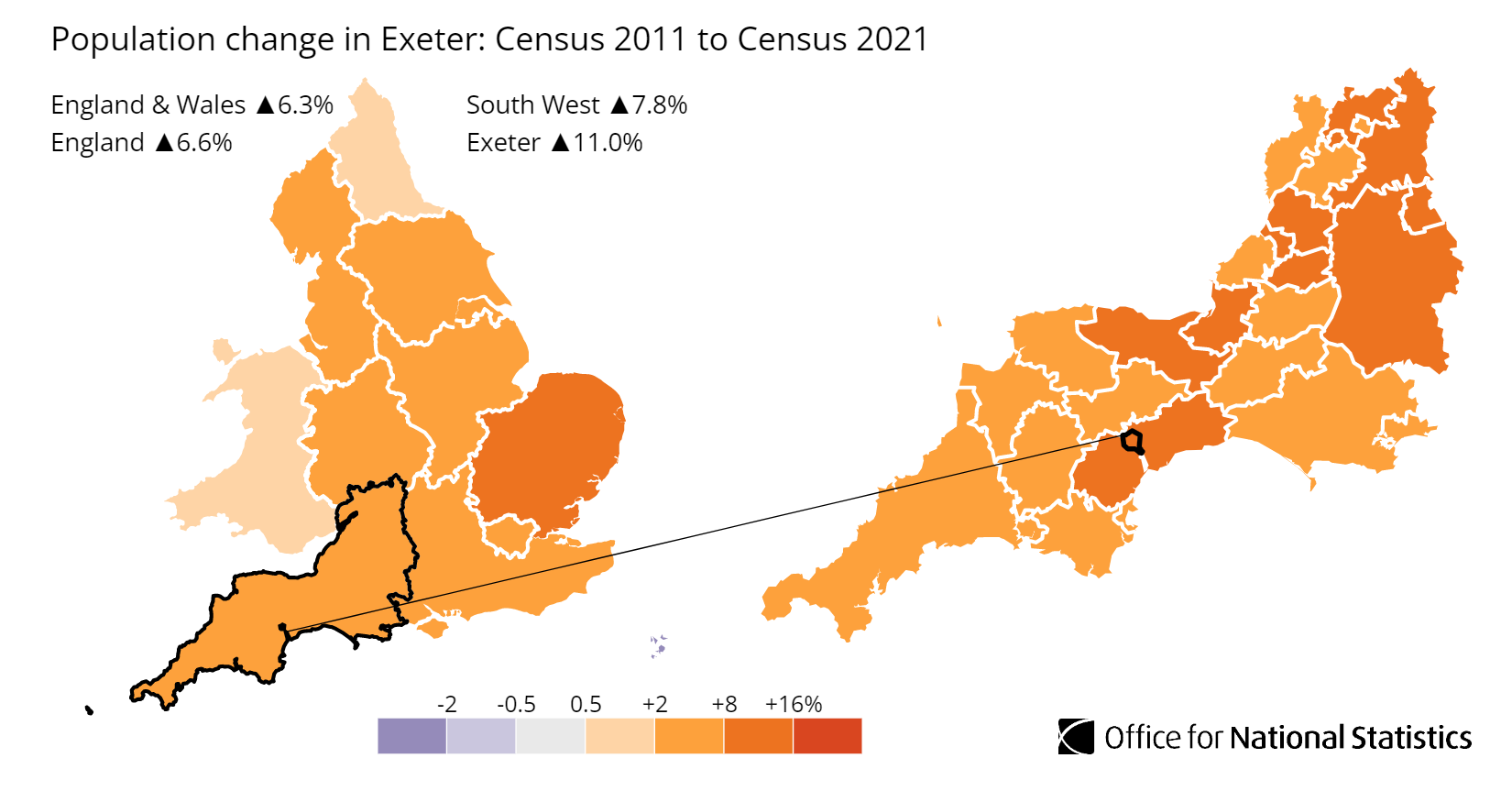
Exeter is a cathedral city in Devon, in the South West of England. The average sold price across Exeter is £286,131 on the HM Land Registry House Price Index, just £3,815 below England's £289,946, a discount of only 1.3%. Most cities priced this close to the England average sit in the commuter South East. Exeter does it on the back of a Russell Group university, a cluster of public-sector employers and a catchment that pulls in the whole of East and Mid Devon. The city's population grew 11.0% between the 2011 and 2021 censuses, from 117,773 to 130,709, well ahead of the 6.6% recorded across England and Wales.
That near-England headline hides a sharp split by property type. Houses in Exeter sell above the national figure, with semi-detached homes 21.1% dearer than England and detached houses 11.5% above, while flats sell 22.0% below. For an investor the practical effect is that the asking price you pay depends far more on what you buy than on where in the city you buy it. EX4 (Exwick, St Davids) is the cheapest postcode by asking price at £299,614 and also carries the highest gross yield at 5.0%, while EX3 (Topsham, Countess Wear) runs to £628,146 and sits outside the lettings market entirely.
This guide covers the city of Exeter (ONS code E07000041) across postcodes EX1 to EX6. Exeter sits on the River Exe in Devon, 44 miles north-east of Plymouth and around 70 miles south-west of Bristol, with the M5, the South West main line and Exeter Airport tying it into the rest of the country.
Article updated: July 2026
Why Invest in Exeter?
Exeter's population grew 11.0% between the 2011 and 2021 censuses, from 117,773 to 130,709 residents. That is one of the faster growth rates among English cities and well ahead of the 6.6% England and Wales average. The growth has come from an expanding university, new housing on the eastern edge of the city around Cranbrook, and a steady flow of professionals relocating to Devon. A city adding residents at that pace keeps a floor under rental demand, because the supply of homes rarely keeps up.
The University of Exeter is a Russell Group institution with a student roll in the tens of thousands, and its main Streatham Campus sits in EX4, the same postcode that carries the city's highest yield. Alongside the university, Exeter has an unusually deep public-sector employment base for a city of its size. The Met Office runs its headquarters from Exeter Science Park, and the Royal Devon University Healthcare NHS Trust is one of the largest employers in the South West. Public-sector salaries are steadier through a downturn than private-sector ones, which is part of why Exeter's housing market held up better than most in 2008.
Transport is part of what holds that tenant demand in place. Exeter has two main rail stations, Exeter St Davids on the western edge in EX4 and the more central Exeter Central just east of Queen Street, plus the smaller Exeter St Thomas. St Davids is managed by Great Western Railway and also served by South Western Railway and CrossCountry, with the fastest trains to London Paddington taking just over two hours and an hourly service to London Waterloo via Salisbury. Local lines run out to Exmouth, Barnstaple, Paignton and Okehampton, the Exmouth service running roughly every 30 minutes through the day. The M5 links the city to Bristol and the wider motorway network, with three council park-and-ride sites placed near its junctions, and Exeter Airport sits about four miles east of the centre with domestic and European routes. For a landlord, this matters because commuters and students both rate the journey into the centre and beyond, and a postcode within walking distance of St Davids or Central, as EX4 and EX1 are, draws a wider pool of tenants than one that depends on the car.
Median gross annual earnings in Exeter are £34,514, which is below the South West median of £37,544 and the Great Britain figure of £39,125. The employment rate is high at 83.9%, but the wage base is modest, and that combination matters for a landlord: it points to strong tenant demand and high occupancy, paired with rents that take a large share of local income. The numbers in the affordability section below put real figures on that pressure.
Exeter Economic Summary
- Population: 130,709 (2021 Census). Growth of 11.0% from 2011.
- Median annual salary: £34,514 (local), £37,544 (South West), £39,125 (Great Britain)
- Employment rate: 83.9% (local)
- Key employment sectors: Health, education, public administration, professional services, retail
Source: ONS Census 2021, Nomis Labour Market Profile (ASHE 2025)
Regeneration and Investment in Exeter
Exeter's largest regeneration commitment is the Liveable Exeter programme, a 20-year plan to deliver 12,000 new homes across brownfield sites in and around the city centre. Most of the active development is concentrated along the river and canal corridor and in the centre itself, where the council has set out to add housing without pushing further into the surrounding Devon countryside.
- Liveable Exeter (In progress, 12,000 homes): A council-led programme to bring forward 12,000 new homes on city-centre and edge-of-centre brownfield sites over two decades, alongside transport and green-space investment. The scale matters for landlords because it signals where new rental stock will land, with the riverside and canal sites carrying the bulk of the homes. Updates at Exeter City Council.
- Exeter City Centre Redevelopment (In progress): A series of city-centre schemes anchored by the new bus station and the St Sidwell's Point leisure centre, the first Passivhaus public pool in the country, with later phases adding homes, hotel and retail space around the centre. The completed leisure centre has already drawn footfall back to the eastern side of the city core. Updates at Exeter City Council.
- Water Lane and the Canal Corridor (Planning stage): The flagship Liveable Exeter site on a brownfield canalside parcel, planned for a mix of market homes, affordable housing and student accommodation. It is the single largest housing parcel in the programme and adds new supply to the inner postcodes where rental demand is strongest.
Source: Office for National Statistics - Population for Exeter
Exeter Property Market Analysis
Average property prices in Exeter have risen 450.4% since January 1995, from £51,982 to £286,131. The sections below trace that journey cycle by cycle, then drill into current postcode-level data for sold prices, price per square foot, asking prices, growth trends and how long homes take to sell.
When was the last house price crash in Exeter?
Exeter's sold prices are recorded by HM Land Registry at city level under the Exeter local authority, with the index running from January 1995 to March 2026, just over 31 years of market history.
The 1995 to 2007 climb: Exeter started at £51,982 in January 1995 and reached £196,062 by June 2007. The price roughly quadrupled over twelve years, with the fastest run between 2001 and 2004 as cheap credit met a city that builds slowly. By December 2000 the average was £76,834; five years later it had passed £163,000.
2008 to 2009, the financial crisis: From the June 2007 peak of £196,062, Exeter fell to a trough of £163,240 in March 2009, a drop of 16.7% over 21 months. The worst single year-on-year reading was -13.8%, also in March 2009. That decline was shallower than England's 18.2% fall over the same downturn, and the university and public-sector wage base is the most likely reason the local market found a floor sooner than larger regional cities did.
2010 to 2013, the flat years: Prices bounced off the 2009 trough and then went sideways. The average sat at £184,946 in December 2010 and was still only £184,290 by January 2013, having drifted within a narrow band for three years without troubling the old peak.
Recovery, 2014: Exeter passed its June 2007 peak in February 2014, at £196,517. That is six years and eight months to get back to the pre-crash high, slower than the national average but in line with much of the South West. By December 2015 the average had reached £216,357.
2016 to 2019, steady growth: The market grew at a measured single-digit pace through these years, moving from £219,544 in March 2016 to £246,122 by December 2019. Inward migration and a tight supply of new homes kept prices rising without the froth seen in some other cities.
2020 to 2022, the pandemic surge: The stamp duty holiday and the shift to remote working sent prices sharply higher in a city that offered space, coast and countryside. Exeter ran from £246,377 in March 2020 to an all-time high of £307,195 in October 2022, the single highest reading in the whole series.
2023 to 2026, the cooling: Higher mortgage rates pulled the heat out of the market. From that October 2022 peak, prices have eased back to £286,131 by March 2026, down 6.9% from the high, with the latest year-on-year reading at -3.2%. An investor buying now is paying roughly what the market last cleared in early 2022. For context on where the wider market sits in its cycle, see our analysis of the 18-year property cycle.
Long-term growth summary:
- 5 years (March 2021 to March 2026): 11.0% growth (£257,889 to £286,131)
- 10 years (March 2016 to March 2026): 30.3% growth (£219,544 to £286,131)
- 15 years (March 2011 to March 2026): 55.7% growth (£183,800 to £286,131)
- 20 years (March 2006 to March 2026): 70.5% growth (£167,849 to £286,131)
- 30 years (January 1995 to March 2026): 450.4% growth (£51,982 to £286,131)
Exeter's 16.7% crash was milder than the national fall, but the recovery took the best part of seven years, and the recent cooling has given back about a year and a half of pandemic gains. The 30-year return of 450.4% is the longer-run story: steady capital growth from a city that adds people faster than it adds homes. An investor who bought at the exact June 2007 peak would be up 46.0% on the Land Registry average today.
- All property types
- Detached
- Semi-detached
- Terraced
- Flats
- All property types
- Detached
- Semi-detached
- Terraced
- Flats
Source: HM Land Registry House Price Index for Exeter, January 1995 to March 2026.
Sold House Prices in Exeter
Exeter's average sold price of £286,131 is 1.3% below England's £289,946, but the headline conceals a wide split: houses sell above England and flats sell 22.0% below it. The narrow city-wide gap is the average of two very different markets. Where the discount comes from is almost entirely the flat segment.
| Property Type | Exeter Average | England Average | Difference |
|---|---|---|---|
| Detached houses | £524,394 | £470,492 | +11.5% |
| Semi-detached houses | £349,126 | £288,185 | +21.1% |
| Terraced houses | £286,418 | £243,788 | +17.5% |
| Flats and maisonettes | £167,442 | £214,563 | -22.0% |
| All property types | £286,131 | £289,946 | -1.3% |
Detached houses average £524,394, which is 11.5% above England's £470,492. Exeter's detached stock concentrates in the outer postcodes, particularly EX6 (Dawlish), where detached homes make up 61.3% of the housing, and EX3 (Topsham, Countess Wear). These are family homes bought by relocating professionals and downsizers from the South East, and annual change of -2.2% reflects the same gentle cooling running through the wider market.
Semi-detached houses carry Exeter's largest premium, at £349,126, fully 21.1% above England's £288,185. The semi is the squeezed middle of the Exeter market: families priced out of detached homes compete for a limited supply of semis in the inner suburbs, and that demand has pushed the category well above the national figure. Annual change of -1.8% makes it the most resilient house type of the four over the past year.
Terraced houses average £286,418, which is 17.5% above England's £243,788. Exeter's terraced stock is largely Victorian and Edwardian and clusters in EX1 (City Centre, Whipton) and EX4 (Exwick, St Davids), within walking distance of the centre and the university. That location is what lifts the price, since the same terrace is the natural HMO and student-let stock. Annual change ran at -2.5% over the year.
Flats and maisonettes average £167,442, which is 22.0% below England's £214,563, and this is where the city-wide discount comes from. The national flat average is inflated by London; strip that out and a regional city like Exeter prices flats on local demand alone. Exeter's flat stock leans towards purpose-built student blocks and ex-local-authority units that trade at lower price points, and the category fell 7.1% over the past year, the sharpest move of any type.
Price Per Square Foot in Exeter
Five of Exeter's six postcodes sit within a £18 band on price per square foot, from £326 in EX5 to £344 in EX2 and EX6, while EX3 stands apart at £458. Measuring by the square foot takes property size out of the comparison, so a postcode that looks dear only because its homes are big gets levelled out. On that basis most of Exeter is remarkably uniform, and the one true premium location is Topsham.
| Rank | Area | Price Per Sq Ft |
|---|---|---|
| 1 | EX5 (Cranbrook, Broadclyst) | £326 |
| 2 | EX4 (Exwick, St Davids) | £332 |
| 3 | EX1 (City Centre, Whipton) | £337 |
| 4 | EX2 (Wonford, St Thomas) | £344 |
| 5 | EX6 (Dawlish) | £344 |
| 6 | EX3 (Topsham, Countess Wear) | £458 |
EX5 (Cranbrook, Broadclyst) is the cheapest space in the city at £326 per square foot, from 500 transactions analysed. Cranbrook is a new-build town on Exeter's eastern edge, and new-build estates of larger-format houses tend to bring the per-square-foot cost down, which is exactly what shows here. EX4, the highest-yielding postcode, sits next at £332, so the income-leading postcode is also one of the cheapest places to buy floor space.
EX3 (Topsham, Countess Wear) at £458 per square foot is 33% above EX6 and EX2, the next-dearest postcodes, on 131 transactions analysed. Topsham is a Georgian estuary village inside Exeter's boundary, and its period houses and waterside position price it like a different town. The thin sales volume, just six a month, means each transaction carries more weight, so the figure should be read as the premium it is rather than a number you can replicate across the postcode.
For Sale Asking Prices in Exeter
Exeter's asking prices run from £299,614 in EX4 to £628,146 in EX3, a spread of more than 2x across just six postcodes. That gap is the single widest feature of the Exeter market. The mean asking price across all six postcodes is £398,902, but the average is pulled upwards by EX3, and most of the city sits well below it.
| Rank | Area | Asking Price |
|---|---|---|
| 1 | EX4 (Exwick, St Davids) | £299,614 |
| 2 | EX1 (City Centre, Whipton) | £322,600 |
| 3 | EX2 (Wonford, St Thomas) | £331,692 |
| 4 | EX5 (Cranbrook, Broadclyst) | £394,150 |
| 5 | EX6 (Dawlish) | £417,212 |
| 6 | EX3 (Topsham, Countess Wear) | £628,146 |
EX4 (Exwick, St Davids) at £299,614 is the only Exeter postcode with an asking price below £300,000, and it is £23,000 cheaper than the next step up. EX4 covers Exwick across the river and the streets around St Davids station, mixing Victorian terraces with post-war housing. It is the entry point to the city, and as the later sections show, it is also the postcode where yield, growth and sales volume all line up best.
EX3 (Topsham, Countess Wear) at £628,146 sits £210,934 above the next-dearest postcode, EX6. That is not a small premium; it is a different market sitting inside the city boundary. Topsham's estuary village stock and its low turnover put it beyond the reach of most buy-to-let budgets, and the rental data later in this guide confirms it operates as owner-occupier territory.

House Price Growth in Exeter
EX4, the cheapest postcode by asking price, has the strongest five-year growth at 10.6%, while EX3, the most expensive, is down 8.9% over the same period. The pattern across Exeter is consistent: the postcodes that cost the least have grown the most, and the premium postcodes have gone backwards. That is the opposite of what a buyer assumes when they pay up for the dearest address.
| Area | 1 Year | 3 Years | 5 Years |
|---|---|---|---|
| EX4 (Exwick, St Davids) | -0.4% | -1.7% | +10.6% |
| EX1 (City Centre, Whipton) | -2.3% | -3.7% | +6.8% |
| EX2 (Wonford, St Thomas) | -1.3% | -8.4% | +6.3% |
| EX6 (Dawlish) | -2.0% | -9.4% | +4.3% |
| EX5 (Cranbrook, Broadclyst) | -3.9% | -3.8% | +3.6% |
| EX3 (Topsham, Countess Wear) | -27.7% | -13.5% | -8.9% |
EX4's 10.6% five-year growth is the best in the city and the only reading that clears 10%. On EX4's £299,614 asking price, that five-year move is worth roughly £29,000 to someone who bought before the run. The figure is also the most reliable in the table, because EX4 has 40 sales a month feeding a deep, stable dataset rather than a handful of trades.
EX3's -27.7% one-year reading is the most dramatic number in the guide, and it needs the volume caveat to read it honestly. Topsham trades around six homes a month, so a single quarter of high-value sales falling out of the average can swing the figure hard. The three-year and five-year readings, both negative, tell the steadier story: the premium end of Exeter has cooled while the cheaper postcodes have held or grown. Every postcode is negative over one year, and five of the six are positive over five, so the longer holding period is where Exeter's growth has shown up.
Monthly Property Sales in Exeter
EX2 and EX4 each trade around 40 homes a month, while EX3 and EX6 manage only six and seven between sales. That gap in transaction volume is the read on how easily you can buy in and, more importantly, sell out again. The inner postcodes are liquid, and the premium outer ones are not.
| Area | Sales Per Month | Turnover | Asking Price |
|---|---|---|---|
| EX2 (Wonford, St Thomas) | 41 | 10% | £331,692 |
| EX4 (Exwick, St Davids) | 40 | 8% | £299,614 |
| EX1 (City Centre, Whipton) | 26 | 8% | £322,600 |
| EX5 (Cranbrook, Broadclyst) | 24 | 8% | £394,150 |
| EX6 (Dawlish) | 7 | 3% | £417,212 |
| EX3 (Topsham, Countess Wear) | 6 | 5% | £628,146 |
EX2 and EX4 together account for 81 of Exeter's monthly sales, more than the other four postcodes combined. For an investor that depth cuts both ways: plenty of stock to choose from going in, and a ready market when the time comes to sell. EX4 pairs that 40-a-month volume with the lowest asking price in the city, so the easiest postcode to trade is also the cheapest to enter.
EX6 (Dawlish) and EX3 (Topsham) sit at the other end, at seven and six sales a month. Thin volume is not a fault in itself, but it changes the holding maths. A postcode that trades six homes a month can leave you waiting a long time for the right buyer, which is a real cost on exit that no yield figure captures. The selling-times section below puts days-on-market numbers on exactly that.
How Long Properties Take to Sell in Exeter
EX2 (Wonford, St Thomas) finds a buyer in around 304 days, the quickest in the city, while a home in EX6 (Dawlish) sits on the market for roughly 1,014 days, more than three times as long. Days on market is the typical time a listing takes to sell; months of unsold stock measures how much for-sale supply is queued up at the current rate of sale. Read together they show where your money would be easiest, and hardest, to get back out.
| Area | Avg Days to Sell | Months of Unsold Stock | Market |
|---|---|---|---|
| EX2 (Wonford, St Thomas) | 304 | 10.0 | Balanced market |
| EX1 (City Centre, Whipton) | 380 | 12.5 | Buyer's market |
| EX4 (Exwick, St Davids) | 380 | 12.5 | Buyer's market |
| EX5 (Cranbrook, Broadclyst) | 380 | 12.5 | Buyer's market |
| EX3 (Topsham, Countess Wear) | 608 | 20.0 | Buyer's market |
| EX6 (Dawlish) | 1014 | 33.3 | Buyer's market |
The gap between EX2 at 10 months of unsold stock and EX6 at 33 months is the exit-liquidity cost that a yield table never shows. Two postcodes can post a similar yield, but if one takes ten months to clear and the other takes three years, the holding cost on the way out is wildly different. Across Exeter the inner postcodes that lead on yield also clear fastest, so the income-strong end of the city is the liquid end too, which is an unusually clean alignment.
What Type of Property Can You Buy in Exeter?
Detached homes are the largest single category in five of Exeter's six postcodes, peaking at 61.3% of stock in EX6, while EX1 stands out as the only postcode where flats and terraces together outweigh the detached share. The mix of housing in each postcode steers which strategy fits. The figures below come from 2021 Census records for each postcode.
| Area | Detached | Semi-detached | Terraced | Flats |
|---|---|---|---|---|
| EX1 (City Centre, Whipton) | 28.1% | 29.4% | 22.3% | 20.2% |
| EX2 (Wonford, St Thomas) | 40.0% | 28.3% | 19.2% | 11.9% |
| EX3 (Topsham, Countess Wear) | 53.9% | 24.4% | 11.0% | 9.7% |
| EX4 (Exwick, St Davids) | 54.0% | 18.6% | 15.3% | 9.2% |
| EX5 (Cranbrook, Broadclyst) | 52.3% | 26.7% | 14.4% | 5.0% |
| EX6 (Dawlish) | 61.3% | 19.5% | 10.5% | 5.4% |
EX1 (City Centre, Whipton) holds the most varied stock, with 22.3% terraced and 20.2% flats, the highest flat share in the city. That is the smaller-unit stock that usually drives the buy-to-let market, and it lines up with EX1 being one of the cheaper postcodes and a core area for student and young-professional lets. The Victorian terraces near the centre are the classic HMO conversion candidates, while the flats suit single and couple lets.
EX6 (Dawlish) sits at the opposite end, 61.3% detached and just 5.4% flats, with EX3, EX4 and EX5 all over half detached as well. Those postcodes are weighted towards larger family homes rather than the compact units that drive rental income, which matches their higher prices and, for EX5 and EX6, their lower yields. The stock mix is the simplest explanation for why the cheaper inner postcodes carry the better rental numbers.
Flats combine purpose-built and converted units, and a small share of mobile and temporary dwellings is left out, so the rows above may not add to exactly 100%.
Exeter Rental Market Analysis
Monthly rents across Exeter's five lettable postcodes sit in a tight band from £1,212 in EX6 to £1,328 in EX1, with gross yields running from 3.5% to 5.0%. For investors asking is buy to let worth it in Exeter, the sections below break down rents, yields and tenant affordability postcode by postcode. If you are looking at how to build a property portfolio in the South West, Exeter's university and public-sector tenant base keeps demand steady through the academic year and beyond. To see what is on the market, browse current buy-to-let property for sale across the region.
Average Rent & Gross Rental Yields in Exeter
EX4 (Exwick, St Davids) leads Exeter on gross yield at 5.0%, and it does so by pairing the lowest asking price (£299,614) with a mid-table rent of £1,248 a month. The rents themselves barely move across the city, so it is the purchase price, not the rent, that decides where the yield lands. EX3 (Topsham) has no rental data, which is itself a signal that it sits outside the lettings market.
| Area | Average Monthly Rent | Asking Price | Gross Yield |
|---|---|---|---|
| EX4 (Exwick, St Davids) | £1,248 | £299,614 | 5.0% |
| EX1 (City Centre, Whipton) | £1,328 | £322,600 | 4.9% |
| EX2 (Wonford, St Thomas) | £1,304 | £331,692 | 4.7% |
| EX5 (Cranbrook, Broadclyst) | £1,250 | £394,150 | 3.8% |
| EX6 (Dawlish) | £1,212 | £417,212 | 3.5% |
| EX3 (Topsham, Countess Wear) | Not enough data | £628,146 | Not enough data |
EX4 at 5.0% pairs the city's lowest asking price with a solid rent, so its £89,884 deposit buys into the highest-yielding postcode in Exeter. The rent of £1,248 is not the top figure in the city, but applied to the cheapest asking price it produces the best return. That is the whole point of the Exeter market: the yield is set on the buy price, not the rent.
EX6 (Dawlish) sits at the bottom on 3.5%. Its rent of £1,212 is actually the lowest in the city, and applied to a £417,212 asking price the income return is thin. EX5 follows close behind at 3.8%, where Cranbrook's higher new-build prices drag the yield down despite a perfectly normal rent. The pattern is consistent across all five lettable postcodes: rents are flat, so the cheaper the buy, the better the yield.
Gross Rental Yield by Postcode
Worth noting alongside the yields: the rental market in EX2 and EX4 is genuinely tight. In both postcodes a home advertised to let finds a tenant in around 45 days, fast enough that the balance of the market sits with landlords rather than tenants, while EX1's rental market is more evenly matched at about 93 days to let. That speed of letting is a separate signal from yield, and in Exeter's case it reinforces the same inner-postcode story.
Is Exeter Rent High?
Every lettable Exeter postcode takes more than 42% of the local median gross monthly income in rent, from 42.1% in EX6 to 46.2% in EX1. The commonly cited affordability threshold is 30% of gross income, and Exeter sits well above it across the board. That is the flip side of the city's strong yields: rents are high relative to what local people earn.
The median gross weekly salary in Exeter is £663.70, which works out at £2,876 a month or £34,514 a year. That is below the South West median of £722.00 a week and the Great Britain figure of £752.40. Data from the Nomis Labour Market Profile (ASHE 2025).
| Rank | Area | Rent as % of Income |
|---|---|---|
| 1 | EX1 (City Centre, Whipton) | 46.2% |
| 2 | EX2 (Wonford, St Thomas) | 45.4% |
| 3 | EX5 (Cranbrook, Broadclyst) | 43.5% |
| 4 | EX4 (Exwick, St Davids) | 43.4% |
| 5 | EX6 (Dawlish) | 42.1% |
| 6 | EX3 (Topsham, Countess Wear) | Not enough data |
EX1's rent of £1,328 a month against a £2,876 median salary takes 46.2% of gross income, the highest share in the city. A single earner on the local median cannot comfortably rent in inner Exeter alone, which is part of why the rental market here runs on students sharing, couples and households where two incomes come in. For a landlord, high rent-to-income ratios point to strong demand and reliable occupancy, but they also mean tenant affordability is stretched, and that is worth holding in mind when setting a rent.

How Big Is Exeter's Private Rented Sector?
The private rented sector is broadly even across Exeter, running from 15.4% of households in EX1 to 20.2% in EX3, with the four outer postcodes all clustered around 18 to 19%. The share of homes already let privately is a read on how established the local tenant market is, and an even spread like Exeter's points to a lettings market that works across the whole city rather than concentrating in one or two postcodes.
| Area | Owned Outright | Owned with Mortgage | Private Rented | Social Rented |
|---|---|---|---|---|
| EX3 (Topsham, Countess Wear) | 43.2% | 31.2% | 20.2% | 4.0% |
| EX5 (Cranbrook, Broadclyst) | 43.1% | 29.6% | 18.9% | 7.2% |
| EX6 (Dawlish) | 50.2% | 25.7% | 18.9% | 4.5% |
| EX4 (Exwick, St Davids) | 45.7% | 29.5% | 18.0% | 6.4% |
| EX2 (Wonford, St Thomas) | 41.6% | 28.7% | 17.9% | 9.9% |
| EX1 (City Centre, Whipton) | 29.6% | 36.2% | 15.4% | 16.3% |
EX3 (Topsham) shows the largest private rented share at 20.2%, which sits oddly against its lack of lettings data and its premium prices. The likely explanation is a small number of higher-value period homes let to professional households rather than a deep, active letting market, which is why no reliable rent figure surfaces for the postcode. EX1, by contrast, has the lowest private rented share at 15.4% but by far the highest social rented share at 16.3%, a reminder that the city-centre postcode mixes student and professional lets with a substantial amount of social housing.
The four outer postcodes, EX2 through EX6, all sit between 17.9% and 18.9% private rented, a tight cluster that tells you Exeter's lettings market is spread evenly rather than concentrated. For an investor that breadth is useful: tenant demand is not pinned to a single postcode, so the choice of where to buy can be driven by yield and liquidity rather than by where renters happen to be.
Local Housing Allowance Rates in Exeter
All six Exeter postcodes fall within the single Exeter Broad Rental Market Area, where Local Housing Allowance runs from £123.58 a week for a shared room to £299.18 a week for a four-bedroom home. Local Housing Allowance is the most a tenant on housing support can claim towards rent, so for that part of the market it works as an effective floor on what a let will bring in. The rates below apply across the whole city. To check the current rate for a specific address, use the government's official Local Housing Allowance calculator.
| Property Size | Weekly LHA Rate | Monthly Equivalent |
|---|---|---|
| Shared accommodation | £123.58 | £536 |
| 1 bedroom | £144.99 | £628 |
| 2 bedrooms | £182.96 | £793 |
| 3 bedrooms | £218.63 | £947 |
| 4 bedrooms | £299.18 | £1,296 |
The two-bedroom rate of £182.96 a week comes to about £793 a month, well below the £1,212 to £1,328 open-market rents recorded across Exeter's lettable postcodes. A benefit-backed tenancy at the LHA rate therefore sits a long way under what the open market pays here, so the stock that fits within these rates is concentrated in the cheaper end of EX1 and EX4. Because Exeter sits in a single broad rental market area, the rates are identical in every postcode, which keeps the calculation simple wherever in the city you buy.
Buy-to-Let Considerations
Are House Prices High in Exeter? Price-to-Earnings Ratios
Buying in Exeter takes between 8.7 and 18.2 times the local median annual salary, depending on the postcode. This is based on the Nomis Labour Market Profile for Exeter, which puts the median gross annual income for Exeter residents at £34,514.
The national benchmark for price-to-earnings is 7.4x (England's average sold price of £289,946 divided by the Great Britain median annual salary of £39,125). Every Exeter postcode sits above that line. Even the most accessible, EX4 at 8.7x, is around 18% above the national ratio, which marks Exeter out as a market where prices run ahead of local pay across the board.
| Rank | Area | Price-to-Earnings Ratio |
|---|---|---|
| 1 | EX4 (Exwick, St Davids) | 8.7x |
| 2 | EX1 (City Centre, Whipton) | 9.3x |
| 3 | EX2 (Wonford, St Thomas) | 9.6x |
| 4 | EX5 (Cranbrook, Broadclyst) | 11.4x |
| 5 | EX6 (Dawlish) | 12.1x |
| 6 | EX3 (Topsham, Countess Wear) | 18.2x |
EX4 at 8.7x is the most affordable entry relative to local earnings, with EX1 and EX2 close behind between 9.3x and 9.6x. Those three inner postcodes cluster together as the part of Exeter where purchase price and local income stay within reach of each other. EX3 at 18.2x sits in a different world, more than double EX4, where the price has long since detached from what a local salary can support and the buyers are downsizers and incomers rather than working households. For a buy-to-let purchase, the inner postcodes keep the closest relationship between purchase price and the rent that local wages can sustain.
Deposit Requirements in Exeter
A 30% deposit in Exeter runs from £89,884 in EX4 to £188,444 in EX3. The £23,000 step from EX4 to EX1 moves you between two similar inner postcodes; the £98,560 gap from EX4 to EX3 moves you into a different market entirely. Alongside the deposit, factor in the stamp duty calculation and the other buy to let fees that make up the total capital required.
| Rank | Area | 30% Deposit Required |
|---|---|---|
| 1 | EX4 (Exwick, St Davids) | £89,884 |
| 2 | EX1 (City Centre, Whipton) | £96,780 |
| 3 | EX2 (Wonford, St Thomas) | £99,508 |
| 4 | EX5 (Cranbrook, Broadclyst) | £118,245 |
| 5 | EX6 (Dawlish) | £125,163 |
| 6 | EX3 (Topsham, Countess Wear) | £188,444 |
EX4 is the cheapest way into Exeter at an £89,884 deposit, and it buys the postcode that leads on yield, growth and liquidity, so the lowest deposit and the strongest numbers happen to sit in the same place. Stepping up to EX1 or EX2 adds £7,000 to £10,000 to the deposit and lands you in a similar inner-city profile, slightly higher rent in EX1's case but a touch lower yield.
The bigger decision is whether to cross into the outer postcodes. EX5 and EX6 ask for £118,245 and £125,163, roughly £30,000 more than EX4, and they return 3.8% and 3.5% yields against EX4's 5.0%. The extra deposit buys a newer or more rural home and a lower income return, which is a different goal from the inner-postcode income play. EX3's £188,444 deposit is more than double EX4's and comes with no rental data at all, so it reads as an owner-occupier or lifestyle purchase rather than a buy-to-let one. For investors exploring lower-deposit routes, see our guide to no-deposit investment property.

What the Exeter Data Tells Buy-to-Let Investors
In Exeter the cheapest postcode to buy is also the best by every rental measure. EX4 (Exwick, St Davids) has the lowest asking price at £299,614, the highest gross yield at 5.0%, the strongest five-year growth at 10.6% and one of the deepest sales markets at 40 a month. A 30% deposit of £89,884 buys into buying investment property in the one postcode where entry cost, income, growth and liquidity all point the same way.
EX1 (City Centre, Whipton) and EX2 (Wonford, St Thomas) are the next tier by the data, both inner postcodes with asking prices under £332,000 and yields of 4.9% and 4.7%. EX1 carries the highest rent in the city at £1,328 and the most varied stock, with the largest flat share for single and couple lets. EX2 trades the most homes of any postcode at 41 a month and lets fastest, so it offers the deepest market on both the buying and the letting side.
The three outer postcodes sit apart. EX5 (Cranbrook, Broadclyst) at 3.8% and EX6 (Dawlish) at 3.5% pair higher new-build or rural prices with the lowest yields, and EX6's homes can take the best part of three years to sell. EX3 (Topsham) has no rental data, negative growth across every timeframe and just six sales a month; it operates as owner-occupier territory, and the numbers in this guide consistently place it outside the lettings market. In a market where the inner postcodes lead on every count, the value for an investor who wants to come in below asking tends to sit in off-market and BMV properties, before a home reaches the open portals.
Exeter does not currently run a selective licence for private landlords, though anyone letting a shared house near the university should confirm the current HMO licensing position with Exeter City Council before committing. With a Russell Group university, a deep public-sector employer base and a population growing faster than its housing supply, Exeter reads as a steady-demand market with modest headline yields, where the income return is set firmly by the buy price.
How Exeter Compares
Exeter's mean asking price of £398,902 is the highest of these three South West cities, yet its top yield of 5.0% is the lowest of the three. The comparison places Exeter alongside two nearby coastal cities, each with a different balance of price and income. Mean asking price and mean monthly rent are simple averages across all postcodes with data, and top gross yield is the single highest postcode yield in each location.
| Location | Mean Asking Price | Mean Monthly Rent | Mean Gross Yield | Top Yield (postcode) |
|---|---|---|---|---|
| Plymouth | £286,818 | £941 | 3.9% | 6.2% (PL5) |
| Bournemouth | £357,582 | £1,385 | 4.6% | 7.4% (BH9) |
| Exeter | £398,902 | £1,268 | 3.8% | 5.0% (EX1, EX4) |
Exeter is the dearest of the three to buy into and the lowest-yielding, which fits a market driven more by capital values and lifestyle demand than by rental return. Plymouth, 40 miles down the coast, costs £112,084 less on mean asking price and reaches a higher top yield of 6.2%, the cheaper-entry counterpoint within the same county. Bournemouth sits between the two on price but tops the table on both rent and yield, at 7.4%, on the back of a deeper and more seaside-driven lettings market.
What Exeter offers against those two is a different tenant base. A Russell Group university, the Met Office, a major NHS trust and the administrative role of being Devon's county city give it an employment mix that is steadier through a downturn than a purely seaside or service economy. Historically that has shown up as a market that held its value better than most through 2008. For a wider, data-led comparison across every UK location, see our guide to the best buy-to-let areas.
Frequently Asked Questions
Is Exeter a good place to invest in buy-to-let?
It is a steady-demand market rather than a high-yield one, and that suits some investors more than others. The pull is a Russell Group university, a deep public-sector employer base in the Met Office and the Royal Devon NHS trust, and a population that grew 11.0% in the decade to 2021, faster than its housing supply. That keeps occupancy high.
The trade-off is the price. Exeter's average sold price of £286,131 is only 1.3% below the England figure, and yields top out at 5.0%, so this is a market where the income return is modest and the case rests on tenant stability and long-run capital growth. If headline yield is the priority, the cheaper Devon and Dorset cities do better on that score.
What are the best areas in Exeter for property investment?
The data makes the split unusually clean. EX4 (Exwick, St Davids) is the cheapest postcode to buy at £299,614 and also the highest-yielding at 5.0%, with the strongest five-year growth and a deep, fast-trading market, so it leads for income. EX1 (City Centre, Whipton) and EX2 (Wonford, St Thomas) are the other two inner postcodes, both under £332,000 with yields of 4.9% and 4.7%.
The outer postcodes serve a different goal. EX5 (Cranbrook) and EX6 (Dawlish) are pricier with lower yields of 3.8% and 3.5%, suited to a buyer prioritising a newer or more rural home over income, while EX3 (Topsham) at £628,146 has no rental data and reads as owner-occupier territory. If income matters most, the three inner postcodes are where the numbers concentrate.
What are average house prices and rents in Exeter?
The average sold price across Exeter is £286,131 on the Land Registry index, about 1.3% below the England average of £289,946 as of March 2026. By type, detached homes average £524,394, semi-detached £349,126, terraced £286,418 and flats £167,442, so houses sell above the England figure and flats well below it.
Asking prices by postcode run from £299,614 in EX4 up to £628,146 in EX3, with a city-wide mean of £398,902. On the rental side, monthly rents sit in a tight band from £1,212 in EX6 to £1,328 in EX1, which produces gross yields from 3.5% to 5.0%. Because rents barely vary, the yield is decided almost entirely by the purchase price.
What type of property is most common in Exeter?
Detached houses, in five of the six postcodes. They run from 28.1% of the stock in EX1 up to 61.3% in EX6, so the city as a whole leans towards larger family homes. That stock mix is part of why prices sit close to the England average despite the modest local wage base.
The smaller units that usually suit buy-to-let, terraces and flats, are most concentrated in EX1 (City Centre, Whipton), at 22.3% terraced and 20.2% flats. That is the classic student and young-professional letting stock, and it lines up with EX1 and the neighbouring EX4 being the core of the city's rental market.
How well connected is Exeter?
Exeter runs two main stations a short distance apart. Exeter St Davids, on the western edge in EX4, is the long-distance hub, managed by Great Western Railway and also served by South Western Railway and CrossCountry, with the fastest trains reaching London Paddington in just over two hours and an hourly service to London Waterloo via Salisbury. Exeter Central, just east of Queen Street, is the more convenient stop for the city core, with the smaller Exeter St Thomas serving the St Thomas side in EX2.
Beyond the mainline, local lines reach Exmouth, Barnstaple, Paignton and Okehampton, the Exmouth service running roughly every 30 minutes. The M5 connects the city to Bristol and the national motorway network, three council park-and-ride sites sit near its junctions, and Exeter Airport lies about four miles east with domestic and European flights. For a landlord, the practical read is that the inner postcodes within reach of St Davids or Central, EX4 and EX1, draw the widest tenant pool.
Is student accommodation a worthwhile investment in Exeter?
The University of Exeter is a Russell Group institution with a roll in the tens of thousands, and its main Streatham Campus sits in EX4, the same postcode that leads the city on yield at 5.0% and average rent of £1,248 a month. Student demand concentrates in EX4 and EX1, where Victorian terraces near campus are the natural HMO stock.
The usual student-let caveats apply: summer void periods of roughly two to three months, higher management input than a single family tenancy, and HMO licensing requirements to confirm with Exeter City Council before letting. For an overview of the purpose-built end of the market, see our guide to UK student accommodation investment.
How does Exeter compare to Plymouth for buy-to-let?
Plymouth is the cheaper-entry, higher-yield option of the two. Its mean asking price is £286,818 against Exeter's £398,902, a gap of £112,084, and its top yield of 6.2% beats Exeter's 5.0%. On sold prices the contrast is even sharper: Plymouth's Land Registry average is £218,125, around 25% below England, where Exeter at £286,131 is just 1.3% below.
What Exeter trades that lower yield for is a different tenant base, with a Russell Group university and a deep public-sector employer mix against Plymouth's larger naval and service economy. Both cities sit in Devon with overlapping tenant catchments, so the choice tends to come down to whether you weight income or stability.
Can I find buy-to-let property under £300,000 in Exeter?
On a postcode-average basis, only EX4 (Exwick, St Davids) clears that bar, at £299,614, just under the line. Individual homes in EX4 and EX1 come in below their postcode averages, particularly terraces and flats, so the sub-£300,000 stock is real but selective.
The clearest route below £300,000 is by property type rather than postcode. Flats across Exeter average £167,442 on the Land Registry index, 22.0% below the England figure, and terraced houses near the centre vary widely around their averages. If a sub-£300,000 entry is the target, EX4 and EX1 flats and terraces are where to look, alongside properties to renovate that can come in below the postcode averages.
Are flats a good buy-to-let investment in Exeter?
Flats are the one property type in Exeter that sells below the England average, at £167,442 against £214,563, a 22.0% discount, where houses of every kind sell above the national figure. That lower asking price is the appeal: a smaller deposit buys into the city's strongest rental postcodes, and flats in EX1 and EX4 sit closest to the university and centre.
The flip side is performance. Exeter's flat segment fell 7.1% over the past year, the sharpest move of any property type, and the stock includes purpose-built student blocks and ex-local-authority units that trade at the lower end. Service charges, leasehold ground rent and the heavier weighting towards student tenants all need factoring in before the headline discount becomes a return.
How do I buy an investment property in Exeter?
Decide first whether you are buying for income or for growth, because in Exeter that points you at different postcodes. EX4 (Exwick, St Davids) leads on yield at 5.0% and is the cheapest entry at £299,614, while the outer postcodes ask for more and return less in income but offer newer or more rural homes. At a 30% deposit, the cash needed runs from £89,884 in EX4 to £188,444 in EX3 depending on the postcode.
Beyond what is listed openly, a good share of investor purchases happen before a property reaches the portals, through off-market properties and BMV properties for sale. To see what is available now, browse investment property exeter devon or buy-to-let homes for sale across the region.
Ready to buy property?
Access off-market investment properties with an average 8%+ annual gross yield (beating the UK's typical 3-5%).
Get property alerts