
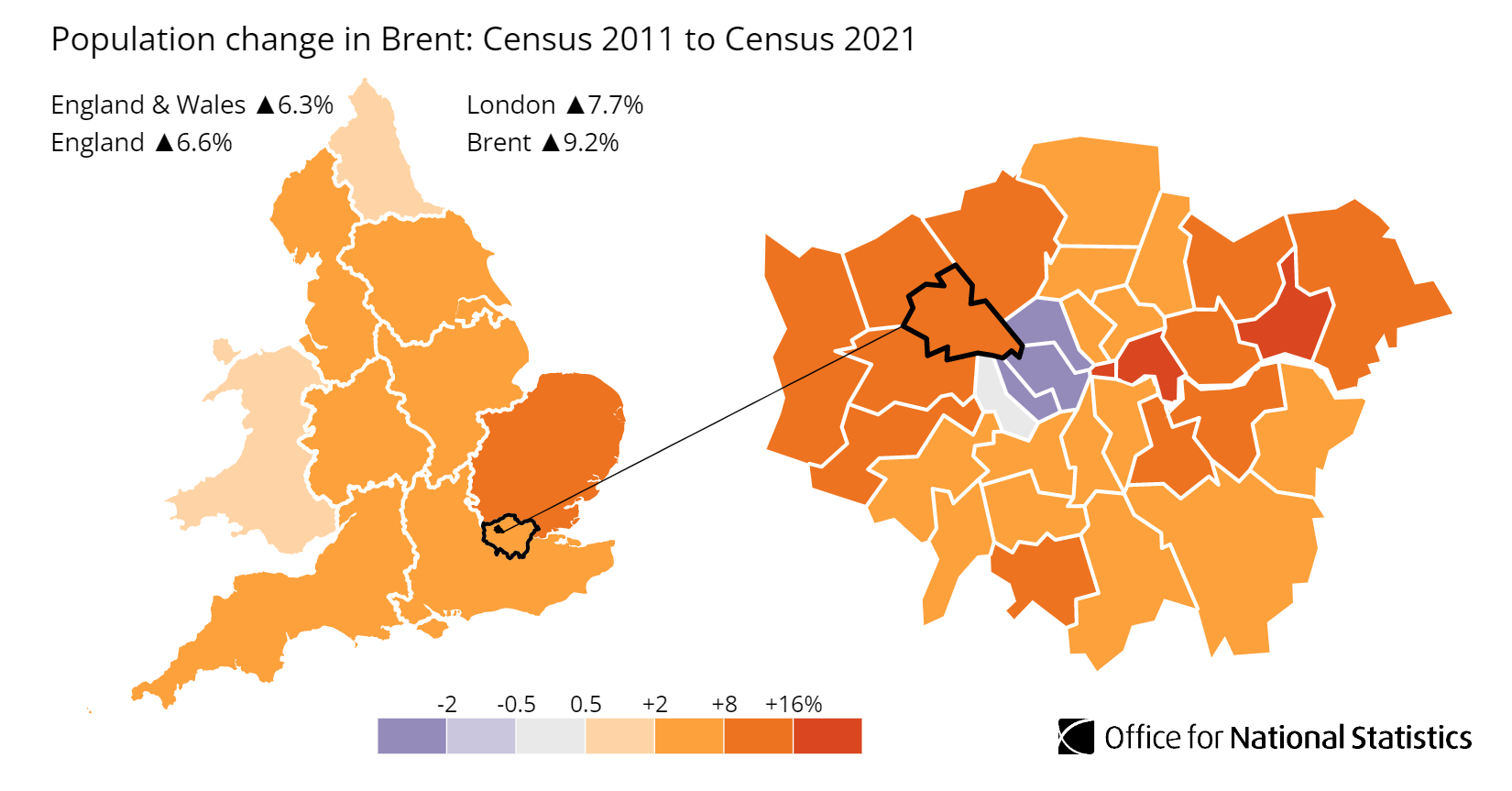
Brent is a borough of north-west London, home to Wembley Stadium. The average sold price across Brent is £538,452 on the HM Land Registry House Price Index, 85.7% above the England average of £289,946 and one of the steepest premiums of any outer London borough. That is the number that frames every Brent decision: you are buying London prices, so the income return has to work hard to keep up. It mostly does. NW9 (Kingsbury, Colindale) still returns a 5.6% gross yield, the highest in the borough, because its asking prices sit at the bottom of the Brent range while rents hold up. The local authority's population grew 9.19% between the 2011 and 2021 censuses, from 311,215 to 339,816 residents.
Eleven postcodes cover the borough, and several share territory with neighbours, so the PropertyData figures for those postcodes reflect the whole postcode district rather than the Brent slice. HA0, HA1, HA3, HA7 and HA8 overlap with Harrow, NW2 reaches into Barnet, NW6 into Camden, and W9 into Westminster. The data tables below cover all eleven, from the £440,533 entry in HA1 (Harrow on the Hill, Sudbury) to the £754,155 asking price in W9 (Maida Vale), a 71.2% spread inside a single borough.
This guide covers the London Borough of Brent (ONS code E09000005) in the north-west of the capital, with Wembley Stadium at its centre. Neighbouring boroughs include Harrow to the north-west, Barnet to the north-east, Camden to the east and Ealing to the south. For investors weighing up where to buy across the UK, Brent sits at the point where the Wembley regeneration pipeline and the borough's transport links meet.
Article updated: June 2026
Why Invest in Brent?
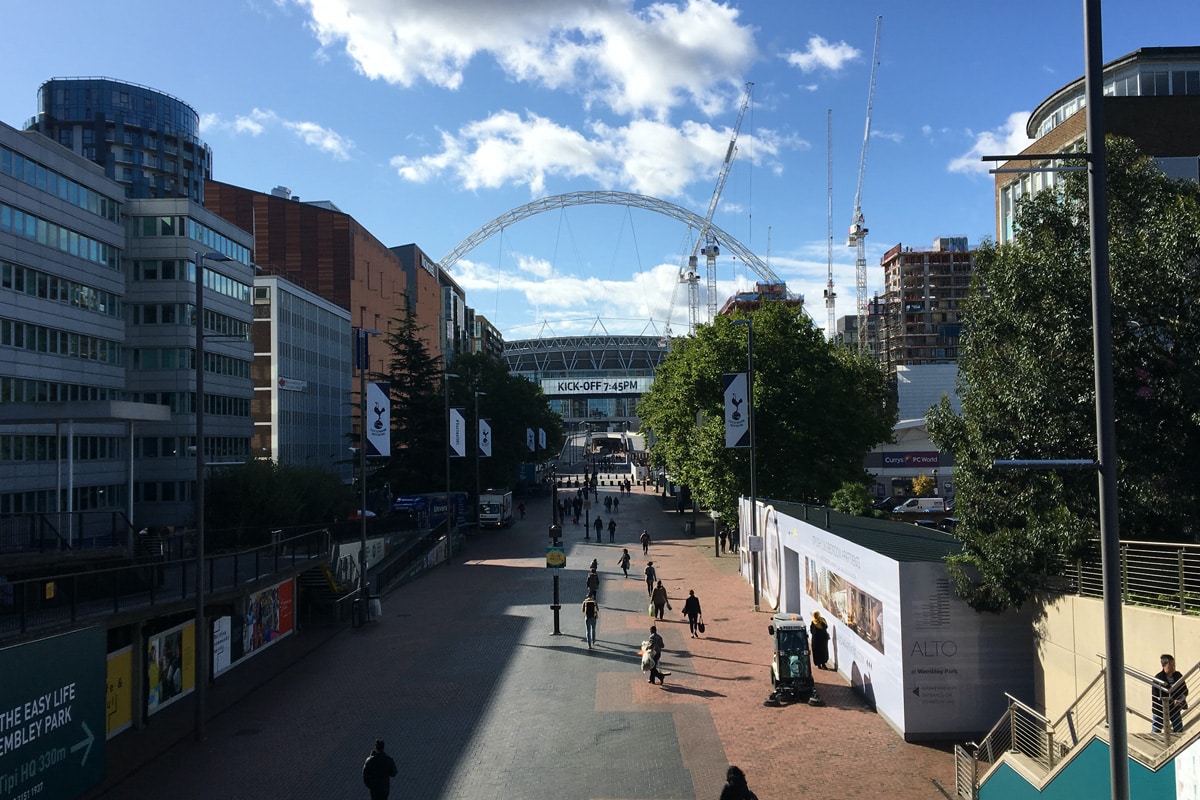
Brent added 28,601 residents between the 2011 and 2021 censuses, a 9.19% rise that outpaced the England and Wales average of 6.3%. The borough now houses 339,816 people across one of London's most diverse populations, anchored by Wembley in the centre and stretching from Kilburn and Queen's Park in the south-east to Kingsbury and Kenton in the north. The draw for tenants is location: Brent sits on the Metropolitan, Jubilee and Bakerloo lines, with Wembley Park three stops from central London, and that connectivity keeps rental demand deep across the borough.
The local employment rate of 76.1% sits just above Great Britain's 75.6% and below the wider London rate. Brent's economy leans on wholesale and retail (18.2% of employee jobs), human health and social work (17.4%) and accommodation and food (8.3%), the last of those swollen by the events economy around Wembley Stadium and the SSE Arena. The borough also carries a large private rented sector, which gives a landlord a tested pool of tenants rather than an untried one.
Here is the catch that shapes every yield in this guide. Median gross weekly earnings for Brent residents are £768.20, marginally above the Great Britain figure of £752.40 but well below the London regional median of £892.60. So tenants here earn outer-London wages while paying inner-London rents, and that gap shows up later in the affordability table. It is why Brent's headline yields stay modest even where rents are high.
Brent Economic Summary
- Population (Brent): 339,816 (2021 Census). Growth of 9.19% from 2011.
- Median annual salary: £39,944 (local), £752.40/week (Great Britain), £892.60/week (London)
- Employment rate: 76.1% (local), 75.6% (Great Britain)
- Unemployment rate: 7.4% (local)
- Key employment sectors: Wholesale and retail, human health and social work, accommodation and food, professional and technical services, administrative services
Source: ONS Census 2021, Nomis Labour Market Profile (ASHE 2025, Employment Oct 2024-Sep 2025)
Regeneration and Investment in Brent
Wembley is designated a London Plan Opportunity Area with a target of 15,000 new homes and 10,000 new jobs, the largest growth area in the borough. Most of Brent's pipeline sits in and around it, with two further programmes in South Kilburn and Staples Corner adding several thousand homes between them.
- Wembley Park (Opportunity Area, 15,000-home target): Quintain's mixed-use development around Wembley Stadium has grown into one of the UK's largest build-to-rent schemes, reshaping the streets between the stadium and Wembley Park station with new homes, public space and the London Designer Outlet. Wembley sits at the centre of Brent's growth-area target of 15,000 homes and 10,000 jobs. Updates at Brent Council Wembley Growth Area.
- South Kilburn (multi-phase, 2,400 new homes): A long-running community-led programme replacing post-war estates with 2,400 new homes alongside new schools, health facilities and transport links in the south-east of the borough. It is one of London's larger estate-renewal schemes and feeds directly into the NW6 rental market. Updates at Brent Council South Kilburn.
- Staples Corner (masterplan, 2,200+ new homes): A masterplan for at least 2,200 new homes and commercial space on the borough's north-eastern edge, where the completed Brent Cross West Thameslink station now puts central London within a short ride. The scheme targets the industrial land around the North Circular for residential-led mixed use. Updates at Brent Council Staples Corner.
Source: Office for National Statistics - Population for Brent
Brent Property Market Analysis
Average property prices in Brent have risen 600.4% since January 1995, from £76,880 to £538,452. The sections below trace that climb cycle by cycle, then drill into current postcode-level data for sold prices, price per square foot, asking prices, growth trends and transaction volumes.
When was the last house price crash in Brent?
Brent is a London borough, so all sold property prices from HM Land Registry are recorded at local authority level. The Land Registry House Price Index tracks average prices from January 1995, covering three decades of London market cycles.
The 1995 to 2007 climb: Brent started at £76,880 in January 1995. Prices doubled to £160,137 by December 2000 and kept climbing through the early 2000s as London pulled ahead of the rest of England. The market reached a pre-crash peak of £326,003 in September 2007, more than four times its 1995 level.
2008 to 2009, the financial crisis: Prices fell from the September 2007 peak of £326,003 to a trough of £279,000 in July 2009, a decline of 14.4% over 22 months. The worst year-on-year reading was -14.0% in July 2009. That was a shallower fall than the England-wide decline of 18.2% over the same period, and the recovery was quick by national standards.
Recovery by 2011: London led the rebound. Brent climbed back above its pre-crash peak by September 2011, when the average reached £330,567. Where many regional markets took the best part of a decade to recover, Brent did it in roughly two years from the trough.
2014 to 2016, the London surge: The mid-2010s were Brent's strongest stretch. Prices ran from £314,490 in March 2011 to £510,565 by March 2016, so the average had comfortably doubled its pre-crash peak inside five years as London's market outran the country.
2017 to 2019, the plateau: Growth stalled. The buy-to-let stamp duty surcharge, tighter mortgage lending and Brexit uncertainty cooled London, and Brent's average drifted in a narrow band rather than pushing higher.
2020 to 2022, the pandemic high: The stamp duty holiday and a shift towards more space lifted prices again, carrying Brent to its all-time high of £599,334 in September 2022.
2023 to present: Higher mortgage rates pulled the market back from that peak. Prices eased to £538,452 by the latest reading in March 2026, with a year-on-year change of -4.1%. Flats led the softening at -6.7% annually, while semi-detached houses were down just 1.4%. The current average sits 10.2% below the September 2022 high.
Long-term growth summary:
- 5 years (March 2021 to March 2026): 1.3% growth (£531,327 to £538,452)
- 10 years (March 2016 to March 2026): 5.5% growth (£510,565 to £538,452)
- 15 years (March 2011 to March 2026): 71.2% growth (£314,490 to £538,452)
- 20 years (March 2006 to March 2026): 102.4% growth (£266,052 to £538,452)
- 30 years (January 1995 to March 2026): 600.4% growth (£76,880 to £538,452)
The five-year figure of 1.3% is the one to sit with. For most of the past three decades Brent delivered double-digit growth over any five-year window, but the post-2022 correction has all but flattened it. The longer the lens, the better the picture looks: 71.2% over 15 years and 600.4% over 30. An investor who bought at the September 2022 high would be 10.2% down on the Land Registry average today, while one who bought a decade earlier would be sitting on a far larger gain.
- All property types
- Detached
- Semi-detached
- Terraced
- Flats
- All property types
- Detached
- Semi-detached
- Terraced
- Flats
Sold House Prices in Brent
The average sold price across all property types in Brent is £538,452, which is 85.7% above the England average of £289,946 as of March 2026. That premium is the London tax, and it is heaviest on houses. Detached homes run 174.1% above the England average while flats sit only 74.6% above, so the way into Brent at anything near the borough average is almost always a flat.
| Property Type | Brent Average | England Average | Difference |
|---|---|---|---|
| Detached houses | £1,289,431 | £470,492 | +174.1% |
| Semi-detached houses | £814,061 | £288,185 | +182.5% |
| Terraced houses | £687,401 | £243,788 | +182.0% |
| Flats and maisonettes | £374,702 | £214,563 | +74.6% |
| All property types | £538,452 | £289,946 | +85.7% |
Detached houses at £1,289,431 carry the largest premium at 174.1% above England's £470,492. There are not many of them, and they cluster in the Stanmore and Edgware end of the borough where HA7 and HA8 hold the most detached stock. Annual change of -2.0% reflects the wider easing at the top of the London market rather than anything specific to Brent.
Semi-detached houses at £814,061 sit 182.5% above England's £288,185, the steepest premium of any type. The borough's interwar semis run through Kingsbury, Kenton and Wembley, and they form the bulk of the family-let market. The annual change of -1.4% is the mildest fall of the four types, so semis have held value best through the correction.
Terraced houses at £687,401 are 182.0% above England's £243,788. Victorian and Edwardian terraces concentrate in the southern postcodes around Kilburn, Willesden and Cricklewood, where they suit both house-shares and family lets. Annual change of -1.8% tracks close to the borough average.
Flats and maisonettes at £374,702 carry the smallest premium at 74.6% above England's £214,563, and they are where Brent's buy-to-let volume lives. Purpose-built and converted flats dominate the inner postcodes, with W9 and NW6 weighted almost entirely towards apartments. Annual change of -6.7% was the sharpest of the four types, the part of the market that moved most through the rate shock.
Price Per Square Foot in Brent
Brent's space ranges from £530 per square foot in HA3 to £934 in W9, a 76% gap that tracks the move from the outer Harrow-side postcodes to inner Maida Vale. Measuring by the square foot strips out how big the homes are and shows what the location itself commands. The Harrow-overlap postcodes anchor the cheaper end; the inner London postcodes carry the premium.
| Rank | Area | Price Per Sq Ft |
|---|---|---|
| 1 | HA3 (Kenton) | £530 |
| 2 | HA8 (Edgware) | £532 |
| 3 | HA9 (Wembley Park) | £537 |
| 4 | HA0 (Wembley) | £538 |
| 5 | HA1 (Harrow on the Hill, Sudbury) | £544 |
| 6 | HA7 (Stanmore, Queensbury) | £576 |
| 7 | NW9 (Kingsbury, Colindale) | £576 |
| 8 | NW10 (Willesden, Harlesden, Kensal Green) | £603 |
| 9 | NW2 (Cricklewood, Dollis Hill) | £623 |
| 10 | NW6 (Kilburn, Queen's Park) | £870 |
| 11 | W9 (Maida Vale) | £934 |
HA3 at £530 per square foot is the cheapest space in Brent, narrowly below the cluster of Harrow-side postcodes around it. Kenton's stock is mostly interwar semis and terraces, the kind of mid-sized family housing that fills a letting agent's books. Based on 541 transactions analysed, HA3's per-square-foot rate sits 43% below W9's.
W9 at £934 per square foot tops the table by a clear margin. Maida Vale's mansion blocks and stucco-fronted conversions sit firmly in prime inner-London territory, and the 398 transactions analysed show a consistent premium over everywhere else in the borough. NW6 at £870 is the only other postcode close to it, reflecting the same inner-London pull through Kilburn and Queen's Park.
For Sale Asking Prices in Brent
HA1 at £440,533 and W9 at £754,155 sit 71.2% apart, the full width of Brent's eleven-postcode market. That hierarchy follows the same outer-to-inner gradient as price per square foot. The mean asking price across all eleven Brent postcodes is £554,541.
| Rank | Area | Asking Price |
|---|---|---|
| 1 | HA1 (Harrow on the Hill, Sudbury) | £440,533 |
| 2 | NW9 (Kingsbury, Colindale) | £443,019 |
| 3 | HA0 (Wembley) | £474,704 |
| 4 | HA9 (Wembley Park) | £484,652 |
| 5 | NW10 (Willesden, Harlesden, Kensal Green) | £523,947 |
| 6 | HA8 (Edgware) | £526,832 |
| 7 | HA3 (Kenton) | £555,430 |
| 8 | NW2 (Cricklewood, Dollis Hill) | £571,094 |
| 9 | HA7 (Stanmore, Queensbury) | £645,003 |
| 10 | NW6 (Kilburn, Queen's Park) | £680,584 |
| 11 | W9 (Maida Vale) | £754,155 |
HA1 at £440,533 is the cheapest entry in the borough, a few thousand pounds below NW9. Harrow on the Hill and Sudbury offer mid-sized flats and terraces at the lower end of the Brent range, and the gap to the next tier up at HA0 is roughly £34,000. For an investor working to a fixed budget, HA1 and NW9 are the two postcodes that open the door.
W9's £754,155 asking price is the borough's ceiling and a different market entirely. Maida Vale draws the same buyer pool as neighbouring Westminster, with period mansion flats and a prime-London postcode commanding the price. The yield data below shows what that price does to the income return.
House Price Growth in Brent
Three Brent postcodes grew across all three timeframes: HA1, HA3 and HA8. HA3 (Kenton) leads the five-year reading at 11.8%, while three postcodes (HA9, NW2 and W9) are slightly negative over five years. The spread is wide, which is what you would expect in a borough that runs from estate-renewal Wembley to prime Maida Vale.
| Area | 1 Year | 3 Years | 5 Years |
|---|---|---|---|
| HA3 (Kenton) | 6.5% | 1.7% | 11.8% |
| HA0 (Wembley) | -0.3% | 4.6% | 10.3% |
| HA8 (Edgware) | 3.8% | 5.0% | 8.9% |
| NW10 (Willesden, Harlesden, Kensal Green) | -3.8% | -11.0% | 8.9% |
| HA7 (Stanmore, Queensbury) | 2.0% | -1.7% | 4.1% |
| HA1 (Harrow on the Hill, Sudbury) | 6.0% | 5.8% | 3.6% |
| NW6 (Kilburn, Queen's Park) | -1.2% | -0.3% | 2.6% |
| NW9 (Kingsbury, Colindale) | -4.9% | -5.4% | 1.0% |
| HA9 (Wembley Park) | -5.9% | 1.3% | -0.1% |
| NW2 (Cricklewood, Dollis Hill) | -1.2% | -2.5% | -0.3% |
| W9 (Maida Vale) | 2.6% | -6.5% | -1.8% |
HA3 at 11.8% five-year growth leads the borough, paired with a positive 6.5% over the past year. Kenton's mid-market family stock held its value through the correction better than the inner postcodes did, and it is one of only three Brent postcodes positive across every window. HA1 and HA8 are the other two, both quietly compounding while the headline-grabbing postcodes wobbled.
NW10 shows the widest split in the table: down 11.0% over three years but up 8.9% over five, so the strong early-period gain has been clawed back recently in Willesden and Harlesden. At the other end, W9 is down 1.8% over five years despite a positive last twelve months, the prime-London pattern of a sharp pandemic-era rise followed by a longer give-back.
Monthly Property Sales in Brent
Transaction volumes run from 16 sales a month in HA7 to 36 in NW10, with 266 across the borough. The busier postcodes are the flat-heavy inner ones where stock turns over more often; the quieter ones are the larger-home outer postcodes. Turnover rates are low across the board, between 4% and 7%.
| Area | Sales Per Month | Turnover | Asking Price |
|---|---|---|---|
| NW10 (Willesden, Harlesden, Kensal Green) | 36 | 6% | £523,947 |
| NW9 (Kingsbury, Colindale) | 31 | 4% | £443,019 |
| NW6 (Kilburn, Queen's Park) | 30 | 4% | £680,584 |
| NW2 (Cricklewood, Dollis Hill) | 27 | 4% | £571,094 |
| HA8 (Edgware) | 26 | 6% | £526,832 |
| HA3 (Kenton) | 23 | 7% | £555,430 |
| HA1 (Harrow on the Hill, Sudbury) | 21 | 4% | £440,533 |
| W9 (Maida Vale) | 21 | 4% | £754,155 |
| HA0 (Wembley) | 18 | 6% | £474,704 |
| HA9 (Wembley Park) | 17 | 4% | £484,652 |
| HA7 (Stanmore, Queensbury) | 16 | 4% | £645,003 |
NW10 records the most transactions at 36 a month, ahead of NW9 and NW6. Willesden, Harlesden and Kensal Green hold a deep pool of flats and terraces at mid-range Brent prices, so more changes hands there than anywhere else in the borough. For an investor, a busier postcode means more comparable evidence when it comes to buying and, in time, selling.
HA7 sits at the bottom with 16 sales a month. Stanmore and Queensbury carry larger, more expensive homes, so the same population produces fewer transactions and they take longer to come round. The 4% turnover across most of the borough is a London feature: homes are held longer here than in higher-churn regional markets.
How Long Properties Take to Sell in Brent
Every Brent postcode currently reads as a buyer's market, with for-sale stock taking from around 14 months of supply in HA0 and HA3 to 25 months in the slower inner postcodes. Months of unsold stock measures how much for-sale supply is sitting there at the current rate of sales; a higher figure means a slower, more negotiable market for whoever is selling.
| Area | Avg Days to Sell | Months of Unsold Stock | Market |
|---|---|---|---|
| HA0 (Wembley) | 435 | 14.3 | Buyer's market |
| HA3 (Kenton) | 435 | 14.3 | Buyer's market |
| HA8 (Edgware) | 507 | 16.7 | Buyer's market |
| NW10 (Willesden, Harlesden, Kensal Green) | 608 | 20.0 | Buyer's market |
| HA1 (Harrow on the Hill, Sudbury) | 761 | 25.0 | Buyer's market |
| HA7 (Stanmore, Queensbury) | 761 | 25.0 | Buyer's market |
| HA9 (Wembley Park) | 761 | 25.0 | Buyer's market |
| NW2 (Cricklewood, Dollis Hill) | 761 | 25.0 | Buyer's market |
| NW6 (Kilburn, Queen's Park) | 761 | 25.0 | Buyer's market |
| NW9 (Kingsbury, Colindale) | 761 | 25.0 | Buyer's market |
| W9 (Maida Vale) | 761 | 25.0 | Buyer's market |
How long a property takes to sell is the holding cost most yield comparisons leave out, and in Brent it cuts both ways. With every postcode showing months of unsold stock well into double figures, a seller has to be patient, but a buyer has room to negotiate on the way in. HA0 and HA3 clear fastest at around 14 months of supply, and the inner postcodes sit slowest at 25. For a long-term hold the slow sale matters most at the exit, which is one more reason Brent rewards patience over a quick flip.
What Type of Property Can You Buy in Brent?
Flats dominate the inner postcodes, reaching 86.6% of stock in W9 and 81.5% in NW6, while houses take over towards Stanmore and Edgware. The mix of housing stock decides which strategy fits where: flat-heavy postcodes suit single lets and sharers, while the semi-rich outer postcodes lend themselves to family lets. The figures below are drawn from 2021 Census records for each postcode.
| Area | Detached | Semi-detached | Terraced | Flats |
|---|---|---|---|---|
| HA0 (Wembley) | 8.0% | 37.7% | 20.4% | 33.8% |
| HA1 (Harrow on the Hill, Sudbury) | 11.7% | 23.0% | 12.1% | 53.1% |
| HA3 (Kenton) | 14.2% | 44.9% | 15.4% | 25.4% |
| HA7 (Stanmore, Queensbury) | 32.3% | 32.7% | 7.9% | 27.0% |
| HA8 (Edgware) | 30.2% | 35.6% | 11.8% | 22.4% |
| HA9 (Wembley Park) | 10.2% | 35.1% | 11.8% | 42.8% |
| NW2 (Cricklewood, Dollis Hill) | 6.7% | 22.9% | 13.4% | 57.1% |
| NW6 (Kilburn, Queen's Park) | 2.7% | 4.7% | 11.0% | 81.5% |
| NW9 (Kingsbury, Colindale) | 9.0% | 39.7% | 13.0% | 38.2% |
| NW10 (Willesden, Harlesden, Kensal Green) | 4.2% | 17.6% | 22.0% | 55.3% |
| W9 (Maida Vale) | 1.5% | 2.9% | 8.9% | 86.6% |
W9 and NW6 are the most flat-dominated postcodes in Brent, at 86.6% and 81.5%, with almost no houses at all. That is classic inner-London stock: mansion blocks and converted period flats that let to professionals and couples rather than families. It pairs with the highest prices per square foot in the borough and the lowest house counts.
HA7 and HA8 sit at the other end, with detached houses at 32.3% and 30.2% and the most balanced overall mix. Stanmore and Edgware are house markets, with detached and semi-detached stock together making up around two-thirds of the homes, which matches their higher prices and lower transaction volumes. NW9 and HA3 give the most evenly split mix of semis, flats and terraces, useful for an investor who wants options on strategy within one postcode.
The flats figure covers both purpose-built blocks and conversions. A small share of mobile and temporary dwellings is not shown, so rows may not total 100%.

Brent Rental Market Analysis
Monthly rents in Brent run from £1,641 in HA1 to £2,769 in W9, with gross rental yields from 3.9% to 5.6% across the eleven postcodes. For investors asking is buy-to-let worth it in Brent, the sections below break down rents, yields and tenant affordability postcode by postcode. If you are looking at starting a property business in outer London, Brent pairs a deep, tested rental market with prices that ask a lot of the income return. Browse current buy-to-let property for sale across the region.
Average Rent & Gross Rental Yields in Brent
Gross rental yields in Brent range from 3.9% in HA3 and HA7 to 5.6% in NW9. The pattern is the familiar one: the cheapest postcodes deliver the highest yields, and the priciest deliver the lowest. NW9 (Kingsbury, Colindale) pairs the borough's second-lowest asking price with a strong £2,075 monthly rent, which is what lifts it to the top.
| Area | Average Monthly Rent | Asking Price | Gross Yield |
|---|---|---|---|
| NW9 (Kingsbury, Colindale) | £2,075 | £443,019 | 5.6% |
| HA9 (Wembley Park) | £2,182 | £484,652 | 5.4% |
| HA0 (Wembley) | £2,060 | £474,704 | 5.2% |
| NW10 (Willesden, Harlesden, Kensal Green) | £2,137 | £523,947 | 4.9% |
| HA1 (Harrow on the Hill, Sudbury) | £1,641 | £440,533 | 4.5% |
| NW2 (Cricklewood, Dollis Hill) | £2,155 | £571,094 | 4.5% |
| W9 (Maida Vale) | £2,769 | £754,155 | 4.4% |
| NW6 (Kilburn, Queen's Park) | £2,428 | £680,584 | 4.3% |
| HA8 (Edgware) | £1,830 | £526,832 | 4.2% |
| HA3 (Kenton) | £1,784 | £555,430 | 3.9% |
| HA7 (Stanmore, Queensbury) | £2,075 | £645,003 | 3.9% |
NW9 at 5.6% leads the borough on yield. A £2,075 monthly rent against a £443,019 asking price is the most efficient pairing in Brent, helped by Colindale's run of newer flats that let quickly. A 30% deposit of £132,906 buys into the highest-yielding postcode.
HA3 and HA7 share the bottom of the table at 3.9%. In HA3 (Kenton) the cause is a modest £1,784 rent against a £555,430 price, while in HA7 (Stanmore, Queensbury) a strong £2,075 rent is dragged down by a £645,003 price. Different routes to the same low yield: one short on rent, the other heavy on price.
Gross Rental Yield by Postcode
Is Brent Rent High?
Monthly rents in Brent take between 49.3% and 83.2% of the local median gross monthly salary, well beyond the 30% affordability benchmark in every postcode. This is the sharpest version of the Brent gap: outer-London wages meeting inner-London rents. No Brent postcode falls below the widely cited 30% threshold, and that affordability squeeze is the structural reason yields stay where they are.
The median gross weekly salary for Brent residents is £768.20, which equates to £3,329 per month or £39,944 per year. That is just above the Great Britain median of £752.40 per week but below the London regional median of £892.60. Data from the Nomis Labour Market Profile (ASHE 2025).
| Rank | Area | Rent as % of Income |
|---|---|---|
| 1 | W9 (Maida Vale) | 83.2% |
| 2 | NW6 (Kilburn, Queen's Park) | 72.9% |
| 3 | HA9 (Wembley Park) | 65.6% |
| 4 | NW2 (Cricklewood, Dollis Hill) | 64.8% |
| 5 | NW10 (Willesden, Harlesden, Kensal Green) | 64.2% |
| 6 | HA7 (Stanmore, Queensbury) | 62.3% |
| 7 | NW9 (Kingsbury, Colindale) | 62.3% |
| 8 | HA0 (Wembley) | 61.9% |
| 9 | HA8 (Edgware) | 55.0% |
| 10 | HA3 (Kenton) | 53.6% |
| 11 | HA1 (Harrow on the Hill, Sudbury) | 49.3% |
HA1 at 49.3% is the most affordable postcode for tenants on the local median wage, and even that takes nearly half of gross income. In practice, most Brent tenancies are shared or carried by households earning above the borough median, which is how the market clears at these levels. For a landlord, that points towards letting to professional sharers and dual-income households rather than single earners on the median salary.
W9 at 83.2% is the least affordable on paper, but the figure says more about who rents there than about strain. Maida Vale lets to higher earners and corporate tenants whose incomes sit well above Brent's median, so the local-salary comparison overstates the pressure. The benefit-funded end of the market, covered in the LHA section below, is a different segment again.
How Big Is Brent's Private Rented Sector?
The private rented sector is deepest in NW2 at 40.2% of households and HA1 at 38.0%, and shallowest in the outer house markets of HA7 and HA8 at 23.2% and 23.8%. The share of homes already let privately is a guide to how large and how tested the local tenant pool is, and across Brent it is consistently deep. The table below shows household tenure by postcode.
| Area | Owned Outright | Owned with Mortgage | Private Rented | Social Rented |
|---|---|---|---|---|
| NW2 (Cricklewood, Dollis Hill) | 21.4% | 17.6% | 40.2% | 19.2% |
| HA1 (Harrow on the Hill, Sudbury) | 24.9% | 27.4% | 38.0% | 8.4% |
| HA9 (Wembley Park) | 25.6% | 19.8% | 37.7% | 15.3% |
| NW6 (Kilburn, Queen's Park) | 15.6% | 18.3% | 37.0% | 28.0% |
| W9 (Maida Vale) | 15.8% | 13.6% | 37.0% | 32.2% |
| HA0 (Wembley) | 28.8% | 23.9% | 35.4% | 10.7% |
| NW10 (Willesden, Harlesden, Kensal Green) | 17.1% | 15.2% | 32.7% | 33.0% |
| NW9 (Kingsbury, Colindale) | 26.3% | 23.3% | 32.6% | 16.3% |
| HA3 (Kenton) | 33.9% | 28.8% | 25.2% | 11.0% |
| HA8 (Edgware) | 32.5% | 32.7% | 23.8% | 10.2% |
| HA7 (Stanmore, Queensbury) | 36.0% | 31.3% | 23.2% | 9.1% |
NW2, HA1 and HA9 carry the largest private rented sectors in Brent, each around or above 38% of households. A rented share that high points to an active, well-supplied lettings market and a wide pool of existing tenants, which matters as much to a landlord as the yield does. HA1 also combines a deep rented sector with the borough's lowest asking price, a useful pairing for a first Brent purchase.
HA3, HA7 and HA8 have the smallest rented sectors at 23% to 25%, with the highest outright ownership. Kenton, Stanmore and Edgware are owner-occupier house markets, so the rental pool is thinner even though the homes themselves are larger. On the demand side, PropertyData reads every Brent postcode as a landlord's market for lettings, with the fastest take-up around Wembley Park, where homes were finding a tenant in roughly 35 days.
Local Housing Allowance Rates in Brent
Brent spans three Broad Rental Market Areas, so the benefit-funded rent floor changes by postcode, from £253.15 a week for a one-bed in the North West London area up to £331.39 in the Inner North and Central London areas. Local Housing Allowance is the most a tenant on housing support can claim towards rent, so for that part of the market it sets an effective floor. Unusually for a single borough, Brent's postcodes do not all share one rate, so the table below splits by area.
| Property Size | North West London (HA + NW9) | Inner North London (NW2, NW6, NW10) | Central London (W9) |
|---|---|---|---|
| Shared accommodation | £142.99 | £163.00 | £190.97 |
| 1 bedroom | £253.15 | £331.39 | £331.39 |
| 2 bedrooms | £310.68 | £412.86 | £412.86 |
| 3 bedrooms | £386.63 | £497.10 | £497.10 |
| 4 bedrooms | £483.29 | £704.22 | £704.22 |
The Harrow-side postcodes (HA0, HA1, HA3, HA7, HA8, HA9) and NW9 fall in the North West London area, where a two-bedroom rate of £310.68 a week works out at about £1,346 a month. The inner postcodes (NW2, NW6, NW10) sit in the Inner North London area, and W9 in Central London, where the two-bed rate rises to £412.86 a week, around £1,789 a month. All of those sit below the open-market rents recorded across Brent, so a benefit-backed tenancy fits most comfortably at the lower-priced, higher-yielding end of the borough around NW9 and the Wembley postcodes. To check the current rate for a specific address, you can use the government's official Local Housing Allowance calculator.
Buy-to-Let Considerations
Are House Prices High in Brent? Price-to-Earnings Ratios
Buying in Brent takes between 11.0 and 18.9 times the local median annual salary. This is based on the Nomis Labour Market Profile for Brent showing the median gross annual income for residents is £39,944.
The national benchmark for price-to-earnings is 7.4x (England's average sold price of £289,946 divided by the Great Britain median annual salary of £39,125). Every Brent postcode sits well above that line, which is the arithmetic behind the borough's modest yields: prices are high relative to local wages everywhere.
| Rank | Area | Price-to-Earnings Ratio |
|---|---|---|
| 1 | HA1 (Harrow on the Hill, Sudbury) | 11.0x |
| 2 | NW9 (Kingsbury, Colindale) | 11.1x |
| 3 | HA0 (Wembley) | 11.9x |
| 4 | HA9 (Wembley Park) | 12.1x |
| 5 | NW10 (Willesden, Harlesden, Kensal Green) | 13.1x |
| 6 | HA8 (Edgware) | 13.2x |
| 7 | HA3 (Kenton) | 13.9x |
| 8 | NW2 (Cricklewood, Dollis Hill) | 14.3x |
| 9 | HA7 (Stanmore, Queensbury) | 16.1x |
| 10 | NW6 (Kilburn, Queen's Park) | 17.0x |
| 11 | W9 (Maida Vale) | 18.9x |
HA1 at 11.0x is the most affordable entry relative to local earnings, with NW9 a fraction behind. Both still sit at well over ten times the local median salary, so even Brent's cheapest postcodes are firmly in London-affordability territory. This is why a mortgage and a 30% deposit, rather than local wages, set the realistic budget here.
W9 at 18.9x is the borough's most stretched ratio, the prime-London end where Maida Vale prices have long since uncoupled from local incomes. Buyers in W9 are typically higher earners, cash buyers or those trading within prime London, and the income return reflects that disconnect.
Deposit Requirements in Brent
A 30% deposit on a buy-to-let property in Brent ranges from £132,160 in HA1 to £226,246 in W9. The £94,086 gap between the cheapest and dearest deposit is itself larger than the entry deposit in many regional cities. For investors comparing Brent with elsewhere in London, these requirements sit above outer-London boroughs like Croydon but below prime central postcodes.
Beyond the deposit, the SDLT calculator and the costs of buy to let affect the total capital required.
| Rank | Area | 30% Deposit Required |
|---|---|---|
| 1 | HA1 (Harrow on the Hill, Sudbury) | £132,160 |
| 2 | NW9 (Kingsbury, Colindale) | £132,906 |
| 3 | HA0 (Wembley) | £142,411 |
| 4 | HA9 (Wembley Park) | £145,396 |
| 5 | NW10 (Willesden, Harlesden, Kensal Green) | £157,184 |
| 6 | HA8 (Edgware) | £158,050 |
| 7 | HA3 (Kenton) | £166,629 |
| 8 | NW2 (Cricklewood, Dollis Hill) | £171,328 |
| 9 | HA7 (Stanmore, Queensbury) | £193,501 |
| 10 | NW6 (Kilburn, Queen's Park) | £204,175 |
| 11 | W9 (Maida Vale) | £226,246 |
HA1 and NW9 are the two cheapest ways into Brent, separated by under £800 on the deposit but pointing in different directions. HA1 brings the deeper rented sector and steadier growth across every window, while NW9 carries the borough's top yield at 5.6% and the stronger monthly rent. The deposit difference is rounding error; the profiles are not.
At the top, W9 asks for £226,246 up front, roughly £94,000 more than HA1, and it buys a prime-London flat market with a 4.4% yield rather than a higher-income outer-London one. The capital required there does far more for the location and the long-run capital story than for the monthly return.
What the Brent Data Tells Buy-to-Let Investors
In Brent the income return is decided at the asking price, and the two cheapest postcodes are where it works hardest. NW9 (Kingsbury, Colindale) carries the top yield at 5.6% on a £443,019 asking price and a £132,906 deposit, while HA1 (Harrow on the Hill, Sudbury) is fractionally cheaper to buy into and brings the deeper rented sector and steadier growth. These are the postcodes where outer-London prices and solid rents line up.
The middle of the borough is a yield-and-stock trade. HA9 (Wembley Park) and HA0 (Wembley) yield 5.4% and 5.2% on the back of the regeneration pipeline and strong rents, while NW10 (Willesden, Harlesden, Kensal Green) offers the busiest sales market at 36 a month on a 4.9% yield. Three postcodes (HA1, HA3 and HA8) grew across one, three and five years, so for capital stability rather than income, those are the steadiest readings.
At the prime end, W9 (Maida Vale) and NW6 (Kilburn, Queen's Park) carry the highest rents in the borough, £2,769 and £2,428 a month, but with yields of 4.4% and 4.3% the price does more for the capital story than for the monthly return. Buyers chasing a discount on these prices tend to work the off-market and below market value property routes rather than the open portals, since every Brent postcode currently reads as a buyer's market with months of unsold stock to negotiate against.
Brent operates a landlord licensing scheme regime across parts of the borough, so a landlord should confirm whether a specific property needs a licence on the council's property licensing pages before letting. With a 9.19% population rise, three major regeneration programmes and a private rented sector that runs deep across most postcodes, Brent reads as a high-cost, high-demand London market: modest headline yields, with a tested tenant base and a long capital record underneath them.
How Brent Compares
Brent's mean asking price of £554,541 sits in the middle of five north and west London locations compared here, while its top yield of 5.6% is among the highest, just behind Ealing's 5.7%. The comparison below places Brent alongside four neighbouring boroughs, each with a different investor profile. The mean asking price and mean monthly rent are simple averages across all postcodes with data; the top gross yield is the single highest postcode yield in each location.
| Location | Mean Asking Price | Mean Monthly Rent | Mean Gross Yield | Top Yield (postcode) |
|---|---|---|---|---|
| Ealing | £541,582 | £2,164 | 4.8% | 5.7% (UB2) |
| Harrow | £549,497 | £1,921 | 4.2% | 5.4% (HA9) |
| Brent | £554,541 | £2,103 | 4.6% | 5.6% (NW9) |
| Barnet | £693,741 | £2,100 | 3.6% | 5.6% (NW9) |
| Camden | £1,020,119 | £3,414 | 4.0% | 5.2% (EC1) |
Brent's top yield of 5.6% is among the highest in this group, just behind Ealing's 5.7%, helped by NW9 sitting at the lower end of the price range while rents hold up. Its mean asking price of £554,541 sits just above neighbouring Ealing and Harrow, the two boroughs most like it on price and tenant profile.
For investors weighing the wider area, Barnet to the north-east trades at a higher mean price of £693,741 on a matching 5.6% top yield, while Camden to the east is a different market entirely, with prime-London prices above £1m and the lowest top yield of the five at 5.2%. Brent and Harrow share the most ground: outer north-west London prices, deep rented sectors and yields that clear 5% at the cheaper end. For a data-driven comparison across all UK locations, see our best buy-to-let areas guide.
Frequently Asked Questions
Is Brent a good place to live for buy-to-let tenants?
For renters, yes, and it mostly comes down to transport. Brent sits on the Metropolitan, Jubilee and Bakerloo lines, with Wembley Park a handful of stops from central London, so it suits commuters who want a London base without paying zone-one prices. That connectivity, plus a population that grew 9.19% over the last decade, keeps demand for rentals deep.
What it is not is cheap for tenants. The local median wage is £768.20 a week, below the London figure, while rents run from £1,641 a month up to £2,769. Most tenancies here are shared or carried by households earning above the borough median, which is worth knowing when you picture who your tenant will be.
What are the best areas in Brent for property investment?
The data splits between income and steadier capital readings. For income, NW9 (Kingsbury, Colindale) leads on yield at 5.6% and is one of the two cheapest ways in, with HA9 (Wembley Park) and HA0 (Wembley) close behind at 5.4% and 5.2% on the back of the regeneration pipeline. For steadier capital readings, HA1, HA3 and HA8 are the three postcodes that grew across one, three and five years.
At the other end, W9 (Maida Vale) and NW6 (Kilburn, Queen's Park) are the prime postcodes: highest rents, lowest yields, and a market driven more by long-run capital value than monthly income. So if yield matters most, look at NW9 and the Wembley postcodes; if you want the prime-London capital story, that is the W9 and NW6 end.
How does Brent compare to Harrow for buy-to-let?
They are close cousins. Both are outer north-west London boroughs with deep rented sectors and a similar tenant profile, and they even share the HA postcodes along their border. On price they are barely apart: Brent's mean asking price is £554,541 against around £535,000 for Harrow.
The edge on yield sits with Brent, where NW9 reaches 5.6% against Harrow's top of around 4.8%, largely because NW9 pairs a low asking price with strong rents. Brent also carries the bigger regeneration pipeline through Wembley. If the choice is between them, it tends to come down to which specific postcode and property you can buy well, rather than a borough-level verdict.
Can I find buy-to-let property under £450,000 in Brent?
Just about, in two postcodes. HA1 (Harrow on the Hill, Sudbury) averages £440,533 and NW9 (Kingsbury, Colindale) £443,019, so both sit fractionally under £450,000 on average, and they happen to be the two highest-yielding affordable options in the borough. Everywhere else starts above that.
Below the postcode average, the route in is by property type. Flats average £374,702 across Brent on the Land Registry index, well under the borough-wide figure, and they cluster in the inner postcodes. If a sub-£450,000 budget is the limit, HA1 and NW9 stock or flats elsewhere are where to look, or explore below market value.
When will the Wembley regeneration affect Brent property prices?
It already has, and it is an ongoing story rather than a single event. Wembley is a designated London Plan Opportunity Area working towards 15,000 new homes and 10,000 jobs, and Quintain's Wembley Park scheme has already delivered thousands of those homes around the stadium. That long build-out is part of why HA9 and HA0 hold strong rents today.
The two newer programmes, South Kilburn (2,400 homes) and Staples Corner (2,200-plus homes), are earlier in their delivery, so their effect on prices is a longer-term one. New supply on this scale also adds rental stock, so the demand and supply sides move together rather than pushing prices up in a straight line.
What are average house prices in Brent?
The average sold price across Brent is £538,452 on the Land Registry index, about 85.7% above the England average of £289,946 as of March 2026. Asking prices by postcode run from £440,533 in HA1 (Harrow on the Hill, Sudbury) up to £754,155 in W9 (Maida Vale), with a borough-wide mean of £554,541. By type, detached homes average £1,289,431, semi-detached £814,061, terraced £687,401 and flats £374,702.
Through a buy-to-let lens, HA1 and NW9 are the cheapest entries, and NW9 is the highest-yielding at 5.6%, while W9 is the dearest and one of the lowest-yielding.
What are the Local Housing Allowance rates in Brent?
Brent is unusual in spanning three benefit areas rather than one, so the rate depends on the postcode. The Harrow-side postcodes and NW9 fall in the North West London area, where a two-bed is £310.68 a week. The NW2, NW6 and NW10 postcodes sit in Inner North London and W9 in Central London, where the two-bed rate rises to £412.86 a week. Those figures are the most a tenant on housing support can claim towards rent, so for that part of the market they set a floor.
What type of property is most common in Brent?
Flats, by a wide margin in the inner postcodes. They reach 86.6% of the stock in W9 (Maida Vale) and 81.5% in NW6 (Kilburn, Queen's Park), where mansion blocks and period conversions dominate. Houses take over as you move out: HA7 (Stanmore, Queensbury) and HA8 (Edgware) are the most house-heavy, with detached and semi-detached homes making up around two-thirds of their stock.
How do I buy an investment property in Brent?
Decide first whether you are buying for income or for the long-run capital story, because that splits the borough cleanly. For income, NW9 (Kingsbury, Colindale) leads on yield at 5.6% and HA1 (Harrow on the Hill, Sudbury) is the cheapest entry with the deeper rented sector. For prime-London capital exposure, W9 and NW6 are the postcodes, at lower yields. Budget for a 30% deposit, which runs from £132,160 in HA1 to £226,246 in W9.
Beyond what is listed openly, many investors buy below asking through off market properties channels, which is worth considering in a borough where every postcode currently sits in a buyer's market. To see what is available now, browse investment properties or buy-to-let homes for sale.
Ready to buy property?
Access off-market investment properties with an average 8%+ annual gross yield (beating the UK's typical 3-5%).
Get property alerts