

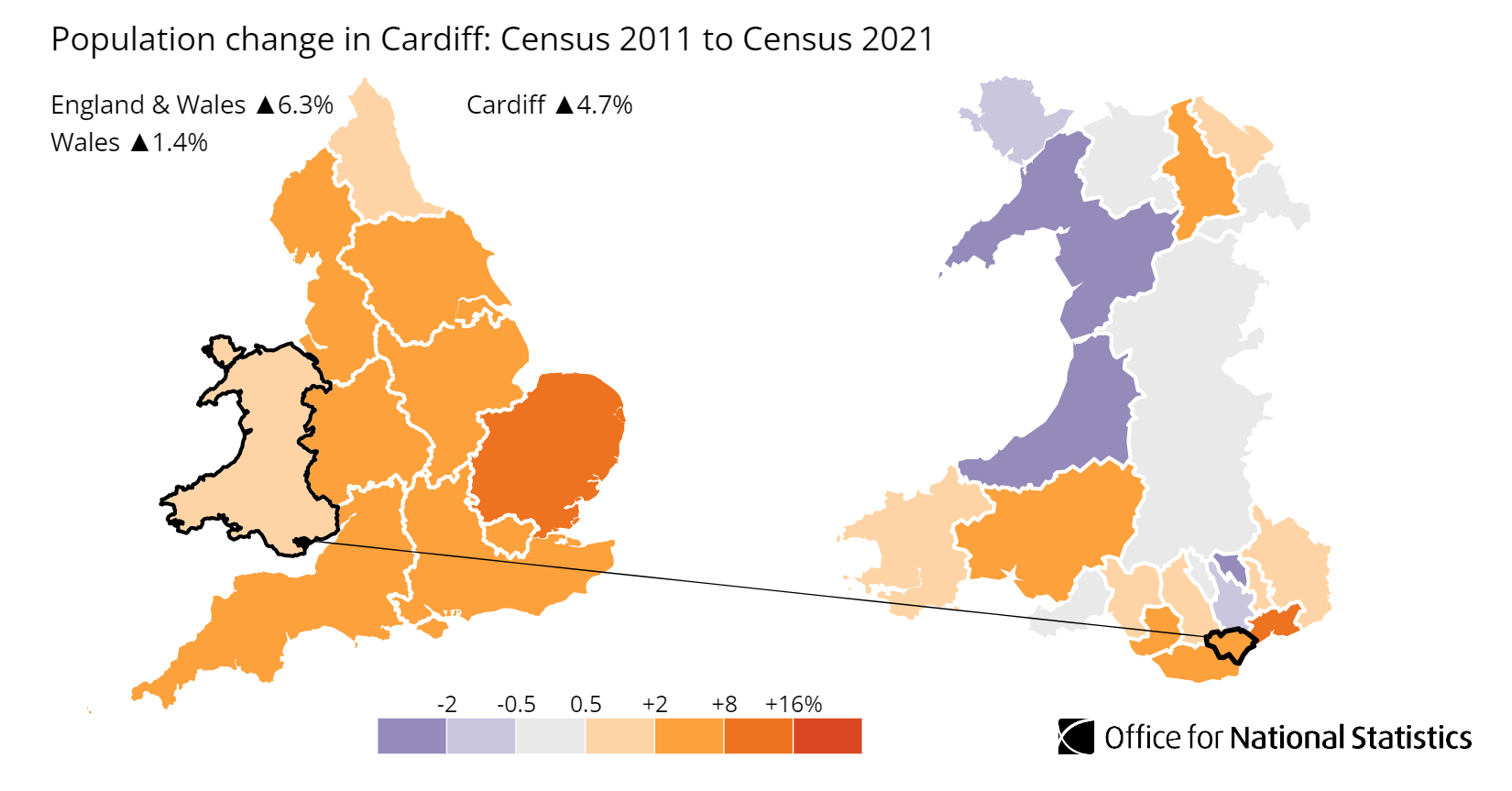
Cardiff is the capital city of Wales, on its south coast. Average sold prices in Cardiff sit at £270,928 on the HM Land Registry House Price Index, 27.1% above the Wales average of £213,240. That is the capital-city premium reading directly off the data: Cardiff costs comfortably more than the country it sits in. Detached, semi-detached, terraced and flatted homes all sell above their Wales equivalents, with detached carrying the widest gap. Cardiff's population grew 4.7% between the 2011 and 2021 censuses, from 346,090 to 362,308 residents.
The premium has a job behind it. Cardiff is the seat of the Welsh Government, the Senedd and BBC Cymru Wales, and the city anchors the Cardiff Capital Region, a £1.23 billion City Deal covering ten South East Wales local authorities. That public-sector base sits alongside three universities with roughly 50,000 students between them. For investors, the spread runs wide: CF10 (City Centre, Cardiff Bay) starts at a £187,587 asking price while CF15 (Radyr, Tongwynlais) reaches £435,179, and the highest yields sit with the cheaper city-centre postcodes rather than the leafier suburbs.
This guide covers the unitary authority of Cardiff (ONS code W06000015) across postcodes CF3, CF5, CF10, CF11, CF14, CF15, CF23 and CF24. Cardiff sits on the south coast of Wales, 45 miles west of Bristol across the Severn estuary. The wider buy-to-let in Wales picture also takes in Newport to the east and Swansea to the west.
Article updated: July 2026
Why Invest in Cardiff?
Cardiff added 16,218 residents between the 2011 and 2021 censuses, a 4.7% rise from 346,090 to 362,308, ahead of the Wales-wide figure and driven by the city's pull as the country's main employment centre. As the capital, Cardiff houses the Welsh Government, the Senedd and BBC Cymru Wales, so a large share of its jobs sit in public administration, healthcare and higher education, the kind of work that holds up through a downturn. The University Hospital of Wales adds a further layer of NHS employment in the north of the city.
Three universities give Cardiff an unusually deep student tenant pool for a city its size, with roughly 50,000 students between Cardiff University, Cardiff Metropolitan University and the University of South Wales. That demand concentrates in CF24 (Roath, Cathays, Splott), the traditional student quarter next to Cardiff University, and CF10 (City Centre, Cardiff Bay). Both postcodes carry the city's highest private-rented shares, at 43.4% and 43.7% of households, a sign of how settled the lettings market is in those areas.
Median gross annual earnings in Cardiff are £36,946, which is above the Wales median of £36,354 but 5.6% below the Great Britain median of £39,125. That sits Cardiff in a particular spot: wages high enough to lead Wales, but a sold-price premium of 27.1% over the country that runs ahead of the wage gap. The student population also drags the headline employment rate down, since students count as economically inactive rather than employed, which is worth holding in mind when reading the figures below.
Cardiff Economic Summary
- Population: 362,308 (2021 Census). Growth of 4.7% from 2011.
- Median annual salary: £36,946 (Cardiff), £39,125 (Great Britain)
- Employment rate: 75.6% (Cardiff), 75.6% (Great Britain)
- Unemployment rate: 4.3% (Cardiff)
- Key employment sectors: Public administration, health and social work, higher education, financial and professional services, media and creative
Source: ONS Census 2021, Nomis Labour Market Profile (ASHE 2025, Employment Oct 2024-Sep 2025)
Regeneration and Investment in Cardiff
More than £400 million of confirmed investment is reshaping Cardiff Bay, the city's main rail gateway and the centre's eastern edge, most of it funded through the Cardiff Capital Region City Deal and UK and Welsh Government money rather than speculative private capital. The City Deal itself runs to £1.23 billion across ten South East Wales authorities, with £734 million ring-fenced for the South Wales Metro and £495 million in a wider investment fund.
- New Cardiff Bay Arena (under construction, ~£300 million): A 15,000-capacity indoor arena at Atlantic Wharf, operated by Live Nation UK with Oak View Group, is now expected to open in 2028 after the timeline slipped and the budget rose from earlier estimates. The wider Atlantic Wharf masterplan adds homes, offices, hotels and leisure space across the surrounding 30 acres. The arena sits in CF10, the city-centre and Bay postcode that already carries Cardiff's highest yield. Updates at the official Atlantic Wharf project site.
- Cardiff Central Station redevelopment (approved, £138.8 million): A full overhaul of Wales' busiest station, which handles 35,000 passengers a day, funded by the UK Government (£77.8 million), the Cardiff Capital Region City Deal (£40 million) and the Welsh Government (£21 million). Construction begins in spring 2026 with most work due to complete by 2029. The station sits on the CF10/CF11 boundary, feeding the city-centre rental catchment. Updates at Global Railway Review.
- Cardiff Capital Region City Deal (active, £1.23 billion): The ten-authority partnership has targeted 25,000 new jobs and £4 billion of private investment over 20 years, with the South Wales Metro the largest single commitment. For Cardiff specifically, better regional rail connectivity widens the commuter catchment that underpins city tenant demand. Updates at Cardiff Capital Region.
Source: Office for National Statistics - Population for Cardiff
Cardiff Property Market Analysis
Average property prices in Cardiff have risen 457.3% since January 1995, from £48,615 to £270,928. The sections below break that journey down cycle by cycle, then drill into current postcode-level data for sold prices, price per square foot, asking prices, growth trends and monthly transaction volumes.
When was the last house price crash in Cardiff?
All sold prices for Cardiff are recorded by HM Land Registry at unitary-authority level, and the House Price Index tracks the city from January 1995 to March 2026, covering 31 years of market cycles.
The 1995 to 2007 climb: Cardiff opened 1995 at £48,615. The first stretch was unhurried, reaching £70,926 by December 2000, a 45.9% gain over six years. Growth then accelerated sharply, and prices more than doubled again to peak at £169,539 in September 2007. Cheap credit and a fast-growing capital-city economy carried prices well past what local wages alone could support.
2008 to 2009, the financial crisis: Prices fell from the September 2007 peak of £169,539 to a trough of £138,867 in April 2009, a decline of 18.1% over 19 months. The worst year-on-year reading was -14.7% in April 2009. Cardiff's fall almost exactly matched the Wales-wide drop and sat in line with the England decline of 18.2%, so the capital offered no special shelter from the national correction.
2010 to 2013, the slow grind: Cardiff bounced off the trough but then stalled. The average sat at £151,084 in December 2010 and was still only £159,917 by the end of 2013, below where it had been before the crash. For nearly four years the market moved sideways rather than recovering.
Recovery, 2014 to 2016: Growth returned, picking up to around 9% a year through mid-2014. Prices passed the September 2007 pre-crash peak of £169,539 in July 2014, at £171,190. That recovery took six years and ten months. By December 2015 the average had reached £181,439.
The 2017 to 2019 steady run: Prices climbed from £189,173 in March 2016 to £195,182 and beyond, holding annual growth of roughly 3% through to the end of the decade. This was the unspectacular, equity-building phase rather than a boom.
2020 to 2022, the pandemic surge: The stamp duty holiday and a shift towards space and coastal proximity hit Cardiff hard. Prices ran from £225,304 in March 2021 to £266,773 by December 2022, the latter year posting 11.4% annual growth. Cardiff's relative affordability against Bristol and London made it a clear winner from the relocation trend.
The 2023 rate shock: Higher mortgage rates cooled the market, and prices eased to £261,221 by December 2023, recording -2.1% annual growth. The correction was brief and shallow against the 2008 fall.
2024 to present: The market steadied and edged back up, reaching £264,868 by December 2024 and a fresh all-time high of £270,928 at the latest March 2026 reading. The current price is 59.8% above the pre-crash peak of £169,539.
Long-term growth summary:
- 5 years (March 2021 to March 2026): 20.2% growth (£225,304 to £270,928)
- 10 years (March 2016 to March 2026): 43.2% growth (£189,173 to £270,928)
- 15 years (March 2011 to March 2026): 81.4% growth (£149,376 to £270,928)
- 20 years (March 2006 to March 2026): 78.0% growth (£152,200 to £270,928)
- 30 years (January 1995 to March 2026): 457.3% growth (£48,615 to £270,928)
Cardiff's 18.1% crash matched the national correction rather than softening it, and the six-year-and-ten-month wait to recover was longer than England's, reflecting the 2010-to-2013 sideways phase. Set against that, the 30-year return of 457.3% is among the stronger long-run records of any UK city. An investor who bought at the exact September 2007 peak would now be 59.8% ahead on the Land Registry average.
- All property types
- Detached
- Semi-detached
- Terraced
- Flats
Source: HM Land Registry House Price Index
| Year | All property types | Detached | Semi-detached | Terraced | Flats |
|---|---|---|---|---|---|
| 1995-01 | £48,615 | £97,778 | £54,172 | £42,300 | £36,198 |
| 1995-02 | £48,199 | £96,036 | £53,892 | £41,963 | £35,863 |
| 1995-03 | £47,852 | £95,186 | £53,472 | £41,700 | £35,583 |
| 1995-04 | £48,006 | £95,024 | £53,653 | £41,871 | £35,743 |
| 1995-05 | £48,321 | £95,371 | £53,936 | £42,216 | £35,959 |
| 1995-06 | £49,276 | £97,083 | £55,037 | £43,018 | £36,801 |
| 1995-07 | £49,861 | £98,427 | £55,688 | £43,576 | £36,998 |
| 1995-08 | £50,178 | £99,773 | £56,007 | £43,846 | £37,022 |
| 1995-09 | £49,571 | £98,741 | £55,273 | £43,397 | £36,314 |
| 1995-10 | £48,132 | £96,019 | £53,807 | £42,011 | £35,418 |
| 1995-11 | £47,561 | £94,848 | £53,274 | £41,381 | £35,292 |
| 1995-12 | £48,113 | £95,933 | £54,019 | £41,767 | £35,828 |
| 1996-01 | £48,615 | £97,368 | £54,519 | £42,220 | £36,073 |
| 1996-02 | £50,360 | £100,870 | £56,519 | £43,777 | £37,188 |
| 1996-03 | £49,638 | £99,611 | £55,789 | £43,135 | £36,549 |
| 1996-04 | £50,348 | £100,425 | £56,518 | £43,837 | £37,180 |
| 1996-05 | £48,417 | £96,049 | £54,239 | £42,289 | £35,704 |
| 1996-06 | £49,000 | £96,953 | £54,717 | £42,871 | £36,298 |
| 1996-07 | £48,358 | £95,964 | £54,040 | £42,302 | £35,631 |
| 1996-08 | £49,669 | £99,167 | £55,465 | £43,423 | £36,455 |
| 1996-09 | £49,576 | £99,639 | £55,339 | £43,331 | £36,122 |
| 1996-10 | £49,863 | £100,393 | £55,691 | £43,559 | £36,273 |
| 1996-11 | £49,608 | £99,566 | £55,430 | £43,348 | £36,162 |
| 1996-12 | £50,506 | £100,773 | £56,522 | £44,176 | £36,797 |
| 1997-01 | £50,670 | £100,978 | £56,671 | £44,376 | £36,827 |
| 1997-02 | £51,275 | £102,596 | £57,339 | £44,848 | £37,272 |
| 1997-03 | £51,106 | £102,553 | £57,042 | £44,703 | £37,153 |
| 1997-04 | £51,988 | £103,996 | £58,075 | £45,499 | £37,800 |
| 1997-05 | £51,824 | £103,345 | £57,979 | £45,431 | £37,455 |
| 1997-06 | £52,508 | £104,759 | £58,827 | £46,058 | £37,713 |
| 1997-07 | £53,334 | £106,617 | £59,687 | £46,863 | £38,020 |
| 1997-08 | £54,387 | £109,104 | £60,842 | £47,778 | £38,650 |
| 1997-09 | £54,546 | £109,597 | £61,056 | £47,901 | £38,689 |
| 1997-10 | £54,494 | £109,781 | £61,116 | £47,731 | £38,771 |
| 1997-11 | £54,120 | £109,281 | £60,831 | £47,300 | £38,552 |
| 1997-12 | £55,237 | £111,504 | £62,215 | £48,210 | £39,417 |
| 1998-01 | £55,597 | £112,740 | £62,536 | £48,507 | £39,608 |
| 1998-02 | £56,045 | £113,568 | £62,902 | £48,915 | £40,104 |
| 1998-03 | £55,590 | £112,729 | £62,274 | £48,598 | £39,667 |
| 1998-04 | £56,159 | £113,276 | £63,024 | £49,166 | £40,016 |
| 1998-05 | £56,203 | £112,858 | £63,075 | £49,347 | £39,864 |
| 1998-06 | £56,528 | £113,327 | £63,396 | £49,621 | £40,279 |
| 1998-07 | £56,705 | £113,794 | £63,531 | £49,807 | £40,335 |
| 1998-08 | £57,605 | £116,197 | £64,461 | £50,574 | £40,853 |
| 1998-09 | £58,040 | £117,466 | £65,013 | £50,929 | £40,965 |
| 1998-10 | £57,619 | £116,988 | £64,550 | £50,417 | £40,906 |
| 1998-11 | £57,430 | £116,887 | £64,554 | £50,036 | £41,014 |
| 1998-12 | £57,071 | £115,791 | £64,163 | £49,698 | £41,001 |
| 1999-01 | £58,906 | £119,537 | £66,259 | £51,298 | £42,255 |
| 1999-02 | £59,009 | £119,569 | £66,318 | £51,473 | £42,240 |
| 1999-03 | £59,450 | £120,859 | £66,806 | £51,801 | £42,555 |
| 1999-04 | £58,623 | £118,599 | £65,818 | £51,211 | £41,955 |
| 1999-05 | £59,467 | £119,869 | £66,684 | £52,056 | £42,576 |
| 1999-06 | £60,265 | £121,301 | £67,512 | £52,850 | £43,034 |
| 1999-07 | £60,839 | £122,913 | £68,114 | £53,334 | £43,312 |
| 1999-08 | £61,678 | £125,014 | £69,006 | £54,069 | £43,756 |
| 1999-09 | £62,526 | £127,192 | £69,861 | £54,783 | £44,324 |
| 1999-10 | £62,795 | £127,847 | £70,282 | £54,861 | £44,783 |
| 1999-11 | £63,313 | £128,890 | £70,933 | £55,235 | £45,305 |
| 1999-12 | £63,316 | £128,249 | £70,965 | £55,248 | £45,587 |
| 2000-01 | £64,847 | £131,664 | £72,686 | £56,605 | £46,448 |
| 2000-02 | £64,053 | £130,228 | £71,753 | £55,866 | £45,917 |
| 2000-03 | £64,183 | £130,814 | £72,025 | £55,922 | £45,748 |
| 2000-04 | £63,702 | £128,977 | £71,346 | £55,563 | £45,723 |
| 2000-05 | £65,378 | £132,050 | £73,280 | £57,021 | £46,987 |
| 2000-06 | £66,808 | £134,477 | £74,839 | £58,263 | £48,252 |
| 2000-07 | £68,311 | £138,535 | £76,670 | £59,479 | £49,034 |
| 2000-08 | £69,595 | £141,814 | £78,148 | £60,447 | £50,045 |
| 2000-09 | £71,090 | £146,066 | £79,758 | £61,608 | £51,095 |
| 2000-10 | £71,701 | £147,513 | £80,591 | £61,950 | £51,778 |
| 2000-11 | £71,229 | £146,851 | £80,036 | £61,448 | £51,595 |
| 2000-12 | £70,926 | £145,639 | £79,758 | £61,099 | £51,747 |
| 2001-01 | £71,536 | £146,870 | £80,223 | £61,674 | £52,321 |
| 2001-02 | £73,290 | £150,215 | £82,198 | £63,249 | £53,509 |
| 2001-03 | £74,038 | £151,931 | £83,092 | £63,923 | £53,811 |
| 2001-04 | £74,166 | £151,580 | £83,080 | £64,180 | £53,903 |
| 2001-05 | £75,044 | £152,226 | £83,945 | £65,154 | £54,511 |
| 2001-06 | £76,316 | £154,112 | £85,141 | £66,325 | £55,722 |
| 2001-07 | £77,868 | £157,428 | £86,934 | £67,692 | £56,698 |
| 2001-08 | £78,323 | £159,260 | £87,308 | £67,983 | £57,139 |
| 2001-09 | £79,827 | £163,283 | £88,867 | £69,259 | £58,138 |
| 2001-10 | £80,642 | £164,965 | £89,828 | £69,774 | £59,119 |
| 2001-11 | £81,552 | £166,794 | £91,073 | £70,327 | £60,107 |
| 2001-12 | £82,069 | £166,773 | £91,779 | £70,587 | £61,123 |
| 2002-01 | £81,767 | £166,088 | £91,416 | £70,279 | £61,064 |
| 2002-02 | £83,907 | £170,189 | £93,541 | £72,211 | £62,797 |
| 2002-03 | £83,728 | £169,917 | £93,335 | £72,146 | £62,426 |
| 2002-04 | £85,497 | £172,612 | £95,109 | £73,714 | £64,123 |
| 2002-05 | £86,011 | £172,446 | £95,797 | £74,221 | £64,602 |
| 2002-06 | £89,383 | £178,643 | £99,231 | £77,268 | £67,333 |
| 2002-07 | £92,686 | £185,156 | £102,872 | £80,347 | £69,343 |
| 2002-08 | £95,526 | £190,964 | £105,905 | £82,899 | £71,332 |
| 2002-09 | £97,525 | £195,021 | £108,490 | £84,624 | £72,435 |
| 2002-10 | £99,171 | £198,362 | £110,709 | £85,752 | £73,944 |
| 2002-11 | £100,449 | £200,931 | £112,208 | £86,752 | £75,066 |
| 2002-12 | £101,767 | £202,747 | £113,795 | £87,749 | £76,525 |
| 2003-01 | £104,772 | £207,984 | £116,728 | £90,608 | £78,832 |
| 2003-02 | £106,056 | £209,497 | £118,250 | £91,702 | £80,068 |
| 2003-03 | £108,848 | £215,504 | £121,108 | £94,169 | £82,169 |
| 2003-04 | £110,042 | £217,381 | £122,734 | £95,024 | £83,330 |
| 2003-05 | £112,400 | £221,595 | £125,372 | £97,260 | £84,768 |
| 2003-06 | £113,693 | £222,299 | £126,739 | £98,551 | £85,999 |
| 2003-07 | £114,055 | £222,218 | £127,112 | £99,156 | £85,860 |
| 2003-08 | £117,042 | £227,271 | £130,328 | £101,952 | £87,997 |
| 2003-09 | £119,234 | £231,656 | £132,916 | £104,091 | £88,893 |
| 2003-10 | £121,026 | £234,347 | £134,750 | £105,796 | £90,325 |
| 2003-11 | £120,428 | £232,972 | £134,197 | £105,223 | £89,945 |
| 2003-12 | £121,263 | £232,410 | £134,932 | £106,099 | £91,142 |
| 2004-01 | £123,410 | £236,916 | £137,325 | £107,894 | £92,828 |
| 2004-02 | £125,640 | £240,453 | £139,599 | £109,887 | £94,812 |
| 2004-03 | £127,342 | £244,328 | £141,279 | £111,438 | £95,983 |
| 2004-04 | £130,394 | £247,364 | £144,584 | £114,801 | £98,060 |
| 2004-05 | £133,849 | £251,351 | £148,176 | £118,434 | £100,637 |
| 2004-06 | £137,811 | £256,696 | £152,493 | £122,233 | £103,782 |
| 2004-07 | £140,493 | £261,418 | £155,735 | £124,748 | £105,478 |
| 2004-08 | £143,223 | £267,306 | £158,861 | £127,250 | £107,134 |
| 2004-09 | £145,854 | £273,335 | £162,075 | £129,571 | £108,618 |
| 2004-10 | £149,530 | £280,121 | £165,691 | £132,546 | £112,139 |
| 2004-11 | £151,154 | £282,689 | £167,322 | £133,817 | £113,843 |
| 2004-12 | £149,390 | £277,879 | £164,900 | £132,357 | £113,110 |
| 2005-01 | £148,113 | £275,424 | £163,118 | £131,407 | £112,184 |
| 2005-02 | £147,557 | £274,092 | £162,587 | £130,907 | £111,782 |
| 2005-03 | £149,324 | £277,839 | £164,809 | £132,372 | £112,923 |
| 2005-04 | £149,463 | £276,936 | £165,377 | £132,514 | £112,976 |
| 2005-05 | £149,932 | £277,576 | £165,730 | £133,124 | £113,228 |
| 2005-06 | £149,406 | £274,697 | £164,993 | £133,162 | £112,657 |
| 2005-07 | £150,057 | £276,175 | £165,891 | £133,971 | £112,695 |
| 2005-08 | £150,509 | £277,144 | £166,365 | £134,686 | £112,628 |
| 2005-09 | £152,839 | £282,757 | £169,078 | £136,742 | £114,066 |
| 2005-10 | £153,155 | £283,037 | £169,026 | £136,900 | £114,762 |
| 2005-11 | £154,610 | £285,252 | £170,767 | £137,998 | £116,118 |
| 2005-12 | £152,669 | £280,023 | £168,152 | £136,260 | £115,283 |
| 2006-01 | £150,832 | £276,843 | £166,007 | £134,961 | £113,500 |
| 2006-02 | £150,454 | £275,081 | £165,171 | £134,760 | £113,534 |
| 2006-03 | £152,200 | £279,478 | £167,455 | £136,336 | £114,375 |
| 2006-04 | £153,318 | £280,327 | £168,830 | £137,458 | £115,204 |
| 2006-05 | £151,592 | £277,205 | £167,215 | £136,009 | £113,586 |
| 2006-06 | £152,073 | £276,952 | £167,788 | £136,751 | £113,742 |
| 2006-07 | £153,201 | £279,398 | £169,065 | £138,075 | £114,087 |
| 2006-08 | £156,980 | £286,941 | £173,375 | £141,921 | £116,113 |
| 2006-09 | £157,856 | £289,677 | £174,507 | £142,832 | £116,278 |
| 2006-10 | £160,283 | £294,321 | £177,160 | £144,858 | £118,264 |
| 2006-11 | £159,266 | £292,601 | £176,205 | £143,827 | £117,524 |
| 2006-12 | £160,566 | £293,460 | £177,345 | £145,140 | £118,794 |
| 2007-01 | £158,858 | £290,618 | £175,543 | £143,606 | £117,412 |
| 2007-02 | £160,843 | £293,754 | £177,436 | £145,217 | £119,354 |
| 2007-03 | £160,529 | £294,230 | £177,221 | £144,963 | £118,805 |
| 2007-04 | £162,776 | £296,908 | £179,447 | £147,425 | £120,389 |
| 2007-05 | £162,628 | £295,384 | £179,152 | £147,640 | £120,191 |
| 2007-06 | £165,270 | £299,497 | £181,972 | £150,215 | £122,124 |
| 2007-07 | £167,353 | £304,668 | £184,432 | £152,090 | £123,335 |
| 2007-08 | £169,352 | £310,181 | £186,835 | £154,228 | £123,994 |
| 2007-09 | £169,539 | £311,846 | £187,209 | £154,220 | £123,992 |
| 2007-10 | £168,594 | £310,624 | £185,864 | £153,133 | £123,634 |
| 2007-11 | £166,984 | £307,944 | £184,186 | £151,187 | £122,887 |
| 2007-12 | £164,523 | £302,581 | £181,311 | £148,954 | £121,321 |
| 2008-01 | £164,683 | £303,528 | £181,587 | £148,920 | £121,467 |
| 2008-02 | £166,051 | £306,602 | £183,145 | £150,080 | £122,400 |
| 2008-03 | £164,923 | £306,120 | £182,360 | £148,971 | £121,079 |
| 2008-04 | £162,891 | £303,016 | £180,269 | £147,328 | £119,175 |
| 2008-05 | £161,542 | £299,910 | £178,778 | £146,422 | £117,939 |
| 2008-06 | £163,153 | £302,339 | £180,341 | £148,101 | £119,110 |
| 2008-07 | £162,301 | £300,329 | £179,643 | £147,292 | £118,438 |
| 2008-08 | £159,507 | £295,986 | £176,492 | £144,769 | £116,291 |
| 2008-09 | £154,861 | £289,829 | £171,139 | £140,343 | £112,878 |
| 2008-10 | £152,786 | £286,767 | £168,702 | £138,249 | £111,559 |
| 2008-11 | £148,844 | £279,988 | £164,593 | £134,412 | £108,720 |
| 2008-12 | £146,500 | £274,024 | £162,264 | £132,530 | £106,831 |
| 2009-01 | £144,674 | £271,515 | £160,225 | £130,716 | £105,545 |
| 2009-02 | £142,544 | £267,487 | £157,764 | £128,568 | £104,443 |
| 2009-03 | £140,857 | £264,712 | £155,723 | £126,647 | £103,886 |
| 2009-04 | £138,867 | £259,228 | £153,671 | £125,142 | £102,420 |
| 2009-05 | £139,849 | £260,024 | £154,745 | £126,638 | £102,643 |
| 2009-06 | £142,970 | £265,480 | £158,401 | £130,040 | £104,065 |
| 2009-07 | £145,042 | £269,871 | £161,022 | £132,331 | £104,553 |
| 2009-08 | £147,734 | £275,967 | £164,248 | £134,934 | £105,741 |
| 2009-09 | £148,024 | £277,293 | £164,875 | £135,128 | £105,515 |
| 2009-10 | £147,760 | £277,290 | £164,781 | £134,757 | £105,164 |
| 2009-11 | £148,618 | £279,373 | £165,717 | £135,719 | £105,421 |
| 2009-12 | £149,579 | £279,923 | £166,876 | £137,101 | £105,740 |
| 2010-01 | £150,557 | £283,131 | £168,344 | £138,167 | £105,469 |
| 2010-02 | £149,961 | £282,422 | £168,522 | £137,539 | £104,243 |
| 2010-03 | £150,196 | £285,155 | £169,078 | £137,215 | £104,198 |
| 2010-04 | £151,712 | £286,862 | £170,862 | £138,617 | £105,492 |
| 2010-05 | £150,966 | £285,225 | £169,788 | £137,924 | £105,293 |
| 2010-06 | £151,911 | £286,336 | £171,019 | £139,129 | £105,509 |
| 2010-07 | £152,516 | £288,545 | £171,674 | £139,933 | £105,298 |
| 2010-08 | £154,879 | £294,053 | £174,719 | £142,080 | £106,268 |
| 2010-09 | £155,798 | £297,594 | £175,783 | £142,744 | £106,588 |
| 2010-10 | £155,406 | £297,343 | £175,445 | £142,047 | £106,534 |
| 2010-11 | £153,215 | £293,894 | £172,813 | £139,761 | £105,363 |
| 2010-12 | £151,084 | £289,190 | £170,648 | £137,672 | £104,036 |
| 2011-01 | £149,893 | £287,799 | £169,272 | £136,399 | £103,248 |
| 2011-02 | £150,336 | £289,416 | £169,607 | £136,760 | £103,555 |
| 2011-03 | £149,376 | £289,677 | £168,345 | £135,630 | £102,839 |
| 2011-04 | £147,012 | £284,832 | £165,607 | £133,461 | £101,377 |
| 2011-05 | £147,250 | £283,345 | £165,846 | £133,697 | £102,027 |
| 2011-06 | £147,877 | £281,714 | £166,625 | £134,617 | £102,581 |
| 2011-07 | £151,519 | £287,667 | £170,631 | £138,106 | £105,185 |
| 2011-08 | £154,033 | £293,588 | £173,929 | £140,624 | £105,882 |
| 2011-09 | £155,484 | £298,111 | £175,594 | £142,005 | £106,338 |
| 2011-10 | £155,821 | £300,023 | £176,528 | £142,133 | £106,014 |
| 2011-11 | £155,380 | £299,325 | £175,868 | £141,488 | £106,175 |
| 2011-12 | £154,963 | £297,196 | £175,624 | £141,014 | £106,146 |
| 2012-01 | £153,863 | £294,035 | £174,426 | £140,345 | £105,127 |
| 2012-02 | £152,831 | £291,729 | £173,575 | £139,627 | £103,901 |
| 2012-03 | £153,104 | £291,457 | £173,845 | £140,036 | £104,058 |
| 2012-04 | £153,257 | £291,619 | £173,867 | £140,003 | £104,576 |
| 2012-05 | £153,891 | £292,225 | £174,349 | £140,634 | £105,270 |
| 2012-06 | £153,618 | £291,333 | £173,733 | £140,838 | £104,750 |
| 2012-07 | £154,959 | £293,518 | £175,063 | £142,444 | £105,340 |
| 2012-08 | £156,227 | £295,596 | £176,511 | £144,035 | £105,633 |
| 2012-09 | £156,236 | £297,103 | £176,509 | £143,898 | £105,504 |
| 2012-10 | £157,078 | £298,523 | £177,673 | £144,560 | £106,110 |
| 2012-11 | £155,633 | £296,271 | £176,085 | £143,033 | £105,271 |
| 2012-12 | £155,351 | £295,637 | £176,079 | £142,674 | £104,995 |
| 2013-01 | £155,336 | £296,451 | £176,438 | £142,583 | £104,595 |
| 2013-02 | £156,279 | £298,537 | £177,554 | £143,421 | £105,167 |
| 2013-03 | £158,045 | £302,901 | £179,660 | £144,731 | £106,510 |
| 2013-04 | £155,225 | £297,134 | £175,975 | £142,423 | £104,659 |
| 2013-05 | £156,047 | £297,953 | £176,886 | £143,247 | £105,315 |
| 2013-06 | £153,703 | £291,714 | £174,170 | £141,574 | £103,459 |
| 2013-07 | £156,498 | £296,694 | £177,304 | £144,244 | £105,298 |
| 2013-08 | £157,104 | £297,605 | £177,996 | £145,076 | £105,307 |
| 2013-09 | £161,766 | £308,217 | £183,355 | £149,059 | £108,427 |
| 2013-10 | £162,976 | £311,743 | £185,063 | £149,850 | £109,168 |
| 2013-11 | £161,712 | £310,082 | £183,837 | £148,354 | £108,494 |
| 2013-12 | £159,917 | £304,996 | £181,932 | £146,809 | £107,441 |
| 2014-01 | £160,453 | £305,512 | £182,530 | £147,324 | £107,906 |
| 2014-02 | £162,172 | £309,061 | £184,596 | £148,901 | £108,958 |
| 2014-03 | £164,707 | £314,038 | £187,475 | £151,251 | £110,559 |
| 2014-04 | £165,011 | £313,770 | £187,756 | £151,771 | £110,656 |
| 2014-05 | £167,439 | £317,005 | £190,258 | £154,267 | £112,363 |
| 2014-06 | £168,907 | £319,637 | £192,006 | £155,712 | £113,217 |
| 2014-07 | £171,190 | £323,964 | £194,767 | £157,959 | £114,478 |
| 2014-08 | £171,898 | £326,042 | £195,941 | £158,685 | £114,525 |
| 2014-09 | £172,079 | £326,906 | £196,158 | £158,878 | £114,515 |
| 2014-10 | £172,670 | £328,340 | £197,002 | £159,146 | £115,094 |
| 2014-11 | £173,493 | £330,637 | £197,954 | £159,569 | £115,910 |
| 2014-12 | £175,030 | £333,845 | £199,695 | £160,773 | £117,146 |
| 2015-01 | £174,787 | £333,433 | £199,424 | £160,509 | £117,020 |
| 2015-02 | £173,878 | £330,926 | £198,138 | £159,697 | £116,676 |
| 2015-03 | £173,921 | £331,127 | £198,336 | £159,622 | £116,752 |
| 2015-04 | £175,145 | £333,745 | £199,600 | £160,837 | £117,479 |
| 2015-05 | £176,542 | £336,125 | £201,478 | £162,105 | £118,315 |
| 2015-06 | £176,794 | £336,336 | £201,982 | £162,659 | £117,977 |
| 2015-07 | £177,517 | £337,065 | £203,063 | £163,350 | £118,390 |
| 2015-08 | £179,681 | £341,397 | £205,529 | £165,593 | £119,466 |
| 2015-09 | £180,414 | £344,160 | £206,273 | £165,983 | £120,129 |
| 2015-10 | £181,244 | £346,974 | £207,396 | £166,614 | £120,524 |
| 2015-11 | £180,127 | £345,607 | £206,366 | £165,367 | £119,777 |
| 2015-12 | £181,439 | £347,847 | £208,235 | £166,583 | £120,466 |
| 2016-01 | £183,475 | £351,194 | £210,956 | £168,380 | £121,786 |
| 2016-02 | £188,044 | £359,977 | £216,374 | £172,560 | £124,729 |
| 2016-03 | £189,173 | £362,520 | £217,296 | £173,526 | £125,728 |
| 2016-04 | £187,680 | £359,091 | £215,296 | £172,315 | £124,803 |
| 2016-05 | £185,468 | £352,895 | £212,175 | £170,417 | £123,880 |
| 2016-06 | £186,852 | £354,219 | £213,767 | £171,791 | £124,907 |
| 2016-07 | £189,619 | £359,243 | £216,666 | £174,458 | £126,795 |
| 2016-08 | £190,760 | £362,645 | £218,001 | £175,423 | £127,416 |
| 2016-09 | £189,466 | £360,608 | £216,764 | £174,124 | £126,472 |
| 2016-10 | £188,288 | £360,040 | £215,701 | £172,309 | £126,174 |
| 2016-11 | £188,703 | £362,615 | £216,468 | £172,185 | £126,614 |
| 2016-12 | £188,054 | £361,922 | £215,458 | £171,395 | £126,500 |
| 2017-01 | £189,176 | £364,008 | £216,335 | £172,739 | £127,087 |
| 2017-02 | £189,118 | £362,647 | £215,616 | £172,738 | £127,560 |
| 2017-03 | £190,669 | £365,324 | £217,243 | £174,141 | £128,735 |
| 2017-04 | £191,194 | £365,620 | £217,594 | £174,582 | £129,407 |
| 2017-05 | £192,525 | £366,764 | £219,506 | £175,761 | £130,360 |
| 2017-06 | £195,045 | £369,649 | £222,133 | £178,319 | £132,256 |
| 2017-07 | £195,348 | £369,279 | £222,736 | £178,508 | £132,575 |
| 2017-08 | £196,333 | £371,566 | £223,768 | £179,756 | £132,818 |
| 2017-09 | £196,682 | £373,873 | £224,503 | £179,962 | £132,691 |
| 2017-10 | £198,303 | £378,199 | £226,764 | £181,381 | £133,394 |
| 2017-11 | £198,807 | £380,114 | £227,829 | £181,486 | £133,684 |
| 2017-12 | £198,278 | £378,597 | £227,629 | £181,056 | £133,113 |
| 2018-01 | £199,228 | £380,506 | £228,753 | £181,926 | £133,714 |
| 2018-02 | £199,563 | £381,758 | £229,087 | £182,681 | £133,341 |
| 2018-03 | £201,318 | £385,955 | £231,143 | £184,437 | £134,165 |
| 2018-04 | £199,533 | £382,269 | £229,339 | £183,267 | £132,340 |
| 2018-05 | £201,072 | £384,905 | £231,471 | £184,733 | £133,142 |
| 2018-06 | £201,709 | £385,723 | £232,619 | £185,172 | £133,558 |
| 2018-07 | £204,670 | £392,178 | £235,956 | £187,831 | £135,485 |
| 2018-08 | £206,028 | £395,023 | £237,424 | £189,131 | £136,335 |
| 2018-09 | £207,030 | £397,774 | £238,421 | £190,280 | £136,672 |
| 2018-10 | £207,169 | £398,505 | £238,764 | £190,283 | £136,715 |
| 2018-11 | £206,108 | £397,630 | £237,920 | £189,182 | £135,718 |
| 2018-12 | £206,173 | £397,247 | £238,336 | £188,979 | £135,953 |
| 2019-01 | £206,483 | £398,612 | £238,978 | £189,104 | £136,030 |
| 2019-02 | £206,818 | £399,587 | £239,296 | £189,277 | £136,407 |
| 2019-03 | £207,046 | £400,832 | £239,840 | £189,638 | £136,096 |
| 2019-04 | £206,848 | £399,136 | £239,473 | £189,987 | £135,740 |
| 2019-05 | £205,626 | £395,628 | £238,295 | £189,321 | £134,519 |
| 2019-06 | £205,852 | £395,147 | £238,466 | £189,628 | £134,812 |
| 2019-07 | £206,242 | £395,885 | £238,802 | £190,033 | £135,092 |
| 2019-08 | £210,310 | £403,719 | £243,467 | £194,056 | £137,475 |
| 2019-09 | £209,842 | £403,021 | £242,380 | £193,979 | £137,071 |
| 2019-10 | £211,094 | £405,662 | £244,710 | £194,836 | £137,619 |
| 2019-11 | £210,754 | £405,796 | £244,877 | £194,141 | £137,304 |
| 2019-12 | £212,355 | £409,576 | £247,510 | £195,339 | £138,021 |
| 2020-01 | £212,212 | £409,958 | £247,261 | £195,484 | £137,531 |
| 2020-02 | £208,661 | £402,861 | £242,999 | £192,628 | £134,921 |
| 2020-03 | £208,037 | £401,739 | £242,234 | £192,260 | £134,279 |
| 2020-04 | £207,983 | £403,755 | £242,167 | £192,498 | £133,567 |
| 2020-05 | £210,101 | £408,933 | £244,884 | £194,025 | £135,008 |
| 2020-06 | £210,446 | £408,766 | £245,624 | £194,771 | £134,788 |
| 2020-07 | £211,705 | £408,433 | £247,074 | £196,064 | £136,006 |
| 2020-08 | £213,567 | £412,053 | £249,648 | £198,536 | £136,259 |
| 2020-09 | £214,969 | £416,501 | £251,363 | £199,887 | £136,734 |
| 2020-10 | £216,007 | £419,539 | £252,776 | £201,124 | £136,831 |
| 2020-11 | £217,221 | £421,381 | £253,793 | £202,436 | £137,741 |
| 2020-12 | £218,537 | £423,255 | £255,184 | £204,089 | £138,376 |
| 2021-01 | £220,906 | £423,582 | £257,423 | £206,540 | £140,757 |
| 2021-02 | £222,370 | £421,750 | £258,265 | £208,229 | £142,774 |
| 2021-03 | £225,304 | £422,570 | £260,702 | £211,136 | £146,019 |
| 2021-04 | £225,872 | £424,224 | £260,878 | £211,776 | £146,466 |
| 2021-05 | £229,208 | £431,915 | £264,843 | £214,783 | £148,383 |
| 2021-06 | £232,259 | £436,387 | £267,969 | £218,327 | £150,137 |
| 2021-07 | £234,986 | £443,264 | £271,633 | £220,397 | £151,736 |
| 2021-08 | £235,540 | £445,774 | £273,259 | £220,860 | £151,187 |
| 2021-09 | £235,221 | £447,278 | £273,822 | £220,213 | £150,278 |
| 2021-10 | £237,302 | £453,816 | £276,918 | £222,073 | £150,720 |
| 2021-11 | £237,134 | £454,791 | £276,836 | £221,726 | £150,482 |
| 2021-12 | £239,467 | £461,640 | £280,154 | £223,695 | £151,301 |
| 2022-01 | £241,400 | £463,240 | £282,770 | £226,106 | £152,049 |
| 2022-02 | £244,606 | £468,235 | £286,448 | £229,307 | £154,242 |
| 2022-03 | £245,522 | £470,730 | £288,089 | £229,971 | £154,498 |
| 2022-04 | £247,916 | £474,676 | £290,385 | £232,615 | £155,990 |
| 2022-05 | £252,021 | £481,960 | £295,438 | £236,880 | £157,919 |
| 2022-06 | £253,660 | £483,688 | £296,869 | £238,852 | £159,084 |
| 2022-07 | £255,778 | £486,785 | £299,784 | £241,296 | £159,667 |
| 2022-08 | £256,581 | £487,523 | £300,680 | £242,685 | £159,491 |
| 2022-09 | £261,646 | £497,436 | £306,957 | £247,812 | £161,792 |
| 2022-10 | £265,774 | £506,498 | £311,871 | £251,400 | £164,428 |
| 2022-11 | £267,875 | £511,835 | £314,524 | £253,110 | £165,617 |
| 2022-12 | £266,773 | £509,236 | £313,089 | £252,030 | £165,240 |
| 2023-01 | £265,280 | £507,008 | £311,795 | £250,508 | £163,952 |
| 2023-02 | £264,072 | £506,126 | £310,342 | £248,982 | £163,355 |
| 2023-03 | £263,948 | £509,098 | £310,855 | £248,035 | £163,025 |
| 2023-04 | £260,380 | £503,252 | £306,603 | £244,331 | £161,043 |
| 2023-05 | £260,962 | £503,409 | £307,213 | £244,760 | £161,772 |
| 2023-06 | £259,538 | £498,683 | £304,951 | £244,188 | £160,769 |
| 2023-07 | £261,359 | £500,153 | £307,233 | £246,554 | £161,479 |
| 2023-08 | £261,807 | £500,712 | £308,034 | £247,739 | £160,797 |
| 2023-09 | £262,796 | £502,792 | £309,390 | £248,876 | £161,026 |
| 2023-10 | £263,364 | £503,172 | £309,683 | £249,417 | £161,735 |
| 2023-11 | £260,774 | £499,315 | £307,029 | £246,191 | £160,561 |
| 2023-12 | £261,221 | £499,043 | £307,776 | £246,292 | £161,285 |
| 2024-01 | £258,663 | £495,415 | £304,733 | £243,913 | £159,438 |
| 2024-02 | £260,041 | £496,192 | £306,123 | £245,807 | £160,113 |
| 2024-03 | £258,949 | £493,540 | £303,897 | £244,404 | £160,225 |
| 2024-04 | £260,837 | £495,238 | £306,025 | £246,329 | £161,589 |
| 2024-05 | £259,855 | £491,852 | £304,132 | £245,319 | £161,640 |
| 2024-06 | £260,080 | £490,919 | £304,444 | £246,353 | £161,233 |
| 2024-07 | £262,143 | £494,722 | £307,108 | £249,087 | £161,731 |
| 2024-08 | £265,159 | £500,766 | £310,899 | £252,764 | £162,707 |
| 2024-09 | £266,508 | £506,004 | £313,331 | £254,132 | £162,650 |
| 2024-10 | £265,928 | £505,826 | £312,117 | £252,737 | £163,148 |
| 2024-11 | £266,414 | £507,794 | £313,401 | £252,933 | £163,178 |
| 2024-12 | £264,868 | £505,546 | £311,459 | £251,366 | £162,275 |
| 2025-01 | £265,913 | £509,153 | £313,368 | £252,696 | £162,059 |
| 2025-02 | £265,214 | £508,114 | £311,847 | £252,185 | £161,897 |
| 2025-03 | £267,765 | £508,014 | £313,858 | £255,077 | £164,748 |
| 2025-04 | £266,477 | £509,668 | £313,315 | £253,222 | £163,183 |
| 2025-05 | £265,180 | £509,011 | £312,450 | £252,125 | £161,466 |
| 2025-06 | £264,646 | £512,620 | £313,243 | £251,518 | £159,361 |
| 2025-07 | £265,434 | £509,403 | £313,534 | £253,403 | £160,027 |
| 2025-08 | £267,066 | £511,735 | £316,134 | £255,145 | £160,586 |
| 2025-09 | £268,475 | £515,245 | £318,225 | £256,907 | £160,586 |
| 2025-10 | £269,786 | £518,341 | £320,234 | £258,212 | £160,928 |
| 2025-11 | £269,847 | £518,564 | £320,009 | £258,510 | £160,880 |
| 2025-12 | £269,600 | £516,218 | £319,546 | £258,557 | £160,932 |
| 2026-01 | £269,628 | £514,620 | £319,684 | £259,127 | £160,681 |
| 2026-02 | £270,068 | £516,050 | £320,732 | £259,408 | £160,626 |
| 2026-03 | £270,928 | £519,332 | £322,423 | £260,503 | £160,108 |
- All property types
- Detached
- Semi-detached
- Terraced
- Flats
Source: HM Land Registry House Price Index
| Year | All property types | Detached | Semi-detached | Terraced | Flats |
|---|---|---|---|---|---|
| 1996-01 | 0.0% | -0.4% | +0.6% | -0.2% | -0.3% |
| 1996-02 | +4.5% | +5.0% | +4.9% | +4.3% | +3.7% |
| 1996-03 | +3.7% | +4.6% | +4.3% | +3.4% | +2.7% |
| 1996-04 | +4.9% | +5.7% | +5.3% | +4.7% | +4.0% |
| 1996-05 | +0.2% | +0.7% | +0.6% | +0.2% | -0.7% |
| 1996-06 | -0.6% | -0.1% | -0.6% | -0.3% | -1.4% |
| 1996-07 | -3.0% | -2.5% | -3.0% | -2.9% | -3.7% |
| 1996-08 | -1.0% | -0.6% | -1.0% | -1.0% | -1.5% |
| 1996-09 | 0.0% | +0.9% | +0.1% | -0.1% | -0.5% |
| 1996-10 | +3.6% | +4.6% | +3.5% | +3.7% | +2.4% |
| 1996-11 | +4.3% | +5.0% | +4.0% | +4.8% | +2.5% |
| 1996-12 | +5.0% | +5.0% | +4.6% | +5.8% | +2.7% |
| 1997-01 | +4.2% | +3.7% | +3.9% | +5.1% | +2.1% |
| 1997-02 | +1.8% | +1.7% | +1.5% | +2.4% | +0.2% |
| 1997-03 | +3.0% | +3.0% | +2.2% | +3.6% | +1.7% |
| 1997-04 | +3.3% | +3.6% | +2.8% | +3.8% | +1.7% |
| 1997-05 | +7.0% | +7.6% | +6.9% | +7.4% | +4.9% |
| 1997-06 | +7.2% | +8.1% | +7.5% | +7.4% | +3.9% |
| 1997-07 | +10.3% | +11.1% | +10.5% | +10.8% | +6.7% |
| 1997-08 | +9.5% | +10.0% | +9.7% | +10.0% | +6.0% |
| 1997-09 | +10.0% | +10.0% | +10.3% | +10.5% | +7.1% |
| 1997-10 | +9.3% | +9.4% | +9.7% | +9.6% | +6.9% |
| 1997-11 | +9.1% | +9.8% | +9.7% | +9.1% | +6.6% |
| 1997-12 | +9.4% | +10.6% | +10.1% | +9.1% | +7.1% |
| 1998-01 | +9.7% | +11.6% | +10.3% | +9.3% | +7.6% |
| 1998-02 | +9.3% | +10.7% | +9.7% | +9.1% | +7.6% |
| 1998-03 | +8.8% | +9.9% | +9.2% | +8.7% | +6.8% |
| 1998-04 | +8.0% | +8.9% | +8.5% | +8.1% | +5.9% |
| 1998-05 | +8.5% | +9.2% | +8.8% | +8.6% | +6.4% |
| 1998-06 | +7.7% | +8.2% | +7.8% | +7.7% | +6.8% |
| 1998-07 | +6.3% | +6.7% | +6.4% | +6.3% | +6.1% |
| 1998-08 | +5.9% | +6.5% | +5.9% | +5.9% | +5.7% |
| 1998-09 | +6.4% | +7.2% | +6.5% | +6.3% | +5.9% |
| 1998-10 | +5.7% | +6.6% | +5.6% | +5.6% | +5.5% |
| 1998-11 | +6.1% | +7.0% | +6.1% | +5.8% | +6.4% |
| 1998-12 | +3.3% | +3.8% | +3.1% | +3.1% | +4.0% |
| 1999-01 | +6.0% | +6.0% | +6.0% | +5.8% | +6.7% |
| 1999-02 | +5.3% | +5.3% | +5.4% | +5.2% | +5.3% |
| 1999-03 | +6.9% | +7.2% | +7.3% | +6.6% | +7.3% |
| 1999-04 | +4.4% | +4.7% | +4.4% | +4.2% | +4.8% |
| 1999-05 | +5.8% | +6.2% | +5.7% | +5.5% | +6.8% |
| 1999-06 | +6.6% | +7.0% | +6.5% | +6.5% | +6.8% |
| 1999-07 | +7.3% | +8.0% | +7.2% | +7.1% | +7.4% |
| 1999-08 | +7.1% | +7.6% | +7.1% | +6.9% | +7.1% |
| 1999-09 | +7.7% | +8.3% | +7.5% | +7.6% | +8.2% |
| 1999-10 | +9.0% | +9.3% | +8.9% | +8.8% | +9.5% |
| 1999-11 | +10.2% | +10.3% | +9.9% | +10.4% | +10.5% |
| 1999-12 | +10.9% | +10.8% | +10.6% | +11.2% | +11.2% |
| 2000-01 | +10.1% | +10.1% | +9.7% | +10.3% | +9.9% |
| 2000-02 | +8.5% | +8.9% | +8.2% | +8.5% | +8.7% |
| 2000-03 | +8.0% | +8.2% | +7.8% | +8.0% | +7.5% |
| 2000-04 | +8.7% | +8.8% | +8.4% | +8.5% | +9.0% |
| 2000-05 | +9.9% | +10.2% | +9.9% | +9.5% | +10.4% |
| 2000-06 | +10.9% | +10.9% | +10.9% | +10.2% | +12.1% |
| 2000-07 | +12.3% | +12.7% | +12.6% | +11.5% | +13.2% |
| 2000-08 | +12.8% | +13.4% | +13.2% | +11.8% | +14.4% |
| 2000-09 | +13.7% | +14.8% | +14.2% | +12.5% | +15.3% |
| 2000-10 | +14.2% | +15.4% | +14.7% | +12.9% | +15.6% |
| 2000-11 | +12.5% | +13.9% | +12.8% | +11.2% | +13.9% |
| 2000-12 | +12.0% | +13.6% | +12.4% | +10.6% | +13.5% |
| 2001-01 | +10.3% | +11.5% | +10.4% | +9.0% | +12.6% |
| 2001-02 | +14.4% | +15.3% | +14.6% | +13.2% | +16.5% |
| 2001-03 | +15.4% | +16.1% | +15.4% | +14.3% | +17.6% |
| 2001-04 | +16.4% | +17.5% | +16.4% | +15.5% | +17.9% |
| 2001-05 | +14.8% | +15.3% | +14.6% | +14.3% | +16.0% |
| 2001-06 | +14.2% | +14.6% | +13.8% | +13.8% | +15.5% |
| 2001-07 | +14.0% | +13.6% | +13.4% | +13.8% | +15.6% |
| 2001-08 | +12.5% | +12.3% | +11.7% | +12.5% | +14.2% |
| 2001-09 | +12.3% | +11.8% | +11.4% | +12.4% | +13.8% |
| 2001-10 | +12.5% | +11.8% | +11.5% | +12.6% | +14.2% |
| 2001-11 | +14.5% | +13.6% | +13.8% | +14.4% | +16.5% |
| 2001-12 | +15.7% | +14.5% | +15.1% | +15.5% | +18.1% |
| 2002-01 | +14.3% | +13.1% | +14.0% | +14.0% | +16.7% |
| 2002-02 | +14.5% | +13.3% | +13.8% | +14.2% | +17.4% |
| 2002-03 | +13.1% | +11.8% | +12.3% | +12.9% | +16.0% |
| 2002-04 | +15.3% | +13.9% | +14.5% | +14.9% | +19.0% |
| 2002-05 | +14.6% | +13.3% | +14.1% | +13.9% | +18.5% |
| 2002-06 | +17.1% | +15.9% | +16.5% | +16.5% | +20.8% |
| 2002-07 | +19.0% | +17.6% | +18.3% | +18.7% | +22.3% |
| 2002-08 | +22.0% | +19.9% | +21.3% | +21.9% | +24.8% |
| 2002-09 | +22.2% | +19.4% | +22.1% | +22.2% | +24.6% |
| 2002-10 | +23.0% | +20.2% | +23.2% | +22.9% | +25.1% |
| 2002-11 | +23.2% | +20.5% | +23.2% | +23.4% | +24.9% |
| 2002-12 | +24.0% | +21.6% | +24.0% | +24.3% | +25.2% |
| 2003-01 | +28.1% | +25.2% | +27.7% | +28.9% | +29.1% |
| 2003-02 | +26.4% | +23.1% | +26.4% | +27.0% | +27.5% |
| 2003-03 | +30.0% | +26.8% | +29.8% | +30.5% | +31.6% |
| 2003-04 | +28.7% | +25.9% | +29.0% | +28.9% | +30.0% |
| 2003-05 | +30.7% | +28.5% | +30.9% | +31.0% | +31.2% |
| 2003-06 | +27.2% | +24.4% | +27.7% | +27.5% | +27.7% |
| 2003-07 | +23.1% | +20.0% | +23.6% | +23.4% | +23.8% |
| 2003-08 | +22.5% | +19.0% | +23.1% | +23.0% | +23.4% |
| 2003-09 | +22.3% | +18.8% | +22.5% | +23.0% | +22.7% |
| 2003-10 | +22.0% | +18.1% | +21.7% | +23.4% | +22.2% |
| 2003-11 | +19.9% | +15.9% | +19.6% | +21.3% | +19.8% |
| 2003-12 | +19.2% | +14.6% | +18.6% | +20.9% | +19.1% |
| 2004-01 | +17.8% | +13.9% | +17.6% | +19.1% | +17.8% |
| 2004-02 | +18.5% | +14.8% | +18.1% | +19.8% | +18.4% |
| 2004-03 | +17.0% | +13.4% | +16.7% | +18.3% | +16.8% |
| 2004-04 | +18.5% | +13.8% | +17.8% | +20.8% | +17.7% |
| 2004-05 | +19.1% | +13.4% | +18.2% | +21.8% | +18.7% |
| 2004-06 | +21.2% | +15.5% | +20.3% | +24.0% | +20.7% |
| 2004-07 | +23.2% | +17.6% | +22.5% | +25.8% | +22.8% |
| 2004-08 | +22.4% | +17.6% | +21.9% | +24.8% | +21.7% |
| 2004-09 | +22.3% | +18.0% | +21.9% | +24.5% | +22.2% |
| 2004-10 | +23.6% | +19.5% | +23.0% | +25.3% | +24.2% |
| 2004-11 | +25.5% | +21.3% | +24.7% | +27.2% | +26.6% |
| 2004-12 | +23.2% | +19.6% | +22.2% | +24.7% | +24.1% |
| 2005-01 | +20.0% | +16.3% | +18.8% | +21.8% | +20.9% |
| 2005-02 | +17.4% | +14.0% | +16.5% | +19.1% | +17.9% |
| 2005-03 | +17.3% | +13.7% | +16.7% | +18.8% | +17.6% |
| 2005-04 | +14.6% | +12.0% | +14.4% | +15.4% | +15.2% |
| 2005-05 | +12.0% | +10.4% | +11.8% | +12.4% | +12.5% |
| 2005-06 | +8.4% | +7.0% | +8.2% | +8.9% | +8.6% |
| 2005-07 | +6.8% | +5.6% | +6.5% | +7.4% | +6.8% |
| 2005-08 | +5.1% | +3.7% | +4.7% | +5.8% | +5.1% |
| 2005-09 | +4.8% | +3.4% | +4.3% | +5.5% | +5.0% |
| 2005-10 | +2.4% | +1.0% | +2.0% | +3.3% | +2.3% |
| 2005-11 | +2.3% | +0.9% | +2.1% | +3.1% | +2.0% |
| 2005-12 | +2.2% | +0.8% | +2.0% | +2.9% | +1.9% |
| 2006-01 | +1.8% | +0.5% | +1.8% | +2.7% | +1.2% |
| 2006-02 | +2.0% | +0.4% | +1.6% | +2.9% | +1.6% |
| 2006-03 | +1.9% | +0.6% | +1.6% | +3.0% | +1.3% |
| 2006-04 | +2.6% | +1.2% | +2.1% | +3.7% | +2.0% |
| 2006-05 | +1.1% | -0.1% | +0.9% | +2.2% | +0.3% |
| 2006-06 | +1.8% | +0.8% | +1.7% | +2.7% | +1.0% |
| 2006-07 | +2.1% | +1.2% | +1.9% | +3.1% | +1.2% |
| 2006-08 | +4.3% | +3.5% | +4.2% | +5.4% | +3.1% |
| 2006-09 | +3.3% | +2.4% | +3.2% | +4.5% | +1.9% |
| 2006-10 | +4.7% | +4.0% | +4.8% | +5.8% | +3.1% |
| 2006-11 | +3.0% | +2.6% | +3.2% | +4.2% | +1.2% |
| 2006-12 | +5.2% | +4.8% | +5.5% | +6.5% | +3.0% |
| 2007-01 | +5.3% | +5.0% | +5.7% | +6.4% | +3.4% |
| 2007-02 | +6.9% | +6.8% | +7.4% | +7.8% | +5.1% |
| 2007-03 | +5.5% | +5.3% | +5.8% | +6.3% | +3.9% |
| 2007-04 | +6.2% | +5.9% | +6.3% | +7.3% | +4.5% |
| 2007-05 | +7.3% | +6.6% | +7.1% | +8.6% | +5.8% |
| 2007-06 | +8.7% | +8.1% | +8.5% | +9.8% | +7.4% |
| 2007-07 | +9.2% | +9.0% | +9.1% | +10.1% | +8.1% |
| 2007-08 | +7.9% | +8.1% | +7.8% | +8.7% | +6.8% |
| 2007-09 | +7.4% | +7.7% | +7.3% | +8.0% | +6.6% |
| 2007-10 | +5.2% | +5.5% | +4.9% | +5.7% | +4.5% |
| 2007-11 | +4.8% | +5.2% | +4.5% | +5.1% | +4.6% |
| 2007-12 | +2.5% | +3.1% | +2.2% | +2.6% | +2.1% |
| 2008-01 | +3.7% | +4.4% | +3.4% | +3.7% | +3.5% |
| 2008-02 | +3.2% | +4.4% | +3.2% | +3.3% | +2.6% |
| 2008-03 | +2.7% | +4.0% | +2.9% | +2.8% | +1.9% |
| 2008-04 | +0.1% | +2.1% | +0.5% | -0.1% | -1.0% |
| 2008-05 | -0.7% | +1.5% | -0.2% | -0.8% | -1.9% |
| 2008-06 | -1.3% | +0.9% | -0.9% | -1.4% | -2.5% |
| 2008-07 | -3.0% | -1.4% | -2.6% | -3.2% | -4.0% |
| 2008-08 | -5.8% | -4.6% | -5.5% | -6.1% | -6.2% |
| 2008-09 | -8.7% | -7.1% | -8.6% | -9.0% | -9.0% |
| 2008-10 | -9.4% | -7.7% | -9.2% | -9.7% | -9.8% |
| 2008-11 | -10.9% | -9.1% | -10.6% | -11.1% | -11.5% |
| 2008-12 | -11.0% | -9.4% | -10.5% | -11.0% | -11.9% |
| 2009-01 | -12.2% | -10.5% | -11.8% | -12.2% | -13.1% |
| 2009-02 | -14.2% | -12.8% | -13.9% | -14.3% | -14.7% |
| 2009-03 | -14.6% | -13.5% | -14.6% | -15.0% | -14.2% |
| 2009-04 | -14.7% | -14.5% | -14.8% | -15.1% | -14.1% |
| 2009-05 | -13.4% | -13.3% | -13.4% | -13.5% | -13.0% |
| 2009-06 | -12.4% | -12.2% | -12.2% | -12.2% | -12.6% |
| 2009-07 | -10.6% | -10.1% | -10.4% | -10.2% | -11.7% |
| 2009-08 | -7.4% | -6.8% | -6.9% | -6.8% | -9.1% |
| 2009-09 | -4.4% | -4.3% | -3.7% | -3.7% | -6.5% |
| 2009-10 | -3.3% | -3.3% | -2.3% | -2.5% | -5.7% |
| 2009-11 | -0.2% | -0.2% | +0.7% | +1.0% | -3.0% |
| 2009-12 | +2.1% | +2.2% | +2.8% | +3.4% | -1.0% |
| 2010-01 | +4.1% | +4.3% | +5.1% | +5.7% | -0.1% |
| 2010-02 | +5.2% | +5.6% | +6.8% | +7.0% | -0.2% |
| 2010-03 | +6.6% | +7.7% | +8.6% | +8.3% | +0.3% |
| 2010-04 | +9.2% | +10.7% | +11.2% | +10.8% | +3.0% |
| 2010-05 | +7.9% | +9.7% | +9.7% | +8.9% | +2.6% |
| 2010-06 | +6.3% | +7.9% | +8.0% | +7.0% | +1.4% |
| 2010-07 | +5.2% | +6.9% | +6.6% | +5.7% | +0.7% |
| 2010-08 | +4.8% | +6.6% | +6.4% | +5.3% | +0.5% |
| 2010-09 | +5.3% | +7.3% | +6.6% | +5.6% | +1.0% |
| 2010-10 | +5.2% | +7.2% | +6.5% | +5.4% | +1.3% |
| 2010-11 | +3.1% | +5.2% | +4.3% | +3.0% | -0.1% |
| 2010-12 | +1.0% | +3.3% | +2.3% | +0.4% | -1.6% |
| 2011-01 | -0.4% | +1.6% | +0.6% | -1.3% | -2.1% |
| 2011-02 | +0.3% | +2.5% | +0.6% | -0.6% | -0.7% |
| 2011-03 | -0.5% | +1.6% | -0.4% | -1.2% | -1.3% |
| 2011-04 | -3.1% | -0.7% | -3.1% | -3.7% | -3.9% |
| 2011-05 | -2.5% | -0.7% | -2.3% | -3.1% | -3.1% |
| 2011-06 | -2.7% | -1.6% | -2.6% | -3.2% | -2.8% |
| 2011-07 | -0.7% | -0.3% | -0.6% | -1.3% | -0.1% |
| 2011-08 | -0.5% | -0.2% | -0.5% | -1.0% | -0.4% |
| 2011-09 | -0.2% | +0.2% | -0.1% | -0.5% | -0.2% |
| 2011-10 | +0.3% | +0.9% | +0.6% | +0.1% | -0.5% |
| 2011-11 | +1.4% | +1.8% | +1.8% | +1.2% | +0.8% |
| 2011-12 | +2.6% | +2.8% | +2.9% | +2.4% | +2.0% |
| 2012-01 | +2.6% | +2.2% | +3.0% | +2.9% | +1.8% |
| 2012-02 | +1.7% | +0.8% | +2.3% | +2.1% | +0.3% |
| 2012-03 | +2.5% | +0.6% | +3.3% | +3.2% | +1.2% |
| 2012-04 | +4.2% | +2.4% | +5.0% | +4.9% | +3.2% |
| 2012-05 | +4.5% | +3.1% | +5.1% | +5.2% | +3.2% |
| 2012-06 | +3.9% | +3.4% | +4.3% | +4.6% | +2.1% |
| 2012-07 | +2.3% | +2.0% | +2.6% | +3.1% | +0.1% |
| 2012-08 | +1.4% | +0.7% | +1.5% | +2.4% | -0.2% |
| 2012-09 | +0.5% | -0.3% | +0.5% | +1.3% | -0.8% |
| 2012-10 | +0.8% | -0.5% | +0.6% | +1.7% | +0.1% |
| 2012-11 | +0.2% | -1.0% | +0.1% | +1.1% | -0.9% |
| 2012-12 | +0.3% | -0.5% | +0.3% | +1.2% | -1.1% |
| 2013-01 | +1.0% | +0.8% | +1.2% | +1.6% | -0.5% |
| 2013-02 | +2.3% | +2.3% | +2.3% | +2.7% | +1.2% |
| 2013-03 | +3.2% | +3.9% | +3.3% | +3.4% | +2.4% |
| 2013-04 | +1.3% | +1.9% | +1.2% | +1.7% | +0.1% |
| 2013-05 | +1.4% | +2.0% | +1.5% | +1.9% | 0.0% |
| 2013-06 | +0.1% | +0.1% | +0.3% | +0.5% | -1.2% |
| 2013-07 | +1.0% | +1.1% | +1.3% | +1.3% | 0.0% |
| 2013-08 | +0.6% | +0.7% | +0.8% | +0.7% | -0.3% |
| 2013-09 | +3.5% | +3.7% | +3.9% | +3.6% | +2.8% |
| 2013-10 | +3.8% | +4.4% | +4.2% | +3.7% | +2.9% |
| 2013-11 | +3.9% | +4.7% | +4.4% | +3.7% | +3.1% |
| 2013-12 | +2.9% | +3.2% | +3.3% | +2.9% | +2.3% |
| 2014-01 | +3.3% | +3.1% | +3.5% | +3.3% | +3.2% |
| 2014-02 | +3.8% | +3.5% | +4.0% | +3.8% | +3.6% |
| 2014-03 | +4.2% | +3.7% | +4.3% | +4.5% | +3.8% |
| 2014-04 | +6.3% | +5.6% | +6.7% | +6.6% | +5.7% |
| 2014-05 | +7.3% | +6.4% | +7.6% | +7.7% | +6.7% |
| 2014-06 | +9.9% | +9.6% | +10.2% | +10.0% | +9.4% |
| 2014-07 | +9.4% | +9.2% | +9.8% | +9.5% | +8.7% |
| 2014-08 | +9.4% | +9.6% | +10.1% | +9.4% | +8.8% |
| 2014-09 | +6.4% | +6.1% | +7.0% | +6.6% | +5.6% |
| 2014-10 | +5.9% | +5.3% | +6.5% | +6.2% | +5.4% |
| 2014-11 | +7.3% | +6.6% | +7.7% | +7.6% | +6.8% |
| 2014-12 | +9.5% | +9.5% | +9.8% | +9.5% | +9.0% |
| 2015-01 | +8.9% | +9.1% | +9.3% | +8.9% | +8.4% |
| 2015-02 | +7.2% | +7.1% | +7.3% | +7.3% | +7.1% |
| 2015-03 | +5.6% | +5.4% | +5.8% | +5.5% | +5.6% |
| 2015-04 | +6.1% | +6.4% | +6.3% | +6.0% | +6.2% |
| 2015-05 | +5.4% | +6.0% | +5.9% | +5.1% | +5.3% |
| 2015-06 | +4.7% | +5.2% | +5.2% | +4.5% | +4.2% |
| 2015-07 | +3.7% | +4.0% | +4.3% | +3.4% | +3.4% |
| 2015-08 | +4.5% | +4.7% | +4.9% | +4.4% | +4.3% |
| 2015-09 | +4.8% | +5.3% | +5.2% | +4.5% | +4.9% |
| 2015-10 | +5.0% | +5.7% | +5.3% | +4.7% | +4.7% |
| 2015-11 | +3.8% | +4.5% | +4.2% | +3.6% | +3.3% |
| 2015-12 | +3.7% | +4.2% | +4.3% | +3.6% | +2.8% |
| 2016-01 | +5.0% | +5.3% | +5.8% | +4.9% | +4.1% |
| 2016-02 | +8.1% | +8.8% | +9.2% | +8.1% | +6.9% |
| 2016-03 | +8.8% | +9.5% | +9.6% | +8.7% | +7.7% |
| 2016-04 | +7.2% | +7.6% | +7.9% | +7.1% | +6.2% |
| 2016-05 | +5.1% | +5.0% | +5.3% | +5.1% | +4.7% |
| 2016-06 | +5.7% | +5.3% | +5.8% | +5.6% | +5.9% |
| 2016-07 | +6.8% | +6.6% | +6.7% | +6.8% | +7.1% |
| 2016-08 | +6.2% | +6.2% | +6.1% | +5.9% | +6.7% |
| 2016-09 | +5.0% | +4.8% | +5.1% | +4.9% | +5.3% |
| 2016-10 | +3.9% | +3.8% | +4.0% | +3.4% | +4.7% |
| 2016-11 | +4.8% | +4.9% | +4.9% | +4.1% | +5.7% |
| 2016-12 | +3.6% | +4.0% | +3.5% | +2.9% | +5.0% |
| 2017-01 | +3.1% | +3.6% | +2.5% | +2.6% | +4.4% |
| 2017-02 | +0.6% | +0.7% | -0.4% | +0.1% | +2.3% |
| 2017-03 | +0.8% | +0.8% | 0.0% | +0.4% | +2.4% |
| 2017-04 | +1.9% | +1.8% | +1.1% | +1.3% | +3.7% |
| 2017-05 | +3.8% | +3.9% | +3.5% | +3.1% | +5.2% |
| 2017-06 | +4.4% | +4.4% | +3.9% | +3.8% | +5.9% |
| 2017-07 | +3.0% | +2.8% | +2.8% | +2.3% | +4.6% |
| 2017-08 | +2.9% | +2.5% | +2.6% | +2.5% | +4.2% |
| 2017-09 | +3.8% | +3.7% | +3.6% | +3.4% | +4.9% |
| 2017-10 | +5.3% | +5.0% | +5.1% | +5.3% | +5.7% |
| 2017-11 | +5.4% | +4.8% | +5.2% | +5.4% | +5.6% |
| 2017-12 | +5.4% | +4.6% | +5.6% | +5.6% | +5.2% |
| 2018-01 | +5.3% | +4.5% | +5.7% | +5.3% | +5.2% |
| 2018-02 | +5.5% | +5.3% | +6.2% | +5.8% | +4.5% |
| 2018-03 | +5.6% | +5.6% | +6.4% | +5.9% | +4.2% |
| 2018-04 | +4.4% | +4.6% | +5.4% | +5.0% | +2.3% |
| 2018-05 | +4.4% | +4.9% | +5.5% | +5.1% | +2.1% |
| 2018-06 | +3.4% | +4.3% | +4.7% | +3.8% | +1.0% |
| 2018-07 | +4.8% | +6.2% | +5.9% | +5.2% | +2.2% |
| 2018-08 | +4.9% | +6.3% | +6.1% | +5.2% | +2.6% |
| 2018-09 | +5.3% | +6.4% | +6.2% | +5.7% | +3.0% |
| 2018-10 | +4.5% | +5.4% | +5.3% | +4.9% | +2.5% |
| 2018-11 | +3.7% | +4.6% | +4.4% | +4.2% | +1.5% |
| 2018-12 | +4.0% | +4.9% | +4.7% | +4.4% | +2.1% |
| 2019-01 | +3.6% | +4.8% | +4.5% | +3.9% | +1.7% |
| 2019-02 | +3.6% | +4.7% | +4.5% | +3.6% | +2.3% |
| 2019-03 | +2.8% | +3.9% | +3.8% | +2.8% | +1.4% |
| 2019-04 | +3.7% | +4.4% | +4.4% | +3.7% | +2.6% |
| 2019-05 | +2.3% | +2.8% | +2.9% | +2.5% | +1.0% |
| 2019-06 | +2.1% | +2.4% | +2.5% | +2.4% | +0.9% |
| 2019-07 | +0.8% | +0.9% | +1.2% | +1.2% | -0.3% |
| 2019-08 | +2.1% | +2.2% | +2.5% | +2.6% | +0.8% |
| 2019-09 | +1.4% | +1.3% | +1.7% | +1.9% | +0.3% |
| 2019-10 | +1.9% | +1.8% | +2.5% | +2.4% | +0.7% |
| 2019-11 | +2.3% | +2.1% | +2.9% | +2.6% | +1.2% |
| 2019-12 | +3.0% | +3.1% | +3.8% | +3.4% | +1.5% |
| 2020-01 | +2.8% | +2.8% | +3.5% | +3.4% | +1.1% |
| 2020-02 | +0.9% | +0.8% | +1.5% | +1.8% | -1.1% |
| 2020-03 | +0.5% | +0.2% | +1.0% | +1.4% | -1.3% |
| 2020-04 | +0.5% | +1.2% | +1.1% | +1.3% | -1.6% |
| 2020-05 | +2.2% | +3.4% | +2.8% | +2.5% | +0.4% |
| 2020-06 | +2.2% | +3.4% | +3.0% | +2.7% | 0.0% |
| 2020-07 | +2.6% | +3.2% | +3.5% | +3.2% | +0.7% |
| 2020-08 | +1.5% | +2.1% | +2.5% | +2.3% | -0.9% |
| 2020-09 | +2.4% | +3.3% | +3.7% | +3.0% | -0.2% |
| 2020-10 | +2.3% | +3.4% | +3.3% | +3.2% | -0.6% |
| 2020-11 | +3.1% | +3.8% | +3.6% | +4.3% | +0.3% |
| 2020-12 | +2.9% | +3.3% | +3.1% | +4.5% | +0.3% |
| 2021-01 | +4.1% | +3.3% | +4.1% | +5.7% | +2.3% |
| 2021-02 | +6.6% | +4.7% | +6.3% | +8.1% | +5.8% |
| 2021-03 | +8.3% | +5.2% | +7.6% | +9.8% | +8.7% |
| 2021-04 | +8.6% | +5.1% | +7.7% | +10.0% | +9.7% |
| 2021-05 | +9.1% | +5.6% | +8.2% | +10.7% | +9.9% |
| 2021-06 | +10.4% | +6.8% | +9.1% | +12.1% | +11.4% |
| 2021-07 | +11.0% | +8.5% | +9.9% | +12.4% | +11.6% |
| 2021-08 | +10.3% | +8.2% | +9.5% | +11.2% | +11.0% |
| 2021-09 | +9.4% | +7.4% | +8.9% | +10.2% | +9.9% |
| 2021-10 | +9.9% | +8.2% | +9.6% | +10.4% | +10.2% |
| 2021-11 | +9.2% | +7.9% | +9.1% | +9.5% | +9.2% |
| 2021-12 | +9.6% | +9.1% | +9.8% | +9.6% | +9.3% |
| 2022-01 | +9.3% | +9.4% | +9.8% | +9.5% | +8.0% |
| 2022-02 | +10.0% | +11.0% | +10.9% | +10.1% | +8.0% |
| 2022-03 | +9.0% | +11.4% | +10.5% | +8.9% | +5.8% |
| 2022-04 | +9.8% | +11.9% | +11.3% | +9.8% | +6.5% |
| 2022-05 | +10.0% | +11.6% | +11.6% | +10.3% | +6.4% |
| 2022-06 | +9.2% | +10.8% | +10.8% | +9.4% | +6.0% |
| 2022-07 | +8.8% | +9.8% | +10.4% | +9.5% | +5.2% |
| 2022-08 | +8.9% | +9.4% | +10.0% | +9.9% | +5.5% |
| 2022-09 | +11.2% | +11.2% | +12.1% | +12.5% | +7.7% |
| 2022-10 | +12.0% | +11.6% | +12.6% | +13.2% | +9.1% |
| 2022-11 | +13.0% | +12.5% | +13.6% | +14.2% | +10.1% |
| 2022-12 | +11.4% | +10.3% | +11.8% | +12.7% | +9.2% |
| 2023-01 | +9.9% | +9.4% | +10.3% | +10.8% | +7.8% |
| 2023-02 | +8.0% | +8.1% | +8.3% | +8.6% | +5.9% |
| 2023-03 | +7.5% | +8.2% | +7.9% | +7.9% | +5.5% |
| 2023-04 | +5.0% | +6.0% | +5.6% | +5.0% | +3.2% |
| 2023-05 | +3.5% | +4.5% | +4.0% | +3.3% | +2.4% |
| 2023-06 | +2.3% | +3.1% | +2.7% | +2.2% | +1.1% |
| 2023-07 | +2.2% | +2.7% | +2.5% | +2.2% | +1.1% |
| 2023-08 | +2.0% | +2.7% | +2.4% | +2.1% | +0.8% |
| 2023-09 | +0.4% | +1.1% | +0.8% | +0.4% | -0.5% |
| 2023-10 | -0.9% | -0.7% | -0.7% | -0.8% | -1.6% |
| 2023-11 | -2.7% | -2.4% | -2.4% | -2.7% | -3.1% |
| 2023-12 | -2.1% | -2.0% | -1.7% | -2.3% | -2.4% |
| 2024-01 | -2.5% | -2.3% | -2.3% | -2.6% | -2.8% |
| 2024-02 | -1.5% | -2.0% | -1.4% | -1.3% | -2.0% |
| 2024-03 | -1.9% | -3.1% | -2.2% | -1.5% | -1.7% |
| 2024-04 | +0.2% | -1.6% | -0.2% | +0.8% | +0.3% |
| 2024-05 | -0.4% | -2.3% | -1.0% | +0.2% | -0.1% |
| 2024-06 | +0.2% | -1.6% | -0.2% | +0.9% | +0.3% |
| 2024-07 | +0.3% | -1.1% | 0.0% | +1.0% | +0.2% |
| 2024-08 | +1.3% | 0.0% | +0.9% | +2.0% | +1.2% |
| 2024-09 | +1.4% | +0.6% | +1.3% | +2.1% | +1.0% |
| 2024-10 | +1.0% | +0.5% | +0.8% | +1.3% | +0.9% |
| 2024-11 | +2.2% | +1.7% | +2.1% | +2.7% | +1.6% |
| 2024-12 | +1.4% | +1.3% | +1.2% | +2.1% | +0.6% |
| 2025-01 | +2.8% | +2.8% | +2.8% | +3.6% | +1.6% |
| 2025-02 | +2.0% | +2.4% | +1.9% | +2.6% | +1.1% |
| 2025-03 | +3.4% | +2.9% | +3.3% | +4.4% | +2.8% |
| 2025-04 | +2.2% | +2.9% | +2.4% | +2.8% | +1.0% |
| 2025-05 | +2.0% | +3.4% | +2.7% | +2.7% | -0.1% |
| 2025-06 | +1.7% | +4.4% | +2.9% | +2.1% | -1.2% |
| 2025-07 | +1.2% | +2.9% | +2.1% | +1.7% | -1.1% |
| 2025-08 | +0.7% | +2.2% | +1.7% | +0.9% | -1.3% |
| 2025-09 | +0.7% | +1.8% | +1.6% | +1.1% | -1.3% |
| 2025-10 | +1.5% | +2.5% | +2.6% | +2.2% | -1.4% |
| 2025-11 | +1.3% | +2.1% | +2.1% | +2.2% | -1.4% |
| 2025-12 | +1.8% | +2.1% | +2.6% | +2.9% | -0.8% |
| 2026-01 | +1.4% | +1.1% | +2.0% | +2.5% | -0.9% |
| 2026-02 | +1.8% | +1.6% | +2.8% | +2.9% | -0.8% |
| 2026-03 | +1.2% | +2.2% | +2.7% | +2.1% | -2.8% |
Sold House Prices in Cardiff
The average sold price across all property types in Cardiff is £270,928, which is 27.1% above the Wales average of £213,240 as of March 2026. That premium is the heart of Cardiff's pricing: as the capital and the country's main employment centre, it sits well clear of the wider Welsh market. The premium holds across every property type, with each of the four selling above its Wales equivalent.
| Property Type | Cardiff Average | Wales Average | Difference |
|---|---|---|---|
| Detached houses | £519,332 | £334,744 | +55.1% |
| Semi-detached houses | £322,423 | £212,913 | +51.4% |
| Terraced houses | £260,503 | £170,907 | +52.4% |
| Flats and maisonettes | £160,108 | £126,165 | +26.9% |
| All property types | £270,928 | £213,240 | +27.1% |
Detached houses at £519,332 sell 55.1% above Wales's £334,744, the widest premium of any type. Cardiff's detached stock concentrates in the western and northern suburbs, in CF5 (Ely, Fairwater) and CF3 (Rumney, St Mellons), where over half the housing is detached. Annual growth of 2.2% points to steady rather than speculative demand.
Semi-detached houses at £322,423 sit 51.4% above Wales's £212,913. This is the family workhorse of the Cardiff market, dominant in CF14 (Whitchurch, Heath, Llandaff North) and CF23 (Penylan, Cyncoed, Pontprennau), and its 2.7% annual growth is the strongest of the four types.
Terraced houses at £260,503 sit 52.4% above Wales's £170,907. The terraced stock is the staple of the inner postcodes, heavily weighted towards CF24 (Roath, Cathays, Splott), where Victorian terraces feed the student and young-professional lettings market. Annual growth of 2.1% keeps pace with the city average.
Flats and maisonettes at £160,108 carry the narrowest premium of the four types, 26.9% above Wales's £126,165. Cardiff's flat stock is concentrated in CF10 (City Centre, Cardiff Bay) and CF24, and the city centre's apartment supply keeps values softer than the houses around it. Annual change of -2.8% confirms a cooler flat market against rising house prices.
Price Per Square Foot in Cardiff
£88 per square foot separates Cardiff's cheapest postcode from its dearest, with CF10 at £252 and CF14 at £340. Measuring by the square foot strips out how big the homes are and gives a cleaner read on what each location commands. CF14 (Whitchurch, Heath, Llandaff North) tops the table, reflecting the established family suburbs and good schools in the city's north.
| Rank | Area | Price Per Sq Ft |
|---|---|---|
| 1 | CF10 (City Centre, Cardiff Bay) | £252 |
| 2 | CF24 (Roath, Cathays, Splott) | £263 |
| 3 | CF3 (Rumney, St Mellons) | £280 |
| 4 | CF11 (Canton, Pontcanna) | £287 |
| 5 | CF5 (Ely, Fairwater) | £303 |
| 6 | CF23 (Penylan, Cyncoed, Pontprennau) | £315 |
| 7 | CF15 (Radyr, Tongwynlais) | £329 |
| 8 | CF14 (Whitchurch, Heath, Llandaff North) | £340 |
CF10 at £252 per square foot is the cheapest space in Cardiff, drawn from 295 transactions analysed. The figure sits low because CF10 is flat-heavy: city-centre apartments and Bay developments carry the lowest per-foot rate in the city, which lines up with CF10 also holding the lowest asking price and the highest yield.
CF14 at £340 per square foot leads the table, from 1,271 transactions analysed, the largest sample of any Cardiff postcode. Buyers there are paying for the family-suburb appeal of Whitchurch and Llandaff North, where larger houses and strong schools draw owner-occupier demand rather than investor money.
For Sale Asking Prices in Cardiff
CF10 at £187,587 and CF15 at £435,179 sit 132.0% apart, the widest asking-price gap across Cardiff's eight postcodes. That spread mirrors the sold-price hierarchy, running from city-centre flats at the bottom to the leafy north-western edge at the top. The mean asking price across all eight postcodes is £316,904.
| Rank | Area | Asking Price |
|---|---|---|
| 1 | CF10 (City Centre, Cardiff Bay) | £187,587 |
| 2 | CF11 (Canton, Pontcanna) | £247,736 |
| 3 | CF24 (Roath, Cathays, Splott) | £253,364 |
| 4 | CF3 (Rumney, St Mellons) | £310,328 |
| 5 | CF5 (Ely, Fairwater) | £354,707 |
| 6 | CF23 (Penylan, Cyncoed, Pontprennau) | £366,342 |
| 7 | CF14 (Whitchurch, Heath, Llandaff North) | £379,992 |
| 8 | CF15 (Radyr, Tongwynlais) | £435,179 |
CF10 at £187,587 is the only postcode where the typical asking price falls below £200,000, and it sits well under the city-wide Land Registry average of £270,928. The step up to CF11 is around £60,000. For an investor working to a budget, CF10 buys the most property for the money and the lowest barrier to entry in the city, and it is mostly flats rather than houses.
CF15 at £435,179 is the priciest postcode, reaching into Radyr and Tongwynlais on the city's rural north-western fringe. It is firmly owner-occupier territory: large detached homes, a small rental sector and, as the yield table below shows, the lowest income return in Cardiff. The £247,592 gap between CF15 and CF10 is the full width of the local market.

House Price Growth in Cardiff
Every Cardiff postcode posted positive five-year growth, led by CF15 at 21.5%, while CF15 and CF24 are the two postcodes that grew across all three timeframes. The five-year readings are strong across the board, yet the one-year column is mostly negative, a sign of the 2023 rate shock still working through the recent figures. CF15 (Radyr, Tongwynlais) posts the strongest numbers, positive in every window.
| Area | 1 Year | 3 Years | 5 Years |
|---|---|---|---|
| CF15 (Radyr, Tongwynlais) | 9.4% | 12.1% | 21.5% |
| CF3 (Rumney, St Mellons) | -0.2% | -0.1% | 18.6% |
| CF14 (Whitchurch, Heath, Llandaff North) | -0.9% | 1.2% | 18.3% |
| CF24 (Roath, Cathays, Splott) | 1.0% | 5.1% | 17.7% |
| CF5 (Ely, Fairwater) | 2.7% | -0.6% | 17.6% |
| CF23 (Penylan, Cyncoed, Pontprennau) | -3.1% | 0.7% | 11.6% |
| CF11 (Canton, Pontcanna) | -1.6% | -0.2% | 7.8% |
| CF10 (City Centre, Cardiff Bay) | -1.8% | 10.7% | 0.7% |
CF15 at 21.5% over five years is the strongest growth in Cardiff, and the only postcode positive over one, three and five years (9.4%, 12.1% and 21.5%). The Radyr and Tongwynlais stock is detached, low-volume and owner-occupier led, the kind of housing that tends to hold its value through a softer market.
CF10's figures are the most uneven: a 0.7% five-year reading against a 10.7% three-year one, and -1.8% over the past year. That pattern is typical of a flat-heavy, city-centre postcode, where apartment values move differently from the house-led suburbs and reflect the softer flat market shown in the sold-price data.
CF3 (Rumney, St Mellons) posted the second-highest five-year growth at 18.6% despite a flat recent year, so its longer-run gains were banked earlier in the cycle rather than in the past twelve months.
Monthly Property Sales in Cardiff
Monthly sales across Cardiff run from 13 transactions in CF15 to 61 in CF5, with turnover rates between 7% and 17%. The busier postcodes are the mid-priced family suburbs, while the cheapest and dearest ends both move more slowly. Higher turnover points to an easier exit when the time comes to sell.
| Area | Sales Per Month | Turnover | Asking Price |
|---|---|---|---|
| CF5 (Ely, Fairwater) | 61 | 16% | £354,707 |
| CF14 (Whitchurch, Heath, Llandaff North) | 58 | 14% | £379,992 |
| CF3 (Rumney, St Mellons) | 40 | 17% | £310,328 |
| CF11 (Canton, Pontcanna) | 38 | 13% | £247,736 |
| CF24 (Roath, Cathays, Splott) | 33 | 12% | £253,364 |
| CF23 (Penylan, Cyncoed, Pontprennau) | 32 | 12% | £366,342 |
| CF10 (City Centre, Cardiff Bay) | 19 | 7% | £187,587 |
| CF15 (Radyr, Tongwynlais) | 13 | 10% | £435,179 |
CF3 records the highest turnover at 17%, with 40 sales a month against a modest pool of homes advertised for sale, so its listings clear faster than anywhere else in the city. For a landlord, that matters as much as the headline yield, because it shortens the wait when you decide to sell.
CF10 sees the lowest turnover at 7%, on just 19 sales a month. City-centre flats sit on the market longer, with each month's sales a smaller share of what is advertised than for the family houses elsewhere in the city, which is the trade-off behind CF10's top yield and lowest asking price.
How Long Properties Take to Sell in Cardiff
CF3 (Rumney, St Mellons) clears fastest at around 179 days, while CF10 (City Centre, Cardiff Bay) is slowest at roughly 435 days, more than twice as long. What a yield figure never shows is how long your money stays tied up at the end. Days on market is the typical time a home is listed before it sells, and the months of unsold stock measures how much for-sale supply is queued at the current rate of sales.
| Area | Avg Days to Sell | Months of Unsold Stock | Market |
|---|---|---|---|
| CF3 (Rumney, St Mellons) | 179 | 5.9 | Seller's market |
| CF5 (Ely, Fairwater) | 203 | 6.7 | Balanced market |
| CF14 (Whitchurch, Heath, Llandaff North) | 217 | 7.1 | Balanced market |
| CF24 (Roath, Cathays, Splott) | 234 | 7.7 | Balanced market |
| CF11 (Canton, Pontcanna) | 254 | 8.3 | Balanced market |
| CF23 (Penylan, Cyncoed, Pontprennau) | 254 | 8.3 | Balanced market |
| CF15 (Radyr, Tongwynlais) | 338 | 11.1 | Balanced market |
| CF10 (City Centre, Cardiff Bay) | 435 | 14.3 | Buyer's market |
CF10's 14.3 months of unsold stock is the highest in Cardiff and the reason it reads as a buyer's market on the sales data. The top yield comes with the slowest exit: an investor in CF10 earns the best income return but should expect a long sale when they eventually want out. CF3, at 5.9 months and the only seller's market in the city, is the mirror image, faster to move but at a lower 4.3% yield.
What Type of Property Can You Buy in Cardiff?
The housing mix swings hard across Cardiff, from CF10 where flats make up 58.6% of stock to CF5 where detached and semi-detached houses account for 76.5%. That split shapes which strategy fits each postcode. The shares quoted here and in the table are the housing-type breakdown a commercial property-data provider reports for each postcode, which it describes as Census-based. The Census release and the areas behind each figure are not specified in the data we hold, so read the percentages as the provider's reported figures rather than verified proportions of all the homes in the postcode.
| Area | Detached | Semi-detached | Terraced | Flats |
|---|---|---|---|---|
| CF10 (City Centre, Cardiff Bay) | 3.2% | 8.5% | 29.8% | 58.6% |
| CF24 (Roath, Cathays, Splott) | 4.4% | 11.1% | 38.2% | 46.1% |
| CF11 (Canton, Pontcanna) | 31.0% | 21.4% | 20.5% | 27.0% |
| CF3 (Rumney, St Mellons) | 50.3% | 24.9% | 8.9% | 6.3% |
| CF5 (Ely, Fairwater) | 51.2% | 25.3% | 15.4% | 7.8% |
| CF14 (Whitchurch, Heath, Llandaff North) | 41.0% | 34.4% | 11.0% | 13.6% |
| CF15 (Radyr, Tongwynlais) | 42.9% | 29.1% | 17.8% | 10.0% |
| CF23 (Penylan, Cyncoed, Pontprennau) | 22.0% | 36.3% | 24.5% | 17.1% |
CF10 is the flat capital of the city, with 58.6% of its stock in apartments and terraced houses making up most of the rest. That is the smaller-unit housing that drives the buy-to-let market, and it lines up with CF10 carrying the lowest asking price and the highest yield. City-centre flats suit single lets and young professionals, while CF24 next door adds the terraced-and-flat stock that serves Cardiff's student market.
CF5 sits at the opposite end, with detached and semi-detached houses together at 76.5% and flats at just 7.4%. The housing here is weighted towards owner-occupier family homes, which matches its higher asking prices and lower yield. CF3 is similar, family-house dominated, with the city's smallest flat share at 6.3%.
The flats figure covers both purpose-built blocks and conversions. A small share of mobile and temporary dwellings is left out, so rows may not total 100%, most visibly in CF3 where that share is larger than usual.
Cardiff Rental Market Analysis
Monthly rents in Cardiff range from £1,106 in CF3 to £1,291 in CF14, with gross rental yields from 3.4% to 7.3% across the eight postcodes. For investors asking whether rental property is a worthwhile investment in Cardiff, the sections below break down rents, yields and tenant affordability postcode by postcode. If you are weighing up starting a property business in Wales, Cardiff's mix of capital-city employment, a 50,000-strong student base and a deep private-rented sector gives a wider tenant pool than most Welsh markets. You can also browse current buy-to-let investments for sale across the region.
Average Rent & Gross Rental Yields in Cardiff
Gross rental yields in Cardiff run from 3.4% in CF15 to 7.3% in CF10, the widest yield spread of any postcode group in the city. The cheapest postcode delivers the top yield and the dearest the lowest, the familiar inverse between price and income return. CF14 charges the highest monthly rent at £1,291 but yields only 4.1%, because its £379,992 asking price is more than double CF10's.
| Area | Average Monthly Rent | Asking Price | Gross Yield |
|---|---|---|---|
| CF10 (City Centre, Cardiff Bay) | £1,147 | £187,587 | 7.3% |
| CF24 (Roath, Cathays, Splott) | £1,268 | £253,364 | 6.0% |
| CF11 (Canton, Pontcanna) | £1,131 | £247,736 | 5.5% |
| CF3 (Rumney, St Mellons) | £1,106 | £310,328 | 4.3% |
| CF14 (Whitchurch, Heath, Llandaff North) | £1,291 | £379,992 | 4.1% |
| CF23 (Penylan, Cyncoed, Pontprennau) | £1,264 | £366,342 | 4.1% |
| CF5 (Ely, Fairwater) | £1,189 | £354,707 | 4.0% |
| CF15 (Radyr, Tongwynlais) | £1,219 | £435,179 | 3.4% |
CF10 at 7.3% combines the lowest asking price with a mid-range rent of £1,147 to deliver the best yield in Cardiff. A 30% deposit of £56,276 gets an investor into the highest-yielding postcode, and the city-centre flat stock there suits single professional lets and student sharers feeding off the universities a short walk away.
CF24 at 6.0% is the second-highest yield and arguably the more balanced buy: it pairs Cardiff's top rent in the affordable band, £1,268, with a £253,364 asking price and the city's student quarter on the doorstep. The deep terraced stock in Cathays and Roath is the classic shared-house catchment.
CF15 at 3.4% sits at the bottom of the yield table. Its £1,219 rent is solid, but the £435,179 asking price compresses the income return to the lowest in Cardiff. In CF15 the premium price does far more for capital values than for yield.
Is Cardiff Rent High?
Monthly rents in Cardiff take between 35.9% and 41.9% of the local median gross monthly salary, and every postcode sits above the 30% affordability line. The commonly used rule of thumb is that rent should stay within 30% of gross income, and Cardiff clears that mark nowhere, a reflection of the gap between the city's capital-city rents and its Welsh-level wages.
The median gross weekly salary in Cardiff is £712.00, and the median annual salary is £36,946, about £3,079 a month. That is just below the Wales median of £719.30 a week and below the Great Britain median of £766.60. Data from the Nomis Labour Market Profile (ASHE 2025).
| Rank | Area | Rent as % of Income |
|---|---|---|
| 1 | CF14 (Whitchurch, Heath, Llandaff North) | 41.9% |
| 2 | CF24 (Roath, Cathays, Splott) | 41.2% |
| 3 | CF23 (Penylan, Cyncoed, Pontprennau) | 41.0% |
| 4 | CF15 (Radyr, Tongwynlais) | 39.6% |
| 5 | CF5 (Ely, Fairwater) | 38.6% |
| 6 | CF10 (City Centre, Cardiff Bay) | 37.2% |
| 7 | CF11 (Canton, Pontcanna) | 36.7% |
| 8 | CF3 (Rumney, St Mellons) | 35.9% |
CF3 at 35.9% is the most affordable postcode for tenants, with a £1,106 rent against the £3,079 median monthly salary. Even the cheapest end of Cardiff sits above the 30% mark, which tells you the city's rents are pitched at a tenant base earning more than the single-earner median, often dual-income households or sharers splitting the cost.
CF14 at 41.9% is the least affordable on the single-salary measure, but the context matters: the family suburbs of Whitchurch and Llandaff North draw professional and dual-income households rather than tenants on the median wage. The student-heavy postcodes like CF24 carry their high ratio for a different reason, because a shared house spreads one rent across several earners.
How Big Is Cardiff's Private Rented Sector?
The private rented sector runs deepest in CF10 and CF24, at 43.7% and 43.4% of households, and thinnest in CF15 at 8.3%. The share of homes already let privately is a read on how large and how established the local tenant pool is, and Cardiff's city-centre and student postcodes carry by far the deepest. The table below shows household tenure by postcode.
| Area | Owned Outright | Owned with Mortgage | Private Rented | Social Rented |
|---|---|---|---|---|
| CF10 (City Centre, Cardiff Bay) | 12.8% | 17.0% | 43.7% | 25.9% |
| CF24 (Roath, Cathays, Splott) | 14.3% | 19.2% | 43.4% | 22.5% |
| CF11 (Canton, Pontcanna) | 35.3% | 31.6% | 21.2% | 11.6% |
| CF23 (Penylan, Cyncoed, Pontprennau) | 35.9% | 33.1% | 15.9% | 14.6% |
| CF5 (Ely, Fairwater) | 42.5% | 36.6% | 11.7% | 9.0% |
| CF14 (Whitchurch, Heath, Llandaff North) | 41.2% | 37.6% | 11.3% | 9.5% |
| CF3 (Rumney, St Mellons) | 42.5% | 34.2% | 9.5% | 12.6% |
| CF15 (Radyr, Tongwynlais) | 41.7% | 38.0% | 8.3% | 11.6% |
CF10 and CF24 have the largest private rented sectors in Cardiff, both above 43% of households, a sign of an active, proven lettings market rather than an untested one. The two postcodes pair that depth with the city's top two yields, 7.3% and 6.0%, so the income return and the tenant pool point the same way. At the other end, CF15's 8.3% private-rented share and 3.4% yield mark it out as owner-occupier territory where lettings are scarce.
On live rental listings, the city-centre and western postcodes read as landlords' markets. CF5 (Ely, Fairwater) sees homes let in around 28 days, CF10 in roughly 46 days and CF11 in about 50, all pointing to tenant demand running ahead of supply. The student-quarter CF24 has the most rental stock advertised but a slower 104-day average, reflecting the seasonal rhythm of student lets rather than weak demand.
Local Housing Allowance Rates in Cardiff
All eight Cardiff postcodes fall within the Cardiff Broad Rental Market Area, where Local Housing Allowance runs from £84.25 a week for a shared room to £299.18 a week for a four-bedroom home. Local Housing Allowance is the most a tenant on housing support can claim towards rent, so any rent above that level is met from the tenant's own income. The rates below apply across the whole city. To check the current rate for a specific address, you can use the government's official Local Housing Allowance calculator.
| Property Size | Weekly LHA Rate | Monthly Equivalent |
|---|---|---|
| Shared accommodation | £84.25 | £365 |
| 1 bedroom | £149.59 | £648 |
| 2 bedrooms | £189.86 | £823 |
| 3 bedrooms | £212.88 | £922 |
| 4 bedrooms | £299.18 | £1,296 |
The two-bedroom LHA rate of £189.86 a week comes to about £823 a month, comfortably below the £1,106 to £1,291 market rents recorded across Cardiff. A benefit-backed tenancy at the LHA rate therefore sits under the open market, and the stock that fits within these rates clusters in CF10 and CF24, where both prices and rents are at their lowest. Because Cardiff is a single rental market area, the rates are identical in every postcode.
Buy-to-Let Considerations
Are House Prices High in Cardiff? Price-to-Earnings Ratios
Buying in Cardiff costs between 5.1 and 11.8 times the median annual salary depending on the postcode. This uses the Nomis Labour Market Profile for Cardiff, which puts the median gross annual income for Cardiff residents at £36,946.
The national benchmark for price-to-earnings is 5.5x, Wales's average sold price of £213,240 divided by the Great Britain median annual salary of £39,125. Only CF10 of Cardiff's eight postcodes sits below that national mark, a reminder that the capital carries a clear premium over the wider Welsh market on every measure.
| Rank | Area | Price-to-Earnings Ratio |
|---|---|---|
| 1 | CF10 (City Centre, Cardiff Bay) | 5.1x |
| 2 | CF11 (Canton, Pontcanna) | 6.7x |
| 3 | CF24 (Roath, Cathays, Splott) | 6.9x |
| 4 | CF3 (Rumney, St Mellons) | 8.4x |
| 5 | CF5 (Ely, Fairwater) | 9.6x |
| 6 | CF23 (Penylan, Cyncoed, Pontprennau) | 9.9x |
| 7 | CF14 (Whitchurch, Heath, Llandaff North) | 10.3x |
| 8 | CF15 (Radyr, Tongwynlais) | 11.8x |
CF10 at 5.1x is the most affordable entry in Cardiff and sits below the 5.5x national benchmark. A property at five times local earnings is competitive with much higher-yielding markets elsewhere, but here it comes with capital-city employment and a 50,000-strong student base behind the rental demand.
CF15 at 11.8x sits highest, nearly twelve times the local median salary. That is firmly premium territory, the detached suburbs of Radyr and Tongwynlais where buyers are typically dual-income or trading equity from elsewhere. For an investor, the high ratio compresses yield and stretches the payback, which is why CF15 carries a low yield, with the return coming more from capital than from rent.
Deposit Requirements in Cardiff
A 30% deposit on a Cardiff buy-to-let runs from £56,276 in CF10 to £130,554 in CF15. The £74,278 gap between the cheapest and dearest deposit is enough to fund well over a second CF10 purchase. For investors weighing Cardiff against other Welsh and South West markets, the CF10 entry deposit sits below Bristol's and broadly level with the cheaper end of Newport.
Beyond the deposit, the stamp duty calculation, which in Wales is Land Transaction Tax, and the other running costs of buy-to-let add to the total capital required.
| Rank | Area | 30% Deposit Required |
|---|---|---|
| 1 | CF10 (City Centre, Cardiff Bay) | £56,276 |
| 2 | CF11 (Canton, Pontcanna) | £74,321 |
| 3 | CF24 (Roath, Cathays, Splott) | £76,009 |
| 4 | CF3 (Rumney, St Mellons) | £93,098 |
| 5 | CF5 (Ely, Fairwater) | £106,412 |
| 6 | CF23 (Penylan, Cyncoed, Pontprennau) | £109,903 |
| 7 | CF14 (Whitchurch, Heath, Llandaff North) | £113,998 |
| 8 | CF15 (Radyr, Tongwynlais) | £130,554 |
CF10 is the cheapest way into Cardiff at a £56,276 deposit, and it buys the top yield at 7.3% on a £1,147 rent. Stepping up to CF24 costs around £20,000 more, and that money buys the student quarter rather than the Bay, with a slightly lower 6.0% yield but a faster-moving market and the higher £1,268 rent. CF10 keeps the entry cost down; CF24 trades a little yield for stronger turnover and a deeper student catchment.
At the top, CF14 and CF23 are within £4,000 of each other on deposit, near enough the same outlay, but they are not the same buy. CF14 (Whitchurch, Heath, Llandaff North) carries the higher rent at £1,291 and the stronger five-year growth at 18.3%, while CF23 (Penylan, Cyncoed, Pontprennau) sits slightly cheaper to enter on a softer 11.6% five-year record. Near-identical deposit, two different family-suburb profiles.

What the Cardiff Data Tells Buy-to-Let Investors
In Cardiff the cheapest way in is also the highest-yielding, and it is a flat market rather than a house one. CF10 (City Centre, Cardiff Bay) has the top yield at 7.3%, the lowest asking price for an investment property in Cardiff at £187,587, and the most affordable prices against local earnings at 5.1 times income. A 30% deposit there is £56,276, the lowest in the city, for a flat renting at £1,147 a month. The trade-off is liquidity: CF10 is the slowest postcode to sell, at around 435 days.
CF24 (Roath, Cathays, Splott) pairs the second-highest yield at 6.0% with Cardiff's deep student quarter, a 43.4% private-rented share and the city's top rent in the affordable band at £1,268. For shared houses and student lets, the terraced stock of Cathays and Roath is the established catchment, fed by roughly 50,000 students across three universities.
At the premium end, CF15 (Radyr, Tongwynlais) tells the opposite story: the strongest growth in the city at 21.5% over five years, but the lowest yield at 3.4% on the highest deposit at £130,554. It is a capital-growth postcode, not an income one. Investors wanting to come in below asking often work the off-market property in Cardiff route, where the cheaper entry points tend to move before they reach the portals.
Cardiff sits well above its country on price, 27.1% over the Wales average, with capital-city employment, three universities and over £400 million of confirmed regeneration behind it. The spread of yields, from 7.3% in the city centre to 3.4% in the suburbs, is the widest of any postcode group in the guide, which means the right postcode depends entirely on whether you are buying for income or for growth.
How Cardiff Compares
Cardiff's mean asking price of £316,904 is the second-highest of five South Wales and South West locations compared here, and its top yield of 7.3% is bettered only by Swansea's. The comparison below places Cardiff alongside four nearby markets, each with a different investor profile. The mean asking price and mean monthly rent are simple averages across all postcodes with data, and the top gross yield is the single highest postcode yield in each location.
| Location | Mean Asking Price | Mean Monthly Rent | Mean Gross Yield | Top Yield (postcode) |
|---|---|---|---|---|
| Swansea | £251,779 | £1,057 | 5.0% | 8.6% (SA1) |
| Wrexham | £261,327 | £821 | 3.8% | 4.3% (LL11, LL14) |
| Newport | £276,613 | £1,012 | 4.4% | 5.1% (NP11, NP19) |
| Cardiff | £316,904 | £1,202 | 4.6% | 7.3% (CF10) |
| Bristol | £373,692 | £1,655 | 5.3% | 6.9% (BS7) |
Cardiff is the second most expensive location in this comparison at £316,904, behind only Bristol across the Severn at £373,692. Yet Cardiff's 7.3% top yield beats Bristol's 6.9% and trails only Swansea at 8.6%, so on income return the Welsh capital holds up well despite its higher prices.
For investors chasing the highest headline yield, Swansea leads the table at 8.6% on the cheapest mean asking price. Newport at 5.1% and Wrexham at 4.3% sit lower on yield, with Wrexham also carrying much lower rents at £821 a month. Cardiff's case is the combination its rivals lack: capital-city employment and the deepest student market in Wales, paired with a top yield that still reaches 7.3%. For a data-led view across every UK market, see our guide to where to invest for yield.
Frequently Asked Questions
Is Cardiff a good place to live for buy-to-let tenants?
For a rental city, it is one of the stronger picks in Wales, and it comes down to who lives there. Cardiff is the capital, so a big share of the work is in the Welsh Government, the NHS, the universities and the BBC, the kind of steady employment that keeps rent paid through a downturn. Add roughly 50,000 students across three universities and you have a tenant pool that is both broad and renewing.
It is also a compact, walkable city with good rail links, which tends to suit renters who settle rather than move on every year. The deepest rental markets, CF10 around the centre and Bay and CF24 in the student quarter, both have more than 43% of homes already let privately, so the demand is proven rather than hoped for.
What are the best areas in Cardiff for property investment?
It depends whether you are after income or growth, and the eight postcodes split fairly cleanly. For yield, CF10 (City Centre and Cardiff Bay) leads at 7.3% on the lowest asking price of £187,587, and CF24 (Roath, Cathays, Splott) follows at 6.0% with the student quarter on the doorstep, so the cheaper inner postcodes are where the income sits.
For growth, the picture flips to the suburbs. CF15 (Radyr, Tongwynlais) has grown 21.5% over five years and posts positive figures across one, three and five years, joined by CF24 as the two postcodes positive in every window, while CF3 (Rumney, St Mellons) added 18.6% over five. Those carry lower yields, 3.4% and 4.3%, so the choice really is whether you want the rent now or the capital later.
Is there demand for student accommodation in Cardiff?
Yes, and it is one of Cardiff's defining features. Around 50,000 students study across Cardiff University, Cardiff Metropolitan University and the University of South Wales, and the bulk of the off-campus market sits in CF24 (Roath, Cathays, Splott), the traditional student quarter next to the main university, with CF10 in the city centre taking the rest. CF24 carries a 43.4% private-rented share, so the shared-house market there is deep and well established.
On the HMO side, a sample of current CF24 room adverts puts a double room with a shared bathroom at around £131 a week, with most between £110 and £160, and an ensuite double nearer £167. Student lets do come with summer voids and more hands-on management than a standard tenancy, so factor that in. For the purpose-built end of the market, see our guide to student property investment, and for how the numbers stack up on a shared house, our guide to HMO property.
How does Cardiff compare to Bristol for buy-to-let?
They are close neighbours across the Severn but priced differently. Bristol's mean asking price is £373,692 against Cardiff's £316,904, so Cardiff is the cheaper way into a major regional city by some margin. On income, Cardiff's top yield of 7.3% actually edges Bristol's 6.9%, though Bristol commands far higher rents at £1,655 a month against Cardiff's £1,202.
The deciding factor is usually budget and tenant base. Bristol has the larger, higher-wage economy and the steeper prices to match; Cardiff offers capital-city employment, a bigger student market and a lower entry point. For an investor priced out of Bristol, Cardiff is the obvious next look.
Can I find buy-to-let property under £200,000 in Cardiff?
On a postcode average, only in CF10 (City Centre, Cardiff Bay), where the typical asking price is £187,587, the one postcode in the city below £200,000. That stock is mostly flats and city-centre apartments rather than houses, which is exactly why CF10 also carries the top yield. Below that, the route is by property type rather than postcode: flats across Cardiff average £160,108 on the Land Registry index, and terraced stock in CF24 sits under the city average. If sub-£200,000 is the target, CF10 flats are the clearest place to look, or explore below market value properties.
When will the new Cardiff Bay arena affect property prices?
Not for a couple of years yet. The 15,000-capacity arena at Atlantic Wharf is under construction but now expected to open in 2028 after the timeline slipped, so any effect on nearby prices is a later-decade story rather than an immediate one. It sits in CF10, the city-centre and Bay postcode that already carries Cardiff's top yield, so the area was already in demand before the arena.
The bigger near-term driver is probably the £138.8 million Cardiff Central station overhaul, with construction starting in spring 2026 and most work due by 2029. Better transport tends to feed rental demand more reliably than a single venue, and it strengthens the same central catchment.
What are average house prices in Cardiff?
The average sold price across Cardiff is £270,928 on the Land Registry index, about 27.1% above the Wales average of £213,240 as of March 2026. By postcode, asking prices run from £187,587 in CF10 (City Centre, Cardiff Bay) up to £435,179 in CF15 (Radyr, Tongwynlais), with a city-wide mean of £316,904. By type, detached homes average £519,332, semi-detached £322,423, terraced £260,503 and flats £160,108.
Read through a buy-to-let lens, CF10 is the cheapest entry and the highest-yielding at 7.3%, while CF15 is the dearest and lowest-yielding at 3.4%.
What type of property is most common in Cardiff?
It depends entirely on the postcode, which is unusual for a single city. In the inner postcodes, flats dominate: 58.6% of stock in CF10 (City Centre, Cardiff Bay) and 46.1% in CF24 (Roath, Cathays, Splott), where the terraced share is also high. Move out to the suburbs and detached houses take over, reaching 51.2% in CF5 (Ely, Fairwater) and 50.3% in CF3 (Rumney, St Mellons). That swing is what gives Cardiff such a wide yield spread, because the smaller flats and terraces that drive rental income sit in the cheaper central postcodes.
What are the Local Housing Allowance rates in Cardiff?
The whole city sits in the Cardiff Broad Rental Market Area, so every postcode shares one set of rates. As of June 2026, Local Housing Allowance runs at £84.25 a week for a shared room, £149.59 for a one-bed, £189.86 for two beds, £212.88 for three and £299.18 for four. That figure is the most a tenant on housing support can claim towards rent, so it is one reference point when reading the benefit-supported end of local demand.
How do I buy an investment property in Cardiff?
Start by deciding whether you are buying for income or for growth, because in Cardiff that points you at opposite ends of the city. For income, CF10 (City Centre, Cardiff Bay) leads on yield at 7.3% and asking price at £187,587, with CF24 close behind at 6.0% in the student quarter. For growth, the suburbs take over, with CF15 (Radyr, Tongwynlais) up 21.5% over five years. Budget for a 30% deposit, which runs from £56,276 in CF10 to £130,554 in CF15 depending on the postcode you land on.
Ready to buy property?
Browse investment properties with prices and gross yields shown for each opportunity.
See the latest deals